2001 DODGE RAM light
[x] Cancel search: lightPage 147 of 2889
INSTALLATION
NOTE: Pinion depth shims are placed between the
rear pinion bearing cone and pinion gear to achieve
proper ring and pinion gear mesh. If ring and pinion
gears are reused, the original pinion depth shim
can be used. Refer to Adjustments (Pinion Gear
Depth) to select the proper shim thickness if ring
and pinion gears are replaced.
(1) Apply Mopar Door Ease stick lubricant to out-
side surface of bearing cups.
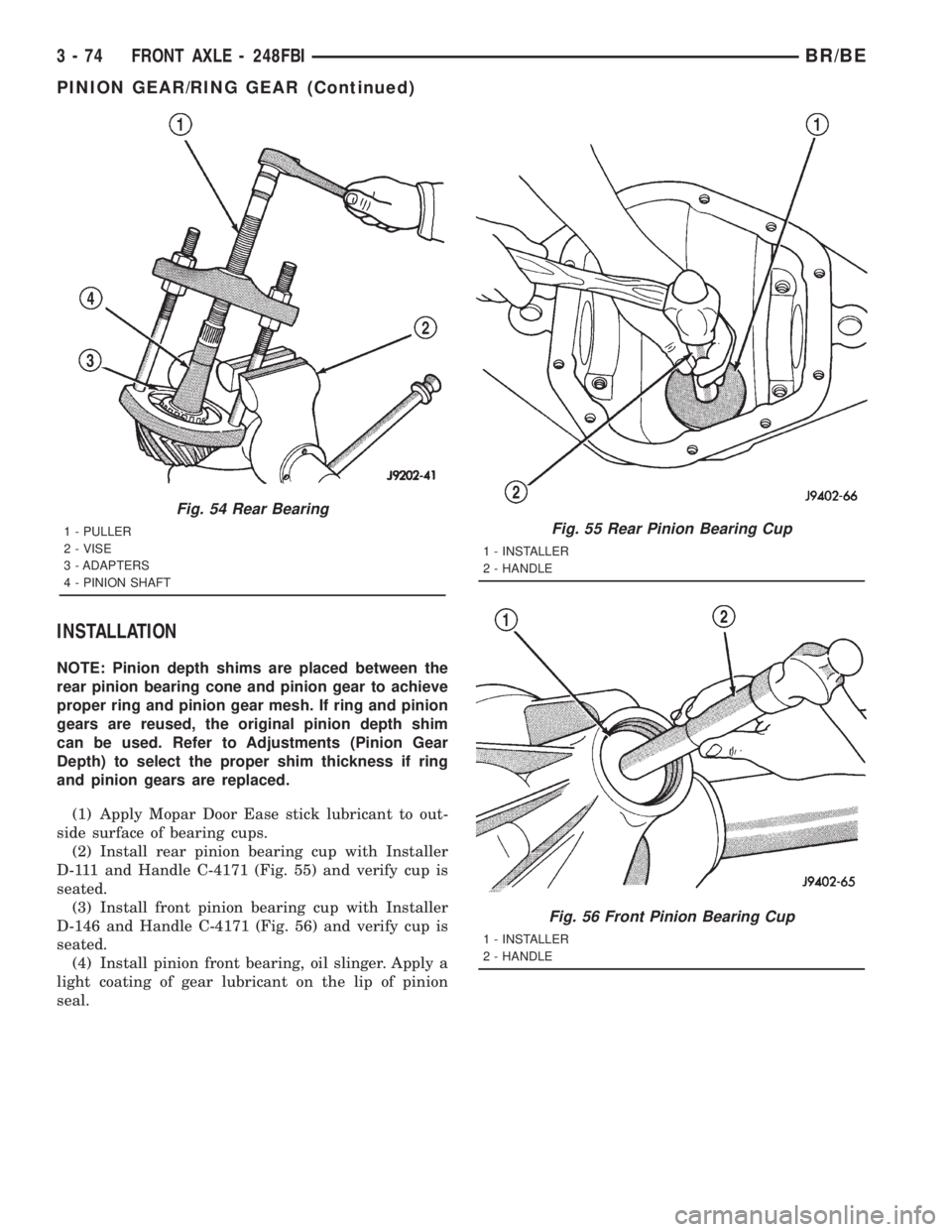
(2) Install rear pinion bearing cup with Installer
D-111 and Handle C-4171 (Fig. 55) and verify cup is
seated.
(3) Install front pinion bearing cup with Installer
D-146 and Handle C-4171 (Fig. 56) and verify cup is
seated.
(4) Install pinion front bearing, oil slinger. Apply a
light coating of gear lubricant on the lip of pinion
seal.
Fig. 54 Rear Bearing
1 - PULLER
2 - VISE
3 - ADAPTERS
4 - PINION SHAFTFig. 55 Rear Pinion Bearing Cup
1 - INSTALLER
2 - HANDLE
Fig. 56 Front Pinion Bearing Cup
1 - INSTALLER
2 - HANDLE
3 - 74 FRONT AXLE - 248FBIBR/BE
PINION GEAR/RING GEAR (Continued)
Page 154 of 2889
When road testing, first warm-up the axle fluid by
driving the vehicle at least 5 miles and then acceler-
ate the vehicle to the speed range where the noise is
the greatest. Shift out-of-gear and coast through the
peak-noise range. If the noise stops or changes
greatly:
²Check for insufficient lubricant.
²Incorrect ring gear backlash.
²Gear damage.
Differential side gears and pinions can be checked
by turning the vehicle. They usually do not cause
noise during straight-ahead driving when the gears
are unloaded. The side gears are loaded during vehi-
cle turns. A worn pinion shaft can also cause a snap-
ping or a knocking noise.
BEARING NOISE
The axle shaft, differential and pinion bearings can
all produce noise when worn or damaged. Bearing
noise can be either a whining, or a growling sound.
Pinion bearings have a constant-pitch noise. This
noise changes only with vehicle speed. Pinion bearing
noise will be higher pitched because it rotates at a
faster rate. Drive the vehicle and load the differen-
tial. If bearing noise occurs, the rear pinion bearing
is the source of the noise. If the bearing noise is
heard during a coast, the front pinion bearing is the
source.
Worn or damaged differential bearings usually pro-
duce a low pitch noise. Differential bearing noise is
similar to pinion bearing noise. The pitch of differen-
tial bearing noise is also constant and varies only
with vehicle speed.
Axle shaft bearings produce noise and vibration
when worn or damaged. The noise generally changes
when the bearings are loaded. Road test the vehicle.
Turn the vehicle sharply to the left and to the right.
This will load the bearings and change the noise
level. Where axle bearing damage is slight, the noise
is usually not noticeable at speeds above 30 mph.
LOW SPEED KNOCK
Low speed knock is generally caused by a worn
U-joint or by worn side±gear thrust washers. A worn
pinion shaft bore will also cause low speed knock.
VIBRATION
Vibration at the rear of the vehicle is usually
caused by a:
²Damaged drive shaft.
²Missing drive shaft balance weight(s).
²Worn or out-of-balance wheels.
²Loose wheel lug nuts.
²Worn U-joint(s).
²Loose/broken springs.
²Damaged axle shaft bearing(s).
²Loose pinion gear nut.
²Excessive pinion yoke run out.
²Bent axle shaft(s).
Check for loose or damaged front-end components
or engine/transmission mounts. These components
can contribute to what appears to be a rearend vibra-
tion. Do not overlook engine accessories, brackets
and drive belts.
All driveline components should be examined
before starting any repair.
(Refer to 22 - TIRES/WHEELS - DIAGNOSIS AND
TESTING)
DRIVELINE SNAP
A snap or clunk noise when the vehicle is shifted
into gear (or the clutch engaged), can be caused by:
²High engine idle speed.
²Transmission shift operation.
²Loose engine/transmission/transfer case mounts.
²Worn U-joints.
²Loose spring mounts.
²Loose pinion gear nut and yoke.
²Excessive ring gear backlash.
²Excessive side gear to case clearance.
The source of a snap or a clunk noise can be deter-
mined with the assistance of a helper. Raise the vehi-
cle on a hoist with the wheels free to rotate. Instruct
the helper to shift the transmission into gear. Listen
for the noise, a mechanics stethoscope is helpful in
isolating the source of a noise.
BR/BEREAR AXLE - 9 1/4 3 - 81
REAR AXLE - 9 1/4 (Continued)
Page 168 of 2889
INSTALLATION
(1) Wipe the axle tube bore clean. Remove any old
sealer or burrs from the tube.
(2) Install the axle shaft bearing with Installer
C-4198 and Handle C-4171 . Ensure that the bearing
part number is against the installer. Verify that the
bearing in installed straight and the tool fully con-
tacts the axle tube when seating the bearing.
(3) Install anewaxle seal with Installer C-4076-B
and Handle C-4735-1. When the tool contacts the
axle tube, the seal is installed to the correct depth.
(4) Coat the lip of the seal with axle lubricant for
protection prior to installing the axle shaft.
(5) Install the axle shaft.
PINION SEAL
REMOVAL
(1) Raise and support the vehicle.
(2) Mark the universal joint, companion flange and
pinion shaft for installation reference.
(3) Remove the propeller shaft from the companion
flange. Secure the propeller shaft in an upright posi-
tion to prevent damage to the rear universal joint.
(4) Remove the wheel and tire assemblies.
(5) Remove the brake drums to prevent any drag.
The drag may cause a false bearing preload torque
measurement.
(6) Rotate the companion flange three or four
times.
(7) Measure the amount of torque necessary to
rotate the pinion with an inch pound torque wrench.
Record the torque reading for installation reference.
(8) Install socket head bolts into two of the
threaded holes in the companion flange, 180É apart.
(9) Position Holder 6719A against the companion
flange and install a hex head bolt and washer into
one of the remaining threaded holes. Tighten the
bolts so the holder is held to the flange.
(10) Hold the flange with holder and remove the
pinion nut and washer.
(11) Remove the companion flange with Remover
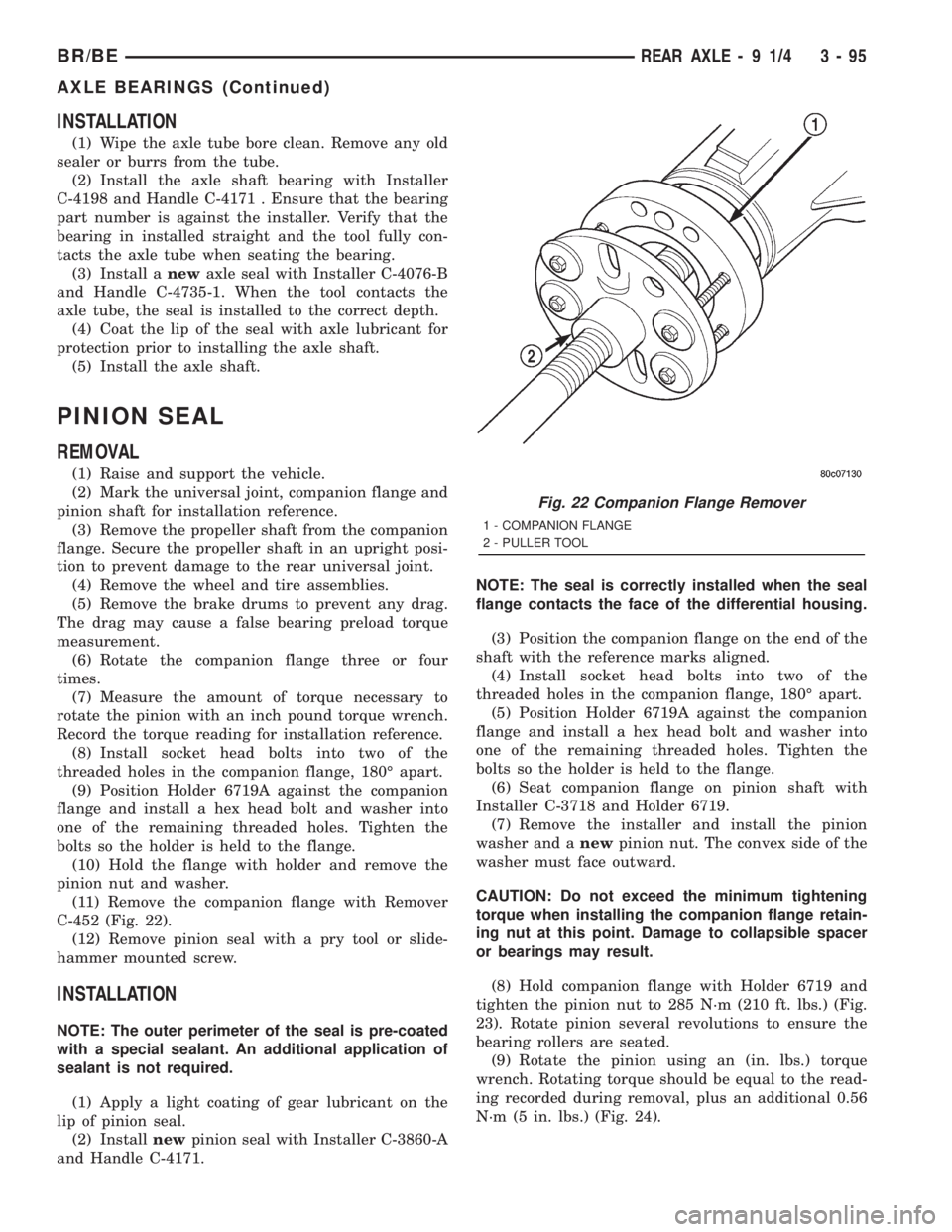
C-452 (Fig. 22).
(12) Remove pinion seal with a pry tool or slide-
hammer mounted screw.
INSTALLATION
NOTE: The outer perimeter of the seal is pre-coated
with a special sealant. An additional application of
sealant is not required.
(1) Apply a light coating of gear lubricant on the
lip of pinion seal.
(2) Installnewpinion seal with Installer C-3860-A
and Handle C-4171.NOTE: The seal is correctly installed when the seal
flange contacts the face of the differential housing.
(3) Position the companion flange on the end of the
shaft with the reference marks aligned.
(4) Install socket head bolts into two of the
threaded holes in the companion flange, 180É apart.
(5) Position Holder 6719A against the companion
flange and install a hex head bolt and washer into
one of the remaining threaded holes. Tighten the
bolts so the holder is held to the flange.
(6) Seat companion flange on pinion shaft with
Installer C-3718 and Holder 6719.
(7) Remove the installer and install the pinion
washer and anewpinion nut. The convex side of the
washer must face outward.
CAUTION: Do not exceed the minimum tightening
torque when installing the companion flange retain-
ing nut at this point. Damage to collapsible spacer
or bearings may result.
(8) Hold companion flange with Holder 6719 and
tighten the pinion nut to 285 N´m (210 ft. lbs.) (Fig.
23). Rotate pinion several revolutions to ensure the
bearing rollers are seated.
(9) Rotate the pinion using an (in. lbs.) torque
wrench. Rotating torque should be equal to the read-
ing recorded during removal, plus an additional 0.56
N´m (5 in. lbs.) (Fig. 24).
Fig. 22 Companion Flange Remover
1 - COMPANION FLANGE
2 - PULLER TOOL
BR/BEREAR AXLE - 9 1/4 3 - 95
AXLE BEARINGS (Continued)
Page 169 of 2889

CAUTION: Never loosen pinion nut to decrease pin-
ion bearing rotating torque and never exceed spec-
ified preload torque. If rotating torque is exceeded,
a new collapsible spacer must be installed.(10) If the rotating torque is low, use Holder 6719
to hold the companion flange (Fig. 23) and tighten
the pinion nut in 6.8 N´m (5 ft. lbs.) increments until
proper rotating torque is achieved.
NOTE: The bearing rotating torque should be con-
stant during a complete revolution of the pinion. If
the rotating torque varies, this indicates a binding
condition.
(11) The seal replacement is unacceptable if the
final pinion nut torque is less than 285 N´m (210 ft.
lbs.).
(12) Install the propeller shaft with the installa-
tion reference marks aligned.
(13) Tighten the companion flange bolts to 108
N´m (80 ft. lbs.).
(14) Install the brake drums.
(15) Install wheel and tire assemblies and lower
the vehicle.
(16) Check the differential housing lubricant level.
DIFFERENTIAL
REMOVAL
(1) Raise and support the vehicle.
(2) Remove lubricant fill hole plug from the differ-
ential housing cover.
(3) Remove differential housing cover and drain
the lubricant from the housing.
(4) Clean the housing cavity with a flushing oil,
light engine oil or lint free cloth.Do not use water,
steam, kerosene or gasoline for cleaning.
(5) Remove the axle shafts.
(6) Remove RWAL/ABS sensor from housing.
NOTE: Side play resulting from bearing races being
loose on case hubs requires replacement of the dif-
ferential case.
(7) Mark the differential housing and differential
bearing caps for installation reference (Fig. 25).
(8) Remove bearing threaded adjuster lock from
each bearing cap. Loosen the bolts, but do not
remove the bearing caps.
(9) Loosen the threaded adjusters with Wrench
C-4164 (Fig. 26).
(10) Hold the differential case while removing
bearing caps and adjusters.
(11) Remove the differential case.
NOTE: Each differential bearing cup and threaded
adjuster must be kept with their respective bearing.
Fig. 23 Pinion Nut
1 - DIFFERENTIAL HOUSING
2 - COMPANION FLANGE HOLDER
3 - TORQUE WRENCH
Fig. 24 Pinion Rotation Torque
1 - COMPANION FLANGE
2 - INCH POUND TORQUE WRENCH
3 - 96 REAR AXLE-91/4BR/BE
PINION SEAL (Continued)
Page 174 of 2889
ASSEMBLY
Clean all components in cleaning solvent. Dry com-
ponents with compressed air. Inspect clutch pack
plates for wear, scoring or damage. Replace both
clutch packs if any one component in either pack is
damaged. Inspect side gears and pinions. Replace
any gear that is worn, cracked, chipped or damaged.
Inspect differential case and pinion shaft. Replace if
worn or damaged.Lubricate each component with gear lubricant
before assembly.
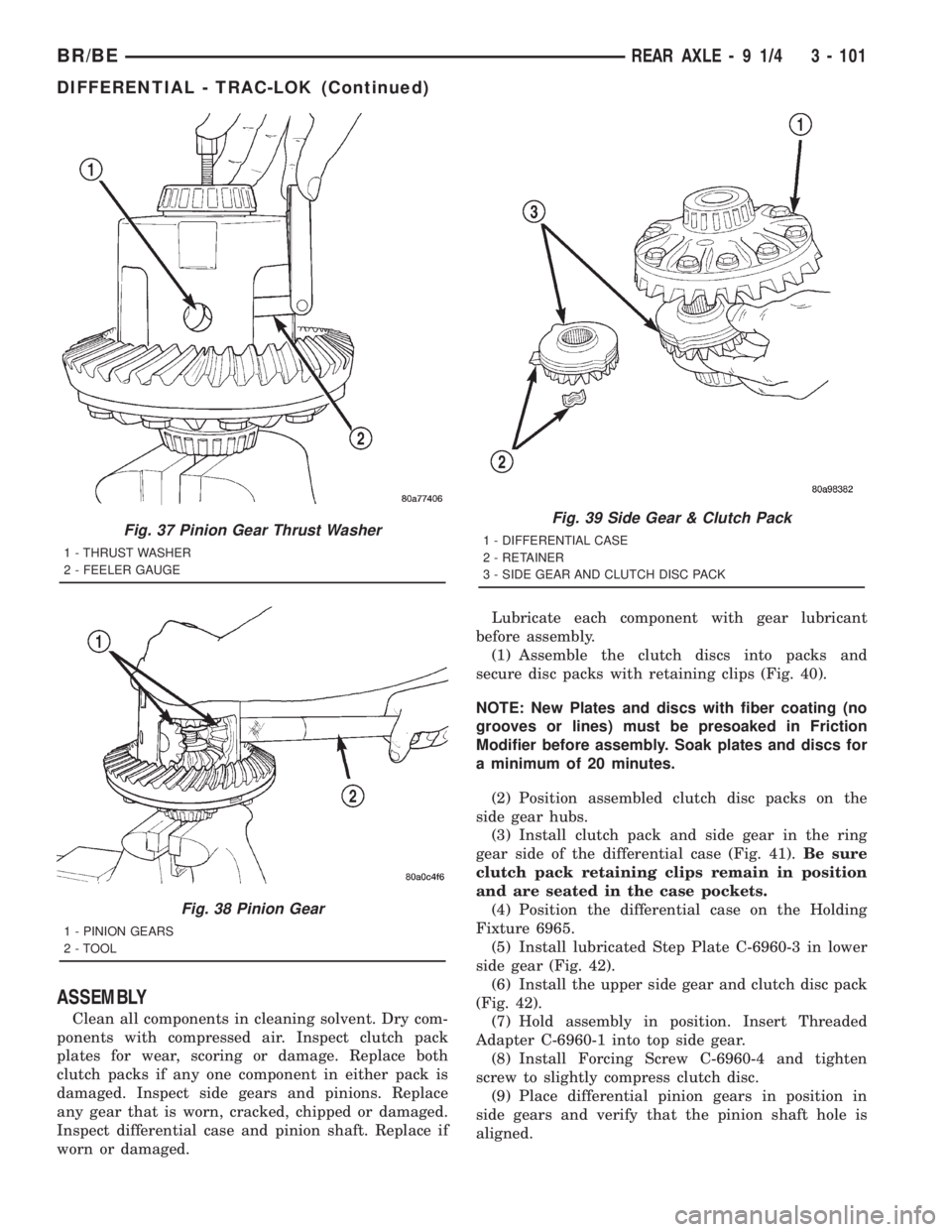
(1) Assemble the clutch discs into packs and
secure disc packs with retaining clips (Fig. 40).
NOTE: New Plates and discs with fiber coating (no
grooves or lines) must be presoaked in Friction
Modifier before assembly. Soak plates and discs for
a minimum of 20 minutes.
(2) Position assembled clutch disc packs on the
side gear hubs.
(3) Install clutch pack and side gear in the ring
gear side of the differential case (Fig. 41).Be sure
clutch pack retaining clips remain in position
and are seated in the case pockets.
(4) Position the differential case on the Holding
Fixture 6965.
(5) Install lubricated Step Plate C-6960-3 in lower
side gear (Fig. 42).
(6) Install the upper side gear and clutch disc pack
(Fig. 42).
(7) Hold assembly in position. Insert Threaded
Adapter C-6960-1 into top side gear.
(8) Install Forcing Screw C-6960-4 and tighten
screw to slightly compress clutch disc.
(9) Place differential pinion gears in position in
side gears and verify that the pinion shaft hole is
aligned.
Fig. 37 Pinion Gear Thrust Washer
1 - THRUST WASHER
2 - FEELER GAUGE
Fig. 38 Pinion Gear
1 - PINION GEARS
2 - TOOL
Fig. 39 Side Gear & Clutch Pack
1 - DIFFERENTIAL CASE
2 - RETAINER
3 - SIDE GEAR AND CLUTCH DISC PACK
BR/BEREAR AXLE - 9 1/4 3 - 101
DIFFERENTIAL - TRAC-LOK (Continued)
Page 175 of 2889
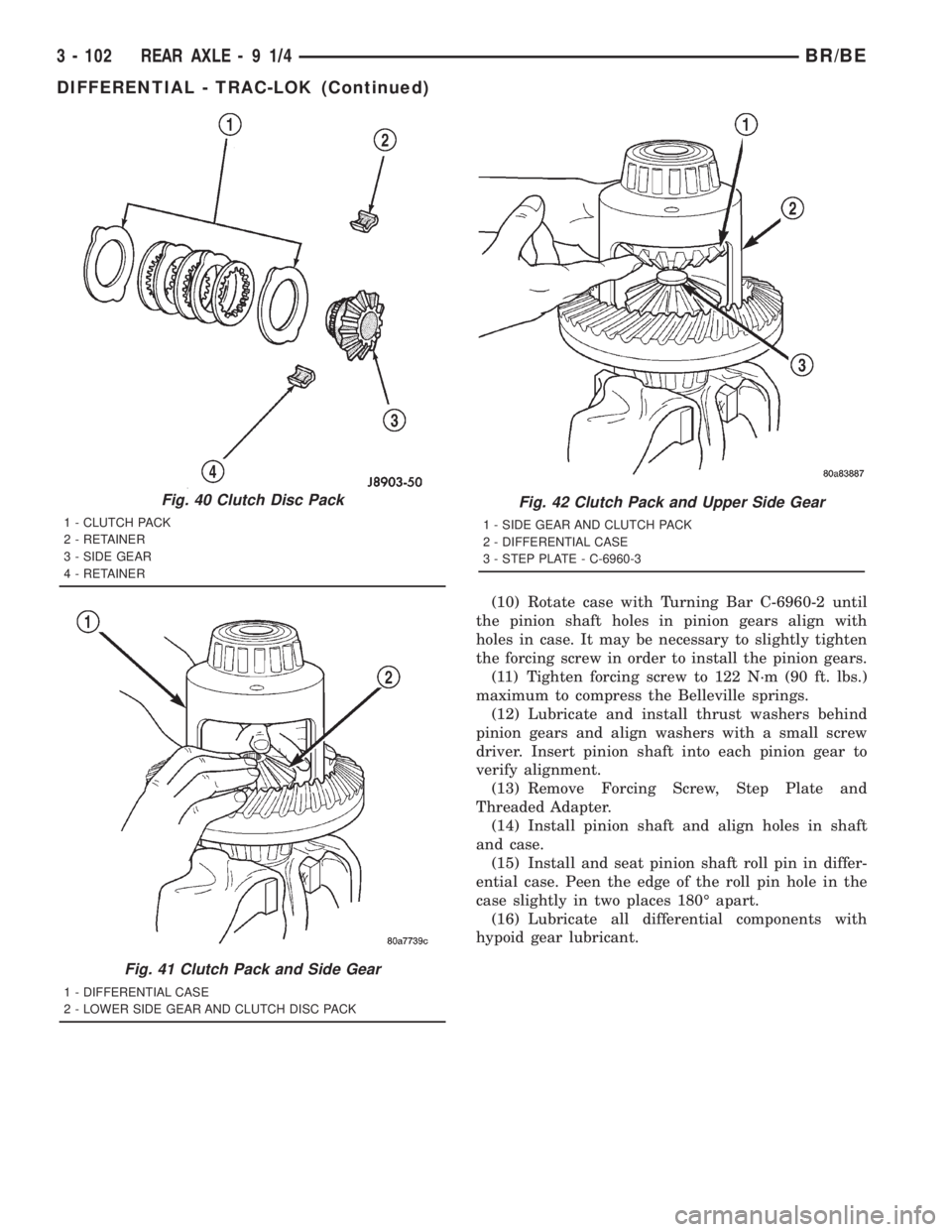
(10) Rotate case with Turning Bar C-6960-2 until
the pinion shaft holes in pinion gears align with
holes in case. It may be necessary to slightly tighten
the forcing screw in order to install the pinion gears.
(11) Tighten forcing screw to 122 N´m (90 ft. lbs.)
maximum to compress the Belleville springs.
(12) Lubricate and install thrust washers behind
pinion gears and align washers with a small screw
driver. Insert pinion shaft into each pinion gear to
verify alignment.
(13) Remove Forcing Screw, Step Plate and
Threaded Adapter.
(14) Install pinion shaft and align holes in shaft
and case.
(15) Install and seat pinion shaft roll pin in differ-
ential case. Peen the edge of the roll pin hole in the
case slightly in two places 180É apart.
(16) Lubricate all differential components with
hypoid gear lubricant.
Fig. 40 Clutch Disc Pack
1 - CLUTCH PACK
2 - RETAINER
3 - SIDE GEAR
4 - RETAINER
Fig. 41 Clutch Pack and Side Gear
1 - DIFFERENTIAL CASE
2 - LOWER SIDE GEAR AND CLUTCH DISC PACK
Fig. 42 Clutch Pack and Upper Side Gear
1 - SIDE GEAR AND CLUTCH PACK
2 - DIFFERENTIAL CASE
3 - STEP PLATE - C-6960-3
3 - 102 REAR AXLE-91/4BR/BE
DIFFERENTIAL - TRAC-LOK (Continued)
Page 178 of 2889
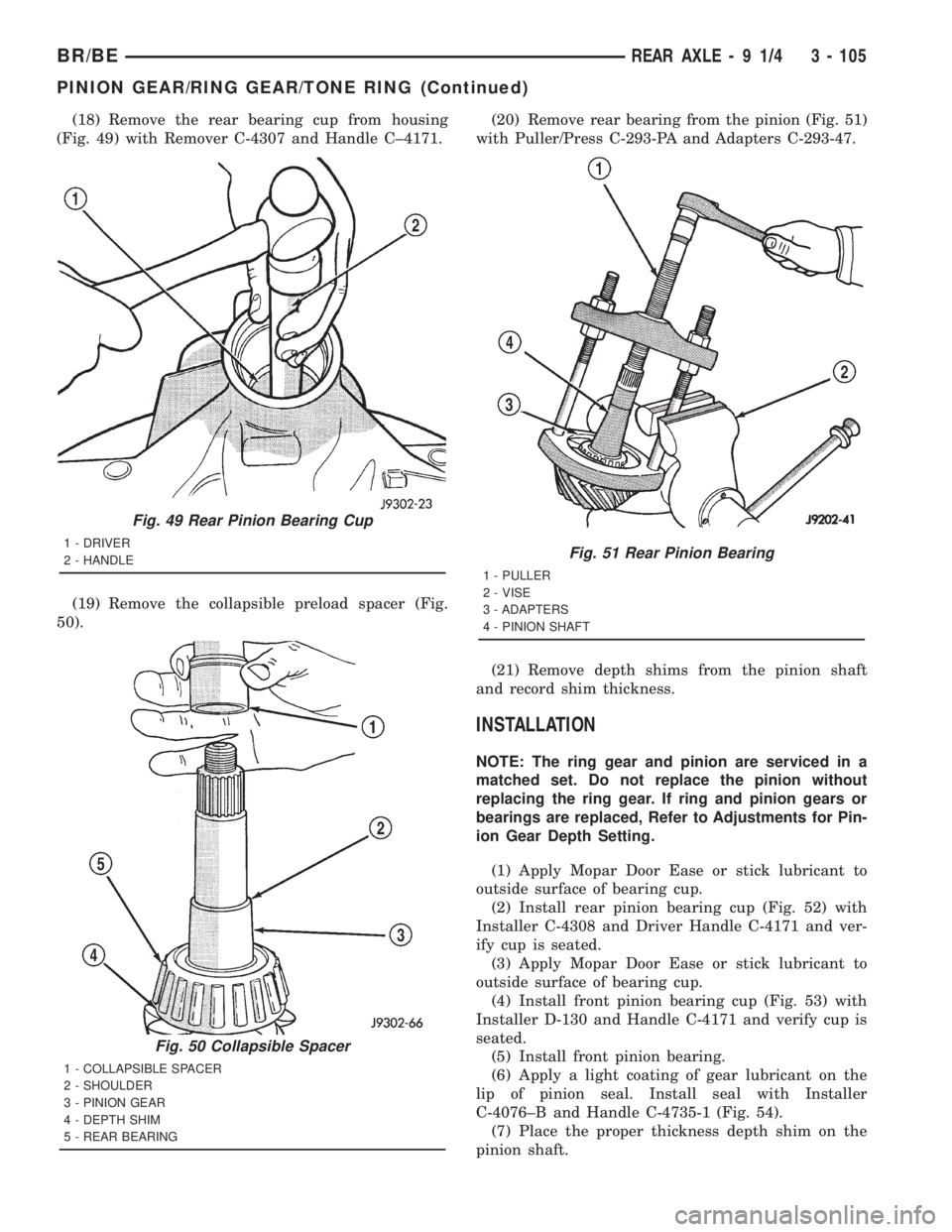
(18) Remove the rear bearing cup from housing
(Fig. 49) with Remover C-4307 and Handle C±4171.
(19) Remove the collapsible preload spacer (Fig.
50).(20) Remove rear bearing from the pinion (Fig. 51)
with Puller/Press C-293-PA and Adapters C-293-47.
(21) Remove depth shims from the pinion shaft
and record shim thickness.
INSTALLATION
NOTE: The ring gear and pinion are serviced in a
matched set. Do not replace the pinion without
replacing the ring gear. If ring and pinion gears or
bearings are replaced, Refer to Adjustments for Pin-
ion Gear Depth Setting.
(1) Apply Mopar Door Ease or stick lubricant to
outside surface of bearing cup.
(2) Install rear pinion bearing cup (Fig. 52) with
Installer C-4308 and Driver Handle C-4171 and ver-
ify cup is seated.
(3) Apply Mopar Door Ease or stick lubricant to
outside surface of bearing cup.
(4) Install front pinion bearing cup (Fig. 53) with
Installer D-130 and Handle C-4171 and verify cup is
seated.
(5) Install front pinion bearing.
(6) Apply a light coating of gear lubricant on the
lip of pinion seal. Install seal with Installer
C-4076±B and Handle C-4735-1 (Fig. 54).
(7) Place the proper thickness depth shim on the
pinion shaft.
Fig. 49 Rear Pinion Bearing Cup
1 - DRIVER
2 - HANDLE
Fig. 50 Collapsible Spacer
1 - COLLAPSIBLE SPACER
2 - SHOULDER
3 - PINION GEAR
4 - DEPTH SHIM
5 - REAR BEARING
Fig. 51 Rear Pinion Bearing
1 - PULLER
2 - VISE
3 - ADAPTERS
4 - PINION SHAFT
BR/BEREAR AXLE - 9 1/4 3 - 105
PINION GEAR/RING GEAR/TONE RING (Continued)
Page 184 of 2889
of traction, the wheel with the least traction may
spin.
DIAGNOSIS AND TESTING - AXLE
GEAR NOISE
Axle gear noise can be caused by insufficient lubri-
cant, incorrect backlash, incorrect pinion depth, tooth
contact, worn/damaged gears, or the carrier housing
not having the proper offset and squareness.
Gear noise usually happens at a specific speed
range. The noise can also occur during a specific type
of driving condition. These conditions are accelera-
tion, deceleration, coast, or constant load.
When road testing, first warm-up the axle fluid by
driving the vehicle at least 5 miles and then acceler-
ate the vehicle to the speed range where the noise is
the greatest. Shift out-of-gear and coast through the
peak-noise range. If the noise stops or changes
greatly:
²Check for insufficient lubricant.
²Incorrect ring gear backlash.
²Gear damage.
Differential side gears and pinions can be checked
by turning the vehicle. They usually do not cause
noise during straight-ahead driving when the gears
are unloaded. The side gears are loaded during vehi-
cle turns. A worn pinion shaft can also cause a snap-
ping or a knocking noise.
BEARING NOISE
The axle shaft, differential and pinion bearings can
all produce noise when worn or damaged. Bearing
noise can be either a whining, or a growling sound.
Pinion bearings have a constant-pitch noise. This
noise changes only with vehicle speed. Pinion bearing
noise will be higher pitched because it rotates at a
faster rate. Drive the vehicle and load the differen-
tial. If bearing noise occurs, the rear pinion bearing
is the source of the noise. If the bearing noise is
heard during a coast, the front pinion bearing is the
source.
Worn or damaged differential bearings usually pro-
duce a low pitch noise. Differential bearing noise is
similar to pinion bearing noise. The pitch of differen-
tial bearing noise is also constant and varies only
with vehicle speed.
Axle shaft bearings produce noise and vibration
when worn or damaged. The noise generally changes
when the bearings are loaded. Road test the vehicle.Turn the vehicle sharply to the left and to the right.
This will load the bearings and change the noise
level. Where axle bearing damage is slight, the noise
is usually not noticeable at speeds above 30 mph.
LOW SPEED KNOCK
Low speed knock is generally caused by a worn
U-joint or by worn side±gear thrust washers. A worn
pinion shaft bore will also cause low speed knock.
VIBRATION
Vibration at the rear of the vehicle is usually
caused by a:
²Damaged drive shaft.
²Missing drive shaft balance weight(s).
²Worn or out-of-balance wheels.
²Loose wheel lug nuts.
²Worn U-joint(s).
²Loose/broken springs.
²Damaged axle shaft bearing(s).
²Loose pinion gear nut.
²Excessive pinion yoke run out.
²Bent axle shaft(s).
Check for loose or damaged front-end components
or engine/transmission mounts. These components
can contribute to what appears to be a rearend vibra-
tion. Do not overlook engine accessories, brackets
and drive belts.
All driveline components should be examined
before starting any repair.
(Refer to 22 - TIRES/WHEELS - DIAGNOSIS AND
TESTING)
DRIVELINE SNAP
A snap or clunk noise when the vehicle is shifted
into gear (or the clutch engaged), can be caused by:
²High engine idle speed.
²Transmission shift operation.
²Loose engine/transmission/transfer case mounts.
²Worn U-joints.
²Loose spring mounts.
²Loose pinion gear nut and yoke.
²Excessive ring gear backlash.
²Excessive side gear to case clearance.
The source of a snap or a clunk noise can be deter-
mined with the assistance of a helper. Raise the vehi-
cle on a hoist with the wheels free to rotate. Instruct
the helper to shift the transmission into gear. Listen
for the noise, a mechanics stethoscope is helpful in
isolating the source of a noise.
BR/BEREAR AXLE - 248RBI 3 - 111
REAR AXLE - 248RBI (Continued)