2001 DODGE RAM plenum
[x] Cancel search: plenumPage 1369 of 2889
(2) Position the oil pump cover onto the timing
chain cover. Tighten cover screws to 14 N´m (125 in.
lbs.) torque.
(3) Make sure that inner ring moves freely after
cover is installed.
(4) Install the timing chain cover (Refer to 9 -
ENGINE/VALVE TIMING/TIMING BELT / CHAIN
COVER(S) - INSTALLATION).
(5) Squirt oil into relief valve hole until oil runs
out.
(6) Install the relief valve and spring.
(7) Using a new pressure relief valve gasket,
install the relief valve plug. Tighten the plug to 20
N´m (15 ft. lbs.) torque.
(8) Install oil filter that has been filled with oil.
INTAKE MANIFOLD
DESCRIPTION
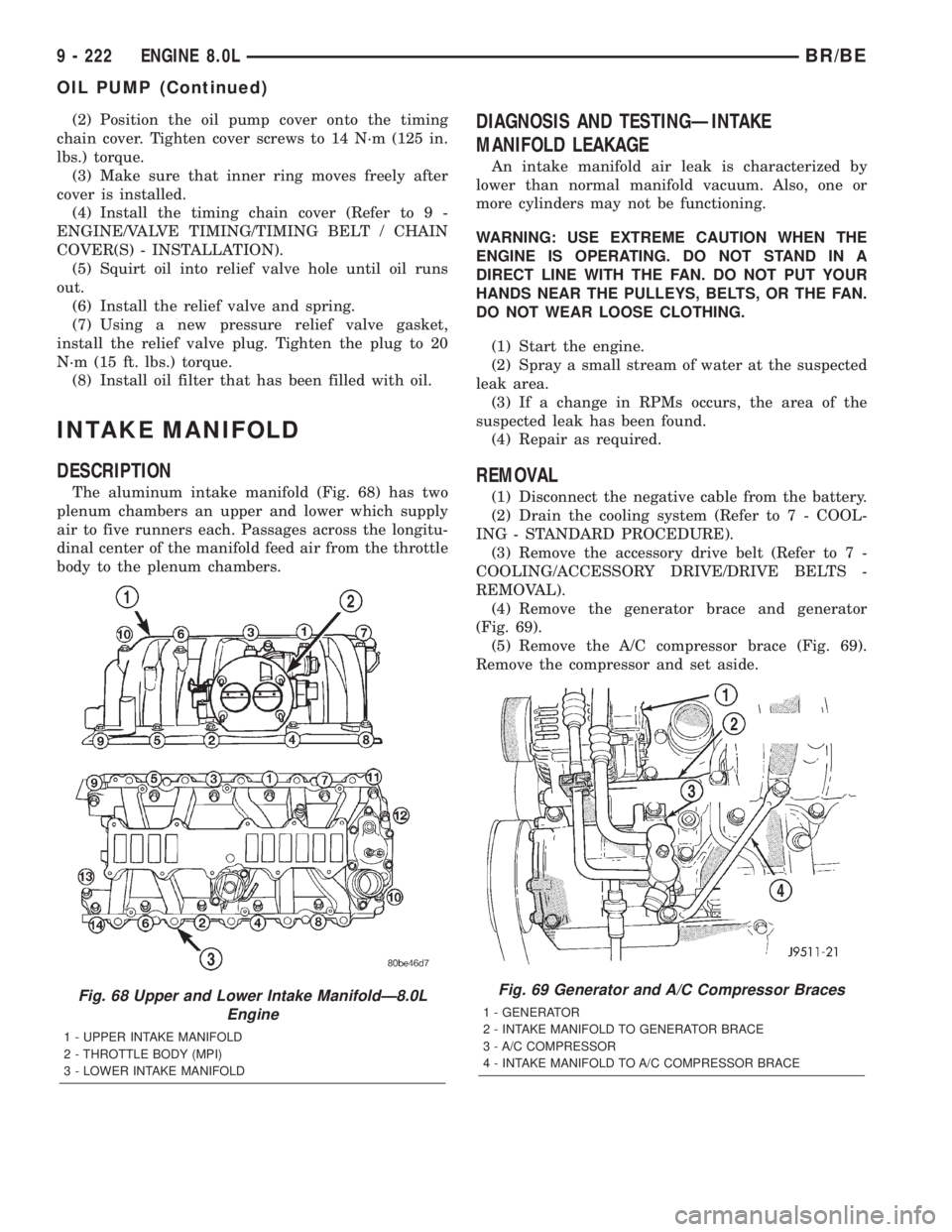
The aluminum intake manifold (Fig. 68) has two
plenum chambers an upper and lower which supply
air to five runners each. Passages across the longitu-
dinal center of the manifold feed air from the throttle
body to the plenum chambers.
DIAGNOSIS AND TESTINGÐINTAKE
MANIFOLD LEAKAGE
An intake manifold air leak is characterized by
lower than normal manifold vacuum. Also, one or
more cylinders may not be functioning.
WARNING: USE EXTREME CAUTION WHEN THE
ENGINE IS OPERATING. DO NOT STAND IN A
DIRECT LINE WITH THE FAN. DO NOT PUT YOUR
HANDS NEAR THE PULLEYS, BELTS, OR THE FAN.
DO NOT WEAR LOOSE CLOTHING.
(1) Start the engine.
(2) Spray a small stream of water at the suspected
leak area.
(3) If a change in RPMs occurs, the area of the
suspected leak has been found.
(4) Repair as required.
REMOVAL
(1) Disconnect the negative cable from the battery.
(2) Drain the cooling system (Refer to 7 - COOL-
ING - STANDARD PROCEDURE).
(3) Remove the accessory drive belt (Refer to 7 -
COOLING/ACCESSORY DRIVE/DRIVE BELTS -
REMOVAL).
(4) Remove the generator brace and generator
(Fig. 69).
(5) Remove the A/C compressor brace (Fig. 69).
Remove the compressor and set aside.
Fig. 68 Upper and Lower Intake ManifoldÐ8.0L
Engine
1 - UPPER INTAKE MANIFOLD
2 - THROTTLE BODY (MPI)
3 - LOWER INTAKE MANIFOLD
Fig. 69 Generator and A/C Compressor Braces
1 - GENERATOR
2 - INTAKE MANIFOLD TO GENERATOR BRACE
3 - A/C COMPRESSOR
4 - INTAKE MANIFOLD TO A/C COMPRESSOR BRACE
9 - 222 ENGINE 8.0LBR/BE
OIL PUMP (Continued)
Page 1370 of 2889
(6) Remove the air cleaner cover and filter.
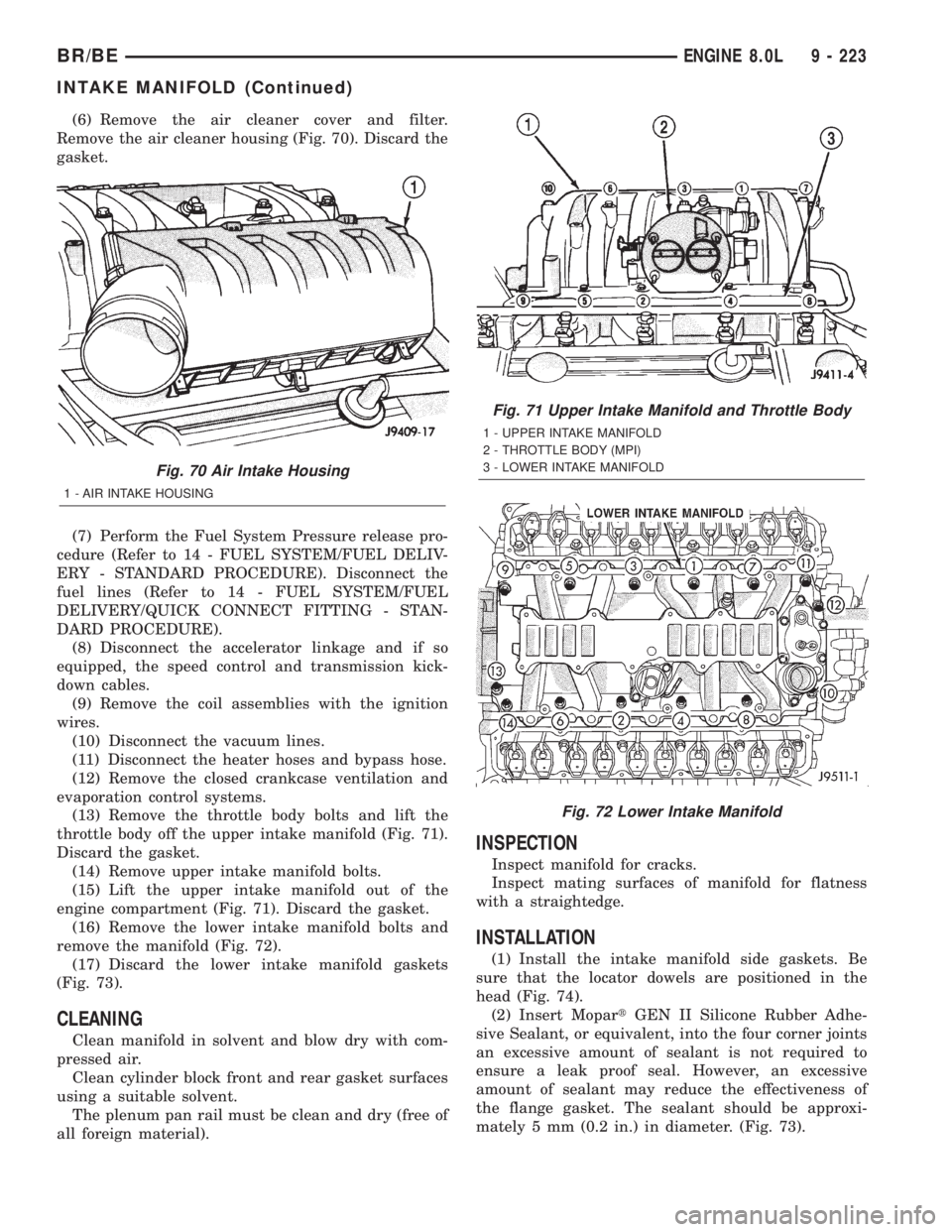
Remove the air cleaner housing (Fig. 70). Discard the
gasket.
(7) Perform the Fuel System Pressure release pro-
cedure (Refer to 14 - FUEL SYSTEM/FUEL DELIV-
ERY - STANDARD PROCEDURE). Disconnect the
fuel lines (Refer to 14 - FUEL SYSTEM/FUEL
DELIVERY/QUICK CONNECT FITTING - STAN-
DARD PROCEDURE).
(8) Disconnect the accelerator linkage and if so
equipped, the speed control and transmission kick-
down cables.
(9) Remove the coil assemblies with the ignition
wires.
(10) Disconnect the vacuum lines.
(11) Disconnect the heater hoses and bypass hose.
(12) Remove the closed crankcase ventilation and
evaporation control systems.
(13) Remove the throttle body bolts and lift the
throttle body off the upper intake manifold (Fig. 71).
Discard the gasket.
(14) Remove upper intake manifold bolts.
(15) Lift the upper intake manifold out of the
engine compartment (Fig. 71). Discard the gasket.
(16) Remove the lower intake manifold bolts and
remove the manifold (Fig. 72).
(17) Discard the lower intake manifold gaskets
(Fig. 73).
CLEANING
Clean manifold in solvent and blow dry with com-
pressed air.
Clean cylinder block front and rear gasket surfaces
using a suitable solvent.
The plenum pan rail must be clean and dry (free of
all foreign material).
INSPECTION
Inspect manifold for cracks.
Inspect mating surfaces of manifold for flatness
with a straightedge.
INSTALLATION
(1) Install the intake manifold side gaskets. Be
sure that the locator dowels are positioned in the
head (Fig. 74).
(2) Insert MopartGEN II Silicone Rubber Adhe-
sive Sealant, or equivalent, into the four corner joints
an excessive amount of sealant is not required to
ensure a leak proof seal. However, an excessive
amount of sealant may reduce the effectiveness of
the flange gasket. The sealant should be approxi-
mately 5 mm (0.2 in.) in diameter. (Fig. 73).
Fig. 70 Air Intake Housing
1 - AIR INTAKE HOUSING
Fig. 71 Upper Intake Manifold and Throttle Body
1 - UPPER INTAKE MANIFOLD
2 - THROTTLE BODY (MPI)
3 - LOWER INTAKE MANIFOLD
Fig. 72 Lower Intake Manifold
BR/BEENGINE 8.0L 9 - 223
INTAKE MANIFOLD (Continued)
Page 1449 of 2889
CLEANING
Clean manifold in solvent and blow dry with com-
pressed air.
Clean cylinder block front and rear gasket surfaces
using a suitable solvent.
The plenum pan rail must be clean and dry (free of
all foreign material).
INSPECTION
Inspect manifold for cracks.
Inspect mating surfaces of manifold for flatness
with a straightedge.
INSTALLATION
(1) Using a new gasket, install the intake manifold
cover.
(2) Install the cover-to-cylinder head bolts that do
not hold down the high pressure fuel line support
brackets. Tighten the bolts to 24 N´m (18 ft. lbs.)
torque.
(3) Install the high pressure fuel lines (Refer to 14
- FUEL SYSTEM/FUEL DELIVERY/FUEL LINES -
INSTALLATION).(4) Install the high pressure fuel line support
bracket-to-intake manifold cover bolts and tighten to
24 N´m (18 ft. lbs.) torque.
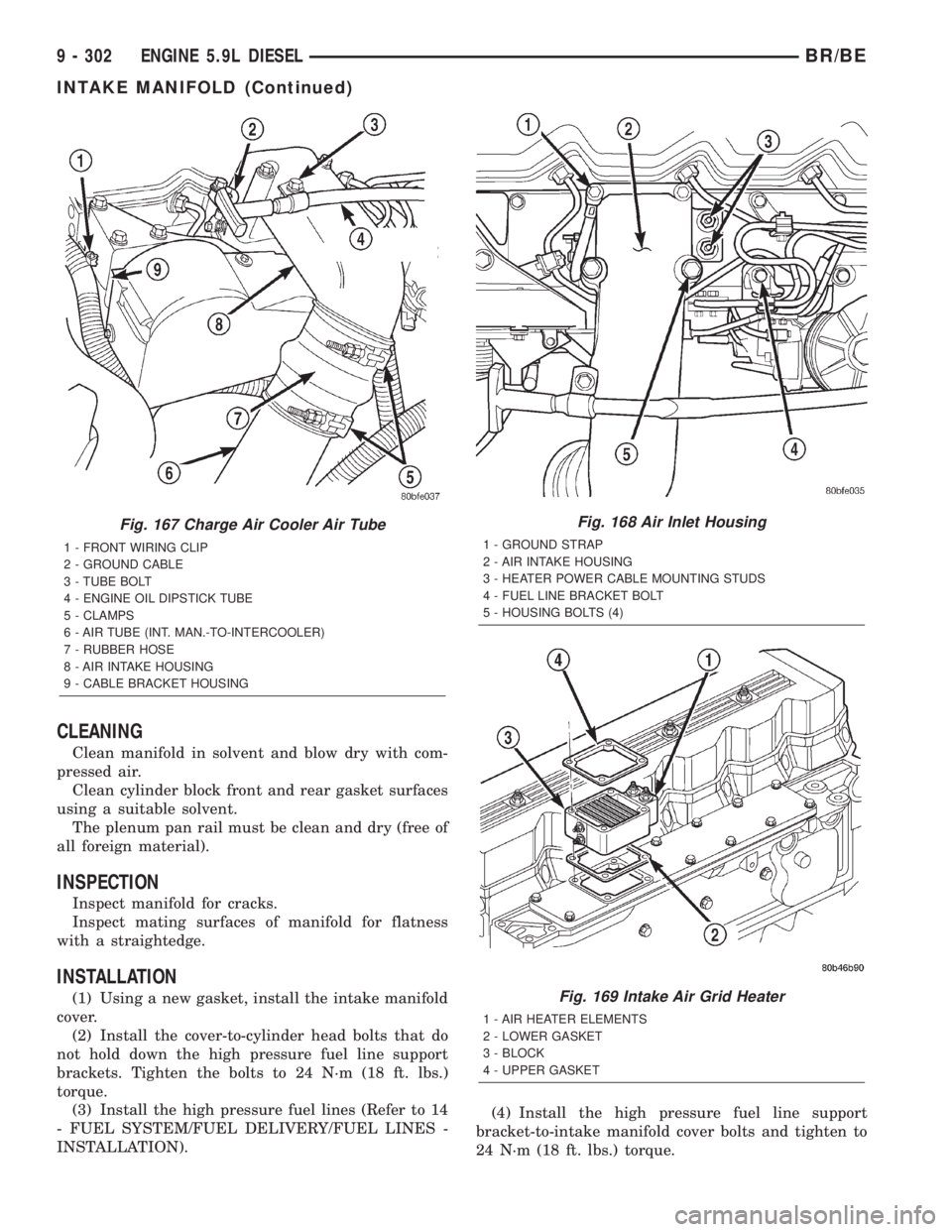
Fig. 167 Charge Air Cooler Air Tube
1 - FRONT WIRING CLIP
2 - GROUND CABLE
3 - TUBE BOLT
4 - ENGINE OIL DIPSTICK TUBE
5 - CLAMPS
6 - AIR TUBE (INT. MAN.-TO-INTERCOOLER)
7 - RUBBER HOSE
8 - AIR INTAKE HOUSING
9 - CABLE BRACKET HOUSING
Fig. 168 Air Inlet Housing
1 - GROUND STRAP
2 - AIR INTAKE HOUSING
3 - HEATER POWER CABLE MOUNTING STUDS
4 - FUEL LINE BRACKET BOLT
5 - HOUSING BOLTS (4)
Fig. 169 Intake Air Grid Heater
1 - AIR HEATER ELEMENTS
2 - LOWER GASKET
3 - BLOCK
4 - UPPER GASKET
9 - 302 ENGINE 5.9L DIESELBR/BE
INTAKE MANIFOLD (Continued)
Page 2758 of 2889
compartment. This check valve also helps to main-
tain the system vacuum needed to retain the selected
HVAC mode settings, but isolates the HVAC vacuum
circuit from the vehicle speed control vacuum circuit.
It prevents the vehicle speed control servo from
bleeding down the HVAC system vacuum during
extended heavy engine load operation.
The vacuum check valve cannot be repaired and, if
faulty or damaged, it must be replaced.
REMOVAL
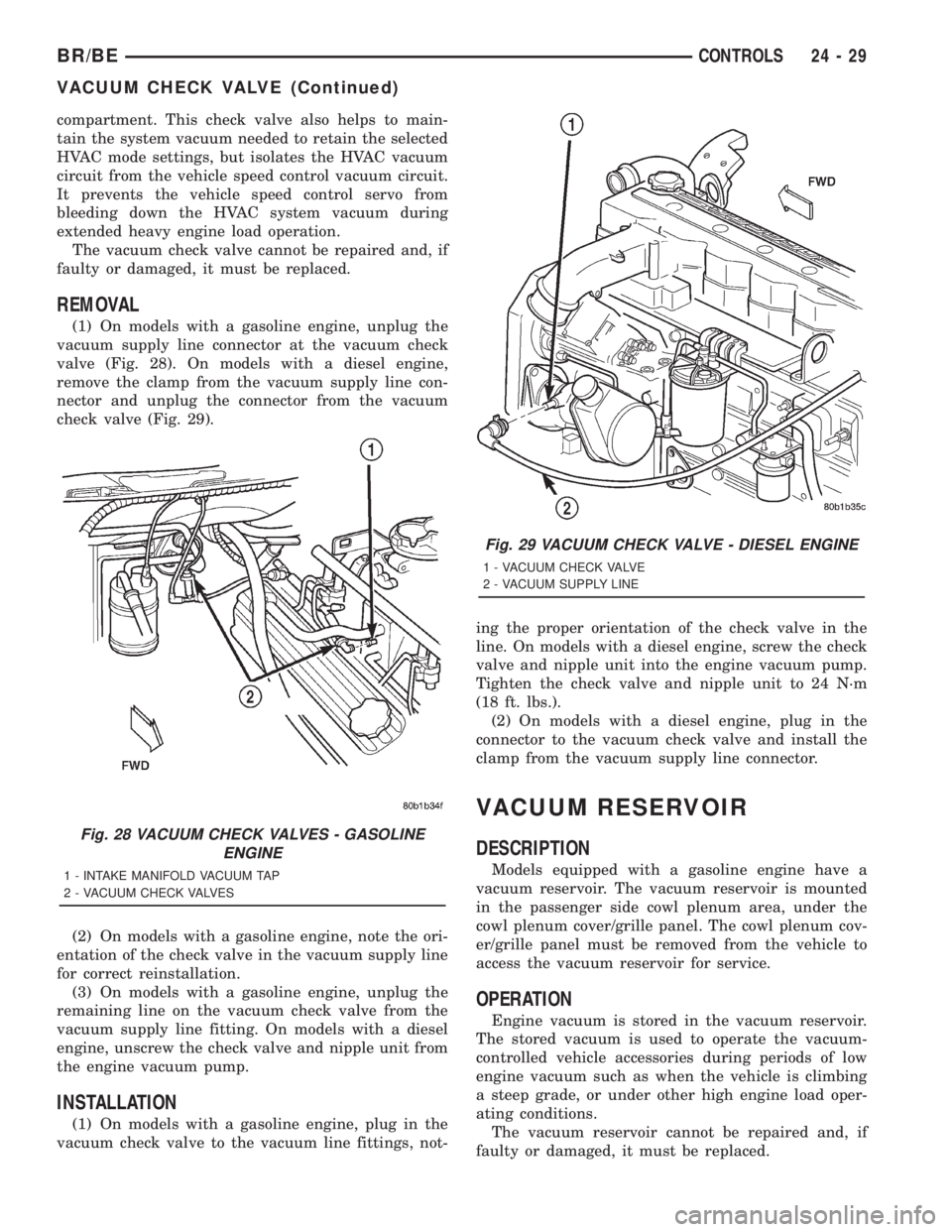
(1) On models with a gasoline engine, unplug the
vacuum supply line connector at the vacuum check
valve (Fig. 28). On models with a diesel engine,
remove the clamp from the vacuum supply line con-
nector and unplug the connector from the vacuum
check valve (Fig. 29).
(2) On models with a gasoline engine, note the ori-
entation of the check valve in the vacuum supply line
for correct reinstallation.
(3) On models with a gasoline engine, unplug the
remaining line on the vacuum check valve from the
vacuum supply line fitting. On models with a diesel
engine, unscrew the check valve and nipple unit from
the engine vacuum pump.
INSTALLATION
(1) On models with a gasoline engine, plug in the
vacuum check valve to the vacuum line fittings, not-ing the proper orientation of the check valve in the
line. On models with a diesel engine, screw the check
valve and nipple unit into the engine vacuum pump.
Tighten the check valve and nipple unit to 24 N´m
(18 ft. lbs.).
(2) On models with a diesel engine, plug in the
connector to the vacuum check valve and install the
clamp from the vacuum supply line connector.
VACUUM RESERVOIR
DESCRIPTION
Models equipped with a gasoline engine have a
vacuum reservoir. The vacuum reservoir is mounted
in the passenger side cowl plenum area, under the
cowl plenum cover/grille panel. The cowl plenum cov-
er/grille panel must be removed from the vehicle to
access the vacuum reservoir for service.
OPERATION
Engine vacuum is stored in the vacuum reservoir.
The stored vacuum is used to operate the vacuum-
controlled vehicle accessories during periods of low
engine vacuum such as when the vehicle is climbing
a steep grade, or under other high engine load oper-
ating conditions.
The vacuum reservoir cannot be repaired and, if
faulty or damaged, it must be replaced.
Fig. 28 VACUUM CHECK VALVES - GASOLINE
ENGINE
1 - INTAKE MANIFOLD VACUUM TAP
2 - VACUUM CHECK VALVES
Fig. 29 VACUUM CHECK VALVE - DIESEL ENGINE
1 - VACUUM CHECK VALVE
2 - VACUUM SUPPLY LINE
BR/BECONTROLS 24 - 29
VACUUM CHECK VALVE (Continued)
Page 2759 of 2889
REMOVAL
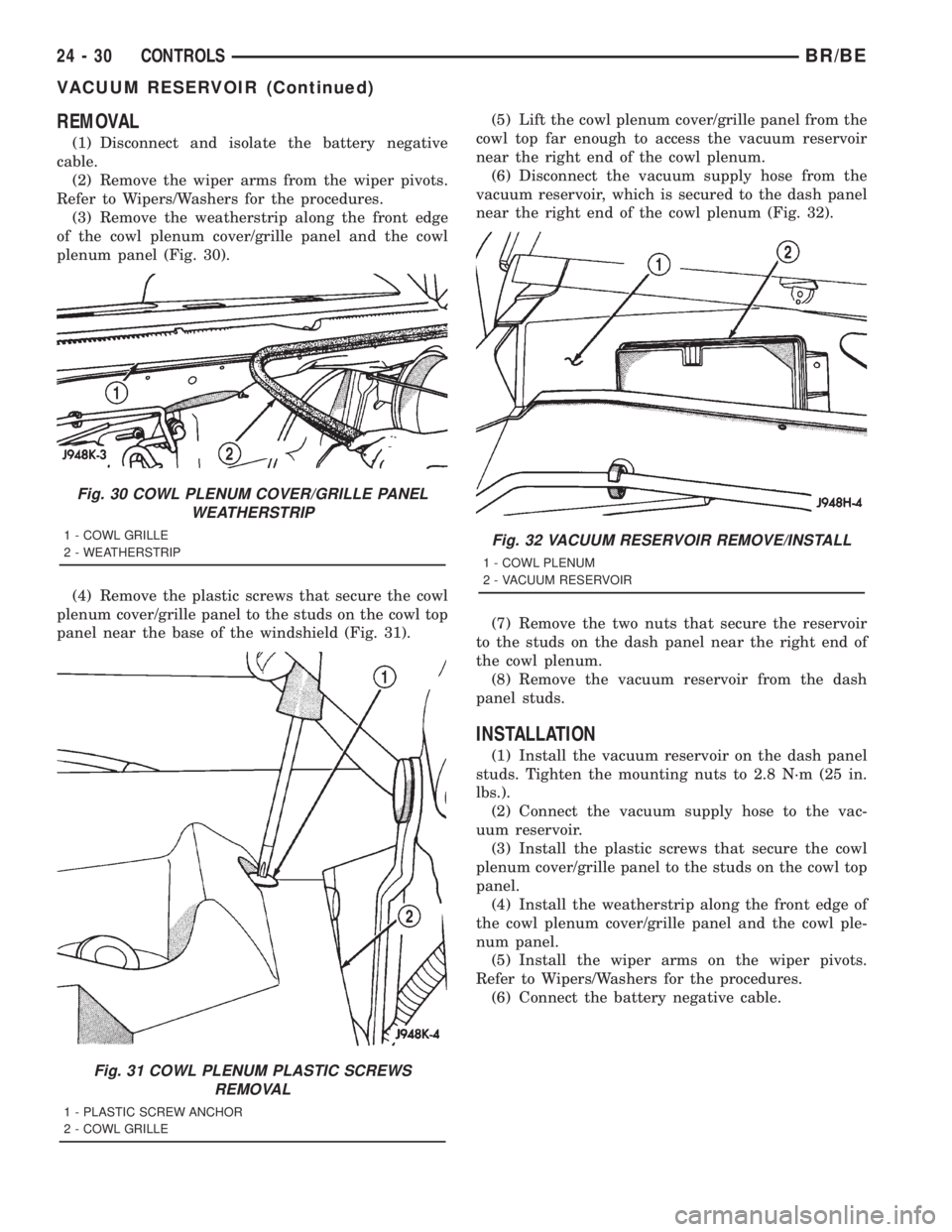
(1) Disconnect and isolate the battery negative
cable.
(2) Remove the wiper arms from the wiper pivots.
Refer to Wipers/Washers for the procedures.
(3) Remove the weatherstrip along the front edge
of the cowl plenum cover/grille panel and the cowl
plenum panel (Fig. 30).
(4) Remove the plastic screws that secure the cowl
plenum cover/grille panel to the studs on the cowl top
panel near the base of the windshield (Fig. 31).(5) Lift the cowl plenum cover/grille panel from the
cowl top far enough to access the vacuum reservoir
near the right end of the cowl plenum.
(6) Disconnect the vacuum supply hose from the
vacuum reservoir, which is secured to the dash panel
near the right end of the cowl plenum (Fig. 32).
(7) Remove the two nuts that secure the reservoir
to the studs on the dash panel near the right end of
the cowl plenum.
(8) Remove the vacuum reservoir from the dash
panel studs.
INSTALLATION
(1) Install the vacuum reservoir on the dash panel
studs. Tighten the mounting nuts to 2.8 N´m (25 in.
lbs.).
(2) Connect the vacuum supply hose to the vac-
uum reservoir.
(3) Install the plastic screws that secure the cowl
plenum cover/grille panel to the studs on the cowl top
panel.
(4) Install the weatherstrip along the front edge of
the cowl plenum cover/grille panel and the cowl ple-
num panel.
(5) Install the wiper arms on the wiper pivots.
Refer to Wipers/Washers for the procedures.
(6) Connect the battery negative cable.
Fig. 30 COWL PLENUM COVER/GRILLE PANEL
WEATHERSTRIP
1 - COWL GRILLE
2 - WEATHERSTRIP
Fig. 31 COWL PLENUM PLASTIC SCREWS
REMOVAL
1 - PLASTIC SCREW ANCHOR
2 - COWL GRILLE
Fig. 32 VACUUM RESERVOIR REMOVE/INSTALL
1 - COWL PLENUM
2 - VACUUM RESERVOIR
24 - 30 CONTROLSBR/BE
VACUUM RESERVOIR (Continued)
Page 2760 of 2889
DISTRIBUTION
TABLE OF CONTENTS
page page
DISTRIBUTION
DESCRIPTION...........................31
AIR OUTLETS
REMOVAL..............................31
INSTALLATION...........................32
BLOWER MOTOR
DESCRIPTION...........................32
OPERATION.............................32
DIAGNOSIS AND TESTING.................33
BLOWER MOTOR......................33
REMOVAL..............................33
INSTALLATION...........................33
DEFROSTER DUCTS
REMOVAL..............................34
INSTALLATION...........................35
HVAC HOUSING
REMOVAL..............................35DISASSEMBLY...........................36
ASSEMBLY.............................36
INSTALLATION...........................37
INSTRUMENT PANEL DEMISTER DUCTS
REMOVAL..............................37
INSTRUMENT PANEL DUCTS
REMOVAL..............................37
BLEND DOOR
REMOVAL..............................38
INSTALLATION...........................38
MODE DOOR
REMOVAL..............................38
INSTALLATION...........................39
RECIRCULATION DOOR
REMOVAL..............................39
INSTALLATION...........................39
DISTRIBUTION
DESCRIPTION - HVAC SYSTEM AIRFLOW
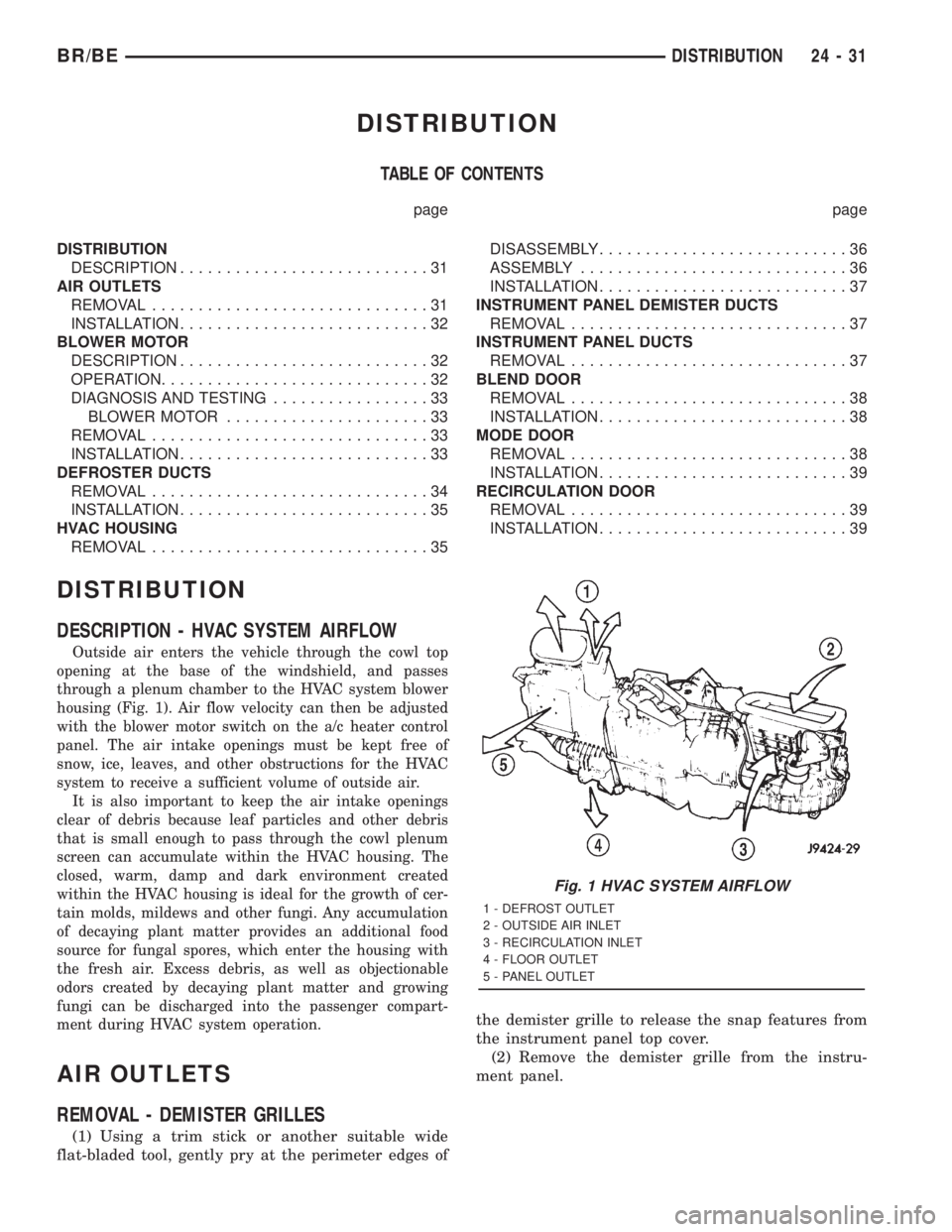
Outside air enters the vehicle through the cowl top
opening at the base of the windshield, and passes
through a plenum chamber to the HVAC system blower
housing (Fig. 1). Air flow velocity can then be adjusted
with the blower motor switch on the a/c heater control
panel. The air intake openings must be kept free of
snow, ice, leaves, and other obstructions for the HVAC
system to receive a sufficient volume of outside air.
It is also important to keep the air intake openings
clear of debris because leaf particles and other debris
that is small enough to pass through the cowl plenum
screen can accumulate within the HVAC housing. The
closed, warm, damp and dark environment created
within the HVAC housing is ideal for the growth of cer-
tain molds, mildews and other fungi. Any accumulation
of decaying plant matter provides an additional food
source for fungal spores, which enter the housing with
the fresh air. Excess debris, as well as objectionable
odors created by decaying plant matter and growing
fungi can be discharged into the passenger compart-
ment during HVAC system operation.
AIR OUTLETS
REMOVAL - DEMISTER GRILLES
(1) Using a trim stick or another suitable wide
flat-bladed tool, gently pry at the perimeter edges ofthe demister grille to release the snap features from
the instrument panel top cover.
(2) Remove the demister grille from the instru-
ment panel.
Fig. 1 HVAC SYSTEM AIRFLOW
1 - DEFROST OUTLET
2 - OUTSIDE AIR INLET
3 - RECIRCULATION INLET
4 - FLOOR OUTLET
5 - PANEL OUTLET
BR/BEDISTRIBUTION 24 - 31
Page 2765 of 2889
(5) Remove the accumulator. (Refer to 24 - HEAT-
ING & AIR CONDITIONING/PLUMBING/ACCU-
MULATOR - REMOVAL) Install plugs in, or tape
over all of the opened refrigerant line fittings.
(6) Drain the engine cooling system. Refer to Cool-
ing for the procedures.
(7)
Disconnect the heater hoses from the heater core
tubes. Refer to Cooling for the procedures. Install plugs
in, or tape over the opened heater core tubes.
(8) Remove the Powertrain Control Module (PCM)
from the dash panel and set it aside, but do not
unplug the PCM wire harness connectors. Refer to
Electronic Control Modules for the procedures.
(9) Remove the nuts from the HVAC housing
mounting studs on the engine compartment side of
the dash panel.
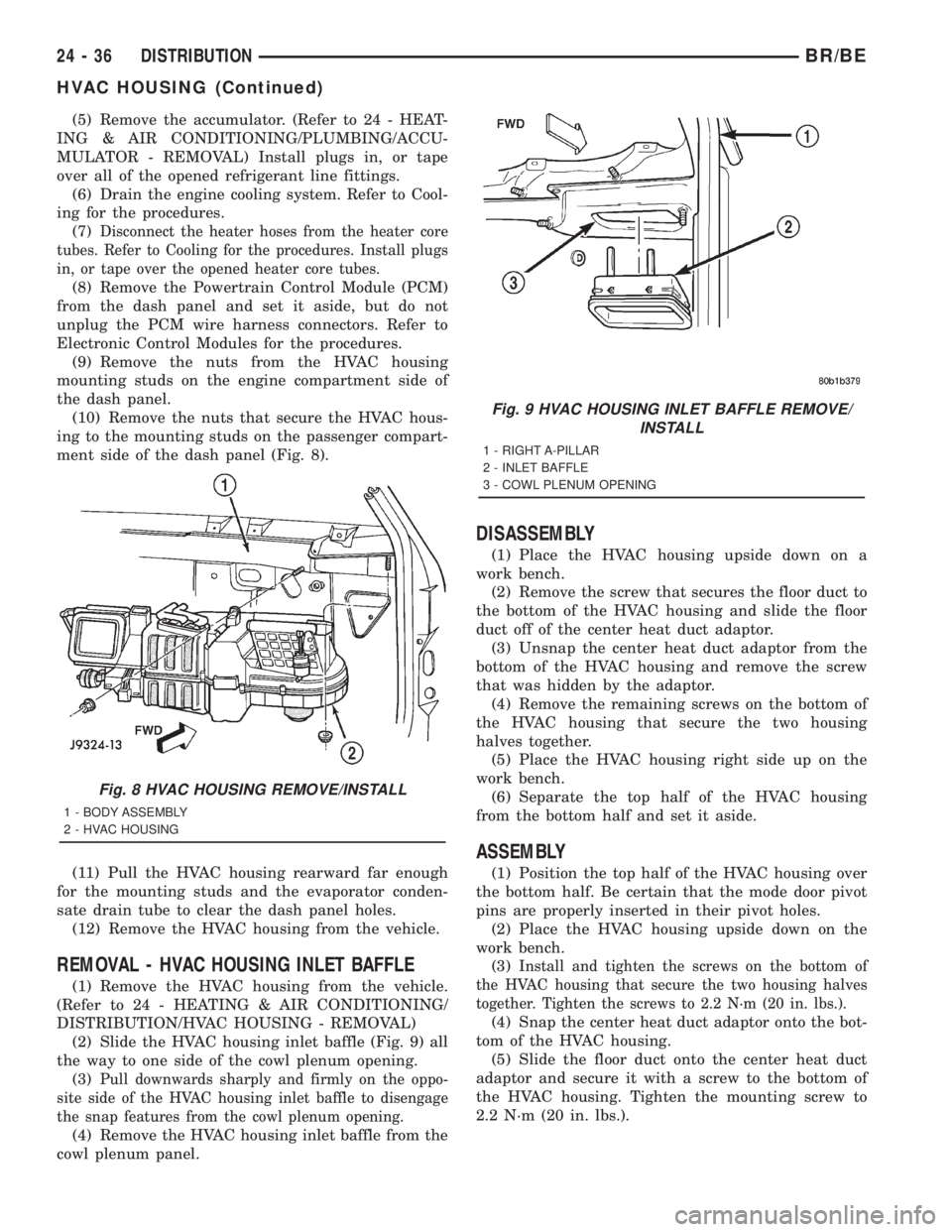
(10) Remove the nuts that secure the HVAC hous-
ing to the mounting studs on the passenger compart-
ment side of the dash panel (Fig. 8).
(11) Pull the HVAC housing rearward far enough
for the mounting studs and the evaporator conden-
sate drain tube to clear the dash panel holes.
(12) Remove the HVAC housing from the vehicle.
REMOVAL - HVAC HOUSING INLET BAFFLE
(1) Remove the HVAC housing from the vehicle.
(Refer to 24 - HEATING & AIR CONDITIONING/
DISTRIBUTION/HVAC HOUSING - REMOVAL)
(2) Slide the HVAC housing inlet baffle (Fig. 9) all
the way to one side of the cowl plenum opening.
(3)
Pull downwards sharply and firmly on the oppo-
site side of the HVAC housing inlet baffle to disengage
the snap features from the cowl plenum opening.
(4) Remove the HVAC housing inlet baffle from the
cowl plenum panel.
DISASSEMBLY
(1) Place the HVAC housing upside down on a
work bench.
(2) Remove the screw that secures the floor duct to
the bottom of the HVAC housing and slide the floor
duct off of the center heat duct adaptor.
(3) Unsnap the center heat duct adaptor from the
bottom of the HVAC housing and remove the screw
that was hidden by the adaptor.
(4) Remove the remaining screws on the bottom of
the HVAC housing that secure the two housing
halves together.
(5) Place the HVAC housing right side up on the
work bench.
(6) Separate the top half of the HVAC housing
from the bottom half and set it aside.
ASSEMBLY
(1) Position the top half of the HVAC housing over
the bottom half. Be certain that the mode door pivot
pins are properly inserted in their pivot holes.
(2) Place the HVAC housing upside down on the
work bench.
(3)
Install and tighten the screws on the bottom of
the HVAC housing that secure the two housing halves
together. Tighten the screws to 2.2 N´m (20 in. lbs.).
(4) Snap the center heat duct adaptor onto the bot-
tom of the HVAC housing.
(5) Slide the floor duct onto the center heat duct
adaptor and secure it with a screw to the bottom of
the HVAC housing. Tighten the mounting screw to
2.2 N´m (20 in. lbs.).
Fig. 8 HVAC HOUSING REMOVE/INSTALL
1 - BODY ASSEMBLY
2 - HVAC HOUSING
Fig. 9 HVAC HOUSING INLET BAFFLE REMOVE/
INSTALL
1 - RIGHT A-PILLAR
2 - INLET BAFFLE
3 - COWL PLENUM OPENING
24 - 36 DISTRIBUTIONBR/BE
HVAC HOUSING (Continued)
Page 2766 of 2889
INSTALLATION
(1) Position the HVAC housing to the dash panel.
Be certain that the evaporator condensate drain tube
and the housing mounting studs are inserted into
their correct mounting holes.
(2) Install the nuts that secure the HVAC housing
to the mounting studs on the passenger compartment
side of the dash panel. Tighten the nuts to 4.5 N´m
(40 in. lbs.).
(3)
Install and tighten the nuts onto the HVAC hous-
ing mounting studs on the engine compartment side of
the dash panel. Tighten the nuts to 7 N´m (60 in. lbs.).
(4) Unplug or remove the tape from the heater
core tubes. Connect the heater hoses to the heater
core tubes and fill the engine cooling system. Refer
Cooling for the procedures.
(5)
If the vehicle is not equipped with air condition-
ing, go to Step 10. If the vehicle is equipped with air
conditioning, install the accumulator. (Refer to 24 -
HEATING & AIR CONDITIONING/PLUMBING/ACCU-
MULATOR - INSTALLATION) Connect the accumulator
inlet tube coupler to the evaporator outlet tube. (Refer
to 24 - HEATING & AIR CONDITIONING/PLUMBING
- STANDARD PROCEDURE - A/C LINE COUPLERS)
(6)Unplug or remove the tape from the liquid line
and the evaporator inlet tube fittings. Connect the liq-
uid line coupler to the evaporator inlet tube. (Refer to
24 - HEATING & AIR CONDITIONING/PLUMBING -
STANDARD PROCEDURE - A/C LINE COUPLERS)
(7) Evacuate the refrigerant system. (Refer to 24 -
HEATING & AIR CONDITIONING/PLUMBING -
STANDARD PROCEDURE - REFRIGERANT SYS-
TEM EVACUATE)
(8) Charge the refrigerant system. (Refer to 24 -
HEATING & AIR CONDITIONING/PLUMBING -
STANDARD PROCEDURE - REFRIGERANT SYS-
TEM CHARGE)
(9) Reinstall the PCM to the dash panel. Refer to
Electronic Control Modules for the procedures.
(10) Reinstall the instrument panel in the vehicle.
Refer to Instrument Panel System for the procedures.
(11) Connect the battery negative cable.
(12) Start the engine and check for proper opera-
tion of the heating and air conditioning systems.
INSTALLATION - HVAC HOUSING INLET
BAFFLE
(1) Install the HVAC housing inlet baffle in the
cowl plenum panel.
(2) Slide the HVAC housing inlet baffle to engage
the snap features.
(3) Make certain that the snap features on each
side of the adapter are fully engaged with the sides
of the plenum panel opening. This must be a water
tight connection to prevent leaks.(4) Install the HVAC housing in the vehicle. (Refer
to 24 - HEATING & AIR CONDITIONING/DISTRI-
BUTION/HVAC HOUSING - INSTALLATION)
INSTRUMENT PANEL
DEMISTER DUCTS
REMOVAL
The defroster duct and the main demister duct are
a single molded plastic unit. The defroster outlet
grilles are heat-staked to the defroster outlets and
cannot be serviced separately. The demister tubes on
each end of the main demister duct are only serviced
in the instrument panel assembly. (Refer to 24 -
HEATING & AIR CONDITIONING/DISTRIBUTION/
DEFROSTER DUCTS - REMOVAL)
INSTRUMENT PANEL DUCTS
REMOVAL
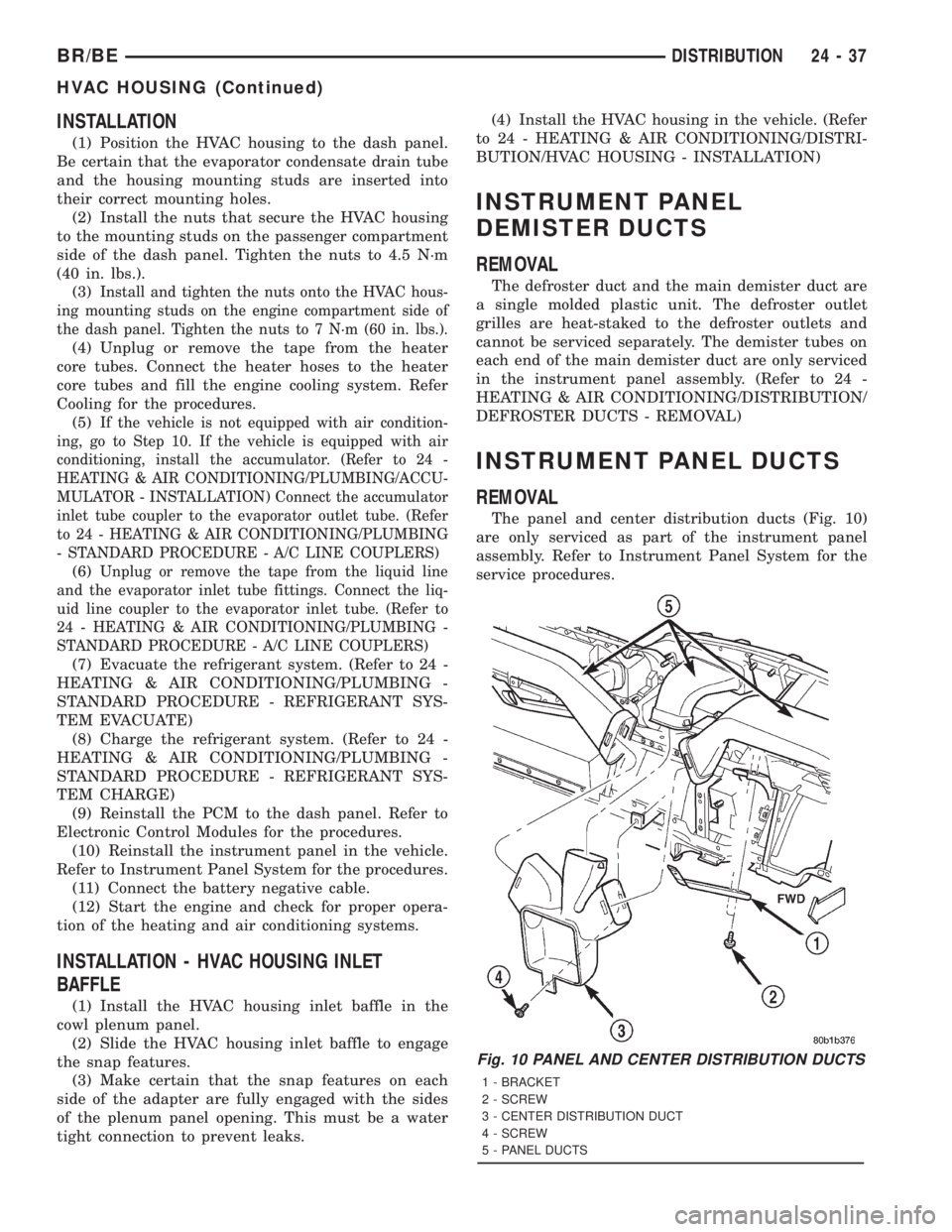
The panel and center distribution ducts (Fig. 10)
are only serviced as part of the instrument panel
assembly. Refer to Instrument Panel System for the
service procedures.
Fig. 10 PANEL AND CENTER DISTRIBUTION DUCTS
1 - BRACKET
2 - SCREW
3 - CENTER DISTRIBUTION DUCT
4 - SCREW
5 - PANEL DUCTS
BR/BEDISTRIBUTION 24 - 37
HVAC HOUSING (Continued)