2001 DODGE RAM Ac control
[x] Cancel search: Ac controlPage 65 of 2889
(4) Install upper grommet and retainer. Install
upper shock nut and tighten to 47 N´m (35 ft. lbs).
SPRING
DESCRIPTION
The springs use a rubber isolators between the
frame bracket and spring. The isolators help prevent
road noise. The bottom of the spring sits on a seat
mounted to the axle.
OPERATION
The coil springs control ride quality and maintain
proper ride height.
REMOVAL
(1) Raise and support the vehicle. Position a
hydraulic jack under the axle to support it.
(2) Paint or scribe alignment marks on lower sus-
pension arm cam adjusters and axle bracket for
installation reference.
(3) Remove the upper suspension arm and loosen
lower suspension arm bolts.
(4) Mark and disconnect the front propeller shaft
from the axle 4x4 models.
(5) Disconnect the track bar from the frame rail
bracket.
(6) Disconnect the drag link from pitman arm.
(7) Disconnect the stabilizer bar link and shock
absorber from the axle.(8) Lower the axle until the spring is free from the
upper mount. Remove the coil spring.
INSTALLATION
(1) Position the coil spring on the axle pad.
(2) Raise the axle into position until the spring
seats in the upper mount.
(3) Connect the stabilizer bar links and shock
absorbers to the axle bracket. Connect the track bar
to the frame rail bracket.
(4) Install the upper suspension arm.
(5) Install the front propeller shaft to the axle 4x4
model.
(6) Install drag link to pitman arm and tighten
nut to specifications. Install new cotter pin.
(7) Remove the supports and lower the vehicle.
(8) Tighten the following suspension components
to specifications:
²Link to stabilizer bar nut.
²Lower shock bolt.
²Track bar bolt at axle shaft tube bracket.
²Upper suspension arm nut at axle bracket.
²Upper suspension nut at frame bracket.
²Align lower suspension arm reference marks and
tighten cam nut.
²Lower suspension nut at frame bracket.
STABILIZER BAR
DESCRIPTION
The stabilizer bar extends across the front under-
side of the chassis and connects to the frame rails.
Links are connected from the bar to the axle brack-
ets. Stabilizer bar mounts are isolated by teflon lined
rubber bushings.
OPERATION
The stabilizer bar is used to minimize vehicle front
sway during turns. The spring steel bar helps to con-
trol the vehicle body in relationship to the suspen-
sion.
REMOVAL
(1) Raise and support the vehicle.
(2) Hold the stabilizer link shafts with a wrench
and remove the link nuts at the stabilizer bar.
(3) Remove the retainers and grommets from the
stabilizer bar links.
(4) Remove the stabilizer bar link nuts from the
axle brackets.
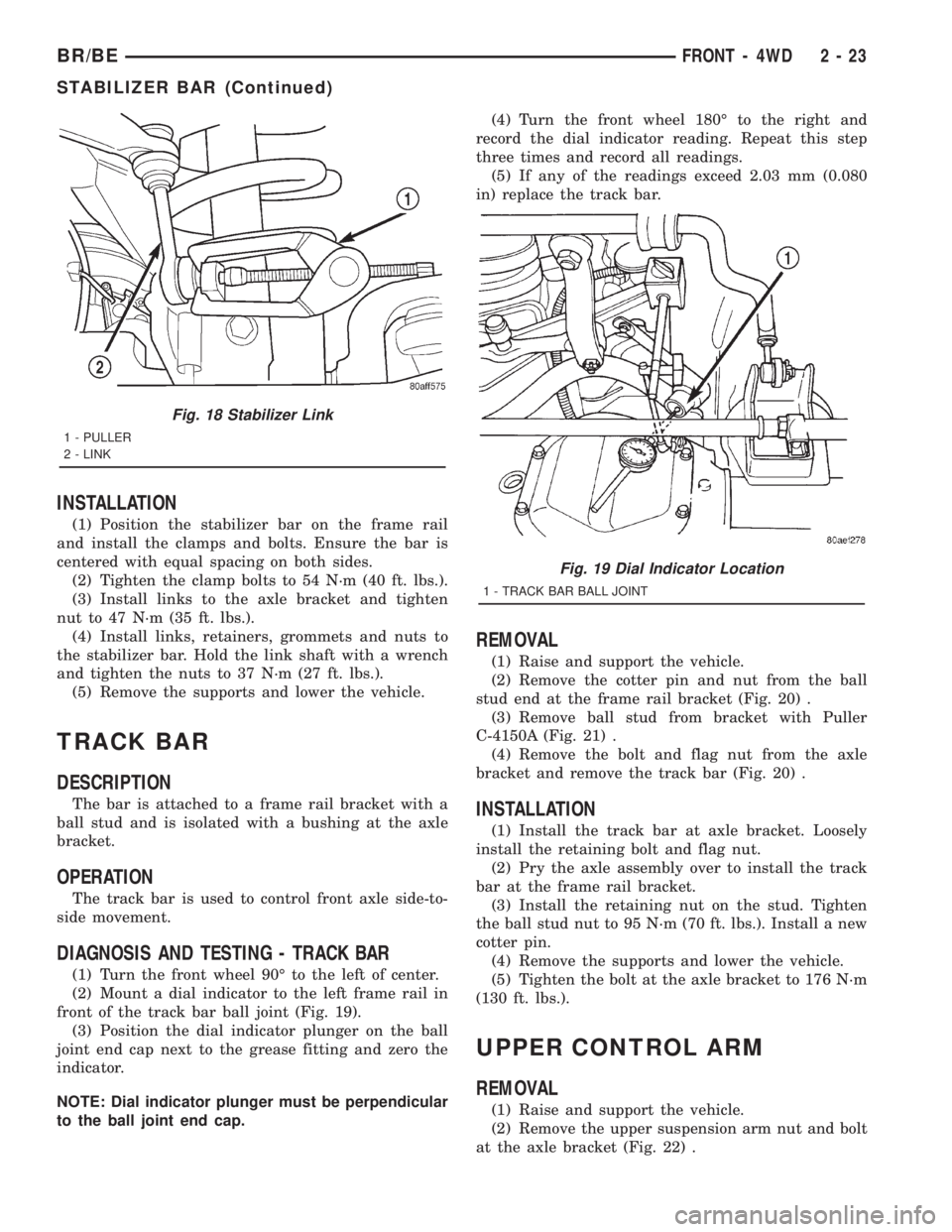
(5) Remove the links from the axle brackets with
Puller C-3894-A (Fig. 18).
(6) Remove the stabilizer bar clamps from the
frame rails and remove the stabilizer bar.
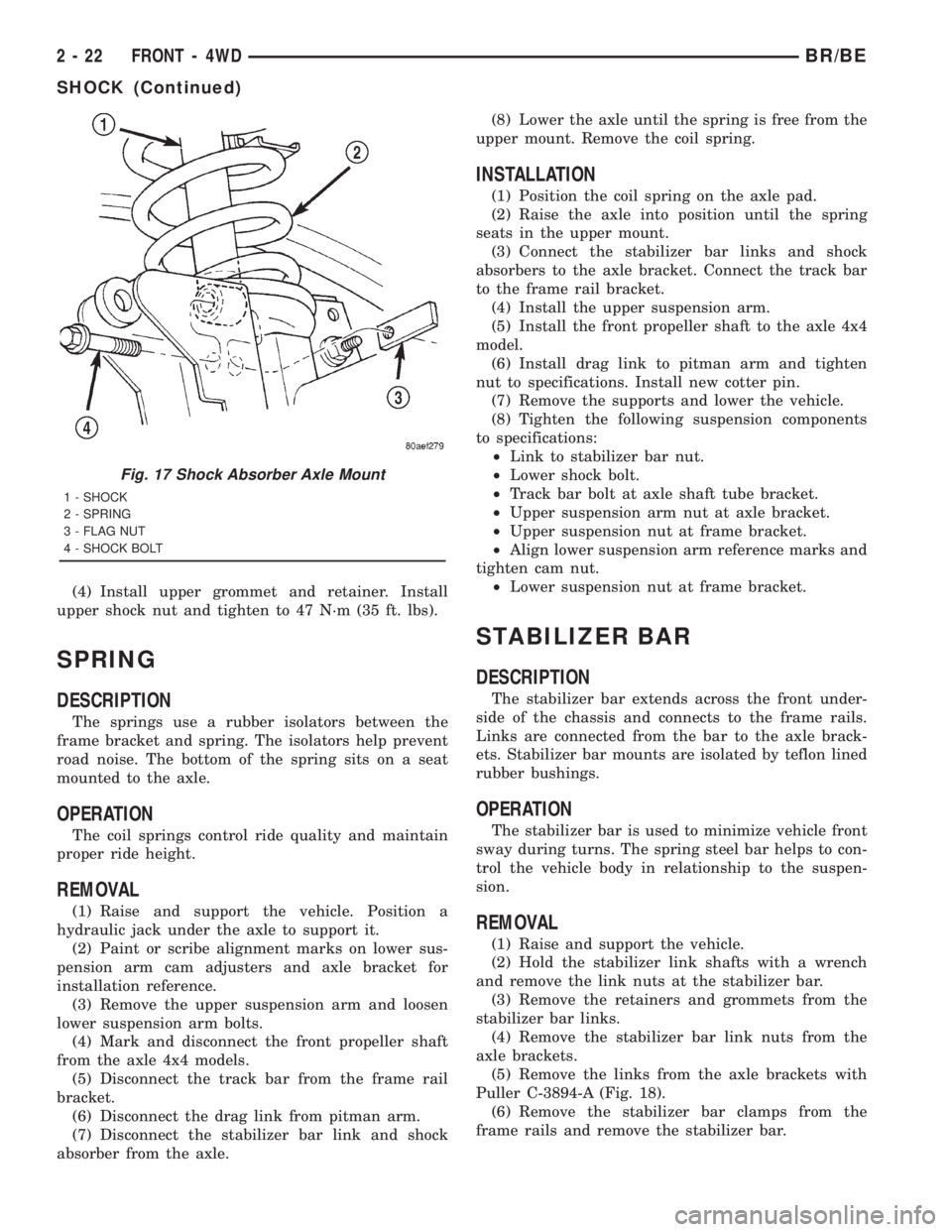
Fig. 17 Shock Absorber Axle Mount
1 - SHOCK
2 - SPRING
3 - FLAG NUT
4 - SHOCK BOLT
2 - 22 FRONT - 4WDBR/BE
SHOCK (Continued)
Page 66 of 2889
INSTALLATION
(1) Position the stabilizer bar on the frame rail
and install the clamps and bolts. Ensure the bar is
centered with equal spacing on both sides.
(2) Tighten the clamp bolts to 54 N´m (40 ft. lbs.).
(3) Install links to the axle bracket and tighten
nut to 47 N´m (35 ft. lbs.).
(4) Install links, retainers, grommets and nuts to
the stabilizer bar. Hold the link shaft with a wrench
and tighten the nuts to 37 N´m (27 ft. lbs.).
(5) Remove the supports and lower the vehicle.
TRACK BAR
DESCRIPTION
The bar is attached to a frame rail bracket with a
ball stud and is isolated with a bushing at the axle
bracket.
OPERATION
The track bar is used to control front axle side-to-
side movement.
DIAGNOSIS AND TESTING - TRACK BAR
(1) Turn the front wheel 90É to the left of center.
(2) Mount a dial indicator to the left frame rail in
front of the track bar ball joint (Fig. 19).
(3) Position the dial indicator plunger on the ball
joint end cap next to the grease fitting and zero the
indicator.
NOTE: Dial indicator plunger must be perpendicular
to the ball joint end cap.(4) Turn the front wheel 180É to the right and
record the dial indicator reading. Repeat this step
three times and record all readings.
(5) If any of the readings exceed 2.03 mm (0.080
in) replace the track bar.
REMOVAL
(1) Raise and support the vehicle.
(2) Remove the cotter pin and nut from the ball
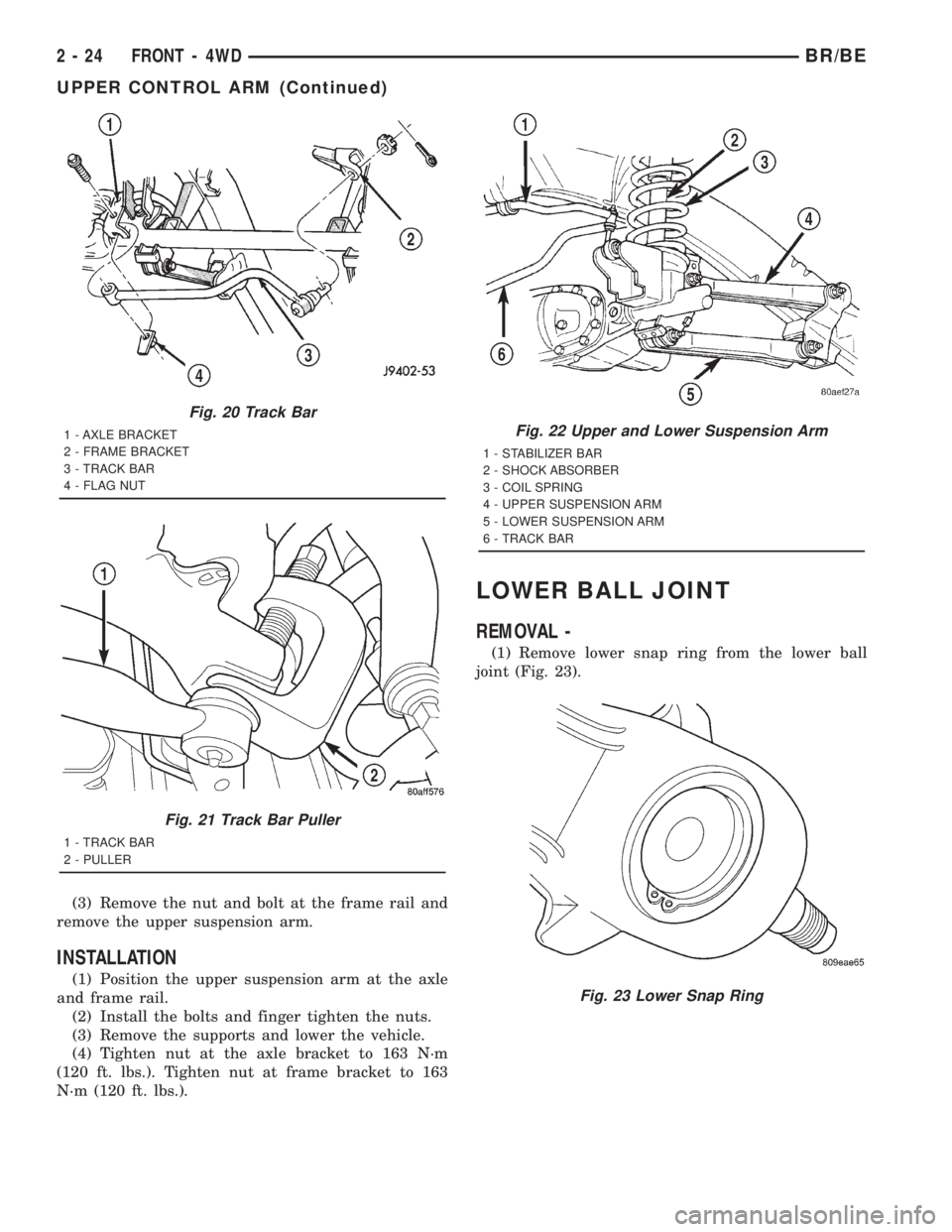
stud end at the frame rail bracket (Fig. 20) .
(3) Remove ball stud from bracket with Puller
C-4150A (Fig. 21) .
(4) Remove the bolt and flag nut from the axle
bracket and remove the track bar (Fig. 20) .
INSTALLATION
(1) Install the track bar at axle bracket. Loosely
install the retaining bolt and flag nut.
(2) Pry the axle assembly over to install the track
bar at the frame rail bracket.
(3) Install the retaining nut on the stud. Tighten
the ball stud nut to 95 N´m (70 ft. lbs.). Install a new
cotter pin.
(4) Remove the supports and lower the vehicle.
(5) Tighten the bolt at the axle bracket to 176 N´m
(130 ft. lbs.).
UPPER CONTROL ARM
REMOVAL
(1) Raise and support the vehicle.
(2) Remove the upper suspension arm nut and bolt
at the axle bracket (Fig. 22) .
Fig. 18 Stabilizer Link
1 - PULLER
2 - LINK
Fig. 19 Dial Indicator Location
1 - TRACK BAR BALL JOINT
BR/BEFRONT - 4WD 2 - 23
STABILIZER BAR (Continued)
Page 67 of 2889
(3) Remove the nut and bolt at the frame rail and
remove the upper suspension arm.
INSTALLATION
(1) Position the upper suspension arm at the axle
and frame rail.
(2) Install the bolts and finger tighten the nuts.
(3) Remove the supports and lower the vehicle.
(4) Tighten nut at the axle bracket to 163 N´m
(120 ft. lbs.). Tighten nut at frame bracket to 163
N´m (120 ft. lbs.).
LOWER BALL JOINT
REMOVAL -
(1) Remove lower snap ring from the lower ball
joint (Fig. 23).
Fig. 20 Track Bar
1 - AXLE BRACKET
2 - FRAME BRACKET
3 - TRACK BAR
4 - FLAG NUT
Fig. 21 Track Bar Puller
1 - TRACK BAR
2 - PULLER
Fig. 22 Upper and Lower Suspension Arm
1 - STABILIZER BAR
2 - SHOCK ABSORBER
3 - COIL SPRING
4 - UPPER SUSPENSION ARM
5 - LOWER SUSPENSION ARM
6 - TRACK BAR
Fig. 23 Lower Snap Ring
2 - 24 FRONT - 4WDBR/BE
UPPER CONTROL ARM (Continued)
Page 71 of 2889
SPECIAL TOOLS
SUSPENSION-REAR
BUSHINGS
REMOVAL
(1) Remove the spring from the vehicle.
(2) Position the spring eye in a press.
(3) Press the bushing out with an appropriate size
driver.
INSTALLATION
(1) Press new bushing into the spring eye with an
appropriate size driver. The bushing should be cen-
tered in the spring eye.
(2) Install the spring on the vehicle.
JOUNCE BUMPER
DESCRIPTION
The jounce bumpers are bolted to the frame rail
above the axle.
OPERATION
The jounce bumpers are used to limit the spring
and axle travel.
SHOCK
DESCRIPTION
The top of the shock absorbers are bolted to the
body crossmember. The bottom of the shocks are
bolted to the axle bracket.
OPERATION
The shocks dampen the jounce and rebound as the
vehicle travels over various road conditions.
REMOVAL
(1) Raise vehicle and support axle.
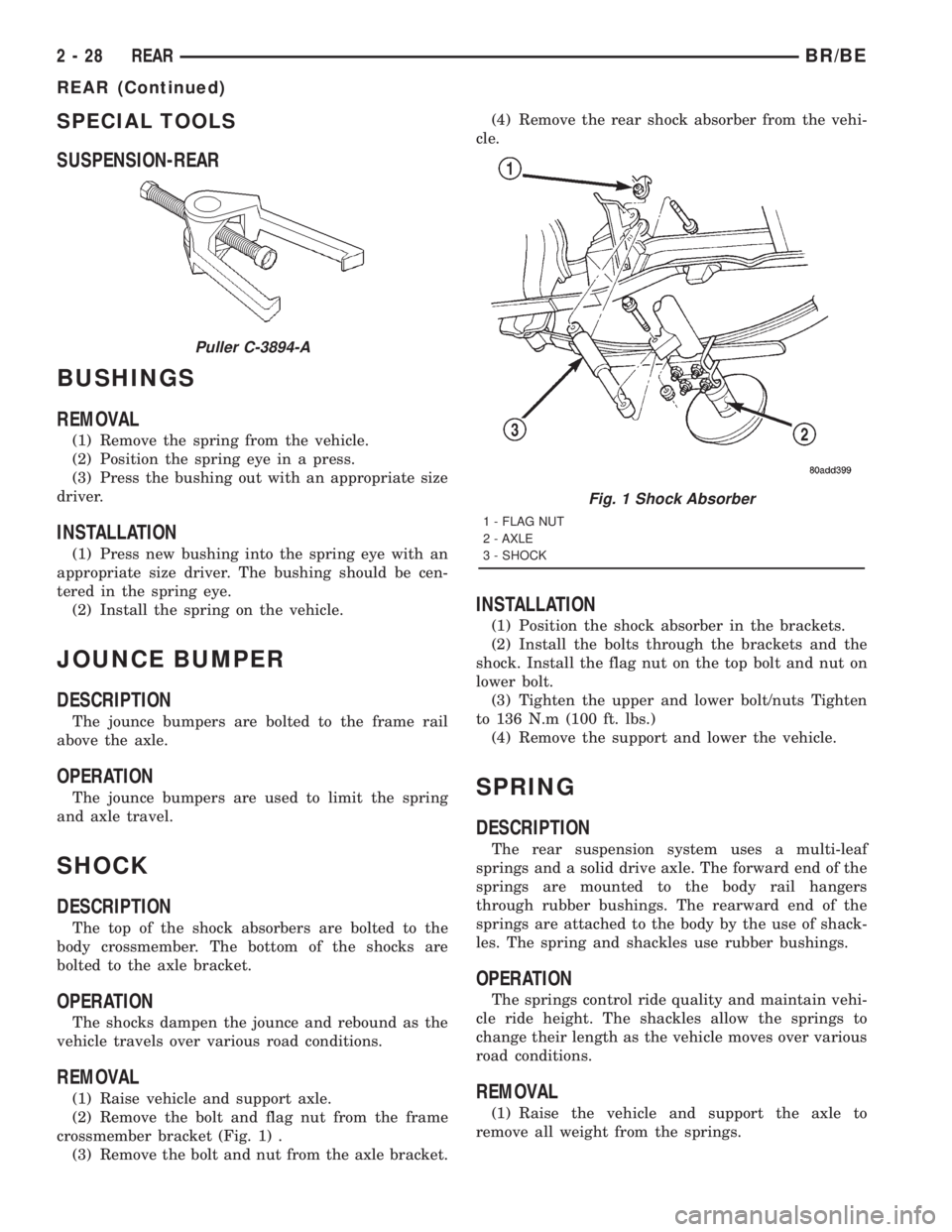
(2) Remove the bolt and flag nut from the frame
crossmember bracket (Fig. 1) .
(3) Remove the bolt and nut from the axle bracket.(4) Remove the rear shock absorber from the vehi-
cle.
INSTALLATION
(1) Position the shock absorber in the brackets.
(2) Install the bolts through the brackets and the
shock. Install the flag nut on the top bolt and nut on
lower bolt.
(3) Tighten the upper and lower bolt/nuts Tighten
to 136 N.m (100 ft. lbs.)
(4) Remove the support and lower the vehicle.
SPRING
DESCRIPTION
The rear suspension system uses a multi-leaf
springs and a solid drive axle. The forward end of the
springs are mounted to the body rail hangers
through rubber bushings. The rearward end of the
springs are attached to the body by the use of shack-
les. The spring and shackles use rubber bushings.
OPERATION
The springs control ride quality and maintain vehi-
cle ride height. The shackles allow the springs to
change their length as the vehicle moves over various
road conditions.
REMOVAL
(1) Raise the vehicle and support the axle to
remove all weight from the springs.
Puller C-3894-A
Fig. 1 Shock Absorber
1 - FLAG NUT
2 - AXLE
3 - SHOCK
2 - 28 REARBR/BE
REAR (Continued)
Page 73 of 2889
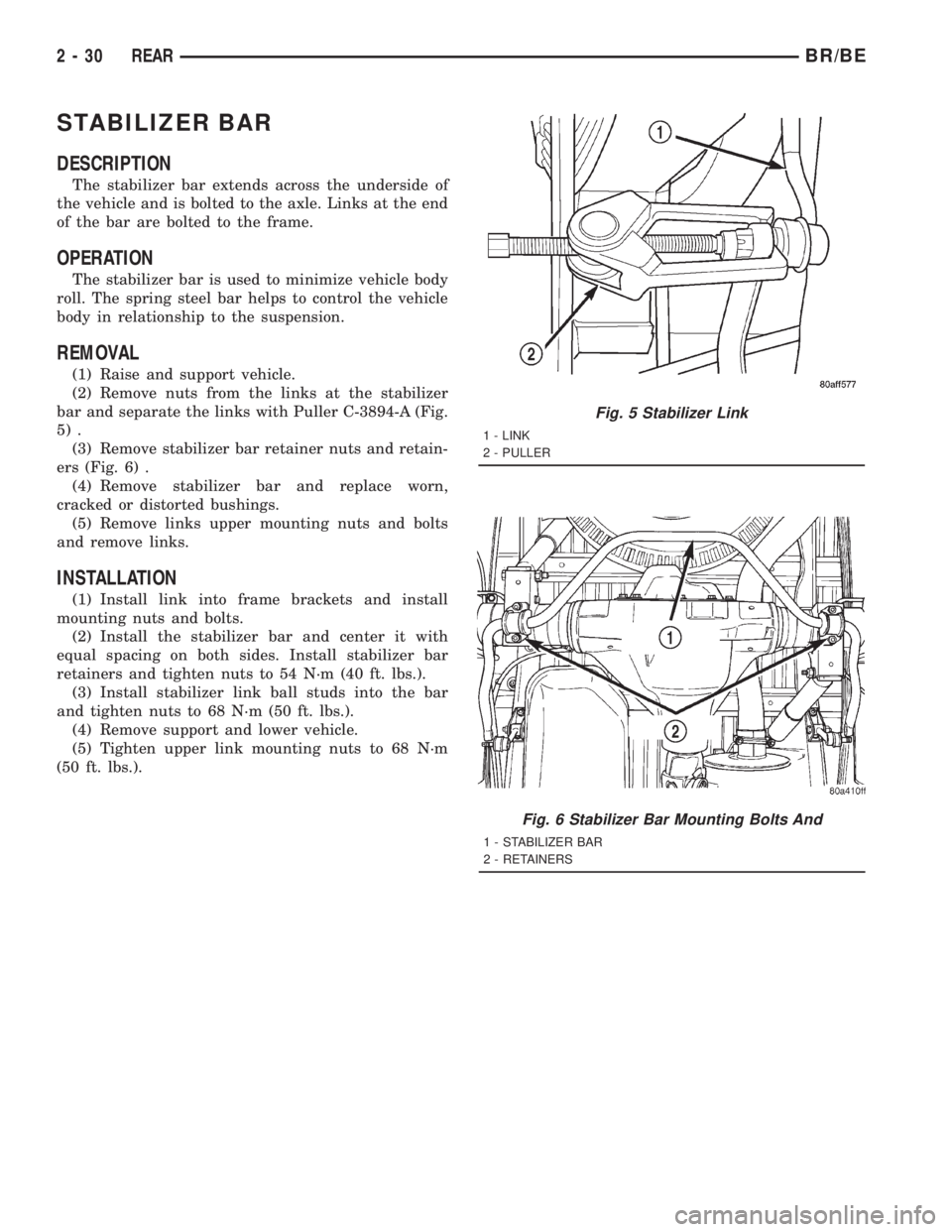
STABILIZER BAR
DESCRIPTION
The stabilizer bar extends across the underside of
the vehicle and is bolted to the axle. Links at the end
of the bar are bolted to the frame.
OPERATION
The stabilizer bar is used to minimize vehicle body
roll. The spring steel bar helps to control the vehicle
body in relationship to the suspension.
REMOVAL
(1) Raise and support vehicle.
(2) Remove nuts from the links at the stabilizer
bar and separate the links with Puller C-3894-A (Fig.
5) .
(3) Remove stabilizer bar retainer nuts and retain-
ers (Fig. 6) .
(4) Remove stabilizer bar and replace worn,
cracked or distorted bushings.
(5) Remove links upper mounting nuts and bolts
and remove links.
INSTALLATION
(1) Install link into frame brackets and install
mounting nuts and bolts.
(2) Install the stabilizer bar and center it with
equal spacing on both sides. Install stabilizer bar
retainers and tighten nuts to 54 N´m (40 ft. lbs.).
(3) Install stabilizer link ball studs into the bar
and tighten nuts to 68 N´m (50 ft. lbs.).
(4) Remove support and lower vehicle.
(5) Tighten upper link mounting nuts to 68 N´m
(50 ft. lbs.).
Fig. 5 Stabilizer Link
1 - LINK
2 - PULLER
Fig. 6 Stabilizer Bar Mounting Bolts And
1 - STABILIZER BAR
2 - RETAINERS
2 - 30 REARBR/BE
Page 102 of 2889
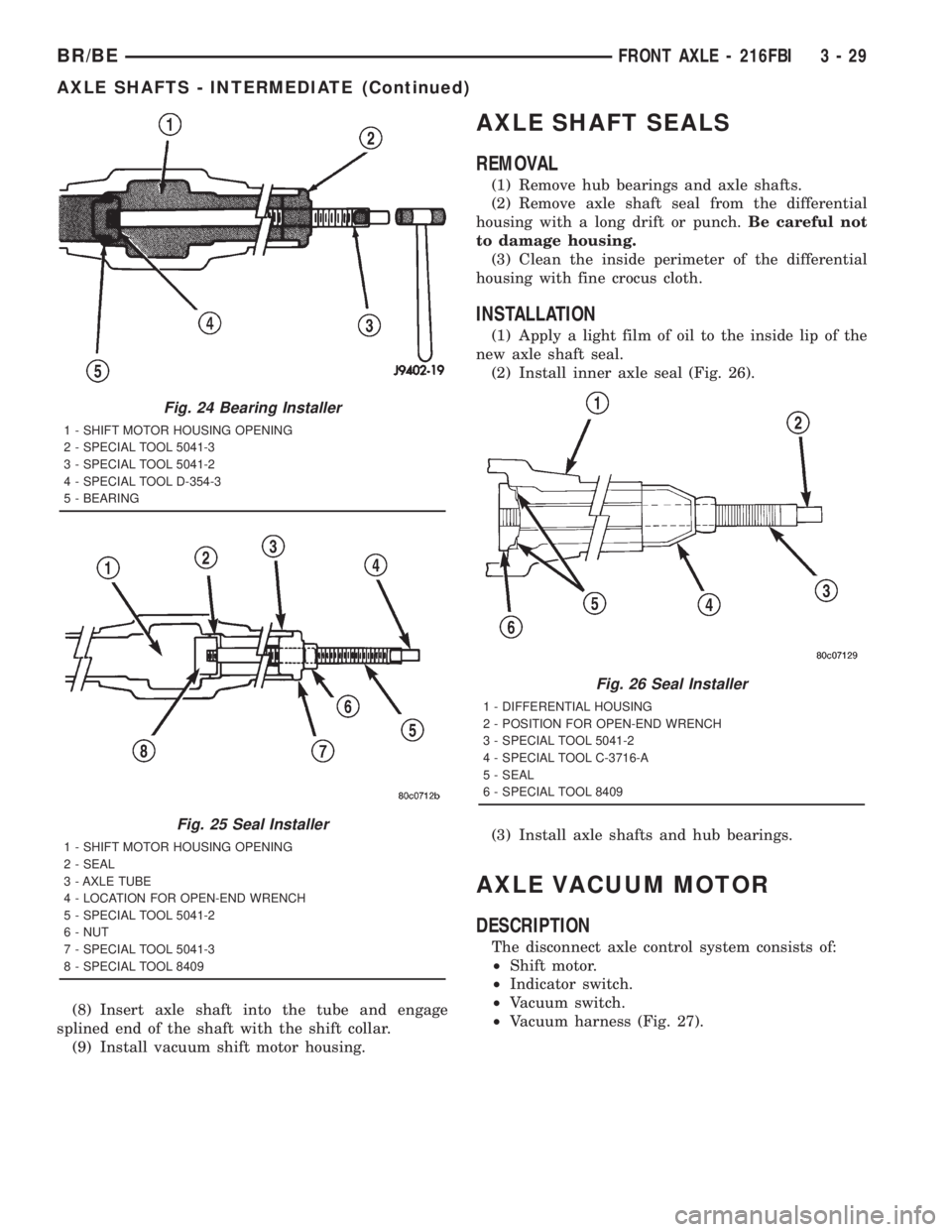
(8) Insert axle shaft into the tube and engage
splined end of the shaft with the shift collar.
(9) Install vacuum shift motor housing.
AXLE SHAFT SEALS
REMOVAL
(1) Remove hub bearings and axle shafts.
(2) Remove axle shaft seal from the differential
housing with a long drift or punch.Be careful not
to damage housing.
(3) Clean the inside perimeter of the differential
housing with fine crocus cloth.
INSTALLATION
(1) Apply a light film of oil to the inside lip of the
new axle shaft seal.
(2) Install inner axle seal (Fig. 26).
(3) Install axle shafts and hub bearings.
AXLE VACUUM MOTOR
DESCRIPTION
The disconnect axle control system consists of:
²Shift motor.
²Indicator switch.
²Vacuum switch.
²Vacuum harness (Fig. 27).
Fig. 24 Bearing Installer
1 - SHIFT MOTOR HOUSING OPENING
2 - SPECIAL TOOL 5041-3
3 - SPECIAL TOOL 5041-2
4 - SPECIAL TOOL D-354-3
5 - BEARING
Fig. 25 Seal Installer
1 - SHIFT MOTOR HOUSING OPENING
2 - SEAL
3 - AXLE TUBE
4 - LOCATION FOR OPEN-END WRENCH
5 - SPECIAL TOOL 5041-2
6 - NUT
7 - SPECIAL TOOL 5041-3
8 - SPECIAL TOOL 8409
Fig. 26 Seal Installer
1 - DIFFERENTIAL HOUSING
2 - POSITION FOR OPEN-END WRENCH
3 - SPECIAL TOOL 5041-2
4 - SPECIAL TOOL C-3716-A
5 - SEAL
6 - SPECIAL TOOL 8409
BR/BEFRONT AXLE - 216FBI 3 - 29
AXLE SHAFTS - INTERMEDIATE (Continued)
Page 103 of 2889
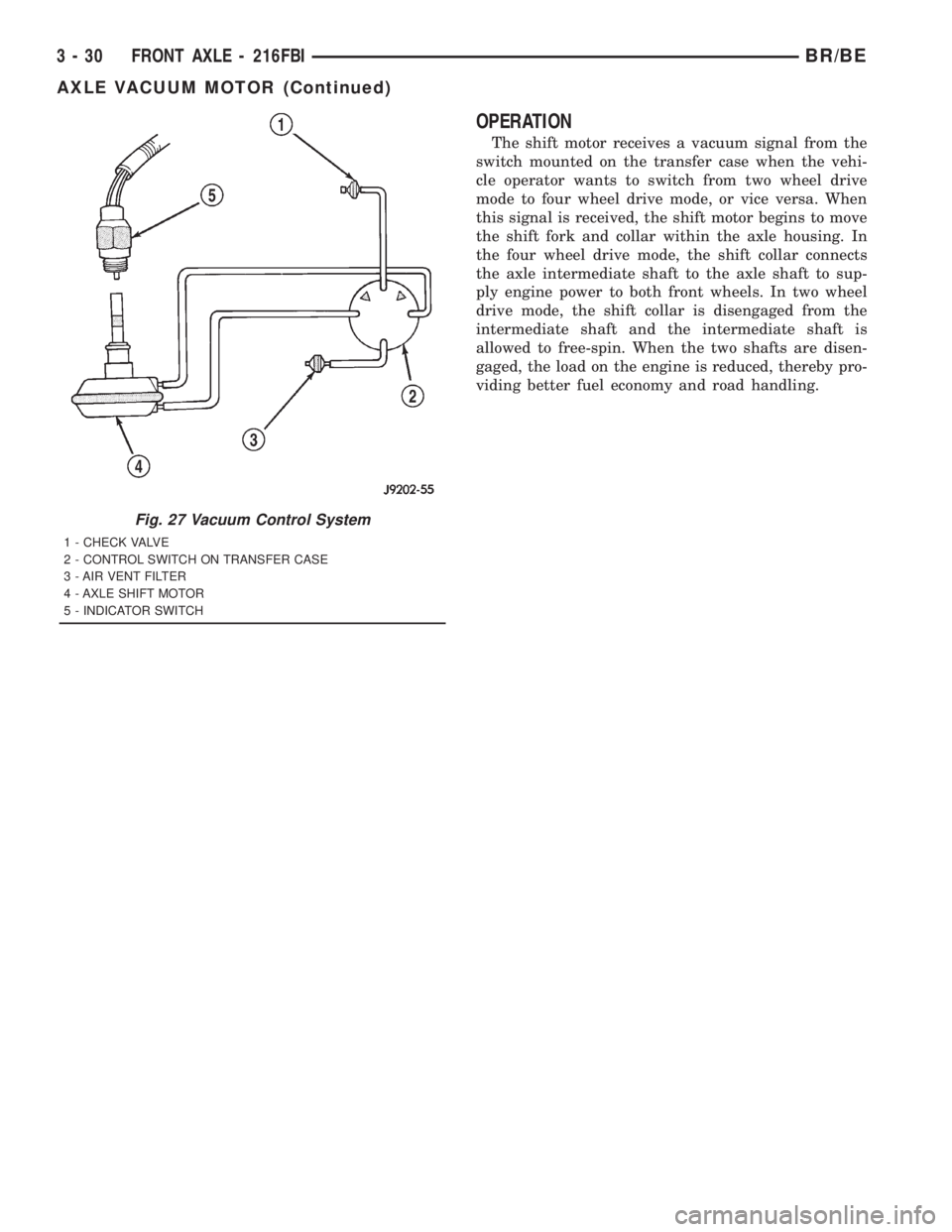
OPERATION
The shift motor receives a vacuum signal from the
switch mounted on the transfer case when the vehi-
cle operator wants to switch from two wheel drive
mode to four wheel drive mode, or vice versa. When
this signal is received, the shift motor begins to move
the shift fork and collar within the axle housing. In
the four wheel drive mode, the shift collar connects
the axle intermediate shaft to the axle shaft to sup-
ply engine power to both front wheels. In two wheel
drive mode, the shift collar is disengaged from the
intermediate shaft and the intermediate shaft is
allowed to free-spin. When the two shafts are disen-
gaged, the load on the engine is reduced, thereby pro-
viding better fuel economy and road handling.
Fig. 27 Vacuum Control System
1 - CHECK VALVE
2 - CONTROL SWITCH ON TRANSFER CASE
3 - AIR VENT FILTER
4 - AXLE SHIFT MOTOR
5 - INDICATOR SWITCH
3 - 30 FRONT AXLE - 216FBIBR/BE
AXLE VACUUM MOTOR (Continued)
Page 135 of 2889
AXLE VACUUM MOTOR
DESCRIPTION
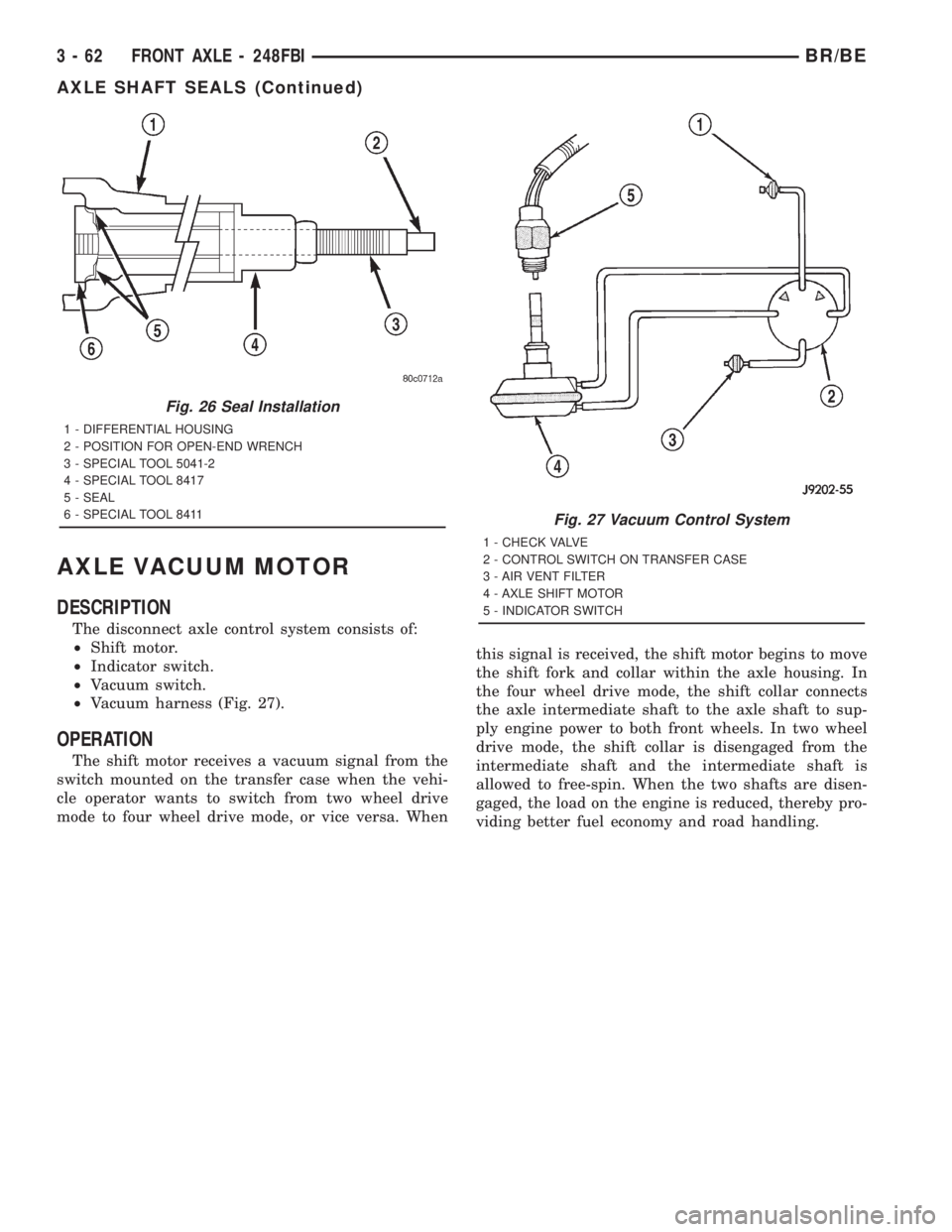
The disconnect axle control system consists of:
²Shift motor.
²Indicator switch.
²Vacuum switch.
²Vacuum harness (Fig. 27).
OPERATION
The shift motor receives a vacuum signal from the
switch mounted on the transfer case when the vehi-
cle operator wants to switch from two wheel drive
mode to four wheel drive mode, or vice versa. Whenthis signal is received, the shift motor begins to move
the shift fork and collar within the axle housing. In
the four wheel drive mode, the shift collar connects
the axle intermediate shaft to the axle shaft to sup-
ply engine power to both front wheels. In two wheel
drive mode, the shift collar is disengaged from the
intermediate shaft and the intermediate shaft is
allowed to free-spin. When the two shafts are disen-
gaged, the load on the engine is reduced, thereby pro-
viding better fuel economy and road handling.
Fig. 26 Seal Installation
1 - DIFFERENTIAL HOUSING
2 - POSITION FOR OPEN-END WRENCH
3 - SPECIAL TOOL 5041-2
4 - SPECIAL TOOL 8417
5 - SEAL
6 - SPECIAL TOOL 8411
Fig. 27 Vacuum Control System
1 - CHECK VALVE
2 - CONTROL SWITCH ON TRANSFER CASE
3 - AIR VENT FILTER
4 - AXLE SHIFT MOTOR
5 - INDICATOR SWITCH
3 - 62 FRONT AXLE - 248FBIBR/BE
AXLE SHAFT SEALS (Continued)