2001 DODGE RAM lock
[x] Cancel search: lockPage 2704 of 2889
SEATS
TABLE OF CONTENTS
page page
SEATS
DESCRIPTION..........................131
OPERATION............................131
CENTER CONSOLE LID
REMOVAL.............................131
INSTALLATION..........................132
CENTER SEAT ARMREST/CONSOLE
REMOVAL.............................132
INSTALLATION..........................132
CENTER SEAT ARMREST/LATCH COVER
REMOVAL.............................132
INSTALLATION..........................132
LUMBAR SUPPORT
REMOVAL.............................133
INSTALLATION..........................133
SEAT - BENCH SEAT
REMOVAL.............................133
INSTALLATION..........................133
SEAT - SPLIT BENCH
REMOVAL.............................134
INSTALLATION..........................134
SEAT BACK - BENCH SEAT
REMOVAL.............................135
INSTALLATION..........................135
SEAT BACK - SPLIT BENCH
REMOVAL.............................135
INSTALLATION..........................136
SEAT BACK COVER
REMOVAL.............................137
INSTALLATION..........................137
SEAT BACK COVER - SPLIT BENCH
REMOVAL.............................137
INSTALLATION..........................138SEAT BACK RECLINER
REMOVAL.............................138
INSTALLATION..........................138
SEAT CUSHION
REMOVAL.............................138
INSTALLATION..........................138
SEAT CUSHION COVER
REMOVAL.............................139
INSTALLATION..........................139
SEAT CUSHION COVER - SPLIT BENCH
REMOVAL.............................139
INSTALLATION..........................140
SEAT RISER
REMOVAL.............................141
INSTALLATION..........................141
SEAT TRACK
REMOVAL.............................141
INSTALLATION..........................141
SEAT TRACK - SPLIT BENCH
REMOVAL.............................142
INSTALLATION..........................142
EASY ENTRY SEAT TRACK
REMOVAL.............................142
INSTALLATION..........................142
SEAT TRACK ADJUSTER
REMOVAL.............................143
INSTALLATION..........................143
STANCHION COVER
REMOVAL.............................143
INSTALLATION..........................143
REAR SEAT
REMOVAL.............................144
INSTALLATION..........................144
SEATS
DESCRIPTION
Seat modules are made up of a seat frame, seat
cushion, seat back cushion, a covering material, and
the electrical components used for power operation, if
equipped. Some seat systems also contain seat belt
components and supplemental restraint systems.
OPERATION
Seat assemblies transport the occupants in comfort
and safety. Seat assemblies also help position occupants
correctly in the event of airbag deployment. Seat cush-
ions, coverings, and electrical components are service-
able. Refer to the appropriate group in this manual.
CENTER CONSOLE LID
REMOVAL
(1) Open console lid.
(2) Using a small flat blade screwdriver, disengage
locking tabs located under the console lid trim bezel.
(3) Separate bezel from lid.
(4) Move driver and passenger seat to full forward
position.
(5) Using a small drift and hammer, tap out con-
sole lid hinge pin.
(6) Separate lid from console.
BR/BESEATS 23 - 131
Page 2717 of 2889
REAR SEAT
REMOVAL
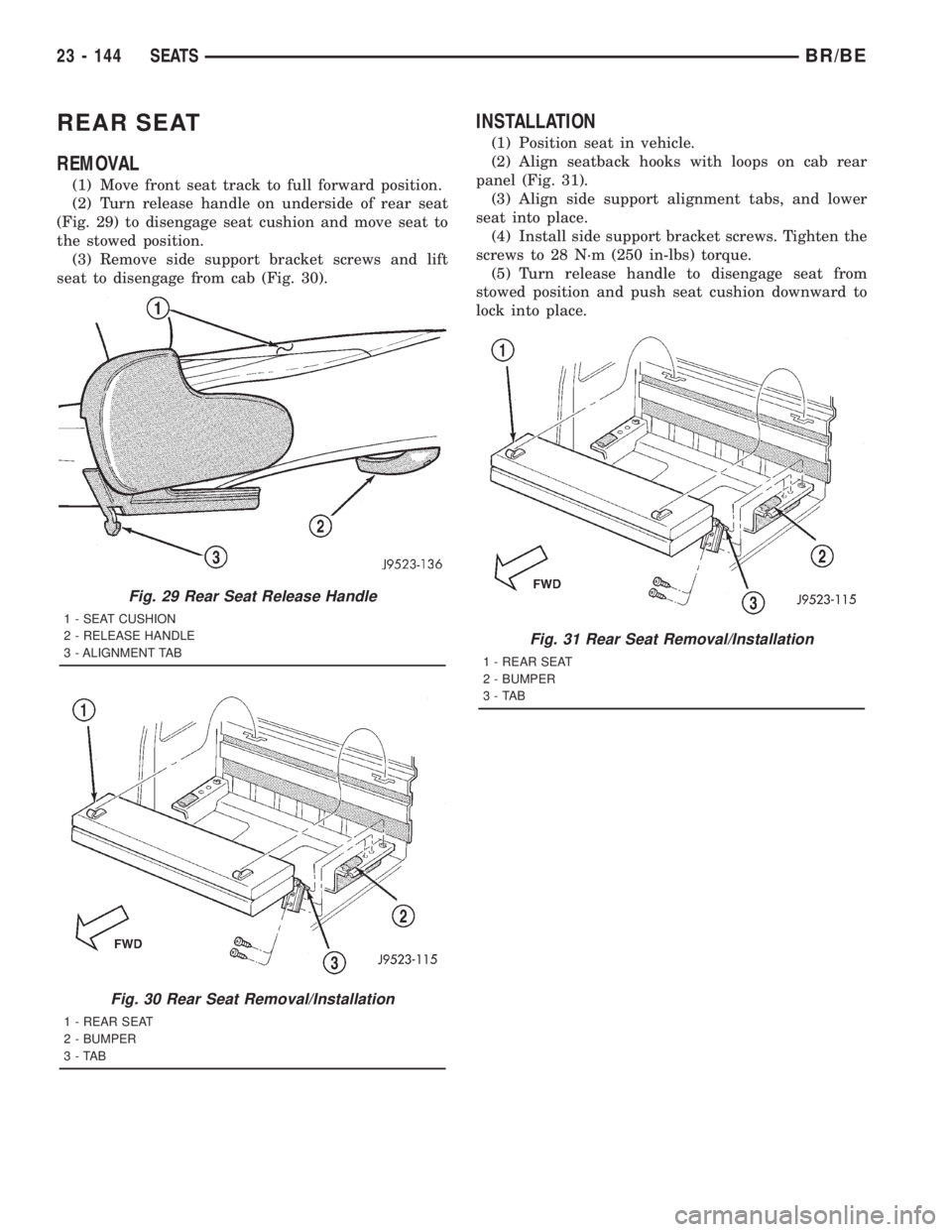
(1) Move front seat track to full forward position.
(2) Turn release handle on underside of rear seat
(Fig. 29) to disengage seat cushion and move seat to
the stowed position.
(3) Remove side support bracket screws and lift
seat to disengage from cab (Fig. 30).
INSTALLATION
(1) Position seat in vehicle.
(2) Align seatback hooks with loops on cab rear
panel (Fig. 31).
(3) Align side support alignment tabs, and lower
seat into place.
(4) Install side support bracket screws. Tighten the
screws to 28 N´m (250 in-lbs) torque.
(5) Turn release handle to disengage seat from
stowed position and push seat cushion downward to
lock into place.
Fig. 29 Rear Seat Release Handle
1 - SEAT CUSHION
2 - RELEASE HANDLE
3 - ALIGNMENT TAB
Fig. 30 Rear Seat Removal/Installation
1 - REAR SEAT
2 - BUMPER
3-TAB
Fig. 31 Rear Seat Removal/Installation
1 - REAR SEAT
2 - BUMPER
3-TAB
23 - 144 SEATSBR/BE
Page 2720 of 2889
BACKLITE VENT GLASS
REMOVAL
(1) Close and latch sliding vent glass.
(2) Remove rear closure panel trim, if necessary.
(Refer to 23 - BODY/INTERIOR/REAR CLOSURE
PANEL TRIM - REMOVAL).
(3) Grasp end of lower run channel.
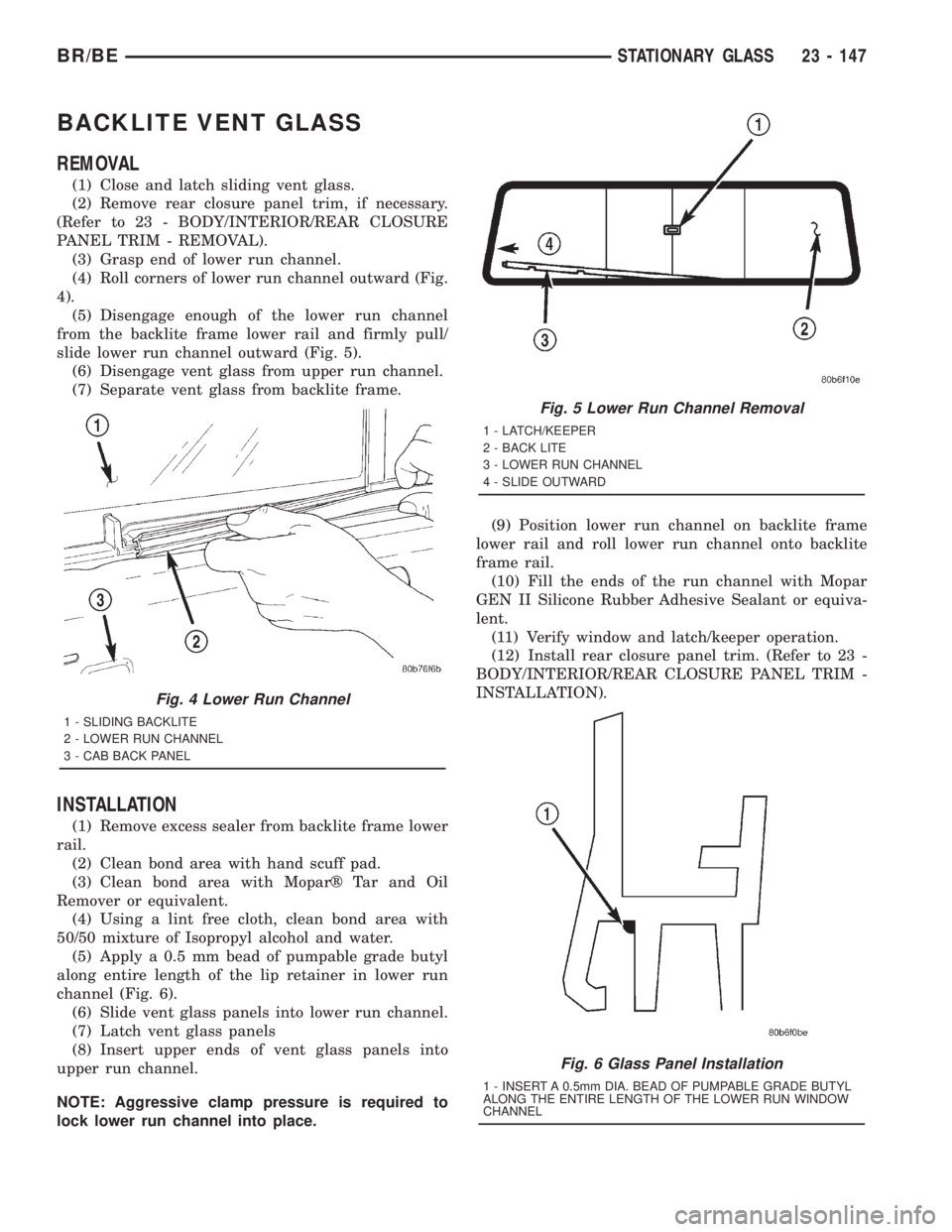
(4) Roll corners of lower run channel outward (Fig.
4).
(5) Disengage enough of the lower run channel
from the backlite frame lower rail and firmly pull/
slide lower run channel outward (Fig. 5).
(6) Disengage vent glass from upper run channel.
(7) Separate vent glass from backlite frame.
INSTALLATION
(1) Remove excess sealer from backlite frame lower
rail.
(2) Clean bond area with hand scuff pad.
(3) Clean bond area with Moparž Tar and Oil
Remover or equivalent.
(4) Using a lint free cloth, clean bond area with
50/50 mixture of Isopropyl alcohol and water.
(5) Apply a 0.5 mm bead of pumpable grade butyl
along entire length of the lip retainer in lower run
channel (Fig. 6).
(6) Slide vent glass panels into lower run channel.
(7) Latch vent glass panels
(8) Insert upper ends of vent glass panels into
upper run channel.
NOTE: Aggressive clamp pressure is required to
lock lower run channel into place.(9) Position lower run channel on backlite frame
lower rail and roll lower run channel onto backlite
frame rail.
(10) Fill the ends of the run channel with Mopar
GEN II Silicone Rubber Adhesive Sealant or equiva-
lent.
(11) Verify window and latch/keeper operation.
(12) Install rear closure panel trim. (Refer to 23 -
BODY/INTERIOR/REAR CLOSURE PANEL TRIM -
INSTALLATION).
Fig. 4 Lower Run Channel
1 - SLIDING BACKLITE
2 - LOWER RUN CHANNEL
3 - CAB BACK PANEL
Fig. 5 Lower Run Channel Removal
1 - LATCH/KEEPER
2 - BACK LITE
3 - LOWER RUN CHANNEL
4 - SLIDE OUTWARD
Fig. 6 Glass Panel Installation
1 - INSERT A 0.5mm DIA. BEAD OF PUMPABLE GRADE BUTYL
ALONG THE ENTIRE LENGTH OF THE LOWER RUN WINDOW
CHANNEL
BR/BESTATIONARY GLASS 23 - 147
Page 2722 of 2889
should remain on the fence. Do not grind off or com-
pletely remove all old urethane from the fence, the
paint finish and bonding strength will be adversely
affected.
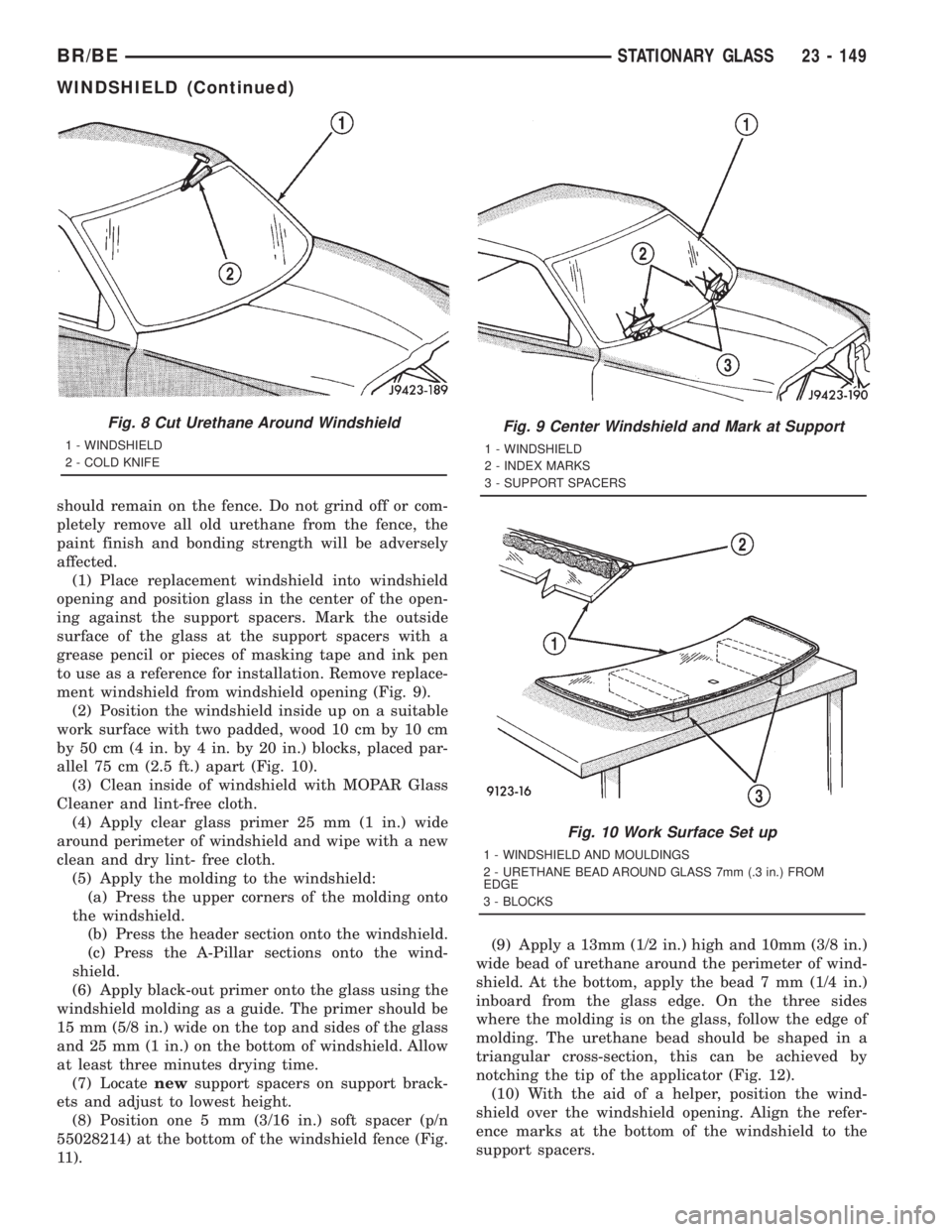
(1) Place replacement windshield into windshield
opening and position glass in the center of the open-
ing against the support spacers. Mark the outside
surface of the glass at the support spacers with a
grease pencil or pieces of masking tape and ink pen
to use as a reference for installation. Remove replace-
ment windshield from windshield opening (Fig. 9).
(2) Position the windshield inside up on a suitable
work surface with two padded, wood 10 cm by 10 cm
by 50 cm (4 in. by 4 in. by 20 in.) blocks, placed par-
allel 75 cm (2.5 ft.) apart (Fig. 10).
(3) Clean inside of windshield with MOPAR Glass
Cleaner and lint-free cloth.
(4) Apply clear glass primer 25 mm (1 in.) wide
around perimeter of windshield and wipe with a new
clean and dry lint- free cloth.
(5) Apply the molding to the windshield:
(a) Press the upper corners of the molding onto
the windshield.
(b) Press the header section onto the windshield.
(c) Press the A-Pillar sections onto the wind-
shield.
(6) Apply black-out primer onto the glass using the
windshield molding as a guide. The primer should be
15 mm (5/8 in.) wide on the top and sides of the glass
and 25 mm (1 in.) on the bottom of windshield. Allow
at least three minutes drying time.
(7) Locatenewsupport spacers on support brack-
ets and adjust to lowest height.
(8) Position one 5 mm (3/16 in.) soft spacer (p/n
55028214) at the bottom of the windshield fence (Fig.
11).(9) Apply a 13mm (1/2 in.) high and 10mm (3/8 in.)
wide bead of urethane around the perimeter of wind-
shield. At the bottom, apply the bead 7 mm (1/4 in.)
inboard from the glass edge. On the three sides
where the molding is on the glass, follow the edge of
molding. The urethane bead should be shaped in a
triangular cross-section, this can be achieved by
notching the tip of the applicator (Fig. 12).
(10) With the aid of a helper, position the wind-
shield over the windshield opening. Align the refer-
ence marks at the bottom of the windshield to the
support spacers.
Fig. 8 Cut Urethane Around Windshield
1 - WINDSHIELD
2 - COLD KNIFE
Fig. 9 Center Windshield and Mark at Support
1 - WINDSHIELD
2 - INDEX MARKS
3 - SUPPORT SPACERS
Fig. 10 Work Surface Set up
1 - WINDSHIELD AND MOULDINGS
2 - URETHANE BEAD AROUND GLASS 7mm (.3 in.) FROM
EDGE
3 - BLOCKS
BR/BESTATIONARY GLASS 23 - 149
WINDSHIELD (Continued)
Page 2724 of 2889
QUARTER WINDOW
REMOVAL
(1) Remove quarter trim panel.
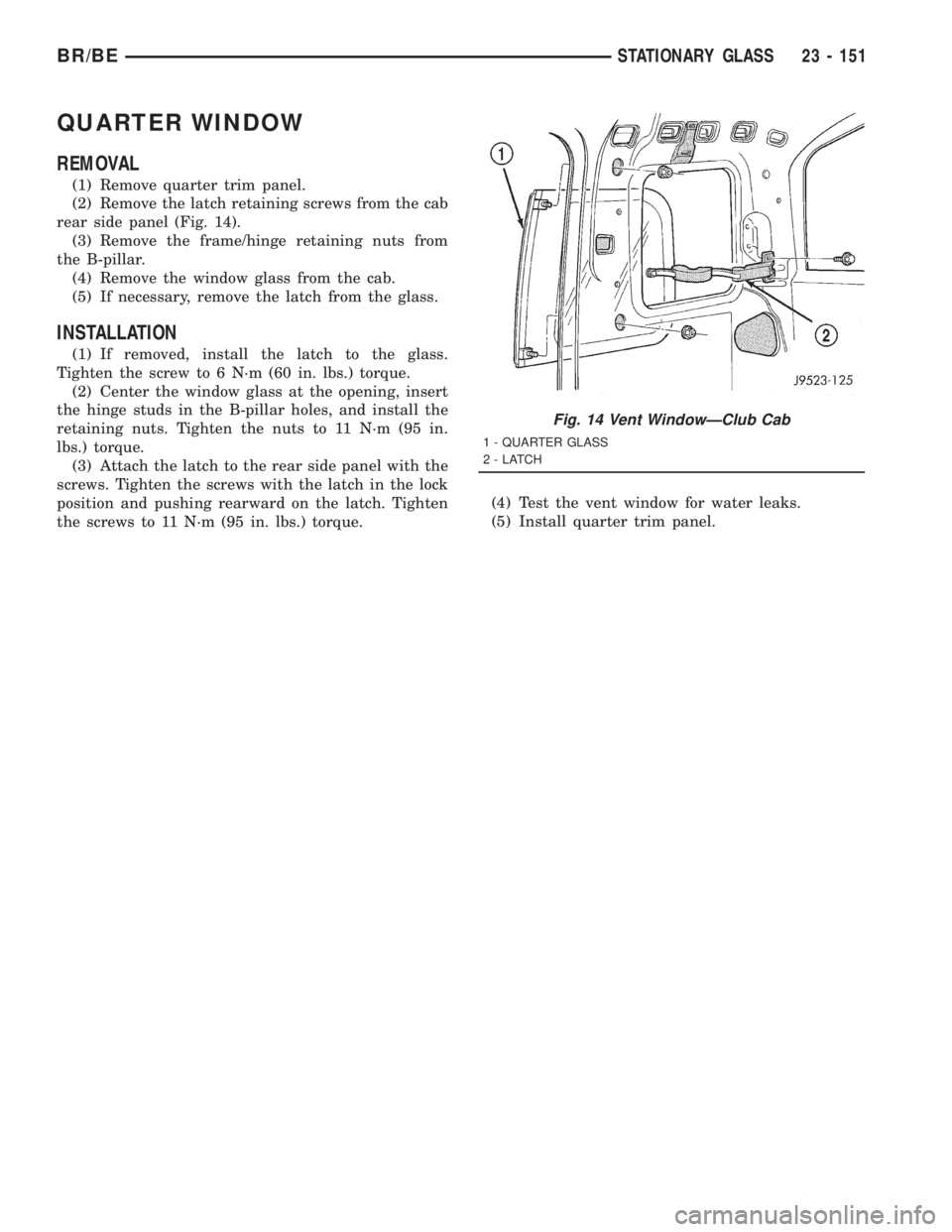
(2) Remove the latch retaining screws from the cab
rear side panel (Fig. 14).
(3) Remove the frame/hinge retaining nuts from
the B-pillar.
(4) Remove the window glass from the cab.
(5) If necessary, remove the latch from the glass.
INSTALLATION
(1) If removed, install the latch to the glass.
Tighten the screw to 6 N´m (60 in. lbs.) torque.
(2) Center the window glass at the opening, insert
the hinge studs in the B-pillar holes, and install the
retaining nuts. Tighten the nuts to 11 N´m (95 in.
lbs.) torque.
(3) Attach the latch to the rear side panel with the
screws. Tighten the screws with the latch in the lock
position and pushing rearward on the latch. Tighten
the screws to 11 N´m (95 in. lbs.) torque.(4) Test the vent window for water leaks.
(5) Install quarter trim panel.
Fig. 14 Vent WindowÐClub Cab
1 - QUARTER GLASS
2-LATCH
BR/BESTATIONARY GLASS 23 - 151
Page 2732 of 2889
(7)With the compressor clutch engaged, record the
panel outlet discharge air temperature, the discharge
pressure (high side), and the suction pressure (low side).
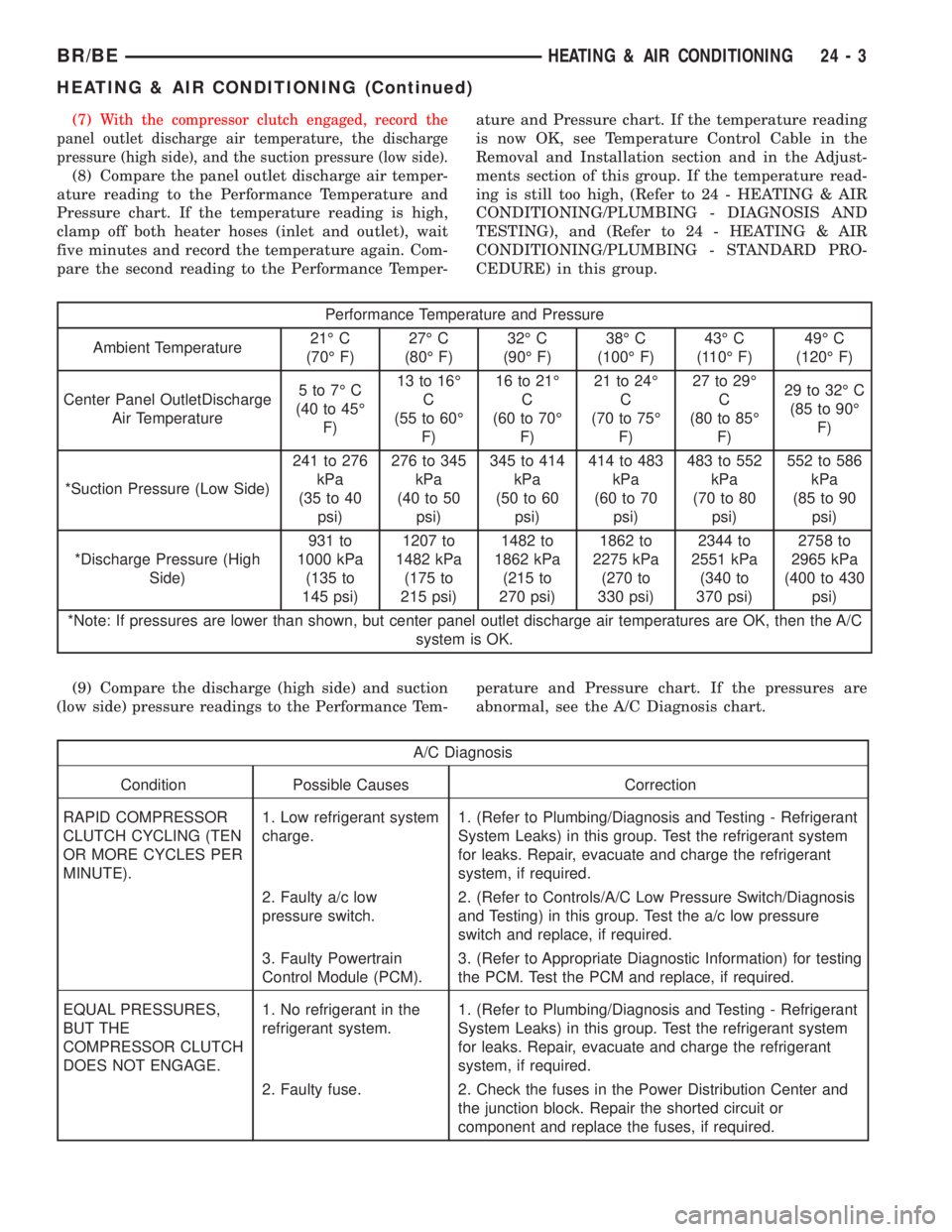
(8) Compare the panel outlet discharge air temper-
ature reading to the Performance Temperature and
Pressure chart. If the temperature reading is high,
clamp off both heater hoses (inlet and outlet), wait
five minutes and record the temperature again. Com-
pare the second reading to the Performance Temper-ature and Pressure chart. If the temperature reading
is now OK, see Temperature Control Cable in the
Removal and Installation section and in the Adjust-
ments section of this group. If the temperature read-
ing is still too high, (Refer to 24 - HEATING & AIR
CONDITIONING/PLUMBING - DIAGNOSIS AND
TESTING), and (Refer to 24 - HEATING & AIR
CONDITIONING/PLUMBING - STANDARD PRO-
CEDURE) in this group.
Performance Temperature and Pressure
Ambient Temperature21É C
(70É F)27É C
(80É F)32É C
(90É F)38É C
(100É F)43É C
(110É F)49É C
(120É F)
Center Panel OutletDischarge
Air Temperature5to7ÉC
(40 to 45É
F)13 to 16É
C
(55 to 60É
F)16 to 21É
C
(60 to 70É
F)21 to 24É
C
(70 to 75É
F)27 to 29É
C
(80 to 85É
F)29 to 32É C
(85 to 90É
F)
*Suction Pressure (Low Side)241 to 276
kPa
(35 to 40
psi)276 to 345
kPa
(40 to 50
psi)345 to 414
kPa
(50 to 60
psi)414 to 483
kPa
(60 to 70
psi)483 to 552
kPa
(70 to 80
psi)552 to 586
kPa
(85 to 90
psi)
*Discharge Pressure (High
Side)931 to
1000 kPa
(135 to
145 psi)1207 to
1482 kPa
(175 to
215 psi)1482 to
1862 kPa
(215 to
270 psi)1862 to
2275 kPa
(270 to
330 psi)2344 to
2551 kPa
(340 to
370 psi)2758 to
2965 kPa
(400 to 430
psi)
*Note: If pressures are lower than shown, but center panel outlet discharge air temperatures are OK, then the A/C
system is OK.
(9) Compare the discharge (high side) and suction
(low side) pressure readings to the Performance Tem-perature and Pressure chart. If the pressures are
abnormal, see the A/C Diagnosis chart.
A/C Diagnosis
Condition Possible Causes Correction
RAPID COMPRESSOR
CLUTCH CYCLING (TEN
OR MORE CYCLES PER
MINUTE).1. Low refrigerant system
charge.1. (Refer to Plumbing/Diagnosis and Testing - Refrigerant
System Leaks) in this group. Test the refrigerant system
for leaks. Repair, evacuate and charge the refrigerant
system, if required.
2. Faulty a/c low
pressure switch.2. (Refer to Controls/A/C Low Pressure Switch/Diagnosis
and Testing) in this group. Test the a/c low pressure
switch and replace, if required.
3. Faulty Powertrain
Control Module (PCM).3. (Refer to Appropriate Diagnostic Information) for testing
the PCM. Test the PCM and replace, if required.
EQUAL PRESSURES,
BUT THE
COMPRESSOR CLUTCH
DOES NOT ENGAGE.1. No refrigerant in the
refrigerant system.1. (Refer to Plumbing/Diagnosis and Testing - Refrigerant
System Leaks) in this group. Test the refrigerant system
for leaks. Repair, evacuate and charge the refrigerant
system, if required.
2. Faulty fuse. 2. Check the fuses in the Power Distribution Center and
the junction block. Repair the shorted circuit or
component and replace the fuses, if required.
BR/BEHEATING & AIR CONDITIONING 24 - 3
HEATING & AIR CONDITIONING (Continued)
Page 2737 of 2889
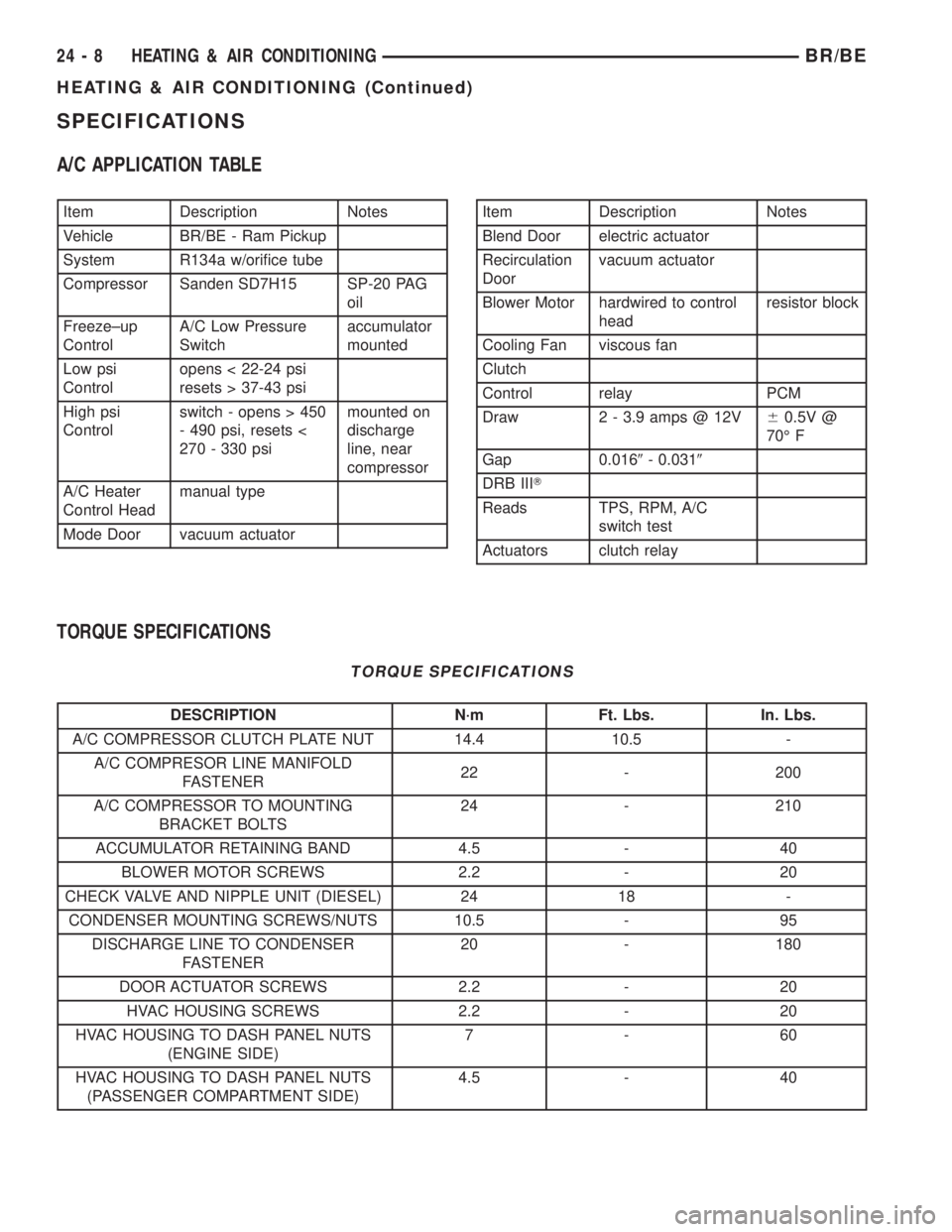
SPECIFICATIONS
A/C APPLICATION TABLE
Item Description Notes
Vehicle BR/BE - Ram Pickup
System R134a w/orifice tube
Compressor Sanden SD7H15 SP-20 PAG
oil
Freeze±up
ControlA/C Low Pressure
Switchaccumulator
mounted
Low psi
Controlopens < 22-24 psi
resets > 37-43 psi
High psi
Controlswitch - opens > 450
- 490 psi, resets <
270 - 330 psimounted on
discharge
line, near
compressor
A/C Heater
Control Headmanual type
Mode Door vacuum actuatorItem Description Notes
Blend Door electric actuator
Recirculation
Doorvacuum actuator
Blower Motor hardwired to control
headresistor block
Cooling Fan viscous fan
Clutch
Control relay PCM
Draw 2 - 3.9 amps @ 12V60.5V @
70É F
Gap 0.0169- 0.0319
DRB IIIT
Reads TPS, RPM, A/C
switch test
Actuators clutch relay
TORQUE SPECIFICATIONS
TORQUE SPECIFICATIONS
DESCRIPTION N´m Ft. Lbs. In. Lbs.
A/C COMPRESSOR CLUTCH PLATE NUT 14.4 10.5 -
A/C COMPRESOR LINE MANIFOLD
FASTENER22 - 200
A/C COMPRESSOR TO MOUNTING
BRACKET BOLTS24 - 210
ACCUMULATOR RETAINING BAND 4.5 - 40
BLOWER MOTOR SCREWS 2.2 - 20
CHECK VALVE AND NIPPLE UNIT (DIESEL) 24 18 -
CONDENSER MOUNTING SCREWS/NUTS 10.5 - 95
DISCHARGE LINE TO CONDENSER
FASTENER20 - 180
DOOR ACTUATOR SCREWS 2.2 - 20
HVAC HOUSING SCREWS 2.2 - 20
HVAC HOUSING TO DASH PANEL NUTS
(ENGINE SIDE)7-60
HVAC HOUSING TO DASH PANEL NUTS
(PASSENGER COMPARTMENT SIDE)4.5 - 40
24 - 8 HEATING & AIR CONDITIONINGBR/BE
HEATING & AIR CONDITIONING (Continued)
Page 2738 of 2889
CONTROLS
TABLE OF CONTENTS
page page
CONTROLS
DIAGNOSIS AND TESTING.................10
VACUUM SYSTEM......................10
A/C COMPRESSOR CLUTCH
DESCRIPTION...........................13
OPERATION.............................13
DIAGNOSIS AND TESTING.................13
A/C COMPRESSOR CLUTCH COIL.........13
STANDARD PROCEDURE..................13
A/C COMPRESSOR CLUTCH BREAK-IN.....13
REMOVAL..............................14
INSPECTION............................16
INSTALLATION...........................16
A/C COMPRESSOR CLUTCH RELAY
DESCRIPTION...........................17
OPERATION.............................17
DIAGNOSIS AND TESTING.................17
A/C COMPRESSOR CLUTCH RELAY........17
REMOVAL..............................18
INSTALLATION...........................18
A/C HEATER CONTROL
DESCRIPTION...........................18
OPERATION.............................18
DIAGNOSIS AND TESTING.................19
A/C HEATER CONTROL..................19
REMOVAL..............................19
INSTALLATION...........................20
A/C HIGH PRESSURE SWITCH
DESCRIPTION...........................20
OPERATION.............................20
DIAGNOSIS AND TESTING.................20
A/C HIGH PRESSURE SWITCH............20
REMOVAL..............................21
INSTALLATION...........................21
A/C LOW PRESSURE SWITCH
DESCRIPTION...........................21
OPERATION.............................21
DIAGNOSIS AND TESTING.................21
A/C LOW PRESSURE SWITCH............21
REMOVAL..............................21INSTALLATION...........................22
BLOWER MOTOR RELAY
DESCRIPTION...........................22
OPERATION.............................22
DIAGNOSIS AND TESTING.................22
BLOWER MOTOR RELAY.................22
REMOVAL..............................23
INSTALLATION...........................23
BLOWER MOTOR RESISTOR BLOCK
DESCRIPTION...........................23
OPERATION.............................23
DIAGNOSIS AND TESTING.................24
BLOWER MOTOR RESISTOR BLOCK.......24
REMOVAL..............................24
INSTALLATION...........................24
BLOWER MOTOR SWITCH
DESCRIPTION...........................24
OPERATION.............................25
DIAGNOSIS AND TESTING.................25
BLOWER MOTOR SWITCH...............25
REMOVAL..............................25
BLEND DOOR ACTUATOR
REMOVAL..............................25
INSTALLATION...........................26
MODE DOOR ACTUATOR
REMOVAL..............................26
INSTALLATION...........................27
RECIRCULATION DOOR ACTUATOR
REMOVAL..............................27
INSTALLATION...........................28
VACUUM CHECK VALVE
DESCRIPTION...........................28
OPERATION.............................28
REMOVAL..............................29
INSTALLATION...........................29
VACUUM RESERVOIR
DESCRIPTION...........................29
OPERATION.............................29
REMOVAL..............................30
INSTALLATION...........................30
BR/BECONTROLS 24 - 9