2001 CHRYSLER VOYAGER ECU
[x] Cancel search: ECUPage 3797 of 4284
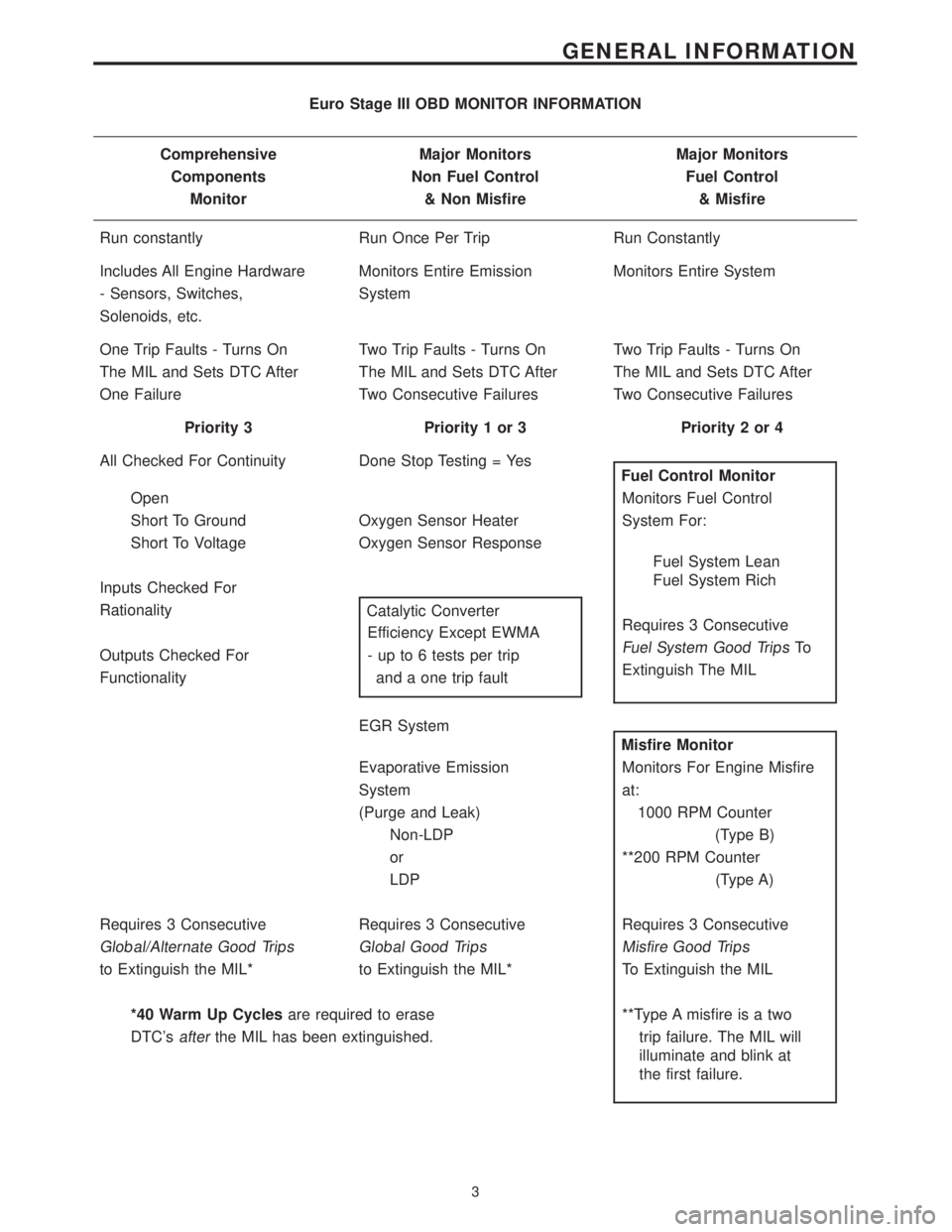
Euro Stage III OBD MONITOR INFORMATION
Comprehensive Major Monitors Major Monitors
Components Non Fuel Control Fuel Control
Monitor & Non Misfire & Misfire
Run constantly Run Once Per Trip Run Constantly
Includes All Engine Hardware Monitors Entire Emission Monitors Entire System
- Sensors, Switches, System
Solenoids, etc.
One Trip Faults - Turns On Two Trip Faults - Turns On Two Trip Faults - Turns On
The MIL and Sets DTC After The MIL and Sets DTC After The MIL and Sets DTC After
One Failure Two Consecutive Failures Two Consecutive Failures
Priority 3 Priority 1 or 3 Priority 2 or 4
All Checked For Continuity Done Stop Testing = Yes
Fuel Control Monitor
Open Monitors Fuel Control
Short To Ground Oxygen Sensor Heater System For:
Short To Voltage Oxygen Sensor Response
Fuel System Lean
Fuel System Rich
Inputs Checked For
Requires 3 Consecutive Rationality
Catalytic Converter
Fuel System Good TripsTo Efficiency Except EWMA
Extinguish The MIL Outputs Checked For - up to 6 tests per trip
Functionality and a one trip fault
EGR System
Misfire Monitor
Evaporative Emission Monitors For Engine Misfire
System at:
(Purge and Leak) 1000 RPM Counter
Non-LDP (Type B)
or **200 RPM Counter
LDP (Type A)
Requires 3 Consecutive Requires 3 Consecutive Requires 3 Consecutive
Global/Alternate Good Trips Global Good Trips Misfire Good Trips
to Extinguish the MIL* to Extinguish the MIL* To Extinguish the MIL
*40 Warm Up Cyclesare required to erase **Type A misfire is a two
DTC's
afterthe MIL has been extinguished. trip failure. The MIL will
illuminate and blink at
the first failure.
3
GENERAL INFORMATION
Page 3801 of 4284
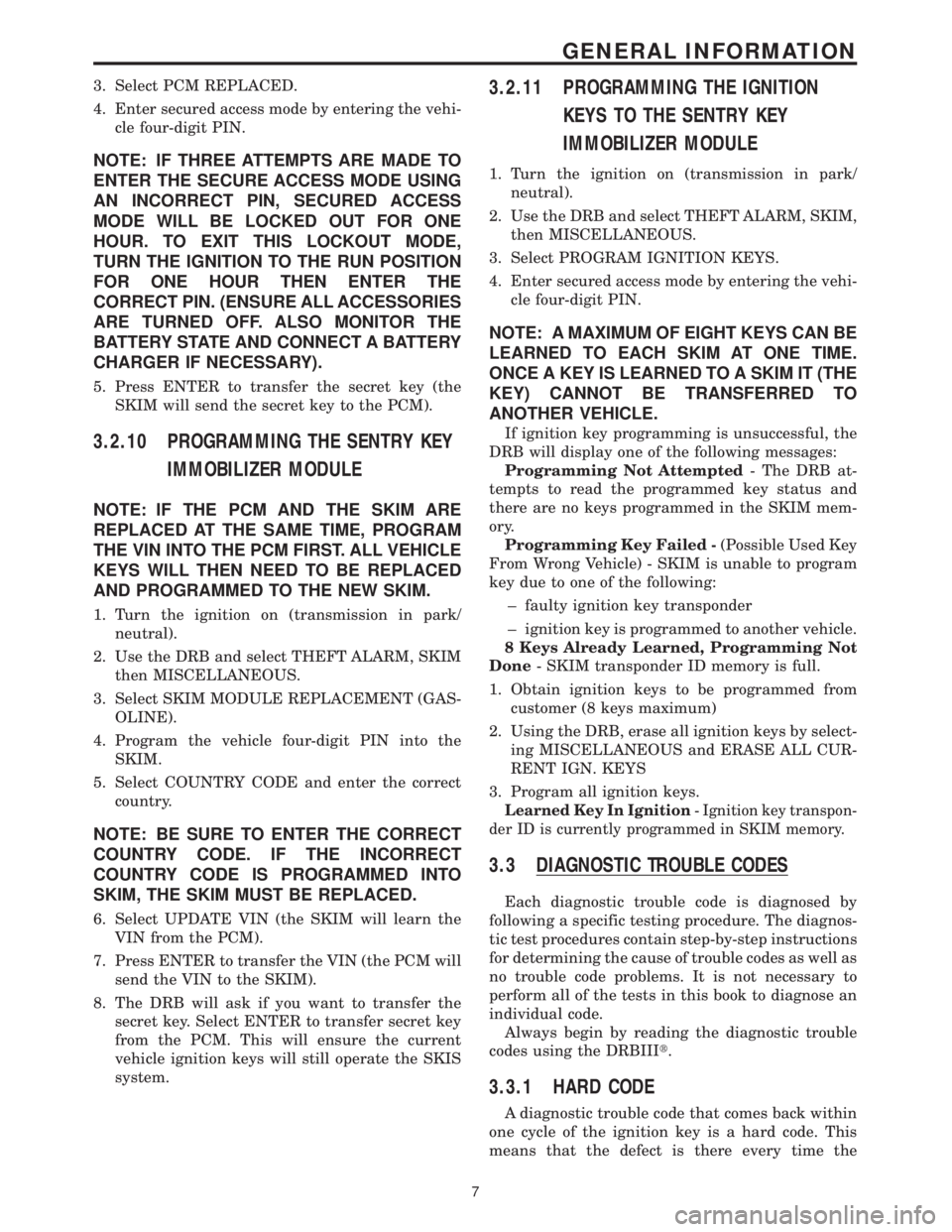
3. Select PCM REPLACED.
4. Enter secured access mode by entering the vehi-
cle four-digit PIN.
NOTE: IF THREE ATTEMPTS ARE MADE TO
ENTER THE SECURE ACCESS MODE USING
AN INCORRECT PIN, SECURED ACCESS
MODE WILL BE LOCKED OUT FOR ONE
HOUR. TO EXIT THIS LOCKOUT MODE,
TURN THE IGNITION TO THE RUN POSITION
FOR ONE HOUR THEN ENTER THE
CORRECT PIN. (ENSURE ALL ACCESSORIES
ARE TURNED OFF. ALSO MONITOR THE
BATTERY STATE AND CONNECT A BATTERY
CHARGER IF NECESSARY).
5. Press ENTER to transfer the secret key (the
SKIM will send the secret key to the PCM).
3.2.10 PROGRAMMING THE SENTRY KEY
IMMOBILIZER MODULE
NOTE: IF THE PCM AND THE SKIM ARE
REPLACED AT THE SAME TIME, PROGRAM
THE VIN INTO THE PCM FIRST. ALL VEHICLE
KEYS WILL THEN NEED TO BE REPLACED
AND PROGRAMMED TO THE NEW SKIM.
1. Turn the ignition on (transmission in park/
neutral).
2. Use the DRB and select THEFT ALARM, SKIM
then MISCELLANEOUS.
3. Select SKIM MODULE REPLACEMENT (GAS-
OLINE).
4. Program the vehicle four-digit PIN into the
SKIM.
5. Select COUNTRY CODE and enter the correct
country.
NOTE: BE SURE TO ENTER THE CORRECT
COUNTRY CODE. IF THE INCORRECT
COUNTRY CODE IS PROGRAMMED INTO
SKIM, THE SKIM MUST BE REPLACED.
6. Select UPDATE VIN (the SKIM will learn the
VIN from the PCM).
7. Press ENTER to transfer the VIN (the PCM will
send the VIN to the SKIM).
8. The DRB will ask if you want to transfer the
secret key. Select ENTER to transfer secret key
from the PCM. This will ensure the current
vehicle ignition keys will still operate the SKIS
system.
3.2.11 PROGRAMMING THE IGNITION
KEYS TO THE SENTRY KEY
IMMOBILIZER MODULE
1. Turn the ignition on (transmission in park/
neutral).
2. Use the DRB and select THEFT ALARM, SKIM,
then MISCELLANEOUS.
3. Select PROGRAM IGNITION KEYS.
4. Enter secured access mode by entering the vehi-
cle four-digit PIN.
NOTE: A MAXIMUM OF EIGHT KEYS CAN BE
LEARNED TO EACH SKIM AT ONE TIME.
ONCE A KEY IS LEARNED TO A SKIM IT (THE
KEY) CANNOT BE TRANSFERRED TO
ANOTHER VEHICLE.
If ignition key programming is unsuccessful, the
DRB will display one of the following messages:
Programming Not Attempted- The DRB at-
tempts to read the programmed key status and
there are no keys programmed in the SKIM mem-
ory.
Programming Key Failed -(Possible Used Key
From Wrong Vehicle) - SKIM is unable to program
key due to one of the following:
± faulty ignition key transponder
± ignition key is programmed to another vehicle.
8 Keys Already Learned, Programming Not
Done- SKIM transponder ID memory is full.
1. Obtain ignition keys to be programmed from
customer (8 keys maximum)
2. Using the DRB, erase all ignition keys by select-
ing MISCELLANEOUS and ERASE ALL CUR-
RENT IGN. KEYS
3. Program all ignition keys.
Learned Key In Ignition- Ignition key transpon-
der ID is currently programmed in SKIM memory.
3.3 DIAGNOSTIC TROUBLE CODES
Each diagnostic trouble code is diagnosed by
following a specific testing procedure. The diagnos-
tic test procedures contain step-by-step instructions
for determining the cause of trouble codes as well as
no trouble code problems. It is not necessary to
perform all of the tests in this book to diagnose an
individual code.
Always begin by reading the diagnostic trouble
codes using the DRBIIIt.
3.3.1 HARD CODE
A diagnostic trouble code that comes back within
one cycle of the ignition key is a hard code. This
means that the defect is there every time the
7
GENERAL INFORMATION
Page 3941 of 4284
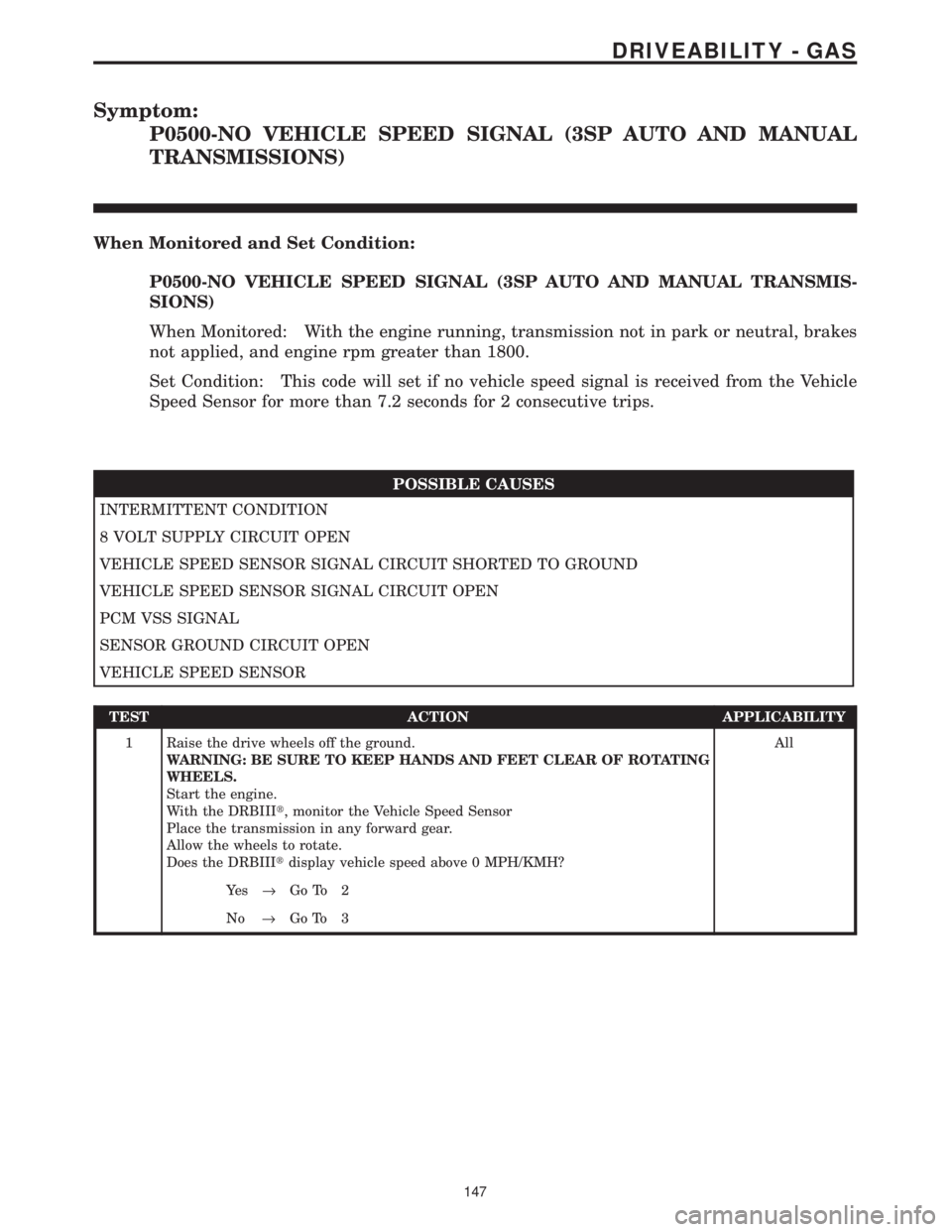
Symptom:
P0500-NO VEHICLE SPEED SIGNAL (3SP AUTO AND MANUAL
TRANSMISSIONS)
When Monitored and Set Condition:
P0500-NO VEHICLE SPEED SIGNAL (3SP AUTO AND MANUAL TRANSMIS-
SIONS)
When Monitored: With the engine running, transmission not in park or neutral, brakes
not applied, and engine rpm greater than 1800.
Set Condition: This code will set if no vehicle speed signal is received from the Vehicle
Speed Sensor for more than 7.2 seconds for 2 consecutive trips.
POSSIBLE CAUSES
INTERMITTENT CONDITION
8 VOLT SUPPLY CIRCUIT OPEN
VEHICLE SPEED SENSOR SIGNAL CIRCUIT SHORTED TO GROUND
VEHICLE SPEED SENSOR SIGNAL CIRCUIT OPEN
PCM VSS SIGNAL
SENSOR GROUND CIRCUIT OPEN
VEHICLE SPEED SENSOR
TEST ACTION APPLICABILITY
1 Raise the drive wheels off the ground.
WARNING: BE SURE TO KEEP HANDS AND FEET CLEAR OF ROTATING
WHEELS.
Start the engine.
With the DRBIIIt, monitor the Vehicle Speed Sensor
Place the transmission in any forward gear.
Allow the wheels to rotate.
Does the DRBIIItdisplay vehicle speed above 0 MPH/KMH?All
Ye s®Go To 2
No®Go To 3
147
DRIVEABILITY - GAS
Page 3944 of 4284
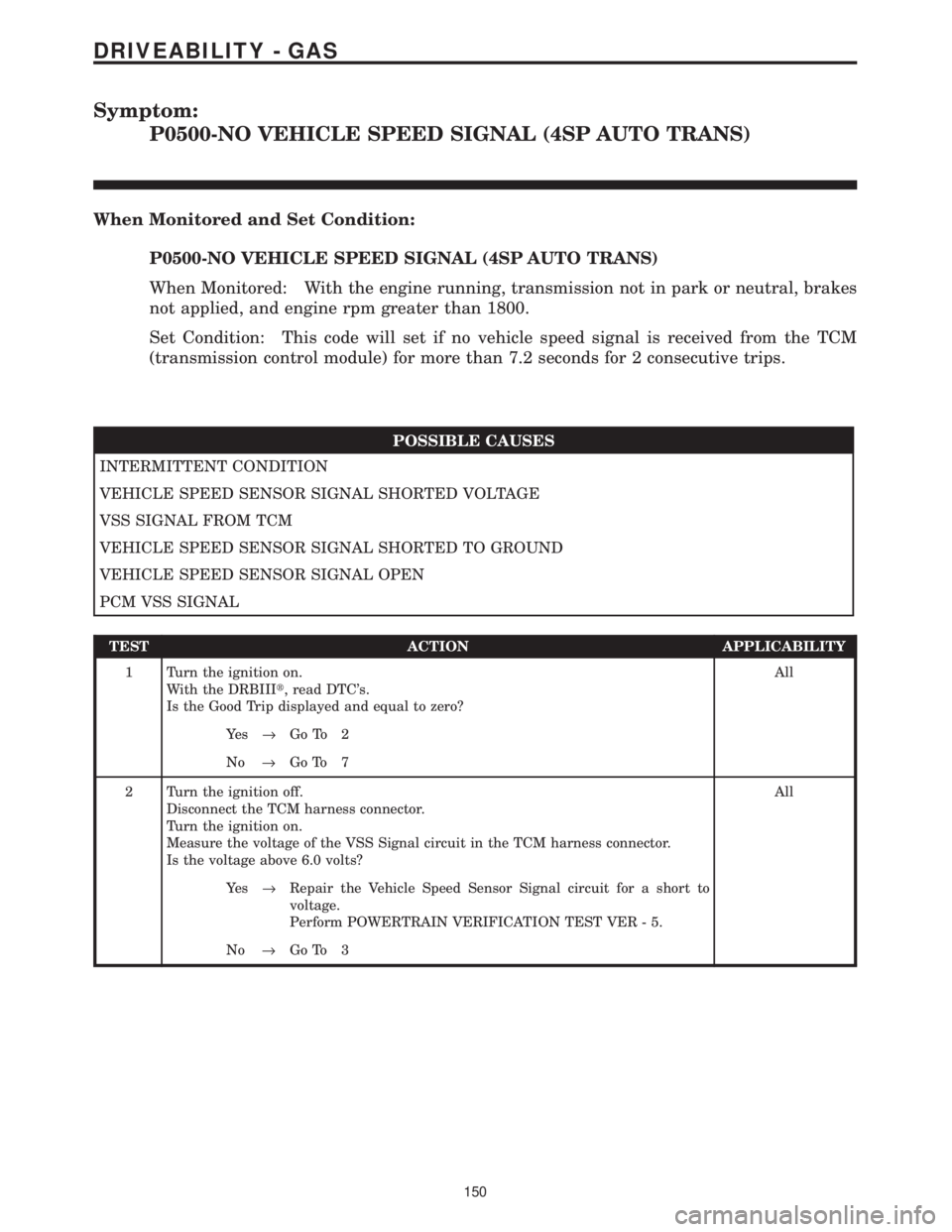
Symptom:
P0500-NO VEHICLE SPEED SIGNAL (4SP AUTO TRANS)
When Monitored and Set Condition:
P0500-NO VEHICLE SPEED SIGNAL (4SP AUTO TRANS)
When Monitored: With the engine running, transmission not in park or neutral, brakes
not applied, and engine rpm greater than 1800.
Set Condition: This code will set if no vehicle speed signal is received from the TCM
(transmission control module) for more than 7.2 seconds for 2 consecutive trips.
POSSIBLE CAUSES
INTERMITTENT CONDITION
VEHICLE SPEED SENSOR SIGNAL SHORTED VOLTAGE
VSS SIGNAL FROM TCM
VEHICLE SPEED SENSOR SIGNAL SHORTED TO GROUND
VEHICLE SPEED SENSOR SIGNAL OPEN
PCM VSS SIGNAL
TEST ACTION APPLICABILITY
1 Turn the ignition on.
With the DRBIIIt, read DTC's.
Is the Good Trip displayed and equal to zero?All
Ye s®Go To 2
No®Go To 7
2 Turn the ignition off.
Disconnect the TCM harness connector.
Turn the ignition on.
Measure the voltage of the VSS Signal circuit in the TCM harness connector.
Is the voltage above 6.0 volts?All
Ye s®Repair the Vehicle Speed Sensor Signal circuit for a short to
voltage.
Perform POWERTRAIN VERIFICATION TEST VER - 5.
No®Go To 3
150
DRIVEABILITY - GAS
Page 3959 of 4284
Symptom:
P0740-TORQ CONV CLU, NO RPM DROP AT LOCKUP (3SP AUTO
TRANS)
When Monitored and Set Condition:
P0740-TORQ CONV CLU, NO RPM DROP AT LOCKUP (3SP AUTO TRANS)
When Monitored: Run in third with converter unlocked for 10 seconds, apply throttle
until it locks then run for 5 seconds, vehicle speed less than 60 MPH. No DTCs set for: TCC
solenoids, any cam/crank conditions, VSS, TPS signal, TPS voltage too high or too low.
Set Condition: Torque converter malfunctions are detected when it does not lock or
unlock properly. Two consecutive trips that fail will store the code. Mountainous terrain
may cause this trouble code.
POSSIBLE CAUSES
INTERMITTENT CONDITION
DTCS PRESENT
TRANSMISSION FLUID
TIRE AND WHEEL SIZE
FUSED IGNITION OUTPUT CIRCUIT
TCC SOLENOID
TCC ASSEMBLY OR TCC SOLENOID STUCK
TCC SOLENOID OPERATION
TEST ACTION APPLICABILITY
1 Turn the ignition on.
With the DRBIIIt, read DTC's.
Is the Good Trip Counter displayed and equal to zero?All
Ye s®Go To 2
No®Go To 9
165
DRIVEABILITY - GAS
Page 3995 of 4284
Symptom:
P1391-INTERMITTENT LOSS OF CMP OR CKP
When Monitored and Set Condition:
P1391-INTERMITTENT LOSS OF CMP OR CKP
When Monitored: Engine running or cranking.
Set Condition: When the failure counter reaches 20 for 2 consecutive trips.
POSSIBLE CAUSES
WIRING HARNESS INSPECTION
TONE WHEEL/PULSE RING INSPECTION
WIRING HARNESS INSPECTION
TONE WHEEL/PULSE RING INSPECTION
CHECKING INTERMITTENT CKP SIGNAL WITH LAB
CHECKING INTERMITTENT CMP SIGNAL WITH LAB
CHECKING INTERMITTENT CKP WIRING WITH LAB SCOPE
CHECKING INTERMITTENT CMP WIRING WITH LAB SCOPE
INTERMITTENT CONDITION
CAMSHAFT POSITION SENSOR
CRANKSHAFT POSITION SENSOR
TEST ACTION APPLICABILITY
1 Turn the ignition on.
With the DRBIIIt, read DTC's.
Is the Good Trip displayed and equal to zero?All
Ye s®Go To 2
No®Go To 10
2 Turn the ignition off.
With the DRBIIItlab scope probe and the Miller special tool #6801, backprobe the
CMP Signal circuit in the CMP harness connector.
WARNING: KEEP CLEAR OF THE ENGINE'S MOVING PARTS.
Start the engine.
Observe the lab scope screen.
Are there any irregular or missing signals?All
Ye s®Go To 3
No®Go To 6
201
DRIVEABILITY - GAS
Page 4047 of 4284
Symptom:
*ENGINE CRANKS DOES NOT START
POSSIBLE CAUSES
FUEL PUMP RELAY
NO START PRE-TEST
POWERTRAIN FUSES OPEN
FUEL PRESSURE OUT OF SPECS
RESTRICTED FUEL SUPPLY LINE
FUEL PUMP INLET STRAINER PLUGGED
FUEL PUMP MODULE
FUEL PUMP CAPACITY (VOLUME) OUT OF SPECS
FUEL PUMP RELAY FUSED B+ CIRCUIT
OTHER POSSIBLE CAUSES FOR NO START
FUEL PUMP RELAY OUTPUT CIRCUIT OPEN
FUEL PUMP GROUND CIRCUIT OPEN/HIGH RESISTANCE
IPM FUSE & RELAY CENTER
FUEL PUMP MODULE
TEST ACTION APPLICABILITY
1Note: The following list of items must be checked before continuing with
any no start tests.
The battery must be fully charged and in good condition. A low charged battery may
produce invalid test results. If the battery is low, charge the battery and then attempt
to start the vehicle by cranking the engine for 15 seconds, 3 consecutive times.
This will allow any DTC's to set that may have been erased due to a dead battery.
Ensure the Powers and Ground to the PCM are ok.
Make sure the PCM communicates with the DRB and that there are no DTC's stored
in the PCM memory. If the PCM reports a No Response condition, refer to the
Communication category for the proper tests.
Read the PCM DTC's with the DRB. If any DTC's are present, they must be repaired
before continuing with any other No Start diagnostic tests. Refer to the Symptom list
for the related P-code that is reported by the PCM.
Ensure that the PCI bus is functional. Attempt to communicate with the Instrument
Cluster and SKIM, If you are unable to establish communicate refer to the
Communication category for the proper symptoms.
The Sentry Key Immobilizer System must be operating properly. Check for proper
communication with the DRB and check for DTC's that may be stored in the Sentry
Key Immobilizer Module (SKIM). repair the DTC(s) before continuing.
If no DTC's are found, using the DRB select Clear PCM (Batt Disconnect).
Crank the engine several times. Using the DRB, read DTC's. If a DTC is present
perform the DTC diagnostics before continuing.
Were any problems found?All
Ye s®Repair as necessary.
Perform POWERTRAIN VERIFICATION TEST VER-1.
No®Go To 2
253
STARTING
Page 4060 of 4284
Symptom List:
ANTENNA FAILURE
COP FAILURE
EEPROM FAILURE
INTERNAL FAULT
RAM FAILURE
SERIAL LINK INTERNAL FAULT
STACK OVERFLOW FAILURE
Test Note: All symptoms listed above are diagnosed using the same tests.
The title for the tests will be ANTENNA FAILURE.
When Monitored and Set Condition:
ANTENNA FAILURE
When Monitored: Every 250 milliseconds with the ignition on.
Set Condition: The SKIM's microcontroller determines that an antenna circuit fault has
occurred for 2.0 consecutive seconds.
COP FAILURE
When Monitored: With the ignition on.
Set Condition: The COP timer is not reset by the microcontroller every 65.5 milliseconds
EEPROM FAILURE
When Monitored: With the ignition on.
Set Condition: When the value written to EEPROM memory does not equal the value
read back after the write operation.
INTERNAL FAULT
When Monitored: With the ignition on.
Set Condition: The SKIM has detected a fault during an internal self test.
RAM FAILURE
When Monitored: With the ignition on.
Set Condition: The RAM fails a test that checks the RAM's ability to retain memory.
SERIAL LINK INTERNAL FAULT
When Monitored: With the ignition on.
Set Condition: The SKIM fails an internal J1850 communication self test.
STACK OVERFLOW FAILURE
When Monitored: With the ignition on.
Set Condition: The microcontroller has exceeded its stack space limit.
266
VEHICLE THEFT/SECURITY