Page 239 of 4284
TEST ACTION APPLICABILITY
2 Turn the ignition off.
Install a substitute relay in place of the NBS Relay.
With the DRB, erase DTCs.
Turn the ignition on.
Turn the Radio on.
With the DRB, read DTCs.
Did these DTCs reset?All
Ye s®Go To 3
No®Replace the original NBS Relay.
Perform BODY VERIFICATION TEST - VER 1.
3 Turn the ignition off.
Remove the Front Control Module from the IPM.
Remove the NBS Relay from the IPM.
Turn the ignition on.
Using a 12-volt test light connected to ground, probe the NBS Relay connector cavity
85.
Is the test light illuminated?All
Ye s®Replace the Intelligent Power Module (IPM).
Perform BODY VERIFICATION TEST - VER 1.
No®Replace the Front Control Module in accordance with the Service
Information.
Perform BODY VERIFICATION TEST - VER 1.
210
AUDIO
NBS OUTPUT 1 SHORT TO BATT ÐContinued
Page 267 of 4284

Symptom:
DRIVER BLEND DOOR TRAVEL TOO SMALL (ACTIVE)
When Monitored and Set Condition:
DRIVER BLEND DOOR TRAVEL TOO SMALL (ACTIVE)
When Monitored: With the ignition on and the IOD fuse installed.
Set Condition: This DTC is set when the ATC monitors the travel range during system
initialization and the measured range is less than expected.
POSSIBLE CAUSES
CHECK THE ATC FOR DTCS
AT C
OBSTRUCTED BLEND DOOR
DRIVER BLEND DOOR ACTUATOR
TEST ACTION APPLICABILITY
1 Turn the ignition on.
With the DRB, read the active ATC DTCs.
Is the DRIVER BLEND DOOR NOT RESPONDING DTC set?All
Ye s®Return to the symptom list and choose the symptom.
With the DRBIIIt, reset the ATC after repair/replacement is
completed.
Perform BODY VERIFICATION TEST - VER 1.
No®Go To 2
2 Turn the ignition off.
Disconnect the Driver Blend Door Actuator harness connector.
Connect a 12-volt Test Light between the Driver Blend Door Actuator harness
connector cavities.
Turn the ignition on.
While monitoring the test light, turn the driver blend control knob from lo to hi.
Note: Observe test light for approximately 30 seconds.
Does the test light start to flash and stay flashing?All
Ye s®Go To 3
No®Replace the ATC.
With the DRBIIIt, reset the ATC after repair/replacement is
completed.
Perform BODY VERIFICATION TEST - VER 1.
238
AUTOMATIC TEMPERATURE CONTROL
Page 285 of 4284

Symptom:
FRONT MODE DOOR TRAVEL TOO SMALL (ACTIVE)
When Monitored and Set Condition:
FRONT MODE DOOR TRAVEL TOO SMALL (ACTIVE)
When Monitored: With the ignition on and the IOD fuse installed.
Set Condition: This DTC is set when the ATC monitors the travel range during system
initialization and the measured range is less than expected.
POSSIBLE CAUSES
CHECK THE ATC FOR DTCS
AT C
OBSTRUCTED MODE DOOR
MODE DOOR ACTUATOR
TEST ACTION APPLICABILITY
1 Turn the ignition on.
With the DRB, read the active ATC DTCs.
Is the FRONT MODE DOOR NOT RESPONDING DTC set?All
Ye s®Return to the symptom list and choose the symptom.
With the DRBIIIt, reset the ATC after repair/replacement is
complete.
Perform BODY VERIFICATION TEST - VER 1.
No®Go To 2
2 Turn the ignition off.
Disconnect the Mode Door Actuator harness connector.
Connect a 12-volt Test Light between the Mode Door Actuator harness connector
cavities.
Turn the ignition on.
While monitoring the test light, turn the mode control knob in each position.
Note: Observe test light for approximately 30 seconds.
Does the test light start to flash and stay flashing?All
Ye s®Go To 3
No®Replace the ATC.
With the DRBIIIt, reset the ATC after repair/replacement is
complete.
Perform BODY VERIFICATION TEST - VER 1.
256
AUTOMATIC TEMPERATURE CONTROL
Page 294 of 4284
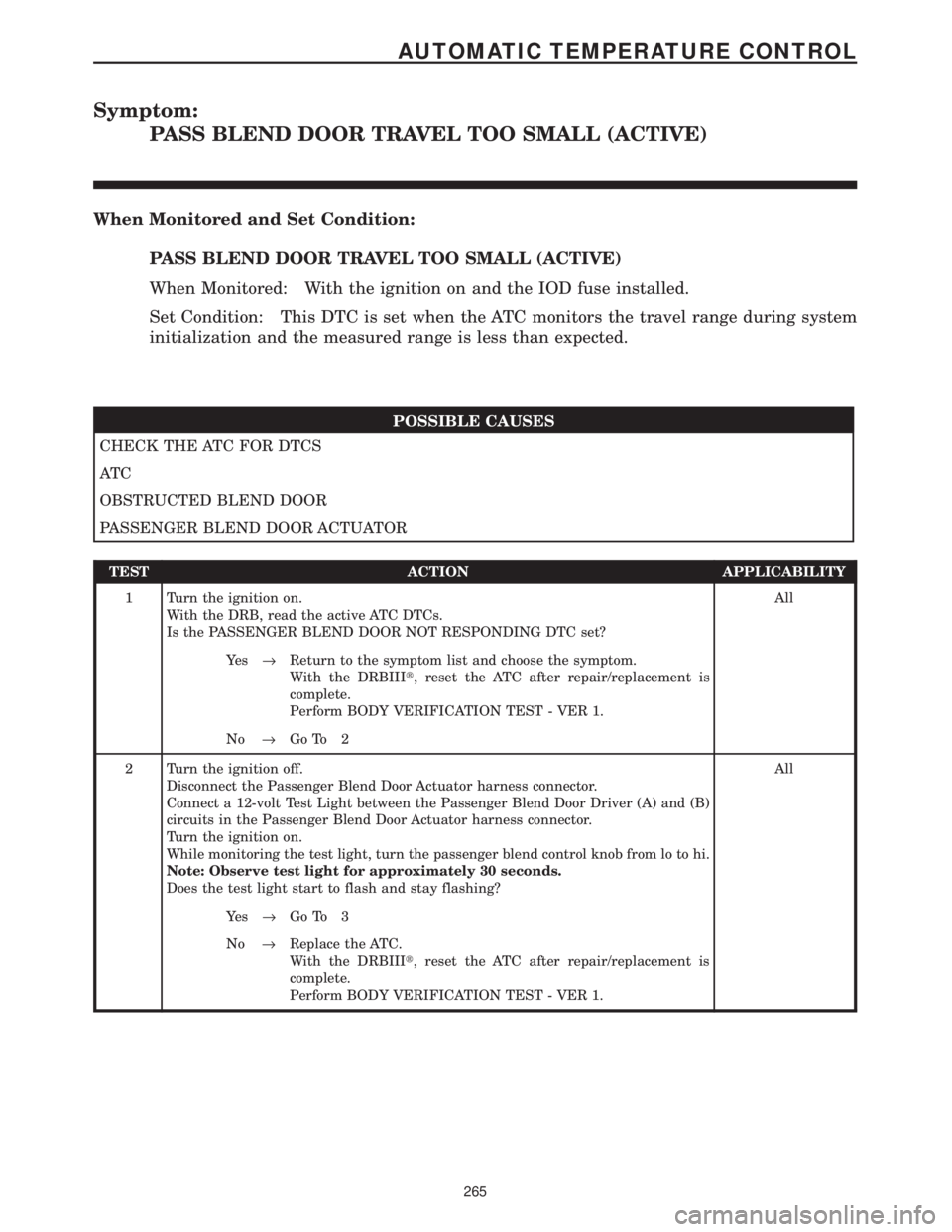
Symptom:
PASS BLEND DOOR TRAVEL TOO SMALL (ACTIVE)
When Monitored and Set Condition:
PASS BLEND DOOR TRAVEL TOO SMALL (ACTIVE)
When Monitored: With the ignition on and the IOD fuse installed.
Set Condition: This DTC is set when the ATC monitors the travel range during system
initialization and the measured range is less than expected.
POSSIBLE CAUSES
CHECK THE ATC FOR DTCS
AT C
OBSTRUCTED BLEND DOOR
PASSENGER BLEND DOOR ACTUATOR
TEST ACTION APPLICABILITY
1 Turn the ignition on.
With the DRB, read the active ATC DTCs.
Is the PASSENGER BLEND DOOR NOT RESPONDING DTC set?All
Ye s®Return to the symptom list and choose the symptom.
With the DRBIIIt, reset the ATC after repair/replacement is
complete.
Perform BODY VERIFICATION TEST - VER 1.
No®Go To 2
2 Turn the ignition off.
Disconnect the Passenger Blend Door Actuator harness connector.
Connect a 12-volt Test Light between the Passenger Blend Door Driver (A) and (B)
circuits in the Passenger Blend Door Actuator harness connector.
Turn the ignition on.
While monitoring the test light, turn the passenger blend control knob from lo to hi.
Note: Observe test light for approximately 30 seconds.
Does the test light start to flash and stay flashing?All
Ye s®Go To 3
No®Replace the ATC.
With the DRBIIIt, reset the ATC after repair/replacement is
complete.
Perform BODY VERIFICATION TEST - VER 1.
265
AUTOMATIC TEMPERATURE CONTROL
Page 301 of 4284

Symptom:
REAR BLEND DOOR TRAVEL TOO SMALL (ACTIVE)
When Monitored and Set Condition:
REAR BLEND DOOR TRAVEL TOO SMALL (ACTIVE)
When Monitored: With the ignition on and the IOD fuse installed.
Set Condition: This DTC is set when the ATC monitors the travel range during system
initialization and the measured range is less than expected.
POSSIBLE CAUSES
CHECK THE ATC FOR DTCS
AT C
OBSTRUCTED BLEND DOOR
REAR BLEND DOOR ACTUATOR
TEST ACTION APPLICABILITY
1 Turn the ignition on.
With the DRB, read the active ATC DTCs.
Is the REAR BLEND DOOR NOT RESPONDING DTC set?All
Ye s®Return to the symptom list and choose the symptom.
With the DRBIIIt, reset the ATC after repair/replacement is
complete.
Perform BODY VERIFICATION TEST - VER 1.
No®Go To 2
2 Turn the ignition off.
Disconnect the Rear Blend Door Actuator harness connector.
Connect a 12-volt Test Light across the Rear Blend Door Actuator harness connector.
Turn the ignition on.
While monitoring the test light, turn the rear blend control knob from lo to hi.
Note: Observe test light for approximately 30 seconds.
Does the test light start to flash and stay flashing?All
Ye s®Go To 3
No®Replace the ATC.
With the DRBIIIt, reset the ATC after repair/replacement is
complete.
Perform BODY VERIFICATION TEST - VER 1.
272
AUTOMATIC TEMPERATURE CONTROL
Page 317 of 4284

Symptom:
REAR MODE DOOR TRAVEL TOO SMALL (ACTIVE)
When Monitored and Set Condition:
REAR MODE DOOR TRAVEL TOO SMALL (ACTIVE)
When Monitored: With the ignition on and the IOD fuse installed.
Set Condition: This DTC is set when the ATC monitors the travel range during system
initialization and the measured range is less than expected.
POSSIBLE CAUSES
CHECK THE ATC FOR DTCS
AT C
OBSTRUCTED MODE DOOR
REAR MODE DOOR ACTUATOR
TEST ACTION APPLICABILITY
1 Turn the ignition on.
With the DRB, read the active ATC DTCs.
Is the REAR MODE DOOR NOT RESPONDING DTC set?All
Ye s®Return to the symptom list and choose the symptom.
With the DRBIIIt, reset the ATC after repair/replacement is
complete.
Perform BODY VERIFICATION TEST - VER 1.
No®Go To 2
2 Turn the ignition off.
Disconnect the Rear Mode Door Actuator harness connector.
Connect a 12-volt Test Light between the rear mode door driver (A) and (B) circuits
in the Rear A/C Heater Unit harness connector.
Turn the ignition on.
While monitoring the test light, turn the rear mode control knob from lo to hi.
Note: Observe test light for approximately 30 seconds.
Does the test light start to flash and stay flashing?All
Ye s®Go To 3
No®Replace the ATC.
With the DRBIIIt, reset the ATC after repair/replacement is
complete.
Perform BODY VERIFICATION TEST - VER 1.
288
AUTOMATIC TEMPERATURE CONTROL
Page 323 of 4284
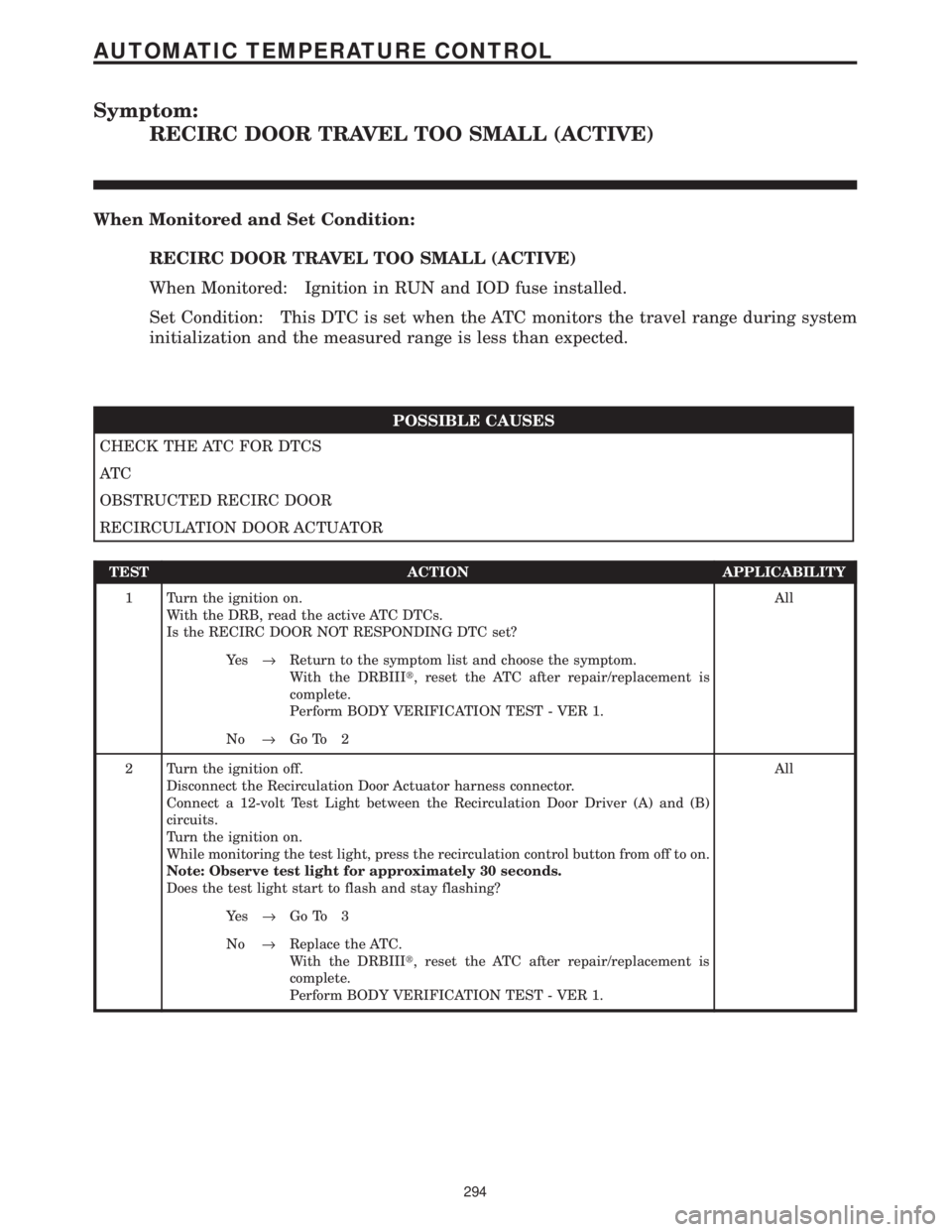
Symptom:
RECIRC DOOR TRAVEL TOO SMALL (ACTIVE)
When Monitored and Set Condition:
RECIRC DOOR TRAVEL TOO SMALL (ACTIVE)
When Monitored: Ignition in RUN and IOD fuse installed.
Set Condition: This DTC is set when the ATC monitors the travel range during system
initialization and the measured range is less than expected.
POSSIBLE CAUSES
CHECK THE ATC FOR DTCS
AT C
OBSTRUCTED RECIRC DOOR
RECIRCULATION DOOR ACTUATOR
TEST ACTION APPLICABILITY
1 Turn the ignition on.
With the DRB, read the active ATC DTCs.
Is the RECIRC DOOR NOT RESPONDING DTC set?All
Ye s®Return to the symptom list and choose the symptom.
With the DRBIIIt, reset the ATC after repair/replacement is
complete.
Perform BODY VERIFICATION TEST - VER 1.
No®Go To 2
2 Turn the ignition off.
Disconnect the Recirculation Door Actuator harness connector.
Connect a 12-volt Test Light between the Recirculation Door Driver (A) and (B)
circuits.
Turn the ignition on.
While monitoring the test light, press the recirculation control button from off to on.
Note: Observe test light for approximately 30 seconds.
Does the test light start to flash and stay flashing?All
Ye s®Go To 3
No®Replace the ATC.
With the DRBIIIt, reset the ATC after repair/replacement is
complete.
Perform BODY VERIFICATION TEST - VER 1.
294
AUTOMATIC TEMPERATURE CONTROL
Page 363 of 4284
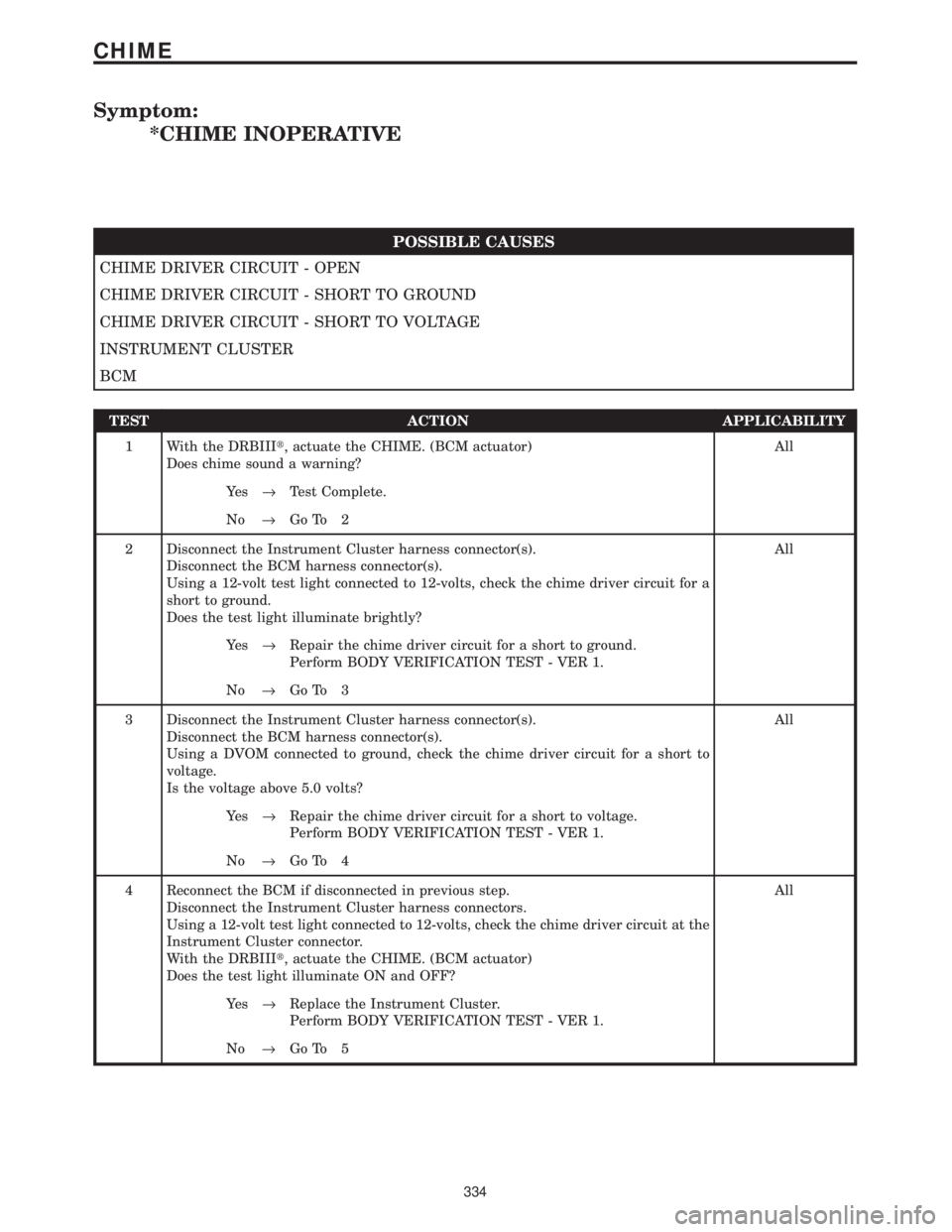
Symptom:
*CHIME INOPERATIVE
POSSIBLE CAUSES
CHIME DRIVER CIRCUIT - OPEN
CHIME DRIVER CIRCUIT - SHORT TO GROUND
CHIME DRIVER CIRCUIT - SHORT TO VOLTAGE
INSTRUMENT CLUSTER
BCM
TEST ACTION APPLICABILITY
1 With the DRBIIIt, actuate the CHIME. (BCM actuator)
Does chime sound a warning?All
Ye s®Test Complete.
No®Go To 2
2 Disconnect the Instrument Cluster harness connector(s).
Disconnect the BCM harness connector(s).
Using a 12-volt test light connected to 12-volts, check the chime driver circuit for a
short to ground.
Does the test light illuminate brightly?All
Ye s®Repair the chime driver circuit for a short to ground.
Perform BODY VERIFICATION TEST - VER 1.
No®Go To 3
3 Disconnect the Instrument Cluster harness connector(s).
Disconnect the BCM harness connector(s).
Using a DVOM connected to ground, check the chime driver circuit for a short to
voltage.
Is the voltage above 5.0 volts?All
Ye s®Repair the chime driver circuit for a short to voltage.
Perform BODY VERIFICATION TEST - VER 1.
No®Go To 4
4 Reconnect the BCM if disconnected in previous step.
Disconnect the Instrument Cluster harness connectors.
Using a 12-volt test light connected to 12-volts, check the chime driver circuit at the
Instrument Cluster connector.
With the DRBIIIt, actuate the CHIME. (BCM actuator)
Does the test light illuminate ON and OFF?All
Ye s®Replace the Instrument Cluster.
Perform BODY VERIFICATION TEST - VER 1.
No®Go To 5
334
CHIME
