Page 1192 of 4284
Symptom:
*BRAKE LAMP SWITCH
POSSIBLE CAUSES
CHECK BRAKE LAMP SWITCH OUTPUT
BRAKE LAMP SWITCH B+ OPEN
BRAKE LAMP SWITCH OUTPUT CIRCUIT SHORT OR OPEN
BRAKE LAMP SWITCH OPEN
CAB -- INTERNAL OPEN
TEST ACTION APPLICABILITY
1 With the DRBIIItin Inputs/Outputs, read the Brake Lamp Switch state.
Press and release the brake pedal.
Does the DRBIIItdisplay PRESSED and RELEASED?All
Ye s®The Brake Lamp Switch is OK.
Perform ABS VERIFICATION TEST - VER 1.
No®Go To 2
2 Disconnect the Brake Lamp Switch harness connector.
Using a 12-volt test light connected to ground, check the Brake Lamp Switch Fused
B+ circuit.
Does the test light illuminate brightly ?All
Ye s®Go To 3
No®Repair the Brake Lamp Switch Fused B+ circuit for an open.
Perform ABS VERIFICATION TEST - VER 1.
3 Disconnect the Brake Lamp Switch harness connector.
Connect a jumper wire between the Brake Lamp Switch B+ and Output circuits.
With the DRBIIItin Inputs/Outputs, read the Brake Lamp Switch state.
Does the DRBIIItdisplay PRESSED?All
Ye s®Replace the Brake Lamp Switch in accordance with the Service
Information.
Perform ABS VERIFICATION TEST - VER 1.
No®Go To 4
4 Disconnect the CAB harness connector.
Disconnect the Brake Lamp Switch harness connector.
Check the Brake Lamp Switch Output circuit for a short to voltage and an open.
Is the Brake Lamp Switch Output circuit shorted or open?All
Ye s®Repair the Brake Lamp Switch Output circuit for a short to
voltage or an open.
Perform ABS VERIFICATION TEST - VER 1.
No®Replace the Controller Anti-Lock Brake in accordance with the
Service Information.
Perform ABS VERIFICATION TEST - VER 1.
35
BRAKES (CAB)
Page 1196 of 4284
Symptom:
*TRAC ON INDICATOR NEVER/ALWAYS ON
POSSIBLE CAUSES
CAB -- INTERNAL FAULT
CHECK TRACTION CONTROL SYSTEM
CLUSTER FAILS SELF TEST
CAB - NO TRAC MESSAGE
TEST ACTION APPLICABILITY
1NOTE: The DRBIIItmust be able to communicate with the CAB prior to
performing this test.
NOTE: Note: If any CAB DTC's are present, they must be repaired prior to
performing this test.
Perform the KEY-ON bulb test.
Did the TRAC Indicator illuminate and then go out?All
Ye s®Go To 2
No®Go To 3
2 Make sure the Traction Control system has not been deactivated with the TRAC OFF
switch.
NOTE: The purpose of this test is to determine if the Traction Control
system is operating.
With the DRBIIItin Inputs/Outputs, read the ABS Pump Motor voltage state.
Accelerate sufficient to cause drive wheel slip.
Does the TRAC Indicator illuminate and the DRBIIItdisplay approximately 9 volts?All
Ye s®The traction control system is functioning normally.
Perform ABS VERIFICATION TEST - VER 1.
No®Replace the Controller Antilock Brake in accordance with the
Service Information.
Perform ABS VERIFICATION TEST - VER 1.
3NOTE: The purpose of this test is to perform the Instrument Cluster self
test.
Depress and hold the Odometer Reset Button.
Turn the Key from OFF to ON and then back to OFF.
Release the Odometer Reset Button.
Do the Instrument Cluster Indicators and Gauges activate and deactivate?All
Ye s®Replace the Controller Antilock Brake in accordance with the
Service Information.
Perform ABS VERIFICATION TEST - VER 1.
No®Replace the Instrument Cluster in accordance with the Service
Information.
Perform ABS VERIFICATION TEST - VER 1.
39
BRAKES (CAB)
Page 1197 of 4284
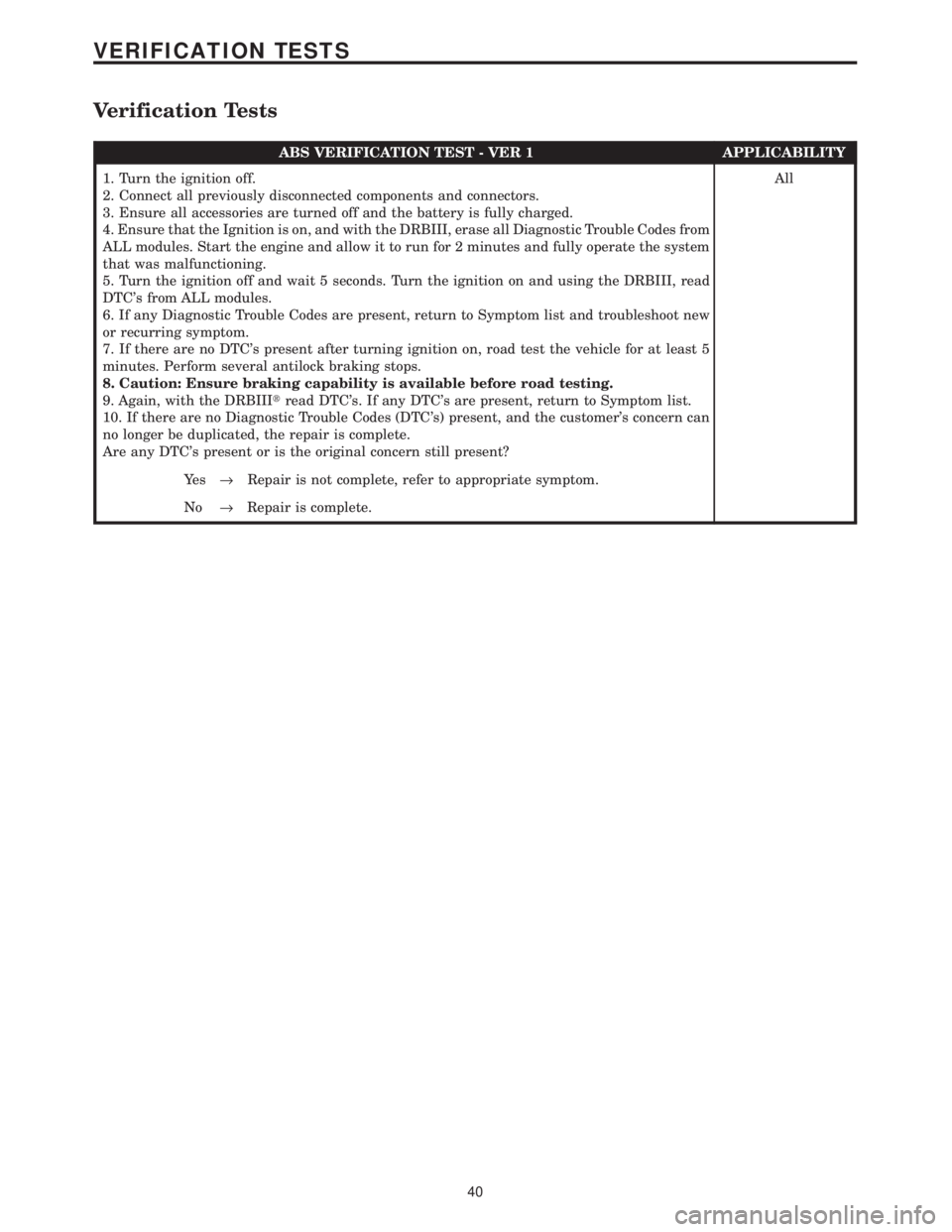
Verification Tests
ABS VERIFICATION TEST - VER 1 APPLICABILITY
1. Turn the ignition off.
2. Connect all previously disconnected components and connectors.
3. Ensure all accessories are turned off and the battery is fully charged.
4. Ensure that the Ignition is on, and with the DRBIII, erase all Diagnostic Trouble Codes from
ALL modules. Start the engine and allow it to run for 2 minutes and fully operate the system
that was malfunctioning.
5. Turn the ignition off and wait 5 seconds. Turn the ignition on and using the DRBIII, read
DTC's from ALL modules.
6. If any Diagnostic Trouble Codes are present, return to Symptom list and troubleshoot new
or recurring symptom.
7. If there are no DTC's present after turning ignition on, road test the vehicle for at least 5
minutes. Perform several antilock braking stops.
8. Caution: Ensure braking capability is available before road testing.
9. Again, with the DRBIIItread DTC's. If any DTC's are present, return to Symptom list.
10. If there are no Diagnostic Trouble Codes (DTC's) present, and the customer's concern can
no longer be duplicated, the repair is complete.
Are any DTC's present or is the original concern still present?All
Ye s®Repair is not complete, refer to appropriate symptom.
No®Repair is complete.
40
VERIFICATION TESTS
Page 1198 of 4284
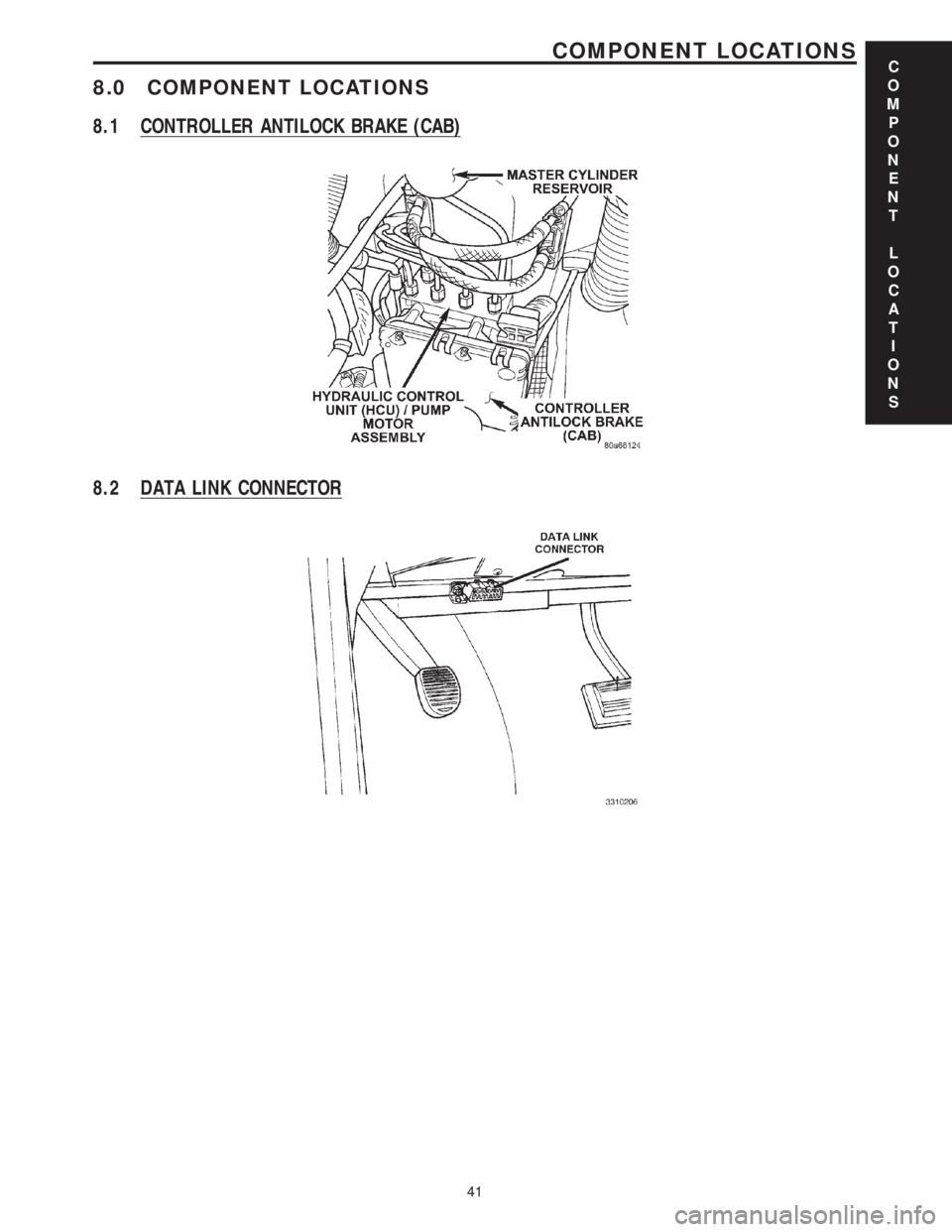
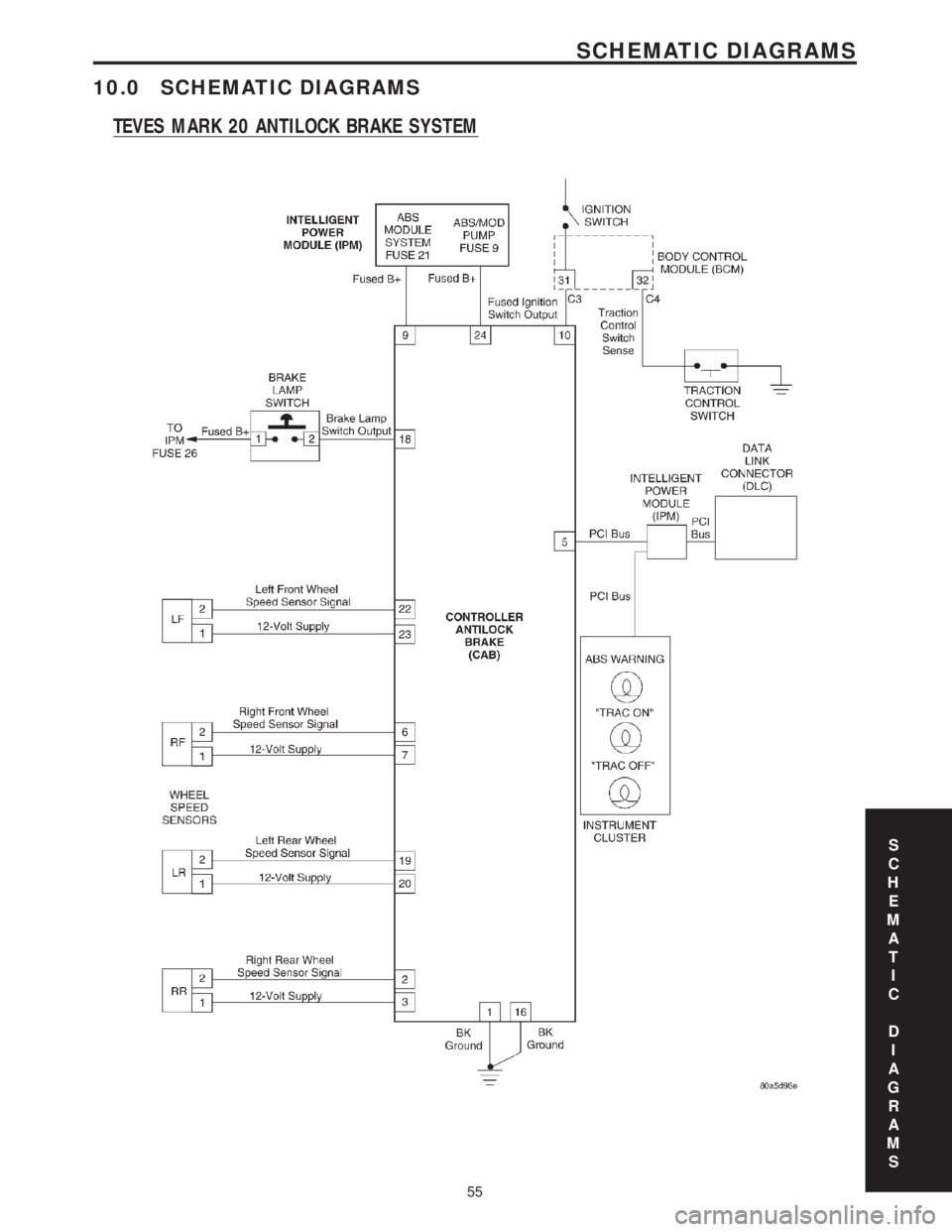
8.0 COMPONENT LOCATIONS
8.1 CONTROLLER ANTILOCK BRAKE (CAB)
8.2 DATA LINK CONNECTOR
C
O
M
P
O
N
E
N
T
L
O
C
A
T
I
O
N
S
41
COMPONENT LOCATIONS
Page 1204 of 4284
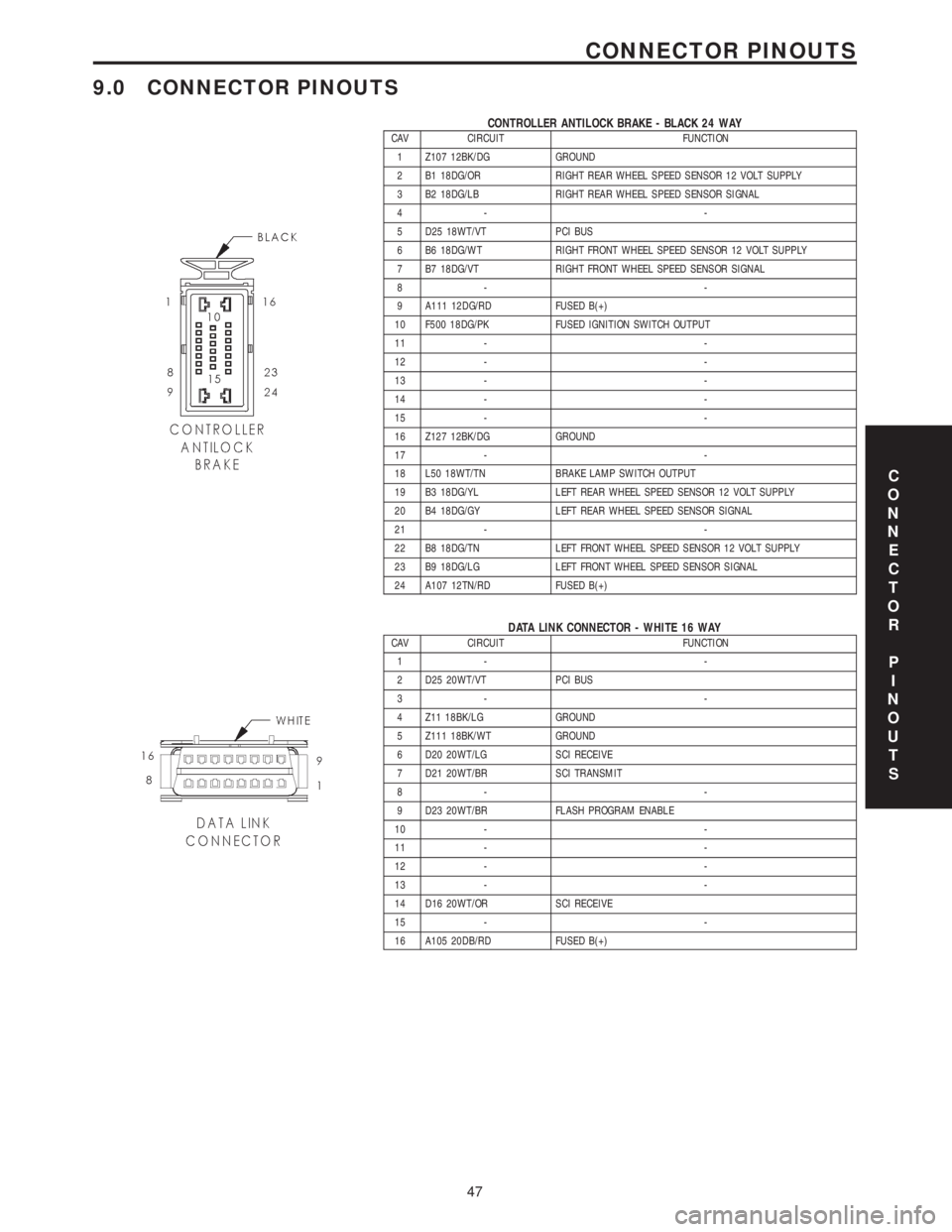
9.0 CONNECTOR PINOUTS
CONTROLLER ANTILOCK BRAKE - BLACK 24 WAYCAV CIRCUIT FUNCTION
1 Z107 12BK/DG GROUND
2 B1 18DG/OR RIGHT REAR WHEEL SPEED SENSOR 12 VOLT SUPPLY
3 B2 18DG/LB RIGHT REAR WHEEL SPEED SENSOR SIGNAL
4- -
5 D25 18WT/VT PCI BUS
6 B6 18DG/WT RIGHT FRONT WHEEL SPEED SENSOR 12 VOLT SUPPLY
7 B7 18DG/VT RIGHT FRONT WHEEL SPEED SENSOR SIGNAL
8- -
9 A111 12DG/RD FUSED B(+)
10 F500 18DG/PK FUSED IGNITION SWITCH OUTPUT
11 - -
12 - -
13 - -
14 - -
15 - -
16 Z127 12BK/DG GROUND
17 - -
18 L50 18WT/TN BRAKE LAMP SWITCH OUTPUT
19 B3 18DG/YL LEFT REAR WHEEL SPEED SENSOR 12 VOLT SUPPLY
20 B4 18DG/GY LEFT REAR WHEEL SPEED SENSOR SIGNAL
21 - -
22 B8 18DG/TN LEFT FRONT WHEEL SPEED SENSOR 12 VOLT SUPPLY
23 B9 18DG/LG LEFT FRONT WHEEL SPEED SENSOR SIGNAL
24 A107 12TN/RD FUSED B(+)
DATA LINK CONNECTOR - WHITE 16 WAYCAV CIRCUIT FUNCTION
1- -
2 D25 20WT/VT PCI BUS
3- -
4 Z11 18BK/LG GROUND
5 Z111 18BK/WT GROUND
6 D20 20WT/LG SCI RECEIVE
7 D21 20WT/BR SCI TRANSMIT
8- -
9 D23 20WT/BR FLASH PROGRAM ENABLE
10 - -
11 - -
12 - -
13 - -
14 D16 20WT/OR SCI RECEIVE
15 - -
16 A105 20DB/RD FUSED B(+)
C
O
N
N
E
C
T
O
R
P
I
N
O
U
T
S
47
CONNECTOR PINOUTS
Page 1205 of 4284
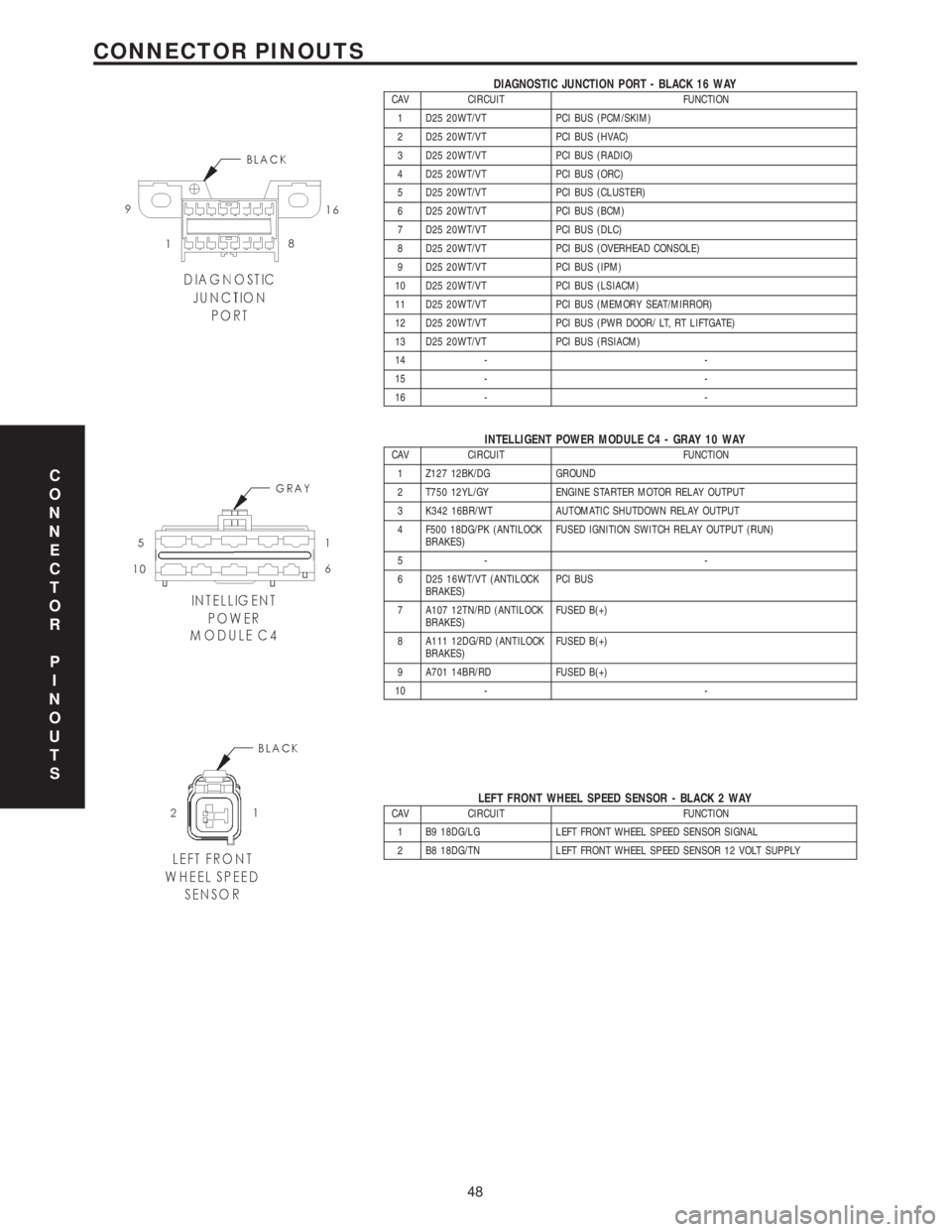
DIAGNOSTIC JUNCTION PORT - BLACK 16 WAYCAV CIRCUIT FUNCTION
1 D25 20WT/VT PCI BUS (PCM/SKIM)
2 D25 20WT/VT PCI BUS (HVAC)
3 D25 20WT/VT PCI BUS (RADIO)
4 D25 20WT/VT PCI BUS (ORC)
5 D25 20WT/VT PCI BUS (CLUSTER)
6 D25 20WT/VT PCI BUS (BCM)
7 D25 20WT/VT PCI BUS (DLC)
8 D25 20WT/VT PCI BUS (OVERHEAD CONSOLE)
9 D25 20WT/VT PCI BUS (IPM)
10 D25 20WT/VT PCI BUS (LSIACM)
11 D25 20WT/VT PCI BUS (MEMORY SEAT/MIRROR)
12 D25 20WT/VT PCI BUS (PWR DOOR/ LT, RT LIFTGATE)
13 D25 20WT/VT PCI BUS (RSIACM)
14 - -
15 - -
16 - -
INTELLIGENT POWER MODULE C4 - GRAY 10 WAYCAV CIRCUIT FUNCTION
1 Z127 12BK/DG GROUND
2 T750 12YL/GY ENGINE STARTER MOTOR RELAY OUTPUT
3 K342 16BR/WT AUTOMATIC SHUTDOWN RELAY OUTPUT
4 F500 18DG/PK (ANTILOCK
BRAKES)FUSED IGNITION SWITCH RELAY OUTPUT (RUN)
5- -
6 D25 16WT/VT (ANTILOCK
BRAKES)PCI BUS
7 A107 12TN/RD (ANTILOCK
BRAKES)FUSED B(+)
8 A111 12DG/RD (ANTILOCK
BRAKES)FUSED B(+)
9 A701 14BR/RD FUSED B(+)
10 - -
LEFT FRONT WHEEL SPEED SENSOR - BLACK 2 WAYCAV CIRCUIT FUNCTION
1 B9 18DG/LG LEFT FRONT WHEEL SPEED SENSOR SIGNAL
2 B8 18DG/TN LEFT FRONT WHEEL SPEED SENSOR 12 VOLT SUPPLY
C
O
N
N
E
C
T
O
R
P
I
N
O
U
T
S
48
CONNECTOR PINOUTS
Page 1212 of 4284
10.0 SCHEMATIC DIAGRAMS
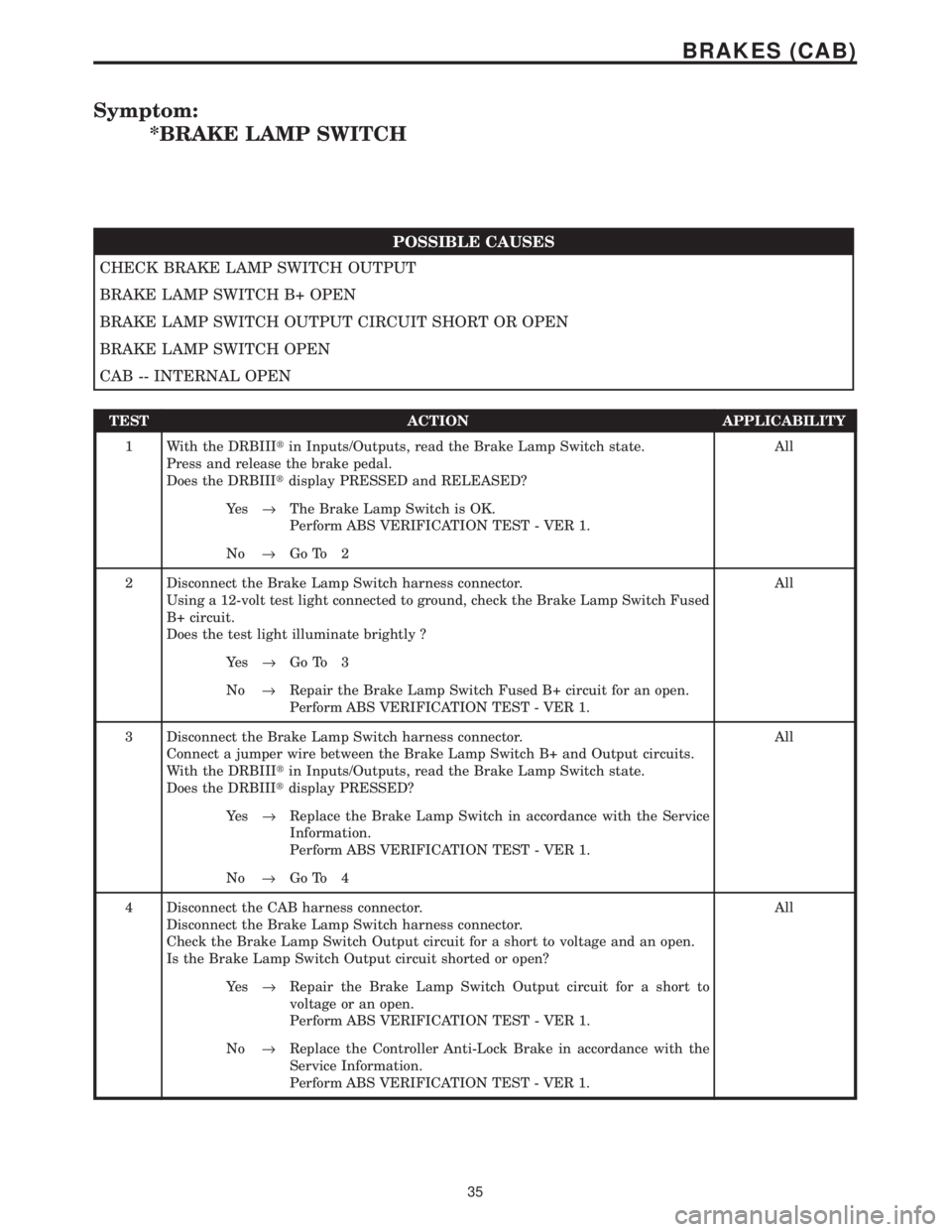
TEVES MARK 20 ANTILOCK BRAKE SYSTEM
S
C
H
E
M
A
T
I
C
D
I
A
G
R
A
M
S
55
SCHEMATIC DIAGRAMS
Page 1226 of 4284
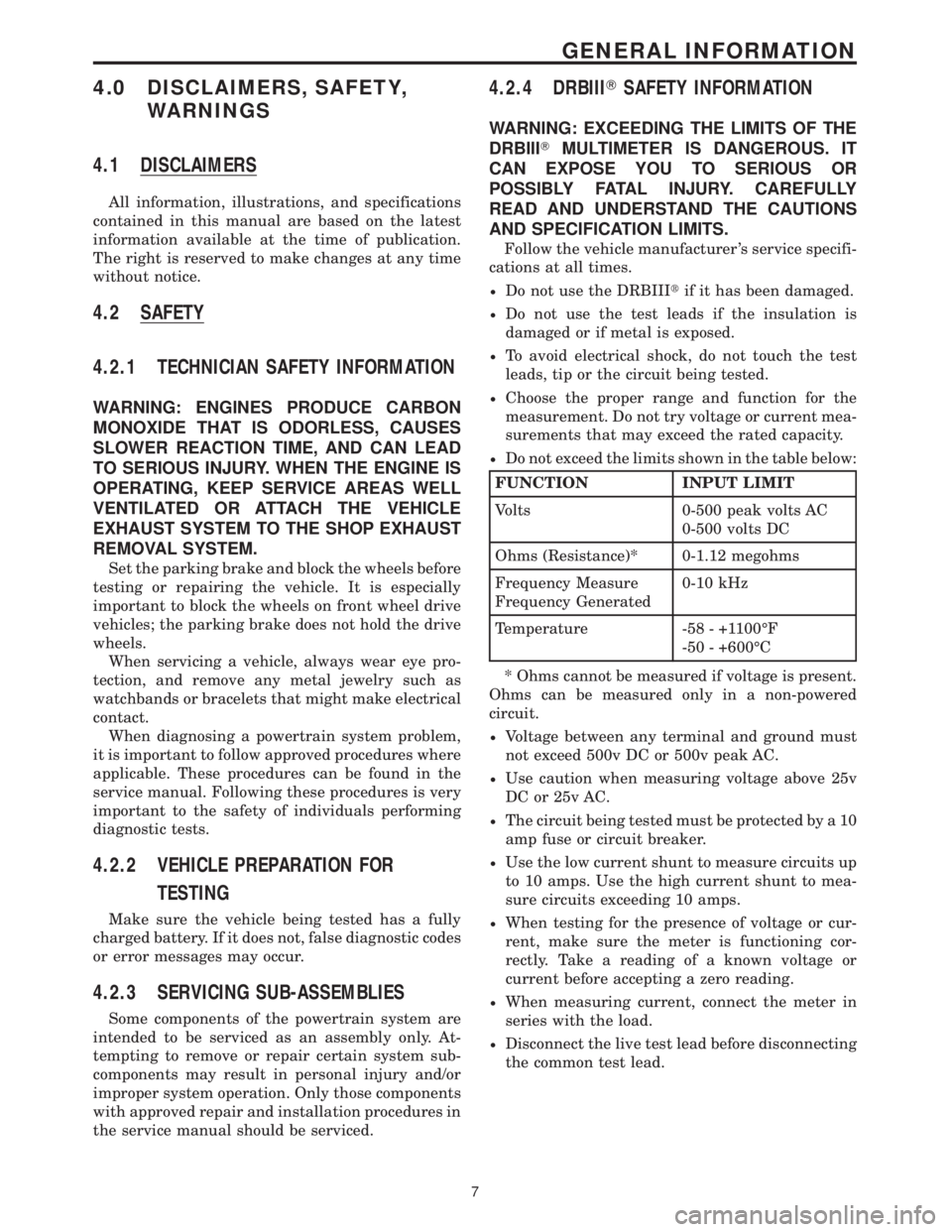
4.0 DISCLAIMERS, SAFETY,
WARNINGS
4.1 DISCLAIMERS
All information, illustrations, and specifications
contained in this manual are based on the latest
information available at the time of publication.
The right is reserved to make changes at any time
without notice.
4.2 SAFETY
4.2.1 TECHNICIAN SAFETY INFORMATION
WARNING: ENGINES PRODUCE CARBON
MONOXIDE THAT IS ODORLESS, CAUSES
SLOWER REACTION TIME, AND CAN LEAD
TO SERIOUS INJURY. WHEN THE ENGINE IS
OPERATING, KEEP SERVICE AREAS WELL
VENTILATED OR ATTACH THE VEHICLE
EXHAUST SYSTEM TO THE SHOP EXHAUST
REMOVAL SYSTEM.
Set the parking brake and block the wheels before
testing or repairing the vehicle. It is especially
important to block the wheels on front wheel drive
vehicles; the parking brake does not hold the drive
wheels.
When servicing a vehicle, always wear eye pro-
tection, and remove any metal jewelry such as
watchbands or bracelets that might make electrical
contact.
When diagnosing a powertrain system problem,
it is important to follow approved procedures where
applicable. These procedures can be found in the
service manual. Following these procedures is very
important to the safety of individuals performing
diagnostic tests.
4.2.2 VEHICLE PREPARATION FOR
TESTING
Make sure the vehicle being tested has a fully
charged battery. If it does not, false diagnostic codes
or error messages may occur.
4.2.3 SERVICING SUB-ASSEMBLIES
Some components of the powertrain system are
intended to be serviced as an assembly only. At-
tempting to remove or repair certain system sub-
components may result in personal injury and/or
improper system operation. Only those components
with approved repair and installation procedures in
the service manual should be serviced.
4.2.4 DRBIIITSAFETY INFORMATION
WARNING: EXCEEDING THE LIMITS OF THE
DRBIIITMULTIMETER IS DANGEROUS. IT
CAN EXPOSE YOU TO SERIOUS OR
POSSIBLY FATAL INJURY. CAREFULLY
READ AND UNDERSTAND THE CAUTIONS
AND SPECIFICATION LIMITS.
Follow the vehicle manufacturer 's service specifi-
cations at all times.
²Do not use the DRBIIItif it has been damaged.
²Do not use the test leads if the insulation is
damaged or if metal is exposed.
²To avoid electrical shock, do not touch the test
leads, tip or the circuit being tested.
²Choose the proper range and function for the
measurement. Do not try voltage or current mea-
surements that may exceed the rated capacity.
²Do not exceed the limits shown in the table below:
FUNCTION INPUT LIMIT
Volts 0-500 peak volts AC
0-500 volts DC
Ohms (Resistance)* 0-1.12 megohms
Frequency Measure
Frequency Generated0-10 kHz
Temperature -58 - +1100ÉF
-50 - +600ÉC
* Ohms cannot be measured if voltage is present.
Ohms can be measured only in a non-powered
circuit.
²Voltage between any terminal and ground must
not exceed 500v DC or 500v peak AC.
²Use caution when measuring voltage above 25v
DC or 25v AC.
²The circuit being tested must be protected by a 10
amp fuse or circuit breaker.
²Use the low current shunt to measure circuits up
to 10 amps. Use the high current shunt to mea-
sure circuits exceeding 10 amps.
²When testing for the presence of voltage or cur-
rent, make sure the meter is functioning cor-
rectly. Take a reading of a known voltage or
current before accepting a zero reading.
²When measuring current, connect the meter in
series with the load.
²Disconnect the live test lead before disconnecting
the common test lead.
7
GENERAL INFORMATION