2001 CHRYSLER VOYAGER engine diesel
[x] Cancel search: engine dieselPage 1404 of 4284
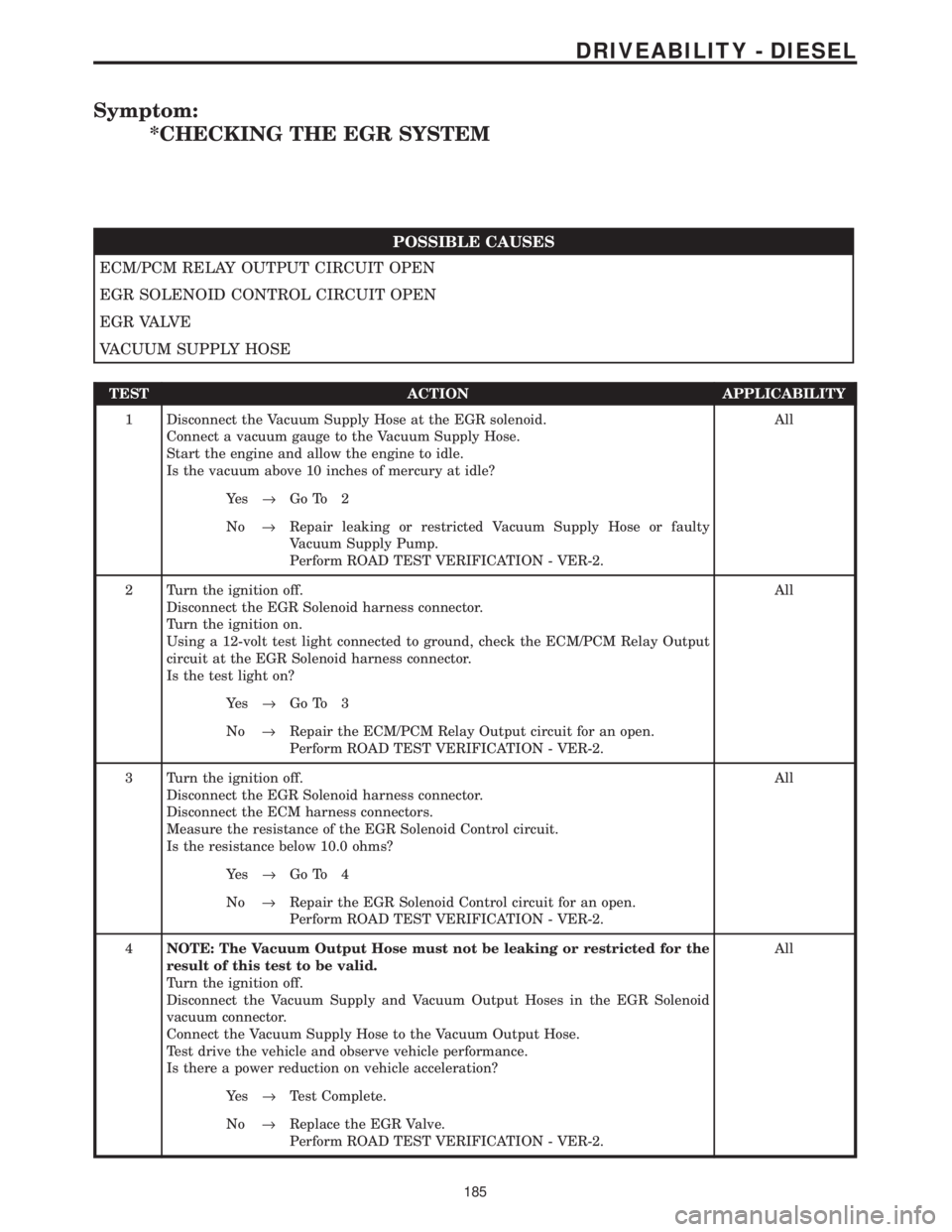
Symptom:
*CHECKING THE EGR SYSTEM
POSSIBLE CAUSES
ECM/PCM RELAY OUTPUT CIRCUIT OPEN
EGR SOLENOID CONTROL CIRCUIT OPEN
EGR VALVE
VACUUM SUPPLY HOSE
TEST ACTION APPLICABILITY
1 Disconnect the Vacuum Supply Hose at the EGR solenoid.
Connect a vacuum gauge to the Vacuum Supply Hose.
Start the engine and allow the engine to idle.
Is the vacuum above 10 inches of mercury at idle?All
Ye s®Go To 2
No®Repair leaking or restricted Vacuum Supply Hose or faulty
Vacuum Supply Pump.
Perform ROAD TEST VERIFICATION - VER-2.
2 Turn the ignition off.
Disconnect the EGR Solenoid harness connector.
Turn the ignition on.
Using a 12-volt test light connected to ground, check the ECM/PCM Relay Output
circuit at the EGR Solenoid harness connector.
Is the test light on?All
Ye s®Go To 3
No®Repair the ECM/PCM Relay Output circuit for an open.
Perform ROAD TEST VERIFICATION - VER-2.
3 Turn the ignition off.
Disconnect the EGR Solenoid harness connector.
Disconnect the ECM harness connectors.
Measure the resistance of the EGR Solenoid Control circuit.
Is the resistance below 10.0 ohms?All
Ye s®Go To 4
No®Repair the EGR Solenoid Control circuit for an open.
Perform ROAD TEST VERIFICATION - VER-2.
4NOTE: The Vacuum Output Hose must not be leaking or restricted for the
result of this test to be valid.
Turn the ignition off.
Disconnect the Vacuum Supply and Vacuum Output Hoses in the EGR Solenoid
vacuum connector.
Connect the Vacuum Supply Hose to the Vacuum Output Hose.
Test drive the vehicle and observe vehicle performance.
Is there a power reduction on vehicle acceleration?All
Ye s®Test Complete.
No®Replace the EGR Valve.
Perform ROAD TEST VERIFICATION - VER-2.
185
DRIVEABILITY - DIESEL
Page 1406 of 4284
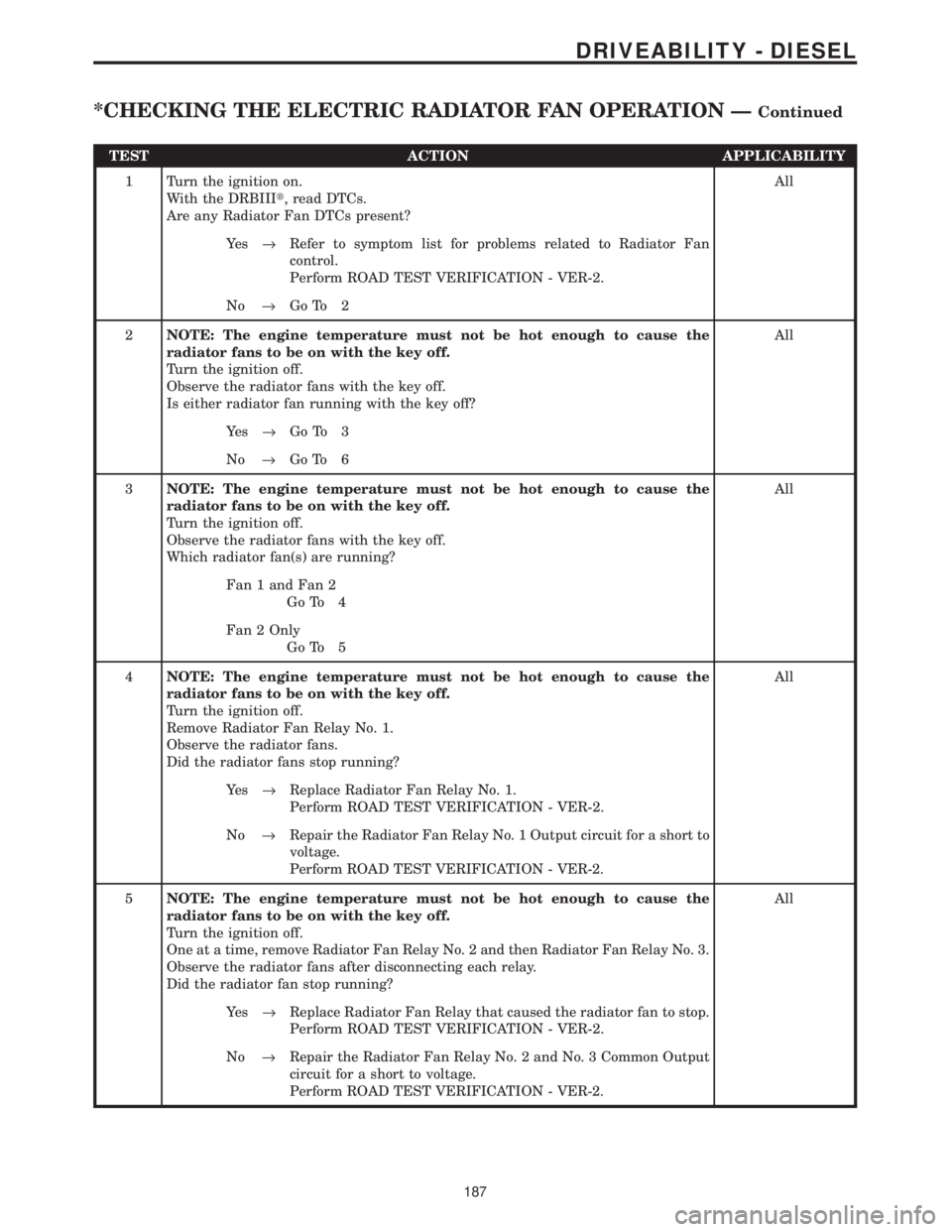
TEST ACTION APPLICABILITY
1 Turn the ignition on.
With the DRBIIIt, read DTCs.
Are any Radiator Fan DTCs present?All
Ye s®Refer to symptom list for problems related to Radiator Fan
control.
Perform ROAD TEST VERIFICATION - VER-2.
No®Go To 2
2NOTE: The engine temperature must not be hot enough to cause the
radiator fans to be on with the key off.
Turn the ignition off.
Observe the radiator fans with the key off.
Is either radiator fan running with the key off?All
Ye s®Go To 3
No®Go To 6
3NOTE: The engine temperature must not be hot enough to cause the
radiator fans to be on with the key off.
Turn the ignition off.
Observe the radiator fans with the key off.
Which radiator fan(s) are running?All
Fan 1 and Fan 2
Go To 4
Fan 2 Only
Go To 5
4NOTE: The engine temperature must not be hot enough to cause the
radiator fans to be on with the key off.
Turn the ignition off.
Remove Radiator Fan Relay No. 1.
Observe the radiator fans.
Did the radiator fans stop running?All
Ye s®Replace Radiator Fan Relay No. 1.
Perform ROAD TEST VERIFICATION - VER-2.
No®Repair the Radiator Fan Relay No. 1 Output circuit for a short to
voltage.
Perform ROAD TEST VERIFICATION - VER-2.
5NOTE: The engine temperature must not be hot enough to cause the
radiator fans to be on with the key off.
Turn the ignition off.
One at a time, remove Radiator Fan Relay No. 2 and then Radiator Fan Relay No. 3.
Observe the radiator fans after disconnecting each relay.
Did the radiator fan stop running?All
Ye s®Replace Radiator Fan Relay that caused the radiator fan to stop.
Perform ROAD TEST VERIFICATION - VER-2.
No®Repair the Radiator Fan Relay No. 2 and No. 3 Common Output
circuit for a short to voltage.
Perform ROAD TEST VERIFICATION - VER-2.
187
DRIVEABILITY - DIESEL
*CHECKING THE ELECTRIC RADIATOR FAN OPERATION ÐContinued
Page 1407 of 4284
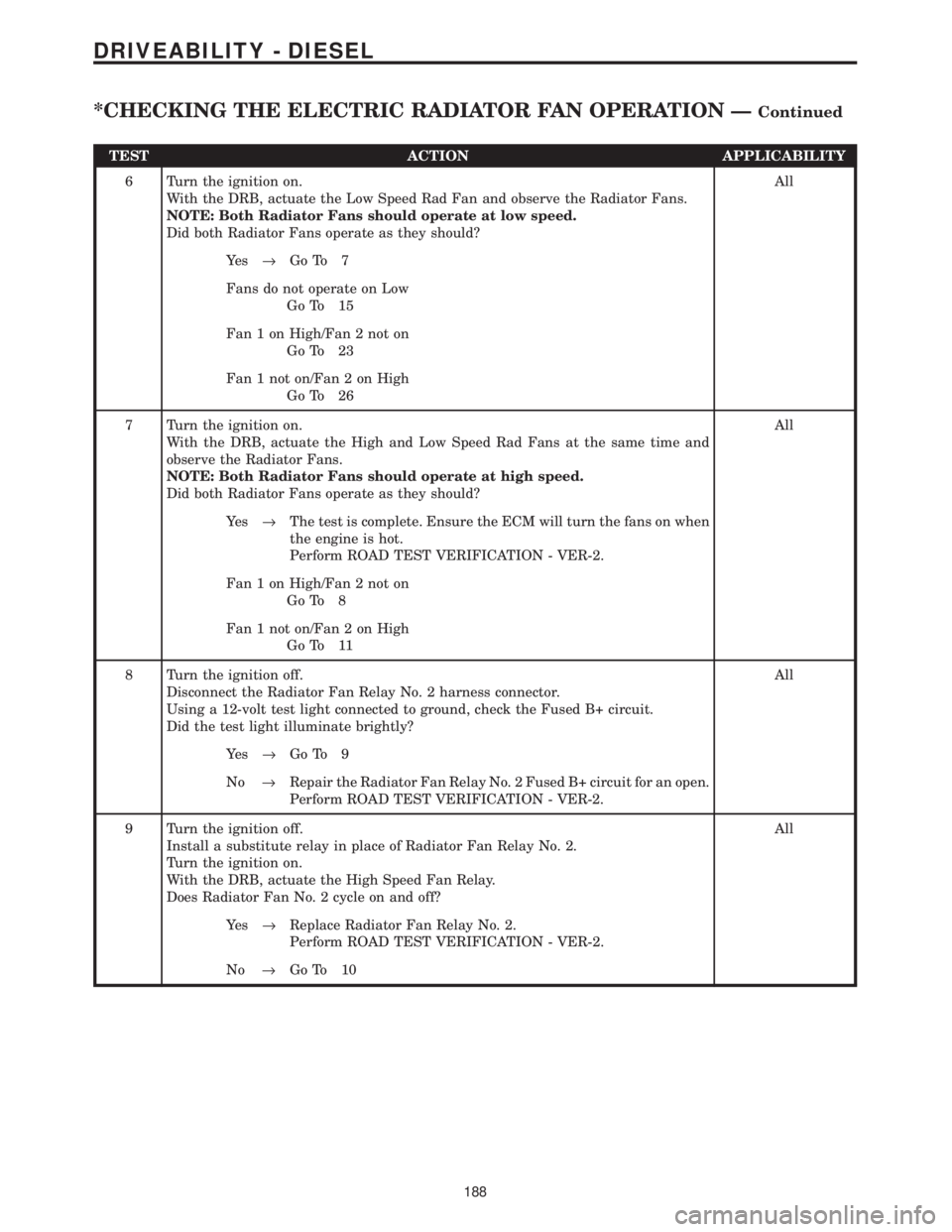
TEST ACTION APPLICABILITY
6 Turn the ignition on.
With the DRB, actuate the Low Speed Rad Fan and observe the Radiator Fans.
NOTE: Both Radiator Fans should operate at low speed.
Did both Radiator Fans operate as they should?All
Ye s®Go To 7
Fans do not operate on Low
Go To 15
Fan 1 on High/Fan 2 not on
Go To 23
Fan 1 not on/Fan 2 on High
Go To 26
7 Turn the ignition on.
With the DRB, actuate the High and Low Speed Rad Fans at the same time and
observe the Radiator Fans.
NOTE: Both Radiator Fans should operate at high speed.
Did both Radiator Fans operate as they should?All
Ye s®The test is complete. Ensure the ECM will turn the fans on when
the engine is hot.
Perform ROAD TEST VERIFICATION - VER-2.
Fan 1 on High/Fan 2 not on
Go To 8
Fan 1 not on/Fan 2 on High
Go To 11
8 Turn the ignition off.
Disconnect the Radiator Fan Relay No. 2 harness connector.
Using a 12-volt test light connected to ground, check the Fused B+ circuit.
Did the test light illuminate brightly?All
Ye s®Go To 9
No®Repair the Radiator Fan Relay No. 2 Fused B+ circuit for an open.
Perform ROAD TEST VERIFICATION - VER-2.
9 Turn the ignition off.
Install a substitute relay in place of Radiator Fan Relay No. 2.
Turn the ignition on.
With the DRB, actuate the High Speed Fan Relay.
Does Radiator Fan No. 2 cycle on and off?All
Ye s®Replace Radiator Fan Relay No. 2.
Perform ROAD TEST VERIFICATION - VER-2.
No®Go To 10
188
DRIVEABILITY - DIESEL
*CHECKING THE ELECTRIC RADIATOR FAN OPERATION ÐContinued
Page 1412 of 4284
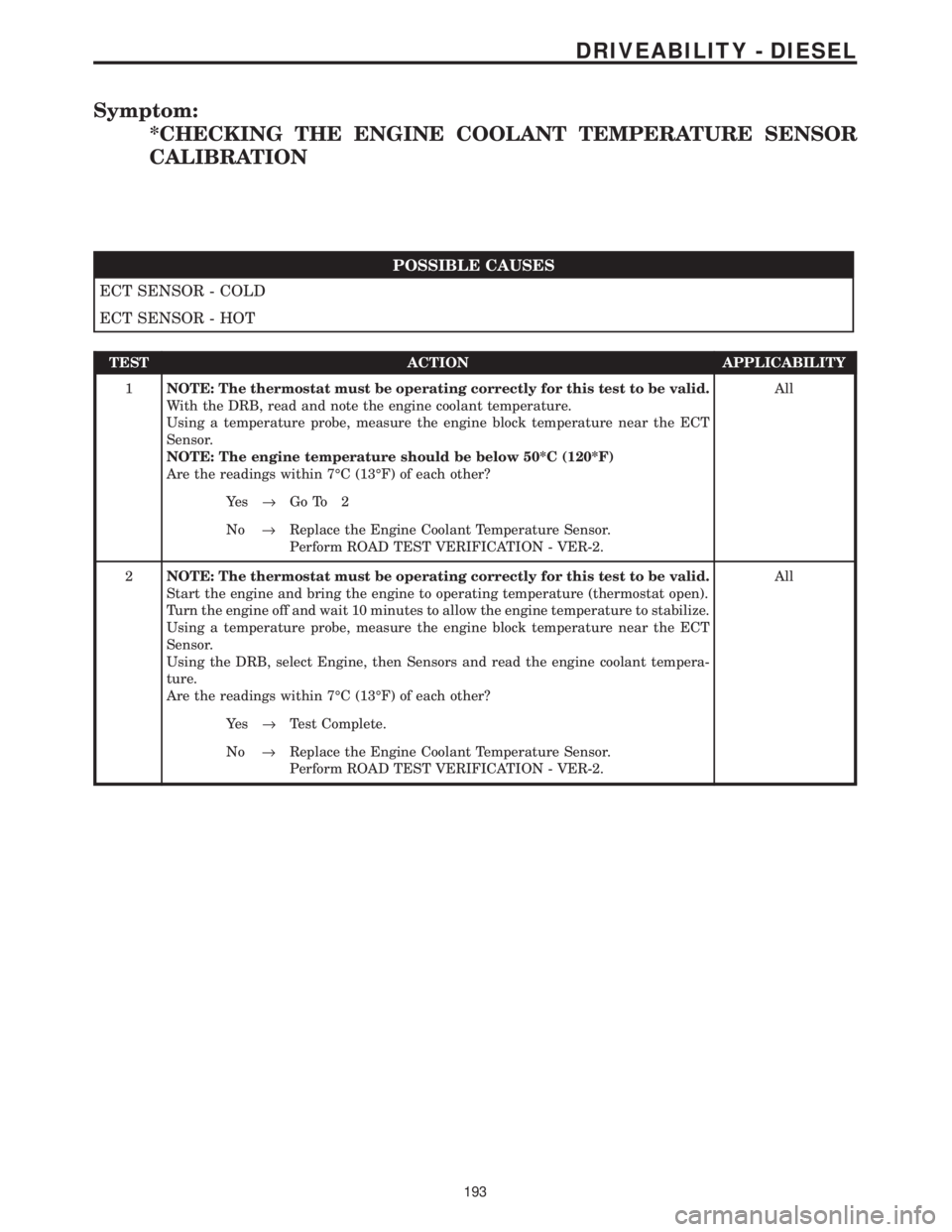
Symptom:
*CHECKING THE ENGINE COOLANT TEMPERATURE SENSOR
CALIBRATION
POSSIBLE CAUSES
ECT SENSOR - COLD
ECT SENSOR - HOT
TEST ACTION APPLICABILITY
1NOTE: The thermostat must be operating correctly for this test to be valid.
With the DRB, read and note the engine coolant temperature.
Using a temperature probe, measure the engine block temperature near the ECT
Sensor.
NOTE: The engine temperature should be below 50*C (120*F)
Are the readings within 7ÉC (13ÉF) of each other?All
Ye s®Go To 2
No®Replace the Engine Coolant Temperature Sensor.
Perform ROAD TEST VERIFICATION - VER-2.
2NOTE: The thermostat must be operating correctly for this test to be valid.
Start the engine and bring the engine to operating temperature (thermostat open).
Turn the engine off and wait 10 minutes to allow the engine temperature to stabilize.
Using a temperature probe, measure the engine block temperature near the ECT
Sensor.
Using the DRB, select Engine, then Sensors and read the engine coolant tempera-
ture.
Are the readings within 7ÉC (13ÉF) of each other?All
Ye s®Test Complete.
No®Replace the Engine Coolant Temperature Sensor.
Perform ROAD TEST VERIFICATION - VER-2.
193
DRIVEABILITY - DIESEL
Page 1413 of 4284
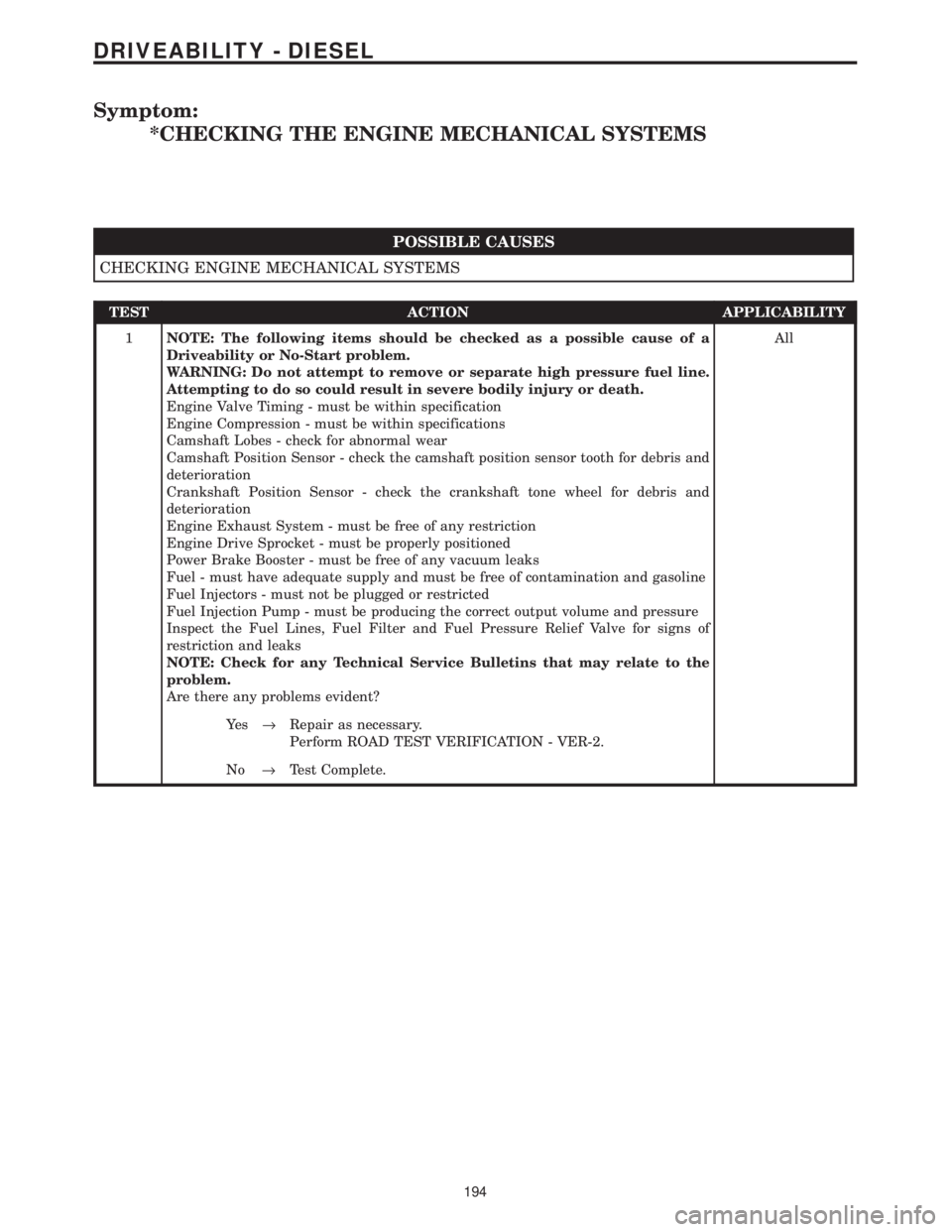
Symptom:
*CHECKING THE ENGINE MECHANICAL SYSTEMS
POSSIBLE CAUSES
CHECKING ENGINE MECHANICAL SYSTEMS
TEST ACTION APPLICABILITY
1NOTE: The following items should be checked as a possible cause of a
Driveability or No-Start problem.
WARNING: Do not attempt to remove or separate high pressure fuel line.
Attempting to do so could result in severe bodily injury or death.
Engine Valve Timing - must be within specification
Engine Compression - must be within specifications
Camshaft Lobes - check for abnormal wear
Camshaft Position Sensor - check the camshaft position sensor tooth for debris and
deterioration
Crankshaft Position Sensor - check the crankshaft tone wheel for debris and
deterioration
Engine Exhaust System - must be free of any restriction
Engine Drive Sprocket - must be properly positioned
Power Brake Booster - must be free of any vacuum leaks
Fuel - must have adequate supply and must be free of contamination and gasoline
Fuel Injectors - must not be plugged or restricted
Fuel Injection Pump - must be producing the correct output volume and pressure
Inspect the Fuel Lines, Fuel Filter and Fuel Pressure Relief Valve for signs of
restriction and leaks
NOTE: Check for any Technical Service Bulletins that may relate to the
problem.
Are there any problems evident?All
Ye s®Repair as necessary.
Perform ROAD TEST VERIFICATION - VER-2.
No®Test Complete.
194
DRIVEABILITY - DIESEL
Page 1419 of 4284
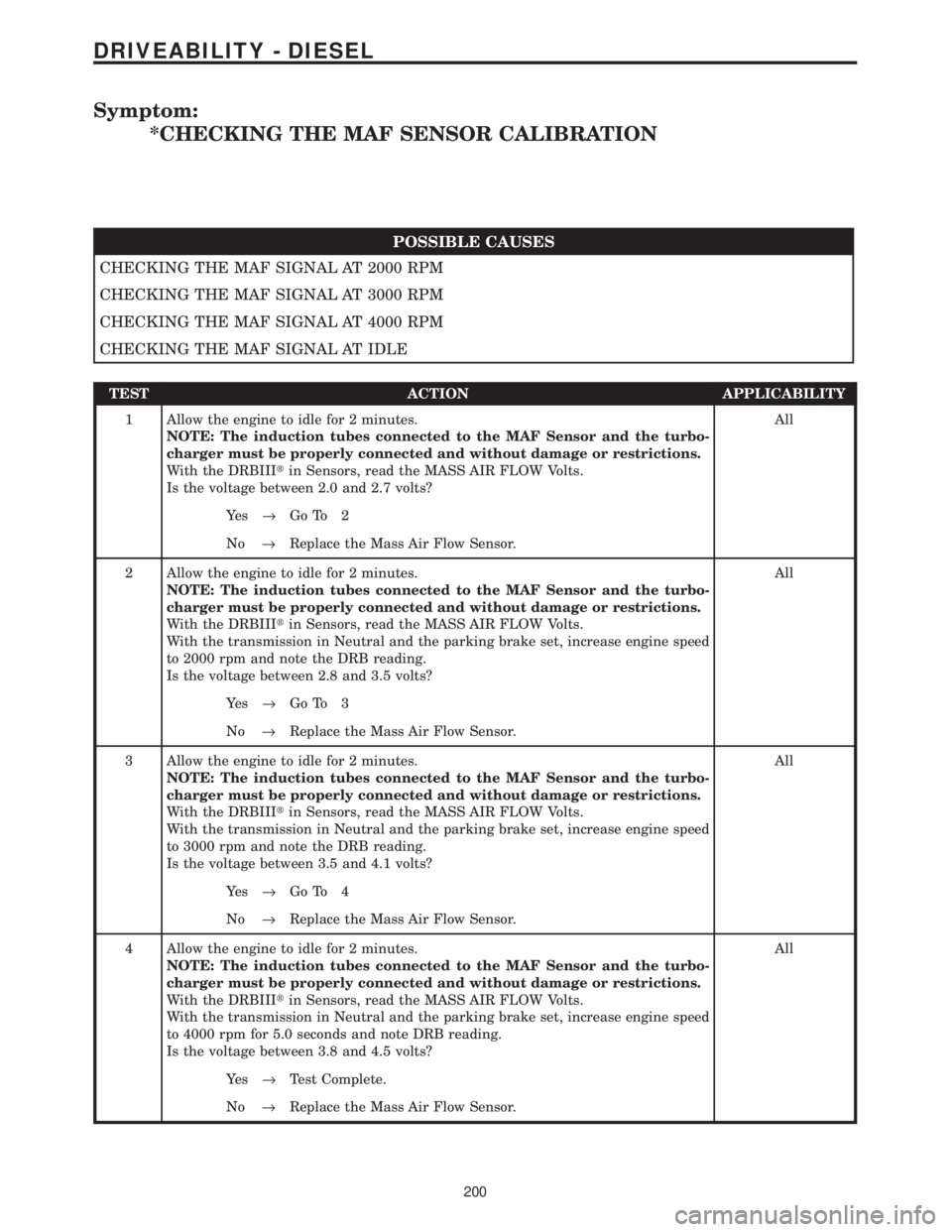
Symptom:
*CHECKING THE MAF SENSOR CALIBRATION
POSSIBLE CAUSES
CHECKING THE MAF SIGNAL AT 2000 RPM
CHECKING THE MAF SIGNAL AT 3000 RPM
CHECKING THE MAF SIGNAL AT 4000 RPM
CHECKING THE MAF SIGNAL AT IDLE
TEST ACTION APPLICABILITY
1 Allow the engine to idle for 2 minutes.
NOTE: The induction tubes connected to the MAF Sensor and the turbo-
charger must be properly connected and without damage or restrictions.
With the DRBIIItin Sensors, read the MASS AIR FLOW Volts.
Is the voltage between 2.0 and 2.7 volts?All
Ye s®Go To 2
No®Replace the Mass Air Flow Sensor.
2 Allow the engine to idle for 2 minutes.
NOTE: The induction tubes connected to the MAF Sensor and the turbo-
charger must be properly connected and without damage or restrictions.
With the DRBIIItin Sensors, read the MASS AIR FLOW Volts.
With the transmission in Neutral and the parking brake set, increase engine speed
to 2000 rpm and note the DRB reading.
Is the voltage between 2.8 and 3.5 volts?All
Ye s®Go To 3
No®Replace the Mass Air Flow Sensor.
3 Allow the engine to idle for 2 minutes.
NOTE: The induction tubes connected to the MAF Sensor and the turbo-
charger must be properly connected and without damage or restrictions.
With the DRBIIItin Sensors, read the MASS AIR FLOW Volts.
With the transmission in Neutral and the parking brake set, increase engine speed
to 3000 rpm and note the DRB reading.
Is the voltage between 3.5 and 4.1 volts?All
Ye s®Go To 4
No®Replace the Mass Air Flow Sensor.
4 Allow the engine to idle for 2 minutes.
NOTE: The induction tubes connected to the MAF Sensor and the turbo-
charger must be properly connected and without damage or restrictions.
With the DRBIIItin Sensors, read the MASS AIR FLOW Volts.
With the transmission in Neutral and the parking brake set, increase engine speed
to 4000 rpm for 5.0 seconds and note DRB reading.
Is the voltage between 3.8 and 4.5 volts?All
Ye s®Test Complete.
No®Replace the Mass Air Flow Sensor.
200
DRIVEABILITY - DIESEL
Page 1420 of 4284
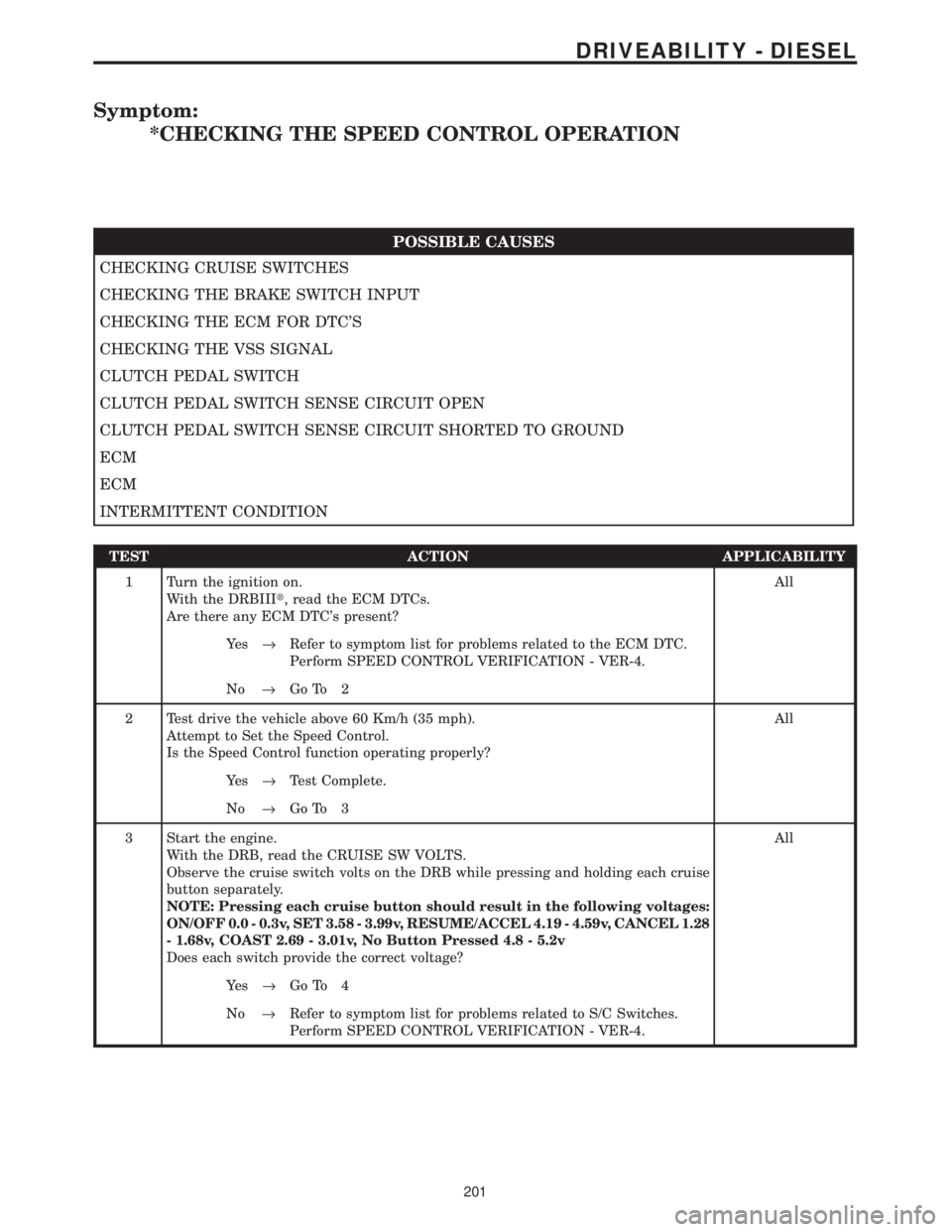
Symptom:
*CHECKING THE SPEED CONTROL OPERATION
POSSIBLE CAUSES
CHECKING CRUISE SWITCHES
CHECKING THE BRAKE SWITCH INPUT
CHECKING THE ECM FOR DTC'S
CHECKING THE VSS SIGNAL
CLUTCH PEDAL SWITCH
CLUTCH PEDAL SWITCH SENSE CIRCUIT OPEN
CLUTCH PEDAL SWITCH SENSE CIRCUIT SHORTED TO GROUND
ECM
ECM
INTERMITTENT CONDITION
TEST ACTION APPLICABILITY
1 Turn the ignition on.
With the DRBIIIt, read the ECM DTCs.
Are there any ECM DTC's present?All
Ye s®Refer to symptom list for problems related to the ECM DTC.
Perform SPEED CONTROL VERIFICATION - VER-4.
No®Go To 2
2 Test drive the vehicle above 60 Km/h (35 mph).
Attempt to Set the Speed Control.
Is the Speed Control function operating properly?All
Ye s®Test Complete.
No®Go To 3
3 Start the engine.
With the DRB, read the CRUISE SW VOLTS.
Observe the cruise switch volts on the DRB while pressing and holding each cruise
button separately.
NOTE: Pressing each cruise button should result in the following voltages:
ON/OFF 0.0 - 0.3v, SET 3.58 - 3.99v, RESUME/ACCEL 4.19 - 4.59v, CANCEL 1.28
- 1.68v, COAST 2.69 - 3.01v, No Button Pressed 4.8 - 5.2v
Does each switch provide the correct voltage?All
Ye s®Go To 4
No®Refer to symptom list for problems related to S/C Switches.
Perform SPEED CONTROL VERIFICATION - VER-4.
201
DRIVEABILITY - DIESEL
Page 1421 of 4284
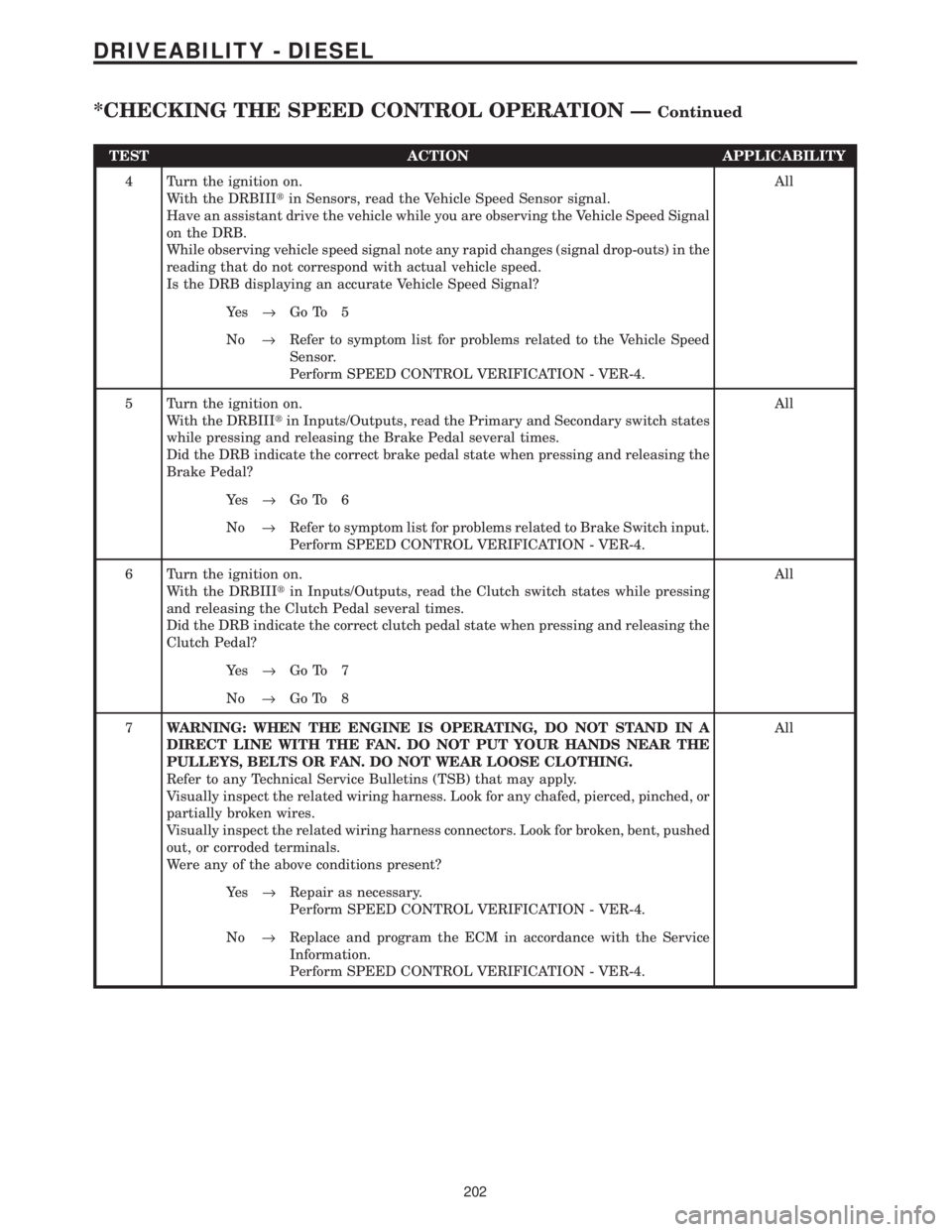
TEST ACTION APPLICABILITY
4 Turn the ignition on.
With the DRBIIItin Sensors, read the Vehicle Speed Sensor signal.
Have an assistant drive the vehicle while you are observing the Vehicle Speed Signal
on the DRB.
While observing vehicle speed signal note any rapid changes (signal drop-outs) in the
reading that do not correspond with actual vehicle speed.
Is the DRB displaying an accurate Vehicle Speed Signal?All
Ye s®Go To 5
No®Refer to symptom list for problems related to the Vehicle Speed
Sensor.
Perform SPEED CONTROL VERIFICATION - VER-4.
5 Turn the ignition on.
With the DRBIIItin Inputs/Outputs, read the Primary and Secondary switch states
while pressing and releasing the Brake Pedal several times.
Did the DRB indicate the correct brake pedal state when pressing and releasing the
Brake Pedal?All
Ye s®Go To 6
No®Refer to symptom list for problems related to Brake Switch input.
Perform SPEED CONTROL VERIFICATION - VER-4.
6 Turn the ignition on.
With the DRBIIItin Inputs/Outputs, read the Clutch switch states while pressing
and releasing the Clutch Pedal several times.
Did the DRB indicate the correct clutch pedal state when pressing and releasing the
Clutch Pedal?All
Ye s®Go To 7
No®Go To 8
7WARNING: WHEN THE ENGINE IS OPERATING, DO NOT STAND IN A
DIRECT LINE WITH THE FAN. DO NOT PUT YOUR HANDS NEAR THE
PULLEYS, BELTS OR FAN. DO NOT WEAR LOOSE CLOTHING.
Refer to any Technical Service Bulletins (TSB) that may apply.
Visually inspect the related wiring harness. Look for any chafed, pierced, pinched, or
partially broken wires.
Visually inspect the related wiring harness connectors. Look for broken, bent, pushed
out, or corroded terminals.
Were any of the above conditions present?All
Ye s®Repair as necessary.
Perform SPEED CONTROL VERIFICATION - VER-4.
No®Replace and program the ECM in accordance with the Service
Information.
Perform SPEED CONTROL VERIFICATION - VER-4.
202
DRIVEABILITY - DIESEL
*CHECKING THE SPEED CONTROL OPERATION ÐContinued