2001 CHRYSLER VOYAGER child lock
[x] Cancel search: child lockPage 2001 of 4284
NOTE: It may be possible to generate Sliding Door
Diagnostic Trouble Codes during normal power
sliding door operation. Refer to the Body Diagnos-
tic Manual for a complete list of diagnostic routines.
For additional information, (Refer to 8 - ELECTRI-
CAL/POWER DOORS - OPERATION) . For a com-
plete power sliding door system wiring schematic,
refer to Wiring Diagrams. For power sliding door sys-
tem operation instructions, refer to the vehicle owner
manual.
WARNING: BE CERTAIN TO READ ALL WARNINGS
AND CAUTIONS IN POWER SLIDING DOOR OPER-
ATION BEFORE ATTEMPTING ANY SERVICE OF
POWER SLIDING DOOR SYSTEM OR COMPO-
NENTS.
OPERATION
With the push of a power sliding door open/close
command switch (key fob, overhead console or B-pil-
lar mounted) a signal is sent out to the Body Control
Module (BCM). The BCM then sends a signal out on
the PCI Data Bus circuit (J1850) to the power sliding
door module. The power sliding door module then
signals the power sliding door latch to release the
door to the unlatched and movable position. The
motor then starts an open cycle.
During the door open cycle, if the power sliding
door module detects sufficient resistance to door
travel, such as an obstruction in the door's path, the
power sliding door module will immediately stop door
movement and reverse door travel to the full open orclosed position. The ability for the power sliding door
module to detect resistance to door travel is accom-
plished by hall effect sensors and the door motor
speed.
The power sliding door control module has the abil-
ity to learn. Anytime a door is opened or closed using
the power sliding door system the module learns
from its cycle. If a replacement power sliding door
component is installed or a door adjustment is made,
the module must re-learn the effort required to open
or close the door. A learn cycle can be performed with
a Diagnostic Scan Tool, such as the DRB IIIt, or with
a complete cycle of the door, using any one of the
command switches. Refer to Standard Procedures in
this section for detailed instructions.
The power sliding door system is designed with a
number of system inhibitors. These inhibitors are
necessary for safety and/or feasibility of the power
sliding door system. See the power sliding door sys-
tem inhibitors noted below:
POWER SLIDING DOOR SYSTEM INHIBITORS
²The power sliding door must be in thefullopen
or closed position in order for the power sliding door
system to start a cycle. If the door is not in this posi-
tion (based on the input from the full open, pawl or
ratchet switches) the door control module will not
respond to command switch inputs.
²The vehicles transmission must be inpark or
neutralin order for the power sliding door system to
start a cycle.
²The vehicles child lockout switch must be in the
ªUNLOCKEDº position in order for the power sliding
door systems B-pillar switches to function.
²If multiple obstacles are detected during the
same power open or close cycle the power sliding
door may go into full manual mode.
²If severe Diagnostic Trouble Codes (DTC) are
stored in the power sliding door control module the
power sliding door may go into full manual mode.
²Due to the high pressure created in the passen-
ger compartment with the blower motor on high, the
power sliding door may not complete a power close
cycle unless a window is cracked, allowing the pres-
sure to escape. This situation will only be experi-
enced on some vehicles, or vehicles with brand new
side door weather seals installed. Refer to the Side
Door Adjustment procedure in the Standard Proce-
dures section of this group.
²The vehicles fuel tank filler door must be in the
closed position. Due to the sliding door interference
with the open fuel tank filler door, mechanical link-
age prevents the side door from opening and striking
the fuel door. Refer to the Body section of this man-
ual for detailed information on the fuel door lockout
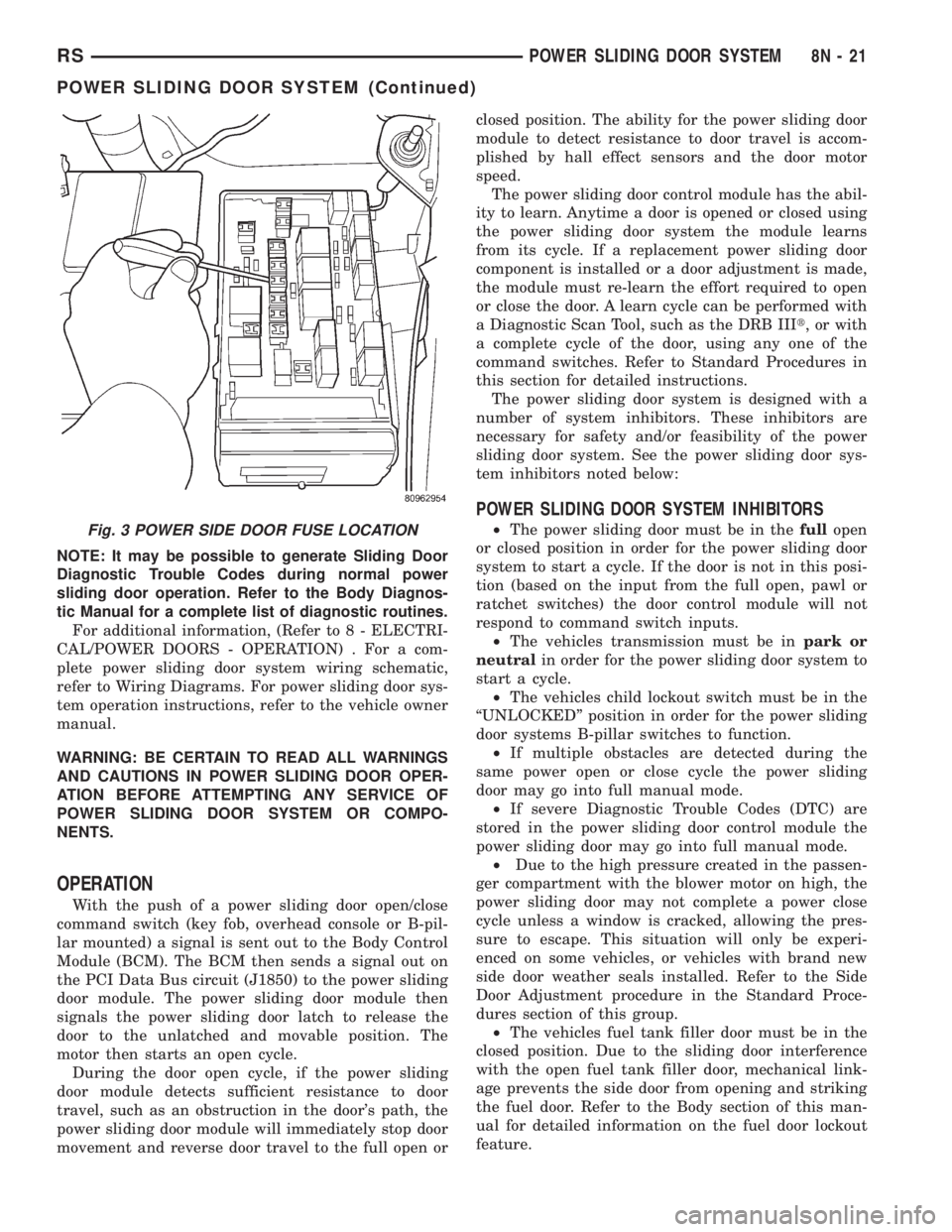
feature.Fig. 3 POWER SIDE DOOR FUSE LOCATION
RSPOWER SLIDING DOOR SYSTEM8N-21
POWER SLIDING DOOR SYSTEM (Continued)
Page 2009 of 4284
LATCH
DESCRIPTION
Vehicles equipped with a power side door or doors
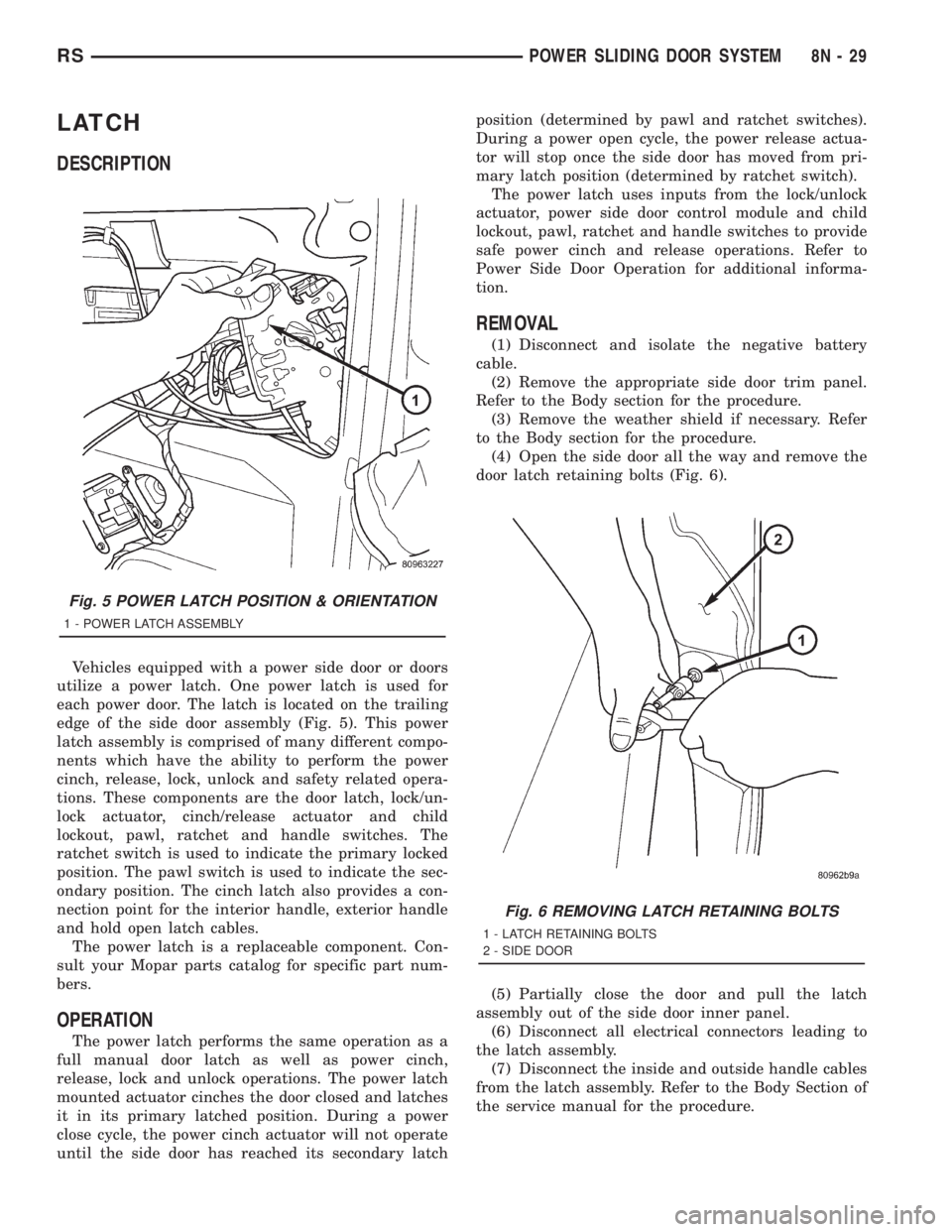
utilize a power latch. One power latch is used for
each power door. The latch is located on the trailing
edge of the side door assembly (Fig. 5). This power
latch assembly is comprised of many different compo-
nents which have the ability to perform the power
cinch, release, lock, unlock and safety related opera-
tions. These components are the door latch, lock/un-
lock actuator, cinch/release actuator and child
lockout, pawl, ratchet and handle switches. The
ratchet switch is used to indicate the primary locked
position. The pawl switch is used to indicate the sec-
ondary position. The cinch latch also provides a con-
nection point for the interior handle, exterior handle
and hold open latch cables.
The power latch is a replaceable component. Con-
sult your Mopar parts catalog for specific part num-
bers.
OPERATION
The power latch performs the same operation as a
full manual door latch as well as power cinch,
release, lock and unlock operations. The power latch
mounted actuator cinches the door closed and latches
it in its primary latched position. During a power
close cycle, the power cinch actuator will not operate
until the side door has reached its secondary latchposition (determined by pawl and ratchet switches).
During a power open cycle, the power release actua-
tor will stop once the side door has moved from pri-
mary latch position (determined by ratchet switch).
The power latch uses inputs from the lock/unlock
actuator, power side door control module and child
lockout, pawl, ratchet and handle switches to provide
safe power cinch and release operations. Refer to
Power Side Door Operation for additional informa-
tion.
REMOVAL
(1) Disconnect and isolate the negative battery
cable.
(2) Remove the appropriate side door trim panel.
Refer to the Body section for the procedure.
(3) Remove the weather shield if necessary. Refer
to the Body section for the procedure.
(4) Open the side door all the way and remove the
door latch retaining bolts (Fig. 6).
(5) Partially close the door and pull the latch
assembly out of the side door inner panel.
(6) Disconnect all electrical connectors leading to
the latch assembly.
(7) Disconnect the inside and outside handle cables
from the latch assembly. Refer to the Body Section of
the service manual for the procedure.
Fig. 5 POWER LATCH POSITION & ORIENTATION
1 - POWER LATCH ASSEMBLY
Fig. 6 REMOVING LATCH RETAINING BOLTS
1 - LATCH RETAINING BOLTS
2 - SIDE DOOR
RSPOWER SLIDING DOOR SYSTEM8N-29
Page 2012 of 4284
LEFT B-PILLAR SWITCH
DESCRIPTION
Vehicles equipped with power sliding side door/s
utilize B-pillar switches. These switches are located
on the interior of the vehicle, on the B-pillar trim
panels. These switches serve as an open and close
command switch for the appropriate power side door.
The B-pillar switches are replaceable. Consult your
Mopar parts catalog for a specific part number.
OPERATION
When the Pillar switch is depressed a signal is
sent to the Body Control Module (BCM), this signal
is then sent to the Power Sliding Door Module, tell-
ing it to start a power open or close cycle. The child
lockout feature must be disabled and the side door
must be unlocked in order for the Pillar switch to
function.
REMOVAL
(1) Disconnect and isolate the negative battery
cable.
(2) Using a trim stick or other small flat-bladed
pry tool, gently pry the leading upper edge of the
B-pillar switch away from the B-pillar trim.
(3) Once the upper edge is free from pillar trim,
rock the switch out of the switch opening.
(4) Disconnect the B-pillar switch electrical con-
nector. First, slide the connector lock away from the
switch then, depress connector retaining tab while
pulling straight apart.
(5) Remove the B-pillar switch from the vehicle.
INSTALLATION
(1) Connect the B-pillar switch electrical connector.
Slide connector lock toward the switch to lock in
place.
(2) Hook the lower edge of the B-pillar switch on
the B-pillar trim and then push the switch firmly
into position.
(3) Connect the negative battery cable.
RIGHT B-PILLAR SWITCH
DESCRIPTION
Vehicles equipped with power sliding side door/s
utilize B-pillar switches. These switches are located
on the interior of the vehicle, on the B-pillar trim
panels. These switches serve as an open and close
command switch for the appropriate power side door.
The B-pillar switches are replaceable. Consult your
Mopar parts catalog for a specific part number.
OPERATION
When the Pillar switch is depressed a signal is
sent to the Body Control Module (BCM), this signal
is then sent to the Power Sliding Door Module, tell-
ing it to start a power open or close cycle. The child
lockout feature must be disabled and the side door
must be unlocked in order for the Pillar switch to
function.
REMOVAL
(1) Disconnect and isolate the negative battery
cable.
(2) Using a trim stick or other small flat-bladed
pry tool, gently pry the leading upper edge of the
B-pillar switch away from the B-pillar trim.
(3) Once the upper edge is free from pillar trim,
rock the switch out of the switch opening.
(4) Disconnect the B-pillar switch electrical con-
nector. First, slide the connector lock away from the
switch then, depress connector retaining tab while
pulling straight apart.
(5) Remove the B-pillar switch from the vehicle.
INSTALLATION
(1) Connect the B-pillar switch electrical connector.
Slide connector lock toward the switch to lock in
place.
(2) Hook the lower edge of the B-pillar switch on
the B-pillar trim and then push the switch firmly
into position.
(3) Connect the negative battery cable.
8N - 32 POWER SLIDING DOOR SYSTEMRS
Page 2519 of 4284
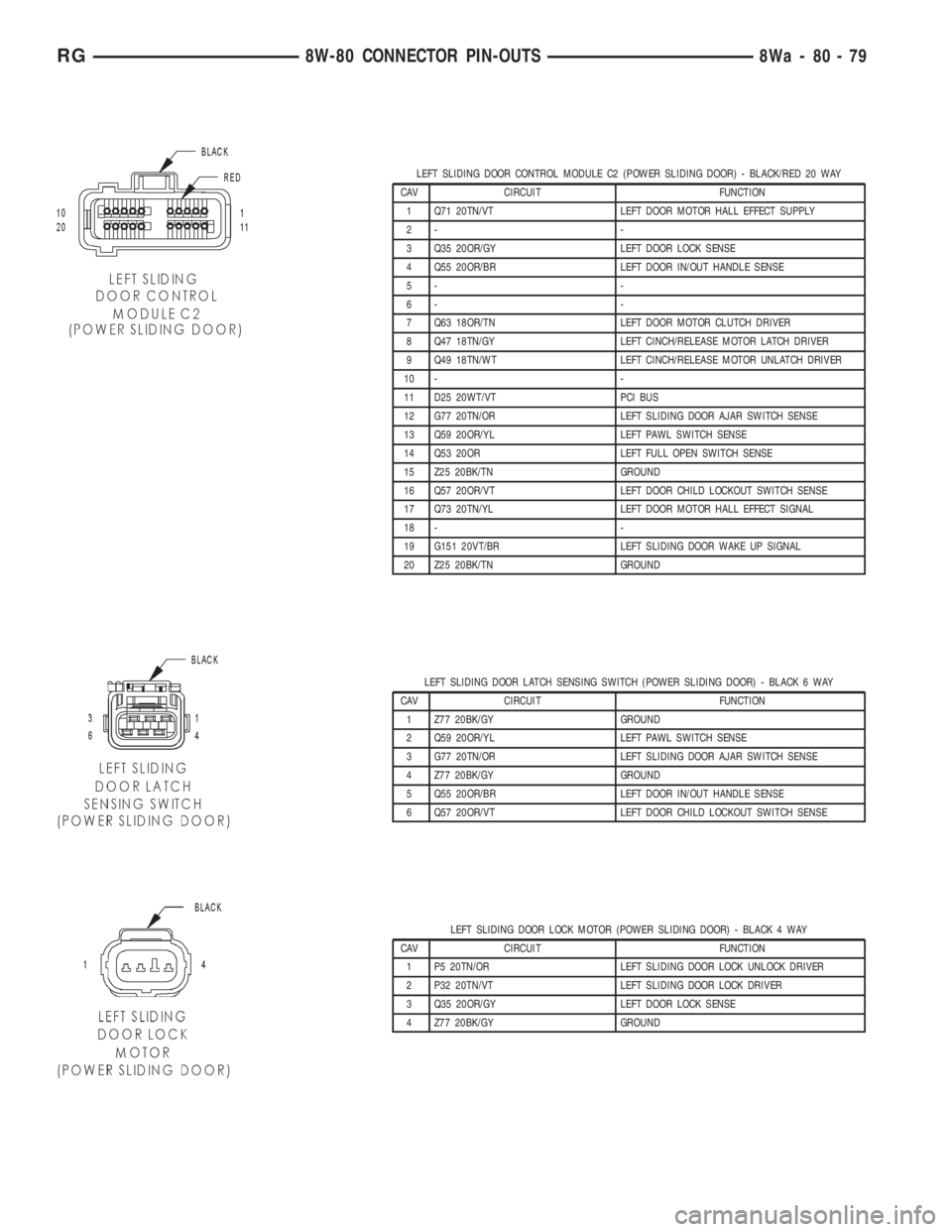
LEFT SLIDING DOOR CONTROL MODULE C2 (POWER SLIDING DOOR) - BLACK/RED 20 WAY
CAV CIRCUIT FUNCTION
1 Q71 20TN/VT LEFT DOOR MOTOR HALL EFFECT SUPPLY
2- -
3 Q35 20OR/GY LEFT DOOR LOCK SENSE
4 Q55 20OR/BR LEFT DOOR IN/OUT HANDLE SENSE
5- -
6- -
7 Q63 18OR/TN LEFT DOOR MOTOR CLUTCH DRIVER
8 Q47 18TN/GY LEFT CINCH/RELEASE MOTOR LATCH DRIVER
9 Q49 18TN/WT LEFT CINCH/RELEASE MOTOR UNLATCH DRIVER
10 - -
11 D25 20WT/VT PCI BUS
12 G77 20TN/OR LEFT SLIDING DOOR AJAR SWITCH SENSE
13 Q59 20OR/YL LEFT PAWL SWITCH SENSE
14 Q53 20OR LEFT FULL OPEN SWITCH SENSE
15 Z25 20BK/TN GROUND
16 Q57 20OR/VT LEFT DOOR CHILD LOCKOUT SWITCH SENSE
17 Q73 20TN/YL LEFT DOOR MOTOR HALL EFFECT SIGNAL
18 - -
19 G151 20VT/BR LEFT SLIDING DOOR WAKE UP SIGNAL
20 Z25 20BK/TN GROUND
LEFT SLIDING DOOR LATCH SENSING SWITCH (POWER SLIDING DOOR) - BLACK 6 WAY
CAV CIRCUIT FUNCTION
1 Z77 20BK/GY GROUND
2 Q59 20OR/YL LEFT PAWL SWITCH SENSE
3 G77 20TN/OR LEFT SLIDING DOOR AJAR SWITCH SENSE
4 Z77 20BK/GY GROUND
5 Q55 20OR/BR LEFT DOOR IN/OUT HANDLE SENSE
6 Q57 20OR/VT LEFT DOOR CHILD LOCKOUT SWITCH SENSE
LEFT SLIDING DOOR LOCK MOTOR (POWER SLIDING DOOR) - BLACK 4 WAY
CAV CIRCUIT FUNCTION
1 P5 20TN/OR LEFT SLIDING DOOR LOCK UNLOCK DRIVER
2 P32 20TN/VT LEFT SLIDING DOOR LOCK DRIVER
3 Q35 20OR/GY LEFT DOOR LOCK SENSE
4 Z77 20BK/GY GROUND
RG8W-80 CONNECTOR PIN-OUTS8Wa-80-79
Page 2554 of 4284
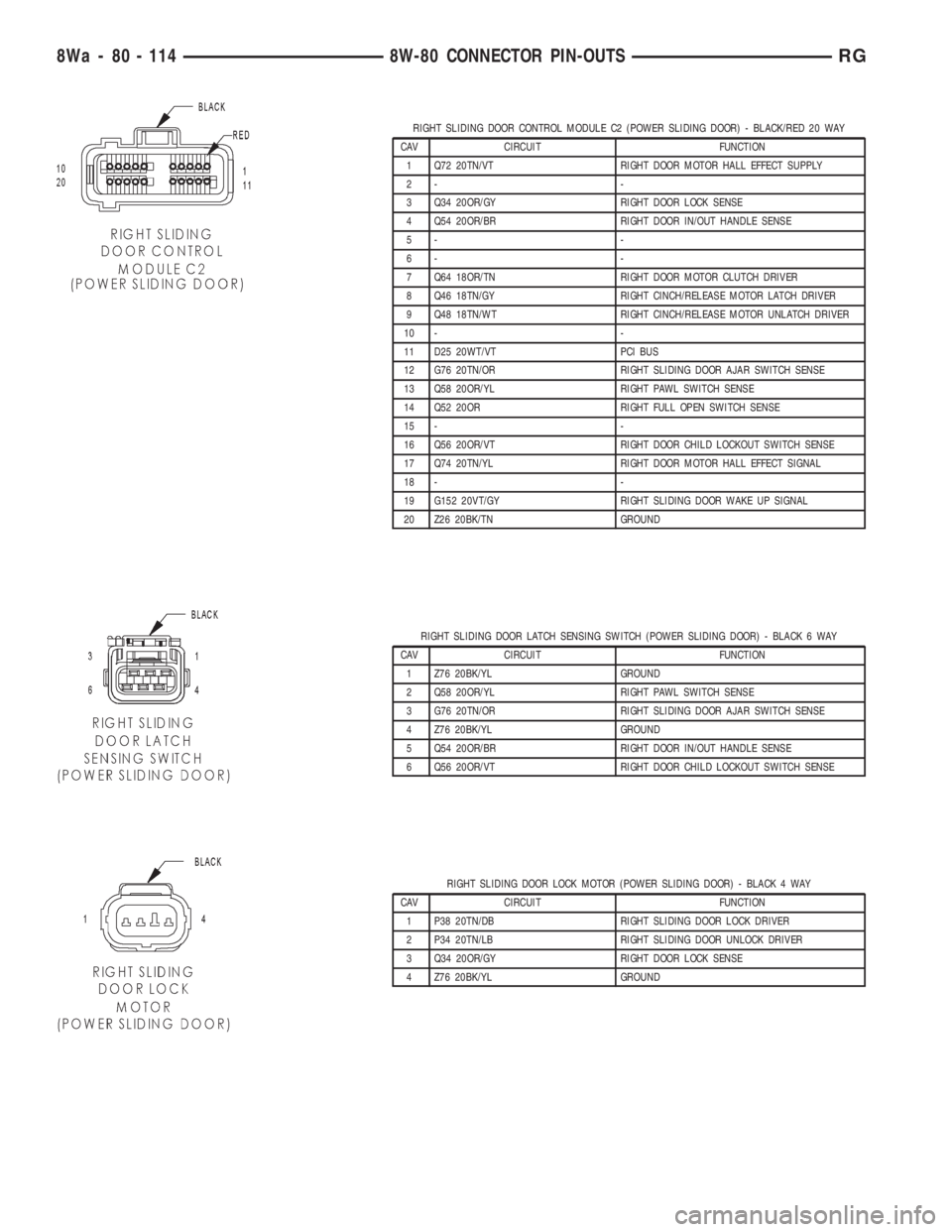
RIGHT SLIDING DOOR CONTROL MODULE C2 (POWER SLIDING DOOR) - BLACK/RED 20 WAY
CAV CIRCUIT FUNCTION
1 Q72 20TN/VT RIGHT DOOR MOTOR HALL EFFECT SUPPLY
2- -
3 Q34 20OR/GY RIGHT DOOR LOCK SENSE
4 Q54 20OR/BR RIGHT DOOR IN/OUT HANDLE SENSE
5- -
6- -
7 Q64 18OR/TN RIGHT DOOR MOTOR CLUTCH DRIVER
8 Q46 18TN/GY RIGHT CINCH/RELEASE MOTOR LATCH DRIVER
9 Q48 18TN/WT RIGHT CINCH/RELEASE MOTOR UNLATCH DRIVER
10 - -
11 D25 20WT/VT PCI BUS
12 G76 20TN/OR RIGHT SLIDING DOOR AJAR SWITCH SENSE
13 Q58 20OR/YL RIGHT PAWL SWITCH SENSE
14 Q52 20OR RIGHT FULL OPEN SWITCH SENSE
15 - -
16 Q56 20OR/VT RIGHT DOOR CHILD LOCKOUT SWITCH SENSE
17 Q74 20TN/YL RIGHT DOOR MOTOR HALL EFFECT SIGNAL
18 - -
19 G152 20VT/GY RIGHT SLIDING DOOR WAKE UP SIGNAL
20 Z26 20BK/TN GROUND
RIGHT SLIDING DOOR LATCH SENSING SWITCH (POWER SLIDING DOOR) - BLACK 6 WAY
CAV CIRCUIT FUNCTION
1 Z76 20BK/YL GROUND
2 Q58 20OR/YL RIGHT PAWL SWITCH SENSE
3 G76 20TN/OR RIGHT SLIDING DOOR AJAR SWITCH SENSE
4 Z76 20BK/YL GROUND
5 Q54 20OR/BR RIGHT DOOR IN/OUT HANDLE SENSE
6 Q56 20OR/VT RIGHT DOOR CHILD LOCKOUT SWITCH SENSE
RIGHT SLIDING DOOR LOCK MOTOR (POWER SLIDING DOOR) - BLACK 4 WAY
CAV CIRCUIT FUNCTION
1 P38 20TN/DB RIGHT SLIDING DOOR LOCK DRIVER
2 P34 20TN/LB RIGHT SLIDING DOOR UNLOCK DRIVER
3 Q34 20OR/GY RIGHT DOOR LOCK SENSE
4 Z76 20BK/YL GROUND
8Wa - 80 - 114 8W-80 CONNECTOR PIN-OUTSRG
Page 3603 of 4284
BENCH SEAT BACK COVER
REMOVAL.............................240
INSTALLATION..........................240
BENCH SEAT TRACK
REMOVAL.............................240
INSTALLATION..........................240
PLASTIC GROCERY BAG RETAINER
REMOVAL.............................241
INSTALLATION..........................241
UNDER SEAT STORAGE BIN
REMOVAL.............................241INSTALLATION..........................241
UNDER SEAT STORAGE BIN GUIDE
REMOVAL.............................242
INSTALLATION..........................242
UNDER SEAT STORAGE BIN LOCK/LATCH
REMOVAL.............................242
INSTALLATION..........................242
LUMBAR SUPPORT
REMOVAL.............................242
INSTALLATION..........................242
CHILD SEAT MODULE
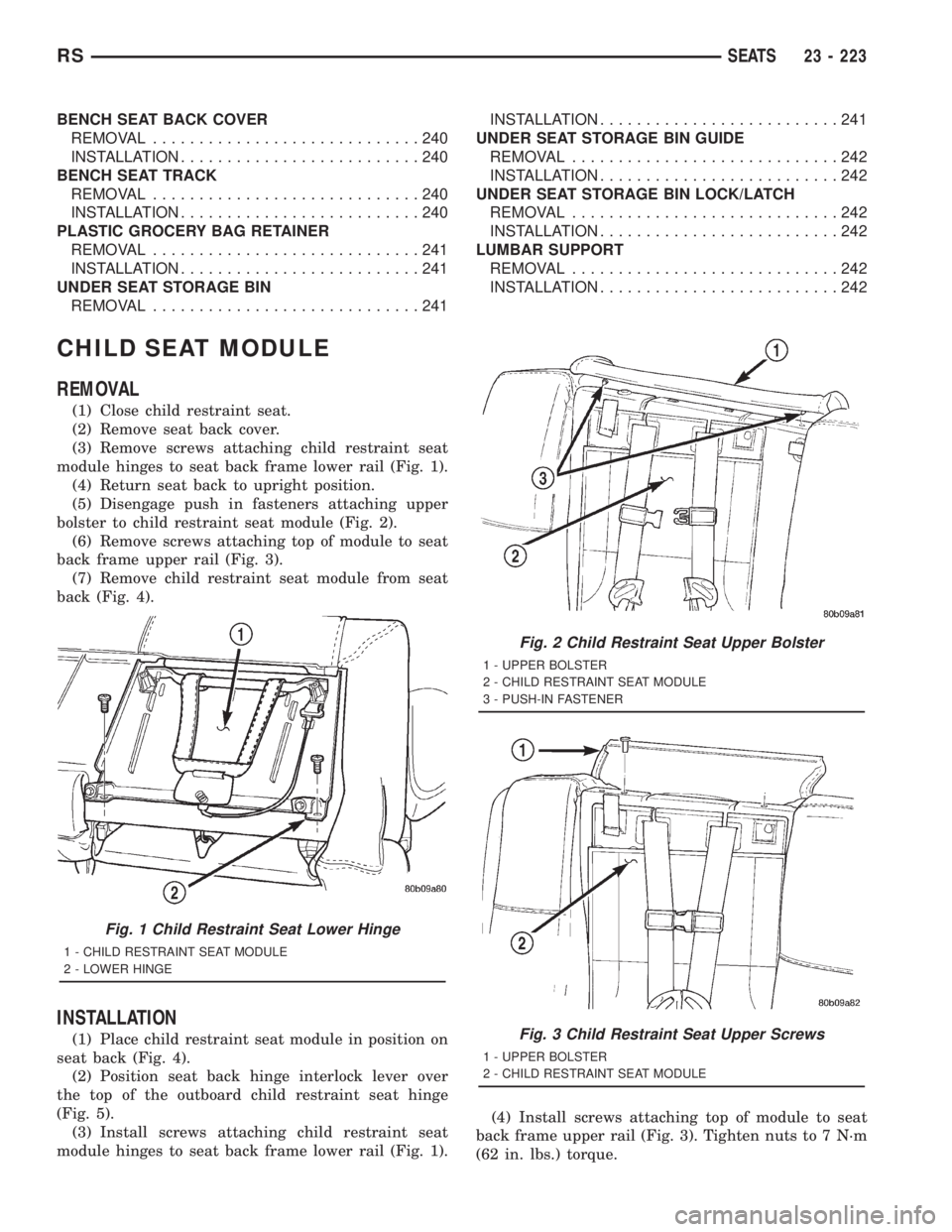
REMOVAL
(1) Close child restraint seat.
(2) Remove seat back cover.
(3) Remove screws attaching child restraint seat
module hinges to seat back frame lower rail (Fig. 1).
(4) Return seat back to upright position.
(5) Disengage push in fasteners attaching upper
bolster to child restraint seat module (Fig. 2).
(6) Remove screws attaching top of module to seat
back frame upper rail (Fig. 3).
(7) Remove child restraint seat module from seat
back (Fig. 4).
INSTALLATION
(1) Place child restraint seat module in position on
seat back (Fig. 4).
(2) Position seat back hinge interlock lever over
the top of the outboard child restraint seat hinge
(Fig. 5).
(3) Install screws attaching child restraint seat
module hinges to seat back frame lower rail (Fig. 1).(4) Install screws attaching top of module to seat
back frame upper rail (Fig. 3). Tighten nuts to 7 N´m
(62 in. lbs.) torque.
Fig. 1 Child Restraint Seat Lower Hinge
1 - CHILD RESTRAINT SEAT MODULE
2 - LOWER HINGE
Fig. 2 Child Restraint Seat Upper Bolster
1 - UPPER BOLSTER
2 - CHILD RESTRAINT SEAT MODULE
3 - PUSH-IN FASTENER
Fig. 3 Child Restraint Seat Upper Screws
1 - UPPER BOLSTER
2 - CHILD RESTRAINT SEAT MODULE
RSSEATS23 - 223
Page 3604 of 4284
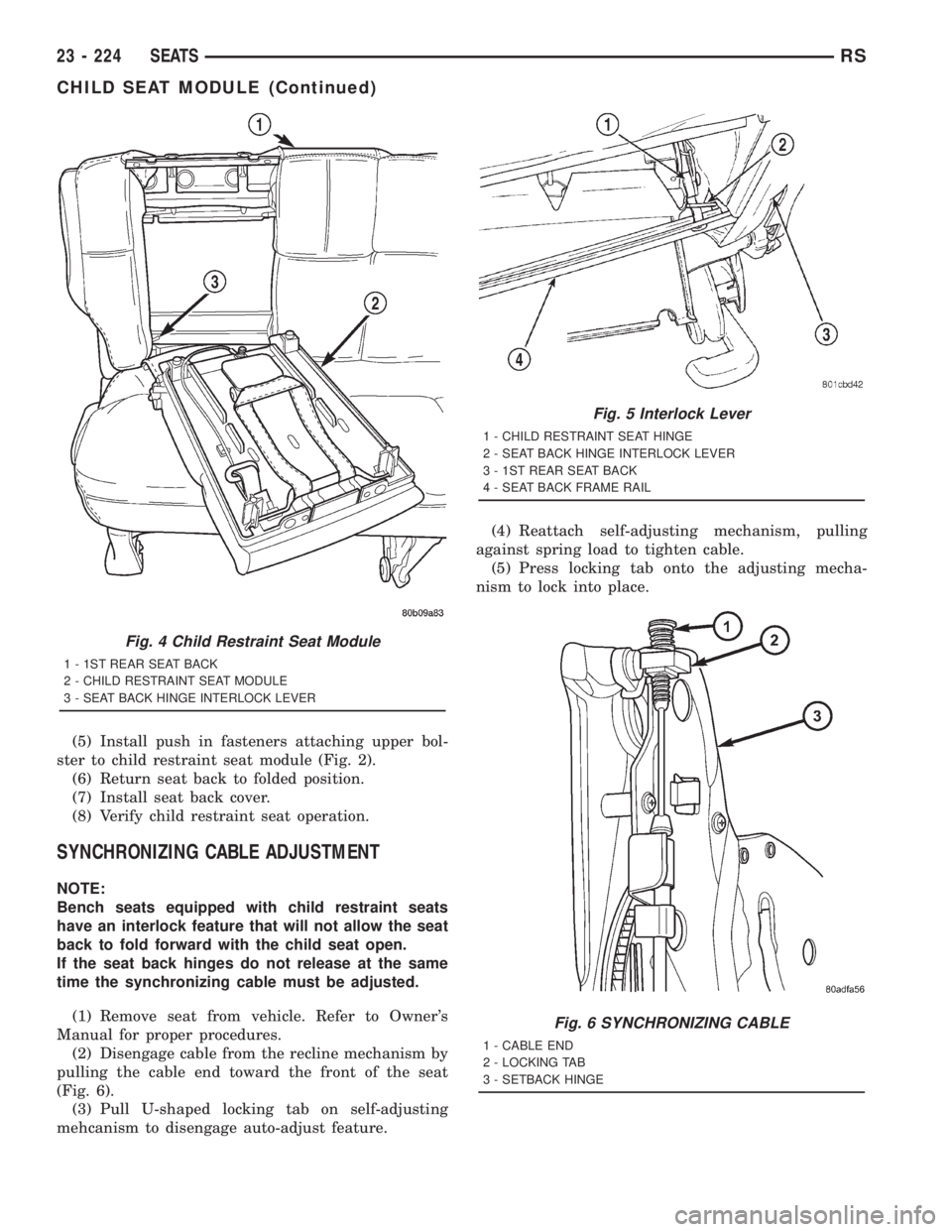
(5) Install push in fasteners attaching upper bol-
ster to child restraint seat module (Fig. 2).
(6) Return seat back to folded position.
(7) Install seat back cover.
(8) Verify child restraint seat operation.
SYNCHRONIZING CABLE ADJUSTMENT
NOTE:
Bench seats equipped with child restraint seats
have an interlock feature that will not allow the seat
back to fold forward with the child seat open.
If the seat back hinges do not release at the same
time the synchronizing cable must be adjusted.
(1) Remove seat from vehicle. Refer to Owner's
Manual for proper procedures.
(2) Disengage cable from the recline mechanism by
pulling the cable end toward the front of the seat
(Fig. 6).
(3) Pull U-shaped locking tab on self-adjusting
mehcanism to disengage auto-adjust feature.(4) Reattach self-adjusting mechanism, pulling
against spring load to tighten cable.
(5) Press locking tab onto the adjusting mecha-
nism to lock into place.
Fig. 4 Child Restraint Seat Module
1 - 1ST REAR SEAT BACK
2 - CHILD RESTRAINT SEAT MODULE
3 - SEAT BACK HINGE INTERLOCK LEVER
Fig. 5 Interlock Lever
1 - CHILD RESTRAINT SEAT HINGE
2 - SEAT BACK HINGE INTERLOCK LEVER
3 - 1ST REAR SEAT BACK
4 - SEAT BACK FRAME RAIL
Fig. 6 SYNCHRONIZING CABLE
1 - CABLE END
2 - LOCKING TAB
3 - SETBACK HINGE
23 - 224 SEATSRS
CHILD SEAT MODULE (Continued)
Page 3605 of 4284
QUAD CHILD SEAT
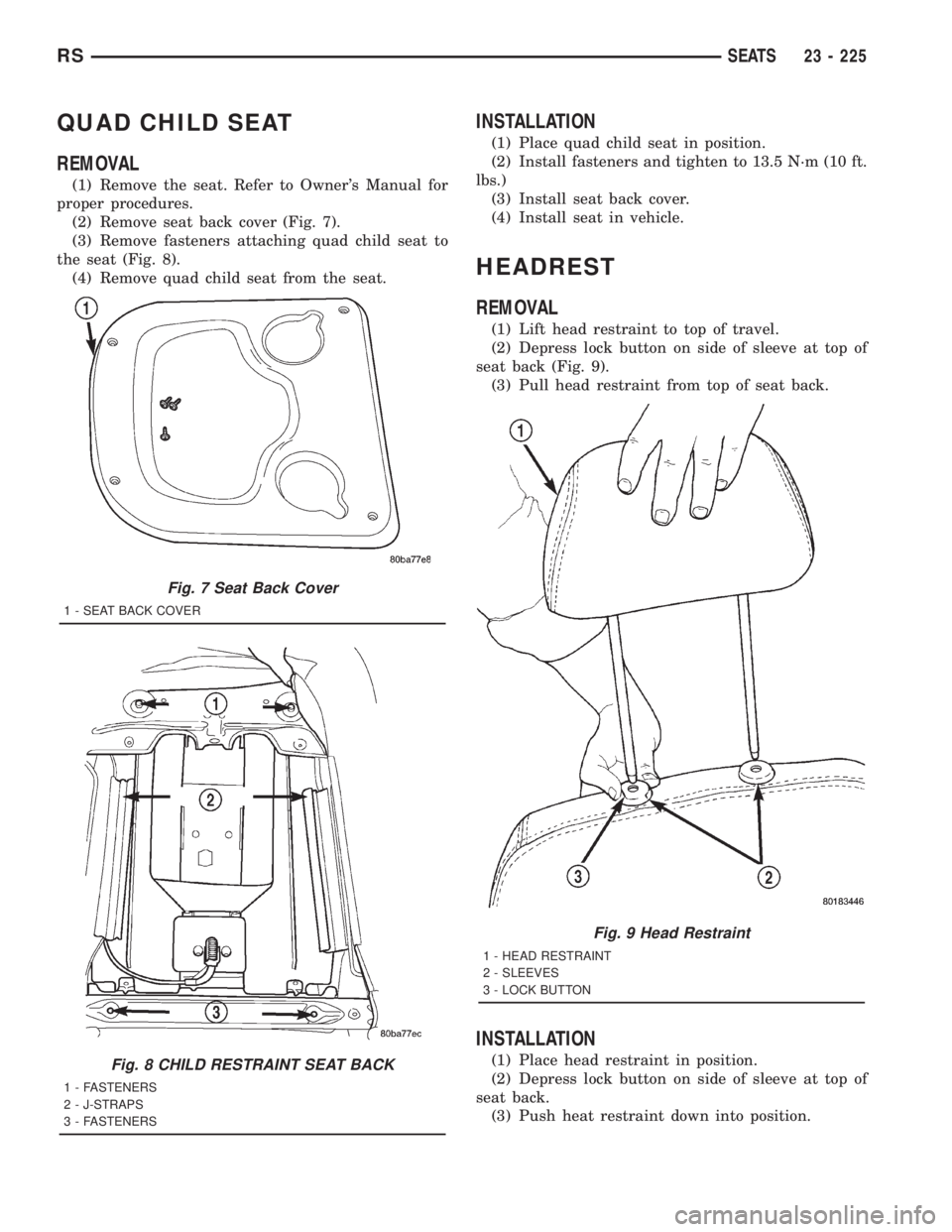
REMOVAL
(1) Remove the seat. Refer to Owner's Manual for
proper procedures.
(2) Remove seat back cover (Fig. 7).
(3) Remove fasteners attaching quad child seat to
the seat (Fig. 8).
(4) Remove quad child seat from the seat.
INSTALLATION
(1) Place quad child seat in position.
(2) Install fasteners and tighten to 13.5 N´m (10 ft.
lbs.)
(3) Install seat back cover.
(4) Install seat in vehicle.
HEADREST
REMOVAL
(1) Lift head restraint to top of travel.
(2) Depress lock button on side of sleeve at top of
seat back (Fig. 9).
(3) Pull head restraint from top of seat back.
INSTALLATION
(1) Place head restraint in position.
(2) Depress lock button on side of sleeve at top of
seat back.
(3) Push heat restraint down into position.
Fig. 7 Seat Back Cover
1 - SEAT BACK COVER
Fig. 8 CHILD RESTRAINT SEAT BACK
1 - FASTENERS
2 - J-STRAPS
3 - FASTENERS
Fig. 9 Head Restraint
1 - HEAD RESTRAINT
2 - SLEEVES
3 - LOCK BUTTON
RSSEATS23 - 225