Page 7 of 4770

3
CAMRY ± OUTLINE OF NEW FEATURES27
8. Brakes
The specifications of the front and rear brakes have been changed.
9. Suspension
The front and rear springs, stabilizers, and shock absorbers have been modified to realize excellent stability,
controllability, and riding comfort.
10. Steering
�A check valve has been added to the power steering gear box to help reduce kickback.
�The rack stroke of the 5S-FE engine model has been changed to 145mm (5.71 in.), which is the same as
in the 1MZ-FE engine.
11. Body
�Hood support dampers are used.
�Two utility hooks added in the luggage room for the gasoline engine model.
�To install the fuel tank in the front area of the luggage compartment, the upper back panel has been cut
out for the 5S-FNE engine model.
�A performance rod that joins the tops of the right and left rear suspension strut towers has been adopted
for the 5S-FNE engine model.
�The shape of the rear floor pan has been changed to prevent the luggage compartment capacity from being
reduced as a result of the installation of the fuel tank in the luggage compartment for the 5S-FNE engine
model.
12. Seat
�The seat cover of the LE grade model has been changed.
�Optional driver power seat added for the LE grade model.
�A fixed type seat back is used for the rear seat for the 5S-FNE engine model.
13. Seat Belt
2-point NR (Non-Retractor) seat belt is used for the rear center seat for the 5S-FNE engine model.
14. Wireless Door Lock Control
Audio answer back is adopted.
15. Lighting
Along with the adoption of the 4-beam headlights, the electrical circuit of the daytime running light system
has been changed.
16. Air Conditioning
�The air inlet mode selector of heater control panel has been changed from the lever type to the push button
type on the CE and LE grade model.
When the air outlet mode is set to the DEF or FOOT / DEF mode, the air inlet mode also changes to the
FRESH mode, has been also added on the CE and LE grade model.
�A fully automatic controlled type air conditioning is used on the XLE grade model.
�A defroster-linked air conditioning start up control has been continuing to use since the previous models
with air conditioning.
17. SRS Airbag
�The inflator of the SRS airbag for the driver has been made more compact and lightweight.
�A signal that causes the supply of fuel to be cut off during a frontal collision is output by the airbag sensor
assembly to the ECM for the 5S-FNE engine model.
Page 9 of 4770
3
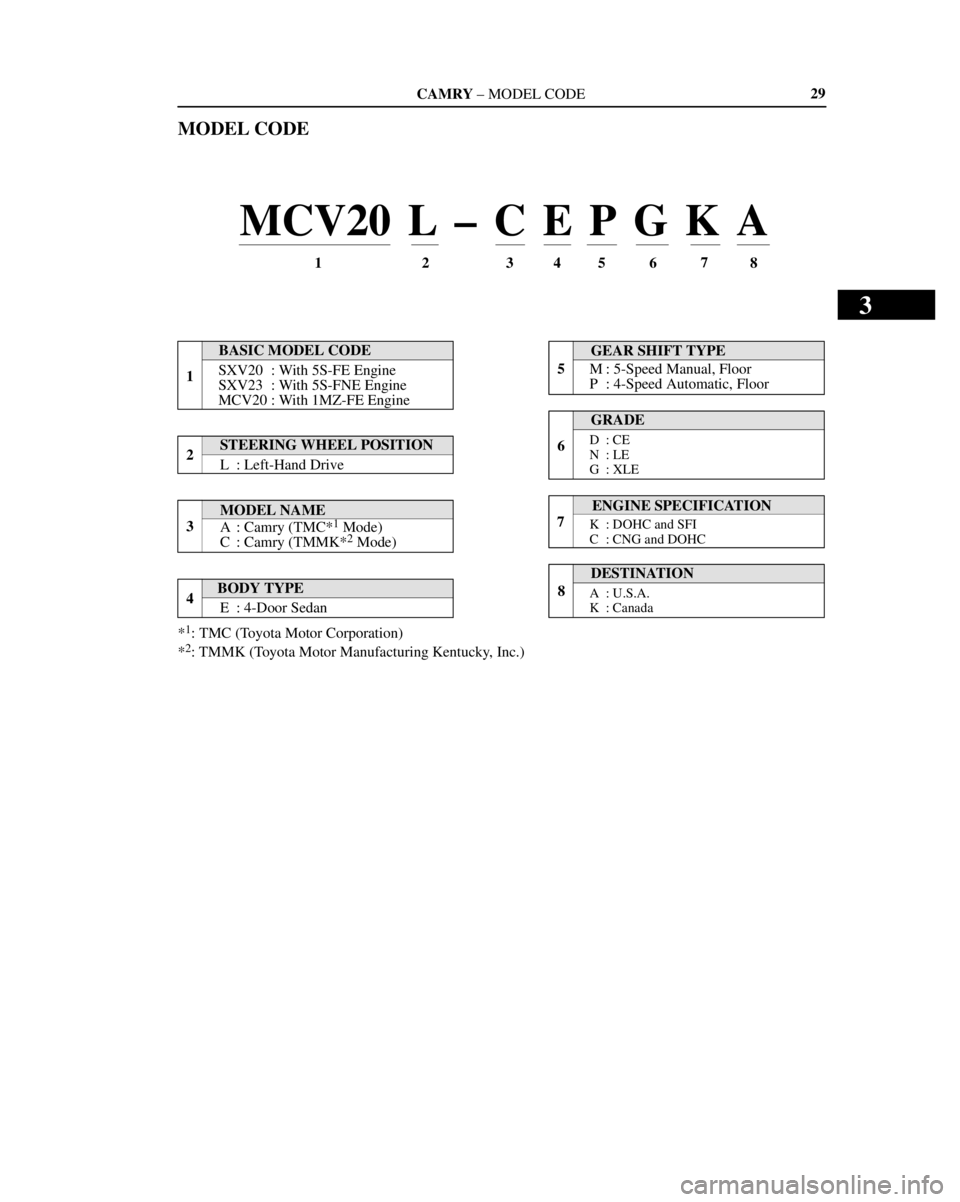
CAMRY ± MODEL CODE
STEERING WHEEL POSITION
MCV20 L ± C E P G K A
1234568
1BASIC MODEL CODE
SXV20 : With 5S-FE Engine
SXV23 : With 5S-FNE Engine
MCV20 : With 1MZ-FE Engine5
6
7
8GEAR SHIFT TYPE
GRADE
ENGINE SPECIFICATION
DESTINATIONK : DOHC and SFI
C : CNG and DOHC
A : U.S.A.
K : Canada D : CE
N: LE
G : XLE
M : 5-Speed Manual, Floor
P : 4-Speed Automatic, Floor
MODEL NAME
BODY TYPE 2
3
4
E : 4-Door Sedan L : Left-Hand Drive
A : Camry (TMC*1 Mode)
C : Camry (TMMK*2 Mode)
*
1: TMC (Toyota Motor Corporation)
*
2: TMMK (Toyota Motor Manufacturing Kentucky, Inc.)729
MODEL CODE
Page 25 of 4770

3
CAMRY ± NEW FEATURES
172CM17
CloseOpen45
2) Fuel Shutoff Valve for Fuel Tank
This valve uses an solenoid valve. The main pipe that supplies compressed gas to the engine is connected
to this valve, which opens when the ignition switch is turned ON. If the engine stalls, this valve automati-
cally shuts off the fuel even if the ignition switch is turned ON. The valve reopens upon restarting the
engine.
Also, this valve shuts off the fuel if the SRS airbag is deployed in a collision or if the pressure in the main
pipe becomes abnormally low.
3) Inlet Check Valve
Connected to a filler pipe that guides the fuel that fills through the coupler, the inlet check valve shuts
off by the force of a spring and by the pressure of the gas in the tank.
During filling, the pressure of the filling gas opens the inlet check valve.
4) Relief Valve
A vent tube is connected to this valve.
If the fuel tank is exposed to an abnormally high temperature, this valve opens (by melting) to discharge
the CNG at a predetermined temperature, thus helping prevent the fuel tank from bursting due to the in-
crease in gas pressure.
The discharged CNG is guided under the floor through a vent tube and is released outside of the vehicle.
Coupler
The coupler allows the fuel to be filled when it is connected with a fuel filling nozzle. The coupler has a
built-in check valve to help prevent the CNG from flowing backward.
Manual Shutoff Valve
This valve is mounted below the vehicle floor.
When servicing the vehicle, this valve can be
manually turned 90 degrees to shut off the main
pipe.
Page 26 of 4770

CAMRY ± NEW FEATURES
167CN10
172CM15
Fuel
Shutoff
Valve
Water Passage
Oil SeparatorRelief Valve 46
Fuel Filter
Mounted below the vehicle floor, the fuel filter
removes any moisture or oil from the fuel.
Fuel Pressure Regulator
�The fuel pressure regulator regulates the fuel pressure by reducing the pressure of the compressed natural
gas from the fuel tank to the fuel injection pressure, which is 8 kg / cm
2 (114 psi, 785 kPa).
�Similar to the fuel shutoff valve for the fuel tank, a fuel shutoff valve is provided on the fuel inlet side
of the fuel pressure regulator to shut off the supply of fuel when the engine is stopped or during abnormal
conditions.
�An oil separator that traps the moisture and oil in the fuel is provided on the low pressure side.
�A built-in relief valve is provided to protect the parts located on the low pressure side.
�While the fuel pressure is being reduced by the fuel pressure regulator, the Joule-Thomson effect
associated with the expansion of the gas causes the fuel pressure regulator to be cooled excessively, exert-
ing unfavorable influence on the rubber parts such as diaphragms and fuel hoses.
Therefore, to raise the gas temperature, a water passage is provided in the fuel pressure regulator to allow
the engine coolant to warm the regulator.
Page 37 of 4770
3
CAMRY ± NEW FEATURES
167CN16
167CN18 167CN17
A ± A Cross Section
Performance RodCut Area
Dumper Stay
Rear Floor Pan for
Gasoline Engine Model
Rear Floor Pan for
CNG Engine ModelMain Muffler
for Gasoline
Engine Model
A
A57
�BODY
�To install the fuel tank in the front area of the luggage compartment, the upper back panel has been cut
for the 5S-FNE engine model.
�To prevent reducing the rigidity of the body due to the upper back panel that has been cut out, as well as
for installing the fuel tank, rear seat back, and package tray trim, a performance rod is used for joining both
rear suspension strut towers for the 5S-FNE engine model.
�The luggage door support has been changed from the torsion bar to the damper stay type for the 5S-FNE
engine model.
�To prevent reducing the capacity of the luggage compartment due to the installation of the fuel tank in the
luggage compartment, the shape of the rear floor pan has been changed.
Page 47 of 4770

1MCV20 L - C E P G K A
12345678
1BASIC MODEL CODESXV20 : With 5S-FE Engine
SXV23 : With 5S-FNE Engine
MCV20 : With 1MZ-FE Engine
2STEERING WHEEL POSITIONL : Left-Hand Drive
4BODY TYPEE : 4-Door Sedan
5GEAR SHIFT TYPEM : 5-Speed Manual, Floor
P : 4-Speed Automatic, Floor
6GRADED : CE
N: LE
G: XLE
8DESTINATIONA : U.S.A.
K : Canada
3MODEL NAMEA : Camry (TMC*1 Made)
C : Camry (TMMK*2 Made)
7ENGINE SPECIFICATIONK : DOHC and SFI
C : CNG and DOHC
CAMRY - MODEL CODE & MODEL LINE-UP3
MODEL CODE
*1: TMC (Toyota Motor Corporation)
*
2: TMMK (Toyota Motor Manufacturing Kentucky, Inc.)
MODEL LINE-UP
DES-BODYTRANSAXLEDES-
TINA-ENGINEBODY
TYPEGRADE5-Speed Manual4-Speed Automatic
TIONTYPES51E153A140EA541E
CESXV20L-
CEMDKASXV20L-
CEPDKA
5S-FELESXV20L-
A(C)EPNKA
USA
XLESXV20L-
A(C)EPGKA
U.S.A.
1MZ FE
LEMCV20L-
CEMNKAMCV20L-
A(C)EPNKA
1MZ-FE
4-DoorXLEMCV20L-
A(C)EPGKA
5S-FNE
4 Door
SedanLESXV23L-
AEPNCA
5S FE
CESXV20L-
AEMDKKSXV20L-
AEPDKK
Canada
5S-FE
LESXV20L-
AEPNKK
Canada
1MZ FE
CEMCV20L-
AEPDKK
1MZ-FE
XLEMCV20L-
AEPGKK
Page 233 of 4770
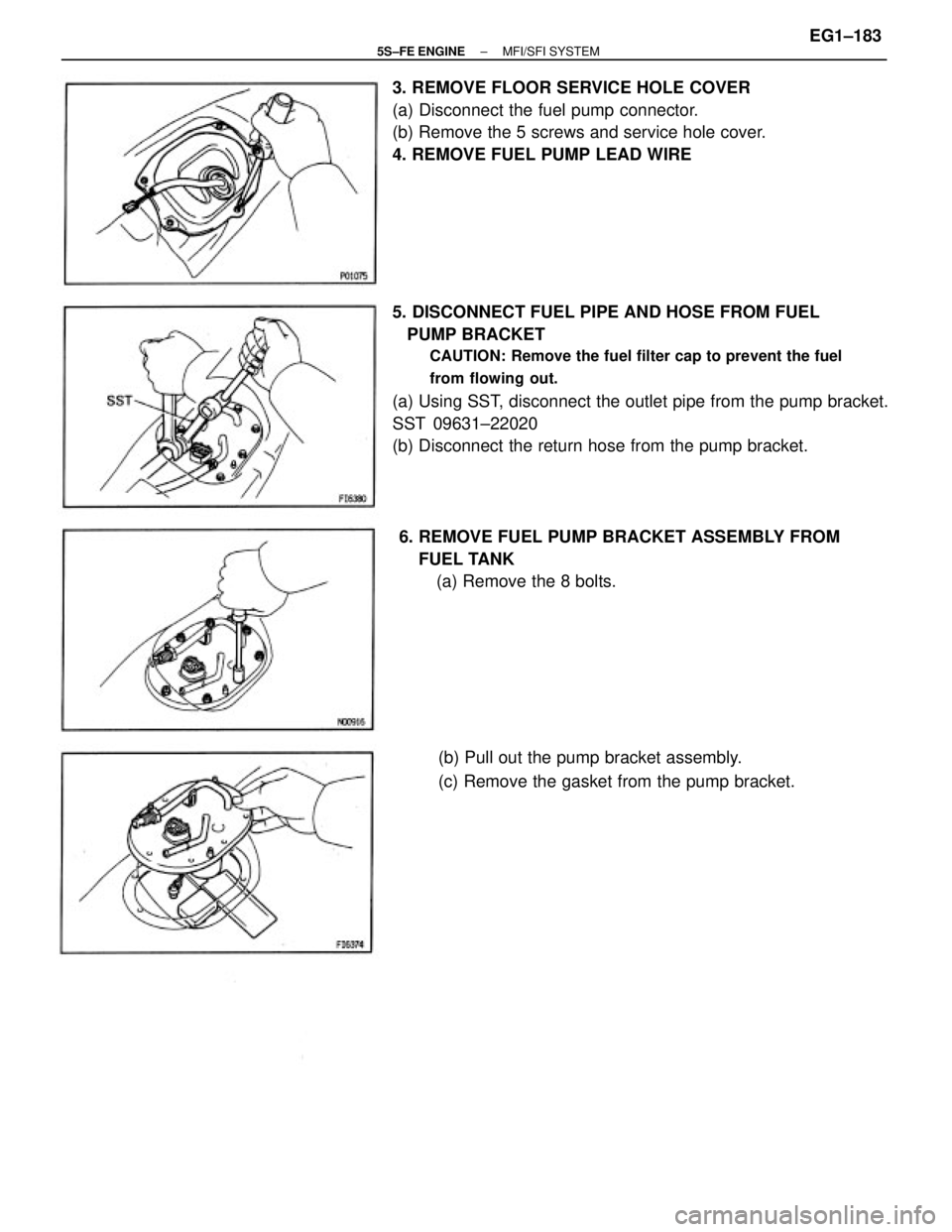
5. DISCONNECT FUEL PIPE AND HOSE FROM FUEL
PUMP BRACKET
CAUTION: Remove the fuel filter cap to prevent the fuel
from flowing out.
(a) Using SST, disconnect the outlet pipe from the pump bracket.
SST 09631±22020
(b) Disconnect the return hose from the pump bracket. 3. REMOVE FLOOR SERVICE HOLE COVER
(a) Disconnect the fuel pump connector.
(b) Remove the 5 screws and service hole cover.
4. REMOVE FUEL PUMP LEAD WIRE
6. REMOVE FUEL PUMP BRACKET ASSEMBLY FROM
FUEL TANK
(a) Remove the 8 bolts.
(b) Pull out the pump bracket assembly.
(c) Remove the gasket from the pump bracket.
± 5S±FE ENGINEMFI/SFI SYSTEMEG1±183
Page 236 of 4770
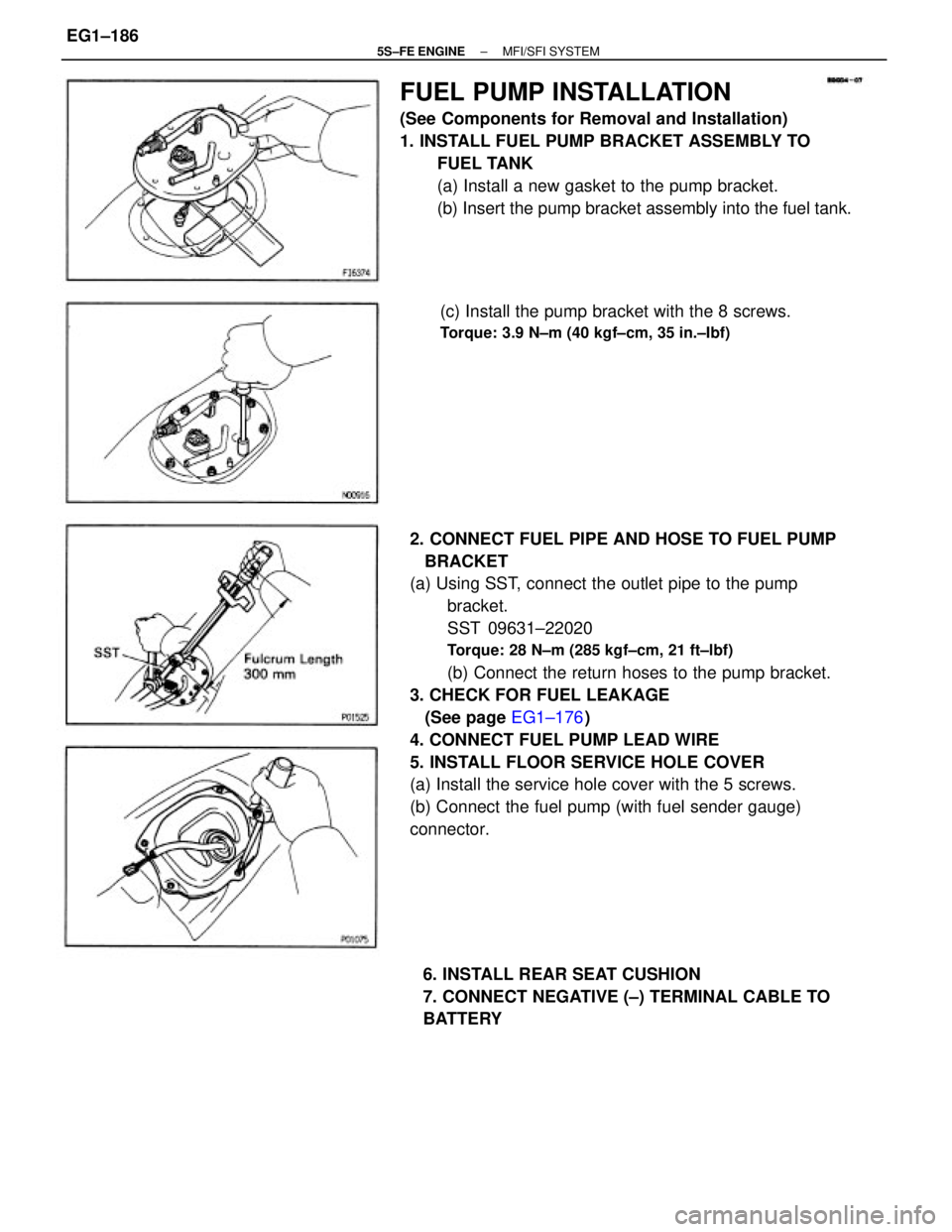
2. CONNECT FUEL PIPE AND HOSE TO FUEL PUMP
BRACKET
(a) Using SST, connect the outlet pipe to the pump
bracket.
SST 09631±22020
Torque: 28 N±m (285 kgf±cm, 21 ft±lbf)
(b) Connect the return hoses to the pump bracket.
3. CHECK FOR FUEL LEAKAGE
(See page EG1±176)
4. CONNECT FUEL PUMP LEAD WIRE
5. INSTALL FLOOR SERVICE HOLE COVER
(a) Install the service hole cover with the 5 screws.
(b) Connect the fuel pump (with fuel sender gauge)
connector.
FUEL PUMP INSTALLATION
(See Components for Removal and Installation)
1. INSTALL FUEL PUMP BRACKET ASSEMBLY TO
FUEL TANK
(a) Install a new gasket to the pump bracket.
(b) Insert the pump bracket assembly into the fuel tank.
6. INSTALL REAR SEAT CUSHION
7. CONNECT NEGATIVE (±) TERMINAL CABLE TO
BATTERY(c) Install the pump bracket with the 8 screws.
Torque: 3.9 N±m (40 kgf±cm, 35 in.±Ibf)
± 5S±FE ENGINEMFI/SFI SYSTEMEG1±186