Page 352 of 4770
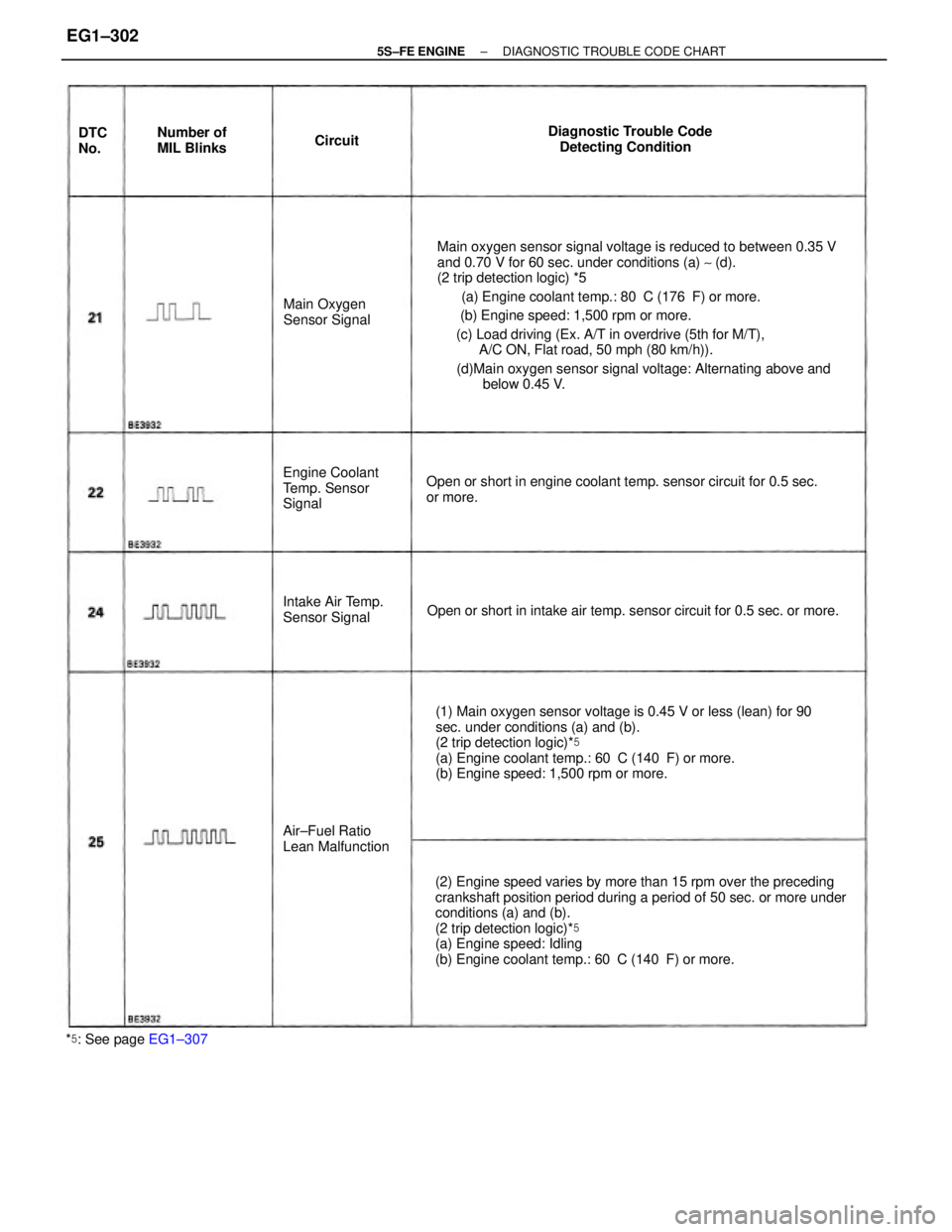
Main oxygen sensor signal voltage is reduced to between 0.35 V
and 0.70 V for 60 sec. under conditions (a) ~ (d).
(2 trip detection logic) *5
(a) Engine coolant temp.: 80�C (176�F) or more.
(b) Engine speed: 1,500 rpm or more.
(c) Load driving (Ex. A/T in overdrive (5th for M/T),
A/C ON, Flat road, 50 mph (80 km/h)).
(d)Main oxygen sensor signal voltage: Alternating above and
below 0.45 V.
(2) Engine speed varies by more than 15 rpm over the preceding
crankshaft position period during a period of 50 sec. or more under
conditions (a) and (b).
(2 trip detection logic)*�
(a) Engine speed: Idling
(b) Engine coolant temp.: 60�C (140�F) or more. (1) Main oxygen sensor voltage is 0.45 V or less (lean) for 90
sec. under conditions (a) and (b).
(2 trip detection logic)*�
(a) Engine coolant temp.: 60�C (140�F) or more.
(b) Engine speed: 1,500 rpm or more. Open or short in engine coolant temp. sensor circuit for 0.5 sec.
or more.
Open or short in intake air temp. sensor circuit for 0.5 sec. or more.Diagnostic Trouble Code
Detecting Condition
Engine Coolant
Temp. Sensor
Signal
Air±Fuel Ratio
Lean Malfunction Intake Air Temp.
Sensor SignalMain Oxygen
Sensor Signal
*�: See page EG1±307Number of
MIL Blinks DTC
No.Circuit
± 5S±FE ENGINEDIAGNOSTIC TROUBLE CODE CHARTEG1±302
Page 353 of 4770
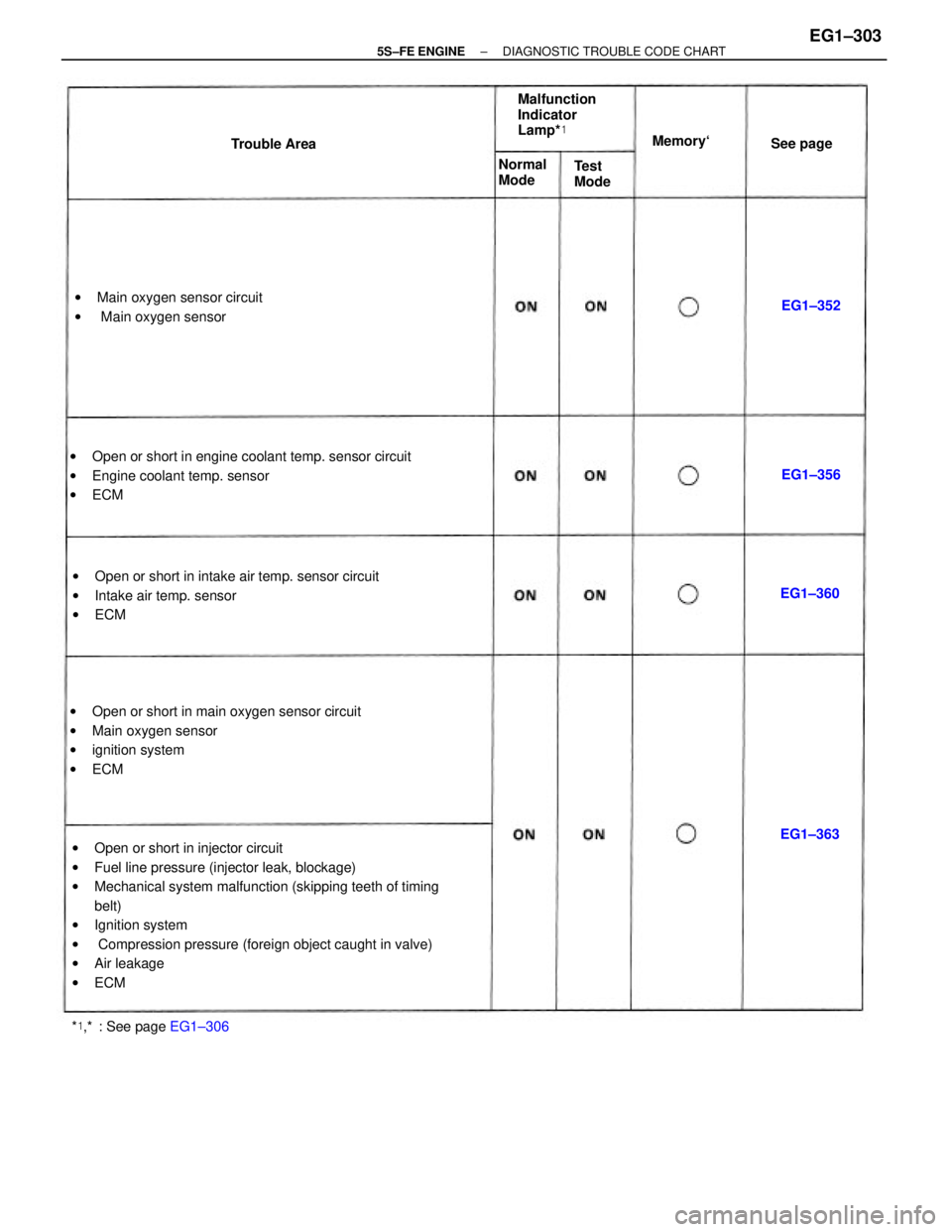
wOpen or short in injector circuit
wFuel line pressure (injector leak, blockage)
wMechanical system malfunction (skipping teeth of timing
belt)
wIgnition system
w Compression pressure (foreign object caught in valve)
wAir leakage
wECM wOpen or short in main oxygen sensor circuit
wMain oxygen sensor
wignition system
wECM wOpen or short in engine coolant temp. sensor circuit
wEngine coolant temp. sensor
wECM
wOpen or short in intake air temp. sensor circuit
wIntake air temp. sensor
wECM wMain oxygen sensor circuit
w Main oxygen sensorMalfunction
Indicator
Lamp*�
*�,*�: See page EG1±306Normal
Mode Trouble AreaMemory`
Test
ModeSee page
EG1±360
EG1±363EG1±352
EG1±356
± 5S±FE ENGINEDIAGNOSTIC TROUBLE CODE CHARTEG1±303
Page 354 of 4770
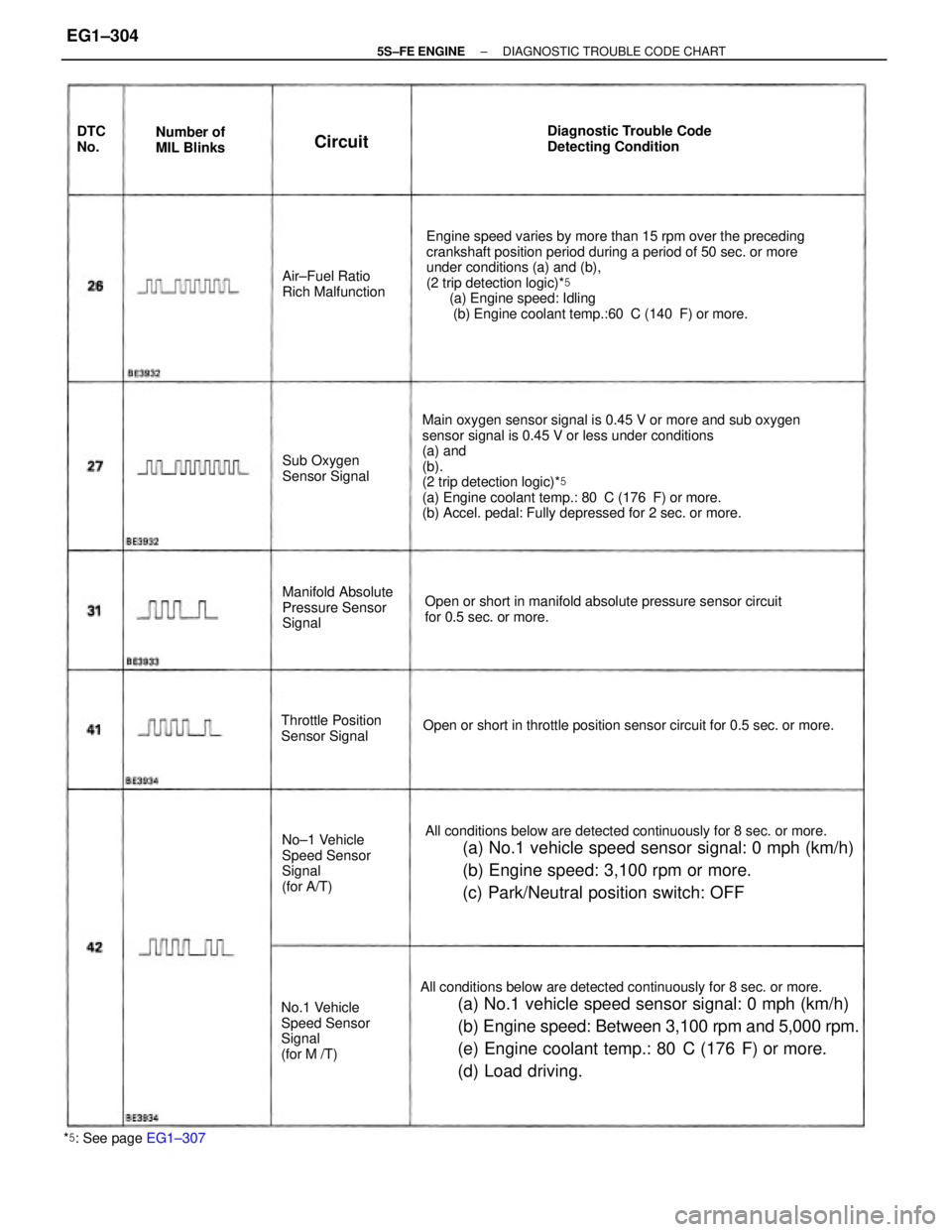
All conditions below are detected continuously for 8 sec. or more.
(a) No.1 vehicle speed sensor signal: 0 mph (km/h)
(b) Engine speed: Between 3,100 rpm and 5,000 rpm.
(e) Engine coolant temp.: 80
�C (176�F) or more.
(d) Load driving.
Engine speed varies by more than 15 rpm over the preceding
crankshaft position period during a period of 50 sec. or more
under conditions (a) and (b),
(2 trip detection logic)*�
(a) Engine speed: Idling
(b) Engine coolant temp.:60�C (140�F) or more.
Main oxygen sensor signal is 0.45 V or more and sub oxygen
sensor signal is 0.45 V or less under conditions
(a) and
(b).
(2 trip detection logic)*�
(a) Engine coolant temp.: 80�C (176�F) or more.
(b) Accel. pedal: Fully depressed for 2 sec. or more.
All conditions below are detected continuously for 8 sec. or more.
(a) No.1 vehicle speed sensor signal: 0 mph (km/h)
(b) Engine speed: 3,100 rpm or more.
(c) Park/Neutral position switch: OFF
Open or short in manifold absolute pressure sensor circuit
for 0.5 sec. or more.
Open or short in throttle position sensor circuit for 0.5 sec. or more.Diagnostic Trouble Code
Detecting Condition
No.1 Vehicle
Speed Sensor
Signal
(for M /T)Manifold Absolute
Pressure Sensor
Signal
No±1 Vehicle
Speed Sensor
Signal
(for A/T) Throttle Position
Sensor SignalAir±Fuel Ratio
Rich Malfunction
Sub Oxygen
Sensor Signal
*�: See page EG1±307Number of
MIL Blinks DTC
No.
Circuit
± 5S±FE ENGINEDIAGNOSTIC TROUBLE CODE CHARTEG1±304
Page 355 of 4770
wOpen or short in injector circuit
wFuel line pressure (injector leak, blockage)
wMechanical system malfunction (skipping teeth of timing
belt)
wIgnition system
wCompression pressure (foreign object caught in valve)
wAir leakage
w ECM
wOpen or short in No.1 vehicle speed sensor circuit
wNo.1 vehicle speed sensor
wCombination meter
wECM wOpen or short in manifold absolute pressure sensor circuit.
wManifold absolute pressure sensor
wECM
wOpen or short in throttle position sensor circuit
wThrottle position sensor
wECM wOpen or short in sub oxygen sensor circuit
wSub oxygen sensor
wECMMalfunction
Indicator
Lamp*�
*�,*�: See page EG1±306Normal
Mode Trouble Area
Memory*�
Test
ModeSee page
EG1±380EG1±369
EG1±376EG1±372EG1±363
OFF OFF
± 5S±FE ENGINEDIAGNOSTIC TROUBLE CODE CHARTEG1±305
Page 356 of 4770

*1; ªONº displayed in the diagnosis mode column indicates that the Malfunction Indicator Lamp is lighted up when a
malfunction is detected. ªOFFº indicates that the ªCHECKº does not light up during malfunction diagnosis, even if a
malfunction is detected. ªN.A.º indicates that the item is not included in malfunction diagnosis.
*2; ªOº in the memory column indicates that a diagnostic trouble code is recorded in the ECM memory when a malfunction
occurs. ªXº indicates that a diagnostic trouble code is not recorded in the ECM memory even if a malfunction occurs.
Accordingly, output of diagnostic results in normal or test mode is performed with the IG switch ON.
*3; Only for California specification vehicles.
*4; Only vehicles with A/T.EGR gas temp. is 70�C (158�F) or below for 50 sec. under
conditions (a) and (b).
(2 trip detection logic)*�
(a) Engine coolant temp.: 80�C (176�F) or more.
(b) EGR operation possible (Ex. A/T in 3rd speed (5th for
M/T), 55 ± 60 mph (88 ± 96 km/h), Flat road).
(1) 3 sec. or more after engine starts with closed throttle position
switch OFF (IDL).
(2) *� Park/Neutral switch OFF (PNP).
(Shift position in ªRº, ªDº, ª2º, or ªLº positions).
(3) A/C switch ON. Open or short in knock sensor circuit with engine speed
between 1,200 rpm and 6,000 rpm.Diagnostic trouble Code
Detecting Condition
Switch Condition
SignalNo starter signal to ECM.
Knock Sensor
Signal
EG R System
Malfunction Number of
MIL Blinks
Starter Signal DTC
No.Circuit
± 5S±FE ENGINEDIAGNOSTIC TROUBLE CODE CHARTEG1±306
Page 357 of 4770
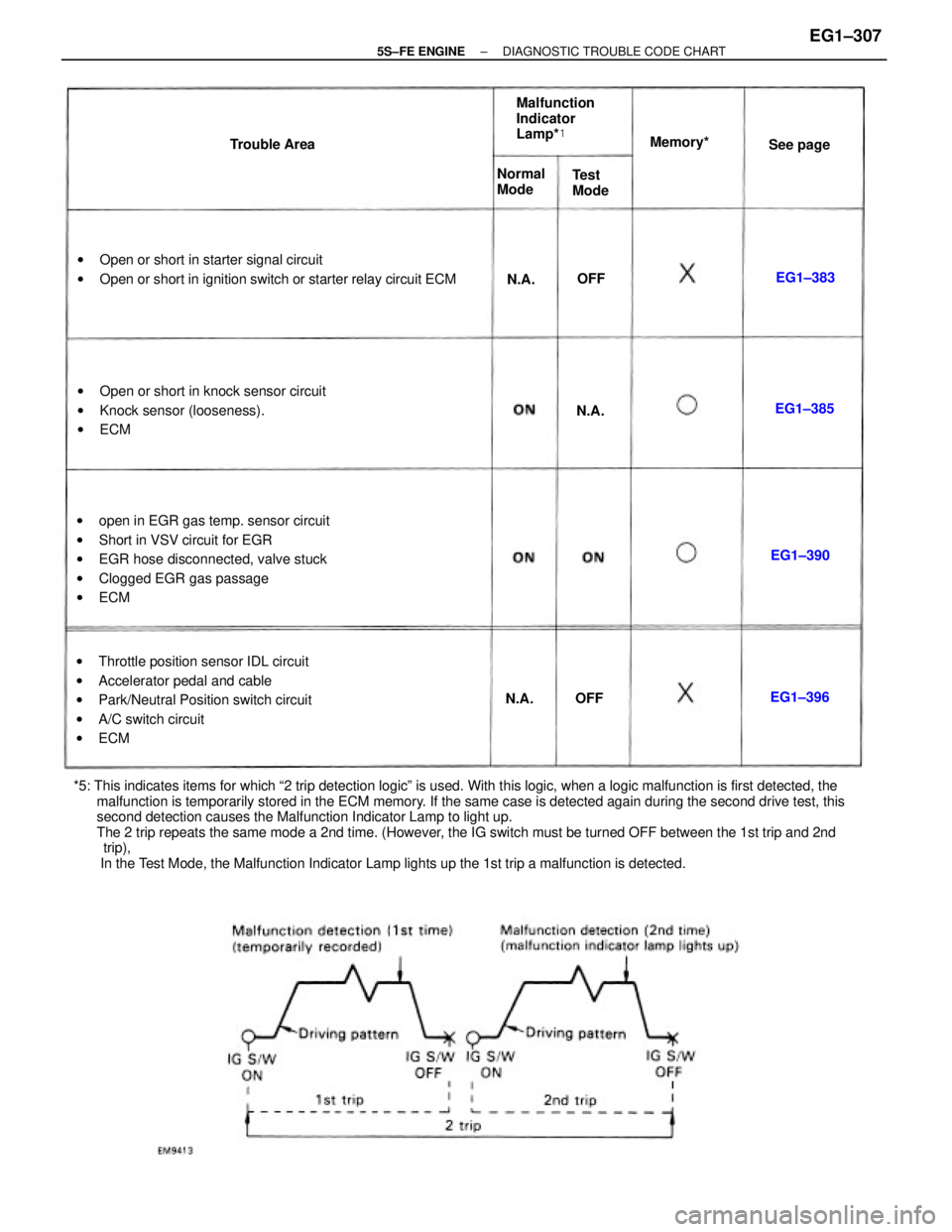
*5: This indicates items for which ª2 trip detection logicº is used. With this logic, when a logic malfunction is first detected, the
malfunction is temporarily stored in the ECM memory. If the same case is detected again during the second drive test, this
second detection causes the Malfunction Indicator Lamp to light up.
The 2 trip repeats the same mode a 2nd time. (However, the IG switch must be turned OFF between the 1st trip and 2nd
trip),
In the Test Mode, the Malfunction Indicator Lamp lights up the 1st trip a malfunction is detected.wopen in EGR gas temp. sensor circuit
wShort in VSV circuit for EGR
wEGR hose disconnected, valve stuck
wClogged EGR gas passage
wECM
wThrottle position sensor IDL circuit
wAccelerator pedal and cable
wPark/Neutral Position switch circuit
wA/C switch circuit
wECM wOpen or short in starter signal circuit
wOpen or short in ignition switch or starter relay circuit ECM
wOpen or short in knock sensor circuit
wKnock sensor (looseness).
wECMMalfunction
Indicator
Lamp*�
Normal
Mode Trouble AreaMemory*�
Test
ModeSee page
EG1±390EG1±385
EG1±396EG1±383
N.A.N.A.
N.A.
OFFOFF
± 5S±FE ENGINEDIAGNOSTIC TROUBLE CODE CHARTEG1±307
Page 359 of 4770
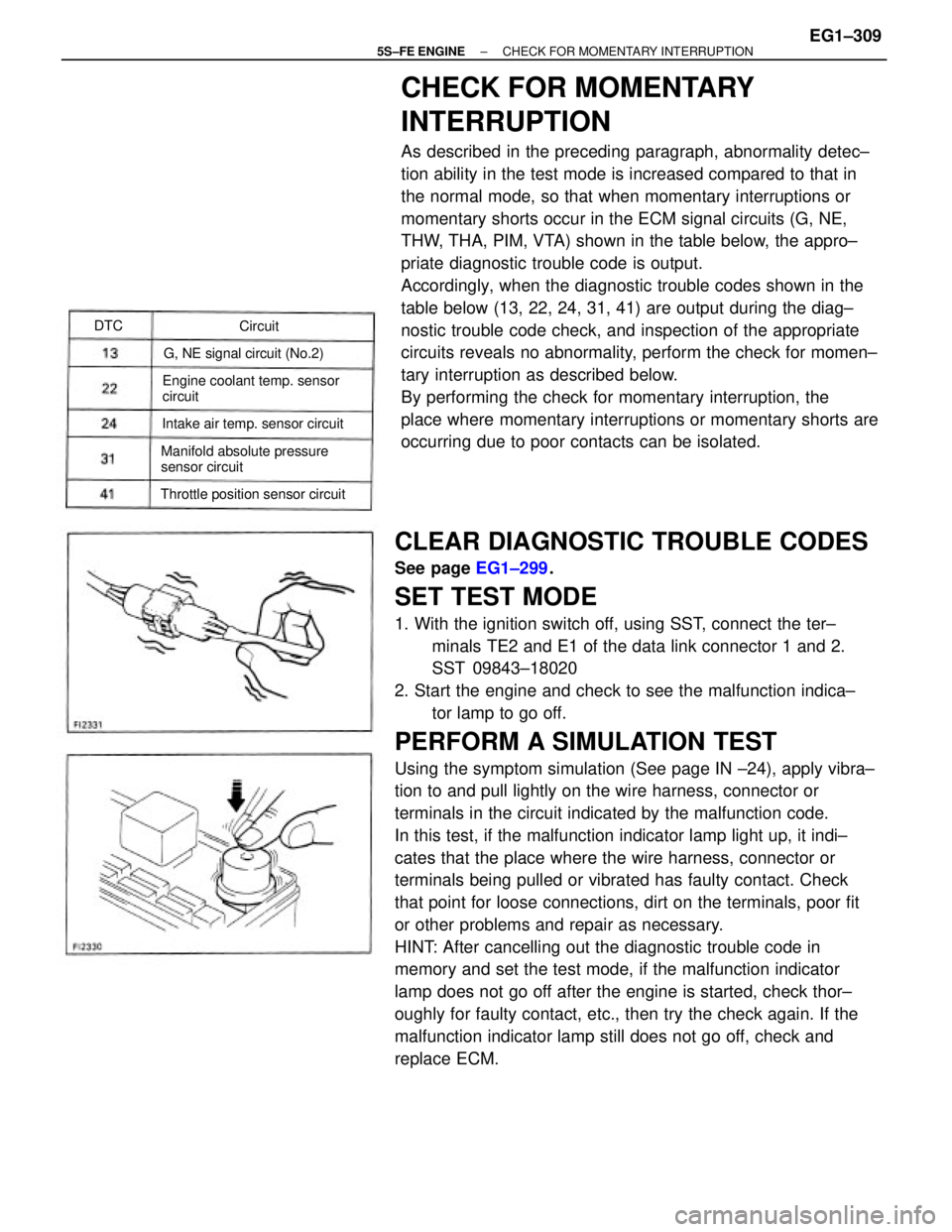
CLEAR DIAGNOSTIC TROUBLE CODES
See page EG1±299.
SET TEST MODE
1. With the ignition switch off, using SST, connect the ter±
minals TE2 and E1 of the data link connector 1 and 2.
SST 09843±18020
2. Start the engine and check to see the malfunction indica±
tor lamp to go off.
PERFORM A SIMULATION TEST
Using the symptom simulation (See page IN ±24), apply vibra±
tion to and pull lightly on the wire harness, connector or
terminals in the circuit indicated by the malfunction code.
In this test, if the malfunction indicator lamp light up, it indi±
cates that the place where the wire harness, connector or
terminals being pulled or vibrated has faulty contact. Check
that point for loose connections, dirt on the terminals, poor fit
or other problems and repair as necessary.
HINT: After cancelling out the diagnostic trouble code in
memory and set the test mode, if the malfunction indicator
lamp does not go off after the engine is started, check thor±
oughly for faulty contact, etc., then try the check again. If the
malfunction indicator lamp still does not go off, check and
replace ECM.
CHECK FOR MOMENTARY
INTERRUPTION
As described in the preceding paragraph, abnormality detec±
tion ability in the test mode is increased compared to that in
the normal mode, so that when momentary interruptions or
momentary shorts occur in the ECM signal circuits (G, NE,
THW, THA, PIM, VTA) shown in the table below, the appro±
priate diagnostic trouble code is output.
Accordingly, when the diagnostic trouble codes shown in the
table below (13, 22, 24, 31, 41) are output during the diag±
nostic trouble code check, and inspection of the appropriate
circuits reveals no abnormality, perform the check for momen±
tary interruption as described below.
By performing the check for momentary interruption, the
place where momentary interruptions or momentary shorts are
occurring due to poor contacts can be isolated.
Engine coolant temp. sensor
circuit
Manifold absolute pressure
sensor circuit
Throttle position sensor circuitIntake air temp. sensor circuitG, NE signal circuit (No.2)Circuit DTC
± 5S±FE ENGINECHECK FOR MOMENTARY INTERRUPTIONEG1±309
Page 369 of 4770
wManifold absolute pressure sensor
wThrottle position sensor Manifold absolute pressure sensor
wDefogger relay
wTaillight relay Engine coolant temp. sensorData link connector 1 and 2
Data link connector 1 and 2Malfunction indicator lamp Injectors (No.2 and No.4)
No.1 vehicle speed sensorThrottle position sensor
Throttle position sensorIntake air temp. sensorEG R gas temp. sensor
Circuit opening relay
Main oxygen sensor
Data link connector 1Sub oxygen sensor Terminal
No.Terminal
No.
A/C amplifier
EFI main relayEFI main relay Sensor ground
Sensor groundA/C amplifier
Power ground
ECM groundConnection Connection
VSV for EG R
Knock sensorSymbol Symbol
Battery Igniter
± 5S±FE ENGINETERMINALS OF ECMEG1±319