Page 435 of 4770
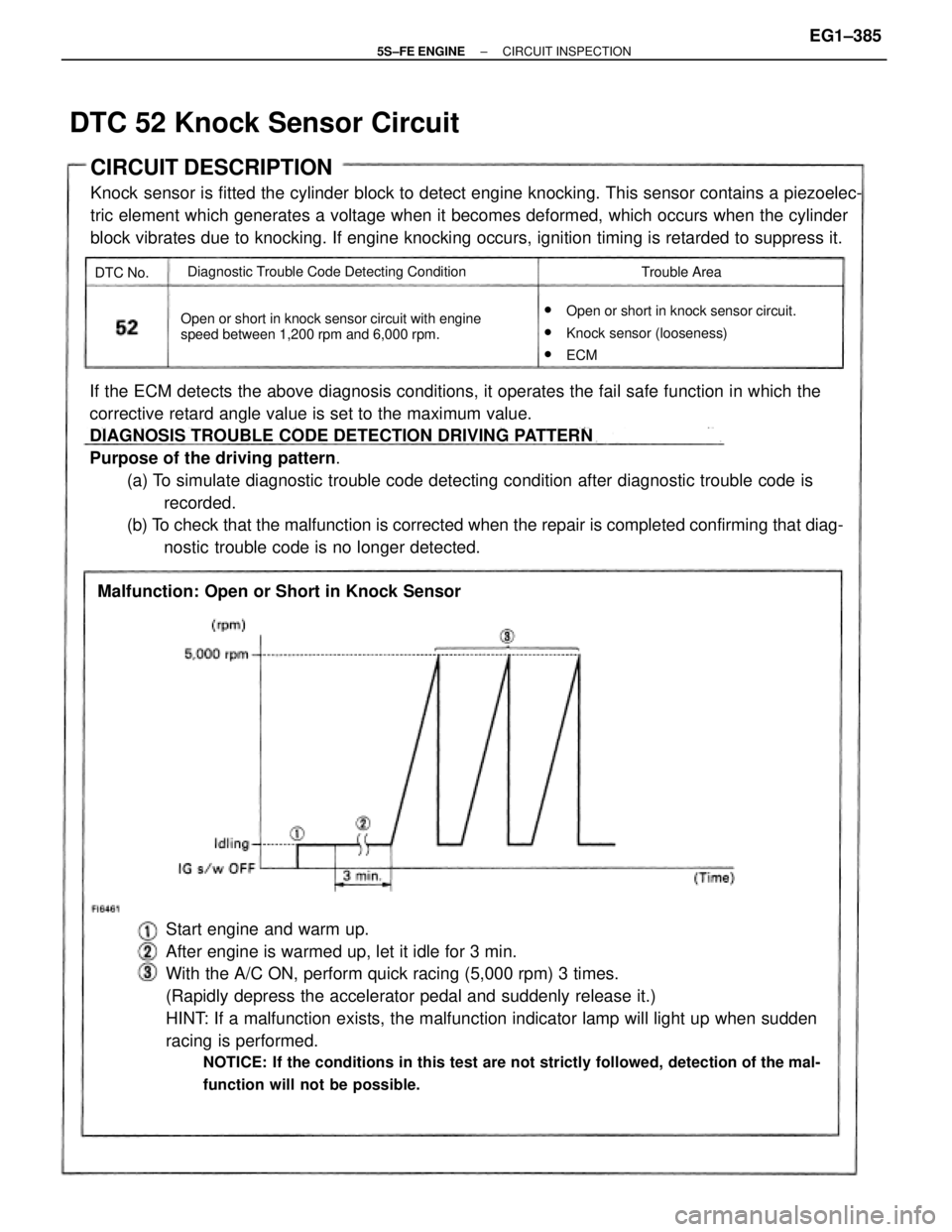
If the ECM detects the above diagnosis conditions, it operates the fail safe function in which the
corrective retard angle value is set to the maximum value.
DIAGNOSIS TROUBLE CODE DETECTION DRIVING PATTERN
Purpose of the driving pattern.
(a) To simulate diagnostic trouble code detecting condition after diagnostic trouble code is
recorded.
(b) To check that the malfunction is corrected when the repair is completed confirming that diag-
nostic trouble code is no longer detected.
Start engine and warm up.
After engine is warmed up, let it idle for 3 min.
With the A/C ON, perform quick racing (5,000 rpm) 3 times.
(Rapidly depress the accelerator pedal and suddenly release it.)
HINT: If a malfunction exists, the malfunction indicator lamp will light up when sudden
racing is performed.
NOTICE: If the conditions in this test are not strictly followed, detection of the mal-
function will not be possible.
CIRCUIT DESCRIPTION
Knock sensor is fitted the cylinder block to detect engine knocking. This sensor contains a piezoelec-
tric element which generates a voltage when it becomes deformed, which occurs when the cylinder
block vibrates due to knocking. If engine knocking occurs, ignition timing is retarded to suppress it.
w
Open or short in knock sensor circuit.
wKnock sensor (looseness)
wECM Open or short in knock sensor circuit with engine
speed between 1,200 rpm and 6,000 rpm.
Malfunction: Open or Short in Knock Sensor
Diagnostic Trouble Code Detecting Condition
Trouble Area
DTC 52 Knock Sensor Circuit
DTC No.
± 5S±FE ENGINECIRCUIT INSPECTIONEG1±385
Page 436 of 4770
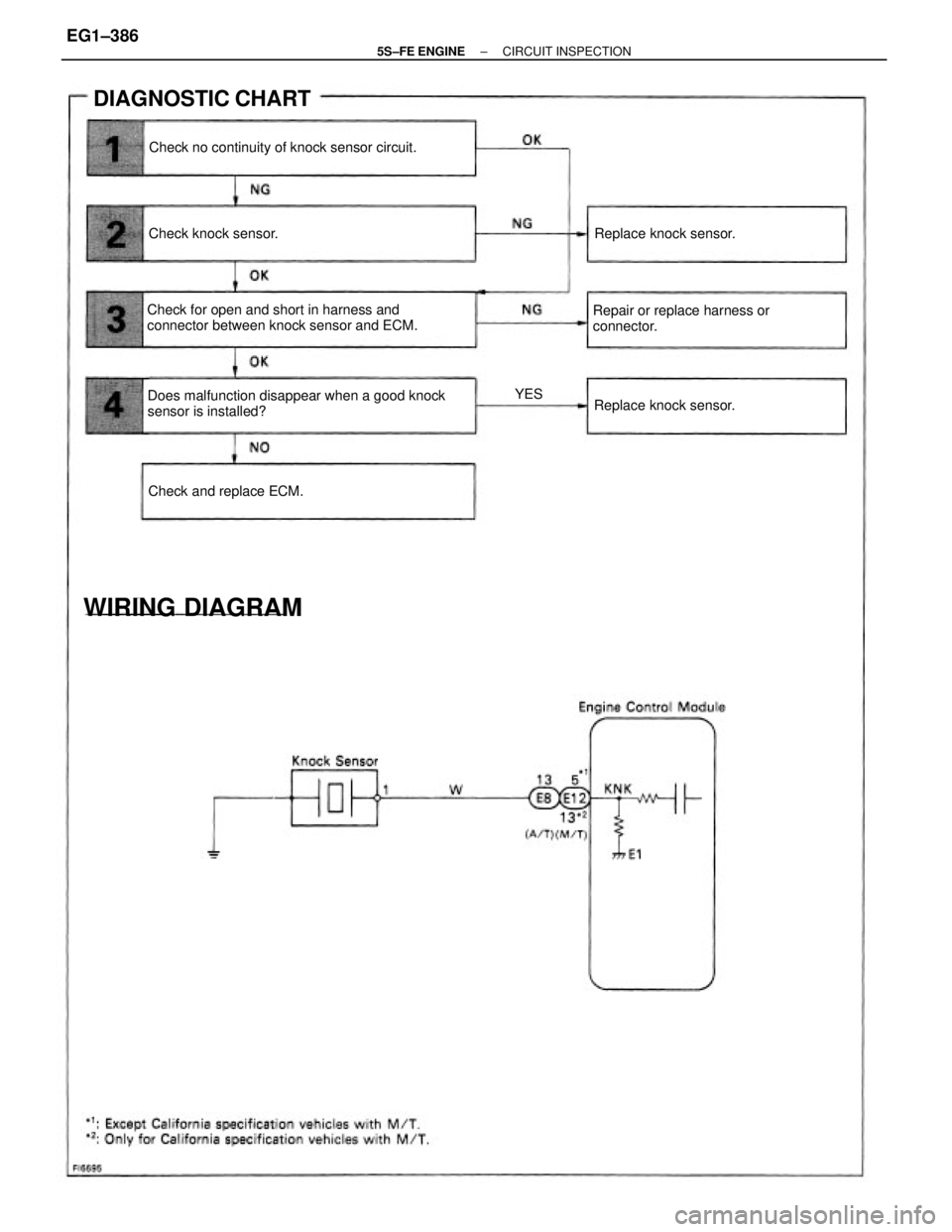
Does malfunction disappear when a good knock
sensor is installed? Check for open and short in harness and
connector between knock sensor and ECM.Repair or replace harness or
connector. Check no continuity of knock sensor circuit.
DIAGNOSTIC CHART
WIRING DIAGRAM
Check and replace ECM.Replace knock sensor.Replace knock sensor. Check knock sensor.
YES
± 5S±FE ENGINECIRCUIT INSPECTIONEG1±386
Page 438 of 4770
Disconnect knock sensor connector.
Check for open and short in harness and connector between engine
control module and knock sensor (See page IN±31).
Does malfunction disappear when a good knock sensor is installed?
Check and replace engine control module.Replace knock sensor (See page EG1±93).
Replace knock sensor (See page EG1±93). Repair or replace harness or connector.
Check knock sensor.
YES
Measure resistance between the knock
sensor terminal and body.
Resistance: 1 M� or higher
± 5S±FE ENGINECIRCUIT INSPECTIONEG1±388
Page 439 of 4770
wSpread the time on the horizontal axis, and
confirm that period of the wave is 132
sec.
(Normal mode vibration frequency of knock
sensor: 7.6 KHz).
HINT: If normal mode vibration frequency is not 7.6
KHz, the sensor is malfunctioning.wWith the engine racing (4,000 rpm) measure
waveform between terminal KN K of engine
control module and body ground.
HINT: The correct waveform appears as shown in the
illustration on the left.
INSPECTION USING OSCILLOSCOPE Reference
± 5S±FE ENGINECIRCUIT INSPECTIONEG1±389
Page 440 of 4770

CIRCUIT DESCRIPTION
The EGR system recirculates exhaust gas, which is controlled to the proper quantity to suit the
driving conditions, into the intake air mixture to slow down combustion, reduce the combustion
temperature and reduces NOx emissions. The amount of EGR is regulated by the EGR vacuum
modulator according to the engine load.
If even one of the following conditions is fulfilled,
the VSV is turned ON by a signal from the ECM.
This results in atmospheric air acting on the EGR
valve, closing the EGR valve and shutting off the
exhaust gas (EGR cut±OFF).
Under the following conditions, EGR is cut to
maintain driveability.
wEngine coolant temp. below 60�C (140�F).
wDuring deceleration (throttle valve closed).
wLight engine load (amount of intake air very
small).
wEngine speed over 4,400 rpm.
wEngine racing.
EG R gas temp. is 70�C (158�F) or below for 50
sec. under conditions (a) and (b).
(2 trip detection logic) *
(a) Engine coolant temp.: 80�C (176�F) or more.
(b) EGR operation possible (EX. A/T in 3rd speed
(5th for M/T), 55 ± 60 mph (88 ± 96 km/h),
Flat road).wOpen in EGR gas temp. sensor circuit.
wShort in VSV circuit for EGR.
wEGR hose disconnected, valve stuck.
wClogged EGR gas passage.
wECM Diagnostic Trouble Code Detecting Condition
*: See page
EG1±307.Trouble Area DTC No.
DTC 71 EGR System Malfunction
± 5S±FE ENGINECIRCUIT INSPECTIONEG1±390
Page 441 of 4770

Disconnect the EFI fuse (15 A) for 10 sec. or more, with IG switch OFF. Initiate
test mode (Connect terminals TE2 and E1 of data link connector, 1 or 2 with IG
switch OFF).
CIRCUIT DESCRIPTION (Cont'd)
DIAGNOSIS TROUBLE CODE DETECTION DRIVING PATTERN
Purpose of the driving pattern.
(a) To simulate diagnostic trouble code detecting condition after diagnostic trouble code is
recorded.
(b) To check that the malfunction is corrected when the repair is completed confirming that diag-
nostic trouble code is no longer detected.
Malfunction: Open in EGR gas temp. sensor circuit
Start the engine and warm up.
After the engine is warmed up, let it idle for 3 min.
With the A/C ON and transmission in 5th gear A/T in ªDº position), drive at
55 ± 60 mph (88 ± 96 km/h) for 4 min. or less.
HINT: If a malfunction exists, the malfunction indicator lamp will light up dur-
ing step (4) .
NOTICE: If the conditions in this test are not strictly observed, detection of
the malfunction will not be possible.
± 5S±FE ENGINECIRCUIT INSPECTIONEG1±391
Page 442 of 4770
Check for open and short in harness and
connector between EFI main relay and ECM.
Check for open in harness and connector
between EGR gas temp. sensor and ECM. Check voltage of VSV for EGR Power source.
Repair or replace harness or
connector.
Repair or replace harness or
connector. Check resistance of EGR gas temp. sensor. Check EGR system (See page EG1±153) .
WIRING DIAGRAM
DIAGNOSTIC CHART
Check resistance of VSV for EG R.
Replace EGR gas temp. sensor.
Check and replace ECM.Check and replace ECM.Replace VSV for EG R.
Repair EGR system.
± 5S±FE ENGINECIRCUIT INSPECTIONEG1±392
Page 445 of 4770
Remove EGR gas temp. sensor.
Measure resistance between terminals of EG R
gas temp. sensor connector.
Resistance: 64 ± 97 k
� at 50�C (122�F)
11 ±16 k
� at 100�C (212�F)
2 ± 4 k
� at 150�C (302�F)
Check for open in harness and connector between EGR gas temp.
sensor and engine control module (See page IN±31). Check resistance of EGR gas temp, sensor.
Check and replace engine control module.Repair or replace harness or connector. Replace EGR gas temp. sensor.
± 5S±FE ENGINECIRCUIT INSPECTIONEG1±395