2000 DODGE NEON warning
[x] Cancel search: warningPage 57 of 1285
(10) With suspension at curb height, tighten the
lateral arm mounting bolt nut at the crossmember to
88 N´m (65 ft. lbs.).
(11) Set the rear toe on the vehicle to the required
specification as necessary. Refer to WHEEL ALIGN-
MENT in this service manual group.
TENSION STRUT
NOTE: Before proceeding with this procedure,
review SERVICE WARNINGS AND CAUTIONS at the
beginning of REMOVAL AND INSTALLATION in this
section.
REMOVAL
(1) Raise the vehicle. Refer to HOISTING in the
LUBRICATION AND MAINTENANCE group for the
proper lifting procedure.
(2) Remove the rear wheel and tire assembly from
the vehicle.
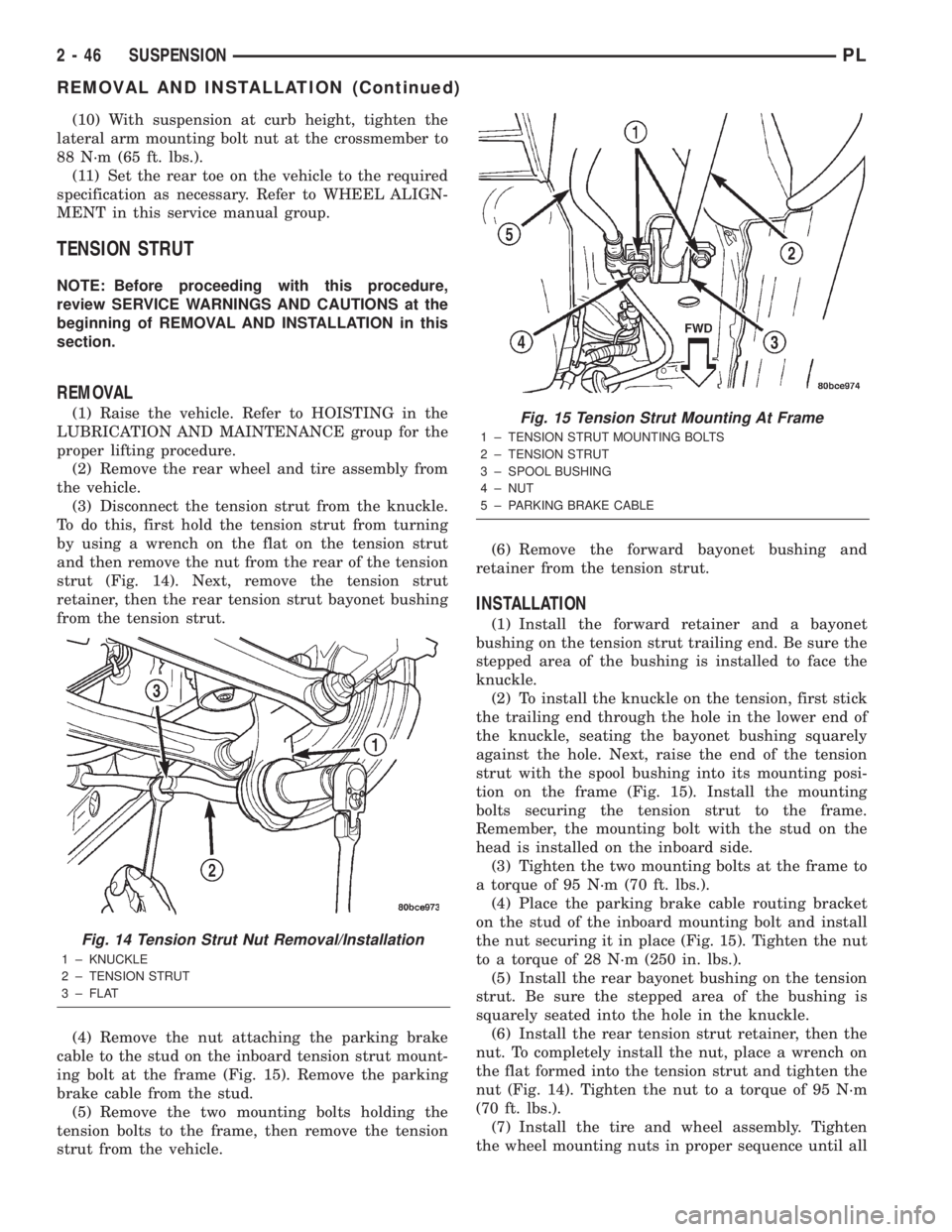
(3) Disconnect the tension strut from the knuckle.
To do this, first hold the tension strut from turning
by using a wrench on the flat on the tension strut
and then remove the nut from the rear of the tension
strut (Fig. 14). Next, remove the tension strut
retainer, then the rear tension strut bayonet bushing
from the tension strut.
(4) Remove the nut attaching the parking brake
cable to the stud on the inboard tension strut mount-
ing bolt at the frame (Fig. 15). Remove the parking
brake cable from the stud.
(5) Remove the two mounting bolts holding the
tension bolts to the frame, then remove the tension
strut from the vehicle.(6) Remove the forward bayonet bushing and
retainer from the tension strut.
INSTALLATION
(1) Install the forward retainer and a bayonet
bushing on the tension strut trailing end. Be sure the
stepped area of the bushing is installed to face the
knuckle.
(2) To install the knuckle on the tension, first stick
the trailing end through the hole in the lower end of
the knuckle, seating the bayonet bushing squarely
against the hole. Next, raise the end of the tension
strut with the spool bushing into its mounting posi-
tion on the frame (Fig. 15). Install the mounting
bolts securing the tension strut to the frame.
Remember, the mounting bolt with the stud on the
head is installed on the inboard side.
(3) Tighten the two mounting bolts at the frame to
a torque of 95 N´m (70 ft. lbs.).
(4) Place the parking brake cable routing bracket
on the stud of the inboard mounting bolt and install
the nut securing it in place (Fig. 15). Tighten the nut
to a torque of 28 N´m (250 in. lbs.).
(5) Install the rear bayonet bushing on the tension
strut. Be sure the stepped area of the bushing is
squarely seated into the hole in the knuckle.
(6) Install the rear tension strut retainer, then the
nut. To completely install the nut, place a wrench on
the flat formed into the tension strut and tighten the
nut (Fig. 14). Tighten the nut to a torque of 95 N´m
(70 ft. lbs.).
(7) Install the tire and wheel assembly. Tighten
the wheel mounting nuts in proper sequence until all
Fig. 14 Tension Strut Nut Removal/Installation
1 ± KNUCKLE
2 ± TENSION STRUT
3 ± FLAT
Fig. 15 Tension Strut Mounting At Frame
1 ± TENSION STRUT MOUNTING BOLTS
2 ± TENSION STRUT
3 ± SPOOL BUSHING
4 ± NUT
5 ± PARKING BRAKE CABLE
2 - 46 SUSPENSIONPL
REMOVAL AND INSTALLATION (Continued)
Page 58 of 1285
nuts are torqued to half specification. Repeat the
tightening sequence, this time, to full specified
torque of 135 N´m (100 ft. lbs.).
(8) Lower the vehicle to ground level.
(9) Set the rear toe on the vehicle to the required
specification if necessary. Refer to WHEEL ALIGN-
MENT in this service manual group.
STABILIZER BAR (REAR)
NOTE: Before proceeding with this procedure,
review SERVICE WARNINGS AND CAUTIONS at the
beginning of REMOVAL AND INSTALLATION in this
section.
REMOVAL
(1) Raise the vehicle. Refer to HOISTING in the
LUBRICATION AND MAINTENANCE group for the
proper lifting procedure.
(2) Remove both rear wheel and tire assemblies
from the vehicle.
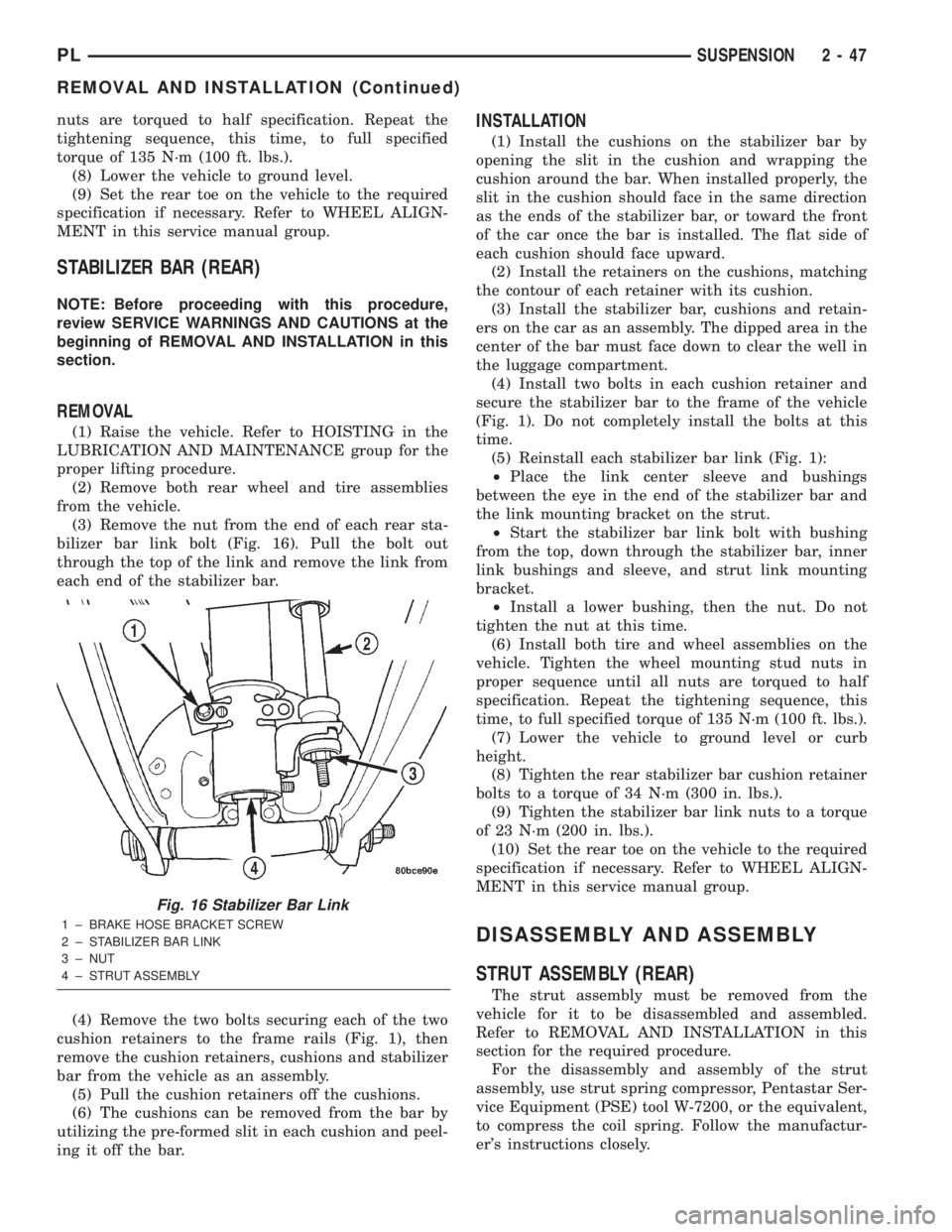
(3) Remove the nut from the end of each rear sta-
bilizer bar link bolt (Fig. 16). Pull the bolt out
through the top of the link and remove the link from
each end of the stabilizer bar.
(4) Remove the two bolts securing each of the two
cushion retainers to the frame rails (Fig. 1), then
remove the cushion retainers, cushions and stabilizer
bar from the vehicle as an assembly.
(5) Pull the cushion retainers off the cushions.
(6) The cushions can be removed from the bar by
utilizing the pre-formed slit in each cushion and peel-
ing it off the bar.
INSTALLATION
(1) Install the cushions on the stabilizer bar by
opening the slit in the cushion and wrapping the
cushion around the bar. When installed properly, the
slit in the cushion should face in the same direction
as the ends of the stabilizer bar, or toward the front
of the car once the bar is installed. The flat side of
each cushion should face upward.
(2) Install the retainers on the cushions, matching
the contour of each retainer with its cushion.
(3) Install the stabilizer bar, cushions and retain-
ers on the car as an assembly. The dipped area in the
center of the bar must face down to clear the well in
the luggage compartment.
(4) Install two bolts in each cushion retainer and
secure the stabilizer bar to the frame of the vehicle
(Fig. 1). Do not completely install the bolts at this
time.
(5) Reinstall each stabilizer bar link (Fig. 1):
²Place the link center sleeve and bushings
between the eye in the end of the stabilizer bar and
the link mounting bracket on the strut.
²Start the stabilizer bar link bolt with bushing
from the top, down through the stabilizer bar, inner
link bushings and sleeve, and strut link mounting
bracket.
²Install a lower bushing, then the nut. Do not
tighten the nut at this time.
(6) Install both tire and wheel assemblies on the
vehicle. Tighten the wheel mounting stud nuts in
proper sequence until all nuts are torqued to half
specification. Repeat the tightening sequence, this
time, to full specified torque of 135 N´m (100 ft. lbs.).
(7) Lower the vehicle to ground level or curb
height.
(8) Tighten the rear stabilizer bar cushion retainer
bolts to a torque of 34 N´m (300 in. lbs.).
(9) Tighten the stabilizer bar link nuts to a torque
of 23 N´m (200 in. lbs.).
(10) Set the rear toe on the vehicle to the required
specification if necessary. Refer to WHEEL ALIGN-
MENT in this service manual group.
DISASSEMBLY AND ASSEMBLY
STRUT ASSEMBLY (REAR)
The strut assembly must be removed from the
vehicle for it to be disassembled and assembled.
Refer to REMOVAL AND INSTALLATION in this
section for the required procedure.
For the disassembly and assembly of the strut
assembly, use strut spring compressor, Pentastar Ser-
vice Equipment (PSE) tool W-7200, or the equivalent,
to compress the coil spring. Follow the manufactur-
er's instructions closely.
Fig. 16 Stabilizer Bar Link
1 ± BRAKE HOSE BRACKET SCREW
2 ± STABILIZER BAR LINK
3 ± NUT
4 ± STRUT ASSEMBLY
PLSUSPENSION 2 - 47
REMOVAL AND INSTALLATION (Continued)
Page 59 of 1285
DISASSEMBLY
(1) If both struts are being serviced at the same
time, mark the coil spring and strut assembly accord-
ing to which side of the vehicle the strut was
removed from, and which strut the coil spring was
removed from.
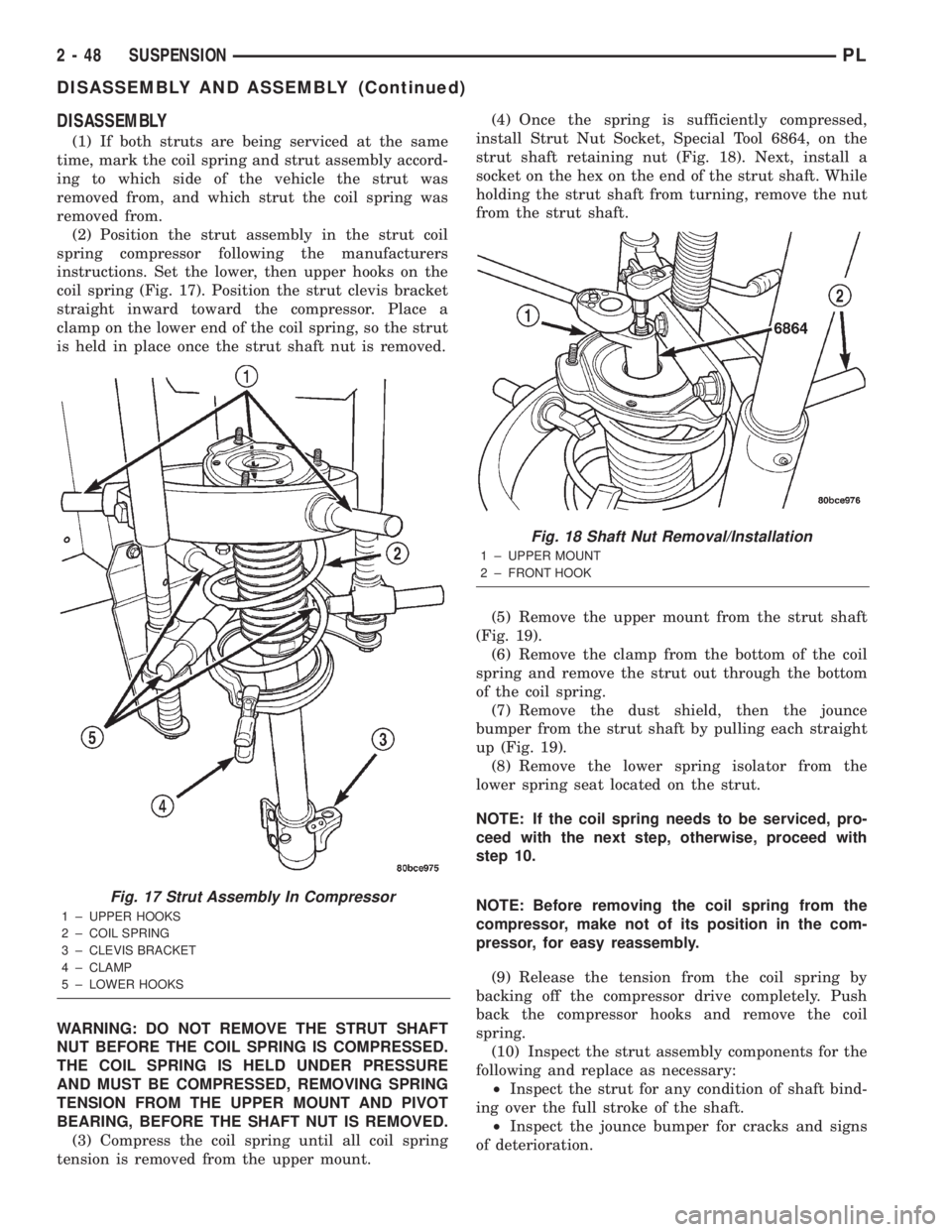
(2) Position the strut assembly in the strut coil
spring compressor following the manufacturers
instructions. Set the lower, then upper hooks on the
coil spring (Fig. 17). Position the strut clevis bracket
straight inward toward the compressor. Place a
clamp on the lower end of the coil spring, so the strut
is held in place once the strut shaft nut is removed.
WARNING: DO NOT REMOVE THE STRUT SHAFT
NUT BEFORE THE COIL SPRING IS COMPRESSED.
THE COIL SPRING IS HELD UNDER PRESSURE
AND MUST BE COMPRESSED, REMOVING SPRING
TENSION FROM THE UPPER MOUNT AND PIVOT
BEARING, BEFORE THE SHAFT NUT IS REMOVED.
(3) Compress the coil spring until all coil spring
tension is removed from the upper mount.(4) Once the spring is sufficiently compressed,
install Strut Nut Socket, Special Tool 6864, on the
strut shaft retaining nut (Fig. 18). Next, install a
socket on the hex on the end of the strut shaft. While
holding the strut shaft from turning, remove the nut
from the strut shaft.
(5) Remove the upper mount from the strut shaft
(Fig. 19).
(6) Remove the clamp from the bottom of the coil
spring and remove the strut out through the bottom
of the coil spring.
(7) Remove the dust shield, then the jounce
bumper from the strut shaft by pulling each straight
up (Fig. 19).
(8) Remove the lower spring isolator from the
lower spring seat located on the strut.
NOTE: If the coil spring needs to be serviced, pro-
ceed with the next step, otherwise, proceed with
step 10.
NOTE: Before removing the coil spring from the
compressor, make not of its position in the com-
pressor, for easy reassembly.
(9) Release the tension from the coil spring by
backing off the compressor drive completely. Push
back the compressor hooks and remove the coil
spring.
(10) Inspect the strut assembly components for the
following and replace as necessary:
²Inspect the strut for any condition of shaft bind-
ing over the full stroke of the shaft.
²Inspect the jounce bumper for cracks and signs
of deterioration.
Fig. 17 Strut Assembly In Compressor
1 ± UPPER HOOKS
2 ± COIL SPRING
3 ± CLEVIS BRACKET
4 ± CLAMP
5 ± LOWER HOOKS
Fig. 18 Shaft Nut Removal/Installation
1 ± UPPER MOUNT
2 ± FRONT HOOK
2 - 48 SUSPENSIONPL
DISASSEMBLY AND ASSEMBLY (Continued)
Page 80 of 1285
BRAKES
TABLE OF CONTENTS
page page
BASE BRAKE SYSTEM...................... 1ANTILOCK BRAKE SYSTEM................. 65
BASE BRAKE SYSTEM
TABLE OF CONTENTS
page page
DESCRIPTION AND OPERATION
BASE BRAKE SYSTEM OPERATION...........2
BASE BRAKE SYSTEM COMPONENTS.........2
DIAGNOSIS AND TESTING
BASE BRAKE SYSTEM DIAGNOSIS CHARTS....9
POWER BRAKE BOOSTER.................11
DRUM BRAKE AUTOMATIC ADJUSTER........12
BRAKE ROTOR..........................12
BRAKE DRUM...........................15
PROPORTIONING VALVE..................15
BRAKE FLUID CONTAMINATION.............17
SERVICE PROCEDURES
BRAKE FLUID LEVEL CHECKING............17
BASE BRAKE BLEEDING...................17
MASTER CYLINDER BLEEDING.............19
BRAKE TUBE REPAIR.....................19
BRAKE ROTOR MACHINING................21
BRAKE DRUM MACHINING.................22
PARKING BRAKE AUTOMATIC ADJUSTER
LOCK OUT............................22
REMOVAL AND INSTALLATION
SERVICE WARNINGS AND CAUTIONS........23
BRAKE PEDAL...........................24
BRAKE LAMP SWITCH....................27
MASTER CYLINDER......................28
BRAKE FLUID RESERVOIR.................29
BRAKE FLUID LEVEL SWITCH..............30
POWER BRAKE BOOSTER.................30
PROPORTIONING VALVE..................32
BRAKES TUBES AND HOSES...............33
DISC BRAKE CALIPER (FRONT).............33
DISC BRAKE SHOES (FRONT)..............35BRAKE ROTOR (FRONT)...................37
DISC BRAKE CALIPER (REAR)..............38
DISC BRAKE SHOES (REAR)...............39
BRAKE ROTOR (REAR)....................41
DRUM BRAKE WHEEL CYLINDER (REAR).....41
DRUM BRAKE SHOES (REAR)..............43
BRAKE DRUM (REAR).....................45
DRUM BRAKE SHOE SUPPORT PLATE
(REAR)...............................46
PARKING BRAKE LEVER...................48
PARKING BRAKE CABLE (REAR)............49
PARKING BRAKE SHOES (REAR DISC
BRAKE)...............................53
DISASSEMBLY AND ASSEMBLY
DISC BRAKE CALIPER (FRONT AND REAR)....55
CLEANING AND INSPECTION
BRAKE TUBES AND HOSES................59
DISC BRAKES (FRONT)....................59
DISC BRAKES (REAR).....................60
DRUM BRAKES (REAR)....................60
ADJUSTMENTS
BRAKE LAMP SWITCH....................61
DRUM BRAKE SHOES.....................61
PARKING BRAKE SHOES (REAR DISC
BRAKES).............................62
SPECIFICATIONS
BRAKE FLUID...........................63
BRAKE ACTUATION SYSTEM...............63
BRAKE FASTENER TORQUE
SPECIFICATIONS.......................63
SPECIAL TOOLS
BASE BRAKE SYSTEM....................64
PLBRAKES 5 - 1
Page 82 of 1285
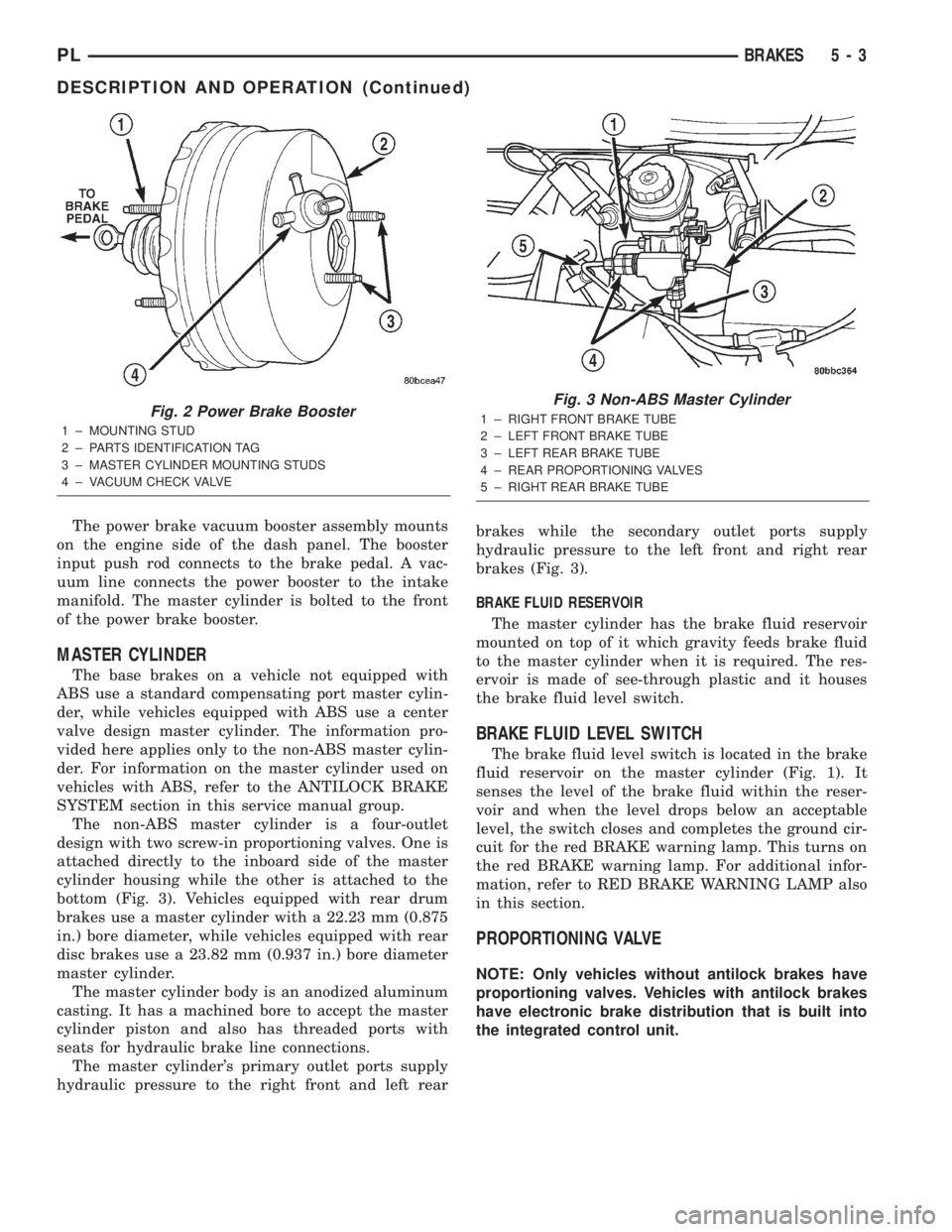
The power brake vacuum booster assembly mounts
on the engine side of the dash panel. The booster
input push rod connects to the brake pedal. A vac-
uum line connects the power booster to the intake
manifold. The master cylinder is bolted to the front
of the power brake booster.
MASTER CYLINDER
The base brakes on a vehicle not equipped with
ABS use a standard compensating port master cylin-
der, while vehicles equipped with ABS use a center
valve design master cylinder. The information pro-
vided here applies only to the non-ABS master cylin-
der. For information on the master cylinder used on
vehicles with ABS, refer to the ANTILOCK BRAKE
SYSTEM section in this service manual group.
The non-ABS master cylinder is a four-outlet
design with two screw-in proportioning valves. One is
attached directly to the inboard side of the master
cylinder housing while the other is attached to the
bottom (Fig. 3). Vehicles equipped with rear drum
brakes use a master cylinder with a 22.23 mm (0.875
in.) bore diameter, while vehicles equipped with rear
disc brakes use a 23.82 mm (0.937 in.) bore diameter
master cylinder.
The master cylinder body is an anodized aluminum
casting. It has a machined bore to accept the master
cylinder piston and also has threaded ports with
seats for hydraulic brake line connections.
The master cylinder's primary outlet ports supply
hydraulic pressure to the right front and left rearbrakes while the secondary outlet ports supply
hydraulic pressure to the left front and right rear
brakes (Fig. 3).
BRAKE FLUID RESERVOIR
The master cylinder has the brake fluid reservoir
mounted on top of it which gravity feeds brake fluid
to the master cylinder when it is required. The res-
ervoir is made of see-through plastic and it houses
the brake fluid level switch.
BRAKE FLUID LEVEL SWITCH
The brake fluid level switch is located in the brake
fluid reservoir on the master cylinder (Fig. 1). It
senses the level of the brake fluid within the reser-
voir and when the level drops below an acceptable
level, the switch closes and completes the ground cir-
cuit for the red BRAKE warning lamp. This turns on
the red BRAKE warning lamp. For additional infor-
mation, refer to RED BRAKE WARNING LAMP also
in this section.
PROPORTIONING VALVE
NOTE: Only vehicles without antilock brakes have
proportioning valves. Vehicles with antilock brakes
have electronic brake distribution that is built into
the integrated control unit.
Fig. 2 Power Brake Booster
1 ± MOUNTING STUD
2 ± PARTS IDENTIFICATION TAG
3 ± MASTER CYLINDER MOUNTING STUDS
4 ± VACUUM CHECK VALVE
Fig. 3 Non-ABS Master Cylinder
1 ± RIGHT FRONT BRAKE TUBE
2 ± LEFT FRONT BRAKE TUBE
3 ± LEFT REAR BRAKE TUBE
4 ± REAR PROPORTIONING VALVES
5 ± RIGHT REAR BRAKE TUBE
PLBRAKES 5 - 3
DESCRIPTION AND OPERATION (Continued)
Page 86 of 1285
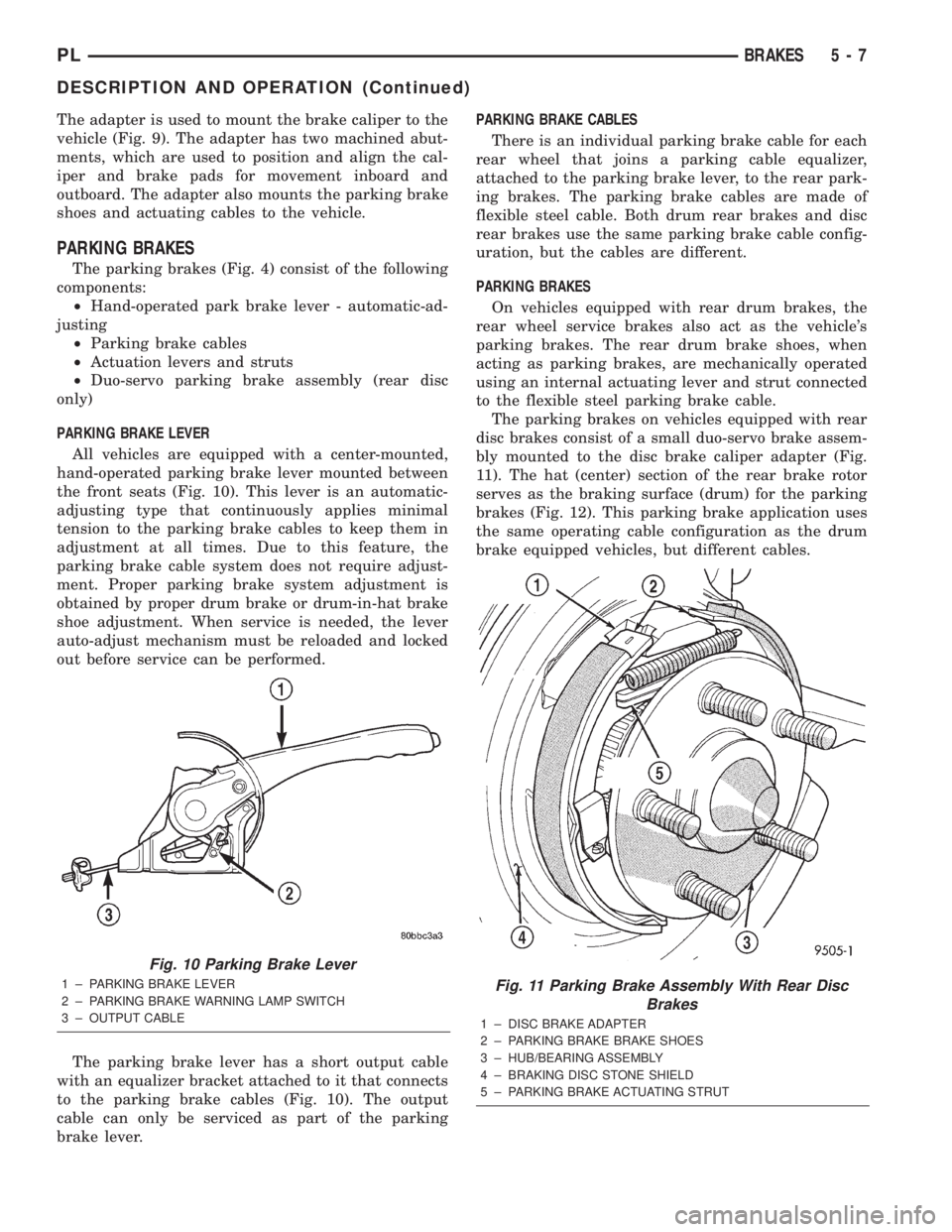
The adapter is used to mount the brake caliper to the
vehicle (Fig. 9). The adapter has two machined abut-
ments, which are used to position and align the cal-
iper and brake pads for movement inboard and
outboard. The adapter also mounts the parking brake
shoes and actuating cables to the vehicle.
PARKING BRAKES
The parking brakes (Fig. 4) consist of the following
components:
²Hand-operated park brake lever - automatic-ad-
justing
²Parking brake cables
²Actuation levers and struts
²Duo-servo parking brake assembly (rear disc
only)
PARKING BRAKE LEVER
All vehicles are equipped with a center-mounted,
hand-operated parking brake lever mounted between
the front seats (Fig. 10). This lever is an automatic-
adjusting type that continuously applies minimal
tension to the parking brake cables to keep them in
adjustment at all times. Due to this feature, the
parking brake cable system does not require adjust-
ment. Proper parking brake system adjustment is
obtained by proper drum brake or drum-in-hat brake
shoe adjustment. When service is needed, the lever
auto-adjust mechanism must be reloaded and locked
out before service can be performed.
The parking brake lever has a short output cable
with an equalizer bracket attached to it that connects
to the parking brake cables (Fig. 10). The output
cable can only be serviced as part of the parking
brake lever.PARKING BRAKE CABLES
There is an individual parking brake cable for each
rear wheel that joins a parking cable equalizer,
attached to the parking brake lever, to the rear park-
ing brakes. The parking brake cables are made of
flexible steel cable. Both drum rear brakes and disc
rear brakes use the same parking brake cable config-
uration, but the cables are different.
PARKING BRAKES
On vehicles equipped with rear drum brakes, the
rear wheel service brakes also act as the vehicle's
parking brakes. The rear drum brake shoes, when
acting as parking brakes, are mechanically operated
using an internal actuating lever and strut connected
to the flexible steel parking brake cable.
The parking brakes on vehicles equipped with rear
disc brakes consist of a small duo-servo brake assem-
bly mounted to the disc brake caliper adapter (Fig.
11). The hat (center) section of the rear brake rotor
serves as the braking surface (drum) for the parking
brakes (Fig. 12). This parking brake application uses
the same operating cable configuration as the drum
brake equipped vehicles, but different cables.
Fig. 10 Parking Brake Lever
1 ± PARKING BRAKE LEVER
2 ± PARKING BRAKE WARNING LAMP SWITCH
3 ± OUTPUT CABLEFig. 11 Parking Brake Assembly With Rear Disc
Brakes
1 ± DISC BRAKE ADAPTER
2 ± PARKING BRAKE BRAKE SHOES
3 ± HUB/BEARING ASSEMBLY
4 ± BRAKING DISC STONE SHIELD
5 ± PARKING BRAKE ACTUATING STRUT
PLBRAKES 5 - 7
DESCRIPTION AND OPERATION (Continued)
Page 87 of 1285
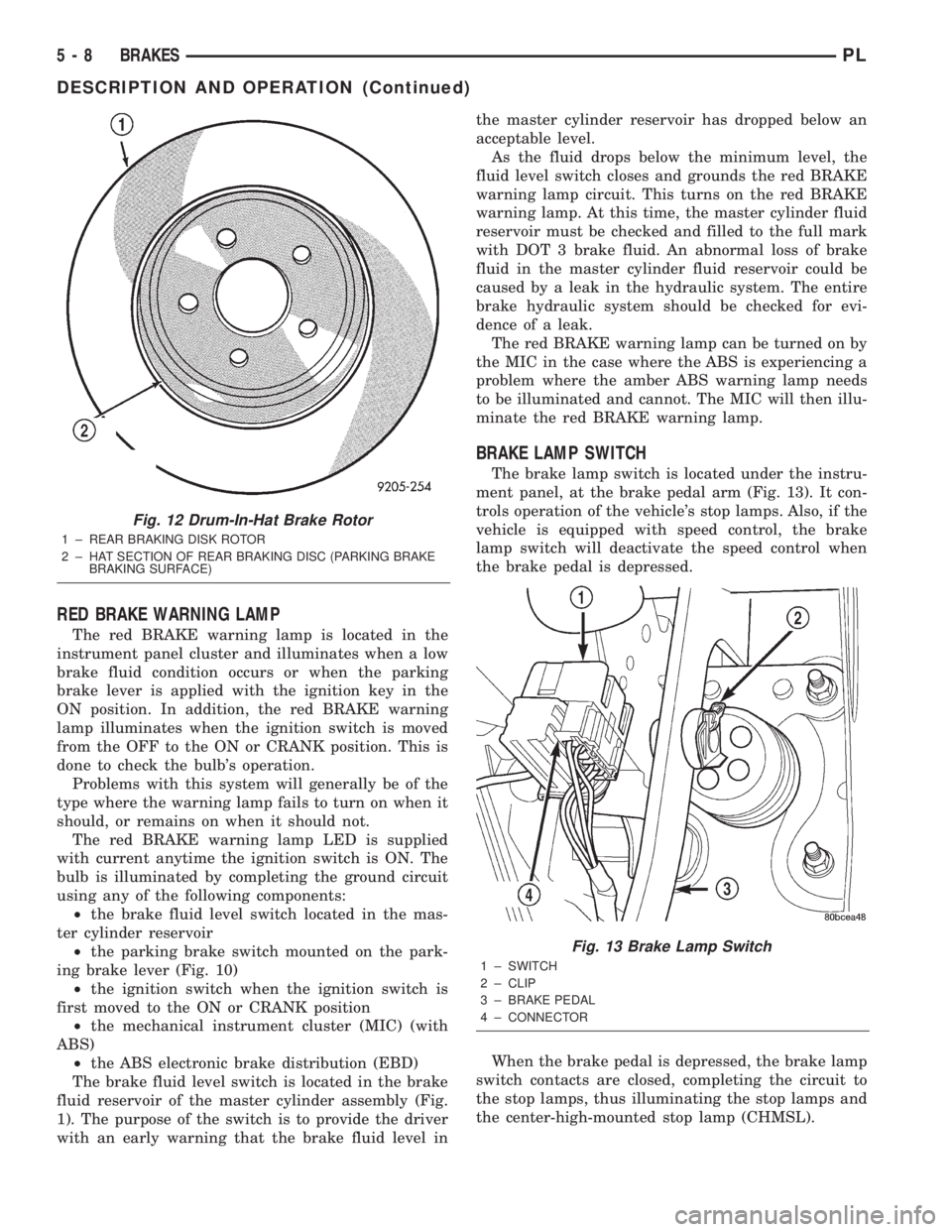
RED BRAKE WARNING LAMP
The red BRAKE warning lamp is located in the
instrument panel cluster and illuminates when a low
brake fluid condition occurs or when the parking
brake lever is applied with the ignition key in the
ON position. In addition, the red BRAKE warning
lamp illuminates when the ignition switch is moved
from the OFF to the ON or CRANK position. This is
done to check the bulb's operation.
Problems with this system will generally be of the
type where the warning lamp fails to turn on when it
should, or remains on when it should not.
The red BRAKE warning lamp LED is supplied
with current anytime the ignition switch is ON. The
bulb is illuminated by completing the ground circuit
using any of the following components:
²the brake fluid level switch located in the mas-
ter cylinder reservoir
²the parking brake switch mounted on the park-
ing brake lever (Fig. 10)
²the ignition switch when the ignition switch is
first moved to the ON or CRANK position
²the mechanical instrument cluster (MIC) (with
ABS)
²the ABS electronic brake distribution (EBD)
The brake fluid level switch is located in the brake
fluid reservoir of the master cylinder assembly (Fig.
1). The purpose of the switch is to provide the driver
with an early warning that the brake fluid level inthe master cylinder reservoir has dropped below an
acceptable level.
As the fluid drops below the minimum level, the
fluid level switch closes and grounds the red BRAKE
warning lamp circuit. This turns on the red BRAKE
warning lamp. At this time, the master cylinder fluid
reservoir must be checked and filled to the full mark
with DOT 3 brake fluid. An abnormal loss of brake
fluid in the master cylinder fluid reservoir could be
caused by a leak in the hydraulic system. The entire
brake hydraulic system should be checked for evi-
dence of a leak.
The red BRAKE warning lamp can be turned on by
the MIC in the case where the ABS is experiencing a
problem where the amber ABS warning lamp needs
to be illuminated and cannot. The MIC will then illu-
minate the red BRAKE warning lamp.
BRAKE LAMP SWITCH
The brake lamp switch is located under the instru-
ment panel, at the brake pedal arm (Fig. 13). It con-
trols operation of the vehicle's stop lamps. Also, if the
vehicle is equipped with speed control, the brake
lamp switch will deactivate the speed control when
the brake pedal is depressed.
When the brake pedal is depressed, the brake lamp
switch contacts are closed, completing the circuit to
the stop lamps, thus illuminating the stop lamps and
the center-high-mounted stop lamp (CHMSL).
Fig. 12 Drum-In-Hat Brake Rotor
1 ± REAR BRAKING DISK ROTOR
2 ± HAT SECTION OF REAR BRAKING DISC (PARKING BRAKE
BRAKING SURFACE)
Fig. 13 Brake Lamp Switch
1 ± SWITCH
2 ± CLIP
3 ± BRAKE PEDAL
4 ± CONNECTOR
5 - 8 BRAKESPL
DESCRIPTION AND OPERATION (Continued)
Page 88 of 1285
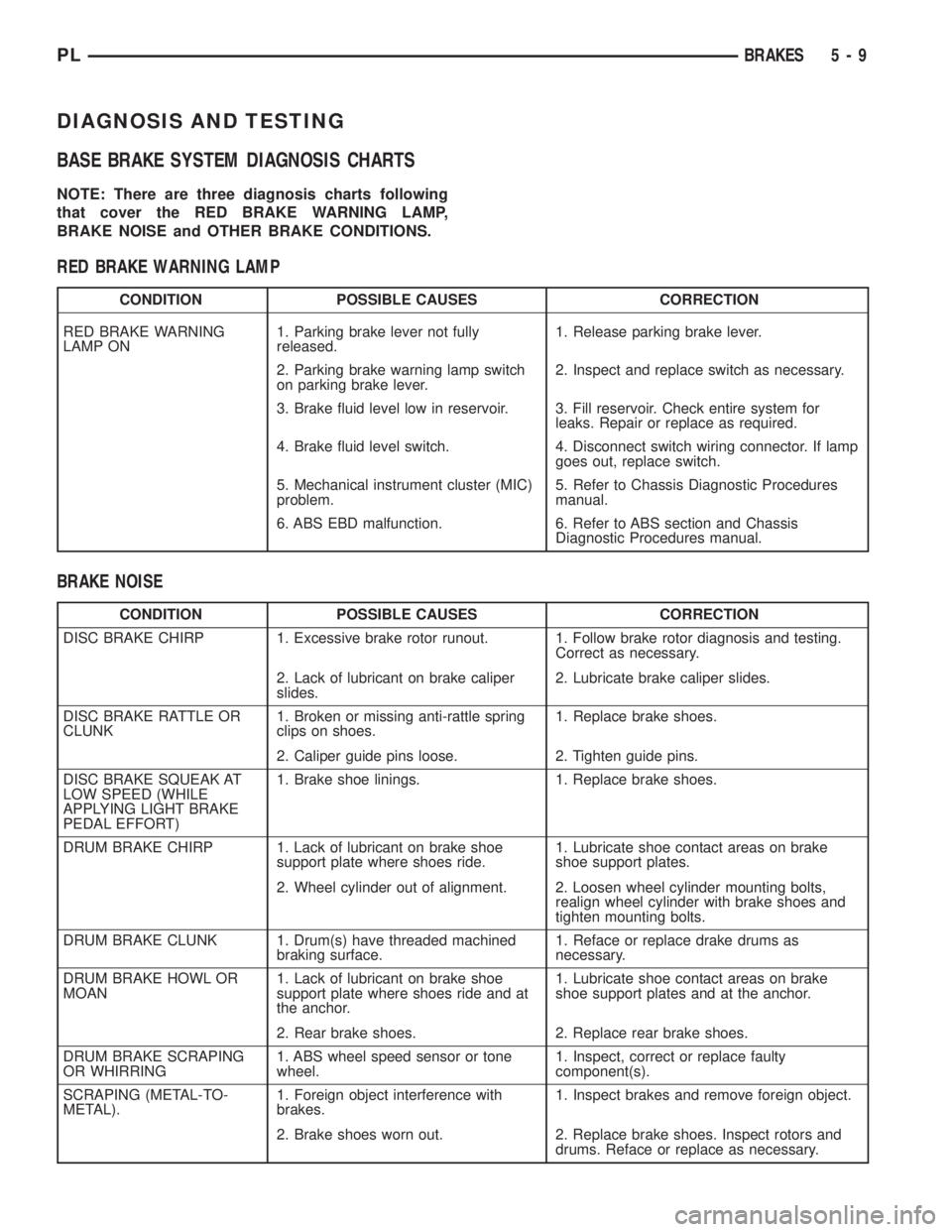
DIAGNOSIS AND TESTING
BASE BRAKE SYSTEM DIAGNOSIS CHARTS
NOTE: There are three diagnosis charts following
that cover the RED BRAKE WARNING LAMP,
BRAKE NOISE and OTHER BRAKE CONDITIONS.
RED BRAKE WARNING LAMP
CONDITION POSSIBLE CAUSES CORRECTION
RED BRAKE WARNING
LAMP ON1. Parking brake lever not fully
released.1. Release parking brake lever.
2. Parking brake warning lamp switch
on parking brake lever.2. Inspect and replace switch as necessary.
3. Brake fluid level low in reservoir. 3. Fill reservoir. Check entire system for
leaks. Repair or replace as required.
4. Brake fluid level switch. 4. Disconnect switch wiring connector. If lamp
goes out, replace switch.
5. Mechanical instrument cluster (MIC)
problem.5. Refer to Chassis Diagnostic Procedures
manual.
6. ABS EBD malfunction. 6. Refer to ABS section and Chassis
Diagnostic Procedures manual.
BRAKE NOISE
CONDITION POSSIBLE CAUSES CORRECTION
DISC BRAKE CHIRP 1. Excessive brake rotor runout. 1. Follow brake rotor diagnosis and testing.
Correct as necessary.
2. Lack of lubricant on brake caliper
slides.2. Lubricate brake caliper slides.
DISC BRAKE RATTLE OR
CLUNK1. Broken or missing anti-rattle spring
clips on shoes.1. Replace brake shoes.
2. Caliper guide pins loose. 2. Tighten guide pins.
DISC BRAKE SQUEAK AT
LOW SPEED (WHILE
APPLYING LIGHT BRAKE
PEDAL EFFORT)1. Brake shoe linings. 1. Replace brake shoes.
DRUM BRAKE CHIRP 1. Lack of lubricant on brake shoe
support plate where shoes ride.1. Lubricate shoe contact areas on brake
shoe support plates.
2. Wheel cylinder out of alignment. 2. Loosen wheel cylinder mounting bolts,
realign wheel cylinder with brake shoes and
tighten mounting bolts.
DRUM BRAKE CLUNK 1. Drum(s) have threaded machined
braking surface.1. Reface or replace drake drums as
necessary.
DRUM BRAKE HOWL OR
MOAN1. Lack of lubricant on brake shoe
support plate where shoes ride and at
the anchor.1. Lubricate shoe contact areas on brake
shoe support plates and at the anchor.
2. Rear brake shoes. 2. Replace rear brake shoes.
DRUM BRAKE SCRAPING
OR WHIRRING1. ABS wheel speed sensor or tone
wheel.1. Inspect, correct or replace faulty
component(s).
SCRAPING (METAL-TO-
METAL).1. Foreign object interference with
brakes.1. Inspect brakes and remove foreign object.
2. Brake shoes worn out. 2. Replace brake shoes. Inspect rotors and
drums. Reface or replace as necessary.
PLBRAKES 5 - 9