2000 AUDI ALLROAD service
[x] Cancel search: servicePage 256 of 306
Only
when tires show unusual wear such as
feather-e dging should they be rotated diag
� nall y. Yo ur vehicle may be equipped with
trres which have a specified rotation direc
tion. The rotation direction is identified by
arrow markings on the sides of the tires.
The rotation direction must not be revers ed.
Therefore, these tires cannot be switched
diagonally. If in doubt, discuss any unusual
tire wear with your authorized Audi Dealer's
service department.
After rotation adjust tire pressure and
torque wheel bolts diagonally to 90 tt lb
(120 Nm). Refer to "Changing a wheel" on
page 267 for details. Tire
replacement
Wheels and tires approved by the manu fac
turer have been specially matched to your
vehicle and contribute greatly to the road
holding, driving characteristics and safety of
the vehicle.
Make sure that the new tires also meet the
specifications listed on the label located on
the inside of the fuel filler flap or on the driv
er's door lock jamb.
It's �mporta nt to remember that in spite of
h �vrng the same tire designation, the actual
s1ze of a tire can vary from tire man ufacturer
to tire man ufacturer. Using different tire and
wheel rim combinations can result in re
duced clearance between the tire and the
vehicle body.
Therefore, never mount tires that
are of a different designation or
have different dimensions from
those of the factory supplied tires
which came equipped on your ve
hicle. VE
HICLE CARE
• If you must replace tires different from
those which were originally factory supplied
on your vehicle, always use the specific
brands, specifications and dimensions
which were specified by Audi for your ve
hicle.
Yo ur authorized Audi dealer or Audi Client
Relations have information regarding the
t1res and wheel rims specified for your car,
and can tell you which tires and tire
man ufacturers were approved by the fac
tory for original equipment installation.
• We recommend that you have your tires
changed by an authorized Audi Dealer, be
cause they have the special tools and nec
essary expertis e.
Furthermore, your authorized Audi Dealer
stocks a range of tires and wheels.
• If the spare tire is different from the tires
that you have mounted on your vehicle (for
example winter tires or wide profile tires),
then use the spare tire for a short period of
time only and drive with extra care. Replace
the flat tire with a tire matching the others
on your vehicle as soon as possible.
255
Page 259 of 306
VEHICLE CA
RE--------------------------
The manufacturing date on the tire
side wall (possibly only on the inside of the
wheel):
DOT ... 12 00 ... means that the tire was
produced in the 12th week of 2000.
Tire strength and performance decline with
age -even if the tires are not used. Tire
manufacturers caution that a tire more than
six years old cannot be expected to perform
reliably and safely even in normal use.
�W ARNING
Old tires can fail in use, causing
loss of vehicle control and person
al injury.
Replace tires after six years re
gardless of tread wear. Always re
duce speed and drive cautiously if
you must use an old tire in an emer
gency. Replace the tire as soon as
possible.
258 Uniform
Tire Quality Grading
Quality grades can be found where applica
ble on the tire side wall between tread,
shoulder and maximum section width. For
example:
Treadwear 200, Traction AA, Tem
perature A.
All passenger car tires must conform to
Federal Safety Requirements in addition to
these grades.
Tr eadwear
The treadwear grade is a comparative rating
based on the wear rate of the tire when
tested under controlled conditions on a spe
cified government test course. For exam
ple, a tire
Qraded 15
0 would wear one and
one half (1112) times as well on the govern
ment course as a tire graded 1 00. The rei a·
tive perfo rmance of tires depends upon the
actual conditions of their use, however, and
may depart significantly from the norm due
to variations in driving habits, service prac
tices and differences in road characteristics
and climate. Tra
ction
The traction grades, from highest to lowest,
are AA, A, Band C. Those grades represent
the tire's ability to stop on wet pave ment as
measured under controlled conditions on
specified government test surfaces of as
phalt and concrete. A tire marked C may
have poor traction performa nce.
�W ARNING
The traction grade assigned to this
tire is based on straight-ahead
braking traction tests, and does
not include acceleration, corner
ing, hydr oplaning or peak traction
characteristics.
Page 263 of 306
VE
HICLE CARE
Difficult operating
conditions
Driving under difficult
conditions
Yo ur Audi has been designed and equipped
for normal operating conditions. This also
applies to the freq uency and the extent of
service requirements as stated in the Main
tenance brochure.
If you are planning to drive your vehicle un
der difficult operating conditions (for exam
ple, continuous trailer towing, very hot or
cold weather, very dusty conditions, poor
fuel quality, etc.) you may want to make
special preparations such as changing to an
appropriate oil viscosity, having your vehicle
thoroughly inspected, etc. Furthermore, the
main tenance should always be matched to
the operating conditions (see page 228).
262 Additional
accessories, Modifications and
Parts replacement
Yo ur vehicle incorporates the latest safety
design features ensuring a high standard of
active and passive safety. This safety could
be compromised by non-approved changes
to the original new-vehicle condition. For
this reason, if parts have to be replaced or
if any modifications are made to the vehicle,
please observe the following points when
installing additional accessories:
• Always cons�lt an author ized Audi
Dealer before purchasing accessories and
before any modifications are carried out. Cl
In your own interest, we advise
you to use only expressly approved
Audi accessories and genuine Audi
spare parts.
These parts and accessories have
been specially designed to be used
on your vehicle.
• Approved Audi accessories and genuine
Audi parts are available from authorized
Audi Dealers.
These dealers also have the necessary facil
ities, tools and trained specialists to install
the parts and accessories properly.
Page 264 of 306
----------------------DO-IT-YOURSELF SERVICE
First aid kit
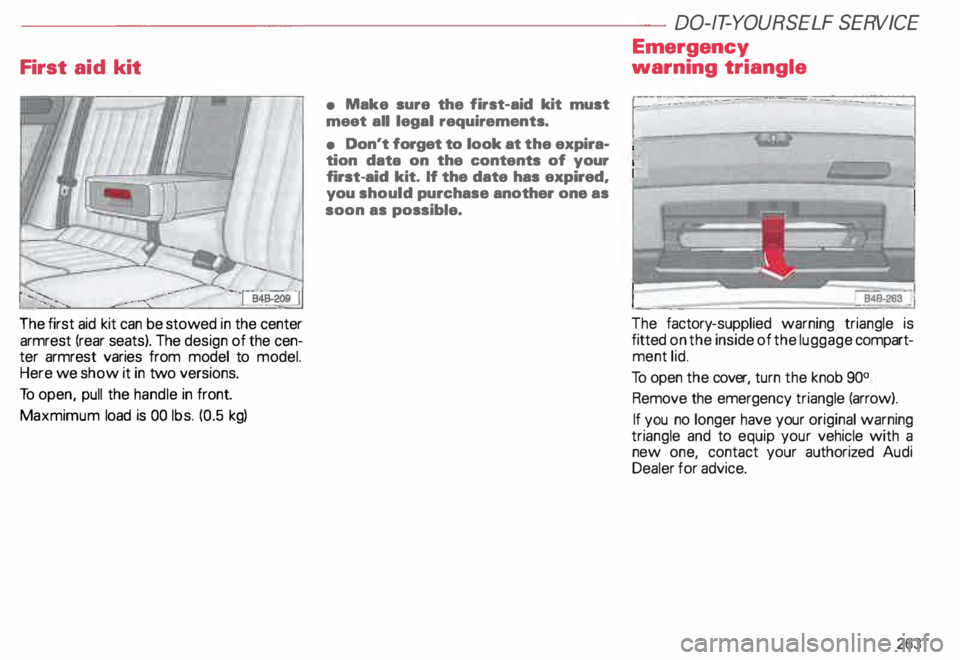
The first aid kit can be stowed in the center
armrest (rear seats). The design of the cen
ter armrest varies from model to model.
Here we show it in two versions.
To open, pull the handle in front.
Maxmimum load is 00 lbs. (0.5 kg) •
Make sure the first-aid kit must
meet all legal requirements.
• Don't forget to look at the expira
tion data on the contents of your
first-aid kit. If the date has expired,
you should purchase another one as
soon as possible. Emergency
warning triangle
The factory -supplied warning triangle is
fitted on the inside of the luggage compart
ment lid.
To open the cover, turn the knob 90°
Remove the emergency triangle (arrow).
If you no longer have your original warning
triangle and to equip your vehicle with a
new one, contact your authorized Audi
Dealer for advice.
263
Page 265 of 306
DO-IT-Y
OURSELF SERVICE----------------------
Jack and
tools
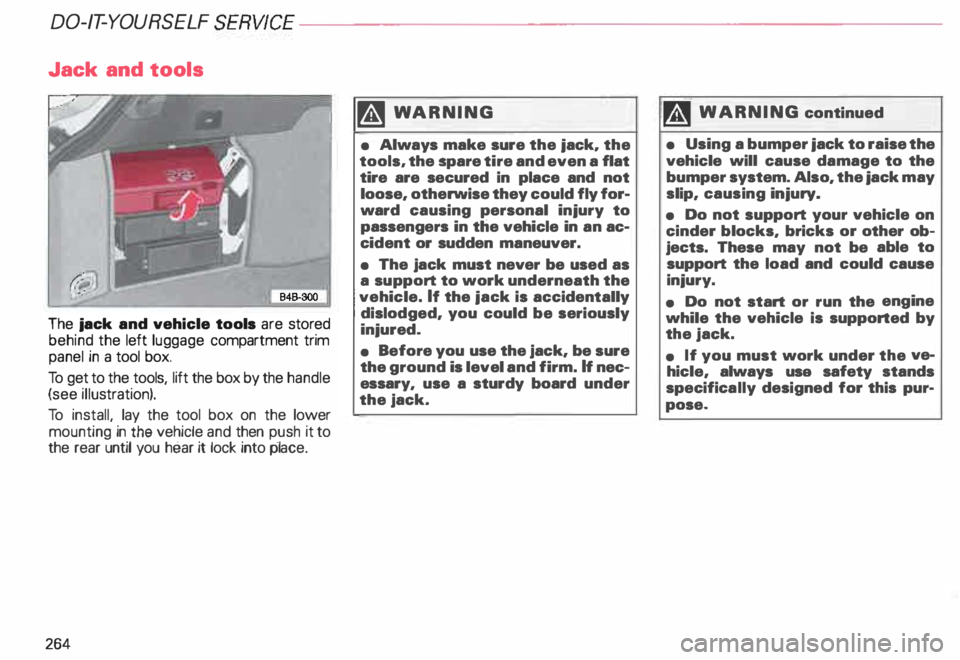
The jack and vehicle tools are stored
behind the left luggage compartment trim
panel in a tool box.
To get to the tools, lift the box by the handle
(see illustration).
To install, lay the tool box on the lower
mounting in the vehicle and then push it to
the rear until you hear it lock into place.
264 �W
ARNING
• Always make sure the jack. the
tools, the spare tire and even a flat
tire are secured in place and not
loose, otherwise they could fly for
ward causing personal injury to
passengers in the vehicle in an ac
cident or sudden maneuver.
• The jack must never be used as
a support to work underneath the
vehicle. If the jack is accidentally
dislodged, you could be seriously
injured.
• Before you use the jack, be sure
the ground is level and firm. If nec
essary, use a sturdy board under
the jack.
, ... WARNING continued
• Using a bumper jack to raise the
vehicle will cause damage to the
bumper system. Also, the jack may
slip, causing injury.
• Do not support your vehicle on
cinder blocks, bricks or other ob
jects. These may not be able to
support the load and could cause
injury.
• Do not start or run the engine
while the vehicle is supported by
the jack.
• If you must work under the ve
hicle, always usa safety stands
specifica lly designed for this pur
pose.
Page 266 of 306
Yo
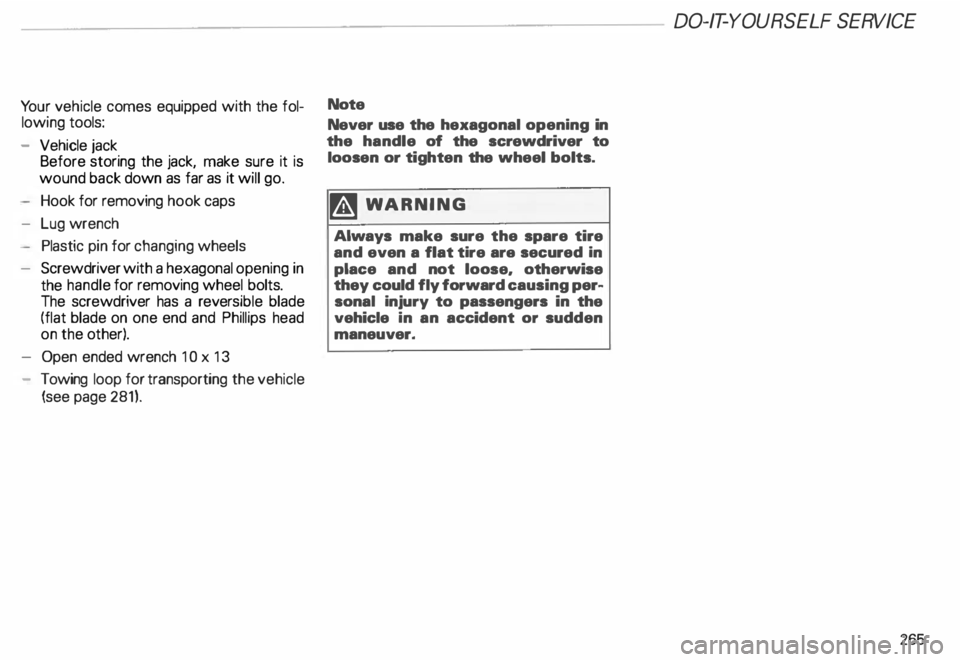
ur vehicle comes equipped with the fol
lowing tools:
- Vehicle jack
Before storing the jack, make sure it is
wound back down as far as it will go.
Hook for removing hook caps
- Lug wrench
Plastic pin for changing wheels
- Screwdriver with a hexagonal opening in
the handle for removing wheel bolts.
The screwdriver has a rever sible blade
(flat blade on one end and Phillips head
on the other).
- Open ended wrench 1 0 x 13
- Towing loop for transporting the vehicle
(see page 281). Note
Never
use the hexagonal opening in
the handle of the screwdriver to
loosen or tighten the wheel bolts.
�W ARNING
Always make sure the spare tire
and even a flat tire are secured in
place and not loose, otherwise
they could fly forward causing per
sonal injury to passengers in the
vehicle in an accident or sudden
maneuver. DO-IT-YOURSELF
SERVICE
265
Page 267 of 306

DO-IT-YOURSELF
SERVICE----------------------
Spare wheel
Yo ur vehicle is equip ped with a spare wheel
(deflated full size spare tire) and an accom
panying compressor.
The deflated full size spare tire and com
pressor are located beneath the floor of the
luggage compartment. The spare wheel is
held down by a knurled bolt.
On vehicle' s equipped with a childr en's
bench seat, the seat must be folded back to
allow the spare wheel to be removed -see
page 94.
"Changine a wheel" and "Inflating the de
flated full size spare tire" -see page 267.
266 The
following points must be ob
served when the deflated full size
spare tire is used:
• The deflated full size spare tire is
only designed for brief, temporary
use. Therefore, replace it with a nor
mal wheel as soon as poss ible.
• Never drive at speeds over 50 mph
(80 km/h). Avoid jackrabbit starts, hard bra
king and aggressive turns!
• Do not take the vehicle to automatic car
washes when the deflated full size spare
tire is installed.
• The deflated full size spare tire was de
veloped especially for your vehicle model. It
must not be used on other models. Simi
larly, do not use spare wheels from other ve
hicle models on your car. •
For engineering reasons, snow chains
must not be used on the deflated full size
spare tire.
If the vehicle must be driven with snow
chains, and one of its rear tires is flat, you
will first need to install the collapsible rear ti
re on the front axle. This is because for engi
neering reaons snow chains can only be in
stalled on special winter tires*1) and only
on rear wheels.
After you've installed the spare tire on the
front axle, install the snow chain on the
wheel you've removed from the front axle.
and then install this wheel on the rear axle
in place of the wheel whose tire is flat. As
soon as possible, correct the tire pressure
to the proper setting.
• Never install normal or winter tires on the
deflated full size spare tire rim.
• Never drive the vehicle with more than
one deflated full size spare tire installed.
11 Not available at the time of printing.
Page 268 of 306

•
The deflated full size spare tire cannot be
repaired or mounted using conventional
shop equipment. This work always has to
be performed by the man ufacturer of the
collapsible tire.
• All the air must be let out of the tire after
use before stowing it in the storage area
prov ided for it in the vehicle. Once all the air
is out, the tire will return to its original form.
To let the air out of the tire, either use a
sharp object to press down on the metal pin
in the valve, or use the valve-remo ving tool
on the back side of the dust cap to unscrew
the valve stem. Changing
a wheel
�W ARNING
You or your passengers could be
injured while changing a wheel if
you do not follow safety precau
tions:
• If you have a flat tire, move a
safe distance off the road. Turn off
the engine, turn the emergency
flasher on and use other warning
devices to alert other motorists.
• Passengers must not rema in in
the vehicle when it is jacked up.
This includes children as well as
adults.
• Make sure that passengers wait
in a safe place away from the ve
hicle and well away from the road
way and traffic.
• Before you change a wheel, be
sure the ground is level and firm.
If necessary, use a sturdy board
under the jack. DO-IT-YOURSELF
SERVICE
�� WARN ING continued
• After installing the spare wheel,
make sure that you remount the
flat tire/Wheel in its storage area
properly and tighten the plastic
knurled screw securely.
• To help prevent the vehicle from
moving suddenly and possibly
slipping off the jack, always fully
set the parking brake and block
the wheel diagonally opposite the
wheel being changed. When one
front wheel is lifted off the
ground, placing the automatic
transmission in P (Park) will not
prevent vehicle movement.
267