2000 AUDI ALLROAD light
[x] Cancel search: lightPage 90 of 306
Air
circulation
Air circulation helps to reduce window fog
ging. Stale air escapes to the outside
through slots in the trim panel on the left
and right side of the luggage compartment.
Be sure to keep these slots free and open.
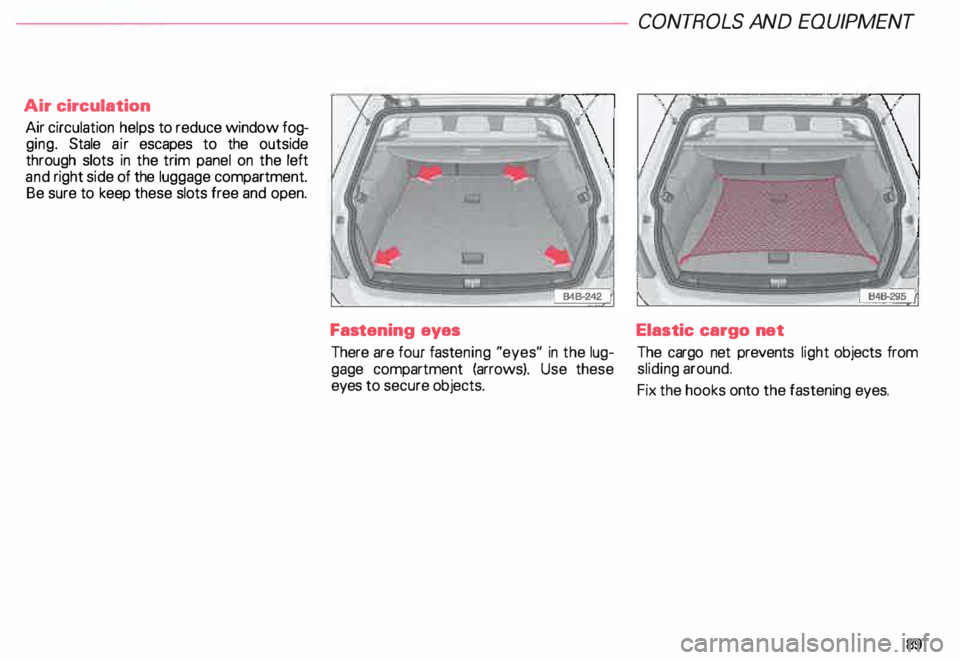
Fastening eyes
There are four fastening "eyes" in the lug
gage compartment (arrows). Use these
eyes to secure objects. CONT
ROLS AND EQUIPMEN T
Elastic cargo net
The cargo net prevents light objects from
sliding around.
Fix the hooks onto the fastening eyes.
89
Page 91 of 306
CONTROLS AND EQUIPMENT---------------------
Luggage compartment
cover
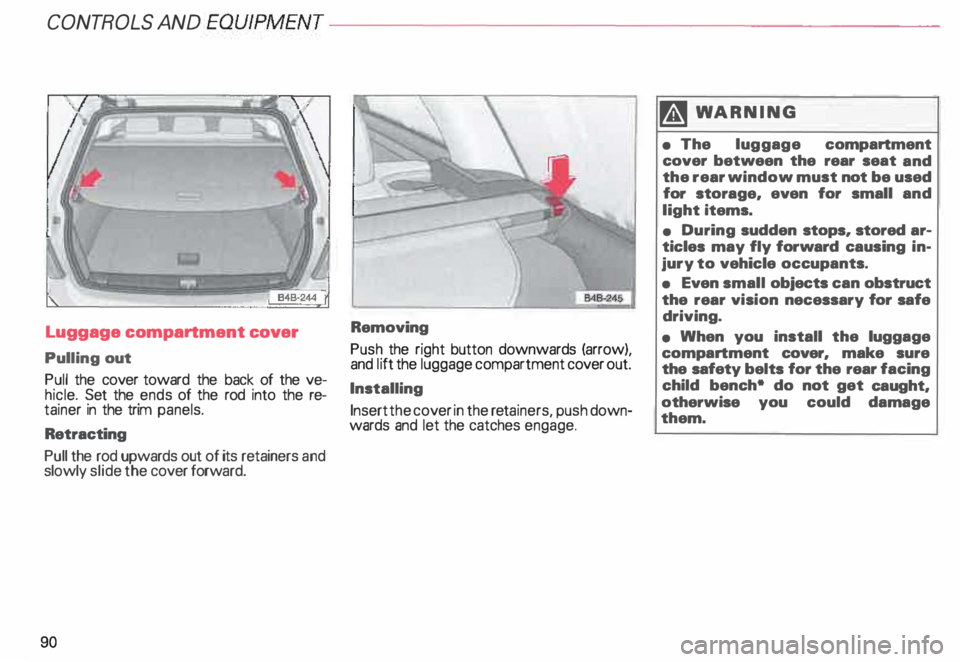
Pulling out
Pull the cover toward the back of the ve
hicle. Set the ends of the rod into the re
tainer in the trim panels.
Retracting
Pull the rod upwards out of its retainers and
slowly slide the cover forward.
90 Removing
Push
the right button downwards (arrow),
and I itt the luggage compartment cover out.
Installing Insert the cover in the reta iners, push down
wards and let the catches engage. �W
ARNING
• The luggage compartment
cover between the rear seat and
the rear window must not be used
for storage, even for small and
light items.
• During sudden stops, stored ar
ticles may fly forward causing in
jury to vehicle occupants.
• Even small objects can obstruct
the rear vision necessary for safe
driving.
• When you install the luggage
compartment cover, make sure
the safety belts for the rear facing
child bench• do not get caught,
otherwise you could damage
them.
Page 97 of 306
CONTROLS
AND
EQUIPMENT---------------------
Ski sack
Use the ski sack to transport and protect
skis and other long, light items in the pas
senger compartment.
Loading the ski sack
Load the ski sack from the luggage
compartment.
• Open the luggage compartment lid and
clear a space in tho center.
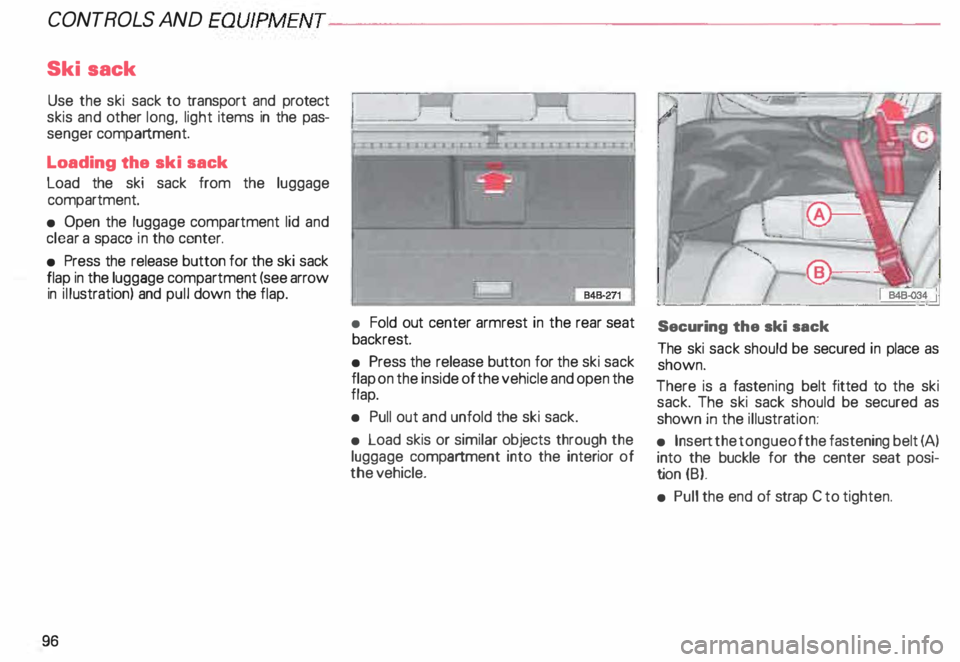
• Press the release button for the ski sack
flap in the luggage compartment (see arrow
in illustration) and pull down the flap.
96 •
Fold out center armrest in the rear seat
backrest.
• Press the release button for the ski sack
flap on the inside of the vehicle and open the
flap.
• Pull out and unfold the ski sack.
• Load skis or similar objects through the
luggage compartment into the interior of
the vehicle. Securing
the ski sack
The ski sack should be secured in place as
shown.
There is a fast ening belt fitted to the ski
sack. The ski sack should be secured as
shown in the illustra tion:
• Insert the tongue of the fastening belt (A)
into the buckle for the center seat posi
ti on (B).
• Pull the end of strap C to tighten.
Page 98 of 306
---------------------CONTROLS
AND EQUIPMENT
Stowing the ski sack
• Close the flap in the luggage compart
ment.
• Fold the ski sack carefully and stow it
away.
• Close the flap inside the passenger's
compartment.
Note
Do not fold and stow away the ski sack if it
is damp (for example, snow melting from
skis). Let it dry completely before you stow
it away. �W
ARNING
• The ski sack is intended only for
the transportation of akis and
other light objects. To reduce the
risk of serious personal injury
never transport heavy or pointed
objects in the ski sack.
• When braking rapidly or during
an accident the load could be dis
placed and cause injury to occu
pants.
• Sharp edges on the load must be
covered for protec tion. Always
fasten the belt tightly around the
sack and its contents (see illustra
tion and description).
97
Page 104 of 306
Parking
brake lever
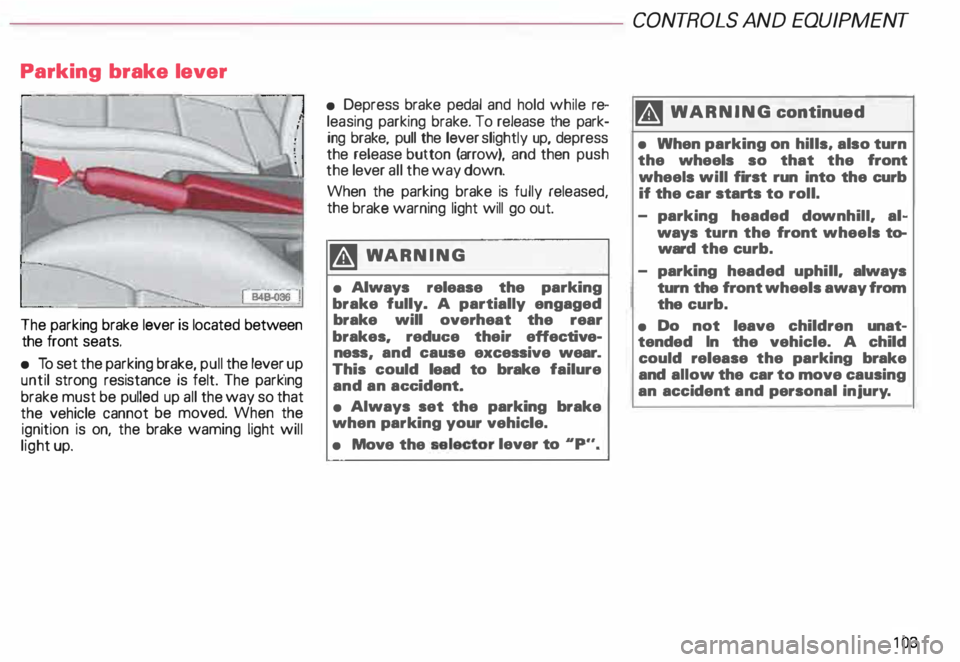
The parking brake lever is located between
the front seats.
• To set the parking brake, pull the lever _up
until strong resistance is felt. The park1ng
brake must be pulled up all the way so that
the vehicle cannot be moved. When the
ignition is on, the brake waming light will
light up. •
Depress brake pedal and hold while re
leasing parking brake. To release the park
ing brake, pull the lever slightly up, depress
the release button (arrow), and then push
the lever all the way down.
When the parking brake is fully released,
the brake warning light will go out.
�W ARNING
• Always release the parking
brake fully. A partially engaged
brake will overheat the rear
brakes. reduc:e their effective
ness and cause excessive wear.
This • could lead to brake failure
and an ac:c:ident.
• Always set the parking brake
when parking your vehicle.
• Move the selector
lever to .. p.,. CONT
ROLS AND EQUIPMENT
II WARNING continued
• When parking on hills, also turn
the wheels so that the front
wheels will first run into the curb
if the car starts to roll.
- parking headed downhill. al
ways turn the front wheels to
ward the curb.
- parking headed uphill. always
turn the front wheels away from
the curb.
• Do not leave children unat
tended In the vehicle. A child
could release the parking brake
and allow the c:ar to move causing
an accident and personal injury.
10 3
Page 106 of 306

Tiptronic®
By using the "liptronic®," you can manu
ally select gears. Here is how:
in the "D" position, push the lever to the
right. You can do this while the vehicle _is
moving or when the vehicle is at a standst11 _1.
The display on the instrument cluster w1ll
show "5", "4", "3", "2" and " 1" as soon
as the selector lever is pushed to the right.
The gear you select will also be highli ghted.
See illustra tion. To
upshift, push the selector lever forward
to the "+" plus position. To downshift, push
the lever to the "-" minus position.
When the vehicle is accelerated in gears 1,
2, 3 and 4, the transmission will automati
cally shift to the next higher gear just before
the maximum speed is reached.
When accelerating, if you apply a "light"
throttle, the liptronic® will shift automati
cally from 1 stto 2nd gear to save fuel. How
ever, if you use a "he avy" throttle, the trans
mission will stay in 1st gear until near
maximum rpm's are reached, or until the
driver shifts into 2nd gear. CONT
ROLS AND EQUIPMENT
When you shift into a higher g� ar tO? early,
the transmission will not upshift until a pre
determined engine rpm has been reached.
When you shift into the next lower gea �. the
engine will downshift only when there IS no
possibility of overfee ding.
When the kickdown comes on, the trans
mission will shift down to a lower gear de
pending on vehicle and engine speeds.
If you take your foot off the accelerator
pedal to make use of the braking effective
ness of the transmission when driving
down a .teep incline, the liptronic® will
downshift from the selected gear into the
next lower gear until it reaches 1st gear
based on road speed and engine rpm's. The
automatic downshifting is interrupted as
soon as you apply throttle again.
105
Page 108 of 306
In selector
lever positions "P" (Park) a no
"N" (Neutral), the instruction "WHEN
STA TIONARY APPLY FOOTBRAKE WHILE
SELECTING GEAR" appears in the instru
ment cluster as a reminder for the driver.
Also, the symbol in the shift console will
light up.
A time delay element prevents the selector
lever from locking when it is moved through
the "N"' (Neutral) position (for example,
going from "R" to "D"). The locking ele
ment only locks the selector lever if it is left
in the "N" (Neutral) position for more than
about one second without the brake pedal
being depressed.
In the N (Neutral) position, the selector le
ver will not lock when the vehicle is driving
faster than 3 mph (5 km/h). Display
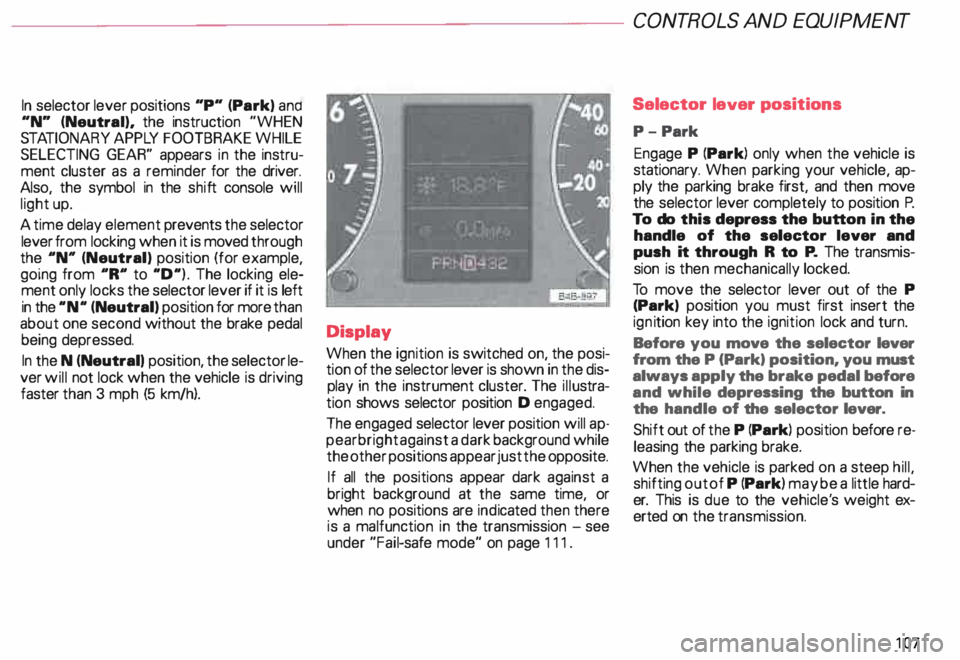
When the ignition is switched on, the posi
tion of the selector lever is shown in the dis
play in the instrument cluster. The illustra
tion shows selector position D engaged.
The engaged selector lever position will ap
pear bright against a dark background while
the other positions appear just the opposite.
If all the positions appear dark against a
bright background at the same time, or
when no positions are indicated then there
is a malfunction in the transmission -see
under "Fail-safe mode" on page 111. CONT
ROLS AND EQUIPMENT
Selector lever positions
P- Park
Engage P (Park) only when the vehicle is
stationary. When parking your vehicle, ap
ply the parking brake first, and then move
the selector lever completely to position P.
To do this depress the button in the
handle of the selector lever and
push it through R to P. The transmis
sion is then mechanically locked.
To move the selector lever out of the P
(Park) position you must first insert the
ign ition key into the ignition lock and turn.
Before you move the selector lever
from the P (Park) position, you must
always apply the brake pedal before
and while depressing the button in
the handle of the selector lever.
Shift out of the P (Park) position before re
leasing the parking brake.
When the vehicle is parked on a steep hill,
shifting out of P (Park) may be a little hard
er. This is due to the vehicle' s weight ex
erted on the transmission.
107
Page 111 of 306

CONTROLS AND
EQUIPMEN T--------------------
Selecting a driving position
�W ARNING
• Power is transmitted to the
wheels as soon as a driving posi
tion Is engaged. Therefore, when
the selector lever is in a driving
position, the vehicle may creep
even at idle speed. Do not release
the parking brake or foot brake un
til you are ready to move.
• If you must check under the
hood with the engine running,
never have any driving position en
gaged. Make sure the selector le
ver is securely locked into the P
(Park) position with the parking
brake firmly set. Otherwise, any
increase in engine speed may set
the vehicle in motion, even with
the parking brake applied.
• Do not accelerate while select
ing a driving position. At this time
the engine must run at idle speed
so that no undue stress will be
placed on the automatic clutches
in the transmission.
110 rA'J
WARNING continued
o If the selector lever is uninten
tionally moved into N (Neutral}
while you are driving, take your
foot off the accelerator pedal and
wait to idle speed before selecting
a driving position.
• Never shift into R (Reverse) or P
(Park) when the vehicle is in mov
ing. You will damage the transmis
sion.
Sta rting off
Select a gear. Wait for the transmis·
sion to engage the gaar (the vehicle
may move slightly). Then press the gas
pedal.
Maneuvering
When alternating between forward (D) and
reverse (R)-for instance, while maneuver
ing the vehicle into a tight parking space -
shift only when the vehicle has come to a
full stop and the engine is running at idle
speed. Stopping
• When stopping briefly, at a traffic light for
example, it is not necessary to move these
lector lever to N (Neutra l). Simply apply
the foot brake.
• The driving positions must never be used
for holding the vehicle on a hill. Always use
the foot brake when stopped on inclines.
mi WARNING
It is best never to get out of the
driver's seat when the engine is
running. However, if you must get
out of the vehicle, do this: Move
the selector lever securely into the
P (Park) position and apply the
parking brake firmly. If you are not
securely in P (Park), your vehicle
could move, possibly causing a se
rious accident.