2000 AUDI ALLROAD page 57
[x] Cancel search: page 57Page 230 of 306
---------------------------------------------------VEHICLE CARE
If in doubt about any servicing, nave 1t done
by your authorized Audi Dealer or any other
properly equipped and qualif ied workshop.
We strongly urge you_ to give your autho
rized Audi Dealer the opportunity to perform
all scheduled maintenance and necessary
repairs. Your dealer has the facilities, origi
nal parts and trained specialists to keep your
vehicle running properly.
Perf orming limited maintenance
yourself
The following pages describe a limited num
ber of procedures which can be performed
on your vehicle with ordinary tools, should
the need arise and trained personnel be un
available. Before perform ing any of these
procedures, always thoroughly read all of
the applicable text and carefully follow the
instructions given. Always rigorously ob
serve the WA RNINGS provided. �W
ARNING
• Serious personal injury may oc
cur as a result of improperly per
formed maintenance, adjustments
or repairs.
• Be extremely careful when
working on the vehicle. Follow
commonly accepted safety prac
tices and good judgment. Never
risk personal injury.
• Do not attempt any of the main
tenance, checks or repairs de
scribed on the following pages if
you are not fully familiar with
these or other procedures with re
spect to the vehicle, or are uncer
tain how to proceed. Do not do any
work without the proper tools and
equipment. Have the necessary
work done by your authorized
Audi Dealer or another properly
equipped and qualified workshop. '4
WARNING continued
• The engine compartment of any
motor vehicle is a potent ially haz
ardous area.
• Always support your vehicle
with safety stands if it is neces
sary to work underneath the ve
hicle. The jack supplied with the
vehicle is not adequate for this
purpose and could collapse caus
ing serious personal injury.
• Never reach into the area
around or touch the radiator fan.
The auxiliary fan is temperature
controlled and can switch on sud
denly.
Always heed all WAR NINGS
on next page.
229
Page 232 of 306

Engine
hood
To unlock the engine hood, pull the re
lease lever on the left under the dashboard.
The hood pops up slightly under spring pres
sure.
Note
Before opening the engine hood,
make sure that the windshield wip
ers are folded flat against the wind
shield. Otherwise, they could dam
age the paint on the hood. To
open, pull the release lever in the direc
tion indicated by the arrow. This will release
the hook under the hood.
Open the hood all the way. It will be held up
by gas pressure in the strut. VEH
ICLE CARE
To close
Pull the hood down until the pressure from
the strut is reduced. Then Jet the hood fall
and latch in place -you do not need to
press the hood down again.
m WARNING
• A hood that is not 'completely
latched could fly up and block
your view while driving. When you
close the engine hood, check it to
make sure the safety catch has
properly engaged. The hood
should be flush with the surround
ing vehicle body parts.
• If you ever notice while driving
that the hood is not secured prop
erly, stop at once and close it.
Always heed all WA RNINGS
on next page.
231
Page 234 of 306
When
adding fluids, always make
sure that they are poured into the
proper container or filler opening,
otherwise serious damage to ve
hicle systems will occur. r:Gb To detect leaks in time, inspect
� the vehicle floor pen from under
neath regular ly. If you see spots
from oil or other vehicle fluids, have
your vehicle inspected by an autho
ri zed Audi Dealer .
D Always heed all WA RNINGS
� on page 232.
Always exercise extreme caution
when working under the engine
hood. -
VE HICLE CARE
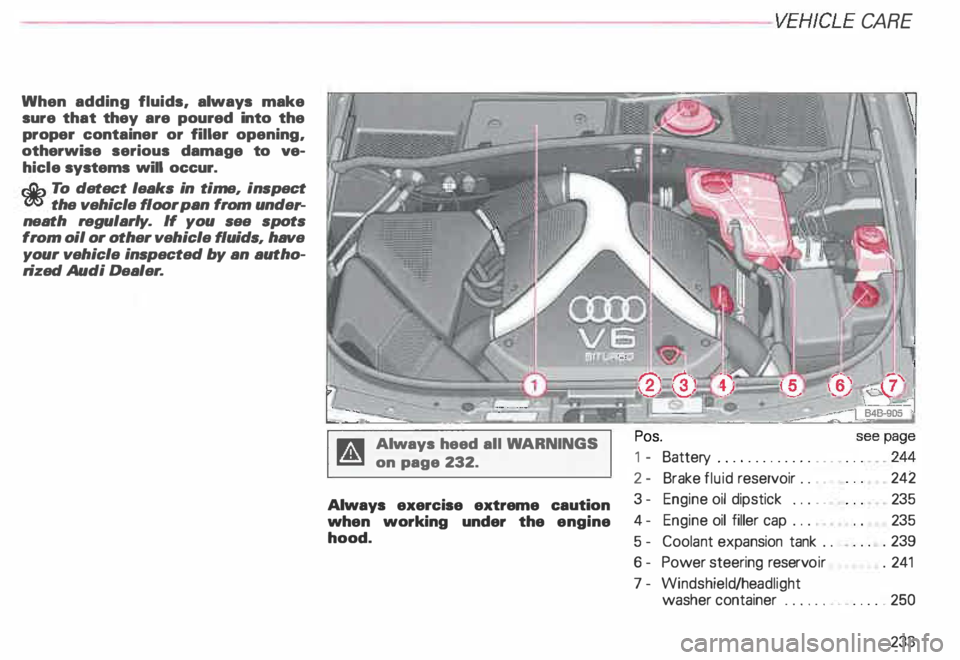
Pos.
1 - Battery ............. . _ .. .. .
2- Brake fluid reservoir . . . 242
3 - Engine oil dipstick ... . _ 235
4- Engine oil filler cap . . . 235
5- Coolant expansion tank . . . 239
6 - Power steering reservoir .
241
7 - Windshield /headlight
washer container ......•• _ .... . 250
233
Page 236 of 306
Engine
oil consumption
The rate of the oil consumption depends on
the quality and viscosity of oil, the speed at
which the engine is operated, the climate,
and road conditions as well as amount of
dilution and oxidation of the lubricant.
Because of these variables, no standard
rate of oil consumption can be established,
but drivers should expect higher oil con
sumption at high speeds and when the en
gine is new.
Therefore, we recommend that you check
the oil level at regular intervals (for example,
each time you are refuelling, or before going
on a long trip).
If the oil level should go below the minimal
level, the check engine oil level warn
ing light* in the instrument cluster will
come on. See page 144. You should check
the oil level using the oil dip stick as soon as
possible, and then top off the oil as neces
sary. Notes
• The engine in your vehicle de
pends on oil to lubricate and cool all
of its moving parts. Therefore the
engine oil should be checked regu
larly and kept at the required level.
• Lack of sufficient engine oil may
lead to severe engine damage.
• The oil pressure warning light is
not an oil level indicator.
A Always
heed all WAR NINGS
� on page 232.
Checking the engine oil level
The best time to check the engine oil level
is when the oil is warm.
To get a true reading, the vehicle must be on
level ground.
A Always heed all WAR NINGS
� on page 232.
• After turning off the engine, wait a few
minu tes for the oil to return to the oil pan. VE
HICLE CARE
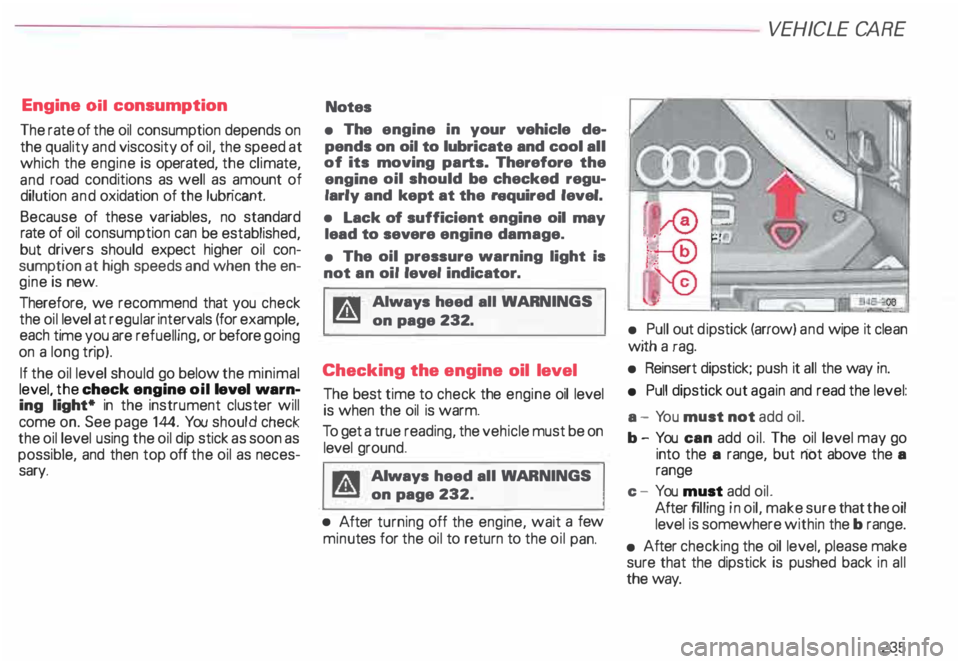
• Pull out dipstick (arrow) and wipe it clean
with a rag.
• Reinsert dipstick; push it all the way in.
• Pull dipstick out again and read the level:
a - Yo u must not add oil.
b- You can add oil. The oil level may go
into the a range, but riot above the a
range
c - You must add oil.
After filling in oil, make sure that the oil
level is somewhere within the b range.
• After checking the oil level, please make
sure that the dipstick is pushed back in all
the way.
235
Page 237 of 306
VEHICLE CA
RE---------------------------------------------------
Adding engine oil
A Always heed all WA RNINGS
r!!J on page 232.
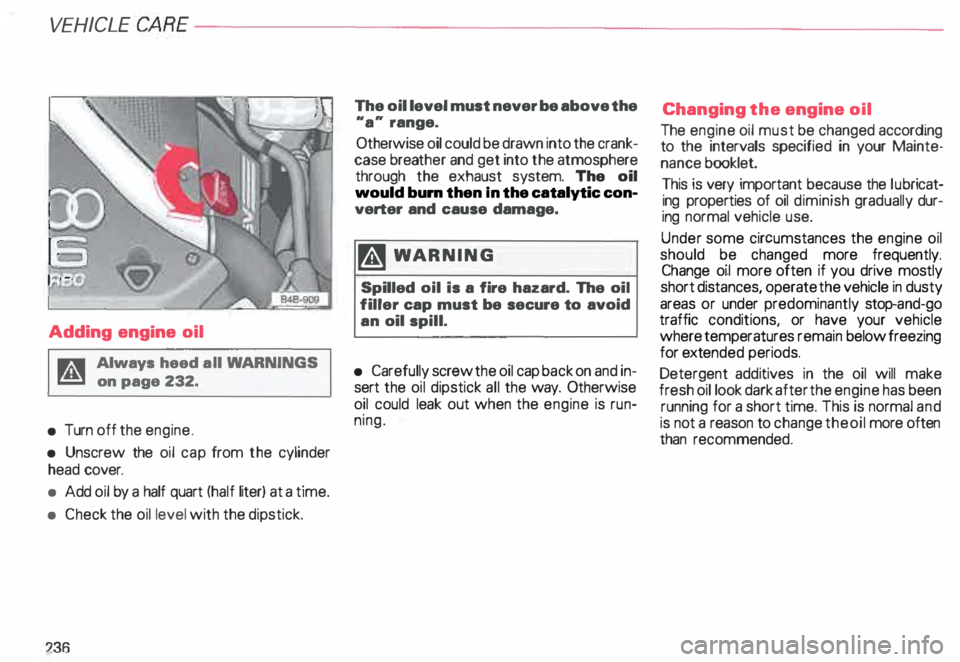
• Turn off the engine.
• Unscrew the oil cap from the cylinder
head cover.
• Add oil by a half quart (half liter) at a time.
• Check the oil level with the dipstick.
:236 The
oil level must never be above the
"a .. range.
Otherwise oil could be drawn into the crank
case breather and get into the atmosphere
through the exhaust system. The oil
would bum then In the catalytic con
verter and cause damage.
� WARNING
Spilled oil is a fire hazard. The oil
filler cap must be secure to avoid
an oil spill.
• Carefully screw the oil cap back on and in
sert the oil dipstick all the way. Otherwise
oil could leak out when the engine is run
ning. Changing
the engine oil
The engine oil must be changed according
to the intervals specified in your Mainte
nance booklet.
This is very important because the lubricat
ing properties of oil diminish gradually dur
ing normal vehicle use.
Under some circumstances the engine oil
should be changed more frequently.
Change oil more often if you drive mostly
short distances, operate the vehicle in dusty
areas or under predominantly stop-and-go
traffic conditions, or have your vehicle
where temperatures remain below freezing
for exte nded periods.
Detergent additives in the oil will make
fresh oil look dark after the engine has been
running for a short time. This is normal and
is not a reason to change the oil more often
than recommended.
Page 238 of 306
---------------------------------------------------VEHICLE CA
RE
�W ARNING
• If you must change the engine
oil in your vehicle:
• Wear eye protection.
• To reduce the risk of burns from
hot engine oil let the engine cool
down to the touch.
• When removing the oil drain
plug with your fingers, stay as far
away as possible. Always keep
your forearm parallel to the
ground to help prevent hot oil
from running down your arm.
• Drain the oil into a container de�
signed for this purpose, one large
enough to hold at least the total
amount of oil in your engine. ,A
WARNING continued
• Engine oil is poisonous. Keep it
well out of the reach of children.
• Continuous contact with used
engine oil is harmful to your skin.
Always protect your skin by wash
ing thoroughly with soap and wa
ter. �
BefoN changing your oil, first
make sure you know where you
can properly dispose of the old oil.
Always dispose of used engine oil
proper ly. Do not dump it on garden
soil, wooded areas, Into open
streams or down sewage drains.
Recycle used engine oi l by taking it
to a used engine oil collection facil
ity in your area, or contact a service
station.
Because of the problem of proper
disposal, along with the special
tools and necessary expertise re
quired, we strongly recommend that
you have your oil changed by an au
thorized Audi Dealer or a qualified
workshop.
Always heed all WA RNINGS
on page 232.
237
Page 239 of 306
VEHICLE CA
RE----------------------------------------------------
Engine cooling system
The cooling system is sealed and generally
requires little attention.
The cooling system has been filled at the
factory with a permanent coolant which
does not need to be changed. The coolant
consists of a mixture of water and the
man ufacturer's coolant additive G 12 ABD
-ant ifreeze on a glycol base with anti-corro
sion additives (50% for USA models; 60o/o
for Canadian models). This mixture assures
the necessary frost protection and protects
alloy components in the engine's cooling
system from corrosion and scaling. It also
raises the boiling point of the coolant.
Do not reduce the concentration of the cool
ant in the summer by adding plain water.
The proportion of coolant additive
must be at least 500fa but not more
than 600fa to maintain antifreeze protec
tion and cooling efficiency.
238 For
year-r ound driving, antifreeze is added at
the factory for temperatures down to:
-31 °F (-35 °C) USA
-40 °F (-40 °C) Canada.
g Always heed all WA RNINGS
E!!1 on page 232.
Never use eny coolant additive
other than our G12 ABD additive
(check label) for your vehicle. This
coolant additive is available at au
thorized Audi Dealers.
Other types of antifreeze can. above
all. significantly reduce corrosion
protection. The resulting corrosion
can cause a loss of coolant and
therefore serious engine damage. When
adding coolant additive to
your cooling system. please remem
ber:
Under no circumstances may G12
ABD be mixed with other coolant ad
ditives (for example G 11 ).
You can recognize G12 ABD in the
expansion tank by its red color. If
the liquid in the expansion tank is
brown, G 12 ABD has been mixed
with another coolant additive. In
this case. your vehicle's coolant
must be changed as soon as pos
sible.
Note
Mixing coolant additives can result
in serious malfunction or engine
damage!
Page 240 of 306
Checking the
engine coolant
level
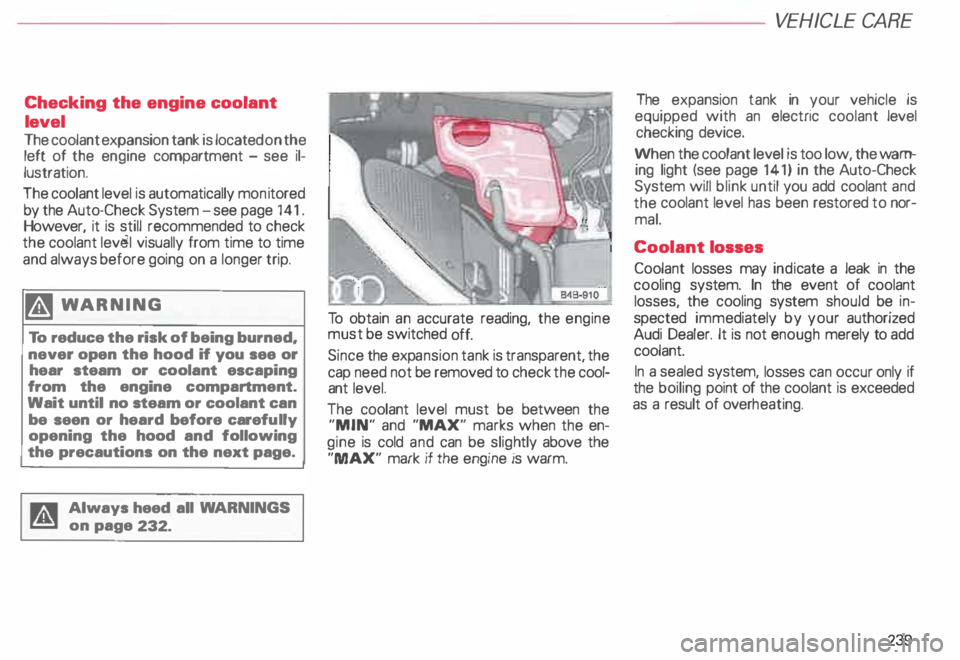
The coolant expansion tank is located on the
left of the engine compartment -see il
lustration.
The coolant level is automatically monitored
by the Auto-Check System -see page 141.
However, it is still recommended to check
the coolant lev�l visually from time to time
and always before going on a longer trip.
�W ARNING
To reduce the risk of being burned.
never open the hood if you see or
hear steam or coolant escaping
from the engine compartment.
Wait until no steam or coolant can
be seen or heard before carefully
opening the hood and following
the precautions on the next page.
Always heed all WA RNINGS
on page 232. To
obtain an accurate reading, the engine
must be switched off.
Since the expa nsion tank is transparent, the
cap need not be removed to check the cool
ant level.
The coolant level must be between the
"MIN" and "MAX" marks when the en
gine is cold and can be slig htly above the
"MAX" mark if the engine is warm. VE
HICLE CARE
The expansion tank in your vehicle is
equipped with an electric coolant level
checking device.
When the coolant level is too low, the warn
ing light (see page 141) in the Auto-Check
System will blink until you add coolant and
the coolant level has been restored to nor
mal.
Coolant losses
Coolant losses may indicate a leak in the
cooling system. In the event of coolant
losses, the cooling system should be in
spected immediately by your authorized
Audi Dealer. It is not enough merely to add
coolant.
In a sealed system, losses can occur only if
the boiling point of the coolant is exceeded
as a result of overheating.
239