2000 AUDI ALLROAD lock
[x] Cancel search: lockPage 232 of 306

Engine
hood
To unlock the engine hood, pull the re
lease lever on the left under the dashboard.
The hood pops up slightly under spring pres
sure.
Note
Before opening the engine hood,
make sure that the windshield wip
ers are folded flat against the wind
shield. Otherwise, they could dam
age the paint on the hood. To
open, pull the release lever in the direc
tion indicated by the arrow. This will release
the hook under the hood.
Open the hood all the way. It will be held up
by gas pressure in the strut. VEH
ICLE CARE
To close
Pull the hood down until the pressure from
the strut is reduced. Then Jet the hood fall
and latch in place -you do not need to
press the hood down again.
m WARNING
• A hood that is not 'completely
latched could fly up and block
your view while driving. When you
close the engine hood, check it to
make sure the safety catch has
properly engaged. The hood
should be flush with the surround
ing vehicle body parts.
• If you ever notice while driving
that the hood is not secured prop
erly, stop at once and close it.
Always heed all WA RNINGS
on next page.
231
Page 241 of 306
VE
HICLE CARE
Adding coolant
� WARNING
The cooling system is under pres
sura and can get very hot. Reduce
the risk of scalding from hot cool
ant by following these steps.
• Turn off the engine and allow it
to cool down.
• Protect face, hands and arms es
caping fluid and steam by covering
the cap with a large, thick rag.
• Turn the cap slowly and very
care fully in a counter--clockwise di
rection while applying light, down
ward pressure on the top of the
cap.
• To help avoid being burned, do
not spill antifreeze or coolant on
the exhaust system or hot engine
parts. Under some conditions, the
ethylene glycol in engine coolant
can catch fire.
240 If,
in an emergency, only water can be add
ed, the correct ratio between water and an
tifreeze (see page 238) must be restored as
soon as possible.
If you have lost a considerable amount of
coolant. then you should add cold antifreeze
and cold water only when the engine is cold.
Do not fill coolant above the "MAX"
mark.
Note
Coolant pollutes the environment
and could cause an engine fire. Ex
cess coolant will be forced out
through the pressure relief valve in
the cap when the engine becomes
hot. Screw cap
on again tightly.
� WARNING
Antifreeze is poisonous. Always
store antifreeze in its original con
tainer and well out of the reach of
children. If you drain the coolant,
it must be caught and safely
stored in a proper container
clearly marked "poison ...
<£> Drained coolant should not be
reused. Always dispose of used
coolant observing all env ironmen
tal regulations.
Always heed all WARNINGS
on page 232.
Page 249 of 306
VEHICLE CA
RE----------------------------------------------------
When disconnecting and
connecting the battery ...
When you disconnect the vehicle battery
please note the following:
- some data stored in the driver informa-
tion system are erased,
- the clock goes out,
- the factory installed radio locks up,
- the Engine management system,
- the one-touch-u p and one-touch-down
functions of the power windows no lon
ger work,
- all stored seat positions in the memory*
are erased.
Af teryou reconnect the battery, you must
reset the clock. � page 118.
You also have to reset the Engine manage
ment system -see "Starter Switch "
�pa ge 113.
You also have to reset the one-touch-up and
one-touch�down feature on power win
dows -see "Power windows "
�p age 71.
248 You
have also reset the seat memory* -see
"Seats"
� page 81.
The radio must be re-coded with the correct
radio code - see your radio Operating In
structions.
Replacement battery
A replacement battery must have the same
specifications and dimensions as the origi
nal equipment battery. Specifications are
listed on the battery housing.
When installing the battery, make sure the
ignition and all electrical consumers are
switched off.
r.Gb. Because of the problem of �proper di
sposal of a battery, we
recommend that you have your au
thorized Audi Dealer change the
battery for you. Batteries contain
sulfuric acid and lead and must al
ways be disp osed of properly ob
serving all environmental regula
tions. Air
cleaner
A dir ty air cleaner element not only reduces
the engine output and increases fuel con
sumption considerably but can also cause
premature engine wear.
Normally, it is not necessary to service the
air cleaner more often than recommended
in the Maintenance booklet. If the vehicle is
driven on very dusty roads, the air cleaner
must be serviced more frequently, even dai
ly.
If your air cleaner element must be
changed mora frequently, we rec
ommend that you have the air clean
er serviced by your authorized Audi
Dealer or a qualified workshop.
The air cleaner element must never
be cleaned or soaked with gasoline,
cleaning solvents or oil.
g Always heed all WARN INGS
t!!3 on page 232.
Page 252 of 306
Wiper
blades
Wiper blades must be in good condition so
that you can see clearly through the wind
shield.
Clean your wiper blades regularly with a
windshield washer solution to prevent
streaking. If the blades are very dirty, for ex
ample with insects, carefully clean the
blades with a sponge or a soft brush.
If the wiper blades begin to streak t �e wind
shield, this could be caused by resrdue left
on the windshield by automatic car washes.
Fill the windshield washer container with a
special solution available at yo�r authorized
Audi Dealer to remove the resrdue.
To prevent damage to the wiping
sys tem, always loosen blades frozen
to glass before operating wipers.
Be sure to inspect the condition of your
wiper blades regularly. For safety reasons,
replace your wiper blades once o; twrce a
year if necessary. See your authonzed Audr
Dealer for replacement blades. Notes
• Commercial hot waxes applied by
automatic car washes affect the
cleanability of the windshield.
• To prevent damage to wiper
blades, do not use gasoline, kero
sene, paint thinner, or other sol
vents on or near the wiper blades.
• To prevent damage to the wiper
arms or other components, do not
attempt to move the wipers by hand. VE
HICL E CA RE
Replacing wiper blades
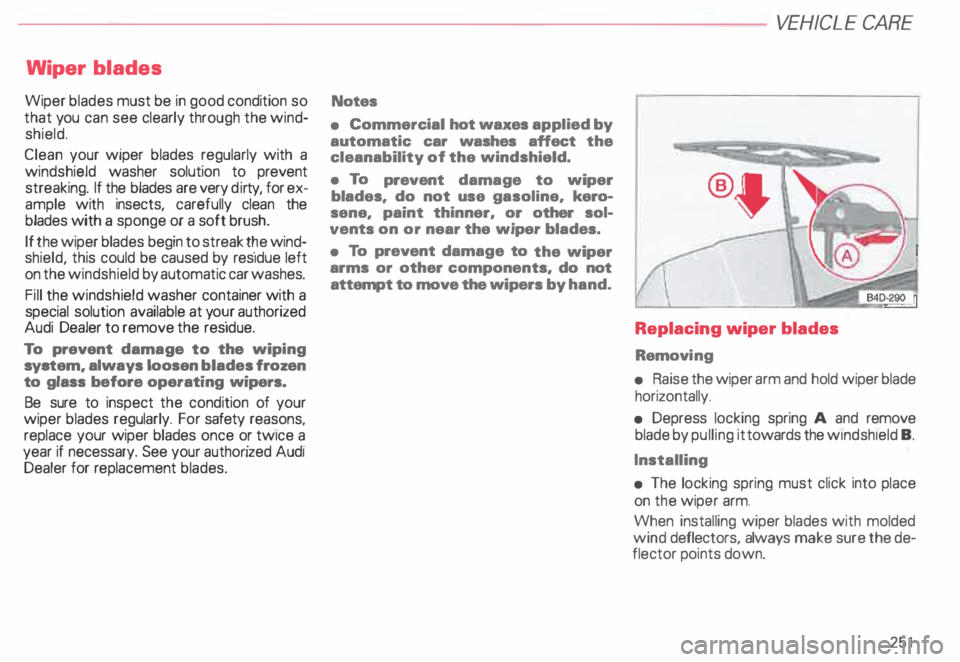
Removi ng
• Raise the wiper arm and hold wiper blade
horizontally.
• Depress locking spring A and remove
blade by pulling it towards the wrndsh1eld B.
Installing
• The locking spring must click into place
on the wiper arm.
When installing wiper blades with molded
wind deflectors, always make sure the de
flector points down.
251
Page 256 of 306
Only
when tires show unusual wear such as
feather-e dging should they be rotated diag
� nall y. Yo ur vehicle may be equipped with
trres which have a specified rotation direc
tion. The rotation direction is identified by
arrow markings on the sides of the tires.
The rotation direction must not be revers ed.
Therefore, these tires cannot be switched
diagonally. If in doubt, discuss any unusual
tire wear with your authorized Audi Dealer's
service department.
After rotation adjust tire pressure and
torque wheel bolts diagonally to 90 tt lb
(120 Nm). Refer to "Changing a wheel" on
page 267 for details. Tire
replacement
Wheels and tires approved by the manu fac
turer have been specially matched to your
vehicle and contribute greatly to the road
holding, driving characteristics and safety of
the vehicle.
Make sure that the new tires also meet the
specifications listed on the label located on
the inside of the fuel filler flap or on the driv
er's door lock jamb.
It's �mporta nt to remember that in spite of
h �vrng the same tire designation, the actual
s1ze of a tire can vary from tire man ufacturer
to tire man ufacturer. Using different tire and
wheel rim combinations can result in re
duced clearance between the tire and the
vehicle body.
Therefore, never mount tires that
are of a different designation or
have different dimensions from
those of the factory supplied tires
which came equipped on your ve
hicle. VE
HICLE CARE
• If you must replace tires different from
those which were originally factory supplied
on your vehicle, always use the specific
brands, specifications and dimensions
which were specified by Audi for your ve
hicle.
Yo ur authorized Audi dealer or Audi Client
Relations have information regarding the
t1res and wheel rims specified for your car,
and can tell you which tires and tire
man ufacturers were approved by the fac
tory for original equipment installation.
• We recommend that you have your tires
changed by an authorized Audi Dealer, be
cause they have the special tools and nec
essary expertis e.
Furthermore, your authorized Audi Dealer
stocks a range of tires and wheels.
• If the spare tire is different from the tires
that you have mounted on your vehicle (for
example winter tires or wide profile tires),
then use the spare tire for a short period of
time only and drive with extra care. Replace
the flat tire with a tire matching the others
on your vehicle as soon as possible.
255
Page 265 of 306
DO-IT-Y
OURSELF SERVICE----------------------
Jack and
tools
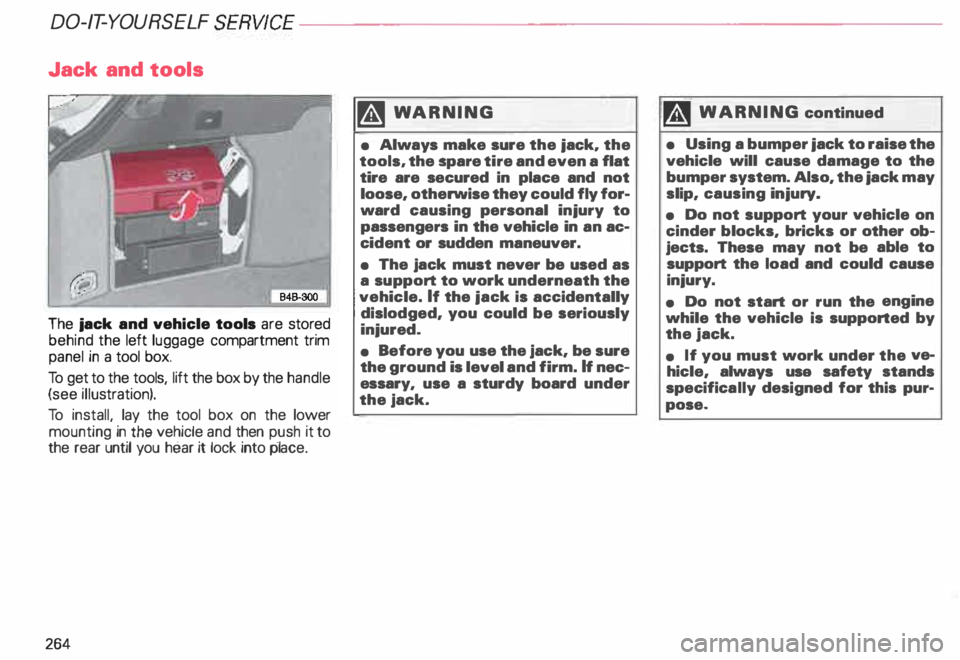
The jack and vehicle tools are stored
behind the left luggage compartment trim
panel in a tool box.
To get to the tools, lift the box by the handle
(see illustration).
To install, lay the tool box on the lower
mounting in the vehicle and then push it to
the rear until you hear it lock into place.
264 �W
ARNING
• Always make sure the jack. the
tools, the spare tire and even a flat
tire are secured in place and not
loose, otherwise they could fly for
ward causing personal injury to
passengers in the vehicle in an ac
cident or sudden maneuver.
• The jack must never be used as
a support to work underneath the
vehicle. If the jack is accidentally
dislodged, you could be seriously
injured.
• Before you use the jack, be sure
the ground is level and firm. If nec
essary, use a sturdy board under
the jack.
, ... WARNING continued
• Using a bumper jack to raise the
vehicle will cause damage to the
bumper system. Also, the jack may
slip, causing injury.
• Do not support your vehicle on
cinder blocks, bricks or other ob
jects. These may not be able to
support the load and could cause
injury.
• Do not start or run the engine
while the vehicle is supported by
the jack.
• If you must work under the ve
hicle, always usa safety stands
specifica lly designed for this pur
pose.
Page 268 of 306

•
The deflated full size spare tire cannot be
repaired or mounted using conventional
shop equipment. This work always has to
be performed by the man ufacturer of the
collapsible tire.
• All the air must be let out of the tire after
use before stowing it in the storage area
prov ided for it in the vehicle. Once all the air
is out, the tire will return to its original form.
To let the air out of the tire, either use a
sharp object to press down on the metal pin
in the valve, or use the valve-remo ving tool
on the back side of the dust cap to unscrew
the valve stem. Changing
a wheel
�W ARNING
You or your passengers could be
injured while changing a wheel if
you do not follow safety precau
tions:
• If you have a flat tire, move a
safe distance off the road. Turn off
the engine, turn the emergency
flasher on and use other warning
devices to alert other motorists.
• Passengers must not rema in in
the vehicle when it is jacked up.
This includes children as well as
adults.
• Make sure that passengers wait
in a safe place away from the ve
hicle and well away from the road
way and traffic.
• Before you change a wheel, be
sure the ground is level and firm.
If necessary, use a sturdy board
under the jack. DO-IT-YOURSELF
SERVICE
�� WARN ING continued
• After installing the spare wheel,
make sure that you remount the
flat tire/Wheel in its storage area
properly and tighten the plastic
knurled screw securely.
• To help prevent the vehicle from
moving suddenly and possibly
slipping off the jack, always fully
set the parking brake and block
the wheel diagonally opposite the
wheel being changed. When one
front wheel is lifted off the
ground, placing the automatic
transmission in P (Park) will not
prevent vehicle movement.
267
Page 271 of 306

DO-IT-Y
OURSELF SERVICE----------------------
\
�W ARNING
Yo u or your passengers could be
injured while changing a wheel if
you do not follow safety precau
tions:
• Jacking at any other place may
damage the vehicle or may result
in personal injuries.
• An unstable surface under the
jack may cause the vehicle to slip
off the jack. Always provide a firm
base for the jack on the ground. If
necessa ry. use a sturdy board un
der the jack.
• On hard. slippery surface (such
as tiles) use a rubber mat or similar
to prevent the jack from slipping.
270 Step
5
• Turn the handle on the jack until the jack
arm just fits underneath the vehicle.
• Position the jack arm on the lower sill of
the vehicle so that the rib in the recess is
surrounded by the jack claw (A) and the
movable base plate (8) of the jack lies flat on
the floor.
When you straighten the jack, make sure
claw doesn't slip off the rib. �W
ARNING
o Do not raise the vehicle until
you are sure the jack is securely
engaged.
• Passengers must not rema in in
the vehicle when it is jacked up.
• Make sure that passengers wait
in a safe place away from the ve
hicle and well away from the road
way and traffic.
• To raise the vehicle, turn the handle
clockwise. Only raise the vehicle as much
as is needed to change a wheel.