2000 AUDI ALLROAD lock
[x] Cancel search: lockPage 207 of 306

VEHICLE
OPER ATION----------------------
Operation
The Anti-Lock Brake System (ABS) and the
Electronic Differential Lock (EDU are inte
grat _ed in the Electronic Stability Progr am. In
a _ddrtron to the data provided by these func
tions, the ESP control unit requires addition
al measurement data provided by hig h-per
forman ?e sensors. The rotat ional speed of
the veh1cle about its vertical axis, vehicle lat
eral acceleration, brake pressure and the
steering angle are measured.
The direction in which the driverwishes to
travel is determined with the aid of the
stee �ing angle and the vehicle speed and is
contmually compared with the actual be
havior of the vehicle.
If the data do not match - for example when
a vehrcle is beginning to spin out of control
- the ESP applies the brakes to the appropri
ate wheels for the given situation and, if
necessar y, changes the vehicle traction
forces so as to reduce the slipping of individ
ual wheels (ASR anti-slip regulation).
206 The
vehicle is then stabilized by the forces
a ?tin � on the wheel during braking. If the ve
hicle IS overstee ring (rear tends to skid out
of the turn), the brakes are mainly applied on
the wheel that is on the outside ofthe curve.
In the case of a vehicle that is und ersteering
(tendency to slide out of the curve). the
brakes are applied at the rear wheel that is
on the inside of the curve. An audible signal
�rll accompany the brake application func
tion.
All �SP senso rs a�e monitored continuously
wh1le the vehicle IS being driven. However,
when the vehicle is driven at low speed on
ex tremely rugged terrain, it is not always
possrble to monrtor the ESP sensors contin
uously. Thus, in rare and exceptional cases
the ESP itself can deactivate (ESP and ABS
ind icator lights will be lit continuously).
In this case. the ride level adjustment sys
tem lowers the vehicle to the normal level
If this happens, you may need to select th�
ride level again (see page 153).
Operation of the ESP and ABS is restored
whenever you restart the engine. m
WAR NING
! he Electronic Stability Program
•• nevertheless subject to the laws
of physics. It is particularly impor
tant to pay attention to this fact on
wet and slippery roads.
It is therefore important that you
always adapt your driving to the
condition of the road and traffic
conditions. Do not allow the in
creased safety provided by the
Electro nic Stability Program sys
tem to lull you into accepting addi
tional safety risks.
Page 212 of 306
-----------------------VEHICL E OPER ATION
Tr ailer towing tips
Yo ur vehicle handles differently when tow
ing a trailer because of the additional weight
and weight distribution. Safety, perfor
mance and economy will greatly depend on
how carefully you load your trailer and oper
ate your rig.
Before you actually tow your trailer, practice
turning, stopping and backing up in an area
away from traffic until you learn the feel of
your vehicle and trailer unit.
Backing up is difficult and requir es practice.
Steering while backing up is generally oppo
site of that when backing your vehicle with
out a trailer.
Maintain a greater distance between your
vehicle and the one in front of you. You will
need more room to stop.
To compensate for the trailer, you will need
a larger than normal turning radius. When
passing, remember that you cannot
accelerate as fast as you normally would be
cause of the added load. Make sure you
have enough room to pass. After passing,
allow plenty of room for your trailer before
changing lanes again.
Avoid jerky starts, sharp turns or rapid lane
changes.
After parking, always block the wheels of
both vehicle and trailer. Do not park with a
trailer on a slope. If it cannot be avoided, do
so only after doing the following:
• Apply foot brake.
• Have someone place chocks under both
vehicle and trailer wheels.
• With chocks in place, slowly release
brakes until wheel blocks absorb the load.
• Turn wheels to curb.
o Apply parking brake.
• Place automatic transmission in "P". If
you move the selector lever of the auto
matic transmission to "P" before applying
the parking brake and before blocking the
wheels, you may require more force later to
move the lever out of the "P" position.
When restarting after parking on a slope, re
verse the procedure:
• Start the engine.
• Shift transmission into gear.
o Release the parking brake and slowly
move away from the wheel blocks.
• Stop and have someone retrieve the
wheel blocks.
Notes
• Do not tow a trailer during the
break-in period of your vehicle.
• If you tow a trailer, your Audi may require
more frequent maintenance due to the ex
tra load -see also page 228.
211
Page 215 of 306

VEHICL E CA
RE----------------------------------------------------
Notes
• Do not wash the vehicle in direct sun
light.
• If the vehicle is rinsed with a hose, do not
direct the water into the lock cylinders -
otherwise they may freeze up in the winter.
�W ARNING
• Do not wash, wax or dry the ve
hicle with the engine running.
• Do not clean the underside of
chassis, fenders, wheel covers,
etc. without protecting your
hands and arms. You may cut your
self on sharp-edged metal parts.
• Moisture and ice on brakes may
affect braking efficiency. Test the
brakes carefully after each vehicle
wash.
214 Washing
your vehicle with a power
washer
If you use a power washer, please note the
following:
• Always follow the operating instructions
for the power washer -especially for pres
sure and spraying distance.
• Make sure that the jet on the spray hose
produces a "fan shape" spray. Do not use
a jet which sprays the water out in a direct
stream or one that has a rota ting jet.
• Water temperature should not exceed
140 °F (60 °C).
�W ARNING
Never wash tires with a jet that
sprays the water out in a direct
stream. This could invisibly dam
age and weaken the tires, even if
they are sprayed from a relatively
long distance for a vary short
amount of time. Damaged and
weakened tires can fail and cause
accidents and personal injury. Headli
ghts
Do not clean your headlights with a dry
towel or sponge. They must be cleaned
with a moistened towel.
Never use a sponge designed for removing
dried-on insects, a kitchen scrubber or any
other similar product since the lens surface
can be damaged by scrat ching and scour
ing.
When using high-pressure washing equip
ment or steam-cl eaning units, never spray
the vehicle with the nozzle close the vehicle
surface and never aim the spray at the same
point for a relatively long period of time.
Polishing Please refer to the imp ortant information on
page 212.
Polish your vehicle only if the paint has lost
its shine and the gloss cannot be brought
back with wax. If the polish used doesn't
contain preservative compounds, the paint
must be waxed afterwards.
Do not treat matte- pain�ed and plas
tic parts with polish or wax.
Page 220 of 306
-------------------------VEHICLE CA
RE
Engine compartment
�W ARNING
• Before working in the engine
compartment. be sure to read the
information on page 232.
I) Before reaching into the front
plenum panel. always re!"ove the
ignition key. Otherw1se. the
windshield wiper system could
unin tentionally be switched on.
possibly causing personal injury
from the moving wiper linkage.
• Do not wash. wax or dry the en�
gine with the engine ru!'l'! ing. Mov
ing or hot parts could 1n1ure you. ,Al
WARNING continued
e Do not clean the underside of
the chassis, fenders. wheel cov
ers. or other hard to reach parts
without protecting your hands and
arms. You may cut yourself on
sharp-edged metal parts.
• Moisture and ice on brakes may
affect braking efficiency. Test the
brakes carefully after each vehicle
wash.
The engine compartment and transmission
have been corrosion protected at the facto
ry.
Remove leaves from the plenum panel in
front of the windshield under the engine
hood. This prevents the water drain holes
from becoming blocked, and it prevents de
bris from entering the vehicle interior
throug h the heating and ventilation ducts. Good
anti-corrosion treatment is very im
porta nt, particularly in the winter. If the ve
hicle is frequently driven on salted roads,
the entire engine compartment and plenum
panel should be thor oughly cleaned at the
end of winter and retreated to prevent salt
damage. At the same time, the underside of
the vehicle should be washed as well.
�W ARNING
Never touch the radiator fan. The
auxiliary electric fan can switch on
suddenly and injure you-
Always switch off the ignition be
fore cleaning the engine _
219
Page 223 of 306
VEHICL E CA
RE----------------------------------------------------
Fuel tank
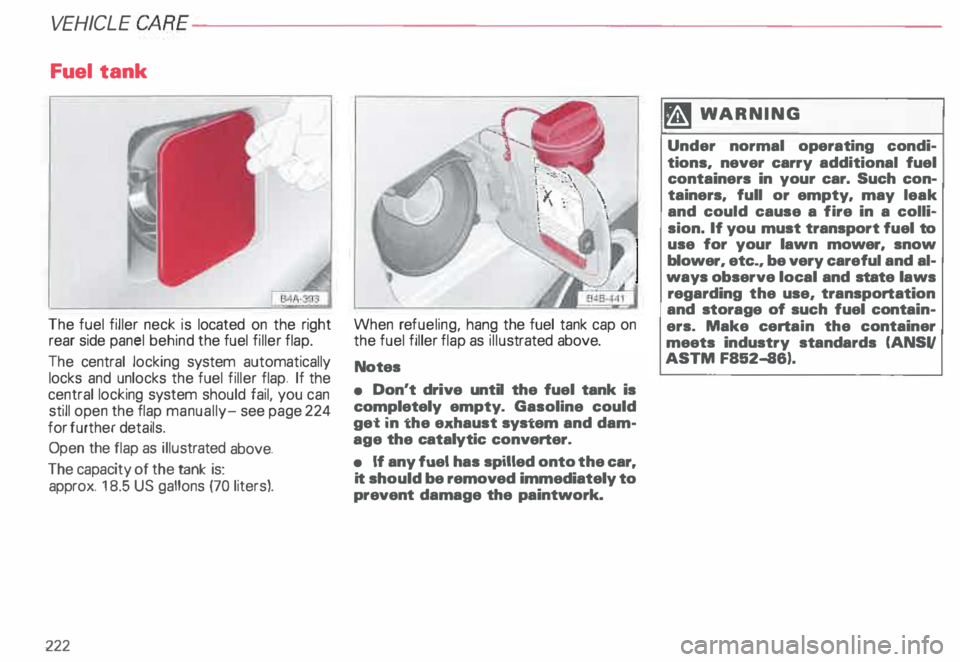
The fuel filler neck is located on the right
rear side panel behind the fuel filler flap.
The central locking system automatically
locks and unlocks the fuel filler flap. If the
central locking system should fail, you can
still open the flap manually- see page 224
for further details.
Open the flap as illustrated above.
The capacity of the tank is:
approx. 18.5 US gallons (70 liters).
-222 When
refueling, hang the fuel tank cap on
the fuel filler flap as illus trated above.
Notes
• Don't drive until the fuel tank is
completely empty. Gasoline could
get in the exhaust system and dam
age the catalytic converter.
• If any fuel has spilled onto the car,
it should be removed immediately to
prevent damage the paintwork. �W
ARNING
Under normal operating condi
tions, never carry additional fuel
containers in your car. Such con
tainers, full or empty, may leak
and could cause a fire in a colli
sion. If you must transport fuel to
use for your lawn mower, snow
blower, etc., be very careful and al
ways observe local and state laws
regarding the use, transportation
and storage of such fuel contain·
ers. Make certain the container
meets industry standards CANSII
ASTM F852-86).
Page 224 of 306
Refu
elling the vehicle
Yo ur vehicle fuel tank has an on-board refu
elling vapor recovery system. This feature
helps to prevent fuel vapors from escaping
from the tank and polluting the environment
while you refuel your vehicle.
In order to fill your tank properly while pro
tecting the environment. please follow this
refueling procedure carefully:
• Turn off the engine.
• Remove the fuel filler cap by turning it
slowly counter clockwise allowing fuel
pressure to dissi pate.
• Insert the fuel nozzle from the gasoline
pump into the fuel filler neck as far as it will
go.
Select a medium refuelling rate, when filling
your tank. �W
ARNING
Failure to shut the engine off while
re fueling and I or to insert the
pump nozzle fully into the car's
filler neck could cause fuel over
flow and fuel spray which can
cause fire or serious injury.
• Stop refueling when the fuel pump shuts
off automatical ly - do not add more fuel or
"top off". dih As soon as the correctly oper� ated nozzle switches off auto
matically for the first time, the tank
is full. Do not try to add more fuel,
because fuel may spill out. In addi
tion, the expansion space in the fuel
tank will be filled -causing the fuel
to overflow when it becomes warm
and pollute the environment.
• After filling your tank, turn the fuel filler
cap clockwise until you hear a definite click.
To avoid fuel spilling or evapor ating from the
fue I tank a I ways close fuel filler cap properly
and completely. VE
HICL E CA RE
Notes
• If you cannot fully insert the pump nozzle,
use another fuel pump or change gas sta
tions.
• Do not refuel your vehicle with the igni
tion switched on. The fuel gauge may other
wise not indicate the exact fuel level after
refu elling.
223
Page 225 of 306
VEHICLE CA
RE-------------------------
Filling a portable fuel container
in excep tional cases
�W ARNING
To reduce the risk of fire and per
sonal injury when filling a fuel con
tainer for a lawn mower or snow
blower, etc. please remember:
• Never fill a portable fuel con
tainer leaving It still in the luggage
compartment or on top of the car.
Static electricity can build up
while filling and can ignite fuel va
pors causing a fire. Always place a
portable fuel container on the
ground before filling.
224 ��
WARNING continued
• Never spill fuel inside the lug
gage compartment or vehicle inte
rior. Fuel vapors are highly flam
mable and can cause fire and seri
ous bums.
• Always observe local and state
(provincaU laws regarding the use,
storage and transportation of such
containers. ·
• Make certain the fuel container
meets industry standards (ANSI/
ASTM F852-86). Emergency
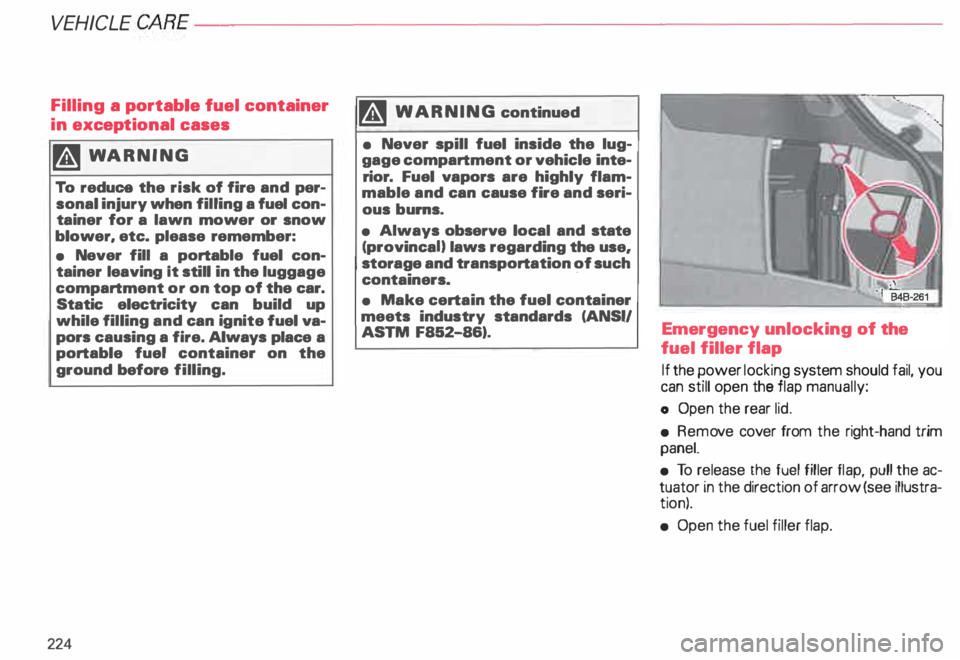
unlocking of the
fuel filler flap
If the !?ower locking system should fail, you
can still open the flap manually:
o Open the rear lid.
• Remo ve cover from the right-hand trim
panel.
• To release the fuel filler flap, pull the ac
tuator in the direction of arrow (see illustra
tion).
• Open the fuel filler flap.
Page 231 of 306
VEHI
CLE CARE
J'4 WARN ING continued
• If you must work underneath
the vehicle with the wheels on the
ground, always make sure the ve
hicle is on level ground. that the
wheels are always securely
blocked and that the engine can
not be started. Always remove the
ignition key before anyone gets
under the vehicle.
Always make sure the transmis
sion selector lever (automatic
transmission) is in "P" (Park posi
tion) and the hand brake is firmly
applied.
• Always be extremely careful
when working on the vehicle. Always follow commonly accepted safety practices and general com
mon sense. Never risk personal in
jury.
230 �
Changing the engine settings
will adversely aHect emission
levels. This Is detrimental to the en
vi ronment and increases fuel con
sumption.
Always observe environmental reg
ulations when disposing of old en
gine oil. used brake fluid, dirty en
gine coolant, spent batteries or
worn out tires.