1999 DODGE NEON ignition
[x] Cancel search: ignitionPage 782 of 1200
(5) Install cylinder head cover using procedure out-
lined in this section.
(6) Perform camshaft and crankshaft timing
relearn procedure as follows:
²Step 1: Connect the DRB scan tool to the data
link (diagnostic) connector. This connector is located
in the passenger compartment; at the lower edge of
instrument panel; near the steering column.
²Step 2: Turn the ignition switch on and access
the ªmiscellaneousº screen.
²Step 3: Select re-learn cam/crank option and fol-
low directions on DRB screen.
CAM FOLLOWER AND HYDRAULIC LASH
ADJUSTER ASSEMBLY
REMOVAL
(1) Remove cylinder head cover using procedure
outlined in this section.
(2) Remove timing belt, sprockets and covers using
procedure outlined in this section.
(3) Remove camshaft. Refer to procedure previ-
ously outline this section.
(4) Remove cam follower assemblies from cylinder
head. Keep the cam followers in the order they have
been removed from the head for reassembly. Mark
hydraulic lash adjusters for reassembly in their orig-
inal position. Lash adjusters are serviced as an
assembly.
NOTE: Inspect the cam follower assembly for wear
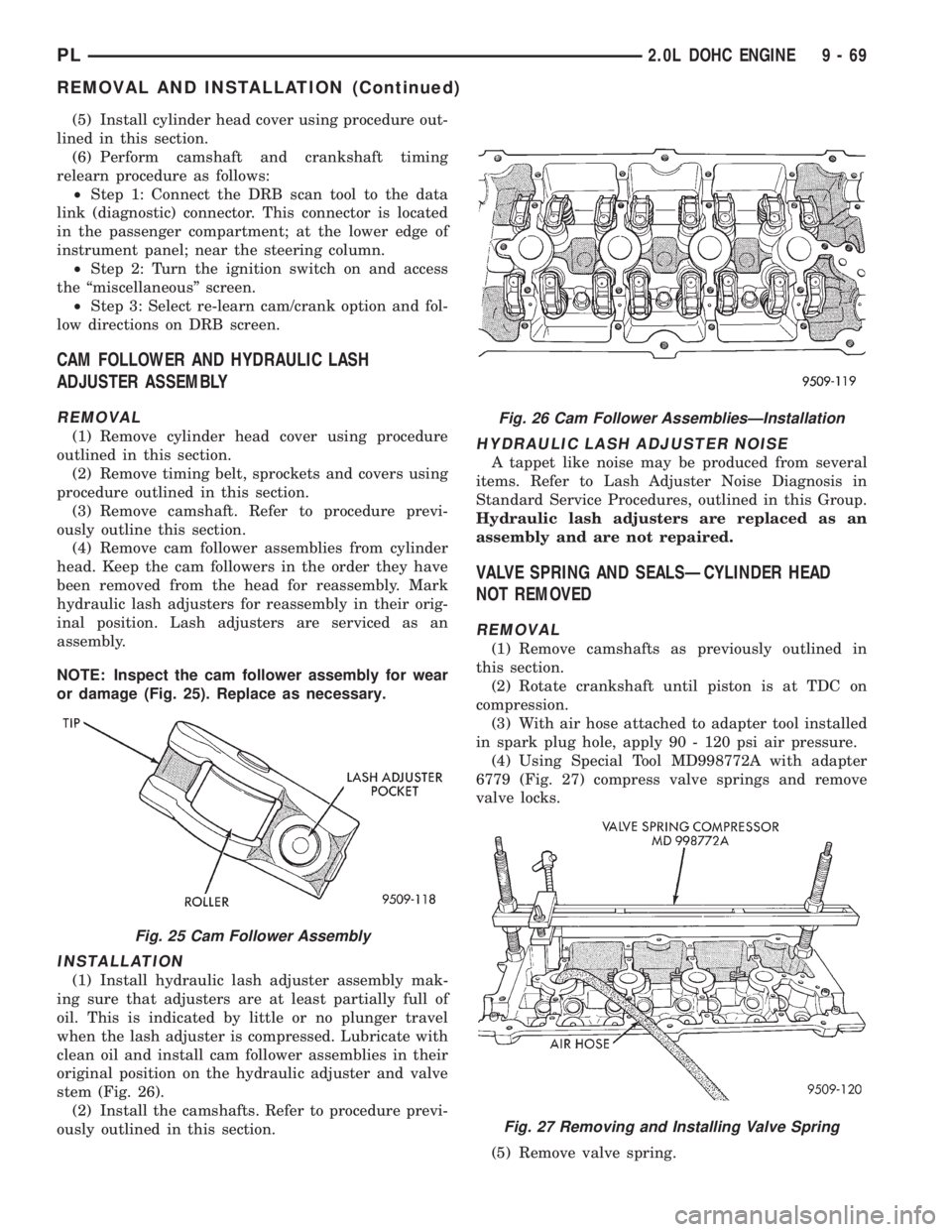
or damage (Fig. 25). Replace as necessary.
INSTALLATION
(1) Install hydraulic lash adjuster assembly mak-
ing sure that adjusters are at least partially full of
oil. This is indicated by little or no plunger travel
when the lash adjuster is compressed. Lubricate with
clean oil and install cam follower assemblies in their
original position on the hydraulic adjuster and valve
stem (Fig. 26).
(2) Install the camshafts. Refer to procedure previ-
ously outlined in this section.
HYDRAULIC LASH ADJUSTER NOISE
A tappet like noise may be produced from several
items. Refer to Lash Adjuster Noise Diagnosis in
Standard Service Procedures, outlined in this Group.
Hydraulic lash adjusters are replaced as an
assembly and are not repaired.
VALVE SPRING AND SEALSÐCYLINDER HEAD
NOT REMOVED
REMOVAL
(1) Remove camshafts as previously outlined in
this section.
(2) Rotate crankshaft until piston is at TDC on
compression.
(3) With air hose attached to adapter tool installed
in spark plug hole, apply 90 - 120 psi air pressure.
(4) Using Special Tool MD998772A with adapter
6779 (Fig. 27) compress valve springs and remove
valve locks.
(5) Remove valve spring.
Fig. 25 Cam Follower Assembly
Fig. 26 Cam Follower AssembliesÐInstallation
Fig. 27 Removing and Installing Valve Spring
PL2.0L DOHC ENGINE 9 - 69
REMOVAL AND INSTALLATION (Continued)
Page 786 of 1200
(14) Connect fuel supply hose to fuel rail.
(15) Install air cleaner duct and air cleaner.
(16) Install accessory drive belts. Refer to Group
07, Cooling System for procedures.
(17) Raise vehicle and connect exhaust system to
exhaust manifold.
(18) Lower vehicle and connect negative cable to
battery.
(19) With DRB scan tool use ASD Fuel System
Test to pressurize fuel system. Check for fuel leaks.
CAUTION: When using the ASD Fuel System Test,
the Auto Shutdown (ASD) relay will remain ener-
gized for 7 minutes, or until the ignition switch is
turned to the OFF position, or Stop All Test is
selected.
(20) Perform camshaft and crankshaft timing
relearn procedure as follows:
²Step 1: Connect the DRB scan tool to the data
link (diagnostic) connector. This connector is located
in the passenger compartment; at the lower edge of
instrument panel; near the steering column.
²Step 2: Turn the ignition switch on and access
the ªmiscellaneousº screen.
²Step 3: Select re-learn cam/crank option and fol-
low directions on DRB screen.
CRANKSHAFT DAMPER
NOTE: If a gap is found in the crankshaft damper,
in the area where the Poly-V Generator belt rides
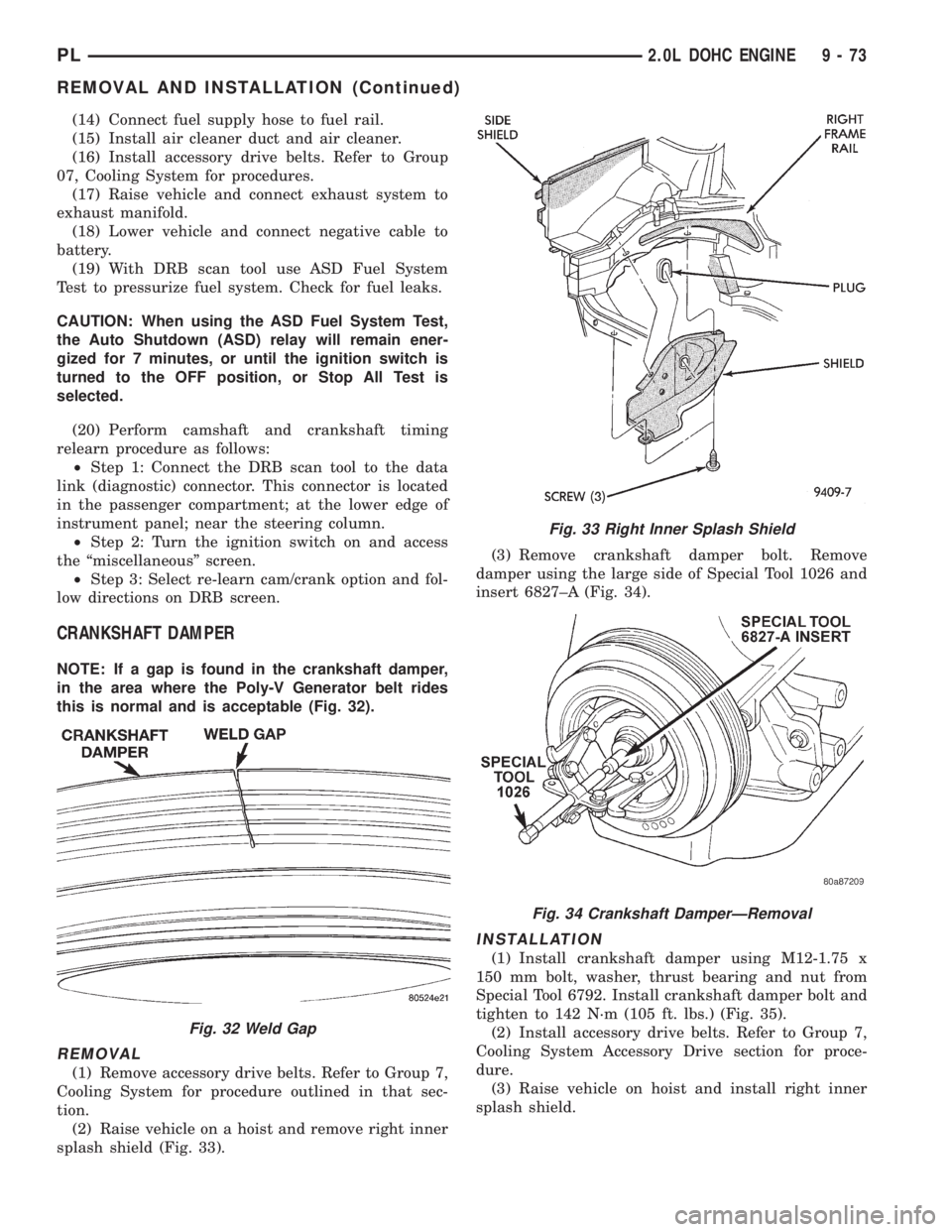
this is normal and is acceptable (Fig. 32).
REMOVAL
(1) Remove accessory drive belts. Refer to Group 7,
Cooling System for procedure outlined in that sec-
tion.
(2) Raise vehicle on a hoist and remove right inner
splash shield (Fig. 33).(3) Remove crankshaft damper bolt. Remove
damper using the large side of Special Tool 1026 and
insert 6827±A (Fig. 34).
INSTALLATION
(1) Install crankshaft damper using M12-1.75 x
150 mm bolt, washer, thrust bearing and nut from
Special Tool 6792. Install crankshaft damper bolt and
tighten to 142 N´m (105 ft. lbs.) (Fig. 35).
(2) Install accessory drive belts. Refer to Group 7,
Cooling System Accessory Drive section for proce-
dure.
(3) Raise vehicle on hoist and install right inner
splash shield.
Fig. 32 Weld Gap
Fig. 33 Right Inner Splash Shield
Fig. 34 Crankshaft DamperÐRemoval
PL2.0L DOHC ENGINE 9 - 73
REMOVAL AND INSTALLATION (Continued)
Page 790 of 1200
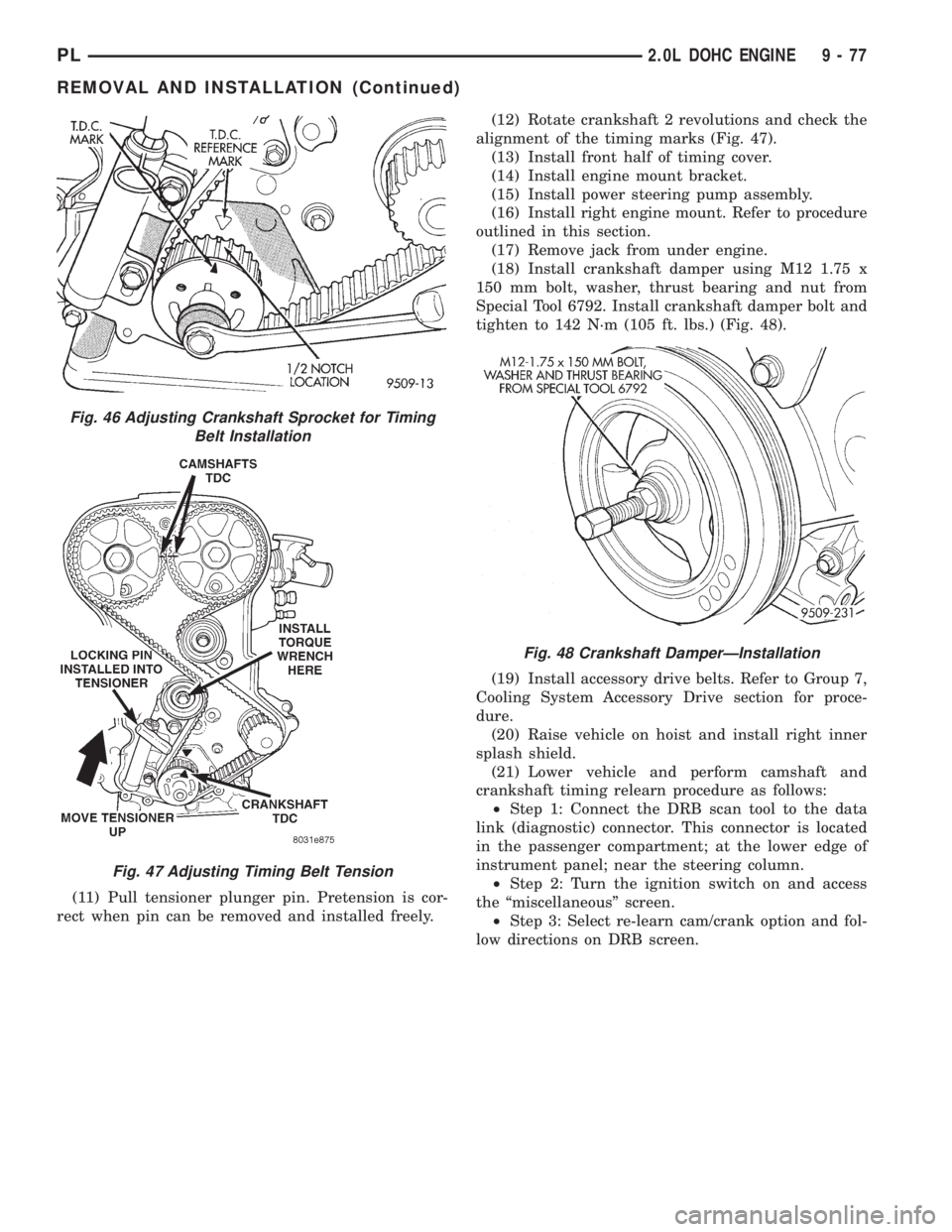
(11) Pull tensioner plunger pin. Pretension is cor-
rect when pin can be removed and installed freely.(12) Rotate crankshaft 2 revolutions and check the
alignment of the timing marks (Fig. 47).
(13) Install front half of timing cover.
(14) Install engine mount bracket.
(15) Install power steering pump assembly.
(16) Install right engine mount. Refer to procedure
outlined in this section.
(17) Remove jack from under engine.
(18) Install crankshaft damper using M12 1.75 x
150 mm bolt, washer, thrust bearing and nut from
Special Tool 6792. Install crankshaft damper bolt and
tighten to 142 N´m (105 ft. lbs.) (Fig. 48).
(19) Install accessory drive belts. Refer to Group 7,
Cooling System Accessory Drive section for proce-
dure.
(20) Raise vehicle on hoist and install right inner
splash shield.
(21) Lower vehicle and perform camshaft and
crankshaft timing relearn procedure as follows:
²Step 1: Connect the DRB scan tool to the data
link (diagnostic) connector. This connector is located
in the passenger compartment; at the lower edge of
instrument panel; near the steering column.
²Step 2: Turn the ignition switch on and access
the ªmiscellaneousº screen.
²Step 3: Select re-learn cam/crank option and fol-
low directions on DRB screen.
Fig. 46 Adjusting Crankshaft Sprocket for Timing
Belt Installation
Fig. 47 Adjusting Timing Belt Tension
Fig. 48 Crankshaft DamperÐInstallation
PL2.0L DOHC ENGINE 9 - 77
REMOVAL AND INSTALLATION (Continued)
Page 793 of 1200
(5) Move crankshaft sprocket to TDC to take up
belt slack.
(6) Release the tensioner by removing the pin or
Allen wrench from the belt tensioner.
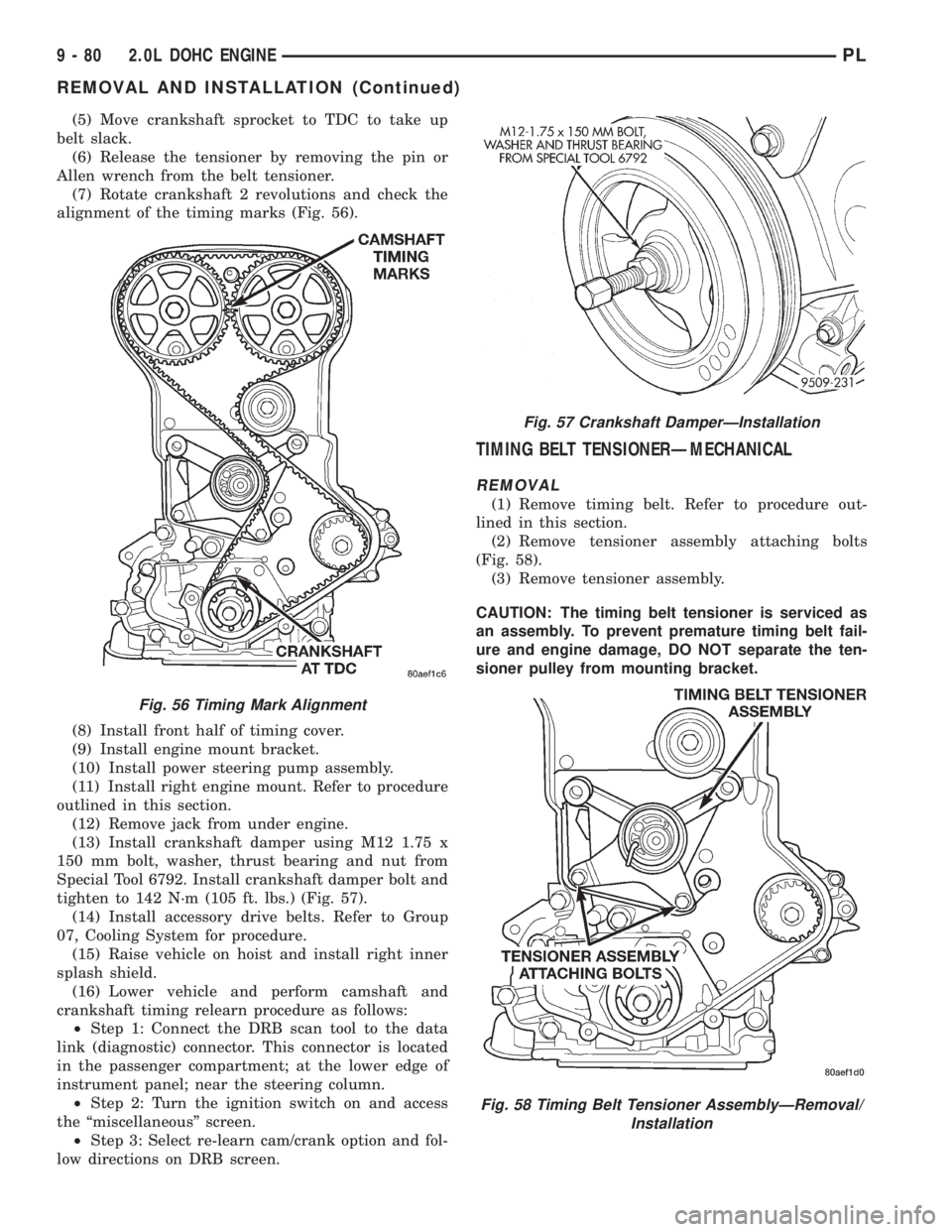
(7) Rotate crankshaft 2 revolutions and check the
alignment of the timing marks (Fig. 56).
(8) Install front half of timing cover.
(9) Install engine mount bracket.
(10) Install power steering pump assembly.
(11) Install right engine mount. Refer to procedure
outlined in this section.
(12) Remove jack from under engine.
(13) Install crankshaft damper using M12 1.75 x
150 mm bolt, washer, thrust bearing and nut from
Special Tool 6792. Install crankshaft damper bolt and
tighten to 142 N´m (105 ft. lbs.) (Fig. 57).
(14) Install accessory drive belts. Refer to Group
07, Cooling System for procedure.
(15) Raise vehicle on hoist and install right inner
splash shield.
(16) Lower vehicle and perform camshaft and
crankshaft timing relearn procedure as follows:
²Step 1: Connect the DRB scan tool to the data
link (diagnostic) connector. This connector is located
in the passenger compartment; at the lower edge of
instrument panel; near the steering column.
²Step 2: Turn the ignition switch on and access
the ªmiscellaneousº screen.
²Step 3: Select re-learn cam/crank option and fol-
low directions on DRB screen.
TIMING BELT TENSIONERÐMECHANICAL
REMOVAL
(1) Remove timing belt. Refer to procedure out-
lined in this section.
(2) Remove tensioner assembly attaching bolts
(Fig. 58).
(3) Remove tensioner assembly.
CAUTION: The timing belt tensioner is serviced as
an assembly. To prevent premature timing belt fail-
ure and engine damage, DO NOT separate the ten-
sioner pulley from mounting bracket.
Fig. 56 Timing Mark Alignment
Fig. 57 Crankshaft DamperÐInstallation
Fig. 58 Timing Belt Tensioner AssemblyÐRemoval/
Installation
9 - 80 2.0L DOHC ENGINEPL
REMOVAL AND INSTALLATION (Continued)
Page 800 of 1200
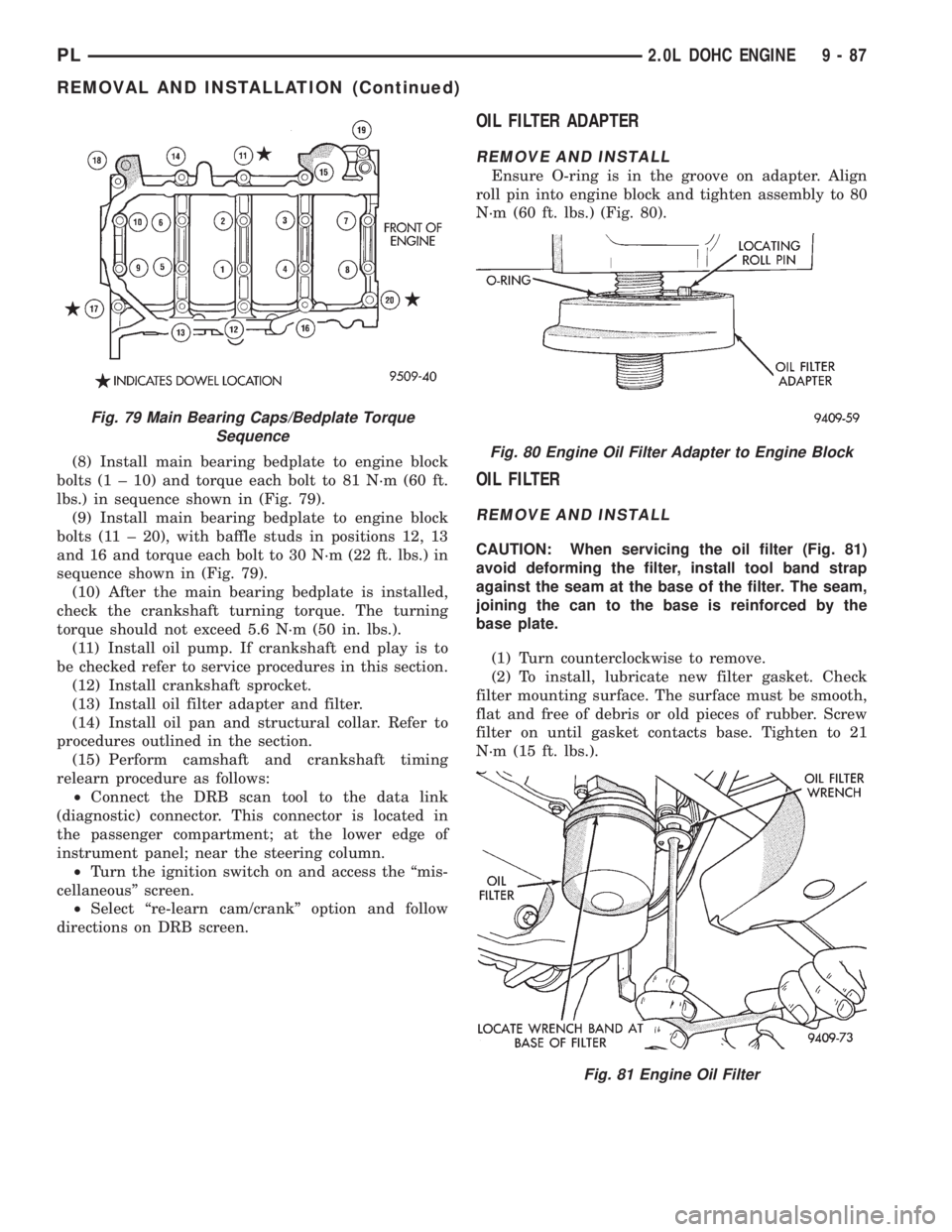
(8) Install main bearing bedplate to engine block
bolts (1 ± 10) and torque each bolt to 81 N´m (60 ft.
lbs.) in sequence shown in (Fig. 79).
(9) Install main bearing bedplate to engine block
bolts (11 ± 20), with baffle studs in positions 12, 13
and 16 and torque each bolt to 30 N´m (22 ft. lbs.) in
sequence shown in (Fig. 79).
(10) After the main bearing bedplate is installed,
check the crankshaft turning torque. The turning
torque should not exceed 5.6 N´m (50 in. lbs.).
(11) Install oil pump. If crankshaft end play is to
be checked refer to service procedures in this section.
(12) Install crankshaft sprocket.
(13) Install oil filter adapter and filter.
(14) Install oil pan and structural collar. Refer to
procedures outlined in the section.
(15) Perform camshaft and crankshaft timing
relearn procedure as follows:
²Connect the DRB scan tool to the data link
(diagnostic) connector. This connector is located in
the passenger compartment; at the lower edge of
instrument panel; near the steering column.
²Turn the ignition switch on and access the ªmis-
cellaneousº screen.
²Select ªre-learn cam/crankº option and follow
directions on DRB screen.
OIL FILTER ADAPTER
REMOVE AND INSTALL
Ensure O-ring is in the groove on adapter. Align
roll pin into engine block and tighten assembly to 80
N´m (60 ft. lbs.) (Fig. 80).
OIL FILTER
REMOVE AND INSTALL
CAUTION: When servicing the oil filter (Fig. 81)
avoid deforming the filter, install tool band strap
against the seam at the base of the filter. The seam,
joining the can to the base is reinforced by the
base plate.
(1) Turn counterclockwise to remove.
(2) To install, lubricate new filter gasket. Check
filter mounting surface. The surface must be smooth,
flat and free of debris or old pieces of rubber. Screw
filter on until gasket contacts base. Tighten to 21
N´m (15 ft. lbs.).
Fig. 79 Main Bearing Caps/Bedplate Torque
Sequence
Fig. 80 Engine Oil Filter Adapter to Engine Block
Fig. 81 Engine Oil Filter
PL2.0L DOHC ENGINE 9 - 87
REMOVAL AND INSTALLATION (Continued)
Page 819 of 1200
DIAGNOSIS AND TESTING
REMOVAL AND INSTALLATION
EXHAUST PIPE AND MUFFLER
REMOVAL
(1) Raise vehicle on hoist and apply penetrating oil
to band clamp fastener of component being removed
(Fig. 6).NOTE: Do not use petroleum-based lubricants
when removing/installing muffler or exhaust pipe
isolators as it may compromise the life of the part.
A suitable substitute is a mixture of liquid dish
soap and water.
(2) Loosen band clamp and remove support insula-
tors at muffler (Fig. 7). Remove muffler from exhaust
pipe.
EXHAUST SYSTEM DIAGNOSIS CHART
CONDITION POSSIBLE CAUSES CORRECTION
EXCESSIVE EXHAUST NOISE
(UNDER HOOD)1. Exhaust manifold cracked or
broken.1. Replace manifold.
2. Manifold to cylinder head leak. 2. Tighten manifold and/or replace
gasket.
3. EGR Valve Leakage. 3. See Below:
(a) EGR valve to manifold gasket. (a) Tighten bolts and/or replace
gasket.
(b) EGR valve to EGR tube gasket. (b) Tighten bolts and/or replace
gasket.
(c) EGR tube to intake manifold
gasket.(c) Tighten bolts and/or replace
gasket.
4. Exhaust flex joint. (non LEV) 4. See Below:
(a) Spring height, not correctly
installed.(a) Check spring height, both sides
(specification is 32.5 mm, 1.28 inch)
look for source of spring height
variation if out of specification
(b) Exhaust sealing ring defective. (b) Inspect seal for damage on
round spherical surface. If no
damage is evident, check for
exhaust restriction causing high back
pressure on heavy acceleration.
5. Exhaust Flex joint to manifold
leak (LEV).5.Tighten nuts or replace gasket.
6. Exhaust flex joint (LEV). 6. Replace catalytic converter
assembly.
7. Pipe and shell noise from front
exhaust pipe.7. Characteristic of single wall pipes.
EXCESSIVE EXHAUST NOISE 1. Leaks at pipe joints. 1. Tighten or replace clamps at
leaking joints.
2. Burned, blown, or rusted out
exhaust pipe or muffler.2. Replace muffler or exhaust pipes.
3. Restriction in muffler or tailpipe. 3. Remove restriction, if possible or
replace as necessary.
4. Catalytic converter material in
muffler.4. replace muffler and converter
assembly. Check fuel injection and
ignition systems for proper operation.
11 - 4 EXHAUST SYSTEM AND INTAKE MANIFOLDPL
Page 821 of 1200
NOTE: When replacement is required on any com-
ponent of the exhaust system, you must use origi-
nal equipment parts (or their equivalent).
INSTALLATION
When assembling exhaust systemdo nottighten
clamps until components are aligned and clearances
are checked.
(1) Assemble catalytic convertor to exhaust mani-
fold connection. Use a new flange gasket (LEV only)
(Fig. 9) or (Fig. 10).
(2) Assemble exhaust pipe to catalytic convertor
and the support to the underbody
(3) Install the muffler to exhaust pipe and the sup-
ports to the underbody.
(4) Working from the front of system;
(5) Align and tighten the catalytic convertor to
exhaust manifold ball joint bolts to 27 N´m (20 ft.
lbs.) (Fig. 9) or flex-joint attaching nuts (LEV) to 28
N´m (250 in. lbs.).
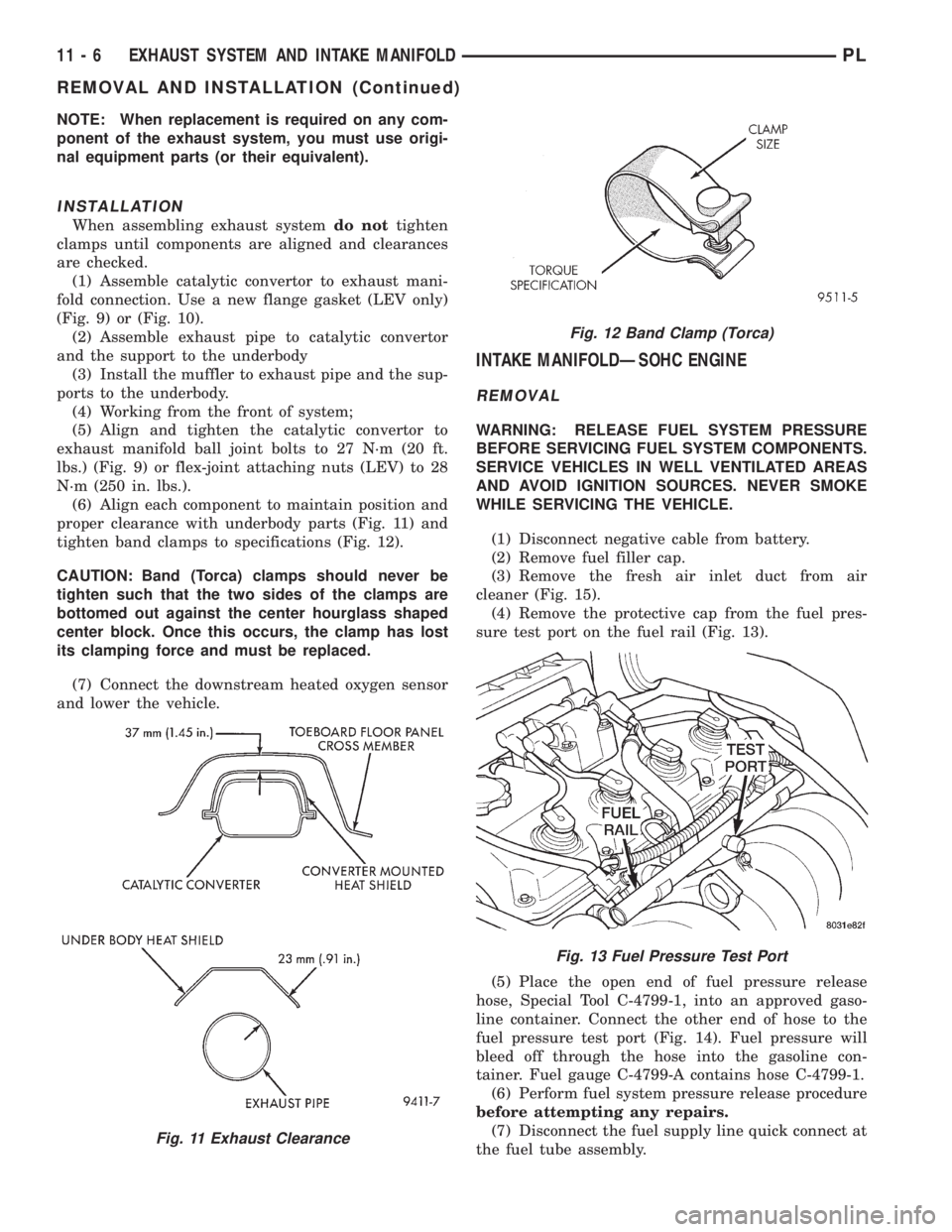
(6) Align each component to maintain position and
proper clearance with underbody parts (Fig. 11) and
tighten band clamps to specifications (Fig. 12).
CAUTION: Band (Torca) clamps should never be
tighten such that the two sides of the clamps are
bottomed out against the center hourglass shaped
center block. Once this occurs, the clamp has lost
its clamping force and must be replaced.
(7) Connect the downstream heated oxygen sensor
and lower the vehicle.
INTAKE MANIFOLDÐSOHC ENGINE
REMOVAL
WARNING: RELEASE FUEL SYSTEM PRESSURE
BEFORE SERVICING FUEL SYSTEM COMPONENTS.
SERVICE VEHICLES IN WELL VENTILATED AREAS
AND AVOID IGNITION SOURCES. NEVER SMOKE
WHILE SERVICING THE VEHICLE.
(1) Disconnect negative cable from battery.
(2) Remove fuel filler cap.
(3) Remove the fresh air inlet duct from air
cleaner (Fig. 15).
(4) Remove the protective cap from the fuel pres-
sure test port on the fuel rail (Fig. 13).
(5) Place the open end of fuel pressure release
hose, Special Tool C-4799-1, into an approved gaso-
line container. Connect the other end of hose to the
fuel pressure test port (Fig. 14). Fuel pressure will
bleed off through the hose into the gasoline con-
tainer. Fuel gauge C-4799-A contains hose C-4799-1.
(6) Perform fuel system pressure release procedure
before attempting any repairs.
(7) Disconnect the fuel supply line quick connect at
the fuel tube assembly.
Fig. 11 Exhaust Clearance
Fig. 12 Band Clamp (Torca)
Fig. 13 Fuel Pressure Test Port
11 - 6 EXHAUST SYSTEM AND INTAKE MANIFOLDPL
REMOVAL AND INSTALLATION (Continued)
Page 823 of 1200
INSTALLATION
Before installing manifold. Clean all mating sur-
faces. Replace all seals, with new seals. All intakemanifold fasteners and washers are to be discarded
andNEWfasteners and washers are to be used.
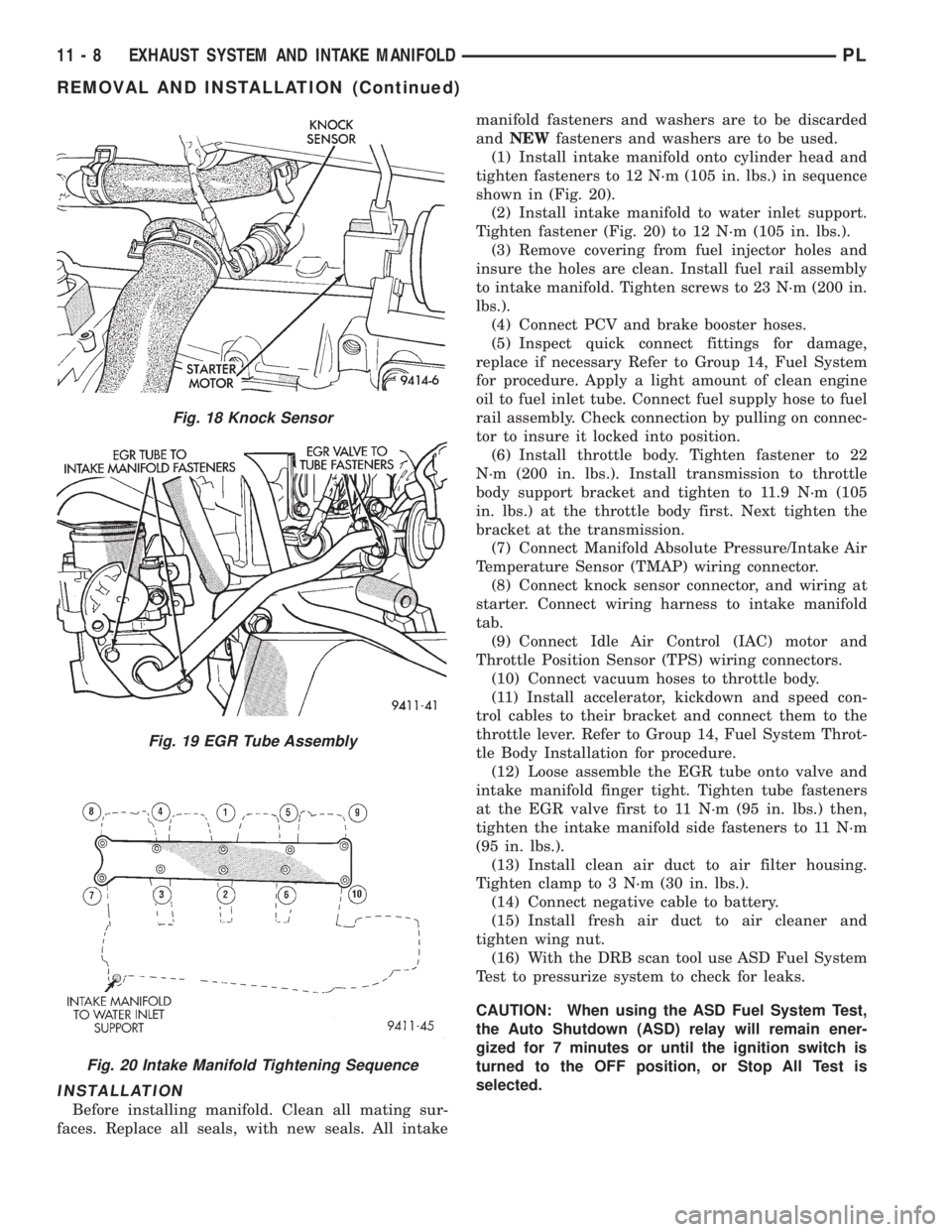
(1) Install intake manifold onto cylinder head and
tighten fasteners to 12 N´m (105 in. lbs.) in sequence
shown in (Fig. 20).
(2) Install intake manifold to water inlet support.
Tighten fastener (Fig. 20) to 12 N´m (105 in. lbs.).
(3) Remove covering from fuel injector holes and
insure the holes are clean. Install fuel rail assembly
to intake manifold. Tighten screws to 23 N´m (200 in.
lbs.).
(4) Connect PCV and brake booster hoses.
(5) Inspect quick connect fittings for damage,
replace if necessary Refer to Group 14, Fuel System
for procedure. Apply a light amount of clean engine
oil to fuel inlet tube. Connect fuel supply hose to fuel
rail assembly. Check connection by pulling on connec-
tor to insure it locked into position.
(6) Install throttle body. Tighten fastener to 22
N´m (200 in. lbs.). Install transmission to throttle
body support bracket and tighten to 11.9 N´m (105
in. lbs.) at the throttle body first. Next tighten the
bracket at the transmission.
(7) Connect Manifold Absolute Pressure/Intake Air
Temperature Sensor (TMAP) wiring connector.
(8) Connect knock sensor connector, and wiring at
starter. Connect wiring harness to intake manifold
tab.
(9) Connect Idle Air Control (IAC) motor and
Throttle Position Sensor (TPS) wiring connectors.
(10) Connect vacuum hoses to throttle body.
(11) Install accelerator, kickdown and speed con-
trol cables to their bracket and connect them to the
throttle lever. Refer to Group 14, Fuel System Throt-
tle Body Installation for procedure.
(12) Loose assemble the EGR tube onto valve and
intake manifold finger tight. Tighten tube fasteners
at the EGR valve first to 11 N´m (95 in. lbs.) then,
tighten the intake manifold side fasteners to 11 N´m
(95 in. lbs.).
(13) Install clean air duct to air filter housing.
Tighten clamp to 3 N´m (30 in. lbs.).
(14) Connect negative cable to battery.
(15) Install fresh air duct to air cleaner and
tighten wing nut.
(16) With the DRB scan tool use ASD Fuel System
Test to pressurize system to check for leaks.
CAUTION: When using the ASD Fuel System Test,
the Auto Shutdown (ASD) relay will remain ener-
gized for 7 minutes or until the ignition switch is
turned to the OFF position, or Stop All Test is
selected.
Fig. 18 Knock Sensor
Fig. 19 EGR Tube Assembly
Fig. 20 Intake Manifold Tightening Sequence
11 - 8 EXHAUST SYSTEM AND INTAKE MANIFOLDPL
REMOVAL AND INSTALLATION (Continued)