1999 DODGE NEON check engine
[x] Cancel search: check enginePage 737 of 1200
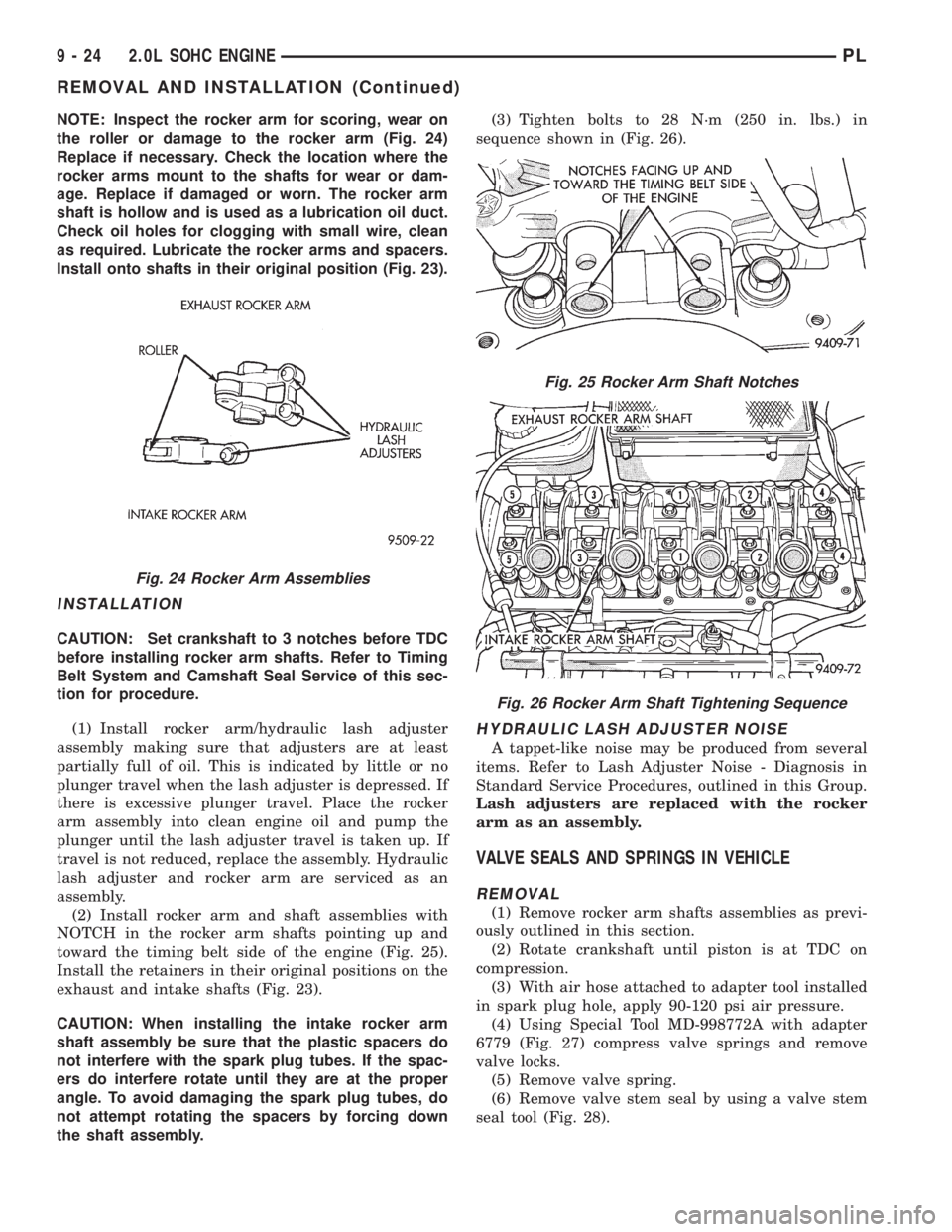
NOTE: Inspect the rocker arm for scoring, wear on
the roller or damage to the rocker arm (Fig. 24)
Replace if necessary. Check the location where the
rocker arms mount to the shafts for wear or dam-
age. Replace if damaged or worn. The rocker arm
shaft is hollow and is used as a lubrication oil duct.
Check oil holes for clogging with small wire, clean
as required. Lubricate the rocker arms and spacers.
Install onto shafts in their original position (Fig. 23).
INSTALLATION
CAUTION: Set crankshaft to 3 notches before TDC
before installing rocker arm shafts. Refer to Timing
Belt System and Camshaft Seal Service of this sec-
tion for procedure.
(1) Install rocker arm/hydraulic lash adjuster
assembly making sure that adjusters are at least
partially full of oil. This is indicated by little or no
plunger travel when the lash adjuster is depressed. If
there is excessive plunger travel. Place the rocker
arm assembly into clean engine oil and pump the
plunger until the lash adjuster travel is taken up. If
travel is not reduced, replace the assembly. Hydraulic
lash adjuster and rocker arm are serviced as an
assembly.
(2) Install rocker arm and shaft assemblies with
NOTCH in the rocker arm shafts pointing up and
toward the timing belt side of the engine (Fig. 25).
Install the retainers in their original positions on the
exhaust and intake shafts (Fig. 23).
CAUTION: When installing the intake rocker arm
shaft assembly be sure that the plastic spacers do
not interfere with the spark plug tubes. If the spac-
ers do interfere rotate until they are at the proper
angle. To avoid damaging the spark plug tubes, do
not attempt rotating the spacers by forcing down
the shaft assembly.(3) Tighten bolts to 28 N´m (250 in. lbs.) in
sequence shown in (Fig. 26).
HYDRAULIC LASH ADJUSTER NOISE
A tappet-like noise may be produced from several
items. Refer to Lash Adjuster Noise - Diagnosis in
Standard Service Procedures, outlined in this Group.
Lash adjusters are replaced with the rocker
arm as an assembly.
VALVE SEALS AND SPRINGS IN VEHICLE
REMOVAL
(1) Remove rocker arm shafts assemblies as previ-
ously outlined in this section.
(2) Rotate crankshaft until piston is at TDC on
compression.
(3) With air hose attached to adapter tool installed
in spark plug hole, apply 90-120 psi air pressure.
(4) Using Special Tool MD-998772A with adapter
6779 (Fig. 27) compress valve springs and remove
valve locks.
(5) Remove valve spring.
(6) Remove valve stem seal by using a valve stem
seal tool (Fig. 28).
Fig. 24 Rocker Arm Assemblies
Fig. 25 Rocker Arm Shaft Notches
Fig. 26 Rocker Arm Shaft Tightening Sequence
9 - 24 2.0L SOHC ENGINEPL
REMOVAL AND INSTALLATION (Continued)
Page 739 of 1200
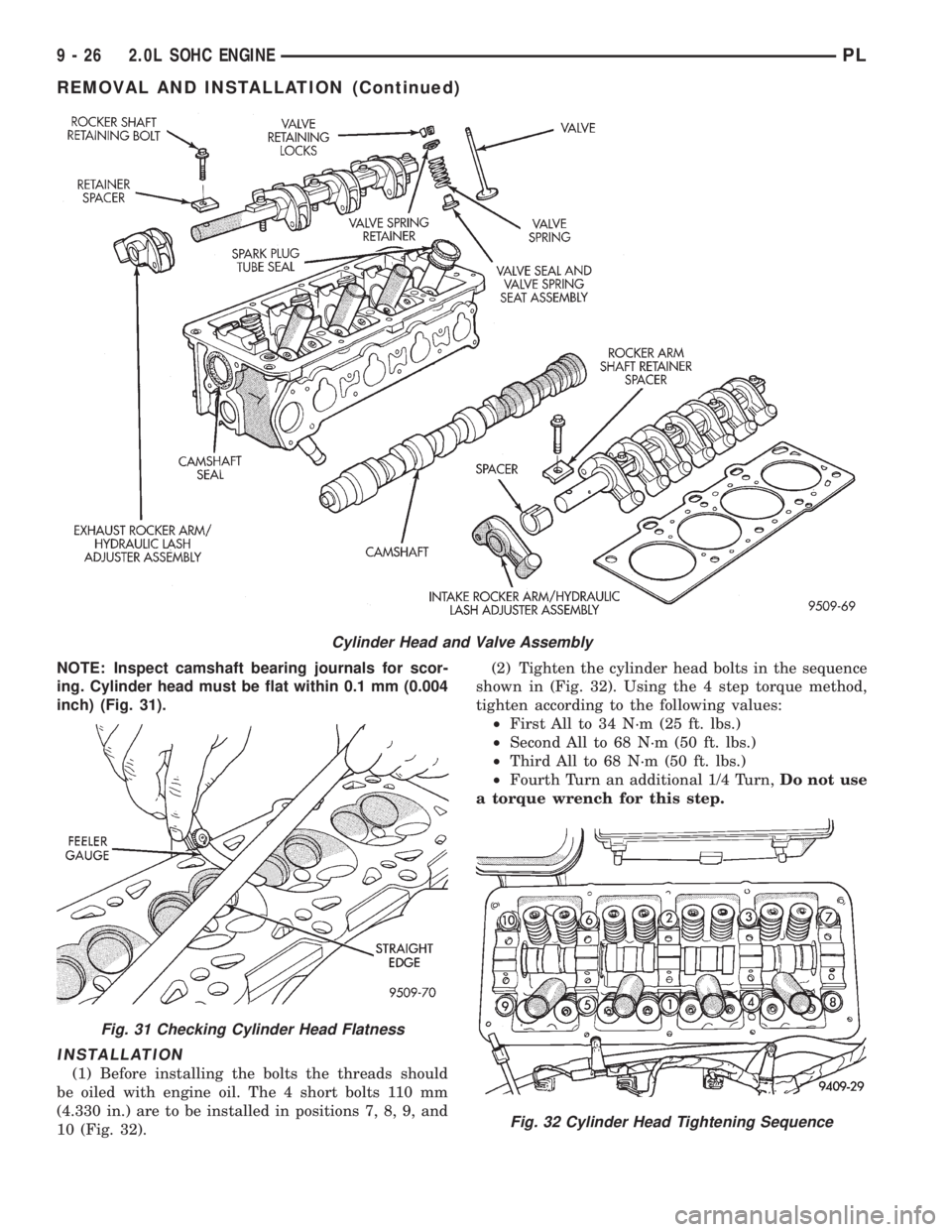
NOTE: Inspect camshaft bearing journals for scor-
ing. Cylinder head must be flat within 0.1 mm (0.004
inch) (Fig. 31).
INSTALLATION
(1) Before installing the bolts the threads should
be oiled with engine oil. The 4 short bolts 110 mm
(4.330 in.) are to be installed in positions 7, 8, 9, and
10 (Fig. 32).(2) Tighten the cylinder head bolts in the sequence
shown in (Fig. 32). Using the 4 step torque method,
tighten according to the following values:
²First All to 34 N´m (25 ft. lbs.)
²Second All to 68 N´m (50 ft. lbs.)
²Third All to 68 N´m (50 ft. lbs.)
²Fourth Turn an additional 1/4 Turn,Do not use
a torque wrench for this step.
Cylinder Head and Valve Assembly
Fig. 31 Checking Cylinder Head Flatness
Fig. 32 Cylinder Head Tightening Sequence
9 - 26 2.0L SOHC ENGINEPL
REMOVAL AND INSTALLATION (Continued)
Page 741 of 1200
CAMSHAFT OIL SEAL
REMOVAL
CAUTION: Do Not Rotate the camshaft or crank-
shaft when timing belt is removed damage to the
engine may occur.
(1) Remove front timing belt cover, timing belt and
tensioner assembly. Refer to procedures outlined in
this section.
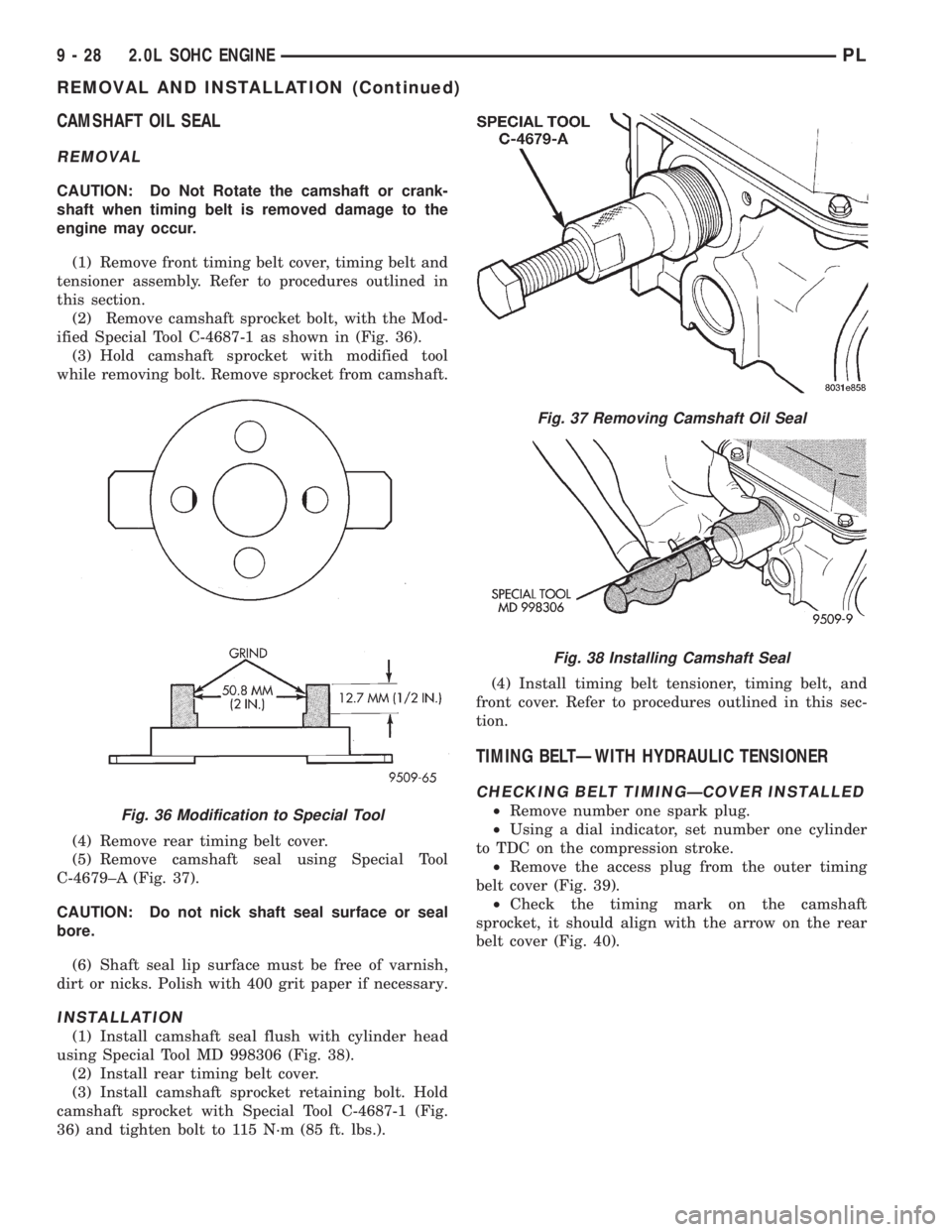
(2) Remove camshaft sprocket bolt, with the Mod-
ified Special Tool C-4687-1 as shown in (Fig. 36).
(3) Hold camshaft sprocket with modified tool
while removing bolt. Remove sprocket from camshaft.
(4) Remove rear timing belt cover.
(5) Remove camshaft seal using Special Tool
C-4679±A (Fig. 37).
CAUTION: Do not nick shaft seal surface or seal
bore.
(6) Shaft seal lip surface must be free of varnish,
dirt or nicks. Polish with 400 grit paper if necessary.
INSTALLATION
(1) Install camshaft seal flush with cylinder head
using Special Tool MD 998306 (Fig. 38).
(2) Install rear timing belt cover.
(3) Install camshaft sprocket retaining bolt. Hold
camshaft sprocket with Special Tool C-4687-1 (Fig.
36) and tighten bolt to 115 N´m (85 ft. lbs.).(4) Install timing belt tensioner, timing belt, and
front cover. Refer to procedures outlined in this sec-
tion.
TIMING BELTÐWITH HYDRAULIC TENSIONER
CHECKING BELT TIMINGÐCOVER INSTALLED
²Remove number one spark plug.
²Using a dial indicator, set number one cylinder
to TDC on the compression stroke.
²Remove the access plug from the outer timing
belt cover (Fig. 39).
²Check the timing mark on the camshaft
sprocket, it should align with the arrow on the rear
belt cover (Fig. 40).Fig. 36 Modification to Special Tool
Fig. 37 Removing Camshaft Oil Seal
Fig. 38 Installing Camshaft Seal
9 - 28 2.0L SOHC ENGINEPL
REMOVAL AND INSTALLATION (Continued)
Page 745 of 1200
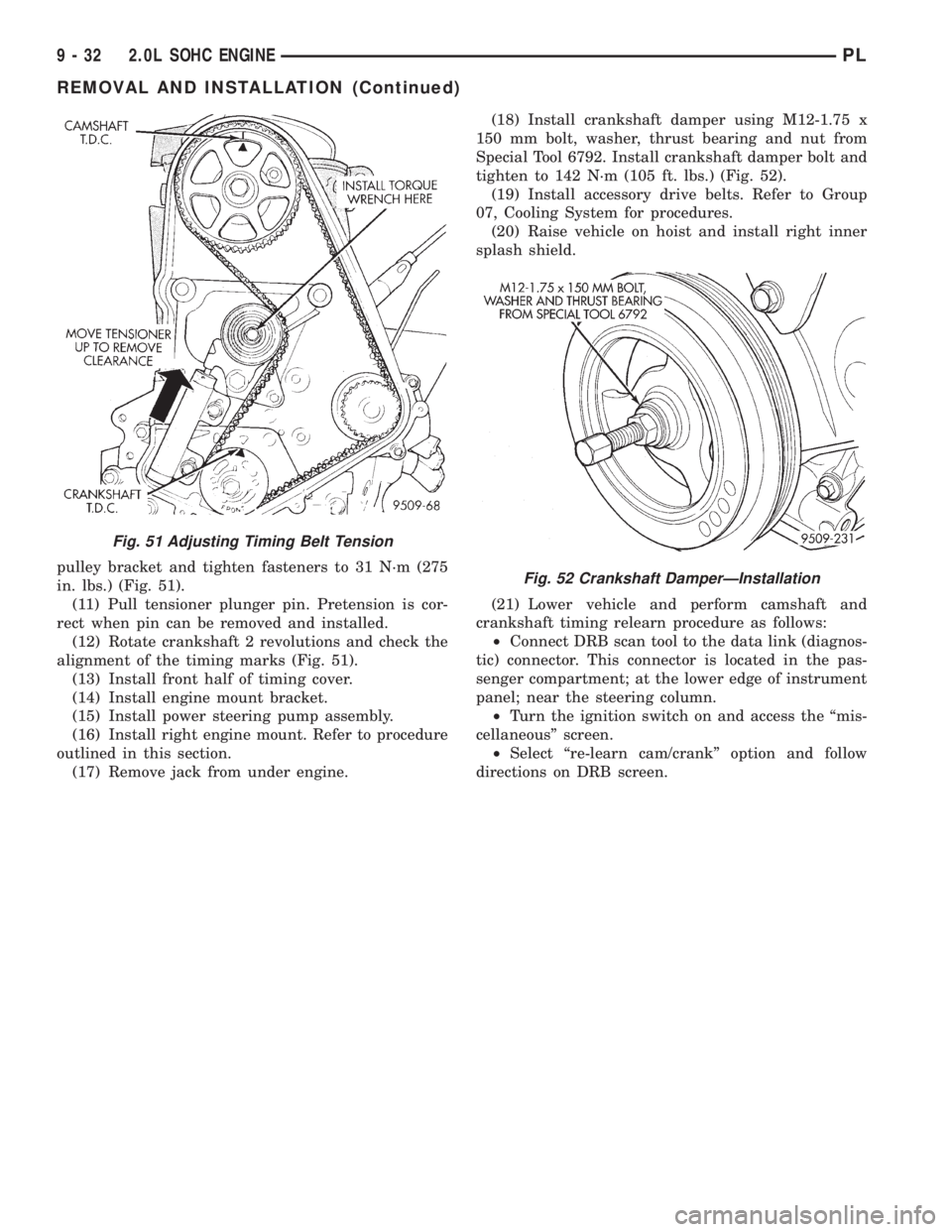
pulley bracket and tighten fasteners to 31 N´m (275
in. lbs.) (Fig. 51).
(11) Pull tensioner plunger pin. Pretension is cor-
rect when pin can be removed and installed.
(12) Rotate crankshaft 2 revolutions and check the
alignment of the timing marks (Fig. 51).
(13) Install front half of timing cover.
(14) Install engine mount bracket.
(15) Install power steering pump assembly.
(16) Install right engine mount. Refer to procedure
outlined in this section.
(17) Remove jack from under engine.(18) Install crankshaft damper using M12-1.75 x
150 mm bolt, washer, thrust bearing and nut from
Special Tool 6792. Install crankshaft damper bolt and
tighten to 142 N´m (105 ft. lbs.) (Fig. 52).
(19) Install accessory drive belts. Refer to Group
07, Cooling System for procedures.
(20) Raise vehicle on hoist and install right inner
splash shield.
(21) Lower vehicle and perform camshaft and
crankshaft timing relearn procedure as follows:
²Connect DRB scan tool to the data link (diagnos-
tic) connector. This connector is located in the pas-
senger compartment; at the lower edge of instrument
panel; near the steering column.
²Turn the ignition switch on and access the ªmis-
cellaneousº screen.
²Select ªre-learn cam/crankº option and follow
directions on DRB screen.
Fig. 51 Adjusting Timing Belt Tension
Fig. 52 Crankshaft DamperÐInstallation
9 - 32 2.0L SOHC ENGINEPL
REMOVAL AND INSTALLATION (Continued)
Page 746 of 1200
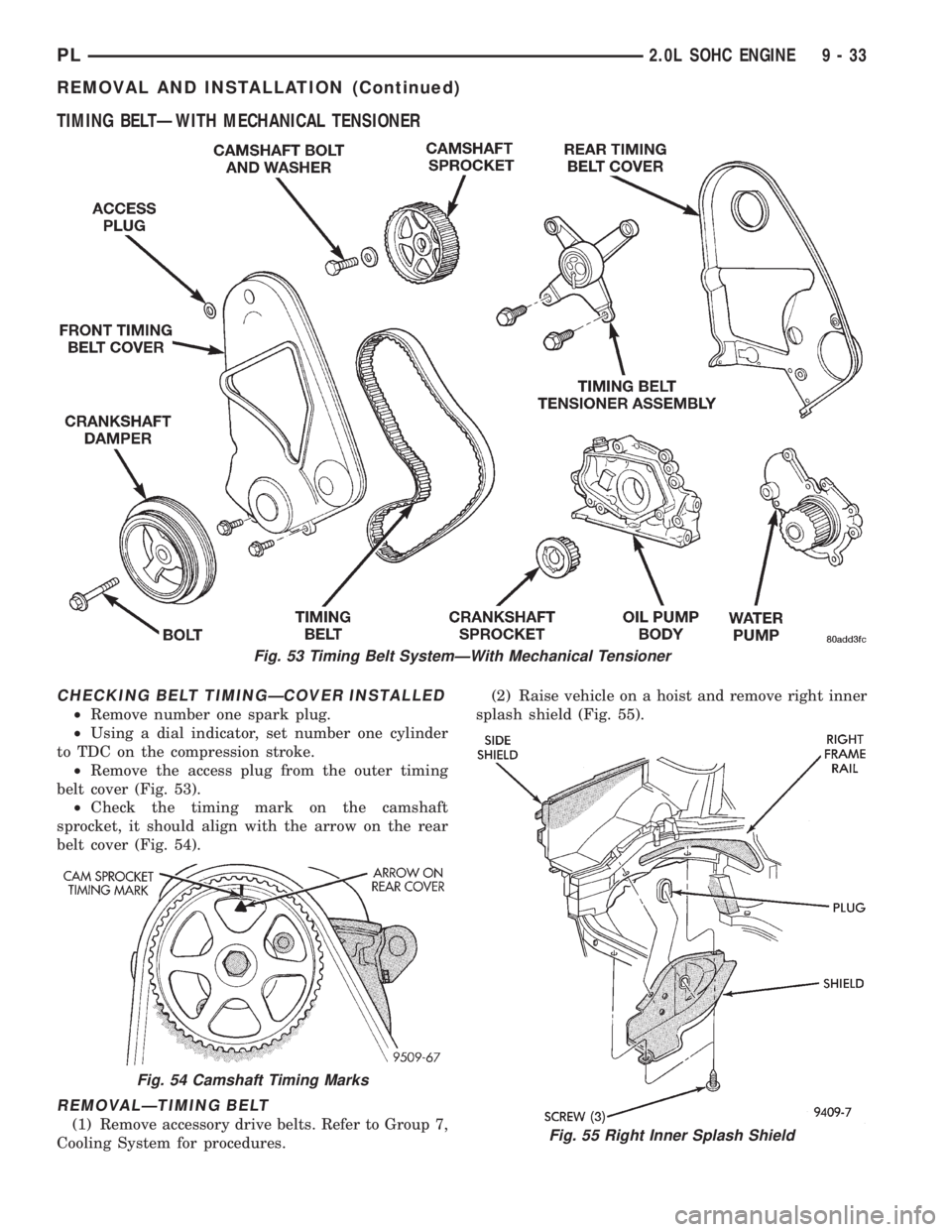
TIMING BELTÐWITH MECHANICAL TENSIONER
CHECKING BELT TIMINGÐCOVER INSTALLED
²Remove number one spark plug.
²Using a dial indicator, set number one cylinder
to TDC on the compression stroke.
²Remove the access plug from the outer timing
belt cover (Fig. 53).
²Check the timing mark on the camshaft
sprocket, it should align with the arrow on the rear
belt cover (Fig. 54).
REMOVALÐTIMING BELT
(1) Remove accessory drive belts. Refer to Group 7,
Cooling System for procedures.(2) Raise vehicle on a hoist and remove right inner
splash shield (Fig. 55).
Fig. 53 Timing Belt SystemÐWith Mechanical Tensioner
Fig. 54 Camshaft Timing Marks
Fig. 55 Right Inner Splash Shield
PL2.0L SOHC ENGINE 9 - 33
REMOVAL AND INSTALLATION (Continued)
Page 748 of 1200
CAMSHAFT AND CRANKSHAFT TIMING
PROCEDURE AND BELT INSTALLATIONÐ
SOHC ENGINE
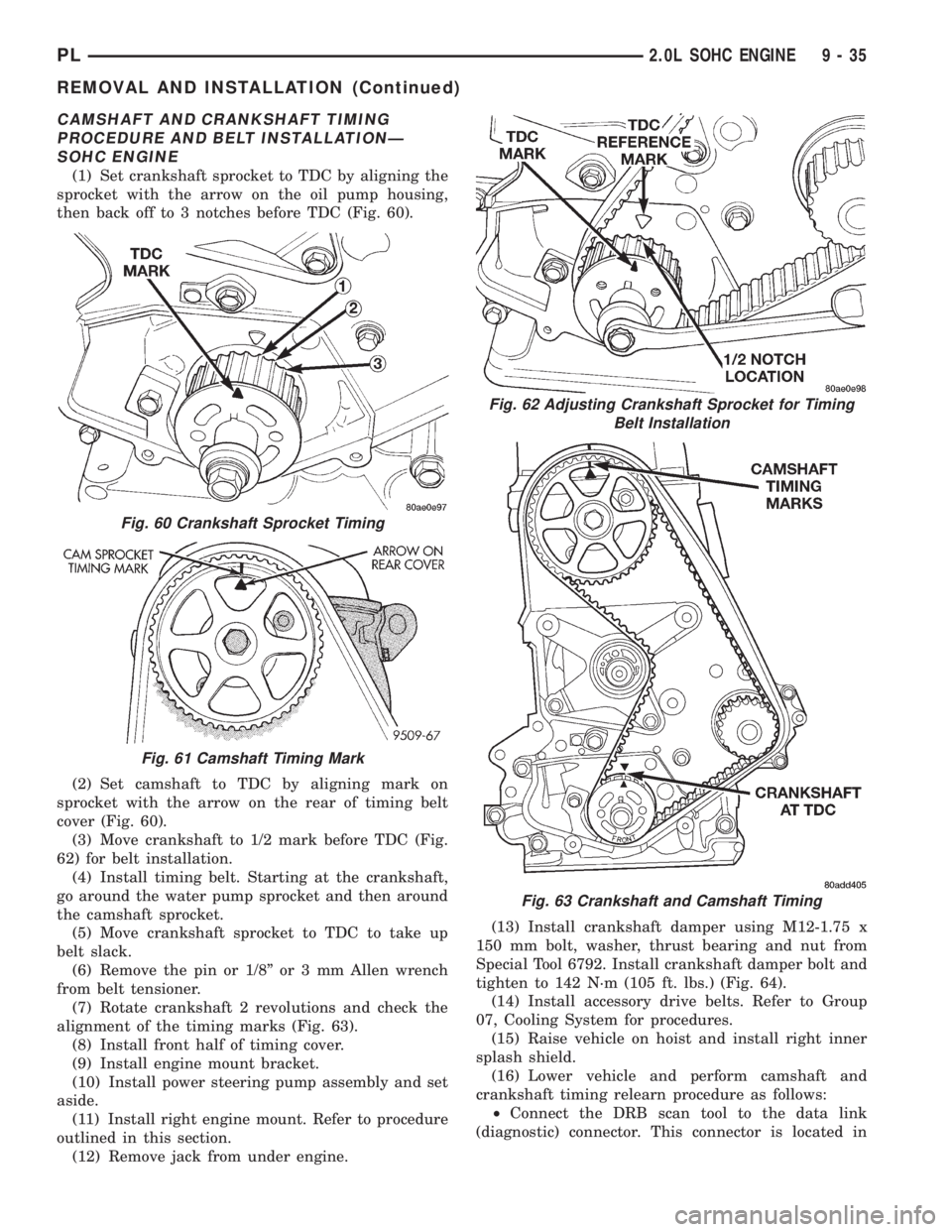
(1) Set crankshaft sprocket to TDC by aligning the
sprocket with the arrow on the oil pump housing,
then back off to 3 notches before TDC (Fig. 60).
(2) Set camshaft to TDC by aligning mark on
sprocket with the arrow on the rear of timing belt
cover (Fig. 60).
(3) Move crankshaft to 1/2 mark before TDC (Fig.
62) for belt installation.
(4) Install timing belt. Starting at the crankshaft,
go around the water pump sprocket and then around
the camshaft sprocket.
(5) Move crankshaft sprocket to TDC to take up
belt slack.
(6) Remove the pin or 1/8º or 3 mm Allen wrench
from belt tensioner.
(7) Rotate crankshaft 2 revolutions and check the
alignment of the timing marks (Fig. 63).
(8) Install front half of timing cover.
(9) Install engine mount bracket.
(10) Install power steering pump assembly and set
aside.
(11) Install right engine mount. Refer to procedure
outlined in this section.
(12) Remove jack from under engine.(13) Install crankshaft damper using M12-1.75 x
150 mm bolt, washer, thrust bearing and nut from
Special Tool 6792. Install crankshaft damper bolt and
tighten to 142 N´m (105 ft. lbs.) (Fig. 64).
(14) Install accessory drive belts. Refer to Group
07, Cooling System for procedures.
(15) Raise vehicle on hoist and install right inner
splash shield.
(16) Lower vehicle and perform camshaft and
crankshaft timing relearn procedure as follows:
²Connect the DRB scan tool to the data link
(diagnostic) connector. This connector is located in
Fig. 60 Crankshaft Sprocket Timing
Fig. 61 Camshaft Timing Mark
Fig. 62 Adjusting Crankshaft Sprocket for Timing
Belt Installation
Fig. 63 Crankshaft and Camshaft Timing
PL2.0L SOHC ENGINE 9 - 35
REMOVAL AND INSTALLATION (Continued)
Page 753 of 1200
CRANKSHAFT MAIN BEARINGS LOCATION
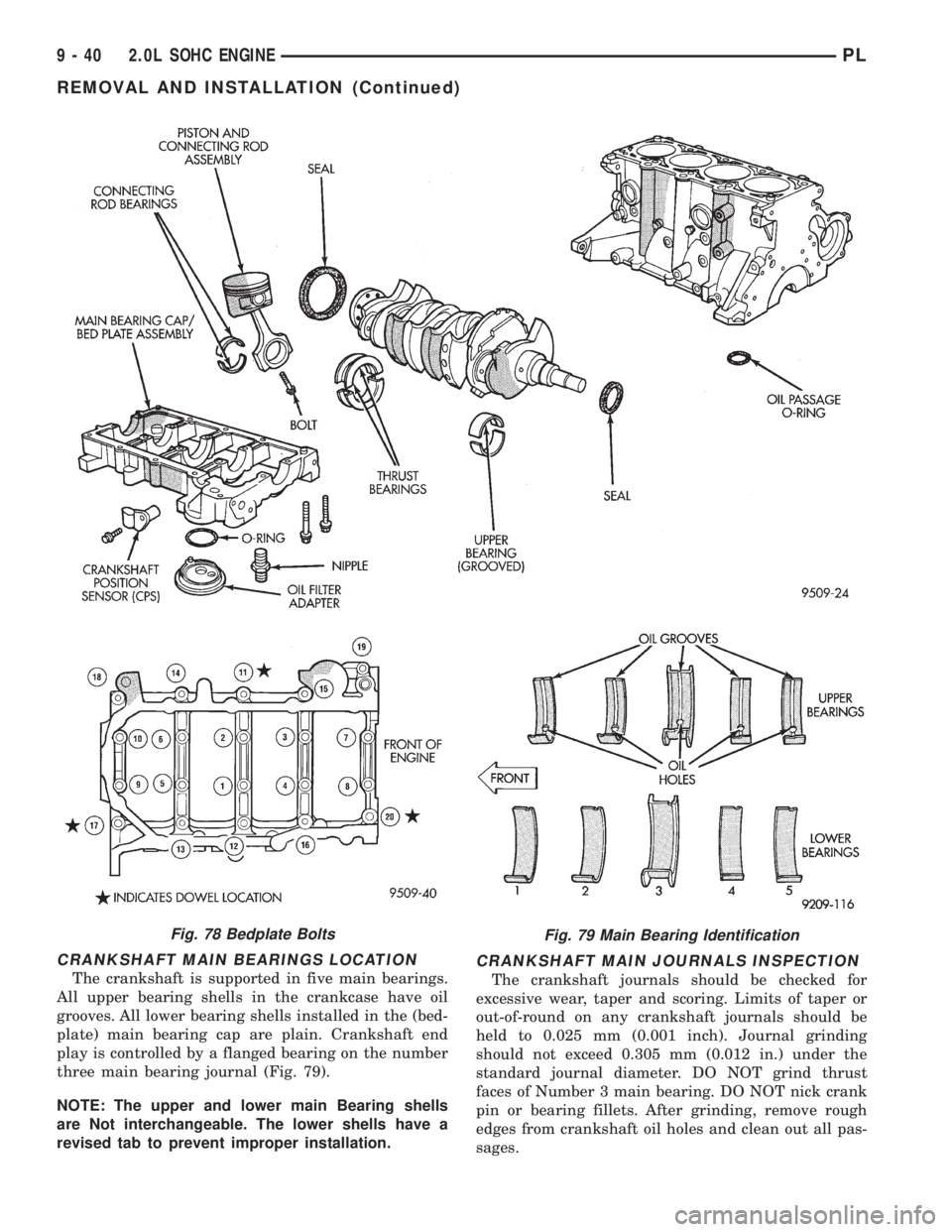
The crankshaft is supported in five main bearings.
All upper bearing shells in the crankcase have oil
grooves. All lower bearing shells installed in the (bed-
plate) main bearing cap are plain. Crankshaft end
play is controlled by a flanged bearing on the number
three main bearing journal (Fig. 79).
NOTE: The upper and lower main Bearing shells
are Not interchangeable. The lower shells have a
revised tab to prevent improper installation.
CRANKSHAFT MAIN JOURNALS INSPECTION
The crankshaft journals should be checked for
excessive wear, taper and scoring. Limits of taper or
out-of-round on any crankshaft journals should be
held to 0.025 mm (0.001 inch). Journal grinding
should not exceed 0.305 mm (0.012 in.) under the
standard journal diameter. DO NOT grind thrust
faces of Number 3 main bearing. DO NOT nick crank
pin or bearing fillets. After grinding, remove rough
edges from crankshaft oil holes and clean out all pas-
sages.
Fig. 78 Bedplate BoltsFig. 79 Main Bearing Identification
9 - 40 2.0L SOHC ENGINEPL
REMOVAL AND INSTALLATION (Continued)
Page 754 of 1200
CAUTION: With the nodular cast iron crankshafts
used it is important that the final paper or cloth pol-
ish after any journal regrind be in the same direc-
tion as normal rotation in the engine.
Upper and lower Number 3 bearing halves are
flanged to carry the crankshaft thrust loads and are
NOT interchangeable with any other bearing halves
in the engine (Fig. 79). All bearing cap bolts removed
during service procedures are to be cleaned and oiled
before installation. Bearing shells are available in
standard and the following undersized: 0.016 mm
(0.0006 inch), 0.032 mm (0.0012 inch), 0.250 mm
(0.010 inch). Never install an undersize bearing that
will reduce clearance below specifications.
INSTALLATION
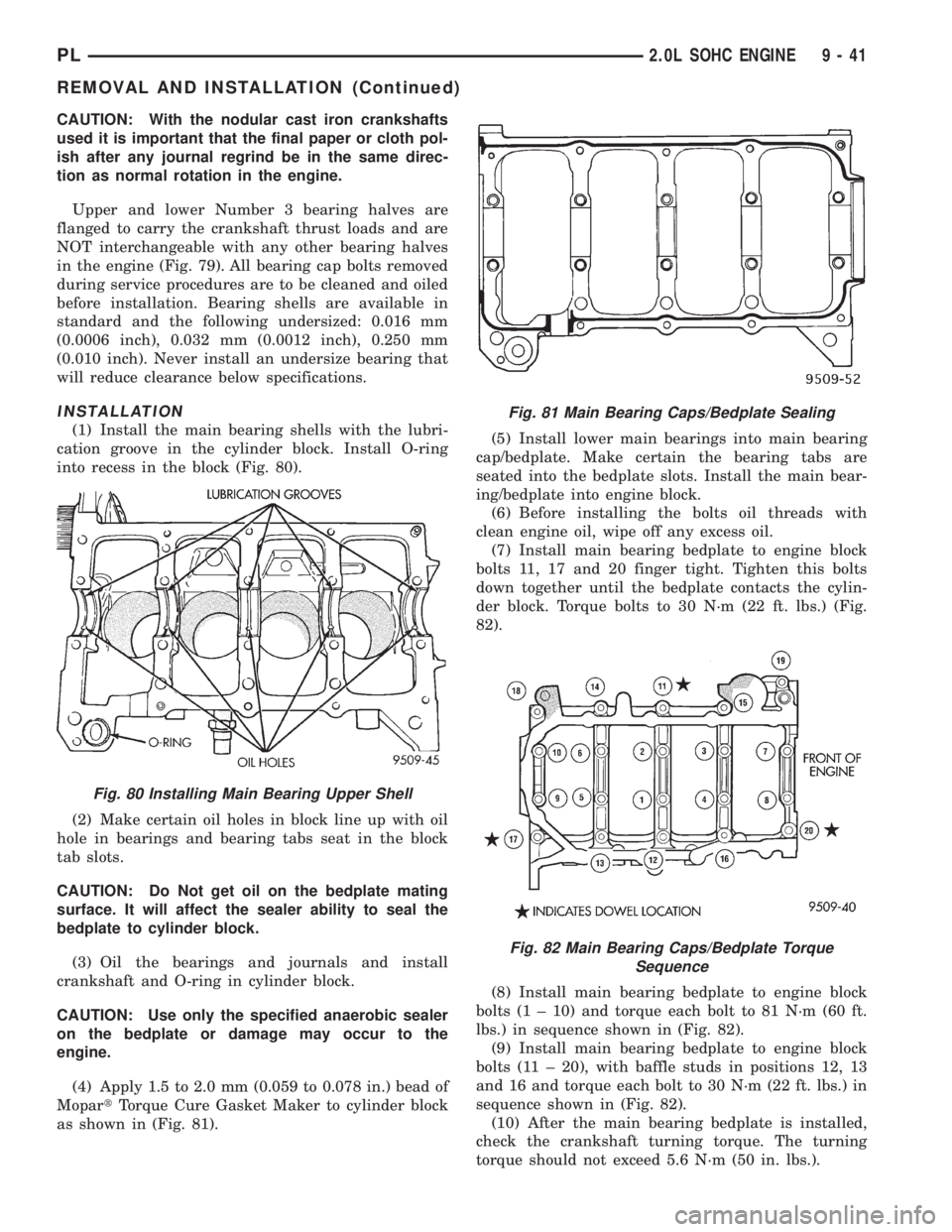
(1) Install the main bearing shells with the lubri-
cation groove in the cylinder block. Install O-ring
into recess in the block (Fig. 80).
(2) Make certain oil holes in block line up with oil
hole in bearings and bearing tabs seat in the block
tab slots.
CAUTION: Do Not get oil on the bedplate mating
surface. It will affect the sealer ability to seal the
bedplate to cylinder block.
(3) Oil the bearings and journals and install
crankshaft and O-ring in cylinder block.
CAUTION: Use only the specified anaerobic sealer
on the bedplate or damage may occur to the
engine.
(4) Apply 1.5 to 2.0 mm (0.059 to 0.078 in.) bead of
MopartTorque Cure Gasket Maker to cylinder block
as shown in (Fig. 81).(5) Install lower main bearings into main bearing
cap/bedplate. Make certain the bearing tabs are
seated into the bedplate slots. Install the main bear-
ing/bedplate into engine block.
(6) Before installing the bolts oil threads with
clean engine oil, wipe off any excess oil.
(7) Install main bearing bedplate to engine block
bolts 11, 17 and 20 finger tight. Tighten this bolts
down together until the bedplate contacts the cylin-
der block. Torque bolts to 30 N´m (22 ft. lbs.) (Fig.
82).
(8) Install main bearing bedplate to engine block
bolts (1 ± 10) and torque each bolt to 81 N´m (60 ft.
lbs.) in sequence shown in (Fig. 82).
(9) Install main bearing bedplate to engine block
bolts (11 ± 20), with baffle studs in positions 12, 13
and 16 and torque each bolt to 30 N´m (22 ft. lbs.) in
sequence shown in (Fig. 82).
(10) After the main bearing bedplate is installed,
check the crankshaft turning torque. The turning
torque should not exceed 5.6 N´m (50 in. lbs.).
Fig. 80 Installing Main Bearing Upper Shell
Fig. 81 Main Bearing Caps/Bedplate Sealing
Fig. 82 Main Bearing Caps/Bedplate Torque
Sequence
PL2.0L SOHC ENGINE 9 - 41
REMOVAL AND INSTALLATION (Continued)