1998 TOYOTA 4RUNNER key
[x] Cancel search: keyPage 210 of 350
4RUNNER (1998)
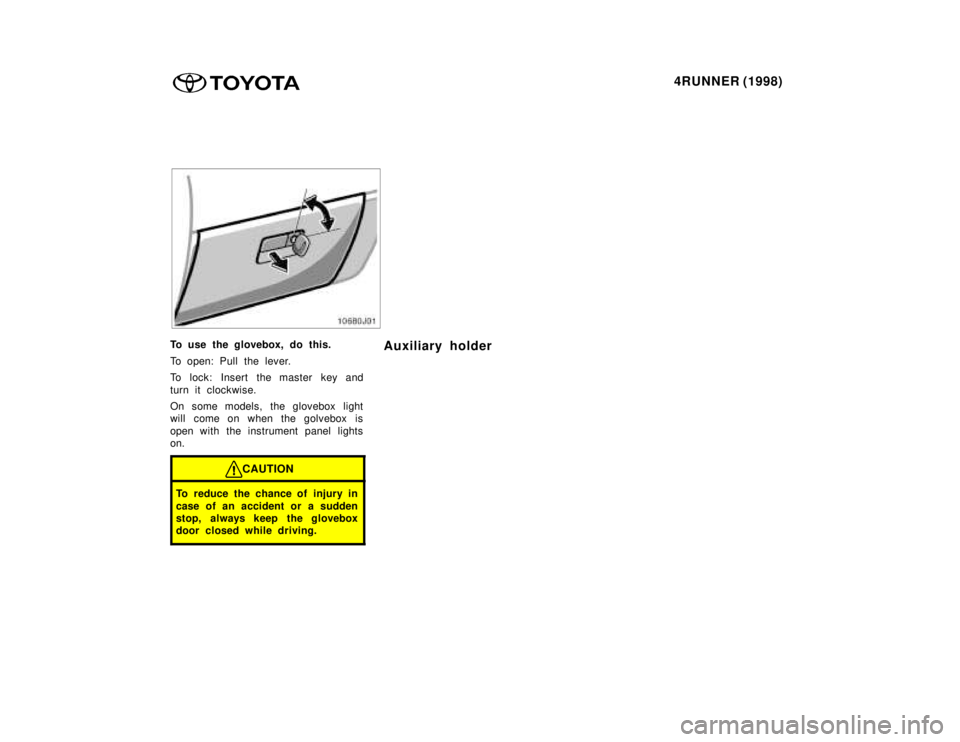
To use the glovebox, do this.
To open: Pull the lever.
To lock: Insert the master key and
turn it clockwise.
On some models, the glovebox light
will come on when the golvebox is
open with the instrument panel lights on.
CAUTION
To reduce the chance of injury in
case of an accident or a sudden
stop, always keep the glovebox
door closed while driving.
Auxiliary holder
Page 229 of 350

4RUNNER (1998)
Ty p e A
Ty p e B
ºABSº warning light This light comes on when the ignition
key is turned to the ºONº position.
After about 3 seconds, the light will
go off.
Page 240 of 350

4RUNNER (1998)
(b) Starting the engine
Before starting the engine, be sure to
follow the instructions in º(a) Before
crankingº.
Normal starting procedure
The multiport fuel injection system/se-
quential multiport fuel injection system
in your engine automatically controls
the proper air- fuel mixture for starting.
You can start a cold or hot engine as
follows:
1. With your foot off the accelerator
pedal, crank the engine by turning the
key to ºSTARTº. Release it when the
engine starts.
2. After the engine runs for about 10
seconds, you are ready to drive.
If the weather is below freezing, let
the engine warm up for a few minutes
before driving.
If the engine stalls...
Simply restart it, using the correct
procedure given in normal starting.
If the engine will not startÐ
See ºIf your vehicle will not startº in
Part 4.
NOTICE
Do not crank for more than 30 seconds at a time. This mayoverheat the starter and wiringsystems.
Do not race a cold engine.
If the engine becomes difficult
to start or stalls frequently,have the engine checked im-mediately.
Always slow down in gusty cross-
winds. This will allow you much
better control.
Drive slowly onto curbs and, if
possible, at a right angle. Avoid
driving onto high, sharp- edged ob-
jects and other road hazards. Fail-
ure to do so can lead to severe
tire damage resulting in tire bursts.
When parking on a hill, turn the
front wheels until they touch the
curb so that the vehicle will not
roll. Apply the parking brake, and
place the transmission in ºPº (auto-
matic) or in first or reverse (manu-
al). If necessary, block the wheels.
Washing your vehicle or driving
through deep water may get the
brakes wet. To see whether they
are wet, check that there is no
traffic near you, and then press the
pedal lightly. If you do not feel a
normal braking force, the brakes
are probably wet. To dry them,
drive the vehicle cautiously while
lightly pressing the brake pedal
with the parking brake pulled. If
they still do not work safely, pull to
the side of the road and call a
Toyota dealer for assistance.
Tips for driving in various
conditions
Page 243 of 350

4RUNNER (1998)
The driver and all passengers
should fasten their seat belts
whenever the vehicle is moving.
NOTICE
If driving through water, such
as when crossing shallowstreams, first check the depth of the water and the bottom of
the river bed for firmness. Driveslowly and avoid deep water.
Take all necessary safety mea-
sures to ensure that water dam-age to the engine or other com- ponents does not occur.
Water entering the engine airintake will cause severe engine
damage.
Water can wash the grease fromwheel bearings, causing rustingand premature failure, and mayalso enter the differentials,
transmission and transfer case,reducing the gear oil's lubrica-ting qualities.
Sand and mud that has accum-
lated in brake drums andaround brake discs may affectbraking efficiency and may dam-
age brake system components.
Always perform a maintenanceinspection after each day of
off- road driving that has takenyou through rough terrain,sand, mud, or water. For sche-
duled maintenance information,refer to the separate ºOwner's Manual Supplement/Maintenance
Scheduleº.
Winter driving tips
Make sure you have ethylene- glycol
antifreeze in the radiator.
NOTICE
Do not use alcohol type anti-freeze.
Check the condition of the battery
and cables.
Cold temperatures reduce the capacity
of any battery, so it must be in top
shape to provide enough power for
winter starting. Chapter 7- 3 tells you
how to visually inspect the battery.
Your Toyota dealer and most service
stations will be pleased to check the
level of charge.
Make sure the engine oil viscosity
is suitable for the cold weather.
See Chapter 7- 2 for recommended
viscosity. Leaving a heavy summer oil
in your vehicle during winter months
may cause harder starting. If you are
not sure about which oil to use, call
your Toyota dealerÐhe will be pleased
to help.
Keep the door locks from freezing.
Squirt lock de- icer or glycerine into
the locks to keep them from freezing.
To open a frozen lock, try heating the
key before inserting it.
Page 254 of 350

4RUNNER (1998)
Part 4
IN CASE OF AN
EMERGENCY
If your vehicle will not start
If your engine stalls while
driving
If your vehicle overheats
If you have a flat tire
If your vehicle needs to be
towed
If you cannot shift automatic
transmission selector lever
If you lose your keys
Before making these checks, make
sure you have followed the correct
starting procedure given in ºHow to
start the engineº in Part 3 and that
you have sufficient fuel.
If the engine is not turning over or
is turning over too slowlyÐ
1. Check that the battery terminals are tight and clean.
2. If the battery terminals are O.K., switch on the interior light.
3. If the light is out, dim or goes out when the starter is cranked, the
battery is discharged. You may try
jump starting. See º(c) Jump start-
ingº for further instructions.
If the light is O.K., but the engine still
will not start, it needs adjustment or
repair. Call a Toyota dealer or quali-
fied repair shop.
NOTICE
Do not pull- or push- start the ve- hicle. It may damage the vehicleor cause a collision when the en-
gine starts. Also the three- way
catalytic converter may overheatand become a fire hazard.
If the engine turns over at its nor-
mal speed but will not startÐ
1. Check that all the push- on connec- tors are tight. (For example, con-
nections at the spark plugs, ignition
coil and/or distributor)
2. If the connectors are O.K., the en- gine may be flooded because of
repeated cranking. See º(b) Start-
ing a flooded engineº for further
instructions.
If your vehicle will not start
Ð
(a) Simple checks
Page 255 of 350

4RUNNER (1998)
(b) Starting a flooded engine
If the engine will not start, your
engine may be flooded because of
repeated cranking.
If this happens, turn the key to
ºSTARTº with the accelerator pedal
held down. Keep the key and acceler-
ator pedal so for 15 seconds and re-
lease them. Then try starting the en-
gine with your foot off the accelerator
pedal.
If the engine does not start after 15
seconds of cranking, release the key,
wait a few minutes and try again.
If the engine still will not start, it
needs adjustment or repair. Call a
Toyota dealer or qualified repair shop
for assistance.
NOTICE
Do not crank for more than 30 seconds at a time. This may over-heat the starter and wiring sys-tems.
(c) Jump starting
To avoid serious personal injury
and damage to your vehicle which
might result from battery explosion,
acid burns, electrical burns, or dam-
aged electronic components, these
instructions must be followed pre-
cisely.
If you are unsure about how to follow
this procedure, we strongly recom-
mend that you seek the help of a
competent mechanic or towing service.
CAUTION
Batteries contain sulfuric acid
which is poisonous and corro-
sive. Wear protective safety
glasses when jump starting, and
avoid spilling acid on your skin, clothing, or vehicle.
If you should accidentally get
acid on yourself or in your
eyes, remove any contaminated
clothing and flush the affected
area with water immediately.
Then get immediate medical
attention. If possible, continue
to apply water with a sponge or
cloth while en route to the med-
ical office.
The gas normally produced by
a battery will explode if a flame
or spark is brought near. Use
only standardized jumper cables
and do not smoke or light a
match while jump starting.
NOTICE
The battery used for boosting
must be 12 V. Do not jump startunless you are sure that thebooster battery is correct.
Page 277 of 350
4RUNNER (1998)
Only when you cannot receive a
towing service from a Toyota dealer
or commercial tow truck service,
tow your vehicle carefully in accor-
dance with the instructions given in
ºÐEmergency towingº in this Part.
Proper equipment will help ensure that
your vehicle is not damaged while be-
ing towed. Commercial operators are
generally aware of the state/provincial
and local laws pertaining to towing.
Your vehicle can be damaged if it is
towed incorrectly. Although most oper-
ators know the correct procedure, it is
possible to make a mistake. To avoid
damage to your vehicle, make sure
the following few precautions are ob-
served. If necessary, show this page
to the tow truck driver. TOWING PRECAUTIONS:
Use a safety chain system for all tow-
ing, and abide by the state/provincial
and local laws. The wheels and axle
on the ground must be in good condi-
tion. If they are damaged, use a tow-
ing dolly.
Two- wheel drive modelsÐ
(a) Towing with wheel lift type
truck
From frontÐ Manual transmission:
We recommend using a towing dolly
under the rear wheels. If you do not
use a towing dolly, release the park-
ing brake and put the transmission
in neutral.
Automatic transmission:
Use a towing dolly under the rear
wheels.
NOTICE
Never tow a vehicle with an auto-
matic transmission from the frontwith the rear wheels on theground, as this may cause serious
damage to the transmission.
From rearÐ Place the ignition key in
the ºACCº position.
NOTICE
When lifting wheels, take care
to ensure adequate groundclearance for towing at the op-posite end of the raised vehicle.
Otherwise, the bumper and/orunderbody of the towed vehiclewill be damaged during towing.
Do not tow with the key re-moved or in the ºLOCKº posi-tion, as the steering lock mech-
anism is not strong enough tohold the front wheels straight
while towing.
(b) Using flat bed truck
Page 278 of 350

4RUNNER (1998)
Four-wheel drive modelsÐ
(a) Towing with wheel lift type truck From frontÐ
Manual transmission:
We recommend using a towing dol-
ly under the rear wheels. If you do
not use a towing dolly, release the
parking brake, put the transmission
in neutral and the transfer in ºH2º.
Automatic transmission:
Use a towing dolly under the rear
wheels.
NOTICE
Never tow a vehicle with an auto-
matic transmission from the frontwith the rear wheels on the
ground, as this may cause serious
damage to the transmission.
From rearÐ We recommend using a
towing dolly under the front wheels. If
you do not use a towing dolly, place
the ignition key in the ºACCº position,
put the transmission in neutral and the
transfer in ºH2º.
NOTICE
Do not tow with the key removed
or in the ºLOCKº position whentowing from the rear without atowing dolly. The steering lock
mechanism is not strong enoughto hold the front wheels straight.
(b) Using flat bed truck