1998 TOYOTA 4RUNNER key
[x] Cancel search: keyPage 118 of 350

4RUNNER (1998)
To turn on the windshield wipers,
move the lever to the desired set-
ting.
The key must be in the ºONº position.
Lever posi-tion
Speed set-ting
Position 1Slow
Position 2Fast
For a single sweep of the windshield,
push the lever up and release it.
To squirt washer fluid, pull the le-
ver toward you.
For instructions on adding washer
fluid, see ºAdding washer fluidº in
Chapter 7- 3. In freezing weather, warm the wind-
shield with the defroster before using
the washer. This will help prevent the
washer fluid from freezing on your
windshield, which can block your vi-
sion.
NOTICE
Do not operate the wipers if the
windshield is dry. It may scratchthe glass.
Back window wiper and
washer
Page 119 of 350

4RUNNER (1998)
To turn on the back window wiper,
twist the lever knob upward.
The key must be in the ºONº position.
Lever posi-tion
Speed set-
ting
Position 1Intermittent
Position 2Normal
To squirt washer fluid on the back
window, twist the knob upward or
downward as far as it will go (position
3 or 4). The knob automatically re-
turns from these positions after you
release it.
For instructions on adding washer
fluid, see ºAdding washer fluidº in
Chapter 7- 3.
NOTICE
Do not operate the back window
wiper if the back window is dry.It may scratch the glass.
Back window defogger
Page 120 of 350

4RUNNER (1998)
To defog or defrost the back win-
dow, push the switch.
The key must be in the ºONº position.
The thin heater wires on the inside of
the back window will quickly clear the
surface. An indicator light will illumi-
nate to indicate the defogger is oper-
ating.
Push the switch once again to turn
the defogger off.
The system will automatically shut off
after the defoggers have operated
about 15 minutes. Make sure you turn the defogger off
when the window is clear. Leaving the
defogger on for a long time could
cause the battery to discharge, espe-
cially during stop- and- go driving. The
defogger is not designed for drying
rain water or for melting snow.
NOTICE
To prevent the battery from be-
ing discharged, turn the switchon when the engine is running.
When cleaning the inside of the
back window, be careful not toscratch or damage the heaterwires.
Page 128 of 350

4RUNNER (1998)
(i) Take vehicle to
To y o t ad ealer
immediately.
(h) Close all doors.
If the indicator or Do this.
buzzer comes on...
(g) Take vehicle to
(type A) Toyota dealer.
(j) Light reminder Turn off lights.
buzzer
(k) Key reminder Remove key. buzzer
(type B)
Page 130 of 350

4RUNNER (1998)
(a) Brake System Warning Light
This light has the following functions:
Parking brake reminder
If this light is on, make sure the park-
ing brake is fully released. The light
should go off.
Low brake fluid level warning
If this light comes on and stays on
while you are driving, slow down and
pull off the road. Then stop the ve-
hicle carefully. There may be a prob-
lem somewhere in the brake system.
Check the fluid level of the see-
through reservoir.
To make sure the parking brake has
not caused the warning light to come
on, check to see that the parking
brake is fully released.
If the brake fluid level is low...
At a safe place, test your brakes by
starting and stopping.
If you judge that the brakes still
work adequately, drive cautiously to
your nearest dealer or shop for re-
pairs.
If the brakes are not working, have
the vehicle towed in for repairs.
(For towing information, see Part
4.)CAUTION
It is dangerous to continue driv-
ing normally when the brake fluid
level is low.
If the brake fluid level is correct...
Have the warning system checked by
your Toyota dealer.
(b) Seat Belt Reminder Light and
Buzzer
Once the ignition key is turned to
ºONº or ºSTARTº, the reminder light
and buzzer come on if the driver's
seat belt is not fastened. Unless the
driver fastens the belt, the light keeps
on flickering and the buzzer sounds
for about 4 to 8 seconds.
(c) Discharge Warning Light
This light warns that the battery is
being discharged.
If it comes on while you are driving,
there is a problem somewhere in the
charging system.
The engine ignition will continue to
operate, however, until the battery is
discharged. Turn off the air condition-
ing, blower, radio, etc., and drive di-
rectly to the nearest Toyota dealer or
repair shop.
NOTICE
Do not continue driving if the en- gine drive belt is broken or loose.
(d) Low Oil Pressure Warning Light
This light warns that the engine oil
pressure is too low.
If it flickers or stays on while you are
driving, pull off the road to a safe
place and stop the engine immediate-
ly. Call a Toyota dealer or qualified
repair shop for assistance.
The light may occasionally flicker
when the engine is idling or it may
come on briefly after a hard stop.
There is no cause for concern if it
then goes out when the engine is ac-
celerated slightly.
The light may come on when the oil
level is extremely low. It is not de-
signed to indicate low oil level, and
the oil level must be checked using
the level dipstick.
NOTICE
Do not drive the vehicle with thewarning light onÐeven for oneblock. It may ruin the engine.
Page 131 of 350

4RUNNER (1998)
(e) Malfunction Indicator Lamp
This lamp comes on in the following
cases.
a. The fuel tank is completely empty. (See ºFuel gaugeº in Chapter
1- 5 for instructions.)
b. The fuel tank cap is not tightened
securely. (See ºFuel tank capº in
Chapter 1- 2 for instructions.)
c. There is a problem somewhere in
your engine or automatic transmis-
sion electrical system.
If it comes on while you are driving
in case c, have your vehicle checked/
repaired by your Toyota dealer as
soon as possible.
(f) Low Fuel Level Warning Light
This light comes on when the fuel
level in the tank becomes nearly
empty. Fill up the tank as soon as
possible.
On inclines or curves, due to the
movement of fuel in the tank, the low
fuel level warning light may come on
earlier than usual.
(g) ºABSº Warning Light
This light warns that there is a prob-
lem somewhere in your anti- lock
brake system. If the light comes on while you are
driving, have your vehicle checked by
your Toyota dealer as soon as pos-
sible.
The light will come on when the igni-
tion key is turned to the ºONº posi-
tion. After about 3 seconds, the light
will go off.
When the ºABSº warning light is on
(and the brake system warning light is
off), the brake system operates con-
ventionally but anti- lock brake system
is not assisting brake performance so
that the wheels can lock- up during
sudden braking or braking on slippery
road surfaces.
Vehicles with rear differential lock sys-
temÐ
The anti-lock brake system does not
operate when the rear differential is
locked. It is normal operation for the
ºABSº warning light to be on at this
time.
(h) Open Door Warning Light
This light remains on until all the
doors and back door are completely
closed.
(i) SRS Airbag Warning Light
This light will come on when the
ignition key is turned to the ºACCº
or ºONº position. After about 6 se-
conds, the light will go off. This
means the airbag system is operat-
ing properly.
The warning light system monitors the
airbag sensor assembly, inflators,
warning light, interconnecting wiring
and power sources.
If either of the following conditions
occurs, this indicates a malfunction
somewhere in the parts monitored by
the warning light system. Contact your
Toyota dealer as soon as possible to
service the vehicle.
The light does not come on when
the ignition key is turned to the
ºACCº or ºONº position or remains on.
The light comes on while driving.
(j) Light Reminder Buzzer
This buzzer will sound if the driver 's
door is opened while the ignition
switch is turned to the ºLOCKº posi-
tion with the headlight switch on. Re-
moving the key will not stop the buzz-
er as long as the headlight switch is on.
Page 132 of 350

4RUNNER (1998)
(k) Key Reminder Buzzer
This buzzer reminds you to remove
the key when you open the driver's
door with the ignition key in the ºACCº
or ºLOCKº position.
(l) Unengaged ºParkº Warning
Light
( vehicles with automatic
transmission)
This light warns that the transmission
ºParkº mechanism is not engaged. If
the front drive control lever is in the
ºNº position while the selector lever is
in the ºPº position, the transmission
will disengage and the wheels will not
lock.
CAUTION
To restore the park function, shift
the front drive control lever out
of ºNº, or the vehicle can move.
(m) Automatic Transmission Fluid Temperature Warning Light
This light warns that the automatic
transmission fluid temperature is too
high.
If this light comes on while you are
driving, slow down and pull off the
road. Stop the vehicle at a safe place
and put the selector lever in ºPº. With
the engine idling, wait until the light
goes off. If the light goes off, you
may start the vehicle again. If the
light does not go off, call a Toyota
dealer or qualified repair shop for as-
sistance.
NOTICE
Continued driving with the warn- ing light on may damage the auto-matic transmission.
(n) Low windshield Washer Fluid Level Warning Light (Canada)
The light warns that the windshield
washer fluid level is too low. Add
washer fluid at your earliest opportuni-
ty. (For instructions, see ºAdding
washer fluidº in Chapter 7- 3.) CHECKING SERVICE REMINDER
INDICATORS
1. Apply the parking brake.
2. Open one of the side doors or the back door.
The open door warning light should
come on.
3. Close the door. The open door warning light should
go off.
4. Turn the ignition key to ºACCº. The SRS airbag warning light
should come on. It goes off after
about 6 seconds.
5. Turn the ignition key to ºONº, but do not start the engine.
All the service reminder indicators
except the open door warning light
and SRS airbag warning light
should come on. The ºABSº warn-
ing light goes off after about 3 se-
conds.
Page 136 of 350
4RUNNER (1998)
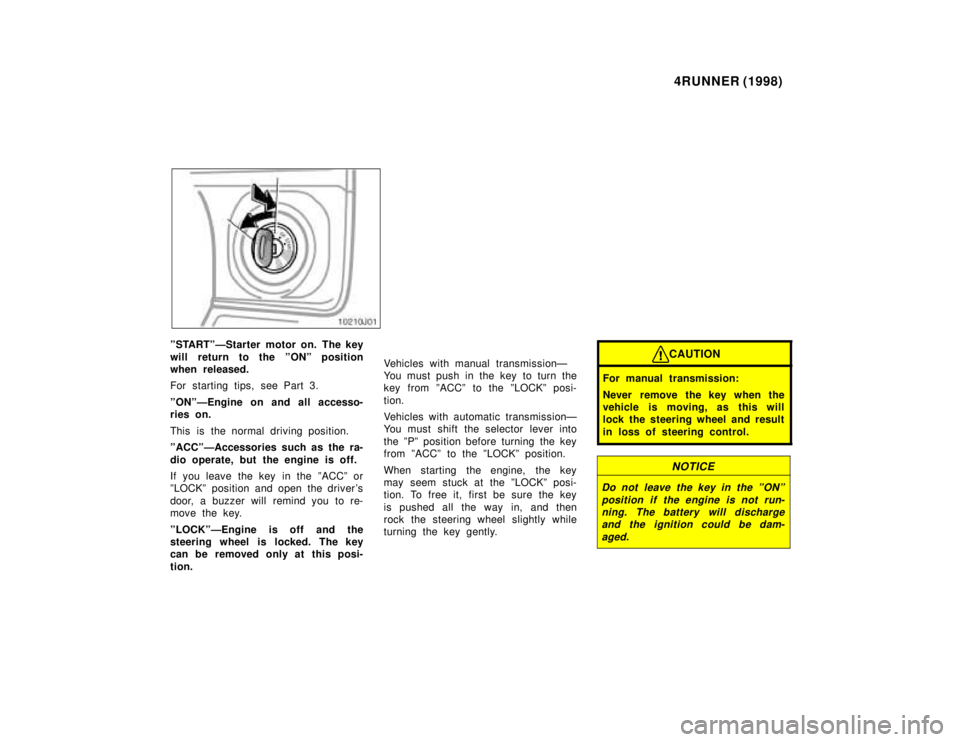
ºSTARTºÐStarter motor on. The key
will return to the ºONº position
when released.
For starting tips, see Part 3.
ºONºÐEngine on and all accesso-
ries on.
This is the normal driving position.
ºACCºÐAccessories such as the ra-
dio operate, but the engine is off.
If you leave the key in the ºACCº or
ºLOCKº position and open the driver's
door, a buzzer will remind you to re-
move the key.
ºLOCKºÐEngine is off and the
steering wheel is locked. The key
can be removed only at this posi-
tion. Vehicles with manual transmissionÐ
You must push in the key to turn the
key from ºACCº to the ºLOCKº posi-
tion.
Vehicles with automatic transmissionÐ
You must shift the selector lever into
the ºPº position before turning the key
from ºACCº to the ºLOCKº position.
When starting the engine, the key
may seem stuck at the ºLOCKº posi-
tion. To free it, first be sure the key
is pushed all the way in, and then
rock the steering wheel slightly while
turning the key gently.CAUTION
For manual transmission:
Never remove the key when the
vehicle is moving, as this will
lock the steering wheel and result
in loss of steering control.
NOTICE
Do not leave the key in the ºONº
position if the engine is not run-ning. The battery will dischargeand the ignition could be dam-
aged.