1998 CHEVROLET CORVETTE torque
[x] Cancel search: torquePage 88 of 378
Downloaded from www.Manualslib.com manuals search engine Leaving Your Vehicle With the Engine
Running (Automatic Transmission Only)
A CAUTION:
I
It can be dangerous to leave your vehicle with the
engine running. Your vehicle could move
suddenly if the shift lever
is not fully in PARK (P)
with the parking brake firmly set. And, if you
leave the vehicle with the engine running,
it could
overheat and even catch fire. You
or others could
be injured. Don’t leave your vehicle with the
engine running unless you have to.
Torque Lock (Automatic Transmission)
If you are parking on a hill and you don’t shift your
transmission into PARK (P) properly, the weight of the
vehicle may put too much force on the parking pawl in
the transmission. You may find it difficult to pull the
shift lever out of PARK (P). This is called “torque lock.”
To prevent torque lock, set the parking brake and then
shift into PARK (P) properly before you leave the
driver’s seat.
To find out how, see “Shifting Into
PARK
(P)” in the Index.
When you are ready to drive, move the shift lever out of
PARK (P)
before you release the parking brake.
If torque lock does occur, you may need to have another
vehicle push yours
a little uphill to take some of the
pressure from the parking pawl in the transmission,
so
you can pull the shift lever out of PARK (P).
2-35
Page 155 of 378
Downloaded from www.Manualslib.com manuals search engine If the engine coolant exceeds 255 “F (124”C), this
message is displayed. If you have been operating your
vehicle under normal driving conditions, you should
pull off from
the road, stop your vehicle and turn off the
engine as soon as possible. You can monitor the coolant
temperature with the GAGES button on the DIC or the
engine coolant gage on the instrument panel cluster. See
“Engine Overheating” in the Index.
HIGH OIL TEMPERATURE REDUCE ENGINE
RPM: You will hear four chimes when this message is
displayed. To acknowledge the warning, press the
RESET button. After you press the RESET button, a
message will be displayed and you will hear a chime
every minute until this condition changes. If you do not
press RESET, the message will remain on the digital
display until the condition changes.
If the engine oil temperature exceeds
320°F (1 60” C),
this message is displayed. You should check the engine
coolant temperature and engine oil level. If your engine
is too hot, see “Engine Overheating’’ in the Index. Your
vehicle may need service,
so see your dealer. You can
monitor the oil temperature with the GAGES button on
the DIC.
HIGH TRANS TEMP: You will hear four chimes
when this message is displayed. To acknowledge this
warning, press the RESET button. After you press the
RESET button, the message will be displayed every
10 minutes until the condition changes. If you do not
press RESET, the message remains on the display until
the condition changes.
If the transmission fluid temperature rises above 263°F
(128°C) or rises rapidly, this message is displayed. The
transmission may shift gears or apply the torque
converter clutch to reduce the fluid temperature. Driving
aggressively or driving on long hills can cause the
transmission fluid temperature to be higher than normal.
If this message appears, you may continue to drive at a
slower speed. You should also monitor the transmission
fluid temperature and allow it to cool to at least 230°F
(1 10°C). The transmission fluid temperature can be
monitored with the GAGES button on the DIC. See
“Automatic Transmission Fluid” in the Index. You
should also check the engine coolant temperature.
If it is
also hot, see “Engine Overheating” in the Index.
If the HIGH TRANS TEMP message is displayed
during normal vehicle operation on flat roads, your
vehicle may need service. See your dealer for an
inspection.
2-102
Page 295 of 378
Downloaded from www.Manualslib.com manuals search engine I~~rrect wheel nuts or improperly tightened
wheel nuts can cause the wheel to become loose
and even come
off. This could lead to an accident.
Be sure to use the correct wheel nuts.
If you have
to replace them, be sure to get new
GM original
equipment wheel nuts.
NOTICE:
Improperly tightened wheel nuts can lead to
brake pulsation and rotor damage. To avoid
expensive brake repairs, evenly tighten the wheel
nuts in the proper sequence and to the proper
torque specification. Used Replacement Wheels
Putting a used wheel
on your vehicle is
dangerous.
You can’t know how it’s been used or
how far it’s been driven. It could fail suddenly
and cause an accident.
If you have to replace a
wheel, use
a new GM original equipment wheel.
Using the Wheel Lock Key
The wheel lock key sits in a small depression in
the
trunk rail directly under the left-hand rear
compartment cover.
Your vehicle’s wheel lock key has a unique registration
number. The registration number is printed on a card
included in your lock nut package.
Also, on this card, is
lost key replacement information. This number is not
recorded by
GM or your dealer, so be sure not to lose
this card.
You will need the information if you ever lose
your wheel lock key.
Page 296 of 378
Downloaded from www.Manualslib.com manuals search engine If you or someone else is going to remove the wheels on
your vehicle, make sure that the special wheel nut socket
and wheel lock key
are being used.
NOTICE:
Your wheels could be damaged if the wheel nut
socket
is not used to remove your vehicle’s wheels.
The wheel nut socket can be used with an air wrench or
a torque wrench. The wheel lock key can be used with a
torque wrench, but not with an air or impact wrench.
I NOTICE:
Your wheel lock key or lock nuts could be
damaged if an
air or impact wrench is used with
this key.
Tire Chains
NOTICE:
Don’t use tire chains. They can damage your
vehicle because there’s not enough clearance.
Use another type of traction device only
if its
manufacturer recommends it for use on your
vehicle and tire size combination and road
conditions. Follow that manufacturer’s
instructions.
To help avoid damage to your
vehicle, drive slowly, readjust or remove the
device
if it’s contacting your vehicle, and don’t
spin your wheels.
If you do find traction devices that will fit, install
them on the rear tires.
6-51
Page 316 of 378
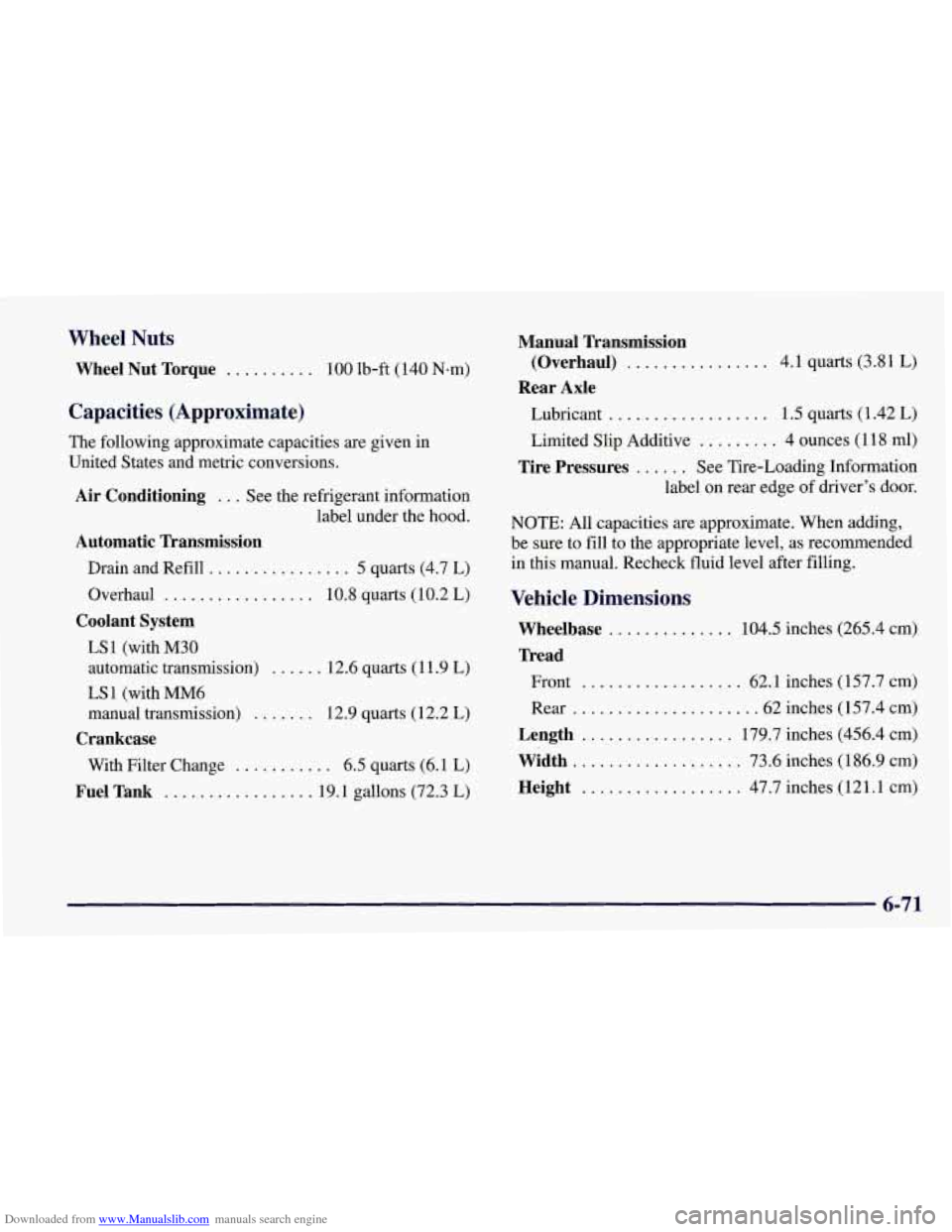
Downloaded from www.Manualslib.com manuals search engine Wheel Nuts
Wheel Nut Torque .......... 100 lb-ft (140 N-m)
Capacities (Approximate)
The following approximate capacities are given in
United States and metric conversions.
Air Conditioning ... See the refrigerant information
label under the hood.
Automatic Transmission
Drain and Refill ................ 5 quarts (4.7 L)
Overhaul
................. 10.8 quarts (10.2 L)
Coolant System
LS 1 (with M30
automatic transmission)
...... 12.6 quarts (1 1.9 L)
LS 1 (with "6
manual transmission)
....... 12.9 quarts ( 12.2 L)
Crankcase
With Filter Change ........... 6.5 quarts (6.1 L)
Fuel Tank ................. 19.1 gallons (72.3 L)
Manual Transmission
Rear Axle (Overhaul)
................ 4.1
quarts (3.8 1 L)
Lubricant
.................. 1.5 quarts (1 -42 L)
Limited Slip Additive ......... 4 ounces (1 18 ml)
Tire Pressures ...... See Tire-Loading Information
label on rear edge of driver's door.
NOTE: All capacities are approximate. When adding,
be sure to fill to the appropriate level, as recommended
in this manual. Recheck fluid level after filling.
Vehicle Dimensions
Wheelbase .............. 104.5 inches (265.4 cm)
Tread
Front .................. 62.1 inches (157.7 cm)
Rear
.................... .62 inches (157.4 cm)
Length ................. 179.7 inches (456.4 cm)
Width ................... 73.6 inches (1 86.9 cm)
Height .................. 47.7 inches (1 21.1 cm)
6-71
Page 365 of 378
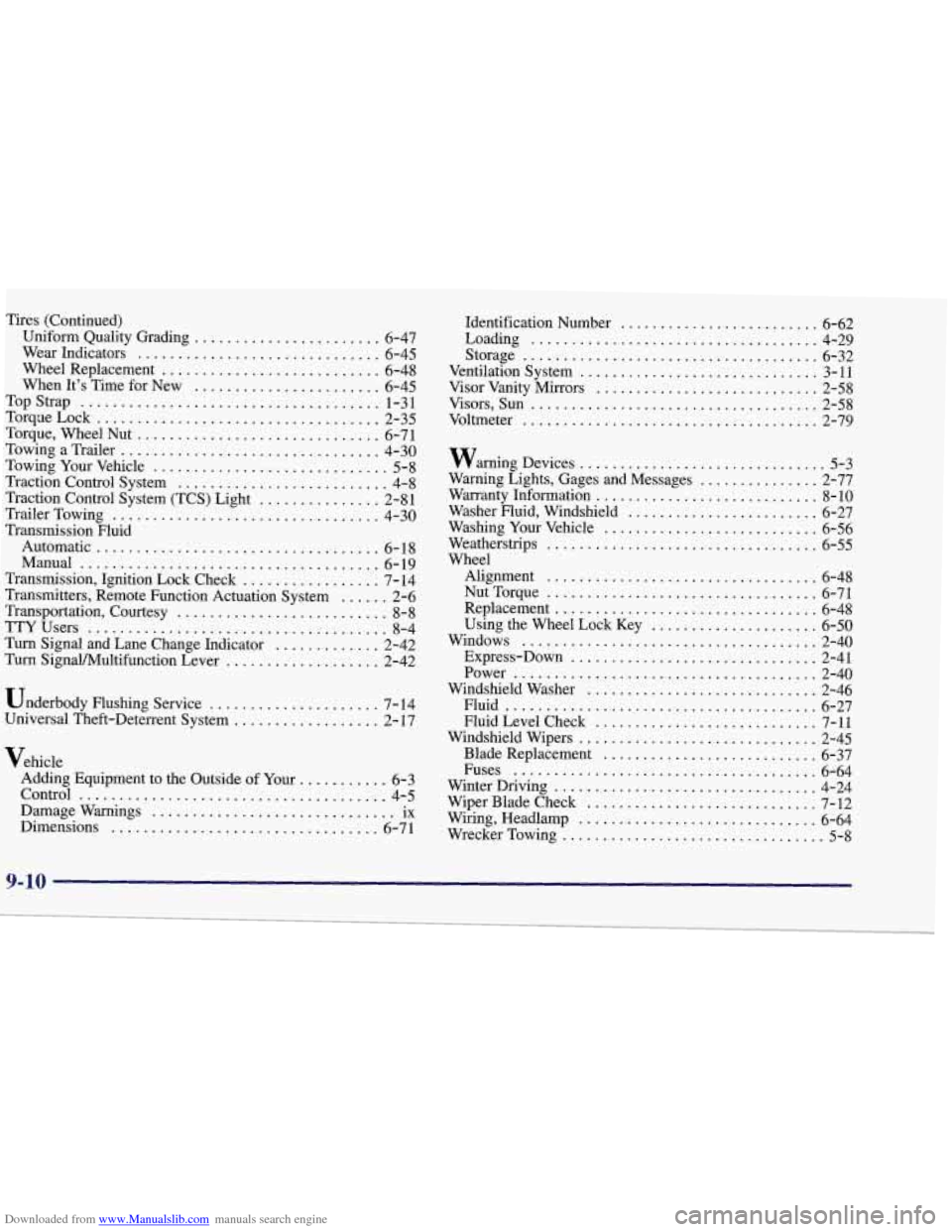
Downloaded from www.Manualslib.com manuals search engine Tires (Continued) Uniform Quality Grading ....................... 6-47
Wear Indicators
.............................. 6-45
Wheel Replacement
........................... 6-48
When It’s Time for New
....................... 6-45
TorqueLock
................................... 2-35
Torque, Wheel Nut .............................. 6-71
Towing a Trailer
................................ 4-30
Towing
Your Vehicle ............................. 5-8
Traction Control System
.......................... 4-8
Traction Control System (TCS) Light
............... 2-81
..................................... Top Strap 1-31
TrailerTowing
................................. 4-30
Transmission Fluid
Automatic 6- 18
...................................
Manual ..................................... 6-19
Transmission, Ignition Lock Check ................. 7-14
Transmitters, Remote Function Actuation System
...... 2-6
Transportation, Courtesy
.......................... 8-8
Turn Signal and Lane Change Indicator
............. 2-42
Turn Signal/Multifunction Lever
................... 2-42
TTYUsers
...................................... 8-4
Underbody Flushing Service
..................... 7-14
Universal Theft-Deterrent System
.................. 2- 17
Vehicle Adding Equipment to the Outside of
Your ........... 6-3
Control
...................................... 4-5
Damage Warnings .............................. ix
Dimensions ................................. 6-71 Identification Number
......................... 6-62
Ventilation System
.............................. 3-11
Visor Vanity Mirrors ............................ 2-58
Loading
.................................... 4-29
Storage
..................................... 6-32
Visors, Sun
.................................... 2-58
Voltmeter
..................................... 2-79
warning Devices
............................... 5-3
Warning Lights. Gages and Messages ............... 2-77
Warranty Information
............................ 8-10
Washer Fluid. Windshield
........................ 6-27
Washing Your Vehicle
........................... 6-56
Weatherstrips
.................................. 6-55
Alignment
.................................. 6-48
NutTorque
.................................. 6-71
Wheel
Replacement ................................. 6-48
Using the Wheel Lock Key
..................... 6-50
Express-Down
............................... 2-41
Power
...................................... 2-40
Windshield Washer ............................. 2-46
Fluid Level Check
............................ 7-11
Windshield Wipers
.............................. 2-45
Blade Replacement
........................... 6-37
Winter Driving
................................. 4-24
Wrecker Towing
................................. 5-8
Windows
..................................... 2-40
Fluid
....................................... 6-27
Fuses
...................................... 6-64
WiperBladeCheck
............................. 7-12
Wiring, Headlamp
.............................. 6-64
9-10
.