1998 BMW CONVERTIBLE light
[x] Cancel search: lightPage 42 of 179

41
At a glanceControls Car careRepairsTechnicalDataIndex
b
The luggage compartment can not
be opened during convertible top oper-
ation.
The side windows move down slightly
when the convertible top operating but-
ton is pressed; if you continue to press
the button after the indicator lamp goes
out, they move up again as soon as the
opening process is completed.c
a
The side windows must be low-
ered slightly during convertible top op-
eration. If the convertible top operation
is interrupted, do not close the side win-
dows with the power window switches.
If the opening or closing process is in-
terrupted, it may not be possible to open
the luggage compartment.
To prevent damage from continuous
dampness, never fold down the convert-
ible top when wet.c
Convenience closing with the
driver's door lockHold the key in the "lock" position with
the door closed.
The windows/sunroof stop moving
immediately when you release the key.b
At higher speeds, low air pressure
in the passenger compartment can
cause the convertible top or the rear
window to begin to flutter. Increase the
air intake via the ventilation control to
prevent low pressure from resulting in
the passenger compartment.c
Closing convertible top manually
when electrical operation failsb
Manual closing is best carried out
from outside the vehicle with the driver's
door open and the driver's seat folded
forward. The rear seat bench must not
be occupied while doing so.c
1 Raise the left rear seat. Pull out the
strap until resistance is felt. Now con-
tinue to pull Þrmly (two audible clicks)
to disengage the drives for the con-
vertible top and convertible top com-
partment lid.
36cde014
Convertible top operation
Page 44 of 179

43
At a glanceControls Car careRepairsTechnicalDataIndex
Longitudinal adjustment Pull lever 1 and slide seat into desired
position.
After releasing the lever, make sure that
the locking device engages properly.Height adjustmentPull lever 2 and load or relieve seat as
required.
Backrest anglePull lever and load or relieve as required.b
You can reduce the load on your
spinal column by sitting all the way
back in the seat with your back pressed
firmly against the backrest.
Ideal sitting posture is achieved with
your head extending from your spine in
a straight line.
For long-distance driving, you may wish
to increase the backrest angle slightly
to reduce muscular tension. Please
remember that you should always
remain able grasp the entire periphery
of the steering wheel without straight-
ening your arms.c
Front headrestsAdjust height by pulling out or pushing
in.
Adjust angle by swiveling.Remove and install the front
headrestsPull the headrests upward until they
stop.
With a forceful jerk, pull the headrests
out of their supports in the backrests.Rear head restraintsAdjust height by pulling out or pushing
in.
360de016
360de017
360de303
Seats
Page 47 of 179
46
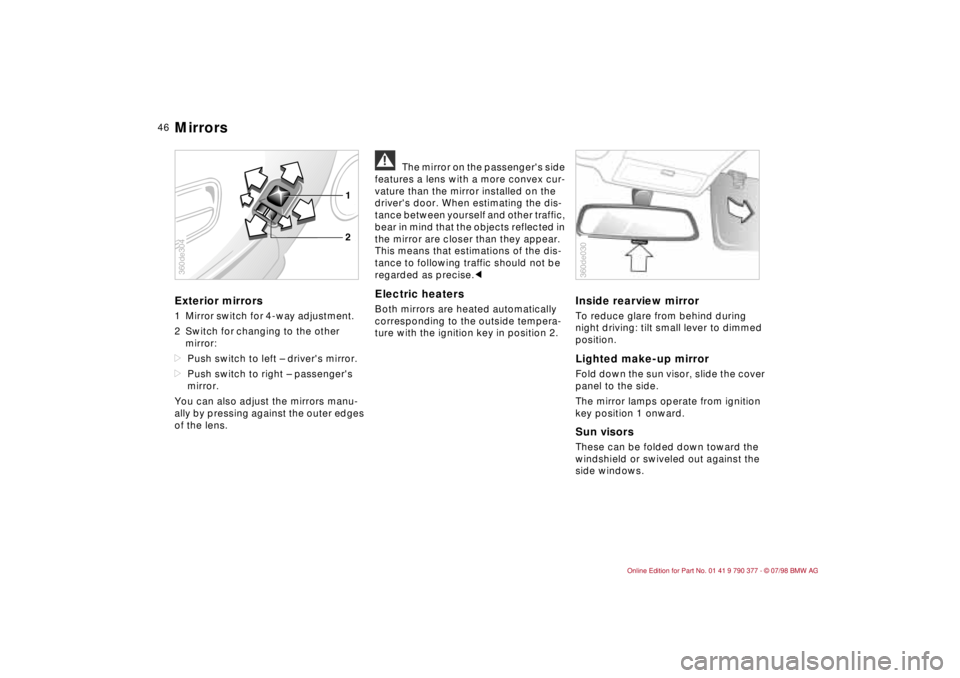
Exterior mirrors1 Mirror switch for 4-way adjustment.
2 Switch for changing to the other
mirror:
dPush switch to left Ð driver's mirror.
dPush switch to right Ð passenger's
mirror.
You can also adjust the mirrors manu-
ally by pressing against the outer edges
of the lens.
a
The mirror on the passenger's side
features a lens with a more convex cur-
vature than the mirror installed on the
driver's door. When estimating the dis-
tance between yourself and other traffic,
bear in mind that the objects reflected in
the mirror are closer than they appear.
This means that estimations of the dis-
tance to following traffic should not be
regarded as precise.c
Electric heatersBoth mirrors are heated automatically
corresponding to the outside tempera-
ture with the ignition key in position 2.
Inside rearview mirrorTo reduce glare from behind during
night driving: tilt small lever to dimmed
position.Lighted make-up mirrorFold down the sun visor, slide the cover
panel to the side.
The mirror lamps operate from ignition
key position 1 onward.Sun visorsThese can be folded down toward the
windshield or swiveled out against the
side windows.
1
2
360de304
360de030
Mirrors
Page 52 of 179

51
At a glanceControls Car careRepairsTechnicalDataIndex
The airbags are triggered by impacts
coming from the directions shown in
the illustration. Note that the supple-
mentary protection against lateral
impact is available only on vehicles
equipped with optional door-mounted
airbags.Indicator lamp in instrument
clusterSystem operational:
dThe indicator lamp comes on briefly.
System malfunction:
dThe indicator lamp fails to come on.dIndicator lamp lights up for approx.
4 seconds, goes out brießy and then
lights up again.
A system malfunction could prevent the
system from responding to an impact
occurring within its normal response
range.
Please have your authorized BMW
Retailer inspect and repair the system
as soon as possible.
a
For your own safety, please ob-
serve the following precautions con-
cerning airbags, as otherwise their
protective function may be impaired. We
also request that you make this informa-
tion available to your passengers, and
that you urge them to observe the in-
structions for safety belt use: the air-
bags are a supplemental restraint
device designed to provide extra pro-
tection; they are not a substitute for
safety belts. Wear your safety belt at all
times. The system does not respond to
minor collisions, if the vehicle rolls over,
or if the impact is at the rear of the vehi-
cle. In this situation, only the safety belt
protects you.
When adjusting your seat, select a posi-
tion that provides maximum distance
between you and the steering wheel, the instrument panel and the door while still
allowing comfortable and safe access to
all vehicle controls.
Always grip the steering wheel on its
rim with your hands at the 9 and 3 oÕclock
positions, otherwise hand and arm inju-
ries could occur when the airbag
inflates.
Never allow any objects to obstruct the
area between the airbag and the driver/
passenger.
Do not use the cover panel above the
passenger-side airbag as a storage
area.
Do not glue, cover or in any way alter
the padded covers on the steering
wheel, the instrument panel or the side
trim panels of the front doors.
Do not install a rear-facing child re-
straint device on the front passenger
seat. Children under 12 years of age
should only sit in the back.c
Even when all these guidelines are
observed, there is still a residual risk of
mild facial injuries occurring in isolated
instances of airbag actuation. The igni-
tion and inßation noise may induce a
mild temporary hearing loss in sensitive
individuals.
Airbag information is also located on
the sun visors.
p
The indicator lamp comes on from
ignition key position 1 to indicate
that the system is operational.
390de142Airbags
Page 55 of 179
54
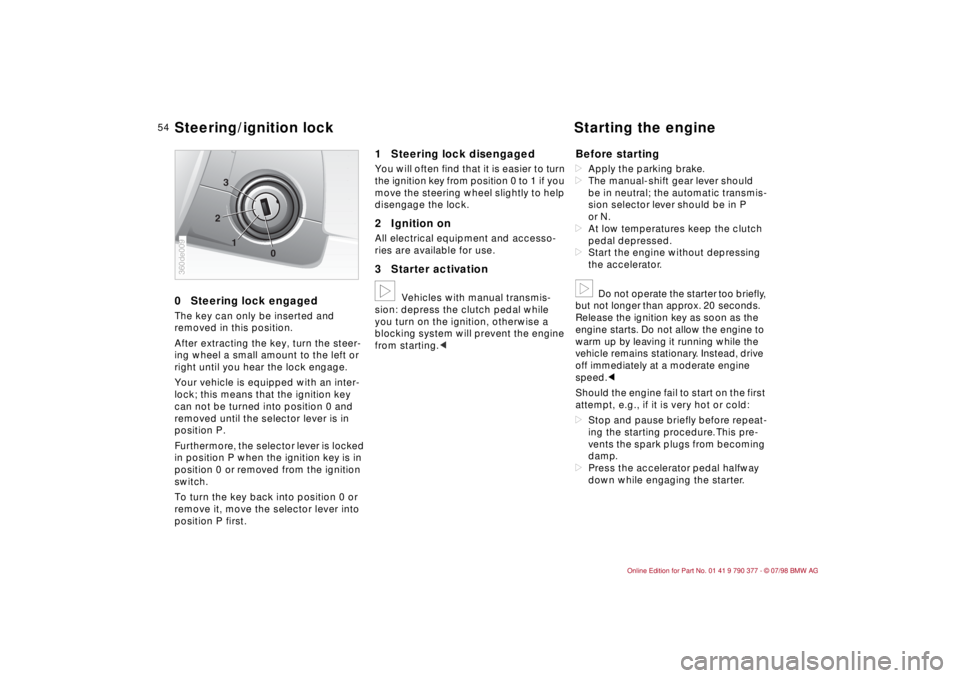
0Steering lock engagedThe key can only be inserted and
removed in this position.
After extracting the key, turn the steer-
ing wheel a small amount to the left or
right until you hear the lock engage.
Your vehicle is equipped with an inter-
lock; this means that the ignition key
can not be turned into position 0 and
removed until the selector lever is in
position P.
Furthermore, the selector lever is locked
in position P when the ignition key is in
position 0 or removed from the ignition
switch.
To turn the key back into position 0 or
remove it, move the selector lever into
position P first.
1 Steering lock disengagedYou will often find that it is easier to turn
the ignition key from position 0 to 1 if you
move the steering wheel slightly to help
disengage the lock.2 Ignition onAll electrical equipment and accesso-
ries are available for use.3 Starter activationb
Vehicles with manual transmis-
sion: depress the clutch pedal while
you turn on the ignition, otherwise a
blocking system will prevent the engine
from starting.c
Before startingdApply the parking brake.
dThe manual-shift gear lever should
be in neutral; the automatic transmis-
sion selector lever should be in P
or N.
dAt low temperatures keep the clutch
pedal depressed.
dStart the engine without depressing
the accelerator.b
Do not operate the starter too briefly,
but not longer than approx. 20 seconds.
Release the ignition key as soon as the
engine starts. Do not allow the engine to
warm up by leaving it running while the
vehicle remains stationary. Instead, drive
off immediately at a moderate engine
speed.c
Should the engine fail to start on the first
attempt, e.g., if it is very hot or cold:
dStop and pause briefly before repeat-
ing the starting procedure. This pre-
vents the spark plugs from becoming
damp.
dPress the accelerator pedal halfway
down while engaging the starter.
1 2
03
360de009Steering/ignition lock Starting the engine
Page 57 of 179
56
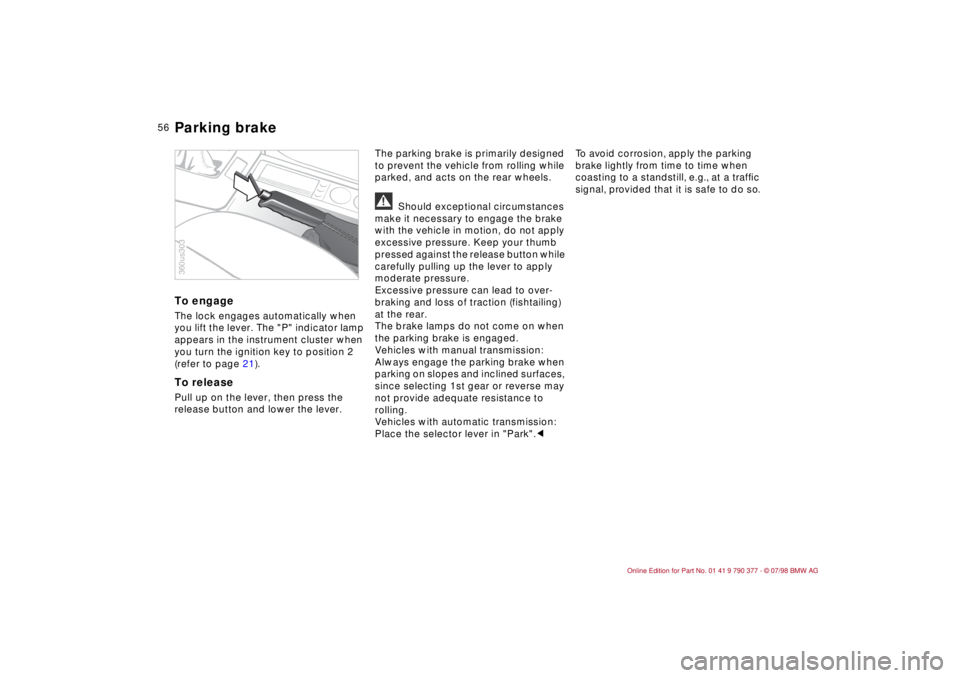
To engageThe lock engages automatically when
you lift the lever. The "P" indicator lamp
appears in the instrument cluster when
you turn the ignition key to position 2
(refer to page 21).To releasePull up on the lever, then press the
release button and lower the lever.The parking brake is primarily designed
to prevent the vehicle from rolling while
parked, and acts on the rear wheels.
a
Should exceptional circumstances
make it necessary to engage the brake
with the vehicle in motion, do not apply
excessive pressure. Keep your thumb
pressed against the release button while
carefully pulling up the lever to apply
moderate pressure.
Excessive pressure can lead to over-
braking and loss of traction (fishtailing)
at the rear.
The brake lamps do not come on when
the parking brake is engaged.
Vehicles with manual transmission:
Always engage the parking brake when
parking on slopes and inclined surfaces,
since selecting 1st gear or reverse may
not provide adequate resistance to
rolling.
Vehicles with automatic transmission:
Place the selector lever in "Park".cTo avoid corrosion, apply the parking
brake lightly from time to time when
coasting to a standstill, e.g., at a trafÞc
signal, provided that it is safe to do so.
360us303Parking brake
Page 58 of 179

57
At a glanceControls Car careRepairsTechnicalDataIndex
The shift lever's neutral plane (dot in the
illustration) is located between 3rd and
4th gears
Whenever you shift from any gear into
"Neutral", the shift lever will automati-
cally return to the specified gear plane.
ReverseSelect only with the vehicle stationary.
Press the shift lever to the left to over-
come the slight resistance.Backup lampsAs you do this the backup lamps will
turn on automatically when the ignition
key is in position 2.a
Do not "ride" the clutch to hold the
vehicle in place on slopes; use the park-
ing brake instead. A slipping clutch in-
creases clutch wear.c
360de044Manual transmission
Page 61 of 179

60
Indicator lamp for shift
electronicsdIf the lamp fails to go out or
dif it lights up during driving, there is a
malfunction in the shifting electronics
or in the transmission.
Bring the vehicle to a stop, select trans-
mission position "P", set the parking
brake and turn the engine off (ignition
key to position 0).
Wait a few seconds, then start the
engine.
If the indicator lamp goes out after a
few seconds, normal transmission per-
formance has been restored. Drive off
normally.
If the indicator lamp does not go out, all
selector lever positions can still be
selected, however in the forward posi-
tions the vehicle has limited perfor-
mances as it drives only in the 3rd or
4th gear.
If this happens, avoid extreme engine
loads and consult the nearest autho-
rized BMW Retailer.
a
Never carry out any work in the
engine compartment without first
ensuring that the transmission is in Park
or Neutral. Never leave children in the
vehicle unattended.c
For information on tow-starting, towing
and jump starting refer to pages 153
and 154.
1 High beam (blue indicator lamp)
2 Headlamp ßasher
3 Turn signal indicator (green indicator
lamp and rhythmic ticking of the
blinker relay).
Flashing of the indicator lamp and tick-
ing faster than normal: a turn-indicator
lamp is defective.
To signal brieflyPress the lever up to but not beyond the
lock.
O
Goes out after the engine has
started.
1
2
3
3
360de039
Automatic transmission*Turn signals/high beam