1998 BMW CONVERTIBLE light
[x] Cancel search: lightPage 132 of 179

13 1
At a glanceControlsCar careRepairsTechnicalDataIndex
Washing your carRight from the start, you can wash your
new BMW either by hand or in an auto-
matic car wash. BMW Convertible: For
instructions on cleaning and care of the
convertible top, refer to page 136 ff.
To prevent spots, avoid washing when
the hood is still warm, or immediately
after and during exposure to strong
sunlight.
When using an automatic car wash,
ensure that
dno damage occurs to vehicles with
add-on body elements (e.g., spoilers,
telephone aerials). Consult the car
wash operator if necessary
dthe vehicle is cleaned with minimum
brush pressure, and that ample water
is available for washing and rinsing.
Loosen and remove stubborn dirt and
dead insects before washing the car.
a
Always maintain an adequate dis-
tance between the spray source and the
vehicle's surface when using spray
wands and high-pressure washers. In-
adequate distance and excessive pres-
sure can damage or weaken the finish,
making it more susceptible to subse-
quent attack. In addition, moisture could
penetrate to vehicle components, lead-
ing to long-term damage.c
Parts of the car which are inaccessible
to the automatic washer - such as door
sills, door and hood edges, etc. -
should be cleaned by hand.
b
Please observe the following
when cleaning the headlamp covers:
dDo not clean by wiping with a dry
cloth (scratches). Never use abra-
sives or strong solvents to clean the
covers.
dRemove dirt and contamination (such
as insects) by soaking with BMW Car
Shampoo and then rinsing with
plenty of water.
dAlways use a de-icer spray to remove
accumulated ice and snow Ð Never
use a scraper!cIn the winter months, it is especially
important to ensure that the car is
washed on a regular basis. Large quan-
tities of dirt and road salt are difficult to
remove, and they also cause damage to
the vehicle.
a
After washing, the brakes may be
wet and thus less effective! Apply the
brakes briefly to dry them.c
Caring for your car
Page 133 of 179

13 2
Exterior finishTo provide effective corrosion protec-
tion, multilayer paintwork is applied at
the factory. Cataphoretic immersion
priming techniques are supplemented
using special body-cavity protectants,
with the application of specially-devel-
oped and extensively tested materials.
The entire underbody is sprayed with a
flexible PVC layer before final compre-
hensive application of a wax-based
protectant.
Regular maintenance makes an impor-
tant contribution to maintaining the
safety and value of your vehicle.
Increasing awareness of the effects of
harmful environmental factors on vehi-
cle finishes have led paint and vehicle
manufacturers to initiate ongoing pro-
grams designed to further improve the
durability of their finishes. Despite the
high quality of the resulting products,
local and regional factors can still have
a negative effect on your car's paint-
work. These should guide you in deter-
mining the frequency and extent of your
efforts to maintain the vehicle finish.
Depending upon material and type of
impact (perforation of paint layer), phys-
ical stresses from sand, road salt,
gravel, etc. can cause corrosion to start extending beneath the finish, starting at
the point of impact.
Road dirt, tar spots, dead insects, ani-
mal droppings (strong alkali effect) and
tree excretions (resins and pollen) all
contain substances capable of causing
damage when allowed to remain on
your car's finish for any period of time
(spots, etching, flaking, separation in
the top coat).
In industrial areas, deposits from ßy ash,
lime, oily soot, sulphur dioxide in pre-
cipitation (acid rain) and other environ-
mental pollutants will damage the car's
surface (usually limited to the external
horizontal surfaces) unless adequate
protection is provided.
In coastal regions, high levels of atmo-
spheric salt and humidity promote cor-
rosion.
In tropical zones, temperatures of over
100 5F (approx. 406) in the shade pre-
vail, in addition to heavy ultraviolet radi-
ation and high humidity. Under those
circumstances, light-colored paints
reach temperatures of up to 175 5F
(approx. 806) and dark paints up to
250 5F (approx. 1206).
Caring for the vehicle finishAs a precaution against damage result-
ing from exposure to aggressive sub-
stances, we recommend that you wash
the car weekly when it is used in an
area with high levels of air pollution or
aggressive natural substances (tree
resin, pollen).
Remove particularly aggressive sub-
stances immediately in order to prevent
changes to, and discoloration of, the
paint. Such substances are e.g., gaso-
line spilled during refueling, oil, grease,
brake fluid and bird droppings.
Any contamination remaining on the
surface of the vehicle will be especially
conspicuous after washing. Use clean-
ing fluid or alcohol with a clean cloth or
cotton pad to remove. You can use tar
remover to remove any spots on the fin-
ish of the vehicle, but should never
apply it or any other aggressive
cleanser to lenses or headlamp covers.
These areas should then be waxed to
maintain protection.b
A full range of car-care products is
available from your BMW Retailer.c
Caring for your car
Page 134 of 179

13 3
At a glanceControlsCar careRepairsTechnicalDataIndex
Waxing your carProtect the finish using carnauba or
synthetic-based waxes only.
The best way to determine when the
finish needs to be waxed is by noting
when water stops beading on the sur-
face.
You can use a glass cleaner to remove
any wax or silicone that may have been
left on the windows during waxing.b
A full range of car-care products is
available from your BMW Retailer.c
Paint damageYou can touch up small areas of dam-
age with BMW spray paint, a BWM
touch-up stick or BMW paint tape.
The paint color code for your car is pro-
vided on a sticker located next to the
type plate and on the first page of your
Service and Warranty Information book-
let.
Damage caused by flying stones,
scratches, etc. must be touched up
without delay to prevent rust from form-
ing.
If corrosion has started to form in an
area with paint damage, remove all rust
and clean the area, then prime the area
with a BMW Primer Stick. Finally, apply
the finish coat. Wait a few days, then
polish the repaired area. Finish by
applying a wax preservative.
More extensive paint damage should be
professionally repaired in accordance
with the manufacturer's instructions.
Your BMW Retailer uses original BMW
finish materials in accordance with offi-
cial repair procedures.
Caring for other vehicle compo-
nents and materialsLight-alloy wheels
* should be treated
with alloy wheel cleaner, particularly dur-
ing the winter months. Refrain from using
aggressive products containing acids,
strong alkalis or abrasives. Alloy wheels
should not be cleaned with a steam jet
operating at temperatures in excess of
140 5F (606) (note manufacturer's
instructions).
You can use window and glass cleaner to
clean inside window surfaces and mir-
rors without smearing and streaking.
Never use polishing pastes or abrasive
(quartz) cleansers on mirror lenses.
Clean plastic parts, imitation leather sur-
faces, the roof lining, the lenses of lamps,
the glass cover of the instrument panel
and all dull black sprayed parts with
water or products for the care of plastics.
Avoid soaking the headliner. Never use
solvents such as lacquer thinner, heavy-
duty grease remover, fuels, etc.
Rubber components should be cleaned
with water only; a rubber treatment or sil-
icone spray may also be applied.
Clean the wiper blades with soapy water.
The wiper blades should be replaced
twice a year, before and after the cold
season.
Caring for your car
Page 135 of 179

13 4
The safety belts should be cleaned with
a mild soap and water solution without
being removed from the car. Never
attempt chemical or dry cleaning, as
damage to the belt fabric could result.
After cleaning, never allow the inertia
reel to retract the belts until they are
completely dry. Dirty safety belts pre-
vent the inertia reel mechanism from
retracting the strap properly, and thus
constitute a safety hazard.
Heavily soiled floor carpets and mats
*
can be cleaned with an interior cleaner.
The floor mats can be removed from the
vehicle for cleaning.
Please use only a damp cloth to clean
wooden fascia panels and components.
Follow up by drying with a soft cloth.
b
Products for cleaning and care are
available from your BMW Retailer.c
Care of upholstery materialsDepressions resulting in the upholstered
materials in the course of everyday use
can be brushed up by brushing with a
lightly dampened brush "against the
nap".
The tendency of the pile to lie in a par-
ticular direction on velour upholstery is
not a quality defect, and, just as on
home textiles or clothing, can not be
avoided.
Fuzz on upholstery materials, rubbed-in
fabric or suede residues can be removed
with a fuzz or Velcro
â brush. A cleaning
glove is available for particularly "stub-
born" fuzz. Stains and fairly large areas
of dirt should be cleaned off without
delay, using lukewarm water and an
interior cleaner, stain remover or clean-
ing-grade benzene. Brush the fabric
afterwards to restore its appearance.
If the upholstery is to be exposed to
intense sunlight or if the vehicle is to be
stored for an extended period, cover all
seats to prevent fading.
b
A full range of car-care products is
available from your BMW Retailer.cThe build-up of an electrostatic charge
on the seat covers, particularly if atmo-
spheric humidity is low, can give the
occupants an unpleasant electric shock
if they touch metal body parts after
leaving the vehicle. Although this is not
dangerous in any way, it can be
avoided by touching a bare or polished
metal part of the car while getting out.
If necessary, anti-static products can
be used to eliminate this effect to a
large extent.
Caring for your car
Page 136 of 179

13 5
At a glanceControlsCar careRepairsTechnicalDataIndex
Leather careThe leather upholstery
* used by BMW
is a natural product of the highest qual-
ity, processed using state-of-the-art
methods to ensure that it will maintain
its high quality for years to come, pro-
vided that it is properly cared for.
Because this product is manufactured
using natural materials, you must make
allowance for its special characteristics
as well as for the peculiarities of its use
and care.
Regular periodic cleaning and care are
essential, as dust and road dirt act as
abrasives in the pores and creases of
the material. This leads to wear spots
and premature brittleness on the sur-
face of the leather. We therefore sug-
gest that you clean the leather with a
vacuum cleaner or dust cloth at frequent
intervals.
For cleaning, use BMW leather cleaning
foam.
As dirt and grease can slowly attack the
protective layer of the leather, the
cleaned leather surfaces must be
treated with BMW Leather Care. This
serves also as an anti-static agent.
To protect against moisture and water
you can treat the leather with BMW
Impregnating Agent.We recommend that you perform this
procedure twice a year on leather ex-
posed to normal use.
Spills should be wiped up immediately.
Remove grease and oil stains without
rubbing, but rather by dabbing with
spot remover.
If the upholstery is to be exposed to
intense sunlight or if the vehicle is to be
stored for an extended period, cover all
leather surfaces (or, better yet, the win-
dows) to prevent fading.
a
Cleaning agents can contain dan-
gerous or unhealthy ingredients. There-
fore always observe the warnings and
danger notices on the package.
Open the doors or windows on your ve-
hicle when cleaning the interior.
Never clean your vehicle with solvents
or other materials not specifically in-
tended for this application.c
Caring for your car
Page 137 of 179

13 6
CareThe appearance and life of the convert-
ible top are highly dependent on its
proper care and operation. You should
pay particular attention to the following
instructions if your care has a light-col-
ored top.
Protect the vehicle from exposure to
intense sunlight whenever possible by
parking it in the shade to prevent the
paint, rubber and fabric-covered parts
from being attacked.
Never fold up the convertible top and
store it in the convertible top compart-
ment when wet, dirty or frozen, as mil-
dew stains and rub spots may result.
To prevent the formation of a fold in the
rear window and mildew stains, do not
leave the top folded up in the convert-
ible top compartment for longer peri-
ods.
If the vehicle is temporarily stored in a
close room, ensure that the top is dry
and provide sufficient ventilation.
Clean off bird droppings immediately,
as they attack the convertible top and
cause the rubber seals to swell due to
their caustic characteristics.Besides water, only treat rubber seals
with talcum powder, rubber care prod-
ucts or silicone spray, particularly when
they feel dry or tend to stick.
Noises, e.g., squeaks, can be elimi-
nated with a lubricant spray.
Never use sharp-edged objects to
clean the rear window of snow and ice.
The use of de-icing spray is not permit-
ted. Due to the danger of damage and
discoloration, do not apply adhesive
tape, stickers etc. to the window or
cover it with plastic film.
The convertible top and its seams may
become leaky as the result of improper
care and cleaning and from the strain of
long use, and depressions and dirt can
result. All warranty claims are void in
these cases. Please take your vehicle to
your BMW Retailer for servicing.
Washing your carYou can wash your BMW Convertible in
automatic car washes. Here preference
should be given to brushless systems.
If a brushless car wash is unavailable
and brush car wash must be used,
modern systems with soft brushes are
preferable. Do not select special wax-
ing programs. The small amount of
beading wax always used in automatic
car washes will not harm your vehicle's
finish.
In the case of more extensive dirt,
which is especially visible on light-col-
ored top materials, clean the top with
the BMW Convertible Cleaning Set.
Please proceed as follows:
Spray the top with the cleaning agent
and then rub with a well-dampened
sponge using circular motions until a
foam develops. Then you can finish
washing the vehicle in an automatic car
wash. After three to five washings the
top should be treated with a special
impregnating spray. Please follow the
instructions on the spray can.
Cleaning and care of the convertible top
Page 147 of 179
14 6
a
Change tires only on a flat, hard
surface affording good traction. Avoid
jacking the car on a soft or slippery sup-
port surface (snow, ice, loose gravel,
etc.), as it could slide sideways.
Take extra care to ensure that the base
of the jack is positioned on a solid sup-
port surface.
Never use wooden blocks or similar
objects to support the base of the jack,
as the weight of the car could exceed
their support capacity.
Never lie beneath the vehicle or start
the engine while the car is supported by
the jack - risk of fatal injury.
Additional precautions to observe when
changing flat tires:
When pulling over on the roadside to
change a tire, always try to park the car
as far as possible from passing traffic.
Switch on the hazard flashers.
All passengers should be outside the
car and well away from your immediate
working area (e.g., behind the guard-
rail).Turn the steering wheel to the straight-
ahead position, remove the key and
engage the steering lock. Shift into 1st
or reverse (selector lever in Park with
automatic) and engage the parking
brake.
If a warning triangle or portable hazard
warning lamp is available, set it up on
the roadside at an appropriate distance
from the rear of the vehicle. Observe all
safety guidelines and regulations.c
b
To avoid rattling noises, note the
positions of the tools and return them to
their original positions.c
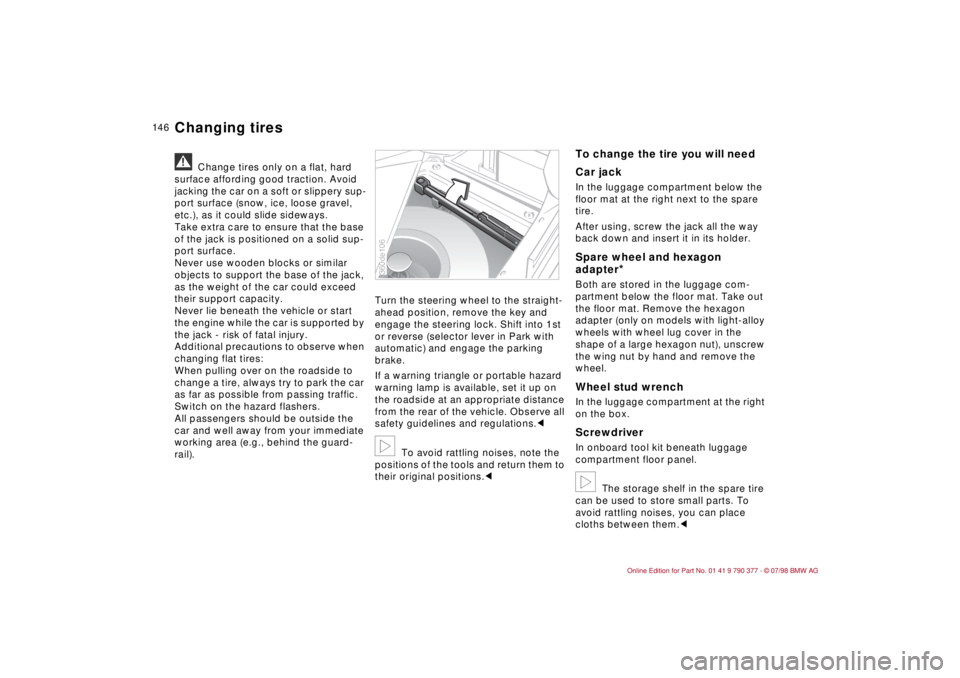
To change the tire you will need
Car jackIn the luggage compartment below the
floor mat at the right next to the spare
tire.
After using, screw the jack all the way
back down and insert it in its holder.Spare wheel and hexagon
adapter
*
Both are stored in the luggage com-
partment below the floor mat. Take out
the floor mat. Remove the hexagon
adapter (only on models with light-alloy
wheels with wheel lug cover in the
shape of a large hexagon nut), unscrew
the wing nut by hand and remove the
wheel.Wheel stud wrench In the luggage compartment at the right
on the box. ScrewdriverIn onboard tool kit beneath luggage
compartment floor panel.b
The storage shelf in the spare tire
can be used to store small parts. To
avoid rattling noises, you can place
cloths between them.c
360de106
Changing tires
Page 148 of 179

14 7
At a glanceControlsCar careRepairsTechnicalDataIndex
Procedure1 Wheel bolt cover
* removal.
Steel disk wheel: remove wheel cover
by hand. Light-alloy wheel with lug
cap in the shape of a large hexagon
nut: position the hexagon adapter on
the lug bolt cover, apply the lug
wrench and turn it to the left.2 Loosen lug bolts 1/2 turn.
3 Remove the respective cover cap
from the jacking point. Depending on
the vehicle version, remove the pro-
tective cap either by inserting the
screwdriver into the slot and turning
to the left (arrow in left illustration) or
by pressing in the cap on the bottom
(arrow in illustration above).4 Insert the jack all the way into the
support while ensuring that the base
of the jack is securely positioned on
the road surface. Always chock the
wheels to prevent the vehicle from
rolling.
5 Turn the handle to raise the jack until
the wheel is free of the ground.
a
The vehicle jack is designed for
changing tires only. Never use it to raise
another vehicle model or a load of an-
other kind, since that could result in ac-
cidents and personal injury.
Never lie beneath the vehicle when it is
supported by the jack Ð risk of fatal inju-
ry!c
6 Unscrew the lug bolts and remove the
wheel.
360de108
365de061
360de109
Changing tires