1998 BMW CONVERTIBLE light
[x] Cancel search: lightPage 94 of 179

93
At a glanceControlsCar careRepairsTechnicalDataIndex
BMW Hi-Fi System (Harman/
Kardon)1On
2Off
In the "On" position, the listener is given
the impression of a considerably larger
passenger compartment with an
improved stereo effect in all seats.
This function should be switched off in
the case of poor radio reception due to
the frequent changes between stereo
and mono which result.
BMW Convertible:
You do not have to operate the con-
trols. The system detects whether the
top is open or closed and regulates the
sound automatically.
To openPress the button and fold down the
door.
The glove compartment lamp switches
on from ignition key position 1.To closeFold up door.To engage locksOnly possible with a master key. a
To reduce the risk of injury, always
close the glove compartment immedi-
ately after use.c
Rechargeable flashlightThe connection for the rechargeable
flashlight is located on the left side of
the glove compartment.
The flashlight features overcharging
protection, so it can be left in its holder
continuously.
However, it must be removed when the
battery is disconnected or removed.a
Ensure that the flashlight is off be-
fore inserting it in its holder.c
HIFI
1
2
360de057
360de058
BMW Hi-Fi System*Glove compartment
Page 95 of 179
94
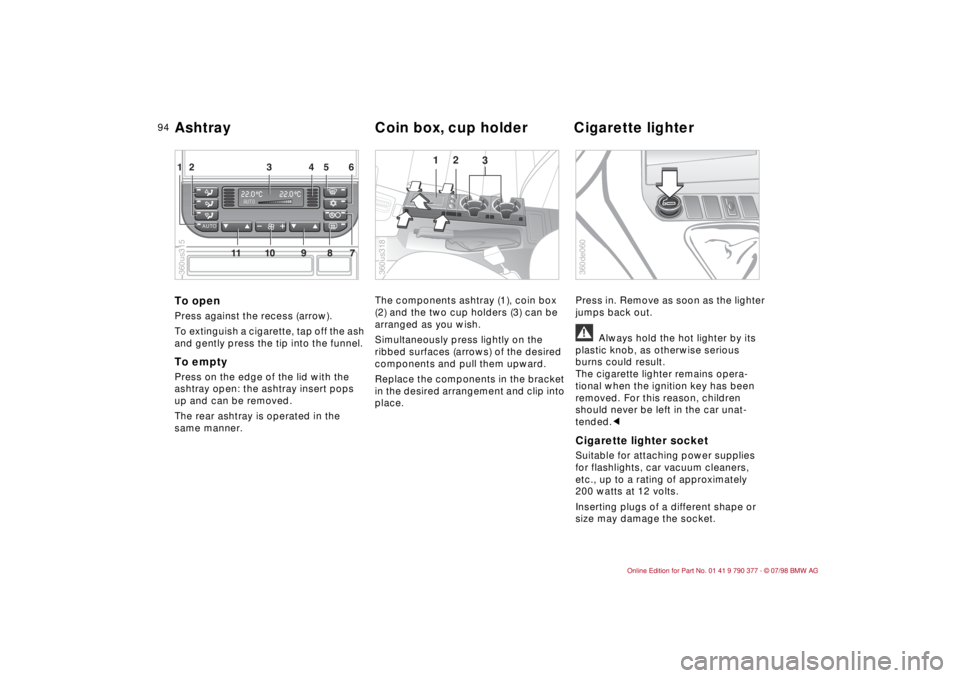
To openPress against the recess (arrow).
To extinguish a cigarette, tap off the ash
and gently press the tip into the funnel.To emptyPress on the edge of the lid with the
ashtray open: the ashtray insert pops
up and can be removed.
The rear ashtray is operated in the
same manner.The components ashtray (1), coin box
(2) and the two cup holders (3) can be
arranged as you wish.
Simultaneously press lightly on the
ribbed surfaces (arrows) of the desired
components and pull them upward.
Replace the components in the bracket
in the desired arrangement and clip into
place.Press in. Remove as soon as the lighter
jumps back out.
a
Always hold the hot lighter by its
plastic knob, as otherwise serious
burns could result.
The cigarette lighter remains opera-
tional when the ignition key has been
removed. For this reason, children
should never be left in the car unat-
tended.c
Cigarette lighter socket Suitable for attaching power supplies
for flashlights, car vacuum cleaners,
etc., up to a rating of approximately
200 watts at 12 volts.
Inserting plugs of a different shape or
size may damage the socket.
A
AUTO
2
1
3456
7 8 9 10 11
AUTO
360us315
1
2
3
360us318
360de060
Ashtray Coin box, cup holder Cigarette lighter
Page 97 of 179
96
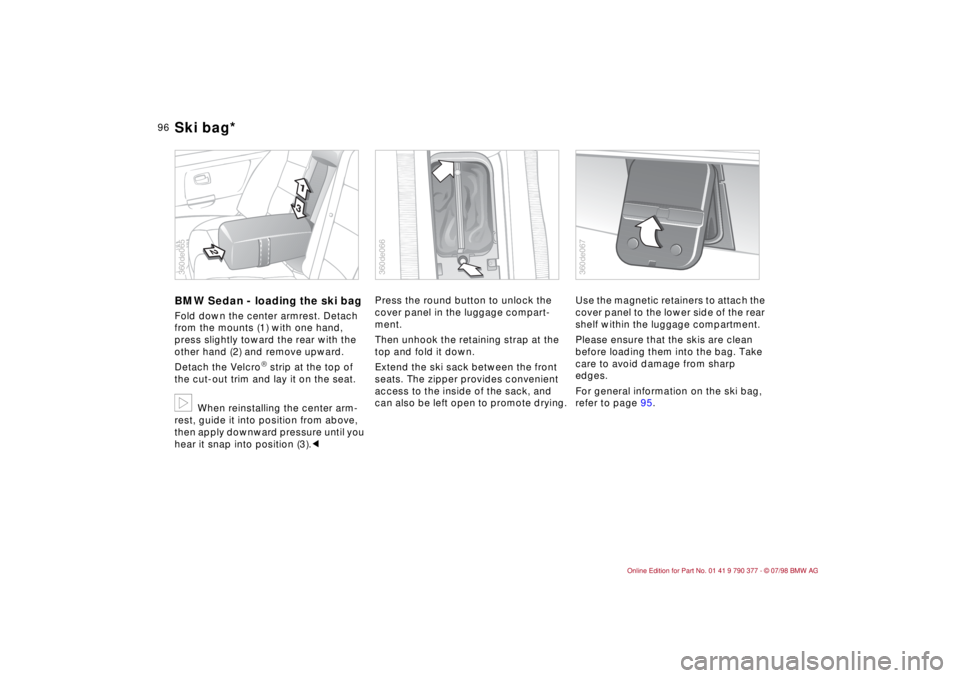
BMW Sedan - loading the ski bagFold down the center armrest. Detach
from the mounts (1) with one hand,
press slightly toward the rear with the
other hand (2) and remove upward.
Detach the Velcro
â strip at the top of
the cut-out trim and lay it on the seat.
b
When reinstalling the center arm-
rest, guide it into position from above,
then apply downward pressure until you
hear it snap into position (3).cPress the round button to unlock the
cover panel in the luggage compart-
ment.
Then unhook the retaining strap at the
top and fold it down.
Extend the ski sack between the front
seats. The zipper provides convenient
access to the inside of the sack, and
can also be left open to promote drying.Use the magnetic retainers to attach the
cover panel to the lower side of the rear
shelf within the luggage compartment.
Please ensure that the skis are clean
before loading them into the bag. Take
care to avoid damage from sharp
edges.
For general information on the ski bag,
refer to page 95.
3
2
1
360de065
360de066
360de067
Ski bag*
Page 99 of 179
98
Stowing a loadIf you are transporting a load in your
BMW
dStow a heavy load as far forward as
possible - directly behind the back-
rests or the front wall of the luggage
compartment - and on the ßoor.
dCover sharp edges and corners.
dDo not pile objects higher than the
top edge of the backrest.
dIf the load is heavy and the rear seat
is unoccupied, put the outer safety
belt in its lock.
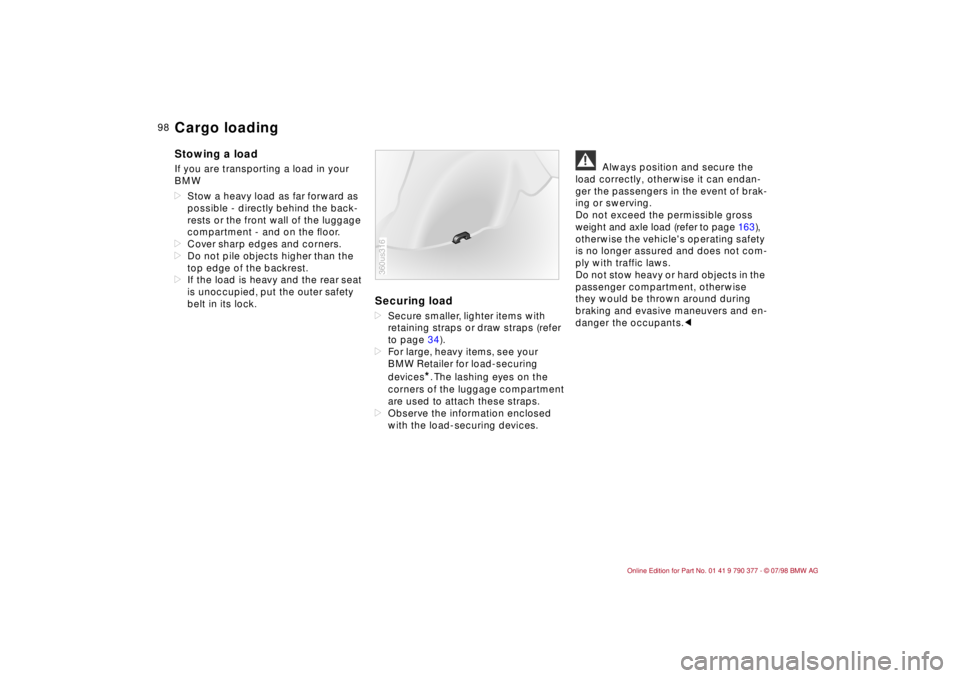
Securing loaddSecure smaller, lighter items with
retaining straps or draw straps (refer
to page 34).
dFor large, heavy items, see your
BMW Retailer for load-securing
devices
*. The lashing eyes on the
corners of the luggage compartment
are used to attach these straps.
dObserve the information enclosed
with the load-securing devices.
a
Always position and secure the
load correctly, otherwise it can endan-
ger the passengers in the event of brak-
ing or swerving.
Do not exceed the permissible gross
weight and axle load (refer to page 16 3),
otherwise the vehicle's operating safety
is no longer assured and does not com-
ply with traffic laws.
Do not stow heavy or hard objects in the
passenger compartment, otherwise
they would be thrown around during
braking and evasive maneuvers and en-
danger the occupants.c
360us316
Cargo loading
Page 102 of 179

101
At a glanceControlsCar careRepairsTechnicalDataIndex
ClutchDepress the clutch throughout its com-
plete travel range to shift gears. Do not
"ride" the clutch by driving with your
foot resting against the pedal.a
Brakes:
Do not drive with your foot resting on the
brake pedal. Even light but consistent
pedal pressure can lead to high temper-
atures, brake wear and possibly even
brake failure.
Aquaplaning:
A wedge of water can form between
tires and road surface when you oper-
ate the vehicle on wet or slushy roads.
This phenomenon is referred to as
aquaplaning, or hydroplaning, and it is
characterized by a partial or complete
loss of contact between the tires and
the road surface. The ultimate results
are loss of steering and braking control.Water on the roads:
When driving through water (maximum
depth one foot = 30 cm) always drive at
walking speed, otherwise damage to
the engine, the electrical system and
the transmission can occur.
Rear window shelf:
Never use the rear window shelf to
store heavy or bulky objects. They
could pose a danger to the occupants
when the car is braked heavily.
Clothes hooks:
When suspending clothing from the
hooks, ensure that they will not obstruct
the driver's vision. Refrain from hanging
heavy objects from the hooks, as these
could cause personal injury when the
car is braked heavily.c
Driving notes
Page 104 of 179

10 3
At a glanceControlsCar careRepairsTechnicalDataIndex
ABS enhances active safety by helping
to prevent the wheels from locking under
braking. When the front wheels slide, the
driver loses steering control over the
vehicle. Traction loss at the rear wheels
can cause the rear end to break into
uncontrolled oversteer.
ABS is designed to meet two essential
requirements during every application:
dto help provide vehicle stability on all
types of road surface (asphalt,
cement, dirt, moisture, snow and ice).
dto help to retain steering and maneu-
vering capability under the same con-
ditions.
However, certain important consider-
ations must be borne in mind in connec-
tion with these requirements:
Not even ABS can suspend the normal
laws of physics. ABS alone can not pre-
vent accidents when the brakes are
applied without an adequate safety
interval between vehicles, when the car
reaches excessive rates of lateral accel-
eration in curves, or if aquaplaning
occurs. Responsibility for these types of
situations remains in the hands (and feet)
of the driver. You should never allow the
added safety of ABS to lull you into a
false sense of security, or mislead you
into taking increased risks that could
affect your own safety and that of others.
Driving with ABSThe yellow ABS warning in the instru-
ment panel goes out as soon as the
engine is started.
The system becomes operative once the
vehicle exceeds a speed of 5 mph
(8 km/h). The ABS is deactivated when-
ever the vehicle's speed drops below
approx. 2 mph (3 km/h). This means that
the wheels can lock in the Þnal phase of
a braking action - a factor of no signiÞ-
cance in actual practice.
The ABS system closed-loop control cir-
cuit cycles in fractions of a second. A
pulsation at the brake pedal indicates to
the driver that ABS is active, that is, that
the car is within its maximum braking
range. In addition, the audible pulsation
that accompanies the control operation
calls your attention to the reduced trac-
tion between tires and road surface
(marginal adhesion), and reminds you
that the vehicle's speed should be
reduced to adapt to road conditions.On road surfaces featuring a loose top
layer on a Þrmer substratum, e.g., on
gravel or snow, the braking distances
with ABS may be longer than with the
wheels locked. However, ABS continues
to provide enhanced vehicle and steer-
ing control under these conditions.
a
To ensure that the system remains
completely operational, never modify the
ABS. Service procedures on ABS are to
be performed by authorized technicians
only.c
ABS may fail to function with maximum
efÞciency when tires of different sizes
are mounted (e.g., winter tires/spare tire;
remount the correct tires at all wheels as
soon as possible).
In the event of a fault, the ABS warning
lamp in the instrument cluster lights up,
refer to page 18. The braking system
then reverts to conventional operation as
on a vehicle without ABS. However,
have the brake system checked by your
BMW Retailer as soon as possible. To
prevent undetected defects and cumu-
lative faults from adversely affecting the
brake system, refer any problems to
your authorized BMW Retailer at the
earliest opportunity.
Antilock Brake System (ABS)
Page 105 of 179

10 4
Disc brakes furnish optimum decelera-
tion and braking control as well as
greater fade resistance under heavy
use.
Limited vehicle use, extended periods
with the car parked or in storage and
light loading will increase the tendency
for corrosion to form on the rotors, and
dirt to accumulate on the pads. This
happens because the minimum pres-
sure between the pad and the disc
required for the self-cleaning function
of the disc brakes is not achieved.
If the brake rotors are corroded, they
will tend to respond to braking with a
pulsating effect which even extended
application will fail to cure.
a
Use only original BMW-approved
brake pads, as otherwise vehicle autho-
rization is no longer valid.c
Driving notes While driving in wet conditions and in
heavy rain, it is a good idea to apply
light pressure to the brake pedal every
few miles - Watch traffic conditions to
ensure that this maneuver does not
endanger other road users. The heat
generated in this braking process helps
dry the brake pads and rotors.
Maximum braking force is obtained
while the wheels continue to rotate,
peaking when the wheels remain on the
verge of locking without actually doing
so. ABS maintains this state automati-
cally. If the ABS fails, you should revert
to the staggered braking technique
described above (refer to page 106).
Extended or steep mountain descents
do not necessarily have to lead to
reduced braking efficiency; downshift
to a gear in which only minimal periodic
brake applications are required (you
can move the selector lever to the
appropriate lower range if your car is
equipped with an automatic transmis-
sion).
You can further increase the engine's
braking effect by selecting a lower gear,
downshifting as far as first gear or plac-
ing the selector lever in position 1 (2).Should engine braking prove inade-
quate, you should still avoid extended,
continuous braking. Instead of main-
taining low to moderate pressure over
an extended period of time, you should
decelerate the vehicle by applying more
substantial force at the pedal (watch for
following traffic!) and then pausing
before repeating the application. This
staggered braking technique allows the
brakes to cool in the intervals between
active braking phases, preventing over-
heating and ensuring that full braking
capacity remains available at all times.
a
Do not allow the vehicle to coast by
pressing down the clutch pedal or shift-
ing into neutral while underway. Never
drive with the engine switched
off (!). The engine provides no braking
effect when the clutch is disengaged or
the transmission is in neutral, and there
is no power-assist for brakes and steer-
ing when the engine is not running.
Never allow floor mats, carpets or other
objects to protrude into the area around
the accelerator, clutch and brake pedals
and obstruct their movement.c
Disc brakes
Page 107 of 179

10 6
BrakesWinter road conditions substantially
reduce the amount of traction available
between the tires and the road surface;
the resulting - considerable - increases
in braking distance should be continu-
ally borne in mind.
ABS is intended to prevent the wheels
from locking under braking; to help the
vehicle to remain stable and sensitive to
steering. Should the ABS fail, with lock-
ing wheels as a result: Reduce the
pressure on the brake pedal until the
wheels just start to roll again while still
maintaining enough force to continue
braking. Then increase the pressure,
release the pressure when the wheels
lock, reapply pressure, etc.
This staggered braking procedure will
reduce stopping distances while help-
ing you maintain steering control.
It can allow you to steer around hazards
once you have reduced the pressure on
the brake pedal.
a
Never downshift to exploit engine
braking when driving on slippery road
surfaces; it could lead to loss of rear-
wheel traction and endanger vehicle
control. ABS and ASC+T can not protect
against such loss of traction, since they
have no effect on this kind of decelera-
tion.c
b
Disengage the clutch during hard
braking on road surfaces affording only
poor or uneven traction.c
Loss of lateral traction (sliding)Release the accelerator pedal and
depress the clutch pedal or push the
selector lever to position N with auto-
matic transmission. Countersteer care-
fully and attempt to regain control of the
vehicle.
ParkingSelect 1st or reverse gear. If your car is
equipped with an automatic transmis-
sion, select Park. Engage the parking
brake when parking on hills and
inclined surfaces. To prevent frost and
corrosion from locking the parking
brake liners at the drum, you can dry
them by gently pulling up the lever
while stopping (ensure that you do not
endanger following traffic).a
The brake lamps do not light up
when the parking brake is applied.c
Winter driving