1997 GMC SIERRA ignition
[x] Cancel search: ignitionPage 177 of 436
Care of Your Cassette Tape Player
A tape player that is not cleaned regularly can cause
reduced sound quality, ruined cassettes or a damaged
mechanism. Cassette tapes should be stored in their
cases away from contaminants, direct sunlight and
extreme heat. If they aren’t,
they may not operate
properly or may cause failure of the tape player.
Your tape player should be cleaned regularly after every
50 hours of use. Your radio may display CLN to indicate
that you have used your tape player for
50 hours without
resetting the tape clean timer. If this message appears
on the display, your cassette tape player needs to be
cleaned. It will still play tapes, but
you should clean it as
soon as possible to prevent damage to your tapes and
player. If you notice a reduction in sound quality, try a
known good cassette to see if
it is the tape or the tape
player
at fault. If this other cassette has no improvement
in sound quality, clean the tape player. Cleaning
may be done with a scrubbing action,
non-abrasive cleaning cassette with pads which scrub
the tape head as the hubs
of the cleaner cassette turn. It
is normal for the cassette to eject while cleaning because
your unit is equipped with a cut tape feature. To
temporarily override this feature for vehicles with
Automatic Tone Control (for one insertion), turn on the
ignition then turn the radio off and press and hold TAPE
AUX until the tape symbol flashes on the display, then
insert the cassette again. For vehicles without Automatic
Tone Control, press both
SEEK arrows within five
seconds of inserting the cassette with the ignition and
radio
off. Insert the cassette at least three times to ensure
thorough cleaning.
A scrubbing action cleaning cassette
is available through your
GM dealership.
You may also choose a non-scrubbing action, wet-type
cleaner which uses a cassette with a fabric belt to clean
the tape head. This type of cleaning cassette will not
eject.
It may not clean as thoroughly as the scrubbing
type cleaner.
3-25
ProCarManuals.com
Page 178 of 436
The cassette tape player is able to detect a broken tape.
Some cleaning cassettes may appear as
a broken tape. If
the cleaning cassette is ejected immediately from the
tape player, follow these steps:
1. Turn the radio off.
2. Turn the ignition on.
3. Press and hold the TAPE-AUX button until the tape
4. Insert the cleaning cassette and the radio will turn on
5. Eject the tape after the tape player has been cleaned.
When the cleaning cassette has been ejected, the broken
tape detection feature is active again.
symbol
flashes.
in cassette mode.
After you clean the player, press and hold EJECT for
five seconds to reset the CLN indicator. The radio will
display
--- to show the indicator was reset.
Cassettes are subject to wear and the sound quality
may degrade over time. Always make sure the cassette
tape is in good condition before you have your tape
player serviced.
Care of Your Compact Discs
Handle discs carefully. Store them in their original cases
or other protective cases and away from direct sunlight
and dust. If the surface of a disc is soiled, dampen a
clean, soft cloth in a mild, neutral detergent solution and
clean
it, wiping from the center to the edge.
Be sure never to touch the signal surface when handling
discs. Pick up discs by grasping the outer edges or the
edge of the hole and the outer edge.
Fixed Mast Antenna
The fixed mast antenna can withstand most car washes
without being damaged.
If the mast should ever become
slightly bent, you can straighten it
out by hand. If the
mast is badly bent, as it might be by vandals, you should
replace
it.
Check every once in a while to be sure the mast is still
tightened
to the cowl.
3-26
ProCarManuals.com
Page 204 of 436
If the water isn’t too deep, then drive through it slowly.
At fast speeds, water splashes on your ignition system
and your vehicle can stall. Stalling can also occur
if you
get your tailpipe under water. And, as long as your
tailpipe is under water, you’ll never be able
to start your
engine. When you go through water, remember that when
your brakes get wet, it may
take you longer to stop.
ki CAU IN:
Driving through rushing water can be dangerous.
Deep water can sweep your vehicle downstream
and you and your passengers could drown.
If it’s
only shallow water, it can still wash away the
ground from under your tires, and
you could lose
traction and roll the vehicle
over. Don’t drive
through rushing water.
After Off-Road Driving
Remove any brush or debris that has collected on
the underbody, chassis or under the hood. These
accumulations can be
a fire hazard.
After operation
in mud or sand, have the brake linings
cleaned and checked. These substances can cause
glazing and
uneven braking. Check the body structure,
steering, suspension, wheels, tires and exhaust system
for damage. Also, check
the fuel lines and cooling
system for any leakage.
Your vehicle will require more frequent service due to
off-road use. Refer to the Maintenance Schedule for
additional information.
See “Driving Through Water”
in the Index for more
information on driving through water.
4-26
ProCarManuals.com
Page 214 of 436
If you drive regularly in steep country, or if you’re
planning to visit there, here are some tips
that can make
your trips safer and more enjoyable. (See “Off-Road
Driving” in the Index for information about
driving off-road.)
0 Keep your vehicle in good shape. Check all fluid
levels and also
the brakes, tires, cooling system and
transmission. These
parts can work hard on
mountain roads.
0 Know how to go down hills. The most important
thing
to know is this: let your engine do some of the
slowing down. Shift to a lower gear when you go
down a steep or long hill.
If you don’t shift down, your brakes could get
so hot that they wouldn’t work well. You would
then have poor braking or even none going
down a hill. You could crash. Shift down to let
your engine assist your brakes on a steep
downhill slope.
7-
Coasting downhill in NEUTRAL (N) or with the
ignition
off is dangerous. Your brakes will have to
do all the work of slowing down. They could get
so hot that they wouldn’t work well. You would
then have poor braking or even none going down
a hill.
You could crash. Always have your engine
running and your vehicle in gear when you
go downhill.
0
0
0
0
Know how to go uphill. You may want to shift down
to
a lower gear. The lower gears help cool your engine
and transmission,
and you can climb the hill better.
Stay
in your own lane when driving on two-lane
roads in hills or mountains. Don’t swing wide
or cut
across the center
of the road. Drive at speeds that let
you stay in your own lane.
As you go over the top of a hill, be alert. There could be
something
in your lane, like a stalled car or an accident.
You may see highway signs on mountains that warn of
special problems. Examples are long grades, passing or
no-passing zones, a falling rocks area or winding
roads. Be alert
to these and take appropriate action.
ProCarManuals.com
Page 239 of 436
Using a Transfer Case Mounted Power
Take-Off (Automatic Transmission)
1. Set the parking brake.
2. Turn the ignition off.
3. Shift the transfer case into NEUTRAL (N).
4. Shift the transmission into NEUTRAL (N).
5. Engage the PTO.
If you are going to drive the vehicle, shift the
transfer case into the range you want. Turn the
ignition to START. Then apply the regular brakes
and release the parking brake.
6. Shift the transmission to THIRD (3) to start the PTO.
7. Release the regular brakes to drive the vehicle.
Disengaging a Power Take-OFF
1. Turn the ignition off.
2. Put the transmission in PARK (P).
3. Release the PTO
4. Restart the engine.
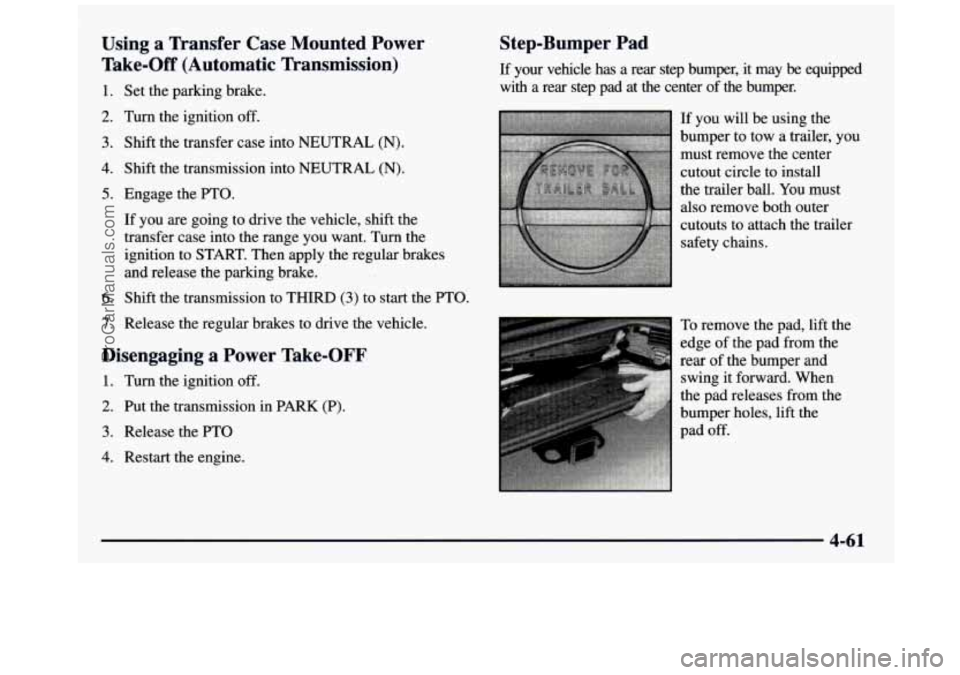
Step-Bumper Pad
If your vehicle has a rear step bumper, it may be equipped
with a rear step pad at the center of the bumper.
If you will be using the
bumper to tow a trailer, you
must remove the center
cutout circle to install
the trailer ball. You must
also remove both outer
cutouts to attach the trailer
safety chains.
To remove the pad, lift the
edge
of the pad from the
rear of the bumper and
the pad releases from the
bumper holes, lift the
pad
off.
swing it forward. When
4-61
ProCarManuals.com
Page 244 of 436
2. Get the vehicles close enough so the jumper cables
can reach, but be
sure the vehicles aren’t touching
each other. If they are, it could cause a ground connection you don’t want. You wouldn’t be able to
start your vehicle, and the bad grounding could
damage the electrical systems.
To avoid the possibility of the vehicles rolling, set the
parking brake
fmly on both vehicles involved in the
jump stat procedure. Put an automatic transmission in
PARK (P) or a manual transmission in NEUTRAL (N).
If you have a four-wheel-drive vehicle, be sure the
transfer case is not
in NEUTRAL (N).
3. Turn off the ignition on both vehicles. Unplug
unnecessary accessories plugged into the cigarette
lighter or accessory power outlets. Turn
off all lamps
that aren’t needed as well
as radios. This will avoid
sparks and help save both batteries.
In addition, it
could save your radio!
I NOTICE:
If you leave your radio on, it could be badly
damaged. The repairs wouldn’t be covered by
your warranty.
4. Open the hoods and locate the batteries. Find the
positive
(+) and negative (-) terminals on each battery.
If your vehicle has air conditioning, the auxiliary
electric fan under the hood can start
up even
when the engine is not running and can injure
you. Keep hands, clothing and tools away
from
any underhood electric fan.
5-4
ProCarManuals.com
Page 250 of 436
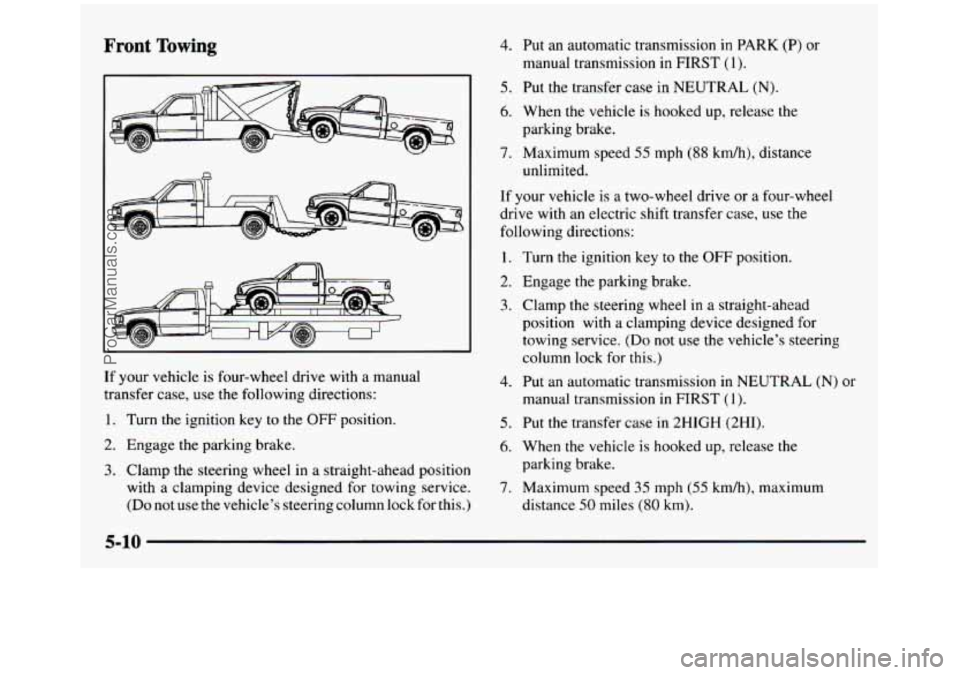
Front Towing 4. Put an automatic transmission in PARK (P) or
manual transmission in FIRST
(1).
5. Put the transfer case in NEUTRAL (N).
6. When the vehicle is hooked up, release the
7. Maximum speed 55 mph (88 kmh), distance
If your vehicle is a two-wheel drive or a four-wheel
drive with an electric shift transfer case,
use the
following directions: parking brake.
unlimited.
1.
2.
3.
If your vehicle is four-wheel drive with a manual transfer case, use the following directions:
1. Turn the ignition key to the OFF position.
2. Engage the parking brake.
3. Clamp the steering wheel in a straight-ahead position
with a clamping device designed for towing service.
(Do not use the vehicle’s steering column lock for this.)
4.
5.
6.
7.
Turn the ignition key to the OFF position.
Engage the parking brake.
Clamp the steering wheel in a straight-ahead
position with
a clamping device designed for
towing service.
(Do not use the vehicle’s steering
column lock
for this.)
Put an automatic transmission
in NEUTRAL (N) or
manual transmission in FIRST (1).
Put the transfer case
in 2HIGH (2HI).
When
the vehicle is hooked up, release the
parking brake.
Maximum speed
35 mph (55 km/h), maximum
distance
50 miles (80 km).
5-10
ProCarManuals.com
Page 349 of 436
FuseKircuit Breaker
15
16
17
18
19
20
21
22
23
24
A
B
Usage
DRL Relay, Fog Lamp Relay
Front and Rear Turn Signals,
Back-up Lamps, BTSI Solenoid
Radio (Ignition)
LCWALNCM, ABS, Cruise Control
Radio (Battery)
PRNDL, Automatic Transmission, Speedometer, Check Gages
Warning Light
Variable Effort Steering
Not Used
Not Used
Front Axle, 4WD Indicator Lamp,
TP2 Relay (Gasoline Engine)
Power Door Lock, Six-Way Power
Seat, Keyless Entry Module
Power Windows
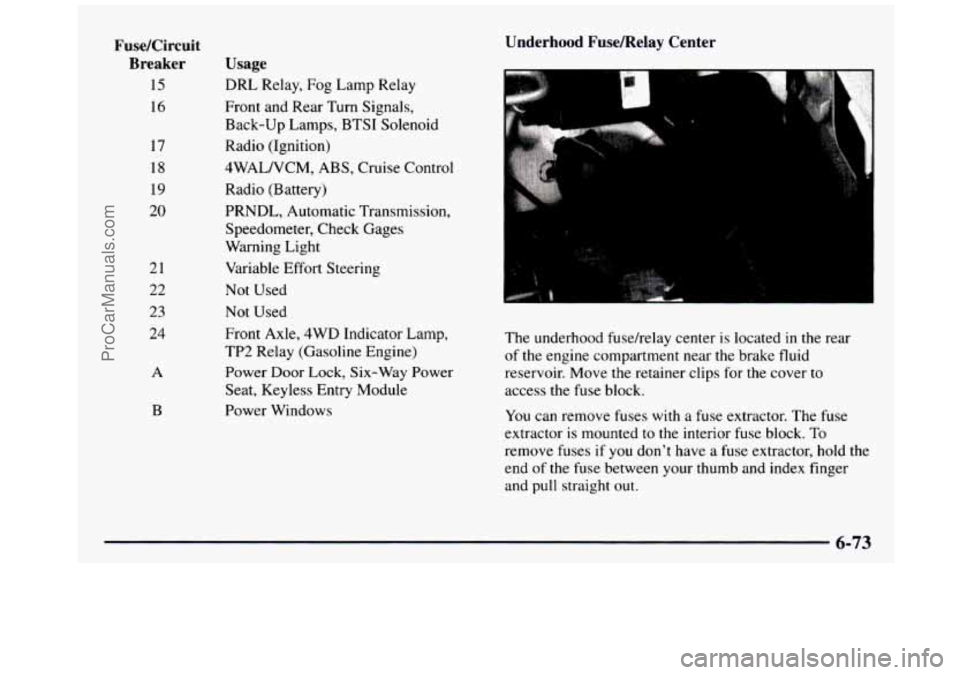
Underhood Fusemelay Center
The underhood fusehelay center is located in the rear
of the engine compartment near the brake fluid
reservoir. Move the retainer clips for the cover to
access the fuse block.
You can remove fuses with
a fuse extractor. The fuse
extractor
is mounted to the interior fuse block. To
remove fuses
if you don’t have a fuse extractor, hold the
end of the fuse between your thumb and index finger
and
pull straight out.
ProCarManuals.com