1997 CHEVROLET S10 turn signal
[x] Cancel search: turn signalPage 6 of 402
Downloaded from www.Manualslib.com manuals search engine L
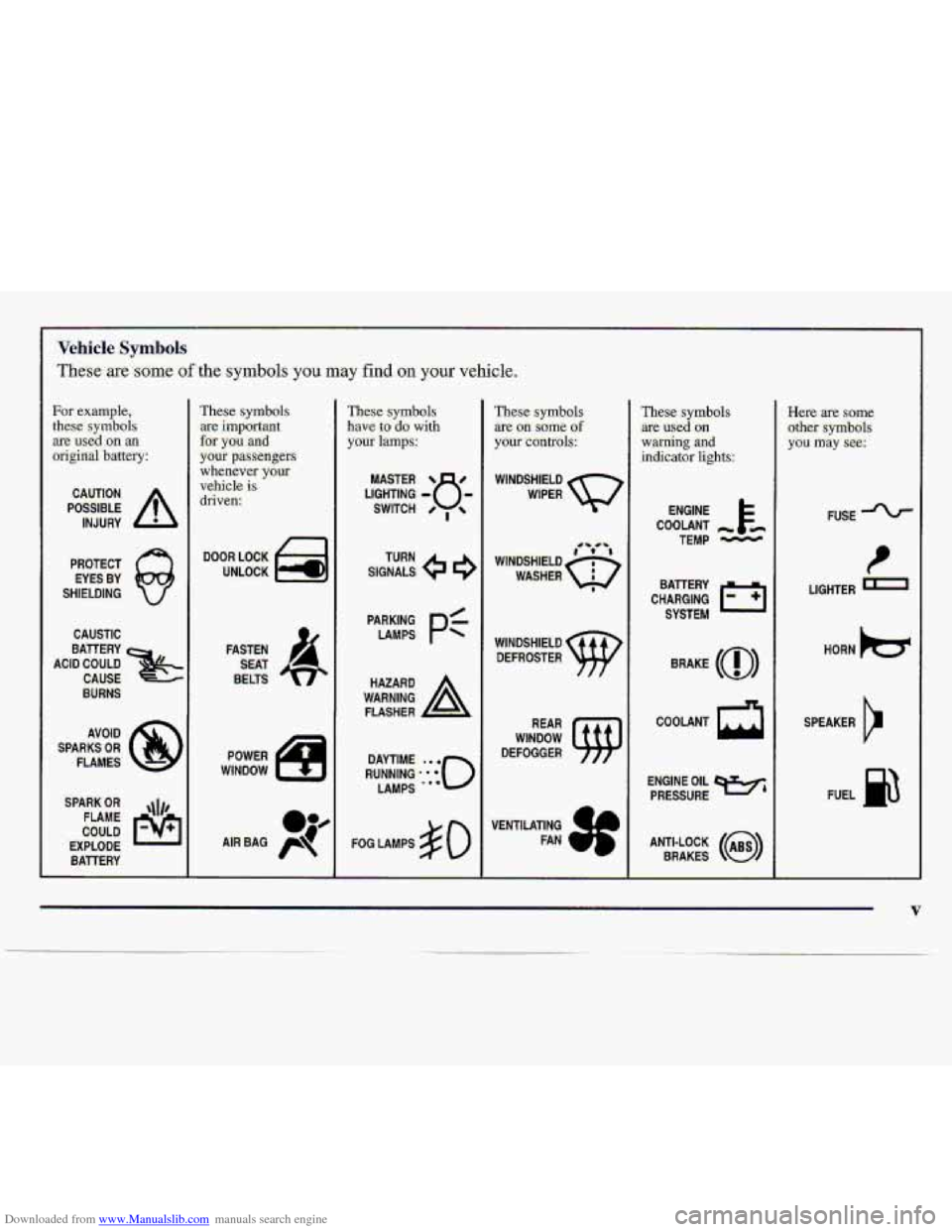
Vehkle .Symbols.
These are sa-me of the s,ymbols you may find on your vehicle.
For-example,
these symbols
are used :on an
original battery:
PROTECT EYES
BY
SHIELDING
CAUSTIC
BURNS
SPARK OR ,111,
COULD FLAME
EXPLODE
BATTERY
These- symbols
:are important
for you and
yo,ur passengers
whenever your
vehicle is
driven:
DOOR LOCK
UNLOCK
FASTEN
SEAT
'BELTS
POWER
WINDOW
These symbols
have to do. with
your iamps.:
LlGmmI ING
.SIGNALS.
6 e3
TURN
WARNING A
HAZARD
FLASHER
FOG LAMPS
$0
These symbols
are on some Qf
your daritroh:
WINDSHIELD WIPER
WINDSHIELD
WINDSHIELD 'DEFROSTER
WiNDOW
DEFOGGER
These symbols
are used oil
warning and
indicator lights:
-BATTERY
CHARGING
SYSTEM
BRAKE (@)
ENGINE OIL w,
PRESSURE
Here are so.me
dther symbols
you may see:
FUSE -%F
I
LIGHTER
HORN
ttT
,SPEAKER
b
FUEL. p3
ANTI-LOCK (@)
BRAKES
V
.."
Page 48 of 402
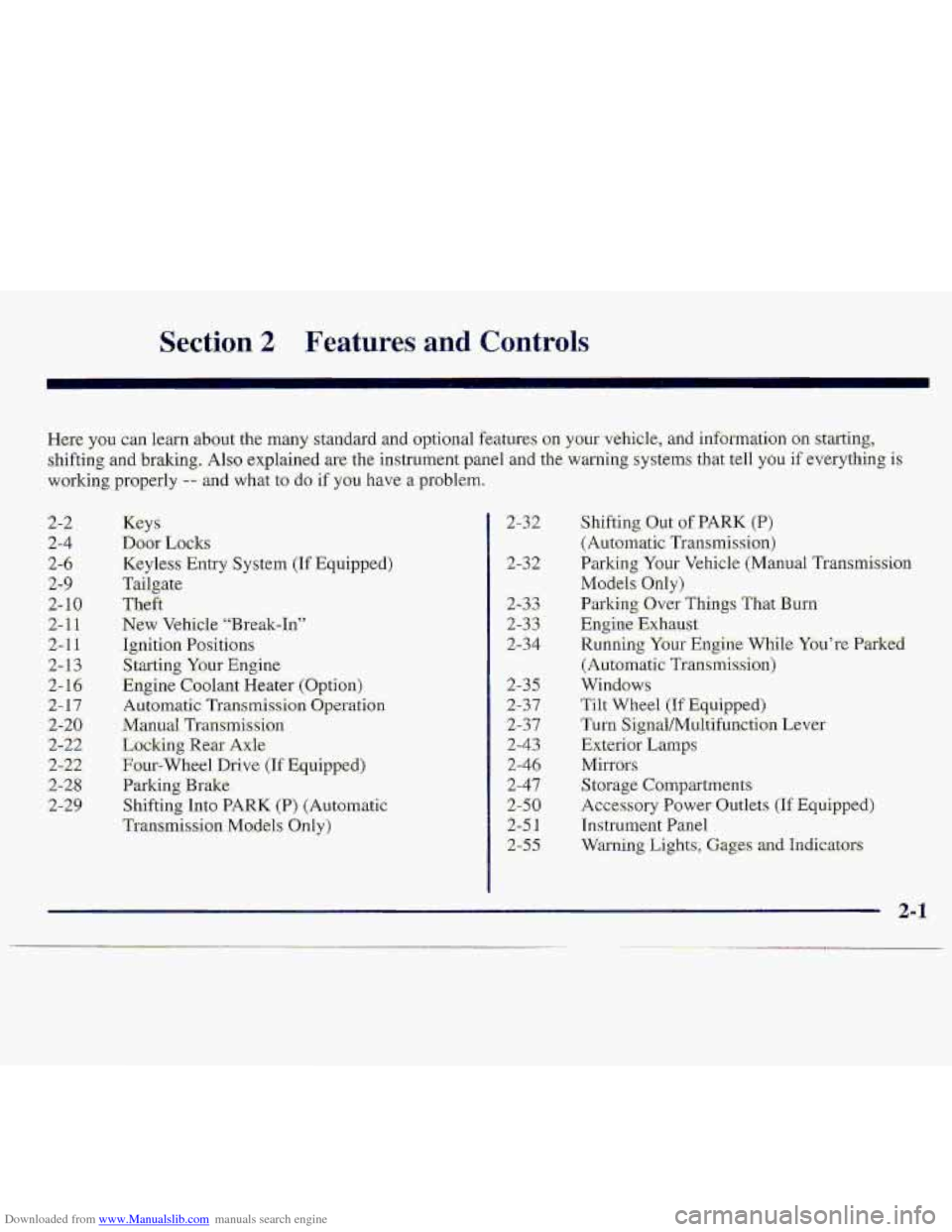
Downloaded from www.Manualslib.com manuals search engine Section 2 Features and Controls
Here y~u can learn about the many standard and opti-onal features o.n your-vehide, and irkofmation on starting,,
shifting
and braking. Also explained are the instrument panel and, the warning systems that teil you if everything is
working properly -- and what to do if you have a problem.
Keys
Door L.ocks
Key1e.s~ Entry 'System- (If Equipped)
Tailgate
Theft
Ne.w Vihicle "Break-In"
Ignition Positions
S.tarting
You Engine
Engine Coolant Heater (Option)
htqmatic. Tr.ansmission Operation
Manual Trmsrnissio,n
Locking Rear Axle:
Four-wheel Drive (If Equipped)
Parking Brake.
Shi€ting
Into PARK (P) (Automatic
Transmission
Ma.dels Only)
2-32
2-52
2-33
2-3 3
2-34
2-35
2-3 7
2-37
2-43
2,-47
2-50
2-5 1
2-55
2-4-6;
Shifting Out of PARK (P)
(Auto'mmtic Transmission)
Parking
Your Vehicle (Manual Transmission
Models Only)
Parlung Qve.1- Things That Burn
.Engine
Exhaust
Running Your EQg-ine While YGu're Parked
(Automatic Transmission)
Windows
Ti it Wheel (If Equipped)
Turn Signal/Multi~~ncti-on- Lever
Exterior Lamps
'3 t-orage Compartments
Accessory
Power Outlets (If Equipped)
Tnstrument Panel
Warning
Lights; Gap .and Tndicatms
2-1
Page 84 of 402
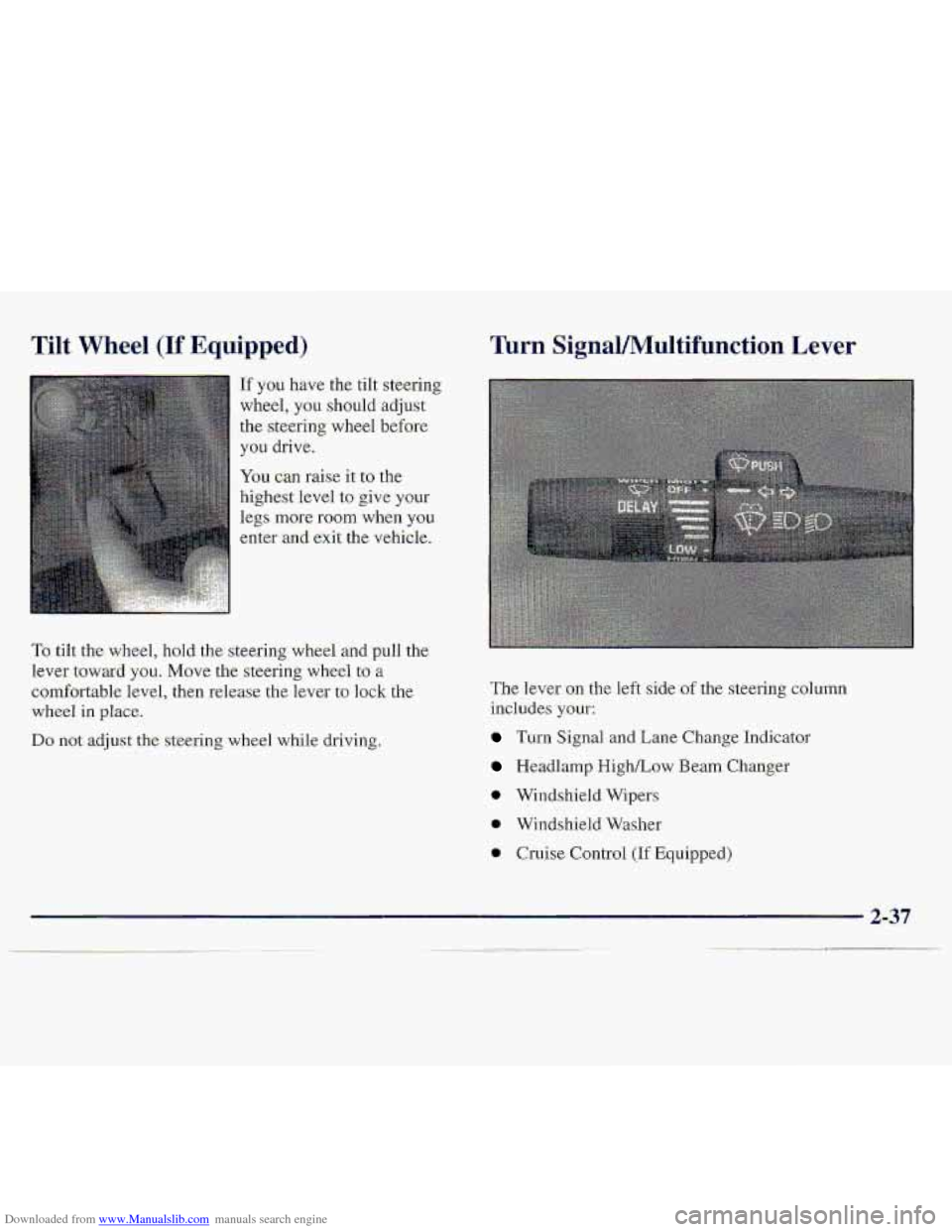
Downloaded from www.Manualslib.com manuals search engine Tilt Wheel (If Equipp-ed)
If you have the tilt steering
wheel, you
shou1.d adjust
the steering wheel before
you drive.
You can raise it. to the
highest level to give your
legs
more room when you
enter ,and exit the vehicle.
To tilt the. wheel, hold the steering wheel and puli the
lever
toward you, Move the steering wheel to a
comfortable level, then release the lever to lock the
wheel in place..
Do not adjust the steering wheel while driving,
Turn Sig-nal/Multifunction Lever
The lever on the left side of the steering column
-includes your:
Turn Signal and Lane Change Indicator
Headlamp High/Low Beam Changer
0 Windshield Wipers
0 Windshield Washer
0 Cruise Control (If Equipped)
Page 85 of 402
Downloaded from www.Manualslib.com manuals search engine Turn and Lane Change Si,gnak
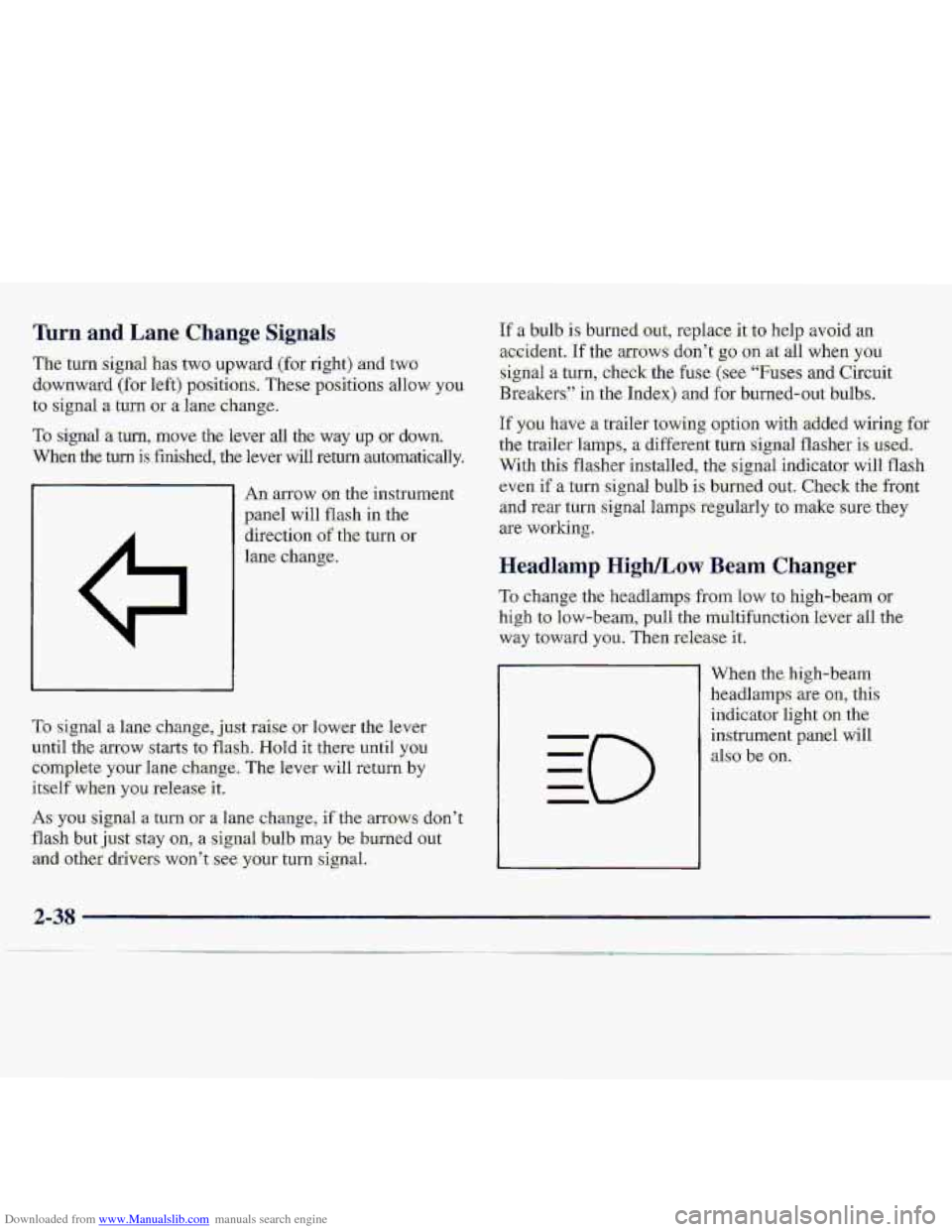
The turn signal has two upward (fat right) and- two
ciownwa~d
(for left) p??sitions. Tbese positions allow you
to signal a turn 0.r a.lane. change:
To signal -a turn, move the lever all the way up or down.
When the turn is finished, the lever will return aut~omatically.
An anow on. the instrume
panel will flash in the
direction
of the- turn or
lane change.
If a bulb is: burned.out, replace it.t-o help avoid an
acc.ident. If the arfows don’t g.0 on at all when you
sign-a1 a turn, check the fuse (see “Fu-se.s and Circuit
Breakersl’ in the .Ind.ex) and for burned-oat bulbs.
If you have n trailer towing option with -added wiring, for
the. traiier%mps, a d-ifferent turn :signal flasher is used.
With this flashes installed, the signal. indicator will flash
even if a.tum
signal bulb is burllid OW. Check the-ffont
an.d rear turn signal lamps -regularly tu make sure. they
are working.
Headl-amp High/Low Beam Changer
To change the headlamps from low to high-beam or
high to low-beam, pull the multifunction lever all the
way t.oward you. Then release it.
To signa1 a Lane change, j,ust raise- or lower the. lever
until the arrow starts to flash. Hold it there until you
Complete your lane,c,hangc, The kevei- will return by
itself when you release it.
As you signal a turn -or a lane c,hange, if the armws don’t
flash but just sxay on, a signal buIb may be burned Gut
arid other. drivers won’t ,see. your turn signal.. When the.’hi.gh-beam
headlamps are
on,. this
indicator
light .OM the
instrument pgniJ will
dso be on.
..
2-38
Page 132 of 402
Downloaded from www.Manualslib.com manuals search engine Disabling the Theft-Deterrent Feat-ure
Enter yoor secret-code as follows; pause no mor'e than
15 seconds between steps:
1. Turn the ignition to ACCESSORY or RUN.
2. Turn the. radio off.
3. Piess the 1 and 4 buttons together. Hold them aown
4. Press MNand 000 will appear cm the display.
5. PPess MNagain tu make the last two digits agree
.until
SEC shows--ox~ the display.
with your
Code.
6. Press I3.R to make the €irst one or two di@ zgree
with;yGur codei
7. Press AM-FM af1e.r yau have confirmed that the
code matches
the secret code you have written down.
The display will show ---j indicating that the radio is
no longer secured.
If the wde.. entered is .incorre.ct, SEC will appear on the
display.
The rad.io will remain secured until the correct
code is
entered.
-When battery power is removed and later app1ie:d to a
J secure.d radio, the radia won't. turn sind LOC will
appearon the-display.
To:unlock a secured radio, see "Unlrxking the
Theft-Det-errent Feature After a Power Loss" earlier i.n
this section.
ff" Stereo
FM. ste.ere.0 will give. you the best sound. B.ut FM signals
will reach only about 10 to 40 miles (16. to 65 km). Tall
buildings or:hills
can inte?fere with FM signals, causing.
the
sound to: dome and. go.
AM
The range for most AM stations is greater than fm FM,
especially at n.ight. The longer rangc, however, can
c&e stxioris to intwfeit-with each other. AM can pick
up noise from things like storms and pawer lines. Try
reducing
the treble-@ reduce this noise- if you ever get it.
Tips About Your Au,dio System
Hearing -damage from loud noise is almos1 undet.ectabk
until
it is too late, Your hearing. can .adapt to higher
volumes
of sound. Sound that seems normal c8n be loud
and harmful to your hearing. Take. precautions by
adjusting-the volume cuntrol, on your radio to a safe
sound lwei before your hearing adapts to it.
3-19
Page 150 of 402
Downloaded from www.Manualslib.com manuals search engine * Check your mirrors, glance over your shoulder and.
start your left lane change
signal before-moving out
of the right.lane to pass. When you are far enough
ahead
of the passe.d vehicle to see its front in your
inside -01, activate your right lane change sigmd
and-move back into the.
ri,ght lane. (Remember that
your-right outside ,mirror is convex. The vehicle you
juslpassed may
seem to be farther away from y6u
than it really is.)
Tfy not co p.ass mufe ,than one vehicle ,at a time
on two-lane’roads. Reconsider before passing the
next vehicle.
D.on’:t overtake-.a slowly moving vehi-de too rapidly.
Even though
the brake -1amp.s are not flashing, it m.a.y
be slowing down or starting to, turn.
Qi If+ you’re being .passed, make it easy- for the
fallowing driver to
get..ahead .of you. Perh,aps you
can ease.&
little to the right.
Let’s review what driving expmts s-ay about what
happens when the thre.e
con.trol systems- (brakes., steering,
and,acceleration) don’t
have enough friction where the
tifes ”meet the road to do what the drivt?r has asked..
In any emergency, don’t give up Keep trying to
steer and constantly seek
an escape route-or aea of
less danger.
In a. skid, a driver cn lose control of .the vehicle, Defensive
drivers .avoid
most skids by taking reasonable care suited t9
existing conditiolrs, and by not “overdriving” those
conditions.. But- ,&ids
are always -pa.ssible.
The three typcis of skids correspond to your vehicle’s
three
c’0ntro1 syst,erns. In. the. brakifig skid, y0.m whe.eIs
aren’t rpl.ling. Ln the steering or- cornering skid, too
much speed or steering in a curve causes tires: to slip and
lase cornehg, foxce,. And. in the acceleration skid, too
much throttle causes the driving wheels- to spin.
4-13
Page 168 of 402
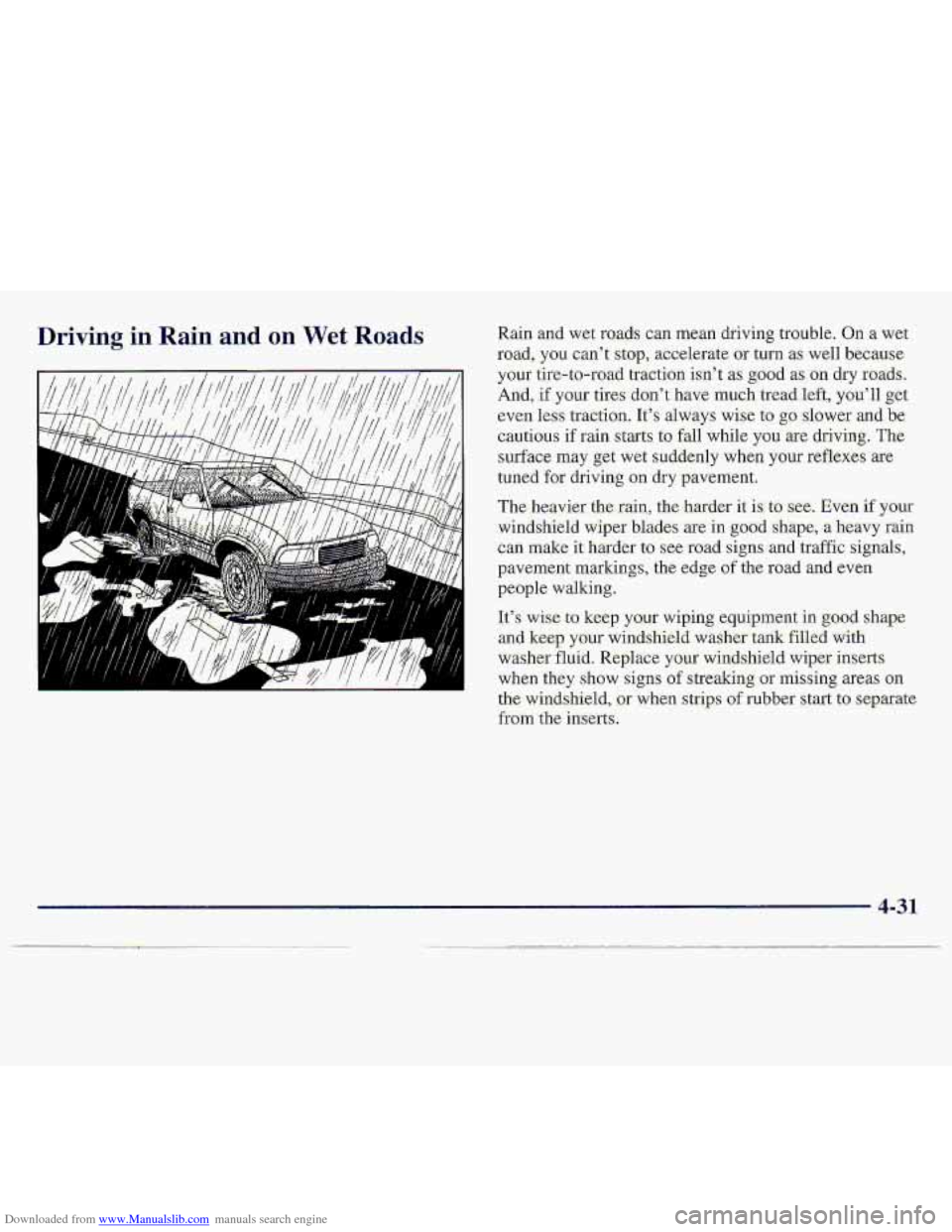
Downloaded from www.Manualslib.com manuals search engine D-riving in Rain and on Wet Roa ; Rain and wet roads can mean driving trouble. On a wet
-road,
you can’t stop, accelerate or turn as well because
your fire-to-road traction isn’t as good.
as on dry roads.
Arid, if your tires don’t- have much tread
.left, you-’11 get
even less traction. It’-s alway,s wise to go :slower and.be.
cautious
if rain starts to fall while you are driving. The-
surface may get wet suddenly when your reflexes are
tuned for driving o,n dry pavement.
The heavier the rain, the harder it is: to see. Even if your
.windshield wiper blades
are in good shape, a heavy rain
can make it harder
to see road signs and traffic signals,
pavernent.maskings, the
edge sf the road and even
people walking.
It’s wise
to ke,ep your wiping equipment-in gaod shape
and keep your windshield washer tank-filled with
washer fluid. Replace
your windshield wiper inserts
when they show signs
of streaking or missing areas on
rhe windshieJd, or when strips of rubber start to sep-arate
from The inserts..
4-31
Page 171 of 402
Downloaded from www.Manualslib.com manuals search engine C.ity Driving.
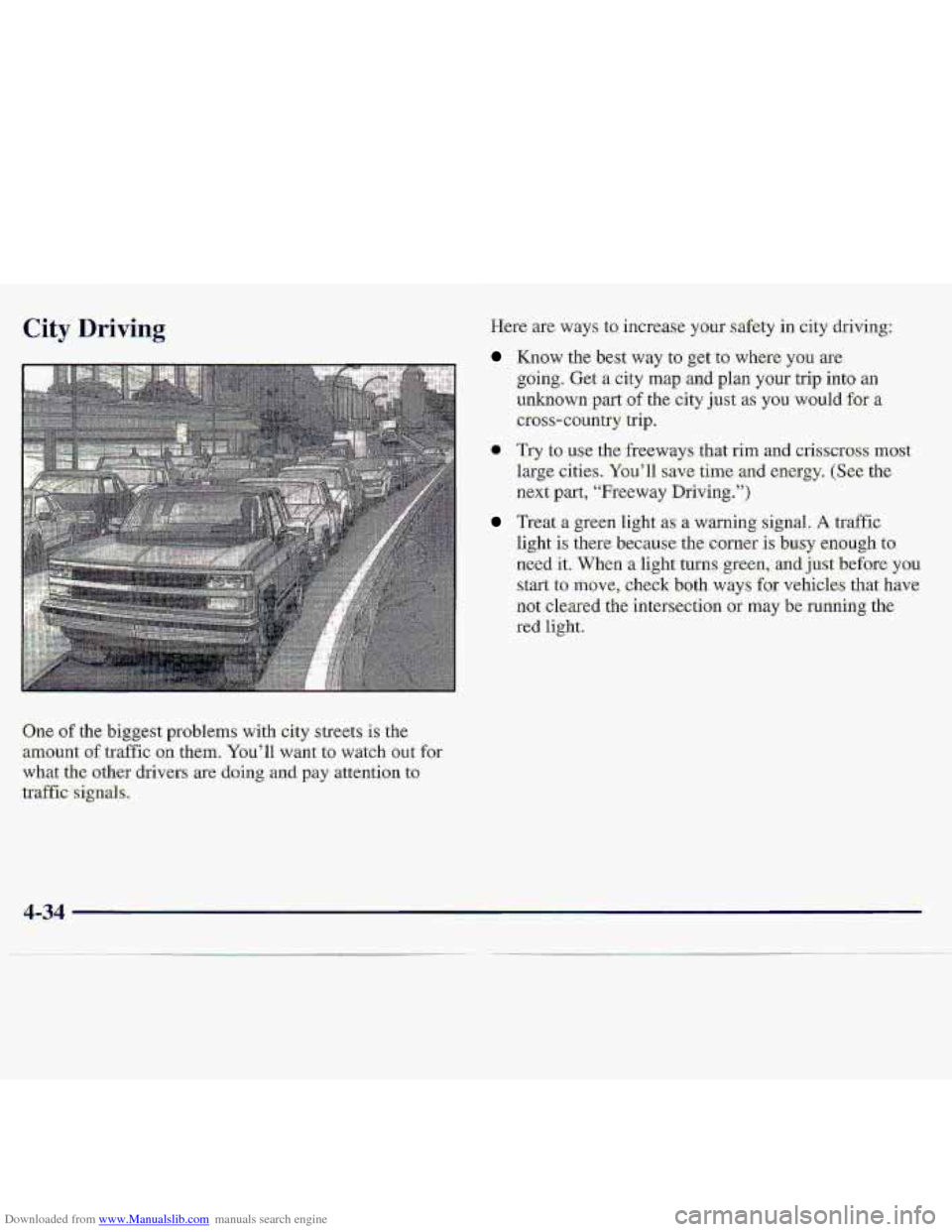
Orkof the bigg.est problems with city streets is the
:amount of traffic on them. You’ll want to watch o.ut for
what the other drivers are doing and pay attention to
traffic -.signals.
Here -are ways to increase y.ou safety in city driving.:
.Know the best way to get to where you are.
going, Get a city map and plan your trip into an
unknown part .of the city just as you wo.uld for a
cross-country trip.
m Try to use the freeways that-rim and.erisscr.oss mmst
large &tie-s. You’ll save time -and energy (See. the
next part, “Freeway Driving.”)
Treat a green light as a warning signal. A traffic
ligh.t-is there because the corner is busy emugh to,
need it. When a light turns gre,en, and just before you
start to Iimve, check both ways for vehicle-s that have
not cleared the intersection Or may be running the’
red li-ght.
4-34