1997 CHEVROLET S10 service schedule
[x] Cancel search: service schedulePage 2 of 402
Downloaded from www.Manualslib.com manuals search engine The 1997 Chevrslet S-Series Owner’s Manual
1,- 1 Seats and Restraint Systems
This section tells you how to use your ‘seats-and s;afety belts properly. It also explains the:“SIB” system.
2-1
3-1
4-1
Features and Controls
This section.expl&s how to start and operate your vehicle.
C.omfOrt Contrals and Audio Systems
This sectiun tells you -how to adjust the venti-lation and cordfort c trols an&how 6 @Crate your audio system.
Your Driving and the Road
.He?& you’ll findhelpful information and tip.s about .the road ami how to drive underdifferent c:onditions.
511.
6-1
8-1
9- 1
Problems on the Road
This scctign tells what.to do. if you have a problem while driving, such as a flat tire or o-verheatd engine, etc.
Service and Appearance Care
Here the manual tells yon how to keep your vehic-le runriing prgperly and 1o.oking;go.od.
Maintenance- Schedule
This section tells you when toperform vehicle maintenance and what fluids and lubficants to use.
Customer Assistance Information
This sectim tells y0.u how to contact Chemolet for assistaxe and how to get s-ervice arid. owner publications.,
It alS0 @VeS YOU information on “Reporting Safety Defects” on page 8- 10.
Index
Here’s an alphabetical listing of.almost every subject in this manual: You can use it to quickly Wna,
something you want to read.
i
Page 166 of 402
Downloaded from www.Manualslib.com manuals search engine After Off-Road Driving
Remove .any brush. or debris th.at has collected an. the-
underbQdy, chassis
or under the hood. These
accu.mulation-s
can be a fire hazard.
After
operation in mud or. sand, have the br&e linings-
cleaned -and checked. These substances can cause
glazing- and uneven braking,. C,heck tihe, body struc.ture,
steerbig, su$pensioonj
wheels, tires .-and exhaust system
for damage, Also, check the file1 lines and cooling
system for any leakage.
Your vehicle will req.uire more frequent service due to
aff-rrrad
use.. Refer to the Maintenance Schedule fo,r
additional infofmation.
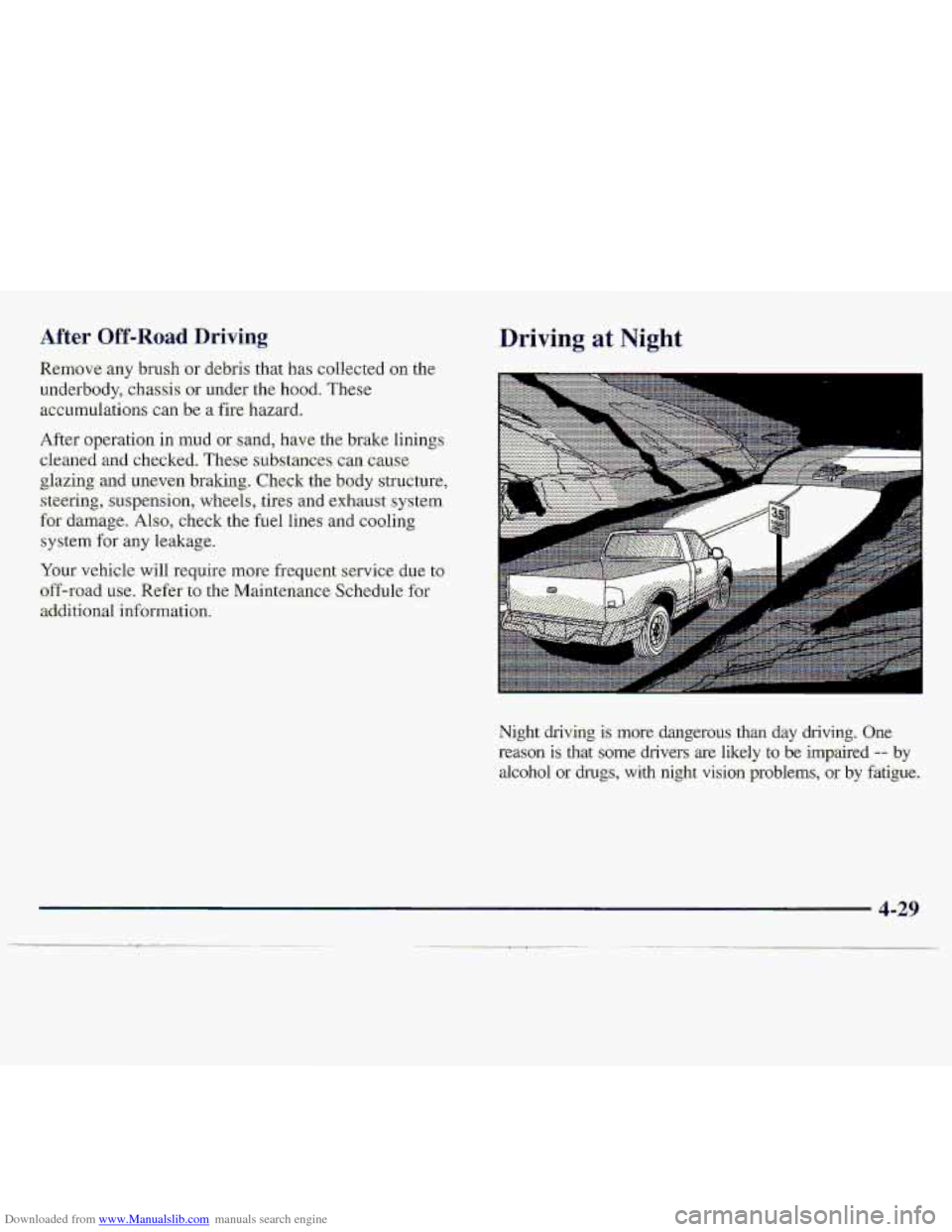
.Driving at Night
Night driving is more dangerous th-an day driving. One
reason is that some drivers are likely to be impaire-d -.- by
alcohol or drugs, with nieht vision broblems, or by fatigue.
4-29
Page 195 of 402
Downloaded from www.Manualslib.com manuals search engine When You Are Re.ady .to Leave After
Parking on a Hill
1. Apply your regular brakes and hold the pedal down
while you:
Start your engine;
s.hift; int,o a.gear; and
.i Release tfie parking brake.
2. Let up dn the brake pedal.
3. .Drive slowly until the trailer- is ele-ar of-the chocks.
4. .Stop. and have someone pick up and store the chocks,
Maintenance W-hen Trailer Towing
Your vehicle will need service more. often when you're
-pullilig'.a trailer. Swthe Maintenance Schedule 'for more
on this. Things. that ar.e e.specizrlly import,at in trailer
operation
-axe automatic trmsrnission.fluid (don't
overfill),
engjne oil, axle lubricant, belt, cooling system
and brake adjustment.
Each of these is covered in this
manual, and the
Tndex- will help you find them. quickly.
If you're traileriqg, i-t's a go0.d i,dea to review these
sections before you start ,your trip ...
Check periodicailp t6 see-.th-at all hitch nuts and bolts
are -tight.
Trailer Wiring Harness,
'The -eight-wire harness is: stored under ysur vehicle
along the
rear frame crossmember. This hamess has a
30-amp feed wire with an inline fuse located by the
.junction block. It has no.cmnecttor .and should he. wired
by a qualified electrical technician. T.he .technician can
use the fullowing c~lor:c.ode chart when connecting the
-wiring harness IO yow trailer:
0
a
a
0
0
0
a
a
Page 251 of 402
Downloaded from www.Manualslib.com manuals search engine a
0
-0
Most trip3 .are less. than 5 to 10 miles (8 to Xi km).
This is particularly impgrtant when outsid.:
tempemratures me below Freezing;
Most trips include.-extensive idling (such .as fiequenr
driving .in stopand-go traffic).
YQU operate- yo.^ vehicle in dusty areas or
You frkquently tow a'traila.
The vehicle is .used for delivtyy ,service, police, taxi
or other cornexcia1 application.
a€f-roid fraquen-tly. Driving
undef these conditions
causes eagineail to
break down sooner. If' a.ny one of these is true for your
vehicle,
-then you need to .change, your oil and filter
every 3,060..mil~s (3' 000 km] or 3 .months - whichever
0cc:U.rs first.
If none of them is true, use the lopg triplhighway
maintenance schedule. Change. the bil-and filter every
'7.,500 miles (1.2.5.00 km) or 1.2 months -- whicheve-r
u.cc.urs first. Driving a vehicle with 3 fully warmqd
engine under highway coridifians causeis engine oil- to
break dawn dower.
Rem-ote Oil Filter (Four=Whe:el Drive)
The access ,dcmx fm the ;re:mote:oil filter is in-the steering
linkage shiqld as-sbrnbly hated under the. r.adiator
support. Twist the screw to unlock or lack the dom.
Make sure 8 you open the door, it is securely closed.
when
you are finished.
Page 254 of 402
Downloaded from www.Manualslib.com manuals search engine When to Check and Change
.A goad time to check-your a0tomati.c transmission fluid
level is when the en.gine .oil is chanzed,
C.hange
both the fluid an.d filter every 50,000-miles
(8'3 000 km) if the vehicle is mainly driven under one or
more of these conditions:
In heavy city traf€ic where the-outsi.de. temperature
regularly reaches.
906F (.32'C) or higher.
In hilly or mountainom terrain.
0 When doing frequent trailer towing.
0 Uses. such as found in taxi, police or delivery service.
If
you do not use your vehicle under any of the-se
cqnditions, the fluid and filter do not require changing.
See "Scheduled Maintenance Services"
in the Index,
How to Check
B.eCanse this operation can be a little difficult, you
may cho.Oge to have this dme at your GM de-alership
Service
Department
If you do it ywrsiAf, be sure to follow all the instruaims
here, uryclu coukd get a false re.adirig on the dipstick.
NOTICE:
Too much or too little fluid can damage- your
transmission,
TQO much can mean that s.ome of
the fluid could come out and fall on hot engine
parts or exhaust system parts, starting a fire. Be
sure to getan accurate reading if .you .check .your
transmission fluid.
Wait &t least.30 minutes before checking the
transmissioil fluid
level if.you have been driving:
* When ou&ide te:mperatures ar~ above 9C>-'F (32 O C).
0 At high spe>ed fbr.quite-.a while.
0 Tn'heavy traffic -- especidly in hot weather.
While pulling
a. trailer:
To -get the right reading, the flui,d'should be at dermal
operating temperature, which- is 1:80."F to 208°F
(82QG to 33°C).
Page 257 of 402
Downloaded from www.Manualslib.com manuals search engine HOW to Add Fluid Manual TransmisSion Fluid
Referto- the. M-aintenance Schedule t~ dtztermirie. what
kind of- tram~ssion fluid to. me. See “Recommended
Fluids and Lubricants:” in. the Index.
Add fluid only after checking tktrmsmission fluid HOT.
(A COLD check is used .only as a reference.) If the fluid
levd is low, add Only enough of the proper flvid. to bring
the le,vel up t.0 the HOT area fora hat check. It doesdt
take much fluid, ,generally less than Qne pint (0.5 L).
Don t ove.$ll.
NOTICE:
We recommend you use only fluid labeled
DEXRON@-III, because. fluid with that label is
made especidy
for-. your automatic transmission.
.Damage caused.
by fluid other than DEXRON-111
is not covered by y.our new vehicle warranty.
After srddiag fluid-, recheck the fluid Ievel as
When the-correct fluid level Ls obtained, .push the
described under “How to Check.”
dipstick back
in all the way; then flip the handle
down
to lock the dipstick in place.
A good time to have it checked is when-the engine
oil is changed. However, the fluid in your manual
transmission doesn’t require charging..
How to Check
Because this operation can be a little difficult, you
may choose to have this done at.you-r GM dealership
Service Department.
‘If YOU do it yourself, be sure. to follow all the
instructions here, or
you could ge.t a false reading,
NOTICE:
Too much or too little-fluid can damage your
transmission.
Too much can mean that same: u1
the fluid could come; out and fall on hot engine.
parts
or exhaust system p-arts, starting a fire. Be
sure
to get an accurate reading if you check your
tranqmission fluid.
Page 259 of 402
Downloaded from www.Manualslib.com manuals search engine When to Check and What to Use Rear Axle
When to Check and Change Lubricant
R.efer to the Maintenance Schedule to determine how
often
.to check the 1ubric.ant and when to chaage it. See
“ScheduIed Maintenance Services” in the 1ndk.x.
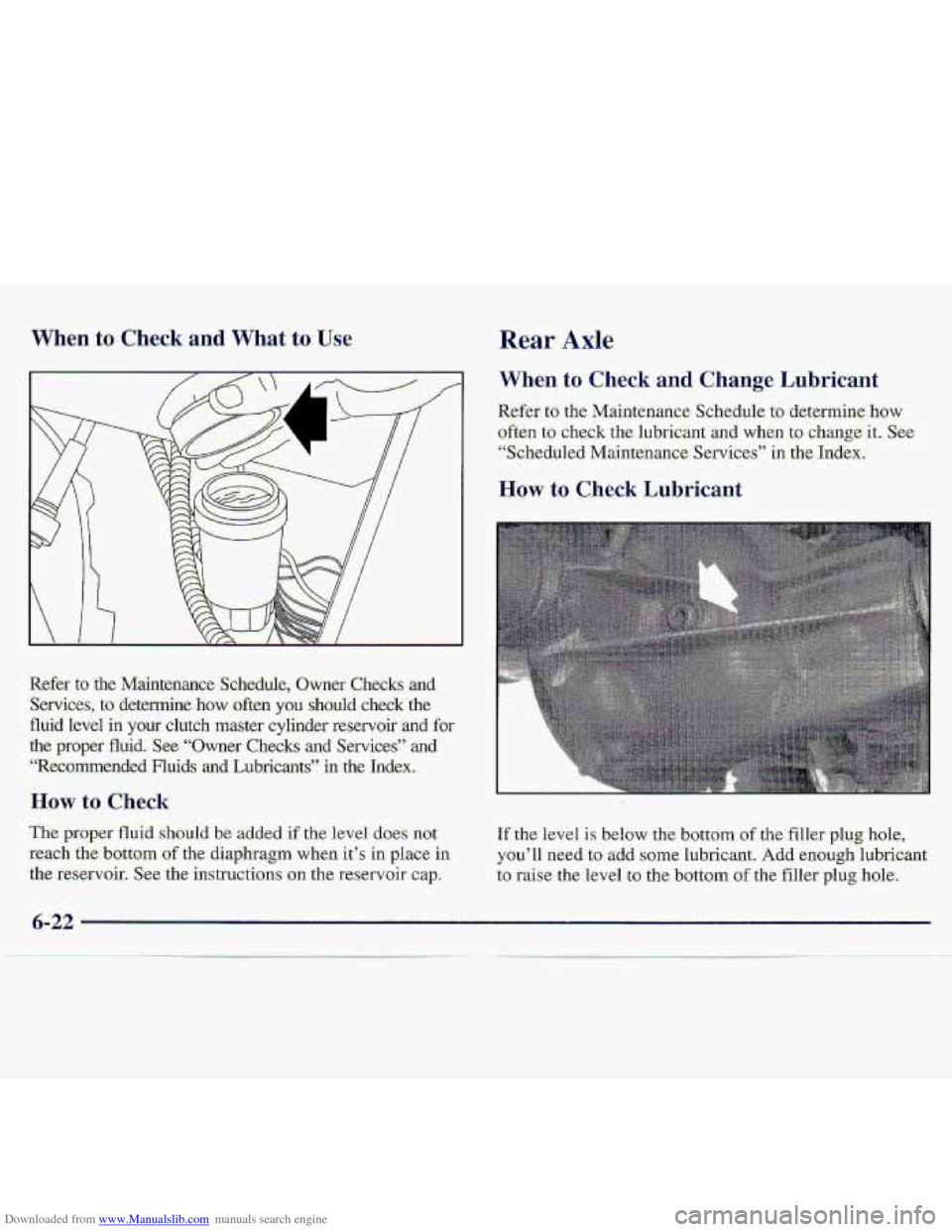
How to Check Lub.ricant
Refer to .the M-aintenance- Schedule, Owner Checks and
Services, to determine. how often you: should check the
fluid he1 in your clutch master cylinder reservoir and for
the
proper fluid. See “Owner Checks and Services” ad
“Fkcommended Fluids and Lubricants” In the Index.
How to Check
The proper fluid should be addeif$the‘levei does not
reach the battornof the diaphragm when it’s in place in
the reservoir. See the instructions on the re-servoir cap. If
the level
is below the bottom of.the filler plug hole,
you’ll need to add som lubricant. Add enough lubricant
to raise, the level to the bottom of the filler plug hole.
6-22
Page 283 of 402
Downloaded from www.Manualslib.com manuals search engine Tire Inspection and Rotation
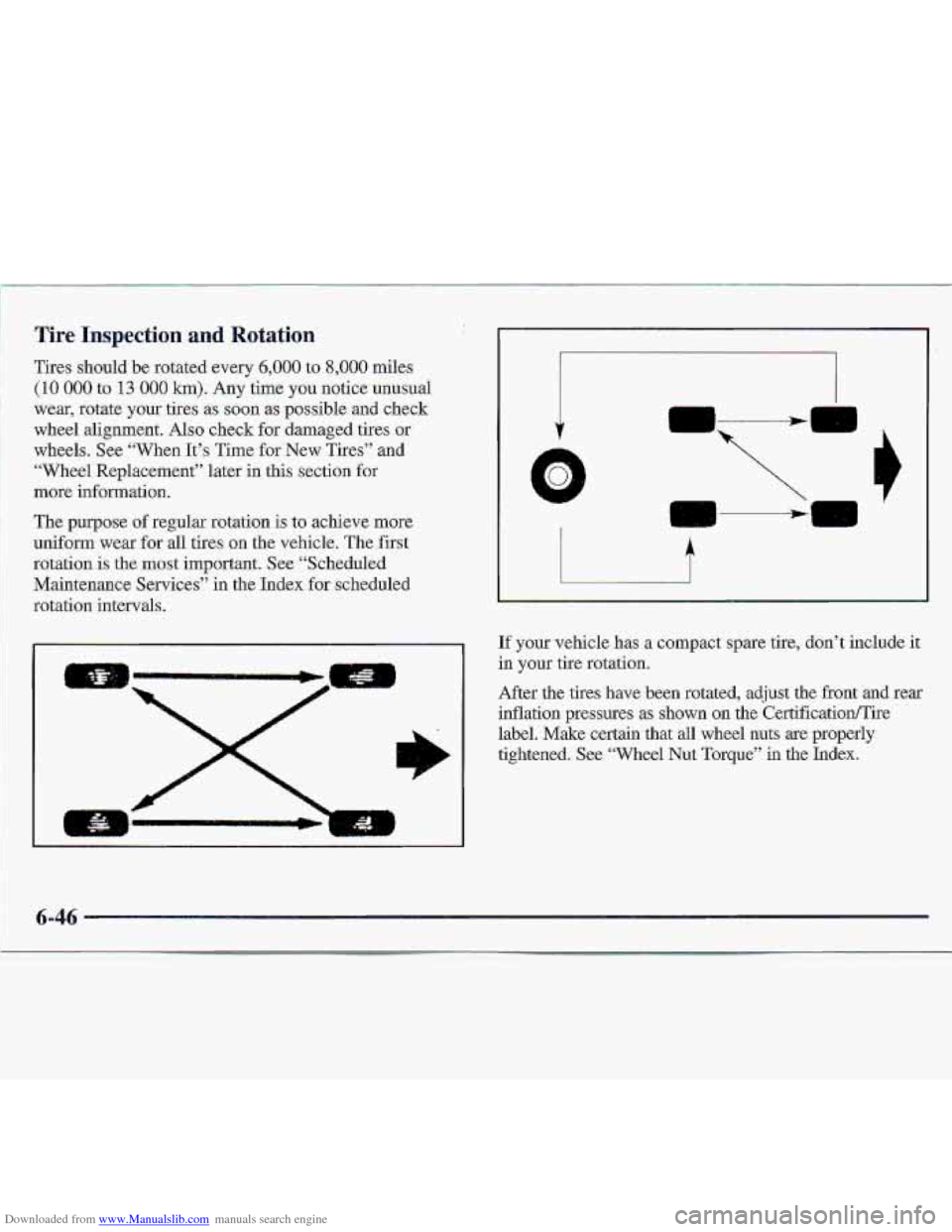
Tires should be rotated every 6,000 to 8,000 miles
(10 QOO. to 13 0.00 km). Any time you notice unusual
wear, rotate your tires
as soon as possible and check
wheel alignment. Also check for damaged tires or
wheels. See “When
It’s Time for New Tires” and
“Wheel Replacement” later in this section for
more information.
The purpose
of regular rotation. is to achieve more
uniform wear for
all tires on the vehicle. The first
rotation is the mast important. See “Scheduled
Maintenance Services”
in the Index for scheduled
rotation intervals.
If your vehicle has a compact spare tire, don’t include it
in your tire rotation.
After the tires have bea rotated, adjust the front
and rear
inflation. pressures
as shown on the Certificatioflire
label. Make certain that all wheel nuts
are. properly
tightened. See “Wheel Nut Torque” in the Index.
6-46 ,,,. .. -~I