1997 CHEVROLET S10 tow
[x] Cancel search: towPage 9 of 402
Downloaded from www.Manualslib.com manuals search engine Seats and Seat Controls
This; section tdls you about the seats -- how to adjust
them,
and fold them up- and down.
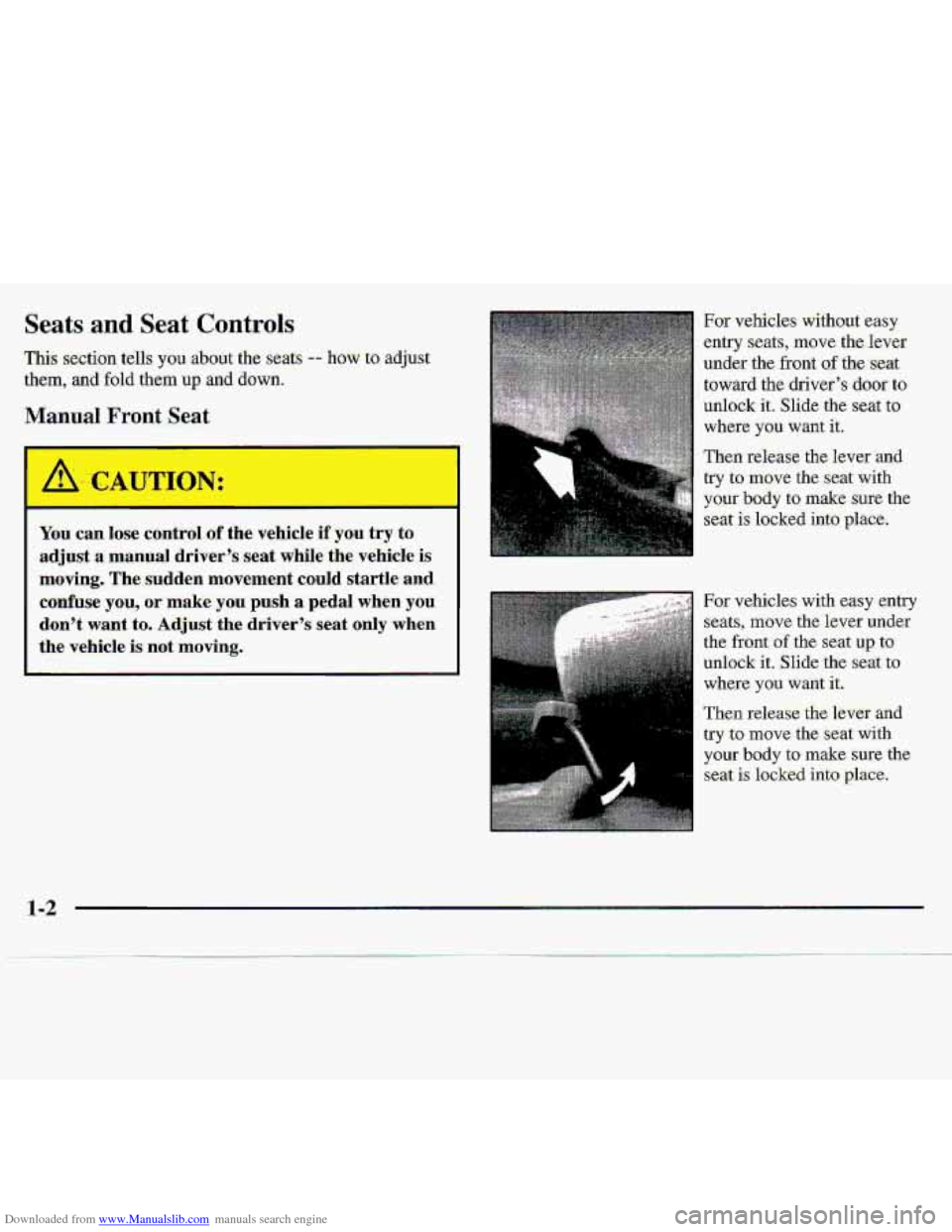
For vehicles without easy
Manual Front Seat
I
You can lose control of the vehicle if you try to
adjust
.a manual .driver’s seat while the vehicle is
moving. The- sudden movement could startle- and
confuse you, or make you push a pedal when you
don’t want to. Adjust the driver’s seat only when
the vehicle is not moving.
entry seats, move the lever
under the front of the seat
toward the driver’s door to
unlock it. Slide the seat to
where. you want it.
Then release the lever and
try to move the seat with
your body to make sure the
seat is locked into place.
For vehicles with-easy entry
seats, move the lever under
the. front
of the seat up to-
unlock
it. Slide the seat to
where you want it.,
Then release the lever and
try to move the seat with
your body to make sure the
seat is locked inTo place. .. . ..
1-2
Page 42 of 402
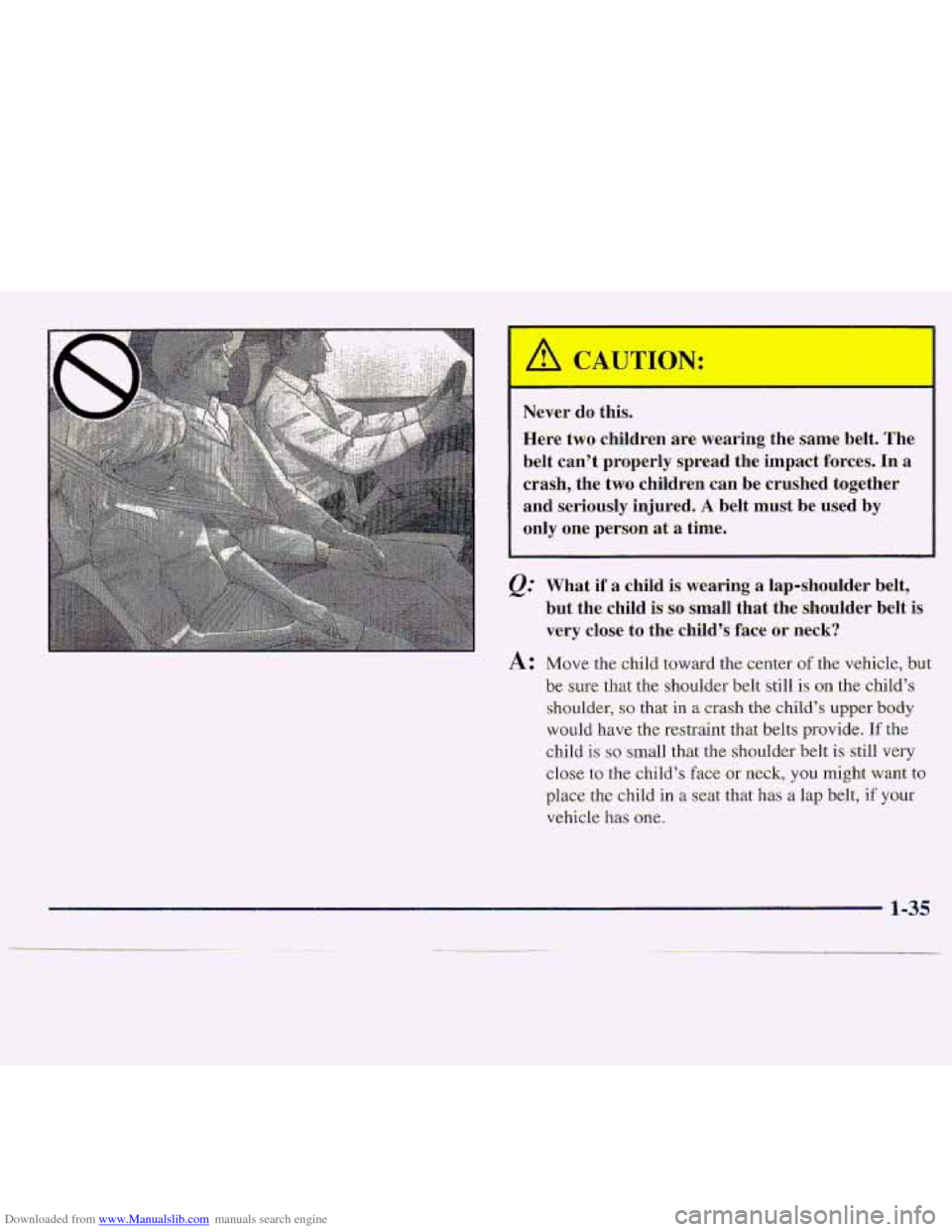
Downloaded from www.Manualslib.com manuals search engine Never do this. Here
two children are wearing the same belt. The
belt can’t properly spread the impact forces.
In a
crash, the two children-can be crushed together
and seriously injuted.
A belt must be used by
only
one person at a time.
&: What if a child is wearing a lap-shoulder belt,
but the child is SO small that the shoulder belt is
very close to the c-hi1d”s face or neck?
A: Move the child toward the center of the vehicle, but
be surethat the shoulder belt still is onthe child’s
shoulder, so that in si crash the child’s ~ip.per body
would have the restraint that belts provide. If the
child
is so small that the shoulder belt is still vc1-y
close.to the child’s face or neck, you might warit to
place. the child
in a seat that has a lap belt, if your
vehi-ck has one.
Page 56 of 402
Downloaded from www.Manualslib.com manuals search engine Tailgate
You can 0pe.n the tailgate by pulling up un the handle
while pulling the tailgate down.
When you put the tailgate b.ack up, b.e sure it
latchgs securely.
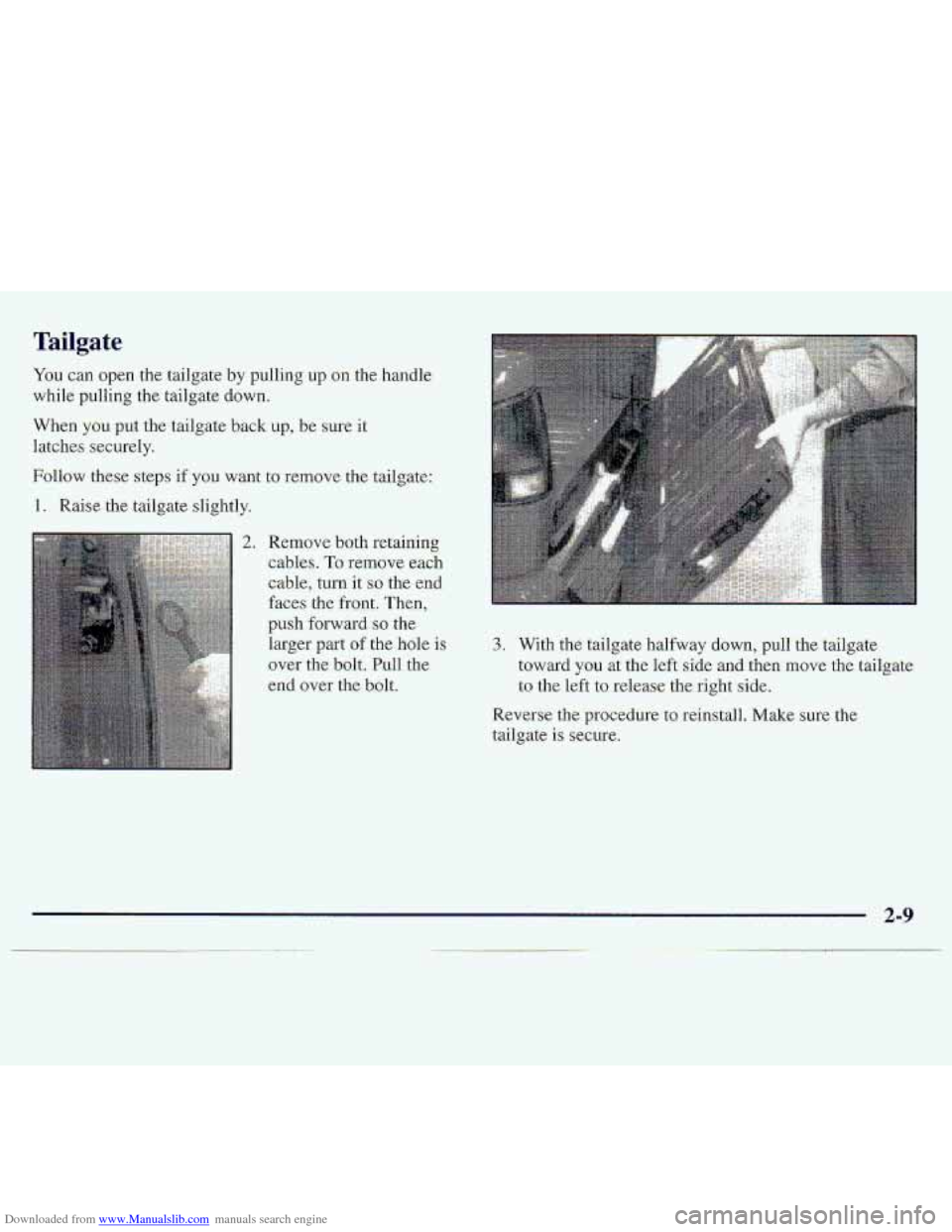
Follow these steps if
you want to remove the tailgate:
1. Raise the tailggte slightly.
2. Remo-ve both retaining
cables.
To remove each
cable, turn it so the end
faces
the hnt. Then,
push forward so the
larger part of the hole' is
over the bolt.
Plrll the.
-end over the
6:olt.
3. With the tailgate halfway down, pull the tailgate
toward
you at the left- side and then move the tailgate
to the le€t to release the-right side.
2-9
Page 58 of 402
Downloaded from www.Manualslib.com manuals search engine New Vehkk “Bre-ak-In”
NOTICE:
Your modern vehicle d.oesn’t need an elaborate
“break-in.”
But it will perform better in the long
run if you follow these guidelines:
0 Keep your speed at 55 mph (88 km/h) or
less far the first 500 miles (805 km).
Don’t drive at any one speed -- fast or
slow
-- for the first-500 miles (805 km).
Don’t make full-thro.ttle starts.
200 miles. (322 km) or so. During this time
your
new brake linings aren’t yetbro-ken
in. Hard stops with new linings cmmean
premature wear and earlier replacement.
Follow this breaking-in guideline every
time you
get new brake linings.
See “Tbwing a Trailer” in the Index for
more information..
Avoid makiilg hard stops for the first
Don’ttow a trailer during break-in.
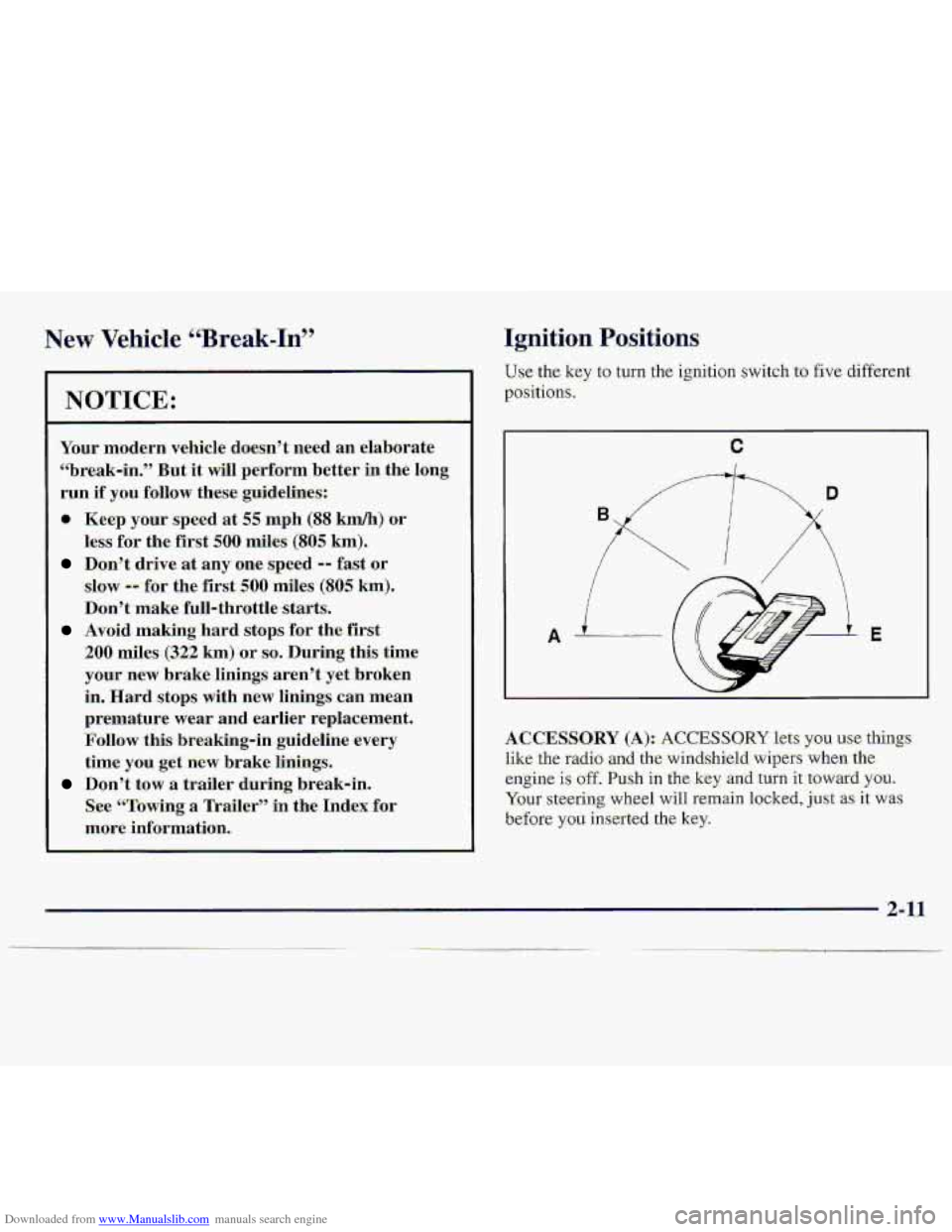
Ignition Positions
Use.the key to-turn the ignition switch to €ive different
positions,
A 3.
ACCESSORY (A):. ACCESSO-RY lets ysu .use‘-thi-ngs
like the radio ad the.winds,hield wipe-rs when the
engine is off. Push i.n the key -and turn it toward. YOU.
Your steering wheel will remain locked, just. as it was
before
you inserted the. key.
2-11
Page 59 of 402
Downloaded from www.Manualslib.com manuals search engine NOTICE:
Don't operate accessories. in the ACCESSORY
position far long periods of time. Prolonged.
operation
of accessories in the ACCESSORY
position could drain your battery-and prevent
you
from skarting your vehicle.
LOCK (E): This position locks your ignition; -steering
wheel-and tra-nsmiss-ion.
It's a theft-deterfeat feature.
You will oaly be able to remove your key whe.n the
ignition is turned to. LOCK.
.OFF (C); This position lets you turn off.the engine but
Tstill turn the steering wheel'. Us.e OFF if you must have
~yx.u- whic1.e in motion while -the erigine :is off (for
example, if your vehickis being towed).
RUN (I)): This is the positio-n for driving.
START (E): This starts your engine. On manual transmission
vehicles, turning t.he key
to
LOCK will lock the steerihgcolumn and result
in
a lass of ability to steer the vehicle. This could
cause
-a collision. If you need to turn the enghe
off while the vehicle is moving, turn the key only
to OFF. Don't press the key release button while
the vehicle is moving.
NOTICE:
If your key seems stuck in 'LOCK. and -you can't
turn it, be sure you
are using the corkect key; if
so, is it all the way in? If'ft is, then turn the
steering wheel left and right while you turn the
key h.ard. But t.urn the key only with
your hand.
Using
a tool to force it could. break the key or the
ignition switch.
'If none of this. works, then your
vehicle needs service.
2-12
Page 61 of 402
Downloaded from www.Manualslib.com manuals search engine I Starting Your 2.2 Liter Engine
1. Without puslung -the accelerator pedal, turn your
ignition key to STUT. When the engine starts, let
go :of the key. The idle speed will go down as your
engine gets
warm.
NOTICE:
Holding your key in START for Ionger than 15
.secon&at a time will cause your battery to h.e
drained much sooner. And the excessive heat- can
7-- t : ~ ,1 :, .. damage your starter motor. ->..c , .-2
NOTICE:
Your engine is designed to work with the
electronics in., your vehicle.
If you add .ekectrical
parts
or accessories, you could change the way
the engine operates. Before addmg electrical
equipment, check
with your dealer. If you dodt,
your engine might not perf0.m properly.
If you ever have to have your vehicle -towed, see
the part
of this manual that tells.how to do it
without damaging your vehicle. See "Towing
Your Vehicle'? in the Index. ~~
1 2. If your engine still won't start (or starts but then
staps), it could be flooded with too much gasoline.
Try pushing your accelerator pedal all the way to the
€lcm and holcling-it there as you hold the key in
START for about three seconds. If'the vehicle starts
briefly but-then stops
again,. db the same thing, but
this time keep the pedal down for five or six-seconds.
This clears the' extra gasoline from the engine.
2-14
Page 62 of 402
Downloaded from www.Manualslib.com manuals search engine Starting You~~~~VQRTEC’~ 4300 Engine
1. Witho.ut pushing the: amilerator pedal, turn your
ignition- key to START. When the-engine starts, let
go of the. key, The idle speed w go-down as your
engine gets warm.
NOTICE:
Holding your key :in START for longer khan
15 .sec.onds at- a lime will cause. your battery-to be
draihed:-much so6ner. And the exc4?ssiVe heat can
damage
your starter motor.
2. If it doe.sn’t start right away? hold your key in
START. If it doe‘sh’t start in 10 seconds, push ,the
accelerator p:edal .all tkway down for five. more
seconds, 01- .until it starts.
3. If your engine stili wun’t .start (or sta?s but then
stops)., wait 15 seca,nds and start over..
When .the engine starts, let go of the key and the
accelerator pedal.
NOTICE:
Your engine is designed to work with t.he
electronics in
your vehicle. If you .add electpica1
parts or :accessories, you could change the way
the engine operates, B-efore adding electrical
equipment, check with
y0u.r dealer. If you dan’t,
your engine might not perform
properly.
If-you ever have to have your vehicle. towed, see
the part
of this manual that tells- how to do it:
without damaging your vehicle. See “Towing,
Your Vehile” in the Index.
.
Page 64 of 402
Downloaded from www.Manualslib.com manuals search engine Automatic Transmission Operation
Your automatic transmission may have a shift lever
located
on the console between the seats or on the
steering column.
There are several different positions for your shift lever.
If your vehicle is equipped with a column shift lever,
it
features an electronic shift position indicator within the
instrument cluster. This display must be powered
anytime the shift lever is capable of being moved out
of
the PARK (P) position. This means that if your key is in
the
OFF position, but not locked, there will be a small
current drain
on your battery which could discharge
your battery over a period of time.
If you need to leave
your key in the ignition
in the OFF position for an
extended period, it is recommended that you disconnect
the battery cable from the battery
to prevent discharging
your battery.
PARK (P): This locks your rear wheels. It’s the best
position to use when you start your engine because your
vehicle can’t move easily.
Lf! C A TION:
It is dangerous to get out of your vehicle if the
shift lever is not fully in
PARK (P) with the
parking brake
firmly set. Your vehicle can roll.
Don’t leave your vehicle when the engine is
running unless you have to.
If you have left the
engine running, the vehicle can move suddenly.
You or others could be injured.
To be sure your
vehicle won’t move, even when you’re on fairly
level ground, always set your parking brake and
move the shift lever to
PARK (P).
If you have four-wheel drive, your vehicle
will be free to roll
-- even if your shift lever
is in
PARK (P) -- if your transfer case is in
NEUTRAL (N). So, be sure the transfer case is in
a drive gear, two-wheel high (2HI) or four-wheel
high (4HI) or four-wheel low (4LO)
-- not in
NEUTRAL (N). See “Shifting Into PARK (P)” in
the Index.
If you’re pulling a trailer, see “Towing
a Trailer’’ in the Index.
2-17