Page 206 of 402
Downloaded from www.Manualslib.com manuals search engine When your vehicle is being towed,. h-ave the ignition key
. md.& ;the OFF- position.. The ite,erin,g wliegl sli~ultl
be. cla-mped in- a straightdahezd position witb a clamping
&vice desi:ped for towing-service. DO fiat ust the
vehicle's steering c.olumxz I-ock for this. The transmission
should be in
NEUTRAL (N) an-d the .transfer case, if you
'31ave one, ShQuLd. be in 2HI. The p&ing.bm.ke shguld-.-lje
seleased.
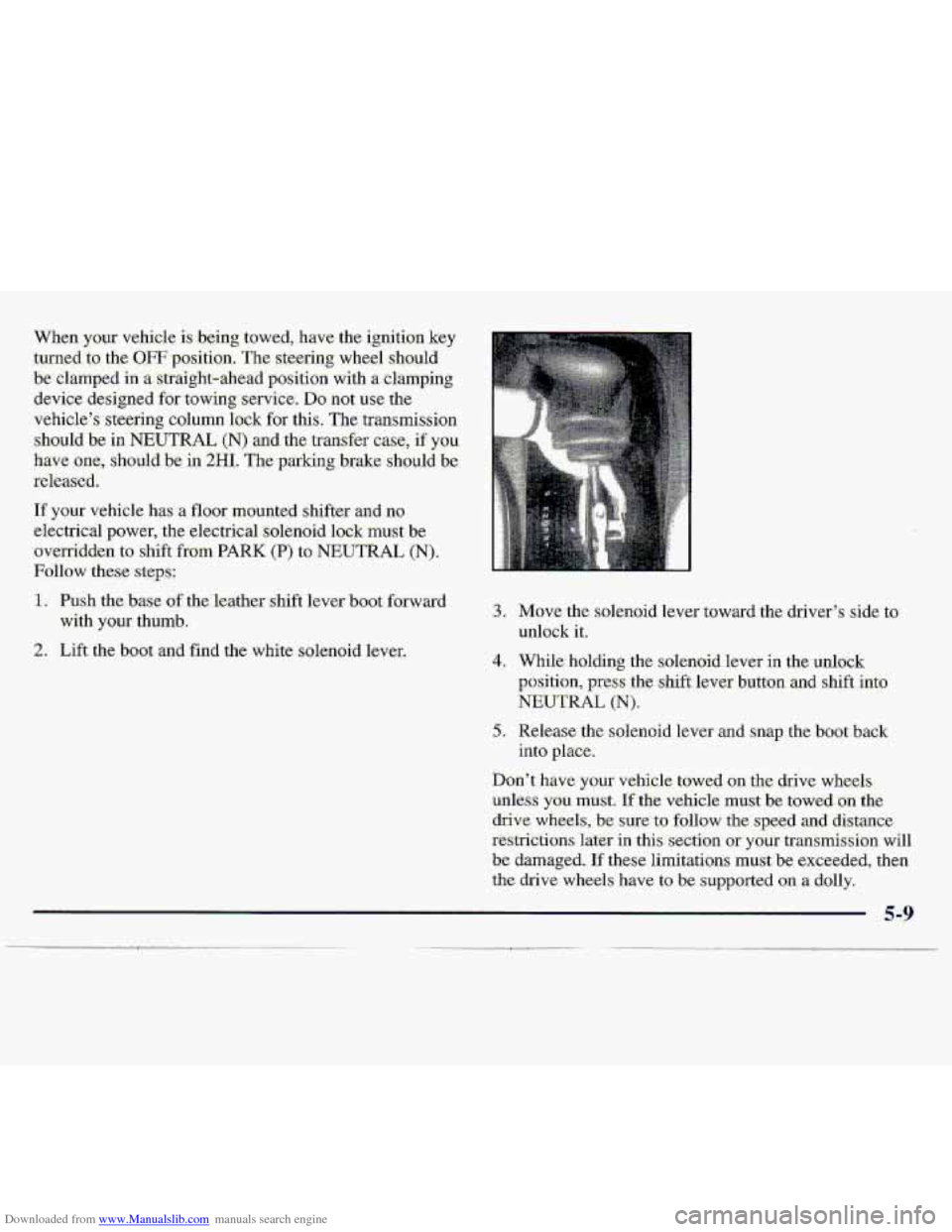
If your vehicle has. a flqor mounted shifter and no
.electrical power,
the electrical.So1enoi.d lock must be
.ovexKidd.m tu shi%t-.hm PARK (P> :to NEUTRAL (Nj.
Follow -:these. step.8:
1. Push the'bme of the.'€e.ather shift leva boat forward
with
your thumb.
L
3.
4.
5'.
'Move the solenoid. lever toward the driver's side to.
m1oc.k it;
'While holding the solenoid lever in the unlock
gosition, press the shift lever button and shift into
NEUTRAL
(N).
Release the solenoid lever and snap the b.QgL.b.a&
into place.
,... . .
Don't have your vehi-cle towed on th-e drive wheels
unless you must. If -the Vehicle .must be towed--on. the
drive wheels, be sure to follow the. sp.e.ad and distance
restrictions
Mer in this section oryour transmission will
be damaged.. If these limitations must be exceeded, the0
the drive wheels have to b:e supported on .a dolly.
Page 207 of 402
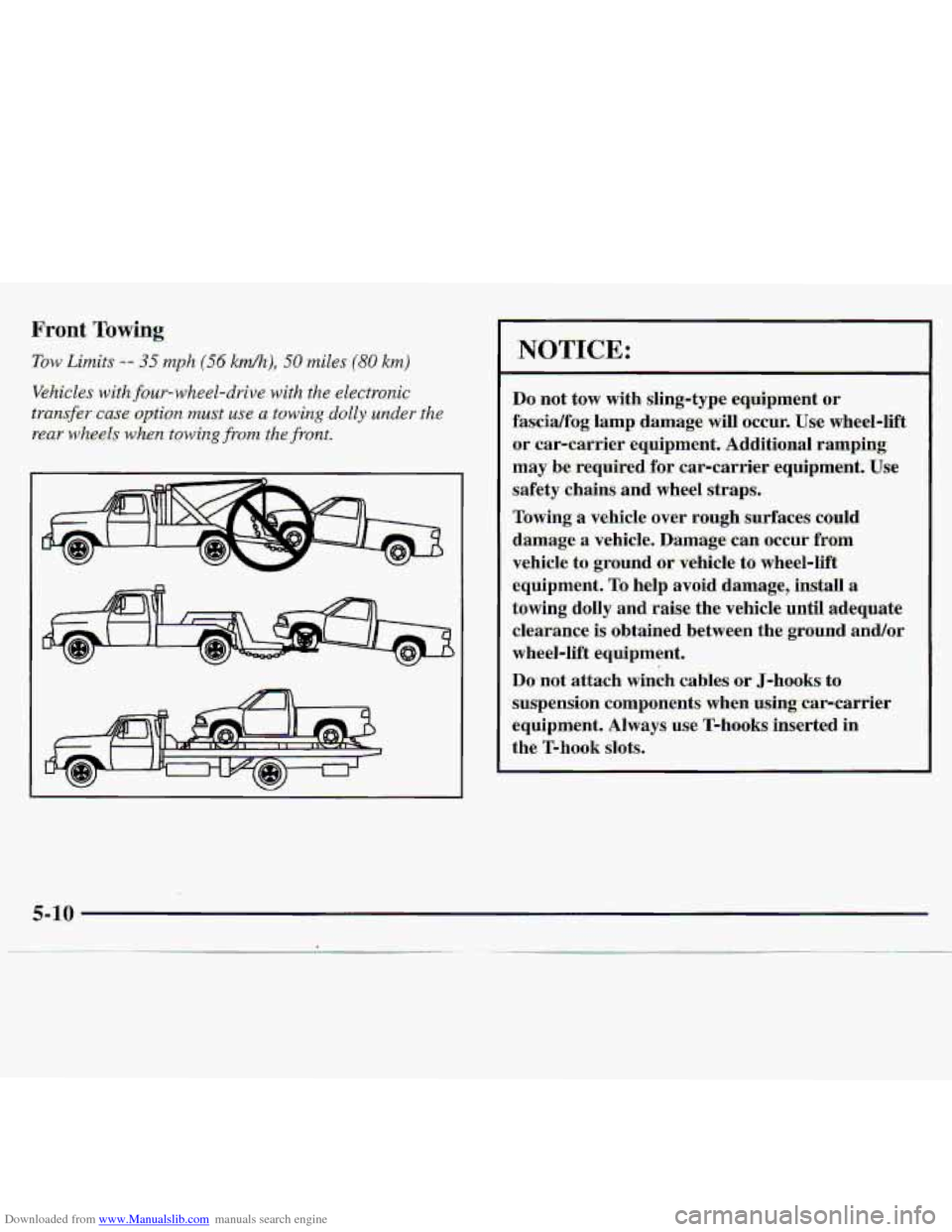
Downloaded from www.Manualslib.com manuals search engine Front Towing;
Tow.Limits. -- 35 rnph (56 kmh), 50 miles (-8O-km)
lrehicles with fuur-whesl-drive with the electronic
-transfercase opth must use a towing dolly under the
mar whe& when towing from the fipnt.
NOTICE:
Do not tow with sling-type equipment or
fascia/fog lamp damage will occur. Use wheel-lift
or car-carrier equipment. Additional ramping
may be. fequiped for car-earrier equipment.
Uk
safety chains and wheel straps.
Towing a vehicle over rough surfaces could
damage
a vehicle. Damage can occur from
vehicle to
ground or vehicle to wheel-lift
equipment.
To help avoid damage, instan a
towing doIly and raise the vehicle until adequate
clearance is obtained between the-ground and/or
wheel-lift equipment.
Do
not attach winch cables or J-haoks to
suspension components. when using;car-carrier
eq-uipment. Always use
T-hooks inserted in
the
T-hook-slots.
Page 208 of 402
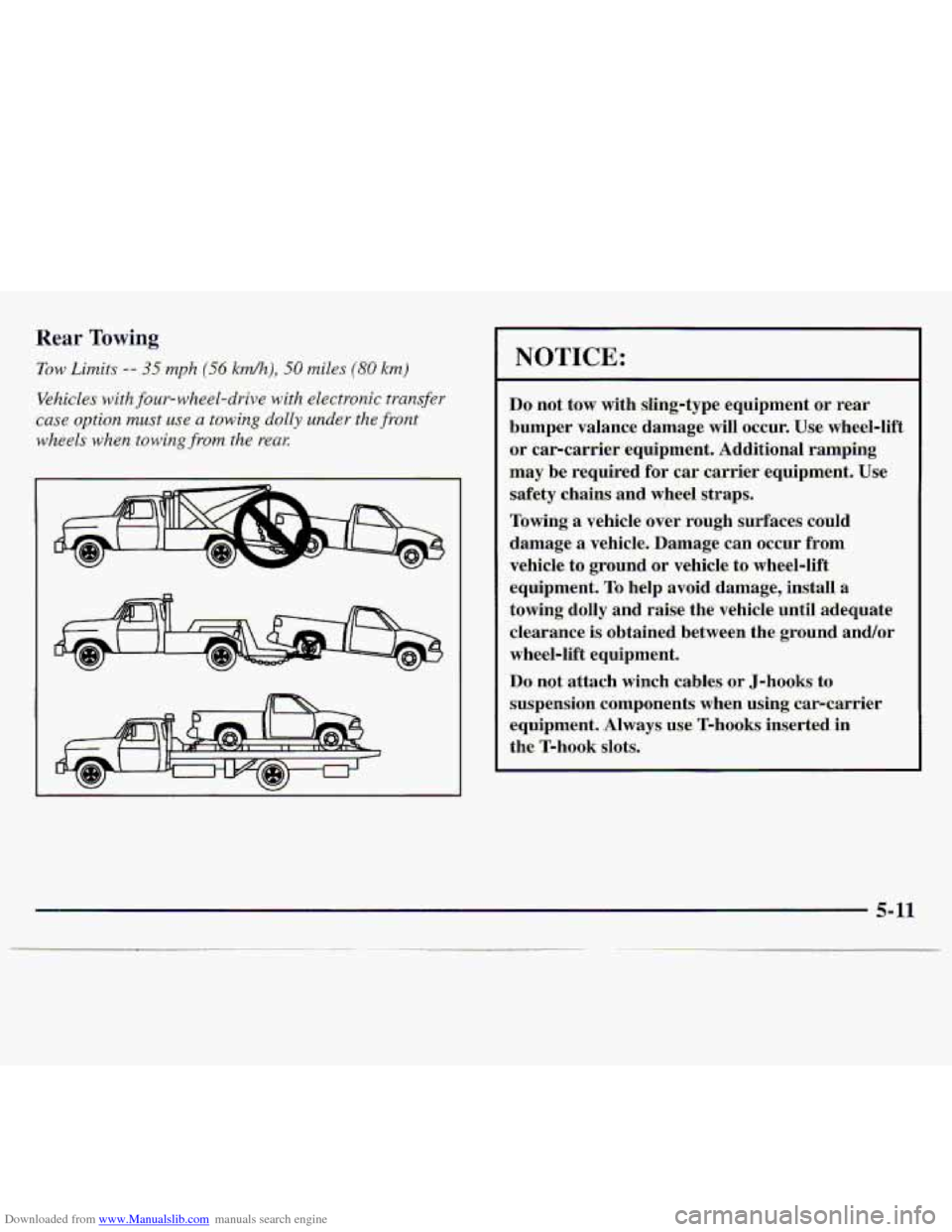
Downloaded from www.Manualslib.com manuals search engine Rear Towing
Tow Limits -- .35 mph (56 kwdh), 50 miles (SO kmj
Vehicles with four-whe&dvive with EkctroHic transfer
case option must use a towing, dolly under th.efron;t
~vheels when towing- frmn the reaz
NOTICE:
Do not tow with sling-type equipment or rear
bumper valance damage will occur. Use wheel-lift ,
or car-carrier equipment. Additional rainping
may
be required for car carrier equipment. Use
safety chains
and wheel straps.
Towing
a vehicle over rough Surfaces could
damage a vehicle. Damage
can occur from
vehicle to .ground
or vehicle to wheel-lift
eq-uipment.
Ta help avoid darnage, install a
towing dally and raise the vehicle until adequate
clearance is obtained between the
ground and/or
wheel-lift equipment.
Do not ,attach winch cables or J-hooks ta
suspension components when using car-carrier
equipment.
Always use- T-hooks inserted in
the
T-hook slots.
5-11
Page 210 of 402
Downloaded from www.Manualslib.com manuals search engine IfNo Steam Is Coming -. From Your Engine
If y0.u get the overheat warning but s.ce or hear RO
steam, the problem may not be too serious. Sometimes
the engine
can get a 1i.ttle too hot when yau:
.O Climb a long hill OLI: a hot day.
0 S.top after high-speed driving.
0 Idle for long periods in traffic.
e- Tow a trailer. See “Dfiving on Grades” in .the Index.
If you get .the overheat warning with no sign of s-team;
try this for a minute or so:-
1. If you have an air conditioner, turn it off.
2. Turn on your heater to full hot at the highest.$gm
speed
and open the window as necessary.
3. 1% you’re in a. traffic jam, shift to NEUTRAL (N);
otherwise, shift to the highest gear while
driving -- AUTOMATlC OVERDRIVE (@) or
DRIVE (D) far automatic transmissions.
If you n.0 longer have the overheat warniiqg,. you
can drive. Just to besafe, driv.e slower for .about
10 minu.tes. If the
warning does;n’.t come back. ofl,
you can drive normdly..
If the warning c.aritinues-, pull OV&, stop, and p-~k y.Our-
vehicle right hway.
If there’s still no sign of steam, push the accelerator Uhtil
the
engine speed is about twice as fast-as normal idie
speed. Bring the. engine speed back to- normal idle sped
after two QP three minutes. Now:s.ye if the warning, stops.
But
&en-, if you still have the .warnhg-, twn qfl--fhc
engine and get Gveryona .out af rhe whicle until it
coois Eo wn.
Page 222 of 402
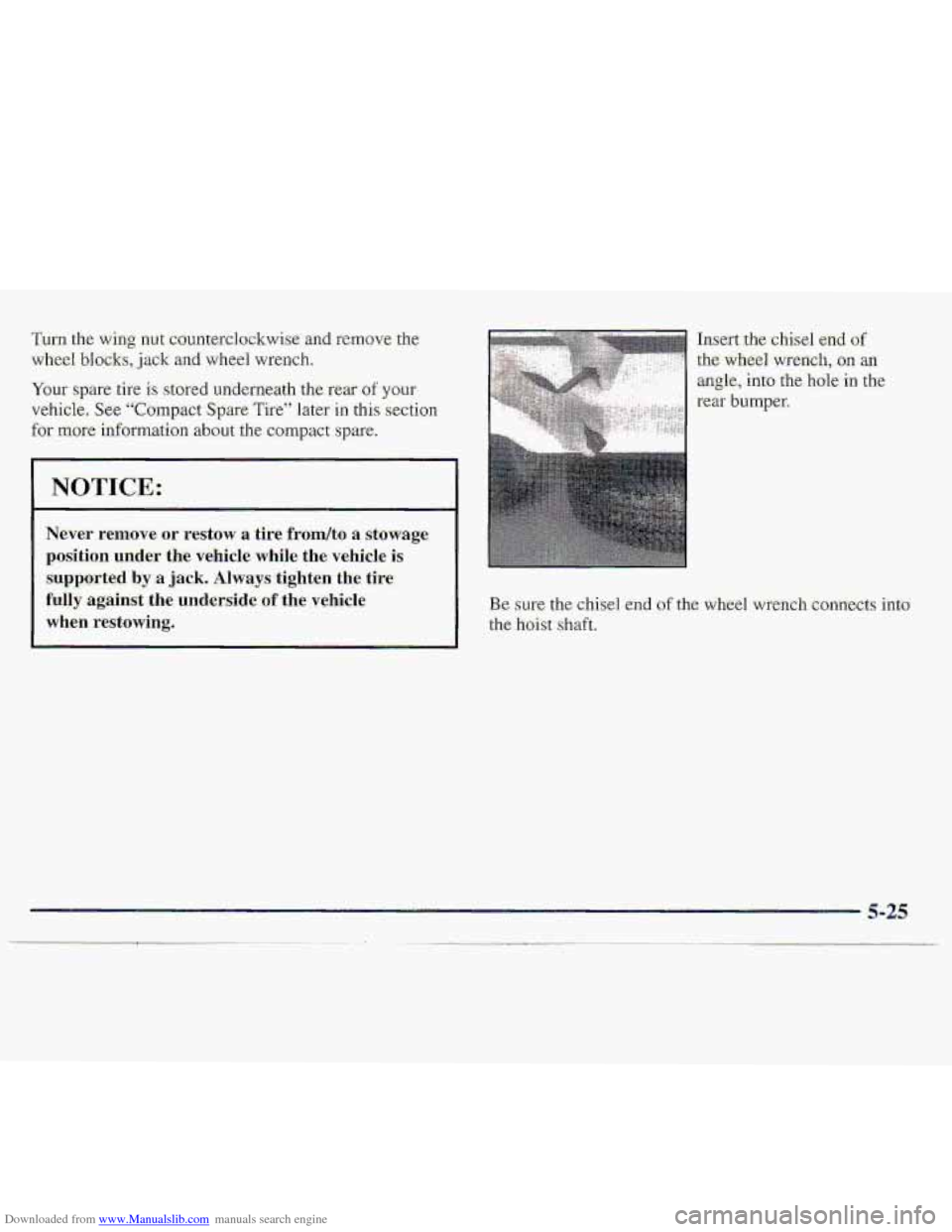
Downloaded from www.Manualslib.com manuals search engine Turn .the wi~%g imt. cwnterclockwise :and rem-ove the
wheel blocks., jack and wheel wrench.
Your spare tire is stored underneath the rear of your
vehicle; See “Compact S-pare Tire” later in this section
for more mformation- about the compact spare.
NOTICQ
Never remove or restow a tire frodto a stowage.
psition under the vehicle while the .vehicle is
suppiorted by .a jack+ Always tighten th.e tire
fully against the: underside- of the vehicle
when restowiqg.
$-E
. _.. - .
Page 224 of 402
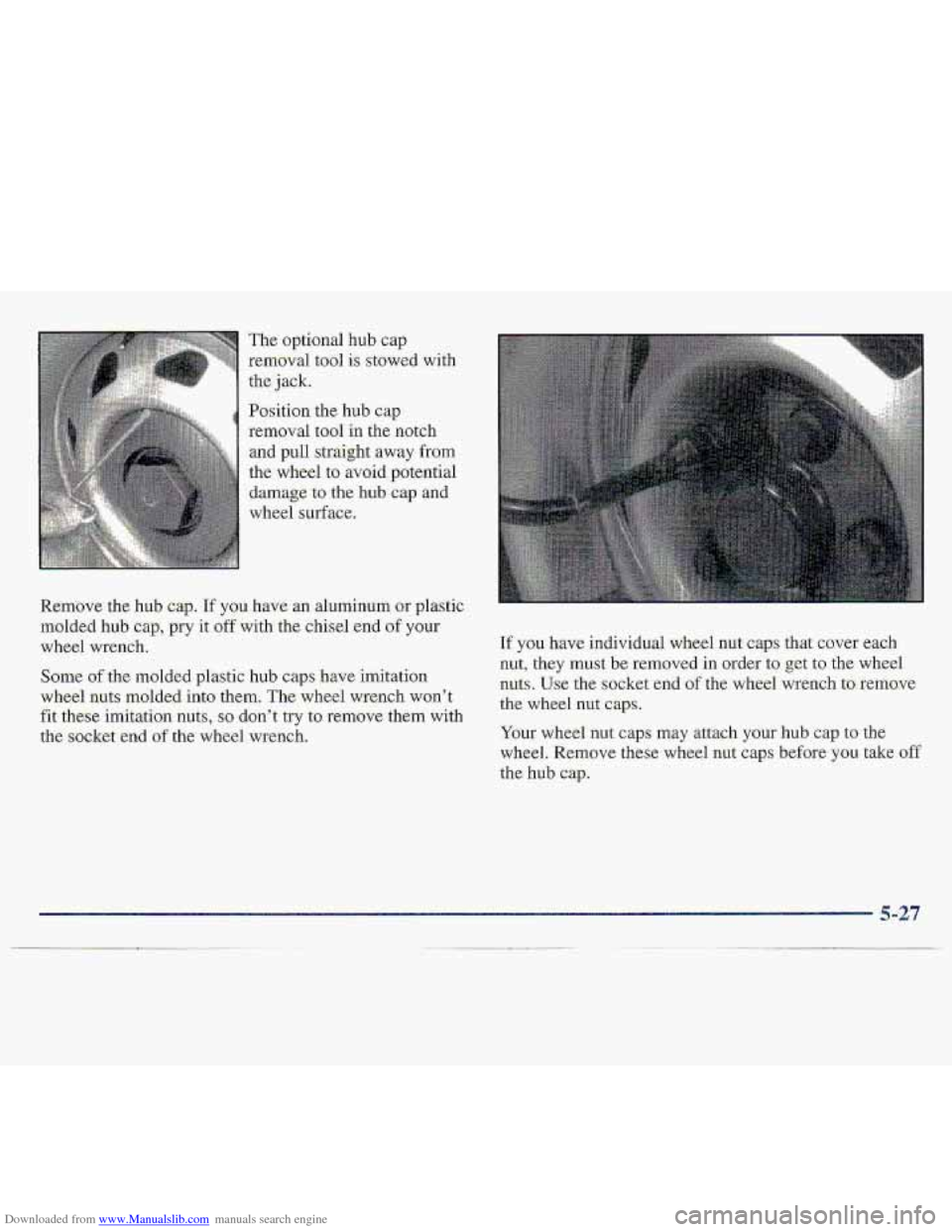
Downloaded from www.Manualslib.com manuals search engine The optional hub cap
removal tool is stowed with
the jack.
Position
the hub cap
removal tool i-n the notch
and pull straight ,away from
the wheel tQ avoid,p.otential
damag,e TO the hubcap and
wheel surface.
Remove.
the hub cap. I€ you hve an aluminum or plastic
molded hGb :cap:, pry it
off with the chisel .end of your
wheel wrench. If you have individual wheel nut caps that cover each
nut, they must
be- removed in order to get to the wheel Some of the molded plastic hub caps. hme imitation
nuts. Use the socket end of the wheel wrench to-rerno.ve wheel nuts -molded into them. The wheel wrench won’t the. wheel nLlt
fit
these imitation nuts, SQ don’t try to remove them with
the socket end of the’ wheel. wrench. Your wheel nut. caps may attach your hub cap to the
wheel, Remove these
whe.el nut caps before you rake off
the hub cap,
Page 227 of 402
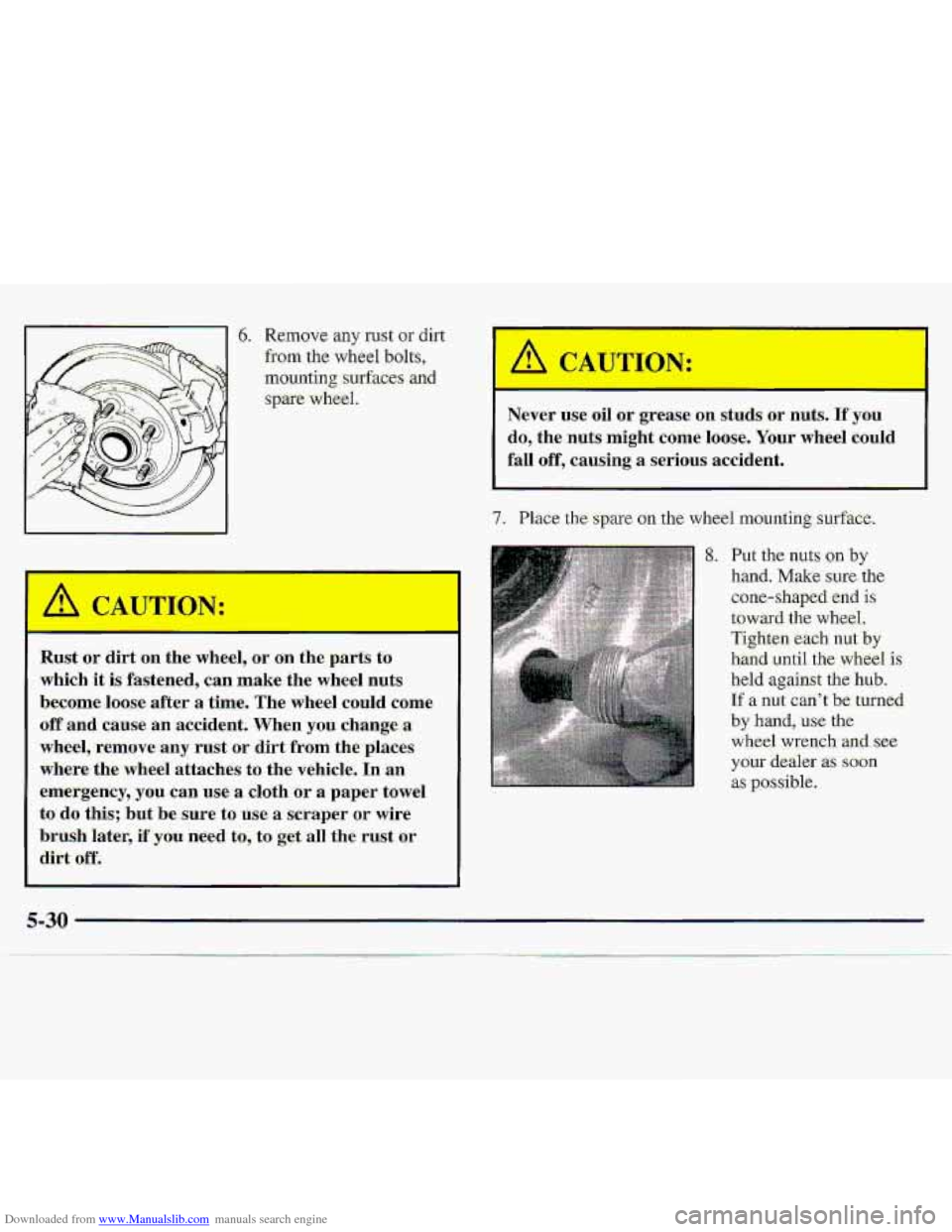
Downloaded from www.Manualslib.com manuals search engine b. Remove any rust or dirt
from the wheel bolts,
mounting surfaces and
spare wheel.
Rust or dirt on the wheel, or on the parts to
which
it is fastened, can make the wheel nuts
become loose after
a the. Th-e wheel could come
off.and cause an accident. When you change a
wheel,-remove-.any rust or dirt from the places
where the wheel attach.es
to the vehicle. In an
emergency,
you can use a cloth or a paper towel
todo this; but be sure to use a scraper or wire
brush rater, if .you need to, to get all the rust or
dirt off.
Never use oil or grease on studs or nuts.. If you
do, the nuts might come loose. Your wheel could
fall off, causing a serious accident.
7. Place the spare on the wheel mounting- surface.
8. Put the nuts on by
hand. Make sure. the
c.one-shapd end is
toward the wheel.
Tighten each nut by
hand untiI the- wheeI is
held against the hub.
If a nut can’t bel turned
by hand,. us.e the
wheel wrench.
and see
your deal.er as soon
as possible.
5-30
Page 234 of 402
Downloaded from www.Manualslib.com manuals search engine NOTICE:
Spinning your wheels can destroy parts of your
vehicle as we11 as the tires. If you spin the wheels
too fast while shifting your transmission back
and forth, you can destroy your- transmission.
For information about using tire chains on your vehicle,
see “Tire Chains” in the Index.
Rocking Your Vehicle To Get It Out
First, turn your steering wheel left and right. That will
;clear the area around your front wheels. Then
shift back
,;and forth between REVERSE (R) and a forward gear (or
*with
a manual transmission, between FIRST (1) or
SECOND (2) and REVERSE(R)), spinning the wheels
as little
as possible. Release the accelerator pedal while
you shift, and press lightly on the accelerator pedal
when the transmission is in g,ear. If that doesn’t get
you
out after a few tries,. you may need to be towed out. Or,
you c.an use.your recovery hooks if your vehicle. has
::them. IT you do need
to be tawed out, see “Towing Your
”Vehicle” in the
Index,.
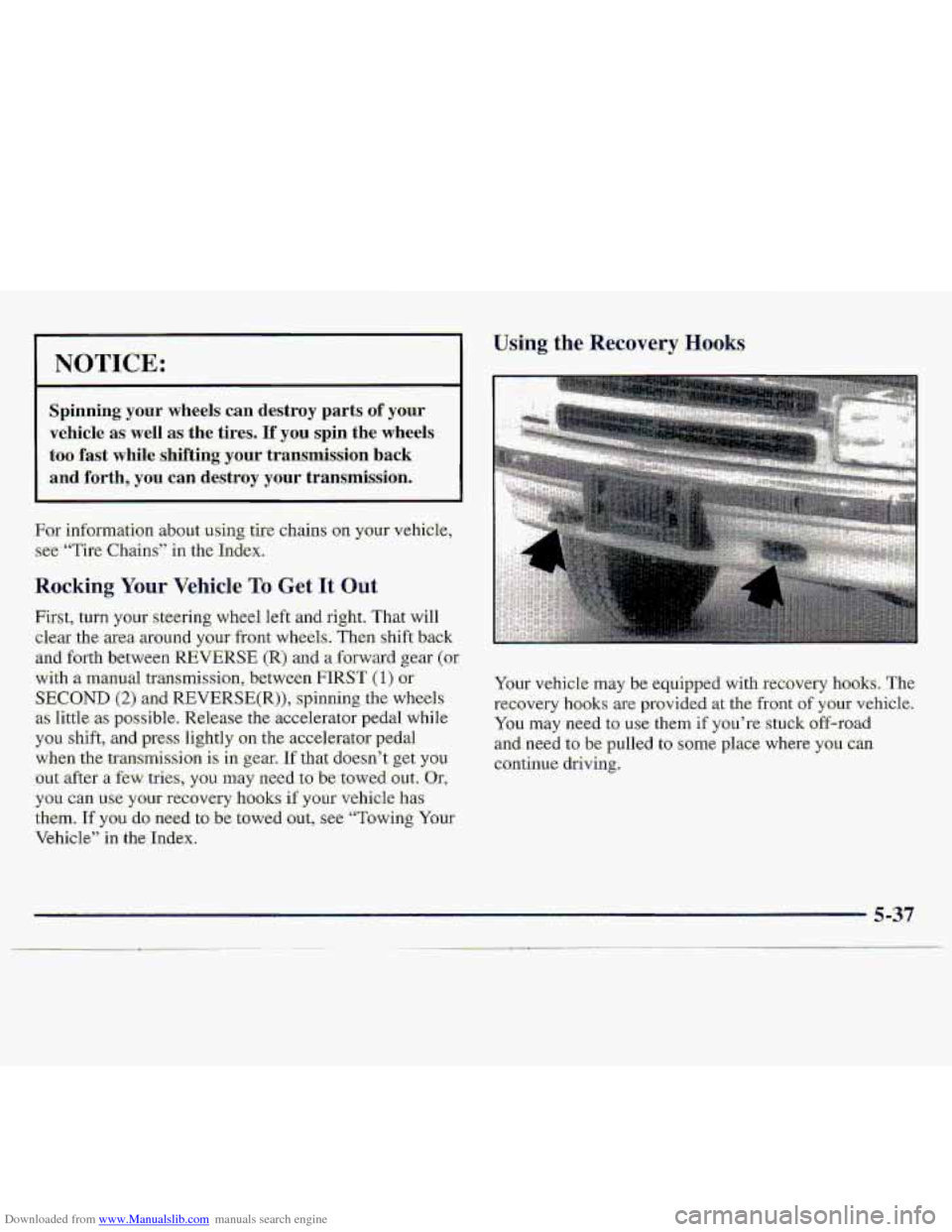
U-sing the Recovery Hooks
Tour vihilfe may be equipped with recovery hooks. The
recovery
hooks are pmvided at the front of yo-ur vehicle.
You may need to use them if you’re stuck off-road
and need to be pulled to some place where you can
wntinue driving.
5-37
____