Page 181 of 402
Downloaded from www.Manualslib.com manuals search engine Load& Your Vehicle
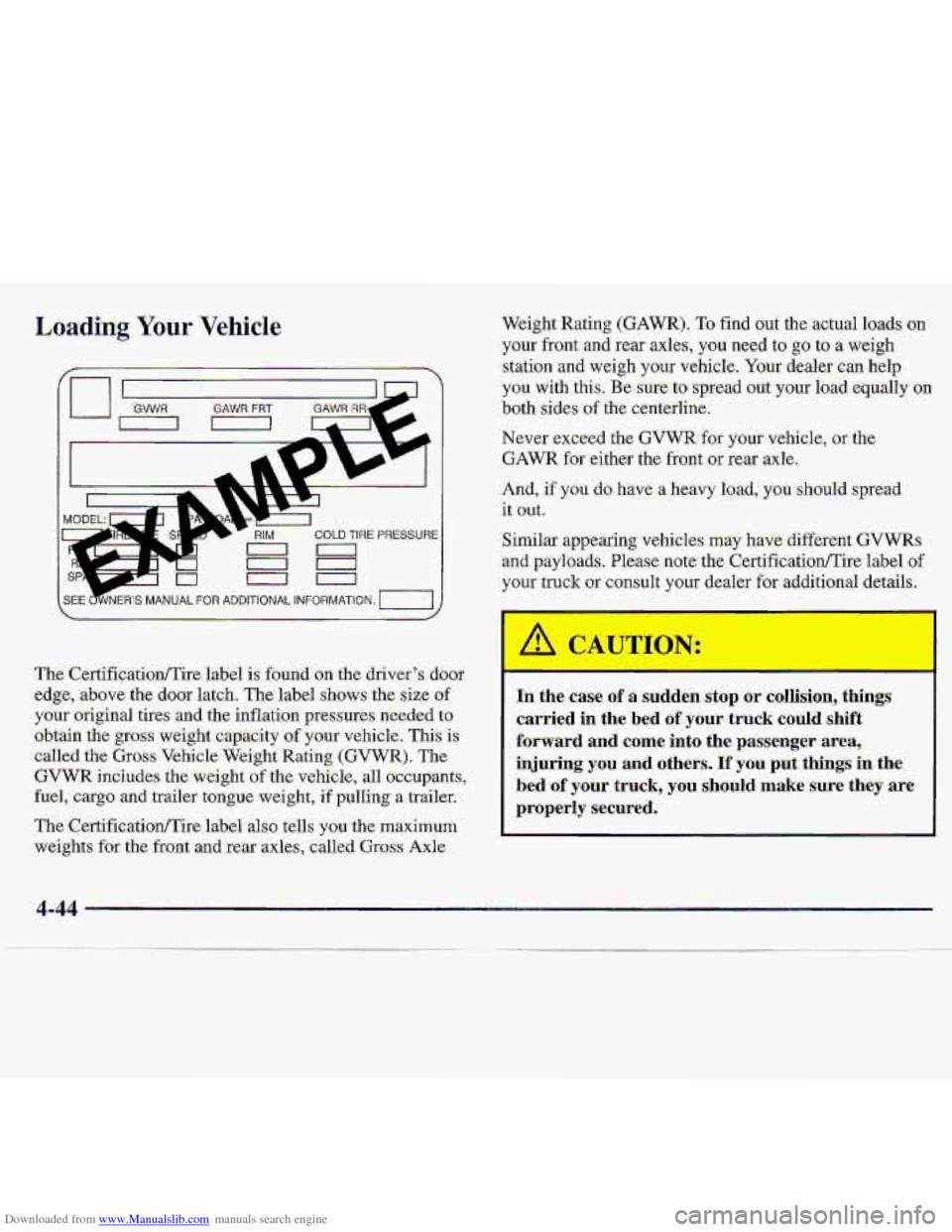
The Certification/Tire.iabel is found on the driver's door
edge, -above the door latch. The label shows the size of
your original. tires and the inflation pressures needed to
obtain the grass weight capacity of your vehicle. This is
called
the Gro-ss- Vehicle Weight Rating (GVWR). The
GVWR
includes the weight of the vehicle, all occupants,
fuel,
cargo aild trailer tongue weight, if pulling a-trailer.
The C&tification/Tire. label
also tells you the maximum
weights for the front and-re,ar axl.es, called Grass Axle Weight
.Rating (GAWR).
To find Qut the actual loads on
your front and rear axles, you need to go to a we.igh
station and weigh your-vehicle. Your dealer
can help
you with this. Be sure to spread out your load equally on
bath sides of the centerline..
Never exceed the GVWR for your vehicle, or the
GAWR
hi either the front or rear axle.
And, if you do have a heavy load, you- sho,uld spfead.
it
out.
Similar appearing vehicles. may have. differeQt GVWRs
and payloads. Please note the Certificatioflire. label sf
your truck or consult your dealer for additional details.
In the.case of a gudden stop or collision, things
carried in the bed of your truck could shift^
forward and come into the passenger area,
injuring you and others. 'If you put things in the
bed of your truck, you should rnake.su.re they are
properly
secured.
I
Page 232 of 402
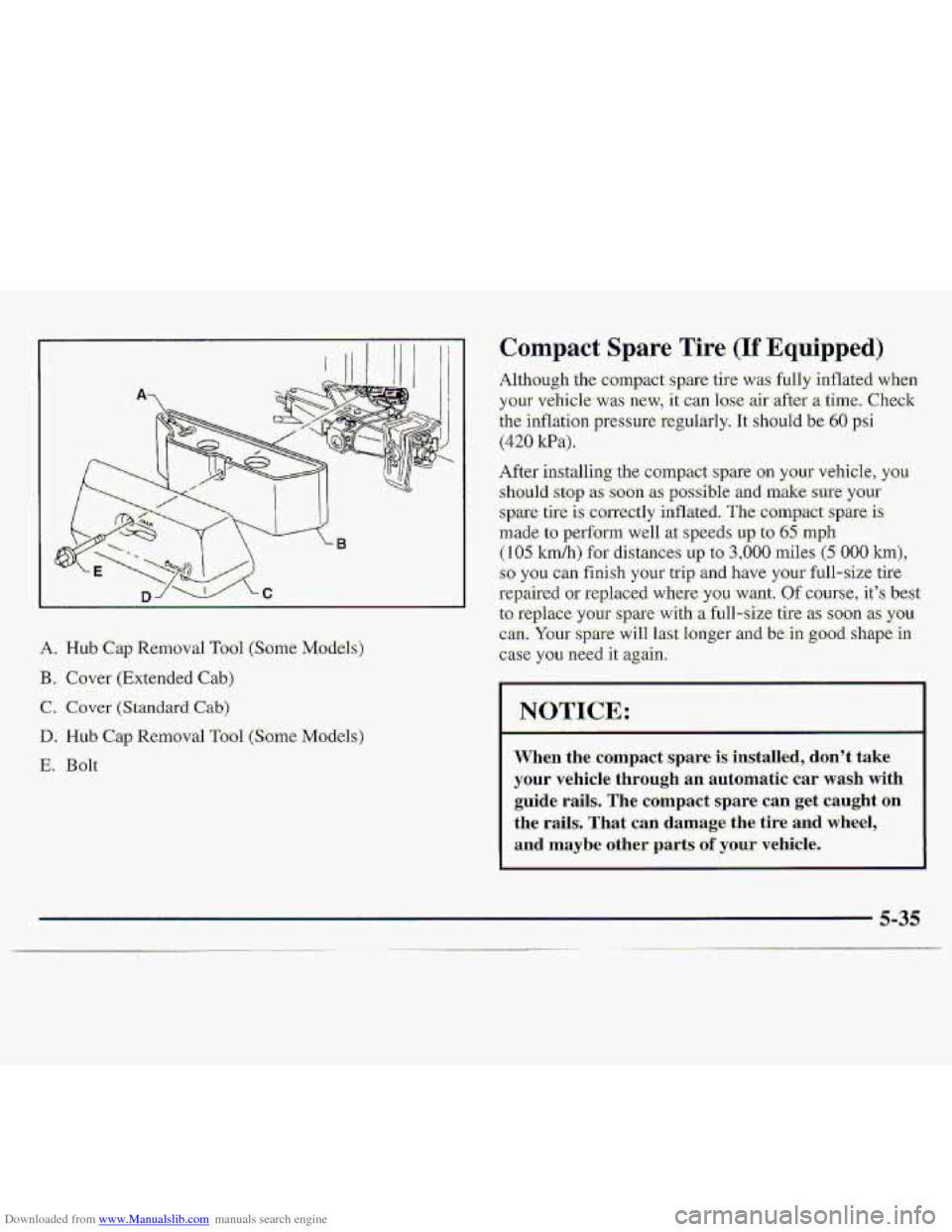
Downloaded from www.Manualslib.com manuals search engine A, Hub Cap Removal Tool (Some Mmiels)
E. Cover (Extended Cab)
%. Cover (Stand,ard Cab)
D. Hub Cap Removal Tool (Some Models)
E. Bdt
Compact Spare Tire (If Equippe.d)
Although the compact spare-tire was fully inflated when
your vehicle w.as new, it can lose air after a time. Check
the. inflation pressure regularly. It should be 60 psi
(420 kPa).
After installing the compact spare on your vehicle, you
should stop as 'soon as possible and 'm.ake-. sure your
spare tire
is cor-rec.tly inflated. The compact spare is
made to perform well at speeds up to 65 :mph
(I 05 krn/h) for distances up to 3,000 miles (5.000 km),
so you can finish your trip and have your full-size tire
repaired or replaceid where.you
want. Of course, it's best
to replace y0.w spare with a full-size tire as soon as you
can. Your spare will last longer and be: in .good shape in
case you-need it again.
I NOTICE: I
When the compact 'spare: is installed, don't ta.ke
your vehicle through
an automatic car wash with
guide rails, The compact spare can get caught on
the rails; That can damage the tire and wheel,
-and maybe other-parts of your vehicle.
Page 284 of 402
Downloaded from www.Manualslib.com manuals search engine When, U’s Time for Nk-W Tires
Rust-or dirt on a wheel,. or on the parts to which
it is fastened, can make wheel nuts bec:ome lo-ose
a-ftep a. time. The wheel coukd come off and cause:
an accident. When you change a wheel, remove
any .rust or dirt from places where the wheel
attaches
to the vehicle. In an emwgency, you can
use a cloth or a paper: towel to do this; but be
sgre to use a scraper or wim brush later, if you
need to, to get all the rust or dirt off. (See
“Changing a Flat Tire” in .the Index.)
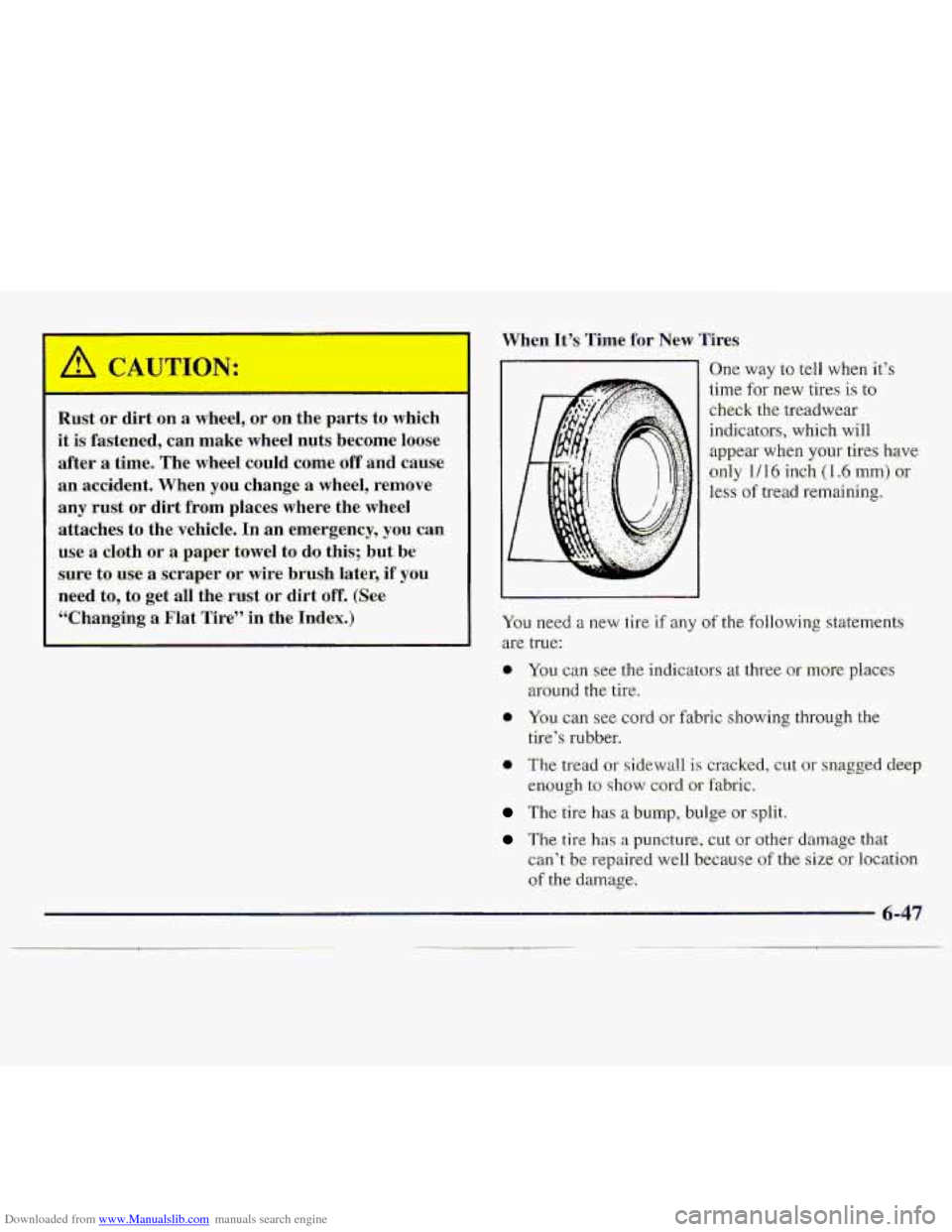
One way to tell when it’s
time
for new tires is to
check the treadwear
indicators, which wil’l
appear when yo-ur tires have
only l/ 16 inch (1.6 mnm) or
less of tread remaining.
10 You can see the indicators at three 01: mn1-e places
around. thetire-.
a You can see cord .or f’abric showing through the
tire’s rubber.
The tread or sidewall is cracked, cut or snagged deep
enou.gh to show cord-or fabric.
The tire has a bump, bulge or split.
The tire hn.s a puncture, cut or other damage that
can’t be repaired well because of the size 01: :location
of the damage.
Page 285 of 402
Downloaded from www.Manualslib.com manuals search engine Buying. New Tires
'If you 'eve.r replace your tires with those- not :having .a
TPC Spec number, make Sure they are the same, size,
load range, speed rating and construction type (bas,
.bias-belted..or radial) as you^ original tires..
Mixing tires could 'cause you to lose control while
driving. If
you mix tires of different: sizes or type-§
(.radial and bias-belted tires), the vehicle may not
handle properly, land you could have .a crash.
Using,tires of different sizes may also cause
.damage to your vehicle. Be sure to use the:.same
size and type tires on all wheels.
It's
all right to drive with your compact spare
(if .you have one), It was developed for use on
your vehkle.
6-48
Page 289 of 402
Downloaded from www.Manualslib.com manuals search engine Tire, Chains
use tire chains. They can damage your vehicle
because there’s not enough clearance.
Use another type
of traction device only if its
manufacturer recommends it
for use on your
vehicle and tire size combination and road
conditions. Follow that -manufacturer’s
instructions.
To help avoid damage to your
vehicle, drive slowly, readjust or remove the
device if
it’s contacting your vehicle, and don’t
spin your -wheels..
NOTICE: (Continued)
’ NOTICE: (Continued)
If you do find a traction device that will fit, install
them on the rear4irgs.
If you have other size tires, use tire chains only
where legal and only when you
must. Use. only
SAE Class “S” type chains that are the proper
size
for your tires. Install them on the drive axle
tires (four-wheel-drive vehicles. can use chains on
both axles) and tighten them as tightly as possible
with the ends. securely fastened. Drive slowly
and
follow the chain manufacturer’s instructions. If
you can hear the chains contztc,ting your vehicle,
stop and retighten them.
If the contact contimes;
slow down until
it stops. Driving toa fast or
spinning the wheels with chains on will damage
your vehicle.