Page 219 of 361
Downloaded from www.Manualslib.com manuals search engine Three important considerations have to do with weight:
the weight
of the trailer,
the weight
of the trailer tongue
and the total weight on your vehicle’s tires.
How heavy can a trailer safely
be?
It should never weigh more than 1,000 lbs. (450 kg)
total, including the load. But even that can be too heavy.
It depends on
how you plan to use your rig. For
example, speed, altitude, road grades, outside
temperature and
how much your vehicle is used to pull a
trailer are all important. And, it can also depend on any
special equipment that you have on your vehicle.
You can ask your dealer for our trailering information or
advice, or you can write us at:
Cadillac Customer Assistance Center
Cadillac Motor Car Division
30009 Van Dyke
P.O. Box 9025
Warren, MI 48090-9025
In Canada, write to:
General Motors of Canada Limited
Customer Communication Centre
1908 Colonel Sam Drive
Oshawa, Ontario
LlH 8P7
e
The tongue load (A) of any trailer is an important
weight to measure because it affects the total capacity
weight
of your vehicle. The capacity weight includes the
curb weight
of the vehicle, any cargo you may carry in
it, and the people who will be riding in the vehicle. And
if you will tow a trailer, you must subtract the tongue
load
from your vehicle’s capacity weight because your
vehicle will
be carrying that weight, too. See “Loading
Your Vehicle” in the Index for more information about
your vehicle’s maximum load capacity.
Page 220 of 361
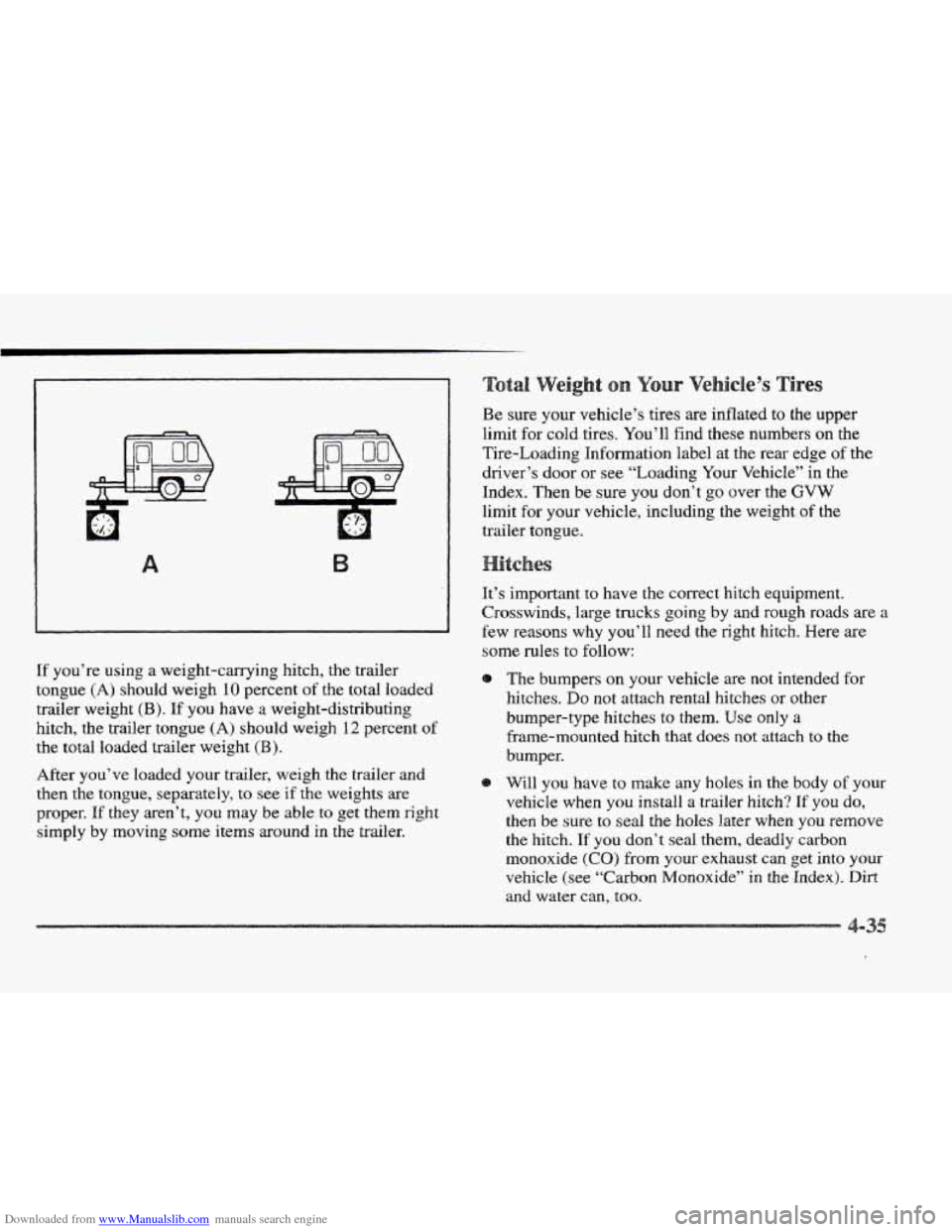
Downloaded from www.Manualslib.com manuals search engine If you’re using a weight-carrying hitch, the trailer
tongue
(A) should weigh 10 percent of the total loaded
trailer weight
(B). If you have a weight-distributing
hitch, the trailer tongue
(A) should weigh 12 percent of
the total loaded trailer weight (B).
After you’ve loaded your trailer, weigh the trailer and
then the tongue, separately, to see if the weights are
proper.
If they aren’t, you may be able to get them right
simply by moving
some items around in the trailer. Be sure
your vehicle’s tires are inflated to the upper
limit for cold tires.
You’ll find these numbers on the
Tire-Loading Information label at the rear edge
of the
driver’s door or see “Loading Your Vehicle” in the
Index. Then be sure you don’t go over the GVW
limit for your vehicle, including the weight of the
trailer tongue.
It’s important
to have the correct hitch equipment.
Crosswinds, large trucks going by and rough roads
are a
few reasons why you’ll need the right hitch. Here are
some rules to follow:
The bumpers on your vehicle are
not intended for
hitches. Do not attach rental hitches or other
bumper-type hitches to them. Wse only a
frame-mounted hitch that does not attach to the
bumper.
Will
you have to make any holes in the body of your
vehicle when you install a trailer hitch?
If YSU do,
then be sure to seal the holes later when you remove
the hitch. If you don’t seal them, deadly carbon
monoxide (CQ) from your exhaust can get into your
vehicle (see “Carbon Monoxide” in the Index).
Dirt
and water can, too.
Page 223 of 361
Downloaded from www.Manualslib.com manuals search engine You really should not park your vehicle, with a trailer
attached,
on a hill. If something goes wrong, your rig
could start
to move. People can be injured, and both
your vehicle and the trailer can be damaged.
But if
you ever have to park your rig on a hill, here’s
how to do it:
1. Apply your regular brakes, but do not shift into
PARK (P).
2. Have someone place chocks under the trailer wheels.
3. When the wheel chocks are in place, release the
regular brakes until
the chocks absorb the load.
PARK (P) firmly and apply your parking brake.
4. Reapply the regular brakes. Then shift into
Release the regular brakes.
1. Apply your regular brakes and hold the pedal down
while you:
Start your engine;
e Shift into a gear; and
Be sure the parking brake has released.
2. Let up on the brake pedal.
3. Drive slowly until the trailer is clear of the chocks.
4. Stop and have someone pick up and store the chocks.
Your vehicle will need service
more often when you’re
pulling
a trailer. See the Maintenance Schedule for more
on this. Things that are especially important in trailer
operation are automatic transaxle fluid (don’t overfill),
engine oil, belt, cooling system and brake adjustment.
Each of these is covered in this manual, and
the Index
will help
you find them quickly. If you’re trailering, it’s
a good idea to review these sections before you start
your trip.
Check periodically to see that all hitch nuts
and bolts
are tight.
Page 234 of 361
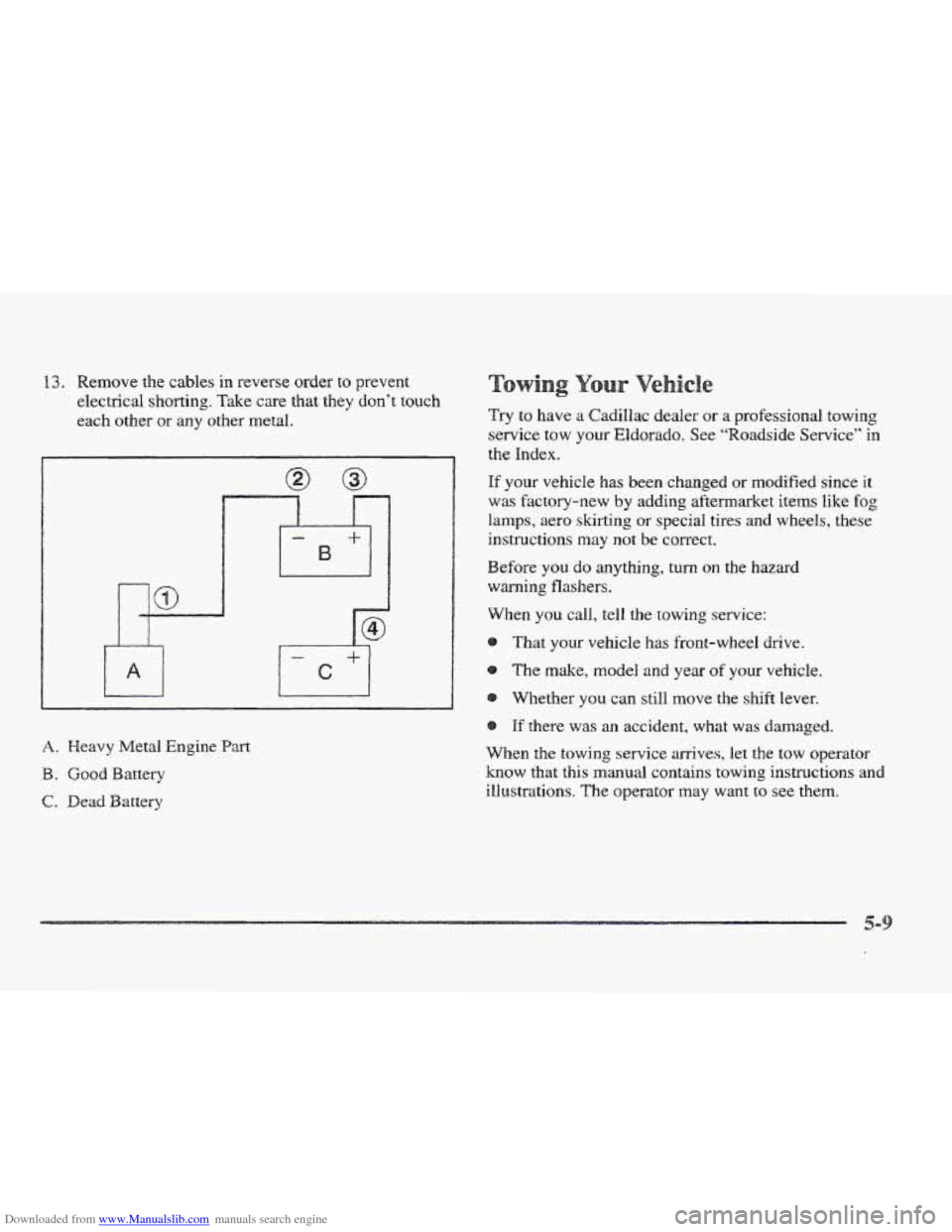
Downloaded from www.Manualslib.com manuals search engine 13. Remove the cables in reverse order to prevent
electrical
shorting. Take care that they don’t touch
each other or any other metal.
A. Heavy Metal Engine Part
B. Good Battery
C. Dead Battery
Try to have a Cadillac dealer or a professional towing
service tow
your Eldorado. See “Roadside Service” in
the Index.
If your vehicle has been changed or modified since it
was Factory-new by adding aftermarket items like fog
lamps, aero skirting or special tires and wheels, these
instructions
may not be correct.
Before
you do anything, turn on the hazard
warning flashers.
When you call, tell the towing service:
That
your vehicle has front-wheel drive.
The make, model and year of your vehicle.
Whethef you can still move the shift lever.
If there was an accident, what was damaged.
When the towhg service arrives, let the tow operator
know that this manual contains towing instructions and
illustrations. The operator may
want to see them.
Page 241 of 361
Downloaded from www.Manualslib.com manuals search engine . -.-
You will find an ENGINE COOLANT HOT-IDLE
ENGINE message or a STOP ENGINE ENGINE
OVERHEATED message on the Driver Information
Center
(IDIC). There is also an engine temperature
warning light andor gage on
the instrument panel.
See “Engine Coolant Temperature
Warning Light” or
“Engine Coolant Temperature Gage” in the Index.
Overheated Engine Protection
Should a low coolant condition exist and the message
STOP ENGINE ENGINE OVERHEATED is displayed,
an overheat protection mode which alternates firing
groups
of four cylinders helps prevent engine damage.
In this mode, you will notice a loss in power and engine
performance.
This operating mode allows your vehicle
to be driven to
a safe place in an emergency; you may
drive up to
50 miles (80 km). Towing a trailer in the
overheat protection mode
should be avoided.
NOTICE:
After driving in the overheated engine protection
operating mode, to avoid engine damage, allow the engine to cool before attempting
any repair.
The engine
oil will be severely degraded. Repair
the cause of coolant loss, change the
oil and reset
the
oil life indicator. See “Engine Oil, When to
Change” in the Index.
Page 242 of 361
Downloaded from www.Manualslib.com manuals search engine L
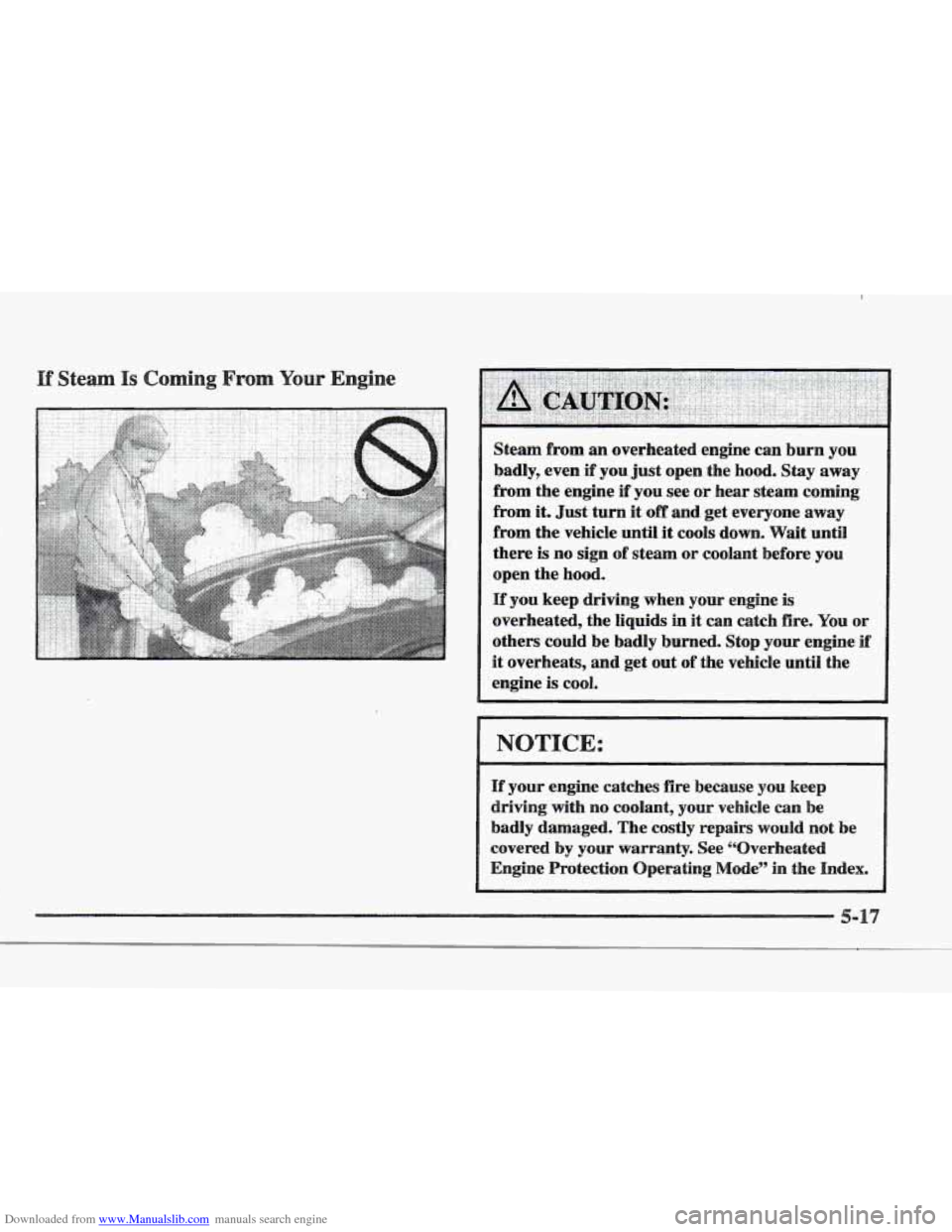
Steam from an overheated engine can burn you
badly, even
if you just open the hood. Stay away
from the engine if you see or hear steam coming
from it. Just turn it off and get everyone away
from the vehicle until it cools down. Wait until
there
is no sign of steam or coolant before you
open the hood,
If you keep driving when your engine is
overheated, the Iiquids in it
can catch fire. You or
others could be badly burned. Stop your engine if
it overheats, and get out
of the vehicle until the
engine is cool.
If your engine catches fire because you keep
driving with
no coolant, your vehicle can be
badly damaged. The costly repairs would not be
covered
by your warranty. See (‘Overheated
Engine Protection Operating Mode” in
the Index.
Page 245 of 361
Downloaded from www.Manualslib.com manuals search engine If it isn’t, the coolant level should be indicated by a
CHECK COOLANT LEVEL message on the Driver
Information Center.
If it is, you may have a leak in the
radiator hoses, heater hoses, radiator, water
pump or
somewhere else in
the cooling system.
Heater and radiatoi hoses, and.other engine
parts, can be very hot. Don’t touch them. If you
do, you can be burned.
.Don’t run sthe engine if-there is a leak. If you
the engine,.+it could loge all coolant. That could
cause an engine fire, and sou could be burned.
Get any leak Pled before you drive ,. the vehicle. ’’-
NOTICE:
Engine damage if you keep running your engine
without coolant isn’t covered by your warranty.
See “Overheated Engine Protection Operating
Mode” in the Index.
If there seems to be no leak, with the engine on, check to
see if the electric engine fans are running. If the engine
is overheating, both fans should be running. If they
aren’t, your vehicle needs service.
Page 246 of 361
Downloaded from www.Manualslib.com manuals search engine If you haven’t found a problem yet, but the coolant level
isn’t
at the proper level (2.5 inches (6.4 cm) below the
base
of the fill neck), add a 50/50 mixture of clean,
water (preferably distilled) and DEX-COOL@ coolant at
the coolant
surge tank, but be sure the cooling system,
including the coolant surge tank pressure cap,
is cool
before you do it. (See “Engine Coolant” in the Index for
more information.)
Steam and scalding liquids from a hot cooling
system can blow out and burn YOU badly. They
1 are under pressure, and if you turn the coolant
~ surge tank pressure cap -- even a little -- they
can come out at high speed. Never turn the cap
when the cooling system, including the coolant
surge
tank pressure cap, is hot. Wait for the
cooling system and coolant surge tank pressure
cap
to coo% if you ever have to turn the
pressure cap.