Page 263 of 361
Downloaded from www.Manualslib.com manuals search engine Spinning yoas wheels can destroy parts of your
vehicle as well as the tires. If you spin the wheels
~QQ fast while shifting your transaxle back and
forth,
you can destroy your transaxle.
For
information about using tire chains on your vehicle,
see “Tire Chains” in the Index.
First, turn your steering wheel left and right. That will
clear the area around your front wheels.
You should turn
your traction control system off. (See “Traction Control
System”
in the Index.) Then shift back and forth
between
REVERSE (R) and a forward gear, spinning the
wheels as little as possible. Release the accelerator pedal
while you shift, and press lightly
on the accelerator
pedal when the transaxle
is in gear. If that doesn’t get
you
out after a few tries, you may need to be towed out.
If you do need to be towed out, see “Towing Your
Vehicle” in the Index.
Page 265 of 361

Downloaded from www.Manualslib.com manuals search engine Service
Your Cadillac dealer knows your vehicle best and wants
you to be happy with it.
We hope you’ll go to your
dealer for all your service needs. You’ll get genuine
GM
parts and GM-trained and supported service people.
We hope you’ll want to keep your GM vehicle all
GM.
Genuine GM parts have one of these marks:
-1co
wn Service Work
If you want to do some of your own service work, you’ll
want to get the proper Cadillac Service Manual. It tells
you much more about how
to service your Cadillac than
this manual can. To order the proper service manual, see
“Service and Owner Publications” in the Index. Your
vehicle
has an air bag system. Before attempting to
do your own service work, see “Servicing Your Air
Bag-Equipped Cadillac” in the Index.
You should keep
a record with all parts receipts and list
the mileage and the date
of any service work you
perform. See “Maintenance Record” in the Maintenance
Schedule booklet.
You can be injured and your vehicle could be
damaged
if you try to do service work on a
vehicle without knowing enough about it.
e Be sure you have sufficient knowledge,
experience, the proper replacement parts
and
tools before you attempt any vehicle
maintenance task.
0 Be sure to use the proper nuts, bob and
other fasteners. “English” and ‘ketric”
fasteners
can be easily confused. If you use !..
the wrong fasteners, parts can later break
or fall off. You could be hurt.
I :*
Page 269 of 361
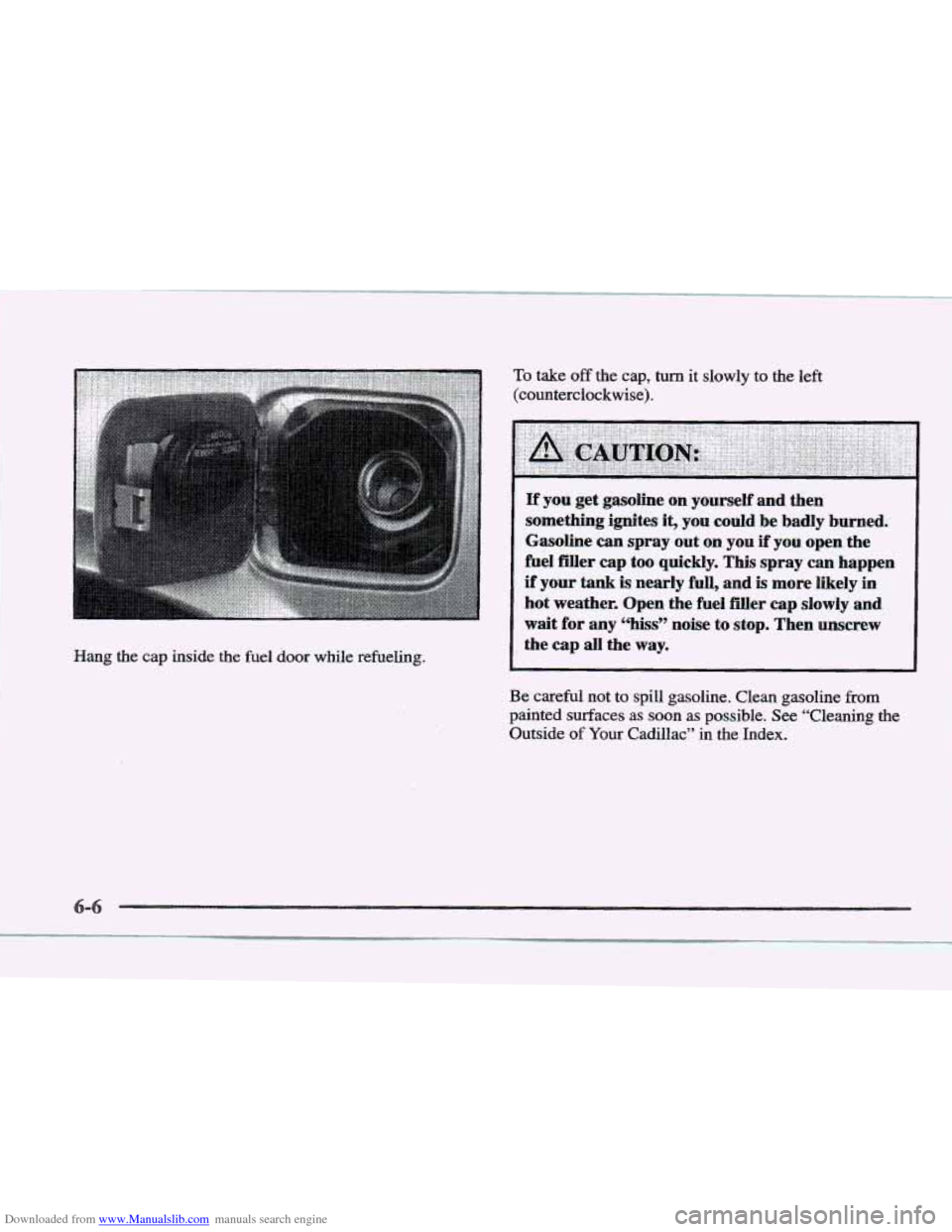
Downloaded from www.Manualslib.com manuals search engine Hang the cap inside the fuel door while refueling.
To take off the cap, turn it slowly to the left
(counterclockwise).
If you get gasoline on yourself and then
something
ignites it, you could be badly burned.
Gasoline can spray out on you
if you open’the
fuel filler cap
too quickly. This spray can happen
if your tank is nearly full, and is more likely in
hot weather. Open the fuel filler cap slowly
and
wait for any 66hiss” noise to stop. Then unscrew
the cap all the way.
Be careful not to spill gasoline. Clean gasoline from
painted surfaces as soon as possible. See “Cleaning the
Outside of Your Cadillac” in the Index.
Page 274 of 361
Downloaded from www.Manualslib.com manuals search engine en t
If the oil is at or below the ADD line, then you’ll need
to add at least one quart of oil. But you must use the
right kind.
This part explains what kind of oil to use. For
crankcase capacity, see “Capacities and Specifications”
in the Index.
Pull out the dipstick and clean it with a paper towel or
cloth, then push it back in all the way. Remove it again,
keeping the tip down,
and check the level.
Page 277 of 361
Downloaded from www.Manualslib.com manuals search engine itives
Don’t add anything to your oil. Your Cadillac dealer is
ready to advise if you tlunk something should be added.
Your Cadillac has an Oil Life Indicator. This feature
will let you
know when to change your oil and
filter
-- usually between 3,000 miles (5 000 km) and
7,500 miles
(12 500 km) since your last oil change.
Under severe conditions,
the indicator may come on
before 3,000 miles (5 000 km). Never drive your vehicle
more than 7,500 miles (12
500 km) or 12 months
(whichever occurs first) without an
oil change.
The system won’t detect dust
in the oil. So, if you
drive
in a dusty area, be sure to change your oil every
3,000 miles
(5 000 km) or sooner if the CHANGE
ENGINE OIL message comes on. Remember to reset
the Oil Life Indicator when the oil has been changed.
For more information, see “Oil Life Indicator”
in
the Index.
After
the oil has been changed, display the OIL LIFE
LEFT message by pressing the INFORMATION (INFO)
button. Then press and hold the RESET (INFO RESET)
button until the display shows “loo.” This resets the oil life
index. The message will remain
off until the next oil
change
is needed. The percentage of oil life remaining
may be checked at any time by pressing the
INFORMATION (INIFQ) button several times until
the OIL LIFE LEFT message appears. For more
information on the Oil Life feature, see “Oil Life
Indicator”
in the Index.
at to
Did you know that used engine oil contains certain
elements that may be unhealthy for your skin and could
even cause cancer? Don’t let used
oil stay on your skin
for very long. Clean your skin and nails with soap and
water,
or a good hand cleaner. Wash or properly throw
away clothing or rags containing used engine oil. (See
the manufacturer’s warnings about the use and disposal
of oil products.)
Used oil can be
a real threat to the environment. If you
change your own oil, be sure to drain all free-flowing oil
from
the filter before disposal. Don’t ever dispose of oil
by putting
it in the trash, pouring it on the ground, into
sewers, or into streams QI- bodies of water. Instead,
recycle
it by takmg it to a place that collects used oil. If
you have
a problem properly disposing of your used oil,
ask your dealer, a service station or a local recycling
center for help.
Page 279 of 361
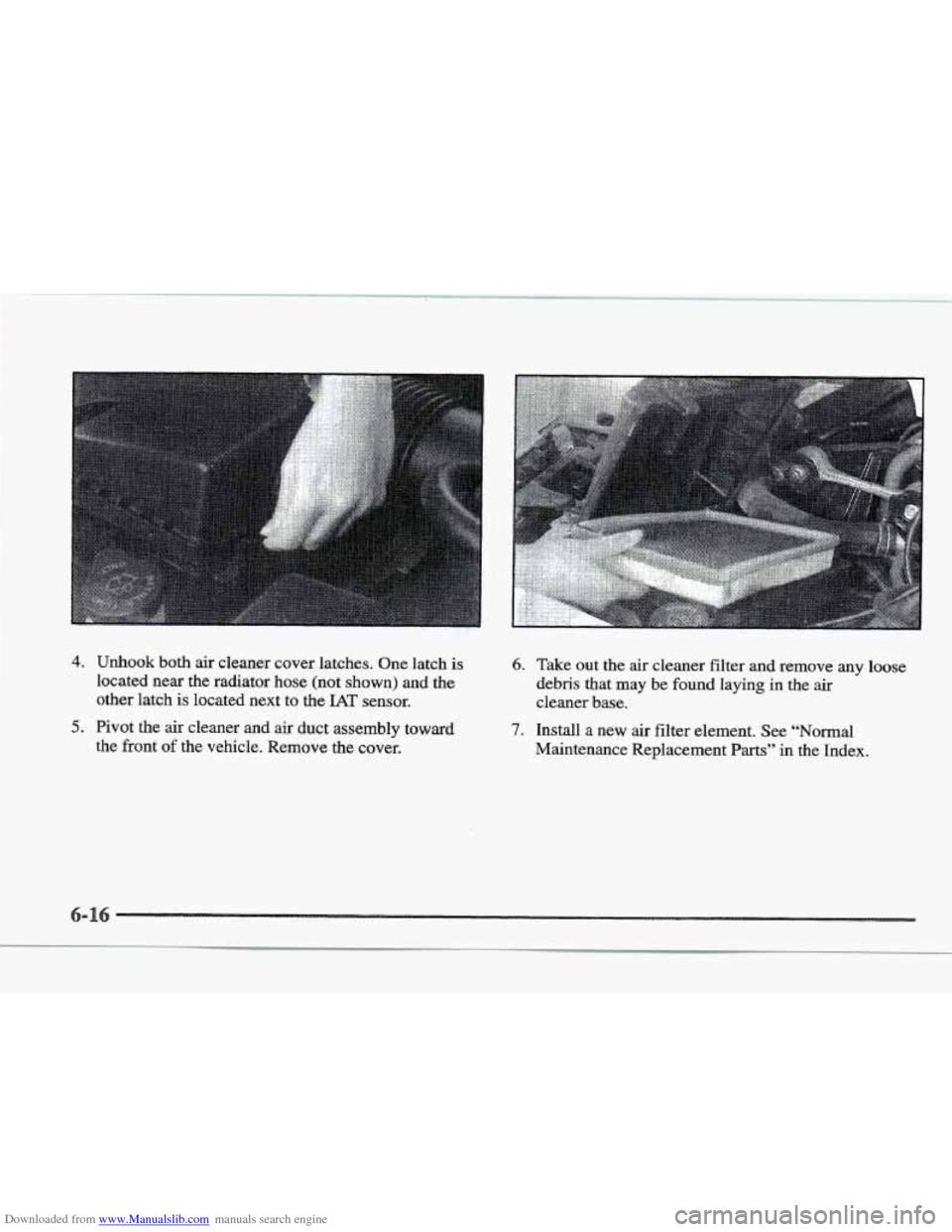
Downloaded from www.Manualslib.com manuals search engine 4. Unhook both air cleaner cover latches. One latch is
located near the radiator hose (not shown) and, the
other latch
is located next to the IAT sensor.
6.
5. Pivot the air cleaner and air duct assembly toward
the front
of the vehicle. Remove the cover.
7.
Take out the air cleaner filter and remove any loose
debris that may be found laying
in the air
cleaner base.
Install a new
air filter element. See “Normal
Maintenance Replacement
Parts” in the Index.
Page 284 of 361
Downloaded from www.Manualslib.com manuals search engine Your vehicle is equipped with a transaxle fluid change
indicator.
A CHANGE TRANS FLUID message will
display on
the Driver Information Center (DIC) when
the powertrain computer determines that the transaxle
fluid needs to be changed or at each
100,080 miles
(160 080 km) interval, whichever occurs first. See your
Maintenance Schedule booklet for more information.
When this message appears, change the transaxle fluid
and reset the transaxle fluid life indicator as follows:
I. Turn the ignition on but do not start the engine.
2. Press and hold the OFF and rear defog buttons on the
climate control at the same time until the
TRANS
FLUID RESET message appears on the DHC.
The cooling s stern in your vehicle is filled with
DEX-COOL engine coolant. This coolant is designed
to remain
in your vehicle for 5 years or 150,000 miles
(240 000 km) whichever occurs first, if you add only
DEX-COOL‘ extended life coolant.
2
The following explains your cooling system and how to
add coolant when
it is low. If YOU have a problem with
engine overheating, see “Engine Overheating”
in
the Index.
A 50/50 mixture of water and DEX-COOL@
coolant will:
@ Give freezing protection down to -34” F (-37°C).
Give boiling protection up to 265 OF (1 29°C).
Protect against rust and corrosion.
Help keep the proper engine temperature.
Let the warning lights and gages work as
they should.
When adding coolant, it is important that you use
only DEX-COOL~ (silicate-free) coolant.
If coolant other than DEX-COOL@is added t~
the system, premature engine, heater core or
radiator corrosion may result. In addition, the
engine coolant
will require change SOQWW 0- at
34b,8(Bo miles (50 000 km) or 24 months,
whichever CD~CUP’S first. Damage caused
of coolant other than
covered
by your new vehicle warranty.
Page 290 of 361

Downloaded from www.Manualslib.com manuals search engine Your brake master cylinder reservoir is here. It is filled
with
DOT-3 brake fluid.
There are only two reasons why the brake fluid level
in
the reservoir might go down. The first is that the brake
fluid goes down to an acceptable level during normal
brake lining wear. When new linings are put in, the fluid
level goes back up. The other reason
is that fluid is
leakng out of the brake system. If it is, you should have
your brake system fixed, since a leak means that sooner
or later your brakes won’t work well, 01- w~n’t work
at all.
so, it isn’t a good idea to “top off’ your brake fluid.
Adding brake fluid won’t correct a leak.
If you add fluid
when your linings are
worn, then you’ll have too much
fluid when you
get new brake linings. YOU should add
(or remove) brake fluid, as necessary, only when work is
done
on the brake hydraulic system.
When your brake fluid
falls to a low level, your brake
warning light will come on. See “Brake System Warning
Light” in the Index.