1996 PONTIAC BONNEVILLE check engine light
[x] Cancel search: check engine lightPage 125 of 387
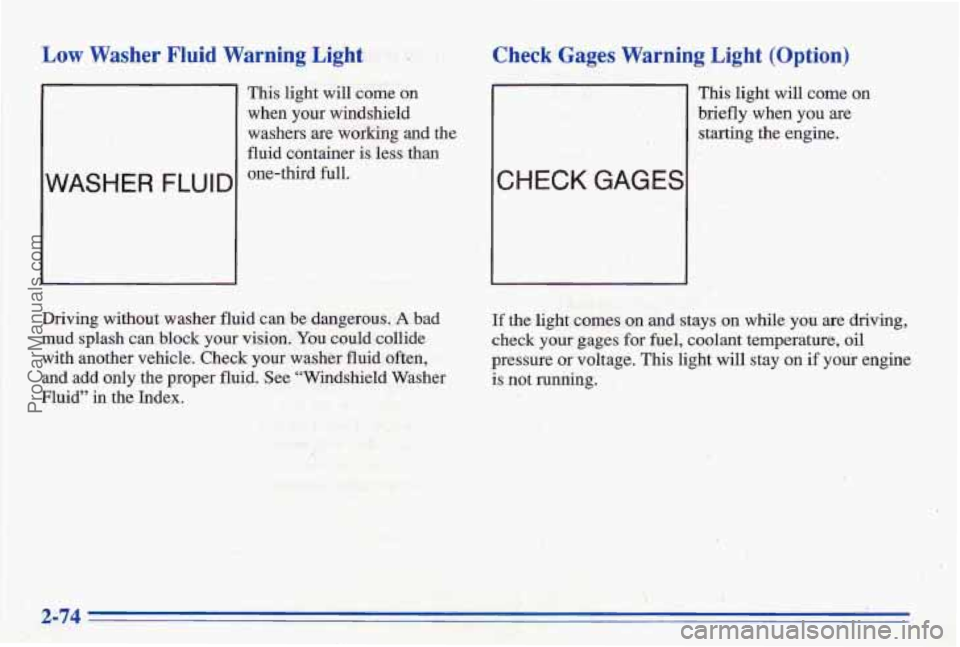
Low Washer Fluid Warning Light
WASHER FLUID
This light will come on
when your windshield
washers are working 'and the
fluid container is less
than
one-third full.
Check Gages Warning ,, Light (Option)
CHECK GAG.ES
This light will come on
briefly when you are
starting the engine.
Driving without washer fluid canbe dangerous.
A bad
mud splash can block
your vision. You could collide
with another vehicle. Check your washer
fluid often,
and add only the proper fluid. See "Windshield Washer
Fluid" in
the Index.
If the light comes on and stays on while you are driving,
check your gages for fuel, coolant temperature, okl
pressure or voltage. This light will stay on if your engine
is not running.
... . - ._
ProCarManuals.com
Page 126 of 387
Fuel Gage
Your fuel gage tells you about how much fuel you have
left, when the ignition is on. When the gage reads in the
yellow band, a warning chime will sound and the
CHECK GAGES warning light will go on, if you have
this option.
Here
are some things that some owners ask about. None
of these show a problem with your fuel gage:
At the service station, the gas pump shuts off before
It takes a little more or less fuel to fill up than the
the
gage reads
FULL (F).
gage indicated. For example, the gage may have
indicated the tank was half full, but it actually took a
little more or less than half the tank's capacity to fill
the tank.
0 The gage moves a little when you turn a corner,
The gage doesn't go back to EMPTY (E) when you
If you have the large span (220") gage, the needle
speed up, or make a hard stop.
turn off the ignition.
moves more
for a given amount of fuel. This does not
indicate excessive
fuel consumption, and is normal.
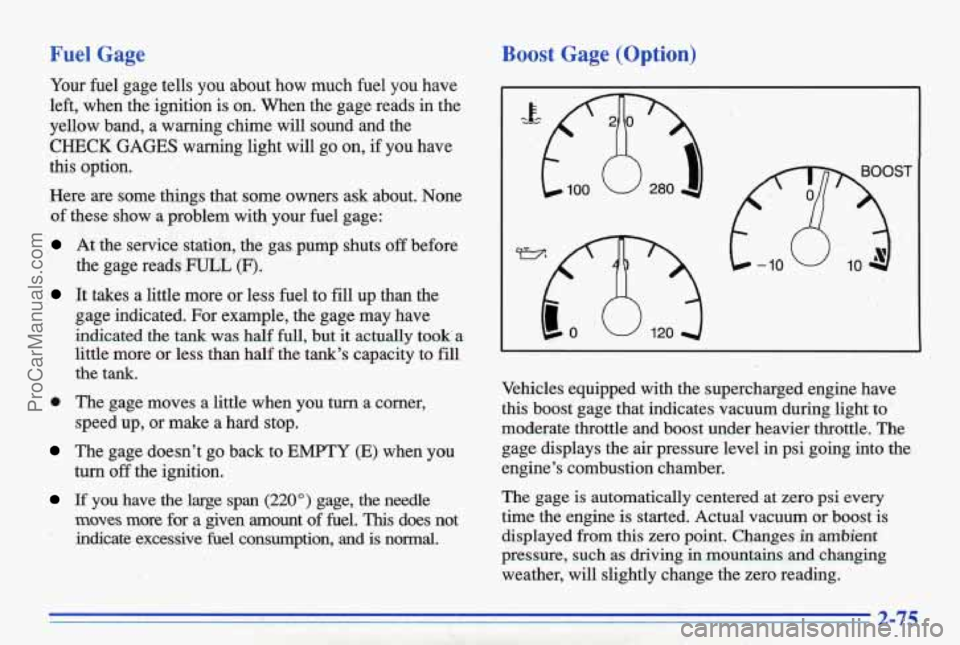
Boost Gage (Option)
OST
Vehicles equipped with the supercharged engine have
this boost gage that indicates vacuum during light to.
moderate throttle and boost under heavier throttle. The
gage displays the air pressure level in psi going into the
engine's combustion chamber.
The gage
is automatically centered at zero psi every
time the engine is started. Actual vacuum or boost is
displayed from this zero point. Changes
in ambient
pressure, such as driving in mountains and changing
weather, will slightly change the zero reading.
ProCarManuals.com
Page 130 of 387
Driver Information Center
3 (-1 INFORMATION (I , J,
DRIVER TRIP
CHECK OIL LEVEL
WASHER FLUID
LOW COOLANT
CHECK QAOES
VOOD DOOR
TRUNK AJAR I
I
MlLES
888888
LAMP
MONITOR
TURN SIQNAL
BACK UP TAIL
BRAKE LAMP
TRIP
8 B 8 8.8
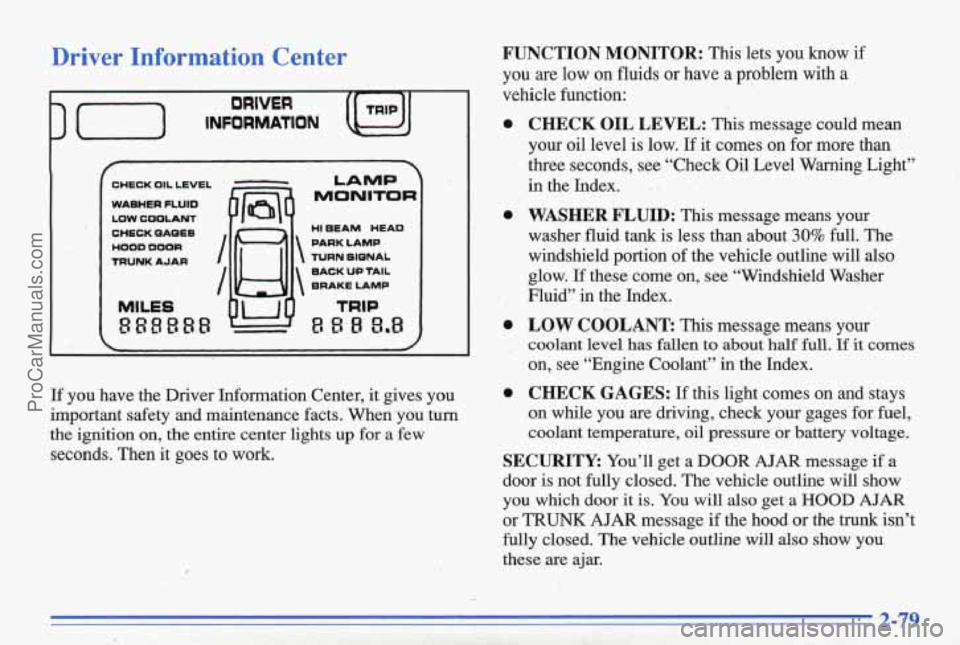
If you have the Driver Information Center, it gives you
important safety and maintenanc,e facts. When you turn
the ignition on, the entire center lights
up for a few
seconds. Then it goes to work.
. ..
..
.. -*
FUNCTION MONITOR: This lets you know if
you are low on fluids or have a problem with a
vehicle function:
CHECK OIL LEVEL: This message could mean
your oil level is low.
If it comes on for more than
three seconds, see "Check Oil Level
Warning Light" . ..
in the Index. - I
WASHER FLUID: This message means your
washer fluid tank is less than about
30% full. 'The
windshield portion of the vehicle outline
will also
glow.
If these come on, see "Windshield Washer
Fluid"
in the Index.
LOW COOLANT This message means your
coolant level has fallen to about half
full. If it comes
on, see "Engine Coolant" in the Index.
CHECK GAGES: If this light comes on and stays
on while you are driving, check your gages for fuel,
coolant temperature, oil pressure or battery voltage.
~. h I_ - I e:. ..
SECURITY: You'll get a DOOR AJAR message if a
door is not fully closed. The vehicle outline will show
you which door it is. You
will also get a HOOD AJAR
or TRUNK AJAR message if the hood or the trunk isn't
fully closed. The vehicle outline will
also show you
these are
ajar. ;,. . . ,--. . ,(/,,:-I.. - : , , .. , .. . . . .! _.
ProCarManuals.com
Page 173 of 387
Avoid needless heavy braking. Some people drive
in spurts -- heavy acceleration followed by heavy
braking
-- rather than keeping pace with traffic. This
is a mistake. Your brakes may not have time to cool
between
hard stops. Your brakes will wear out much
faster if you
do a lot of heavy braking. If you keep pace
with the traffic and allow realistic following distances,
you will eliminate
a lot of unnecessary braking. That
means better braking
and longer brake life.
If your engine ever stops while you’re driving, brake
normally but don’t pump your brakes. If you do, the
pedal may
get harder to push down. If your engine -
stops, you dill still have some power brake assist. But
you
will use it when you brake. Once the power assist is
used up,
it may take longer to stop and the brake pedal
will be harder tol push.
Anti-Lock Brakes
Your vehicle has anti-lock brakes (ABS). ABS is an
advanced electronic braking system that will help
prevent
a braking skid.
When you start your engine, or when you begin to drive
away, your anti-lock, brake system
will check itself. You
may hear a momentary motor or clicking noise while
this test is
going on, and you may even notice that your
brake pedal moves
a little. This is normal.
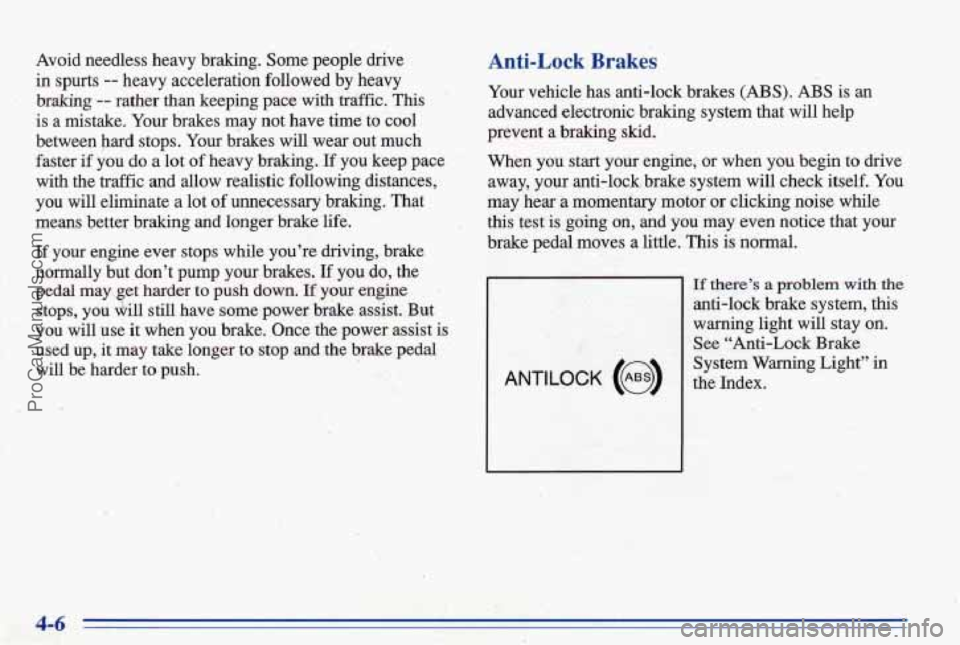
ANTILOCK (a)
If there’s a problem with the
anti-lock brake system, this
warning light will stay on.
See “Anti-Lock Brake
System
Warning Light” in
the Index.
4-6
ProCarManuals.com
Page 196 of 387
_I .
-- 1. <. i - .
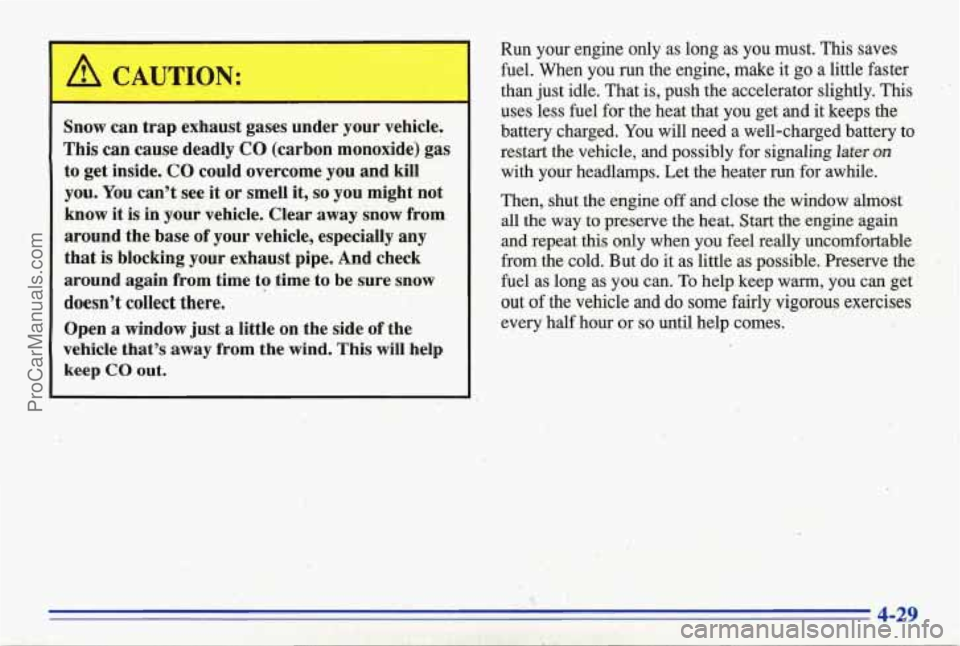
A CAUTION:
Snow can trap exhaust gases under your vehicle.
This can cause deadly CO (carbon monoxide)'gas
to get inside. CO could overcome you and kill
you. Youxan't see
it or smell it, so you might not
~QW it is in your vehicle. Clear away snow from
around the base of your vehicle, especially any
that is blocking your exhaust pipe. And check
around again from time to time to be sure snow
doesn't
collect there.
Open
a window just a little on the side of the
vehicle
that's away from the wind. This will help
keep CO out.
Run your engine only as long as you must. This saves
fuel. When you run the engine, make it
go a little faster
than just idle. That is, push the accelerator slightly.
This
uses less fuel for the heat that you get and it keeps the
battery charged. You will need a well-charged battery to
restart the vehicle, and possibly for signaling
later OIZ
with your headlamps. Let the heater run for awhile.
Then, shut the engine
off and close the window almost
all the way to preserve the heat. Start the engine again
and repeat
this only when you feel really uncomfortable
from the cold. But do it as little as possible. Preserve the
fuel as long as you can.
To help keep warm, you can get
out of the vehicle and do some fairly vigorous exercises
every half hour or so until help comes.
4-29
a. . ProCarManuals.com
Page 204 of 387
Making Turns
NOTICE:
Making very sharp turns while trailering could
cause the trailer to come in contact with the
vehicle. Your vehicle could be damaged. Avoid
making very sharp turns while trailering.
When you’re turning with a trailer, make wider turns than
normal. Do this so your trailer won’t strike soft shoulders,
curbs, road signs, trees or other objects. Avoid jerky
or
sudden maneuvers. Signal well in advance. ‘
. Turn ,Signals When Towing a Trailer’
When you tow a trailer, your vehicle may need a
different
turn signal flasher and/or extra wiring. Check
with your Pontiac dealer. The green
arrows on your
instrument panel will flash whenever you signal a turn
or lane change. Properly hooked up,’ the trailer lamps
will also flash, telling other drivers you’re about to turn,
change lanes or stop. When towing a trailer, the green arrows
on your
instrument panel will flash for turns
even if the bulbs on
the trailer are burned out.
Thus, you may think drivers
behind you are seeing your signal when they are not. It’s
important to check occasionally to be sure the trailer
bulbs are still working.
Your vehicle has bulb warning lights. When you’plug
a trailer lighting system into your vehicle’s lighting
system, its bulb warning lights may not let you
know if
one of your lamps goes out. So, when you have a trailer
lighting system plugged in, be sure to check your
vehicle and trailer lamps
from time to time to be sure
they’re
all working. Once you disconnect the trailer
lamps, the bulb warning lights again can tell you
if one
of ypur vehicle lamps is out.
Driving On Grades
Reduce speed and shift to a lower gear before you start
down a long or steep downgrade.
If you don’t shift
down, you might have to use your brakes so much that
they. would get hot
and no longer work well.
On a long uphill grade, shift down to Dm (D) and
reduce your speed to around
45 mph (70 km/h) to reduce
the possibility of engine and transaxle overheating.
4-37
ProCarManuals.com
Page 208 of 387
1. Check the other vehicle. It must have a 12-volt
battery with
a negative ground system.
NOTICE:
If the other system isn’t a 12-volt system with a
negative ground, both vehicles can be damaged.
2. Get the vehicles close enough so the jumper cables
can reach, but be sure the vehicles aren’t touching-
each other.
If they are, it could cause a ground
connection you don’t want. You wouldn’t be able
to
start your Pontiac, and the bad grounding could
damage the electrical systems.
You could be injured
if the vehicles roll. Set the
parking brake firmly on each vehicle. Put an
automatic transaxle in PARK (P) or a manual
transaxle
in NEUTRAL (N).
3. Turn off the ignition on both vehicles. Unplug
unnecessary accessories plugged into the cigarette
lighter. Turn
off all lamps that aren’t needed as well
I as radios. This will avoid sparks and help save both
batteries. In addition, it could save your radio!
NOTICE:
If you leave your radio on, it could be badly
damaged.
The repairs wouldn’t be covered by
your warranty.
4. Open the hoods and locate the batteries.
An electric fan can start ~ even wl 3 the engine
is not running and can injure you. Keep hands,
clothing and tools away
from any underhood
electric fan.
5-3
ProCarManuals.com
Page 209 of 387
Using a match near a battery can cause battery
gas to exp1ode:People have been hurt doing this,
and some have been blinded. Use a flashlight
if
you need more light.
Be
sure the battery has enough water. You don’t
need to
add water to the Deko Freedom@ battery
installed
in every new GM vehicle, But if a battery
has filler caps, be sure the right mount of fluid is
there. If it is low, add water to take care of that first.
If you don’t, explosive gas could be present.
Battery fluid contains acid that can burn
you,
Don’t get it on you. If you accidentally get it in
your eyes
or on your skin, flush the place with
water and get medical help immediately.
5. Find the positive (+) and negative (-) terminals on
6. Check that the jumper cables don’t have loose or
each
battery.
missing insulation. If they do, you
could get a shock.
The vehicles could be damaged, too.
Before
you connect the cables, here are some basic
things you should know. Positive (+) will go to
positive (+) and negative (-) will go to negative (-)
or a metal engine part. Don’t connect positive (+)’ to
negative (-) or you’ll get a short that would damage
the battery and maybe other parts, too.
A CAUTION: I .
m Fans or other moving engme parts can injure yon
badly. Keep your hands away from moving parts
once the engines are running.
5-4
ProCarManuals.com