Page 191 of 340
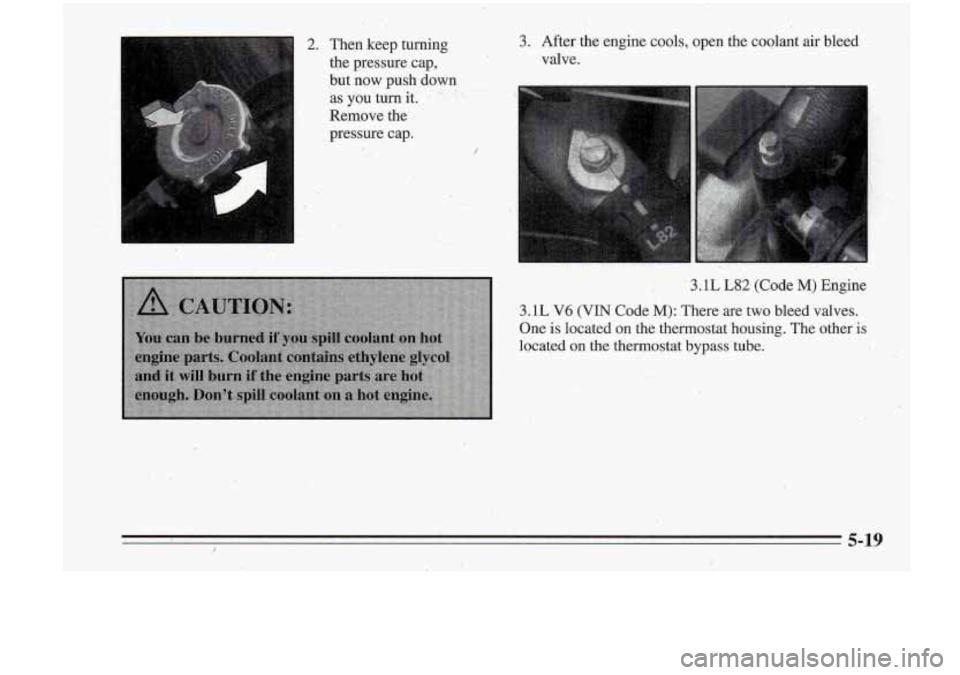
3. After the engine cools, open the coolant air bleed
valve.
3: ...
. -. 1 .. ., ..
,. I, . " "3; 1L L82 (Code M) Engine
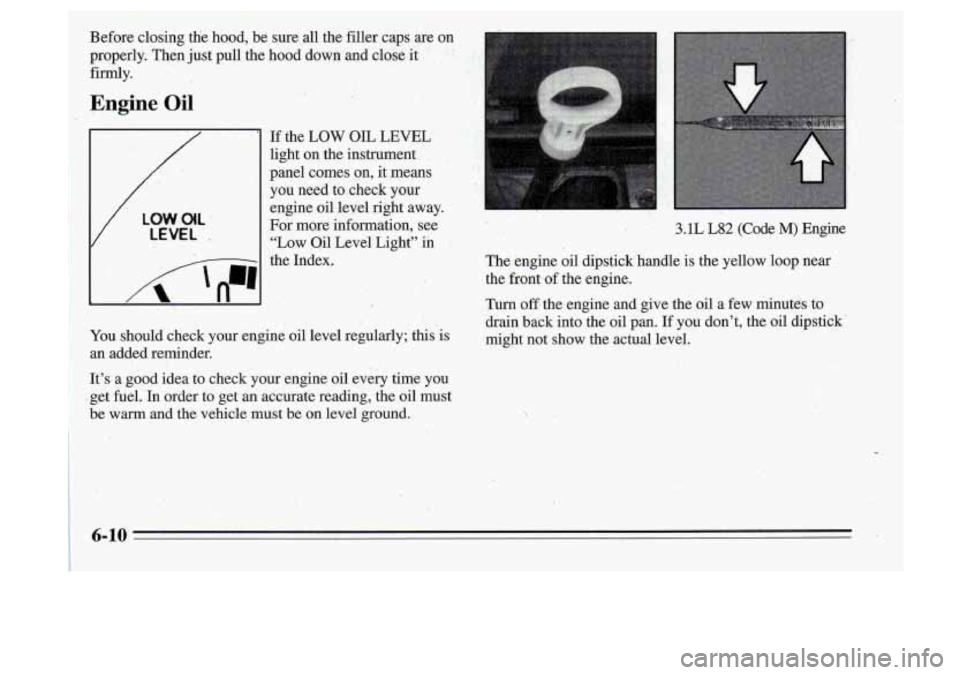
3.1L V6 (VIN Code M): There are two bleed valves.
One
is located on the thermostat housing. The other is
located on the thermostat bypass tube.
/ 5-19
Page 192 of 340
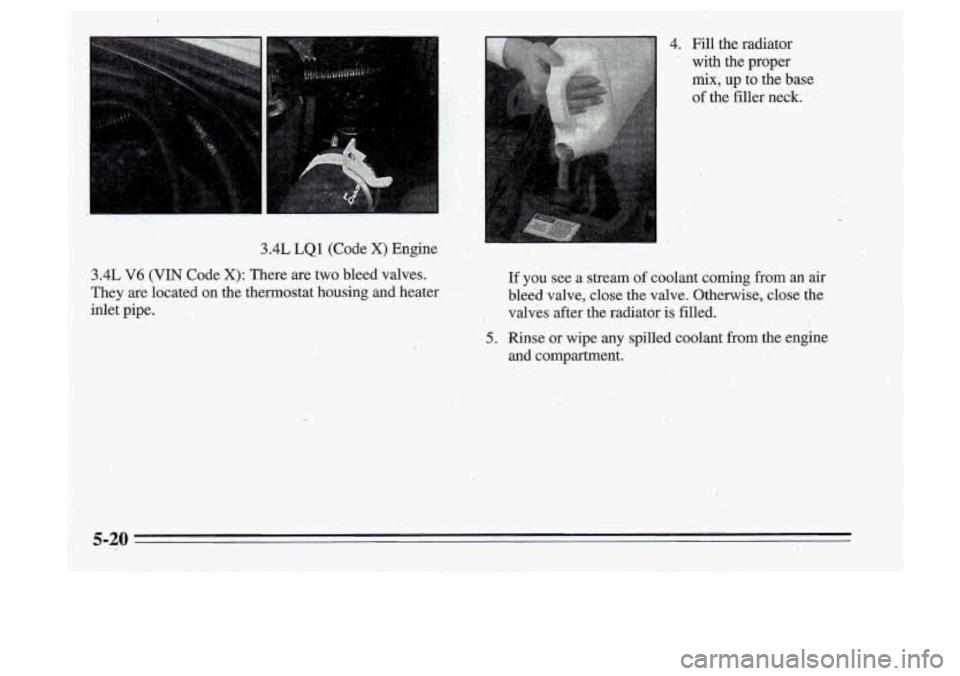
3.4L LQ1 (Code X) Engine
They are located
on the thermostat housing and heater
inlet pipe.
1 3.4L V6 (VIN Code X): There are two bleed valves.
4. Fill the radiator
with the proper
mix,
up. to the base
of the 'filler neck.
If
you see a stream.of coolant coming from an air
bleed valve, close the valve. Otherwise, close the-
valves after the radiator i.s filled.
5. Rinse or wipe any spilled coolant from the engine
and compartment.
Page 193 of 340
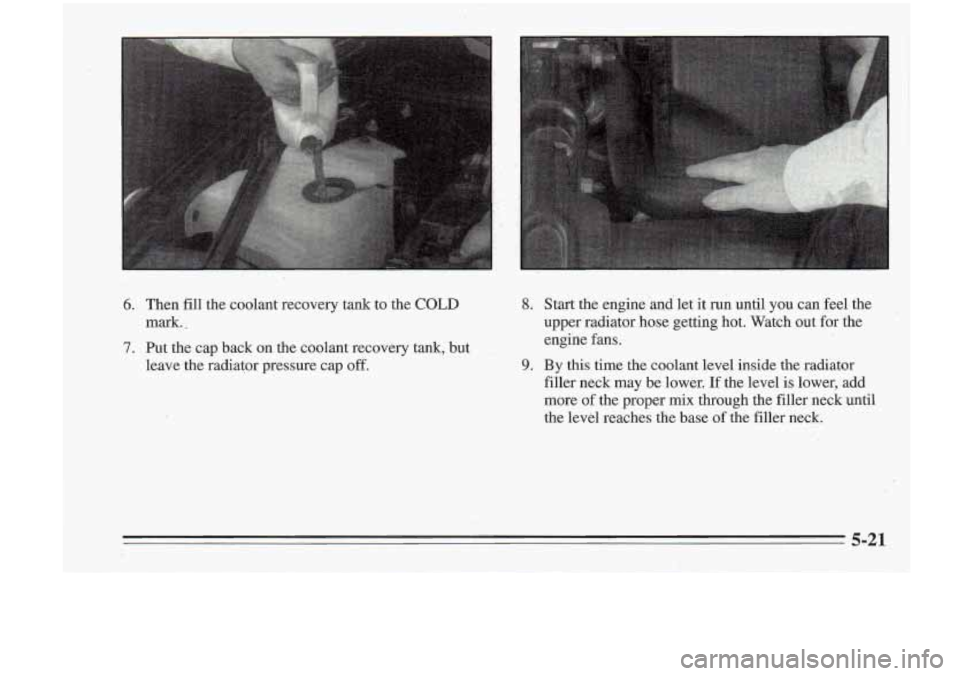
6. Then fill the coolant recovery tank to the COLD
7. Put the cap back on the coolant recovery tank, but
mark.
-
leave the
radiator pressure cap off.
8. Start the engine 'and let it run until you can feel the
upper radiator hose getting hot. Watch out for the
engine fans.
filler neck may be lower. If the level
is lower, add
more of the proper
mix through the filler neck until
the level reaches the base of the filler neck.
9. By this time the coolant level inside the radiator
5-21 ~.
Page 194 of 340
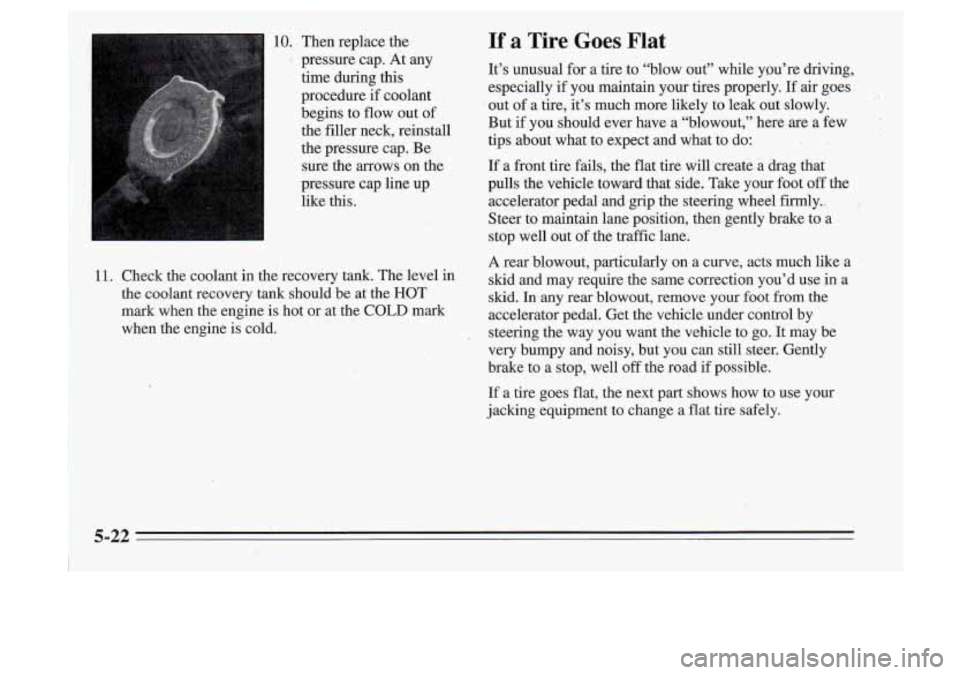
10. Then replace the
’ pressure cap. At any
time during this
procedure if coolant
begins to flow out of
the filler neck, reinstall
the pressure cap. Be
sure the arrows on the
pressure cap line up
like this.
11. Check the coolant in the recovery tank. The level in
the coolant recovery tank should be at the HOT
mark when the engine
is hot or at the COLD mark
when the engine
is cold.
If a Tire Goes Flat
It’s unusual for a tire to “blow out” while you’re \
driving,
especially
if you maintain your tires properly. If air goes
out
of a tire, it’s much more likely to leak out slowly.
But if you should ever have a “blowout,” here are a few
tips about what to expect and what to do:
If a front tire fails, the flat tire will create a drag that
pulls the vehicle toward that side. Take your foot
off the
accelerator pedal and grip the steering wheel firmly.,
Steer to maintain lane position, then gently brake to a
stop well out of the traffic lane.
A rear blowout, particularly on a curve, acts much like a
skid and may require the same correction you’d use in a
skid. In any rear blowout, remove your foot from the
accelerator pedal. Get the vehicle under control by
steering the way you want the vehicle to go.
It may be
very bumpy and noisy, but you can still steer. Gently
brake to a stop, well
off the road if possible.
If a tire goes flat, the next part shows how to
use your
jacking equipment to change a flat tire safely.
Page 207 of 340
Fuel
Use regular unleaded gasoline rated at 87 octane or
higher. It should meet specifications ASTM
D4814 in
the United States and CGSB
3.5-92 in Canada. These
fuels should have the proper additives,
so you should not
have to add anything to the fuel.
In the United States and Canada, it’s easy to be sure you
get the right kind of gasoline (unleaded). You’ll see
UNLEADED right on the pump. And only unleaded
nozzles will fit into your vehicle’s filler neck.
Be sure the posted octane.is at least 87.
If the octane is
less than 87, you may get a heavy knogking noise when
you drive.
If it’s bad enough, it can‘damage your engine.
If you’re using fuel rated at 87 octane or higher and you
still’hear heavy knocking, your engine needs service.
But don’t worry
if you hear a little pinging noise when
you’re accelerating
or driving up a hill. That’s normal,
and you don’t have to buy a higher octane fuel to get rid
of pinging. It’s the heavy, constant knock that means
you have a problem.
‘4
What about gasoline with blending materials that
contain oxygen (oxygenates), such as MTBE or alcohol?
MTBE is “methyl tertiary-butyl ether.” Fuel that is no
more than
15% MTBE is fine for your vehicle.
Ethanol is ethyl or grain alcohol. Properly-blended fuel
that is no more than
10% ethanol is fine for your
vehcle.
Methanol is methyl or wood alcohol.
NOTICE:
Fuel that is more than 5% methanol is bad for
your vehicle. DonTt use it. It can corrode metal
parts in your fuel system and also damage plastic
and rubber parts. That damage wouldn’t b,e
, covered under your warranty. And even at 5% or
less,, there must be “cosolvents”
and corrosion
preventers in
this fuel to help avoid these
problems.
Page 208 of 340
I
Gasolines for Cleaner Air
Your use of gasoline with deposit control additives will
help prevent deposits from forming in your engine and
fuel system. That helps keep your engine in tune and
your emission control system working properly. It’s
good for your vehicle, and you’ll be doing your part for
cleaner air.
Many gasolines are now blended with oxygenates. General Motors recommends that you use gasolines with
these blending materials, such as MTBE and ethanol. By
doing
so, you can help clean the air, especially in those
parts of the country that have high carbon monoxide levels.
In addition, some gasoline suppliers are now producing
reformulated gasolines. These gasolines are specially
designed to reduce vehicle emissions. General Motors
recommends that you use reformulated gasoline. By doing
so, you can help clean the air, especially in those
parts of the country that have high ozone levels.
You should ask your service station operators if their
gasolines contain deposit control additives and
oxygenates, and
if they have been reformulated to
reduce vehicle emissions.
Fuels in Foreign Countries
If you plan on driving in another country outside the
U.S. or Canada, unleaded fuel may be hard to find. Do
not use leaded gasoline. If you use even one tankful,
your emission controls won’t work well or at all. With
continuous use, spark plugs can get fouled, the exhaust
system can corrode, and your engine oil can deteriorate
quickly. Your vehicle’s oxygen sensor will be damaged.
All of that means costly repairs that wouldn’t be covered
by your warranty.
To check on fuel availability, ask an auto club, or
contact a major oil company that does business in the
country where you’ll be driving.
You can also write us at the following address for
advice. Just tell
us where you’re going and give your
Vehicle Identification Number (VIN).
General Motors Overseas Distribution Corporation
North American Export Sales (NAES)
1908 Colonel Sam Drive
Oshawa, Ontario
L1H 8P7
6-4 .I
Page 213 of 340
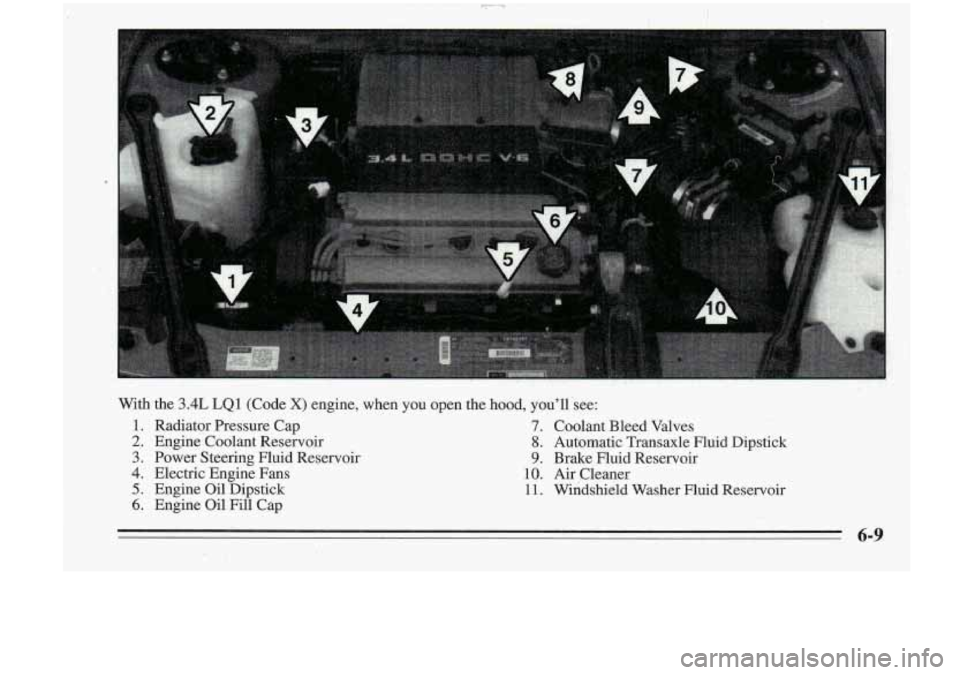
With the 3.4L LQ1 (Code X) engine, when you open the hood, you’ll see:
1. Radiator Pressure Cap
2. Engine Coolant Reservoir
3. Power Steering Fluid Reservoir
4. Electric Engine Fans
5. Engine Oil Dipstick
6. Engine Oil Fill Cap
7. Coolant Bleed Valves
8. Automatic Transaxle Fluid Dipstick
9. Brake Fluid Reservoir
10. Air Cleaner
11. Windshield Washer Fluid Reservoir
6-9
Page 214 of 340
Before closing the hood, be sure all the filler caps are on
properly. Then just pull the hood down and close it
firmly.
Engine Oil .. , ‘I: ~. ’. .I
LOW OIL
LEVEL
If the LOW OIL LEVEL
light on the instrument
panel co-mes on, it means
you need to check your
engine oil level right away.
For more information, see “Low Oil Level Light” in
the Index.
You should check your engine oil level regularly; this is
an added reminder.
It’s a
good idea to check your engine oil every time you
get
fuel. In order to get an accurate reading, the oil must
be warm
and the vehicle must be on level ground.
c
,3.1L.L82 (Code M) Engine
The engine
oil dipstick handle is the yellow loop near
the front of the engine.
Turn. off, the engine and give the oil a few minutes to
drain back into the oil pan. If you don’t, the oil dipstick ’
might not show the actual level.