Page 259 of 340
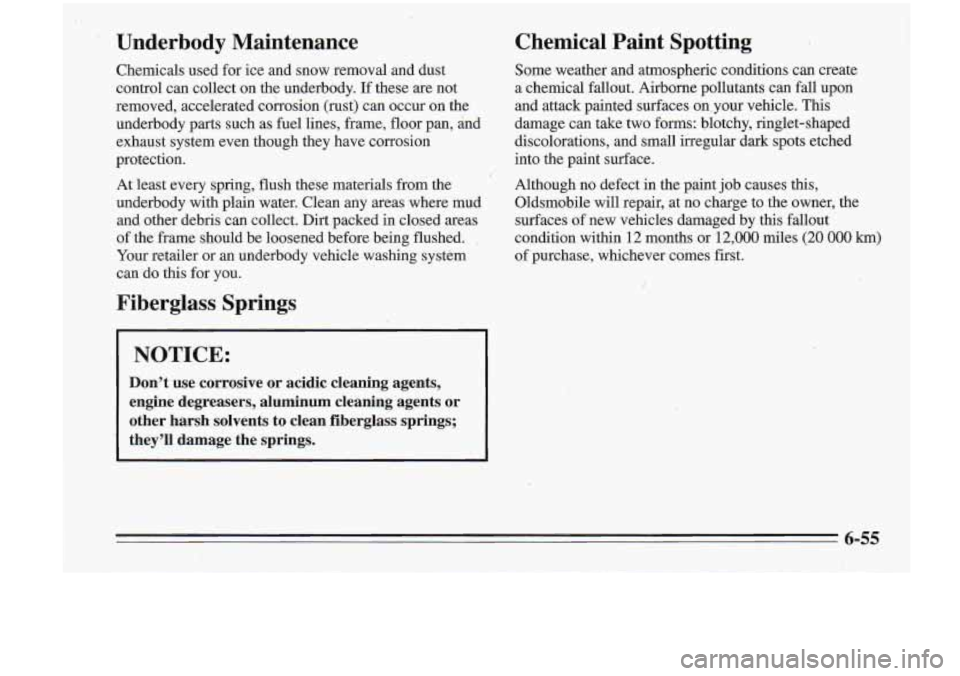
Underbody Maintenance
Chemicals used for ice and snow.removal and dust
control can collect on the underbody.
If these .are not
removed, accelerated coirosion (rust) can occur on the
underbody
parts such as fuel lines, frame, floor pan, and
exhaust system even though they have corrosion
protection.
At least every spring, flush these materials from the
underbody with plain water. Clean any areas where mud
and other debris can collect. Dirt packed in closed areas
of the frame should be loosened before being flushed.
Your retailer
or an underbody vehicle -washing system
can do this for you.
Fiberglass Springs
I
NOTICE: 1
Don’t use corrosive or acidic cleaning agents,
engine degreasers, aluminum cleaning agents or
other harsh solvents to clean fiberglass springs;
they’ll damage the springs.
Chemical Paint Spotting
Some weather and atmospheric conditions can create
a chemical fallout. Airborne pollutants can fall upon
and attack painted surfaces on,your vehicle. This
damage can take two
forms: blotchy, ringlet-shaped
discolorations, and small irregular dark spots etched
into the paint surface.
Although
no defect in the paint job causes this,
Oldsmobile will repair, at no charge to the owner, the
surfaces of new vehicles damaged by this fallout
condition within
12 months or 12,000 miles (20 000 h)
of purchase, whichever comes first.
6-55
Page 261 of 340
I.
Vehicle Identification Number (VIN)
I
U I
ENGINE / 1.&5 ASSEMBLY
CODE MODEL YEAR PLANT
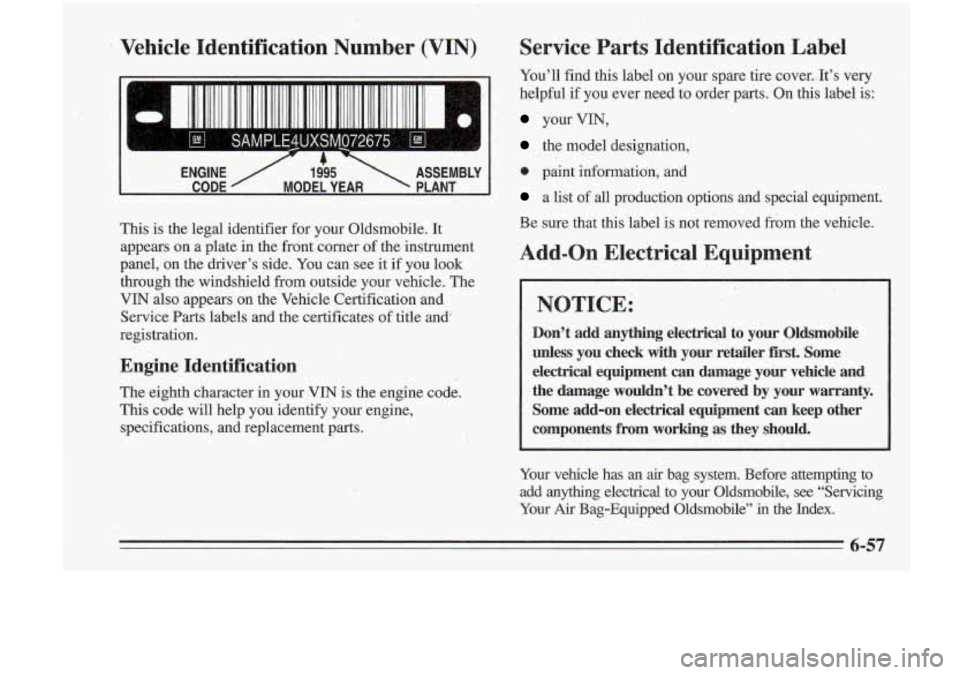
This is the legal identifier for your Oldsmobile. It
appears on a plate in the front corner of the instrument
panel,
on the driver’s side. You can see it if you look
through the windshield from outside your vehicle. The
VIN also appears on the’vehicle Certification and
Service
Parts labels and the certificates of title and’
registration.
Engine Identification
The eighth character in your VIN is the engine code.
This code will help you identify your engine,
specifications, and replacement parts.
Service Parts Identification Label
You’ll find this label on your spare tire cover. I It’s very
helpful if you ever need
to order parts. On this label is:
your VIN,
the model designation,
9 paint information, and
a list of all production options and special equipment.
Be sure that this label
is not removed from the vehicle.
Add-on Electrical Equipment
NOTICE:
Don’t add anything electrical to your Oldsmobile
unless you check with your, retailer
first. Some
electrical equipment can damage your vehicle and
the damage wouldn’t be covered by your warranty. Some add-on electrical eqtiipment can keep other
components from working
as they should.
Your vehicle has an air bag system. Before attempting to
add anythng electrical to your Oldsmobile, see “Servicing
Your
Air Bag-Equipped Oldsmobile” in the Index.
Page 271 of 340
1 Section 7 Maintenance Schedule
I
IMPORTANT:
KEEP ENGINE OIL
AT THE PROPER
LEVEL AND CHANGE AS
RECOMMENDED
This section covers the $ naintenml ce required for yoiir
Oldsmobile. Your vehicle,needs these services to retain its
safety, dependability .and emission control performar ,
Introduction
Your Vehicle and the Environment
Proper vehicle maintenance not only helps to keep your
vehicle in good working condition, but also helps the
environment. All recommended maintenance procedures
are important. Improper vehicle maintenance or the
removal of important components can significantly
affect the quality 'of the air we breathe. Improper fluid
levels or even the wrong tire inflation can increase the
level of emissions from your vehicle.
TO help protect our
environment, and to help keep your vehicle ingood
condition, please maintain your vehicle properly.
Have you purchased the GM Protection -Plan? The Plan
supplements
your new vehicle warranties. See your
Oldsmobile retailer for details.
7-1
Page 274 of 340
,i
Maintenance Schedule
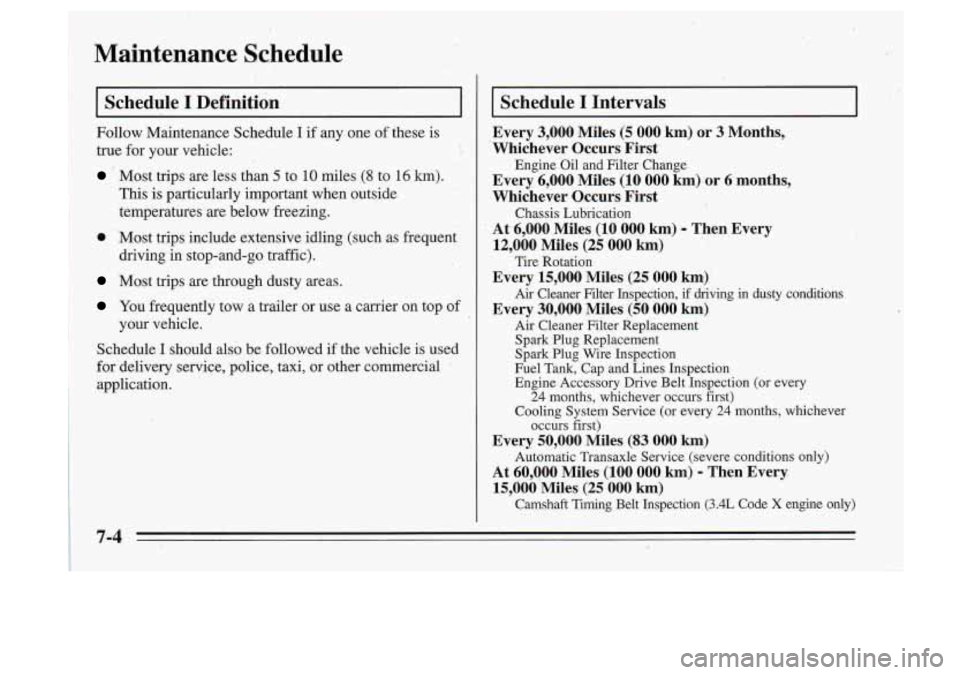
Schedule I Definition
Follow Maintenance Schedule I if any one of these is
true for your vehicle:
' Most tripsare less than 5 to 10 miles (8 to 16 km).
This 'is particularly important when outside
temperatures are below freezing.
0 'Most trips include extensive idling (such as frequent
driving in stop-and-go traffic).
Most trips are through dusty areas.
You frequently tow a trailer or use a carrier on top of
Schedule
I should also be followed if the vehicle is used
for delivery service, police, taxi, or other commercial
application. your vehicle.
I Schedule I Intervals
Every 3,000 Miles (5 000 b) or 3 Months,
'Whichever Occurs First
Every
6,000 Miles (10 000 km) or 6 months,
Whichever Occurs First
Chassis Lubrication
At-6,000 Miles (10 000 km) - Then Every
12,000 Miles (25 000 km)
Every 15,000 Miles (25 000 km).
Every 30,000 Miles (50 000 km),
Engine Oil and Filter Change
I
Tire Rotation
Air Cleaner Filter Inspection, if driving in dusty conditic
Air Cleaner Filter Replacement Spark Plug Replacement
Spark Plug Wire Inspection
Fuel Tank, Cap and Lines Inspection
Engine Accessory Drive Belt Inspection (or every 24 months, whichever occurs
first)
ms
Cooling System Service (or every
24 months, whichever
occurs first)
Every 50,000 Miles (83 000 km)
At 60,000 Miles (100 000 km) - Then Every.
15,600 Miles (25 000 km)
Autdmatic Transaxle Service (severe conditions only)
Camshaft Timing Belt Inspection (3.4L Code
X engine only)
7-4
!
Page 275 of 340
Maintenance Schedule
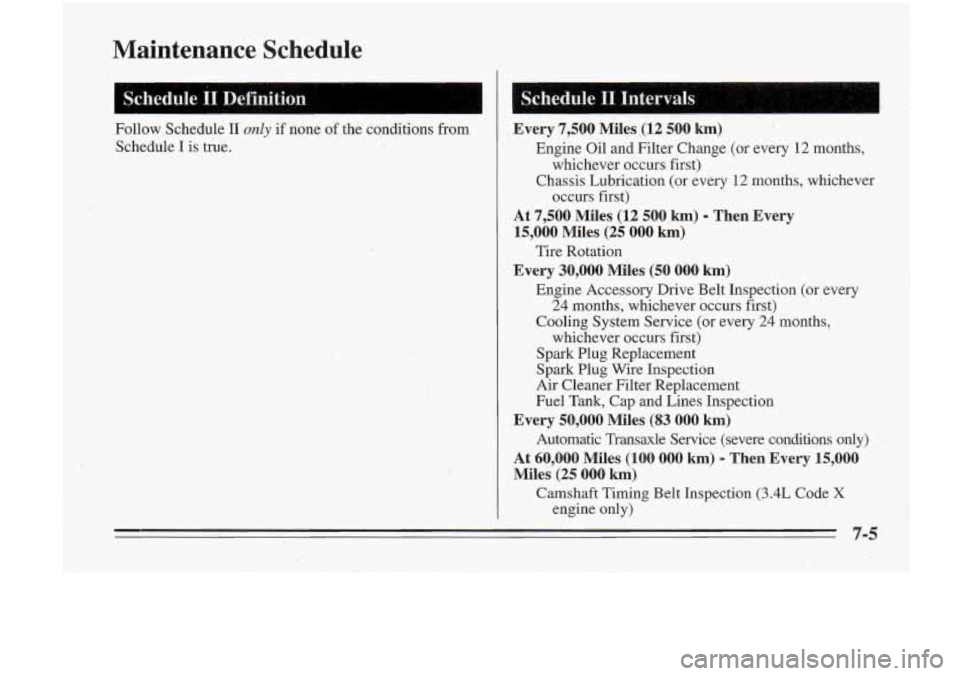
Schedule II~Definition
Follow Schedule II only if none of the conditions from
Schedule
I is true.
I
1:; S.chedule 11. Intervals (1, a 1 k I ,
Every 7,500 Miles,(l2 500 km)
Engine Oil and Filter Change (or every 12 months,
Chassis Lubrication (or every
12 months, whichever
whichever occurs
first)
occurs first)
At 7,500 Miles (12 500 km) - Then Every
15,000 Miles (25 000 km)
Every 30,000 Miles (50 000 km)
Tire Rotation
Engine Accessory Drive Belt Inspection (or every
24 months, whichever bccurs first)
Cooling System Service (or every
24 months,
whichever occurs first)
Spark Plug Replacement
Spark Plug Wire Inspection
Air Cleaner Filter Replacement
Fuel Tank, Cap and Lines Inspection
Automatic Transaxle Service (severe conditions only)
Every 50,000 Miles (83 000 km)
At 60,000 Miles (100 000 km) - Then Every 15,000
Miles (25 000 km)
Camshaft Timing Bel& Inspection (3.4L Code X
engine only)
7-5
Page 277 of 340
I Maintenance Schedule I I
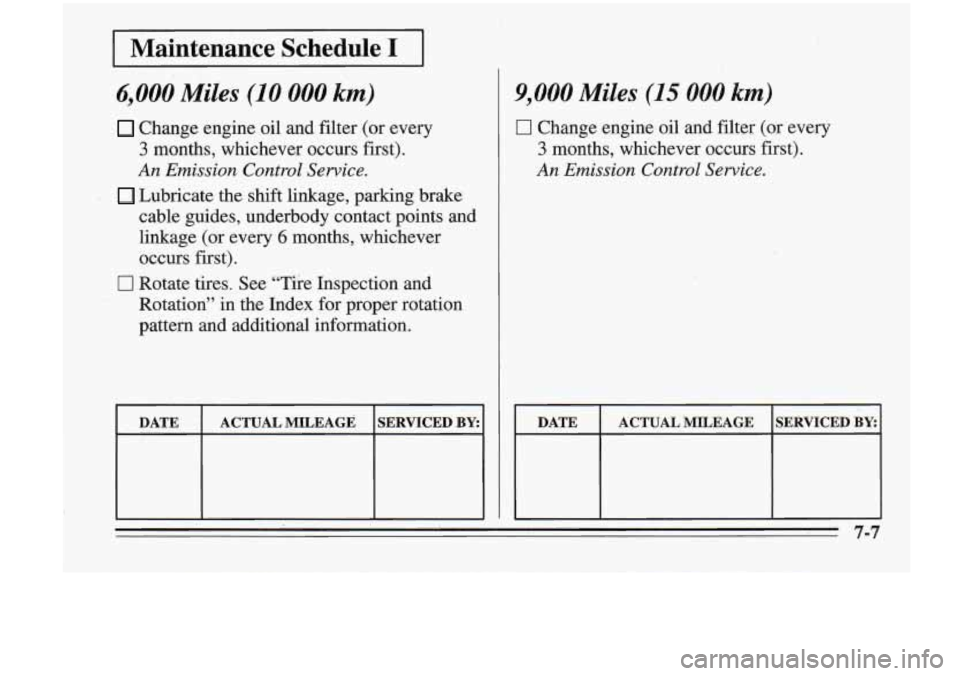
6,000 Miles. (10 000 km)
Change engine oil and filter (or every
3 months, whichever occurs first).
An Emission Control Service.
cable guides, underbody contact points and
linkage (or every
6 months, whichever
occurs first).
0 Rotate tires. See “Tire Inspection and
Rotation’’ in the Index for proper rotation
pattern and additional information.
. -Lubricate the shift linkage, parking brake
I DATE I ACTUAL MILEAGE ISERVICED BYJ
9,000 Miles (15 000 km)
0 Change engine oil ,and filter (or every
3 months, whichever occurs first).
An Emission Control Service.
DATE SERVICED BY: ACTUAL MILEAGE
Page 278 of 340
I
I Maintenance Schedule I I
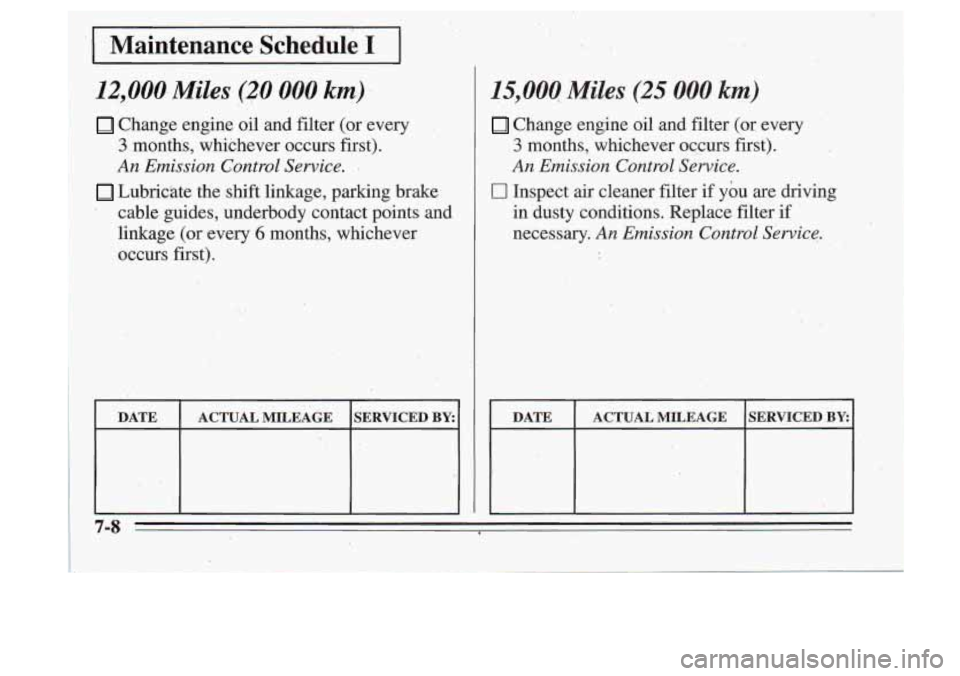
12,OOO.,Miles (20 000 km)
Change engine oil and filter (or every
3 months, whichever occurs first).
An Emission Control Service.
.
Lubrichte the shift linkage, parking brake
d cable guides, underbody contact points and
linkage (or every
6 months, whichever
occurs first).
DATE ACTUAL MILEAGE SERVICED BY:
I
.. ,_ i LI ..
15,000 Miles. (25 000 km)
Change engine oil and filter (or every
3 months, whichever occurs first).
An Emission Control Service.
CI Inspect air cleaner filter if you are driving
in dusty conditions. Replace filter if
necessary. An Emission Control Service.
DATE
L
ACTUAL MILEAGE SERVICED BY:
-
7-8 *
Page 279 of 340
I Maintenance Schedule 1’ I
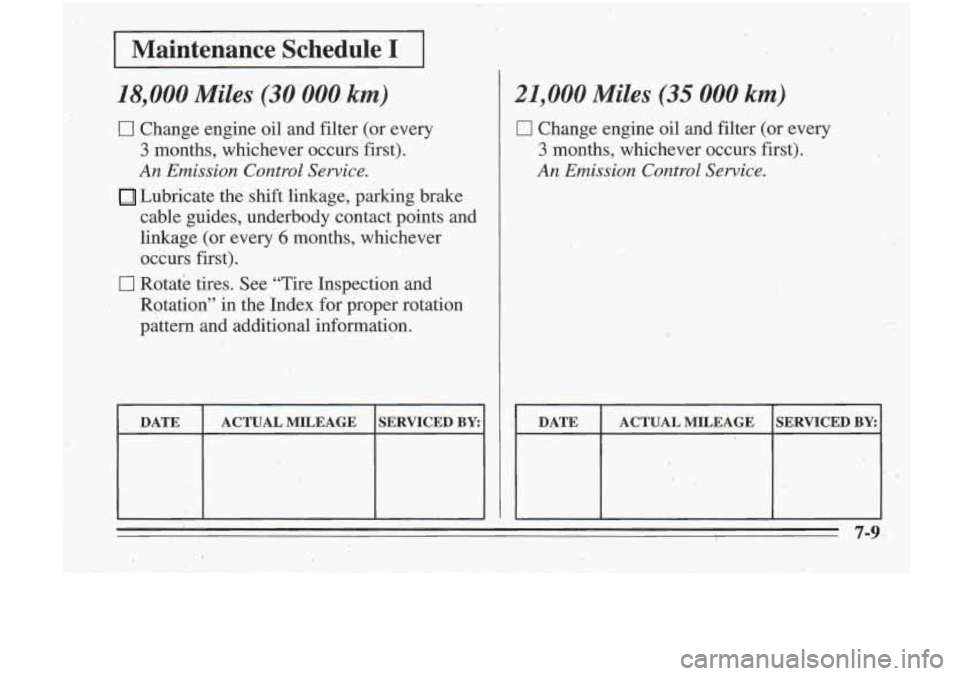
18,000 Miles (30’000, km)
0 Change engine oil and filter (or every
3 months, whichever occurs “first).
An Emission Control Service.
Lubricate the shift linkage, parking brake
cable guides, underbody contact points and
linkage (or every
6 months, whichever
occurs first).
0 Rotate tires. See “Tire Inspection and
Rotation”
in the Index for proper rotation
pattern and additional information.
, DATE SERVICED
BE
ACTUAL MILEAGE
21,000 Miles (35 000 km)
0 Change engine oil and filter (or every
3 months, whichever occurs first).
An Emission Control Service.
. SERVICEDBY:
ACTUALMILEAGE
DATE ,
7-9,