1995 Oldsmobile Cutlass Supreme engine
[x] Cancel search: enginePage 157 of 340
3 Once you are m,oving on the freeway, make certain you
allow a reasonable following distance. Expect to move
slightly slower at night.
When you want to leave the freeway, move to the proper
lane well in advance.
If you-miss your exit do not, under
any circumstances, stop and back up. Drive on to the
next exit.
The exit ramp can be curved, sometimes quite sharply.
The exit speed is usually. posted.
Reduce your speed according to your speedometer, not
to your sense of motion. After driving for any distance
at higher speeds, you may tend to think you are going
slower’than you actually are.
Before Leaving on a Long- Trip
Make sure you’re ready. Try to be well rested. If you
must
start when you’re not fresh -- such as after a day’s
work
.-- don’t plan to make too many miles that first part
of the journey. Wear comfortable clothing and shoes you
can easily drive in. Is your vehicle ready
for a long trip? If you keep it
serviced and maintained, it’s ready to go.
If it needs
service, have it done before starting out. Of course,
you’ll find experienced and able service experts in
Oldsmobile retailers all across North America. They’ll
be ready and willing to help
if you need it.
Here are some things you can check before a trip:
0
0
0
0
0
0
0
,Windshield Washer Fluid: Is the reservoir full? Are
all windows clean inside and outside?
Wiper Blades: Are they in good shape?
Fuel, Engine Oil, Other FZuids: Have you checked
all levels?
,
Lights: Are .they all working? Are the lenses clean?
Tires: They are vitally important to a safe,
trouble-free trip. Is the tread gaod enough for
long-distance driving? Are the tires all inflated to the
recommended pressure?
Weather Forecasts: What’s the weather outlook
along your route? Should you delay your trip a short
time‘to avoid a major
storm system?
Maps: Do you have up-to-date maps?
,
Page 159 of 340
If you drive regularly in steep country, or if you're
planning to visit there, here are some tips that can make
your trips safer and more enjoyable.
Keep your vehicle-in good shape. Check all fluid
1evel.s and. also the brakes; tires, cooling system and
..
transaxle. These parts can work,hard on mountain
roads.
Know how to go down hills. The most important
thing to know is this: let your' engine do some of the
slowing down. Shift to a lower, gear when you go
down a steep or long hill.
e Know, how to gauphill. You may want to shift down
to a lower gek The 1ower.gearshelp cool your engine
and tramaxle, and you can climb the hill better.,
Stay in your own lane when driving on two-lane
roads
iri hills or mountains. Don't swing wide or cut
'% across the center of the road, Drive at speeds that let
you stay
in your own lane.
As you go over the top of a hill, be alert. There, dould
be something in your lane, like a stalled ca~
or an
accident.
You.m&y see highway ,signs on mountains that warn
,of special problems. Examples are long grades,
passing
or no-passing zones, a falling rocks &ea, or
winding roads. Be aleq to these aad'take appropriate
action.
,,
4-21
Page 160 of 340
Winter Driving
Here are some tips for winter driving:
Have your Oldsmobile in good shape for winter. Be
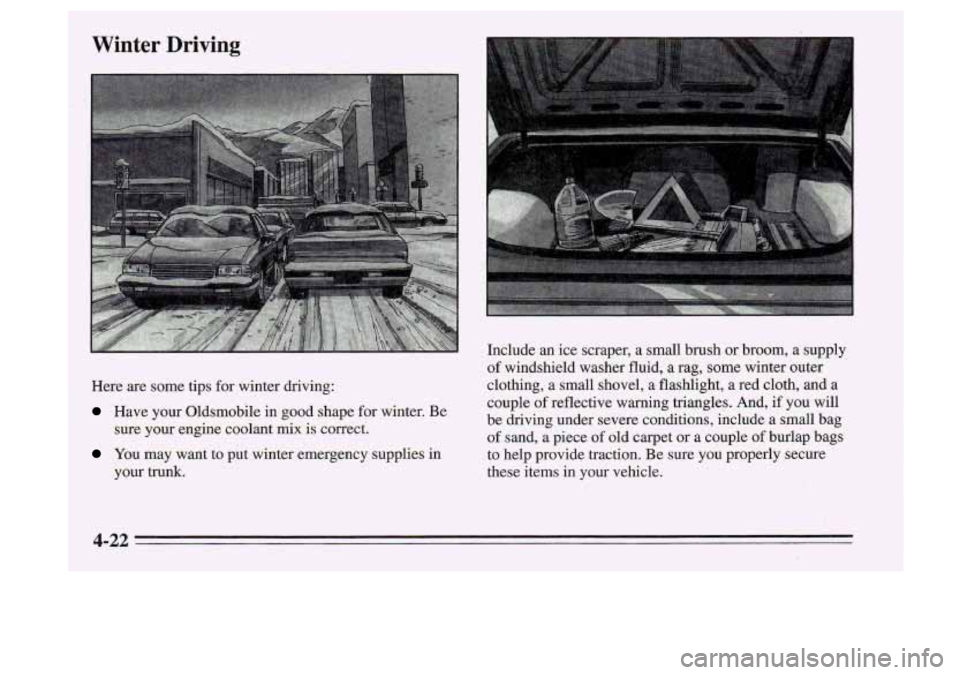
You may want to put winter emergency supplies in
sure your
engine coolant
mix is correct.
your
trunk.
Include an ice scraper, a small brush or broom, a supply
of .windshield washer fluid, a rag, some winter outer
clothing, a small shovel,
.a flashlight, a red cloth, and a
couple of reflective warning triangles. And, if you will
be driving under severe conditidns, include a small bag
of sand, a piece of old carpet or a couple of burlap bags
to help provide .traction. Be sure you properly secure
these items in your vehicle.
4-22
Page 167 of 340
I
I
If You Do Decide To Pull A Trailer
If you do, here are some important points.
0 There are may different laws, including speec i limit
restrictions, having to do with trailering. Make sure
your rig will be legal, not only where you live but
also where you’ll be driving. A good source for this
information can be state or provincial police.
0 Consider using a sway control.
You can ask a hitch dealer about sway controls.
0
0
0
Don’t tow a trailer at all during the first 1000 miles
(1
600 km) your new vehicle is driven. Your engine,
axle or other parts could be damaged.
Then, during
the first 500 miles (800 km) that you
tow a trailer, don’t drive over
50 mph (80 km/h) and
don’t make starts at, full throttle. This helps your
engine and other parts of your vehicle wear in at the
heavier loads.
Obey speed limit restrictions when towing a trailer.
Don’t
drive faster than the’maximum posted speed
for trailers (or no more than 55 mph (90 km/h)) to
save wear on your vehicle’s parts. Three important
considerations have to do with weight:
Weight of the Trailer
How heavy can a trailer safely be?
It should never weigh more than 1,000 pounds
(450: kg).
But even that can be too heavy.
It depends on how you plan to use your rig.
For
example, speed, altitude, road grades, outside
temperature and how much your vehicle is, used to pull
a
trailer are all important. And, it can also depend on any
special equipment that you have on your vehicle.
You can ask your retailer for our trailering information
or advice, or
you can write us at Oldsmobile Network,.
P.O. Box 30095, Lansing, MI 48909.
In Canada, write to General Motors of Canada Limited,
Customer Assistance Center, 1908 Colonel
Sam Drive,
Oshawa, Ontario LlH
8P7.
4-29
I
Page 171 of 340
Making ’hrns When towing a trailer, the green arrows on your
.~ ~~~ ~ ~~ ~ instrument panel will flash for turns even if the bulbs on
the trailer are burned oat. Thus, you may think drivers
c e.. NOTICE: behind you are seeing your signal when they are not. It’s
, important to check occasionally to be sure the trailer
Making very sharp turns while trailering could bulbs ‘be still w’orking.
cause the trailer to come in contact with the
vehicle. Your vehicle could
be damaged. Avoid Driving On Grades
I- making very sharp turns while trailering. I
When you’re turning with a trailer, make wider turns
than normal.
Do this so your trailer won’t strike soft
shoulders, curbs, road
signs, trees, or other objects.
Avoid,jerky or sudden maneuvers. Signal well in
advance.
lhrn Signals When Towing a Trailer
When you tow a trailer, your vehicle has to have a
different turn signal flasher and extra wiring. The green
arrows on your instrument panel will flash whenever
you signal a turn
or lane change. Properly hooked up,
the trailer lamps
will also flash, telling other drivers
you’re about to turn, change lanes or,stop. Reduce
speed and shift to a lower gear
before you start
down a long or steep downgrade. If you don’t shift
down, you might have to use your brakes
so much that
they would get hot and no longer work well.
On a long uphill grade, shift down and reduce your
speed to around
45 mph (70 kdh) to reduce the
possibility of engine and transaxle overheating.
If you are towing a trailer, you may prefer to drive in
THIRD (3) instead of DRIVE (D) (or, as you need to, a
lower gear).
4-33
Page 172 of 340
Parking on Hills
You really should not park your vehicle, with a trailer
attached,
on a hill. If something goes wrong, your rig
could start to move. People can be injured, and
both^
your vehicle and the trailer can be darnaged.
But if you ever have to park your rig on a hill, here’s
how to do it:
.I. Apply your regular brakes, but don’t shift into
.. !PARK (P) yet.
2. ‘Have someone place chocks under the trailer wheels.
3. When the wheel chocks are in place, release the
regular brakes until the chocks absorb the load.
4. Reapply the regular brakes. Then apply your parking
brake, and then shift to PARK
(P).
When You Are Ready to Leave After
Parking o,n a
Hill
1. Apply your regular brakes and hold the pedal down
8’. .
while you:
Start your engine;
Shift into a gear; and
Release the parking brake.
2. Let up on the brake pedal.
3. Drive slowly until the trailer is dear of the chocks.
4. Stop and have someone pick up and store the chocks.
Maintenance When Trailer Towing
Your vehicle will need service more often when you’re
pulling a trailer. See the Maintenance Schedule for,more
.on this. Things that are especially important in trailer
operation are automatic transaxle fluid (don’t oyerfill),
engine oil, belt, cooling system, .and brake adjustment.
Each of these
is covered in this manual, and the Index
will help you find them quickly. If you’re trailering, it’s
a good idea
to review these sections before you start
your trip.
Check periodically to see that all hitch nuts and bolts are
tight.
4-34,
Page 175 of 340
2. Get the vehicles close enougn so the jumper cables
can reach, but be sure the vehicles aren’t touching
each other. If they are, it could cause a ground
connection you don’t want. You wouldn’t be able to
start your Oldsmobile, and the bad grounding could
damage the electrical systems.
You could be injured if the vehicles roll. Set the
parking brake firmly on each vehicle. Put
an
automatic transaxle in PARK (P) or a manual
transaxle in
NEUTRAL (N).
3. Turn off the ignition on both vehicles. Turn off all
lamps that aren’t needed, and radios.
This will avoid
sparks and help Save both batteries. And it could
save your radio!
“NOTICE:
If you leave your radio on, it could be badly
damaged. The repairs wouldn’t be covered by
your warranty.
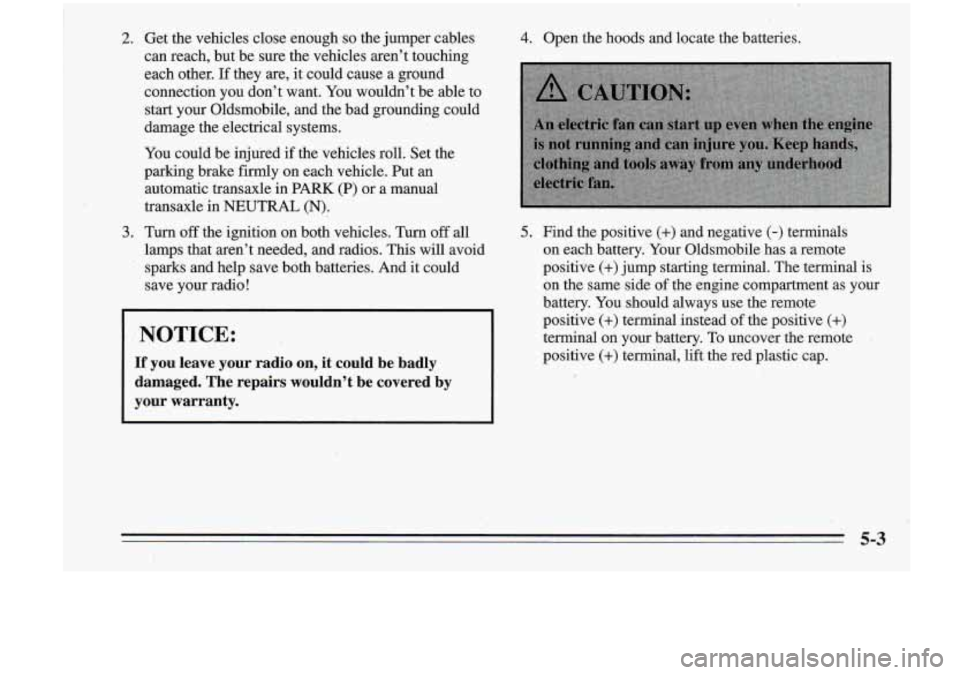
4. Open the hoods and locate the batteries.
5. Find the positive (+) and negative (-) terminals
on each battery. Your Oldsmobile has a remote
positive
(+) jump starting terminal. The terminal is
on the same side
of the engine compartment as your
battery. You should always use the remote
positive
(+) terminal instead of the positive (+)
terminal on your battery. To uncover the remote .
positive (+) termihal, lift the red plastic cap.
1
5-3
..
Page 176 of 340
6. Check that the jumper cables don’t have loose or
missing insulation. If they do, you could get
a shock.
The vehicles could be damaged, too.
Before you connect the cables, here
are some basic
things you should know. Positive
(+) will .go to
positive
(+) and negative (-) will go to negative (-)
or a metal engine part. Don’t connect (+) to (-), or
you’ll get a short that would damage the battery and
maybe other
parts, too.