Page 75 of 340
DRIVE (D): This position is for normal driving. It is the
Overdrive position. If you need more power for passing,
and you’re:
- Going less than 35 mph (56 M), push your
accelerator pedal about halfway down.
- Going about 35 mph (56 kmh) or more, push the
accelerator pedal all the way down.
You’ll shift down to the next gear and have more
power.
NOTICE:
If your vehicle seems tb start up rather slowly, or
if it seems not to
shift gears as you go faster,
something
may be wrong with a transaxle system
sensor.
If you drive very far that way, your
vehicle can be damaged.
So, if this happens, have
your vehicle serviced right away. Until then, you
can use SECOND
(2) when you are driving less
than
35 mph (56 km/h) and DRIVE (D) for
higher speeds. THIRD
(3): THIRD (3) is like DRIVE (D),
but you
never
go into Overdrive.
Here are some times you might choose THIRD
(3)
instead of DRIVE (D):
- When driving on hilly, winding roads.
- When towing a trailer, so there is less shifting
- When going down a steep hill.
SECOND
(2): This position gives you more power but
lower fuel economy. You can use SECOND
(2) on hills.
It can help control your speed
as you go down steep
mountain roads, but then you would also want to use
between gears.
lr
brakes off and on.
NOTICE:
Don’t drive in SECOND (2) for more than
5 miles (8 km), or at speeds over 55 mph
(88 km/h), or you can damage your transaxle. Use
DRIVE
@) or THIRD (3) as much aspossible.
Don’t
shift into SECOND (2) unless you are going
slower than
65 mph (105 km/h), or you can
damage your engine.
Page 80 of 340
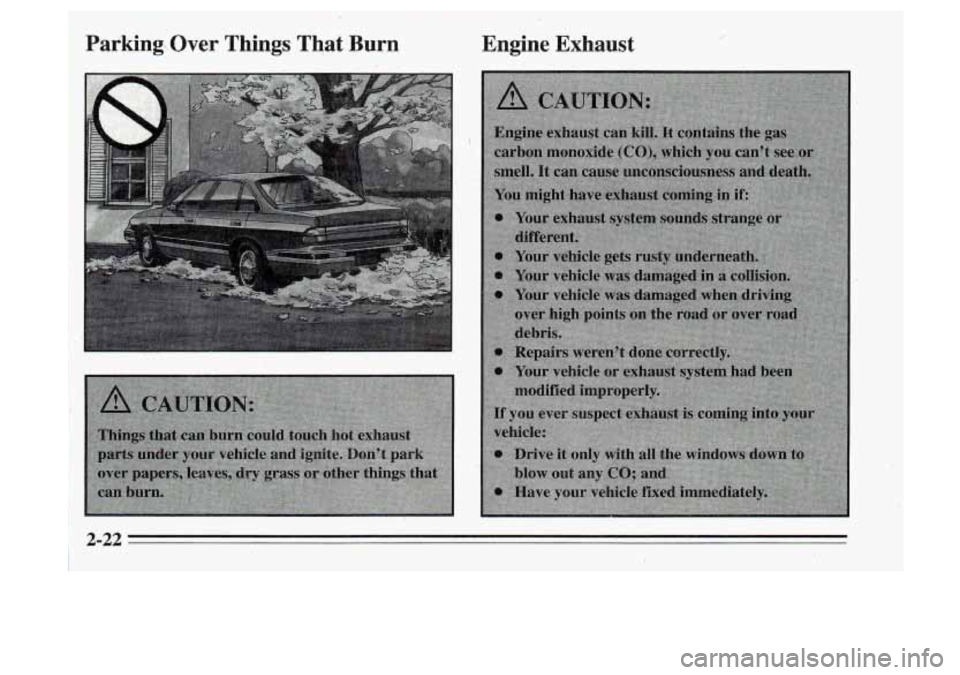
Parking Over Things That Burn
Engine Exhaust
I
Page 81 of 340
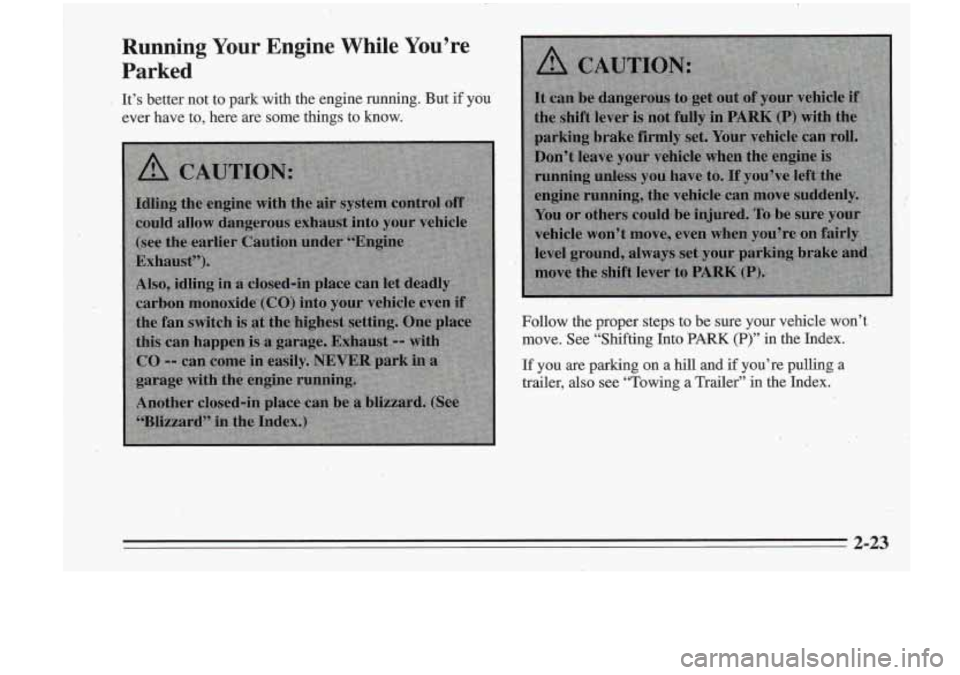
Running Your Engine While You’re
Parked
It’s better not to park ‘with the engine running. But if you
ever have to, here are some things to know.
2-23
Page 102 of 340
!
!
Tachometer
The tachometer displays the engine speed in thousands
of revolutiotts per minute (rpm).
NOTICE:
Do not operate the engine with the tachometer in
the red area, or engine damage may occur.
1. '
2-44 < ., ., . .I .,. , ...
.-
Page 103 of 340
Warning Lights, Gages and Indicators
This part describes the warning lights and,gages that
may be
on your vehicle. The pictures will help you
locate them.
Warning lights and gages can signal that something
is
wrong before it becomFs serious enough to cause an
expensive repair or replacement. Paying attention to
your warning.lights and gages could also save you or
others from injury.
Warning lights come on when there may be or is a
problem with one of your vehicle’s functions.
As you
will see in the details on the next few pages, some
warning lights come on briefly when you start the
engine just to let you know they’re working.
If you are
‘familiar with this section, you should not be alarmed
when this happens.
Gages can indicate when there may be or is a problem
with one-of your vehicle’s functions. Often gages and
warning lights work together to let you know when
there’s a problem with your vehicle.
When one
of the warning lights comes on and stays on
when you are driving, or when one of the gages shows
there may be a problem, check the section that
tells you
what to do about
it. Please follow this manual’s advice.
Waiting to do repairs can be costly
-- and even dangerous.
So please
get to know your warning lights
and gages. They’re
a big help.
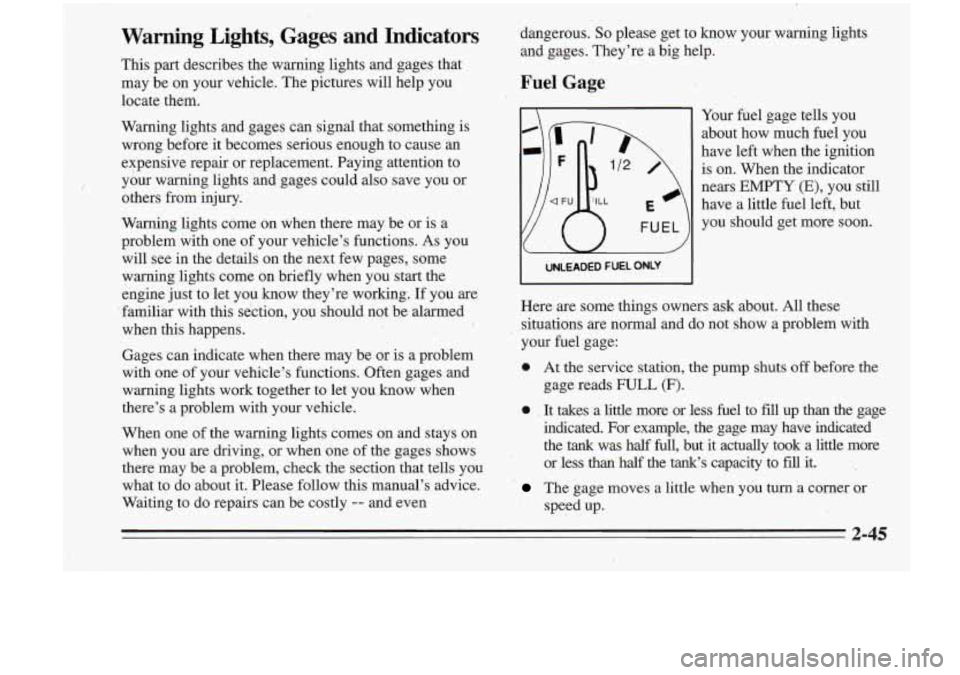
Fuel Gage
Your fuel gage tells you
about how much fuel
YOU
have left when the ignition
is on. When the indicator
nears
EMPTY (E), you still
have
a little fuel left, but
you should get more soon.
UNLEADED FUEL ONLY I
I
Here are some things owners ask about. All these
situations are normal and do not show a problem with
your fuel gage:
0 At the service station, the pump shuts off before the
gage reads
FULL (F).
0 . It takes a little more or less fuel to fill up than the gage
indicated. For example, the gage may have indicated
the
tank was half full, but it actually took a little more
or less
than half the tank‘s capacity to fill it.
The gage moves a little when you turn a corner or
speed up.
2-45
Page 108 of 340
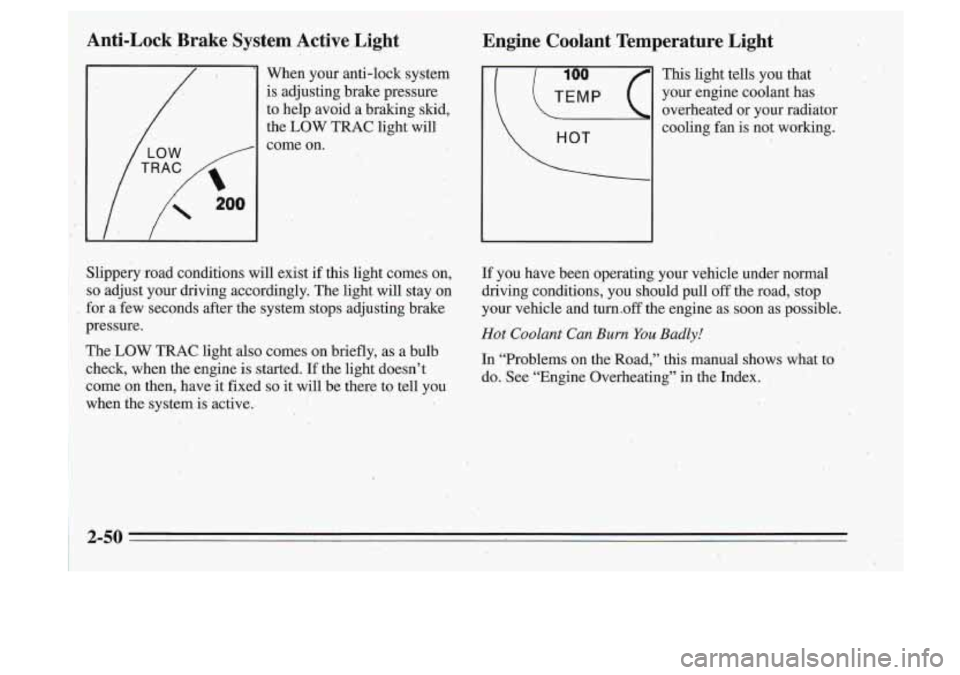
Anti-Lock Brake System Active Light
When your anti-lock system
is adjusting brake pressure
to help avoid a braking skid,
the LOW TRAC light will
come on.
Slippery road conditions will exist if this light comes on,
so adjust your driving accordingly. The light will stay on
for a few seconds after the system stops adjusting brake
pressure.
The LOW TRAC light also comes on briefly, as a bulb
check, when the engine is started. If the light doesn’t
come on then, have it fixed
so it will be there to tell you
when the system is active.
‘ This light tells.you that
your engine coolant has
, overheated or your radiator
cooling fan is not working.
If you have been operating your vehicle under normal
driving conditions, you should pull
off the road;stop’
your vehicle and turn.off the engine as soon as possible.
Hot Coolant Can Burn You Badly!
In “Problems on the~Road,” this manual shows what to
do. See “Engine Overheating”
in the Index.
2-50
Page 109 of 340
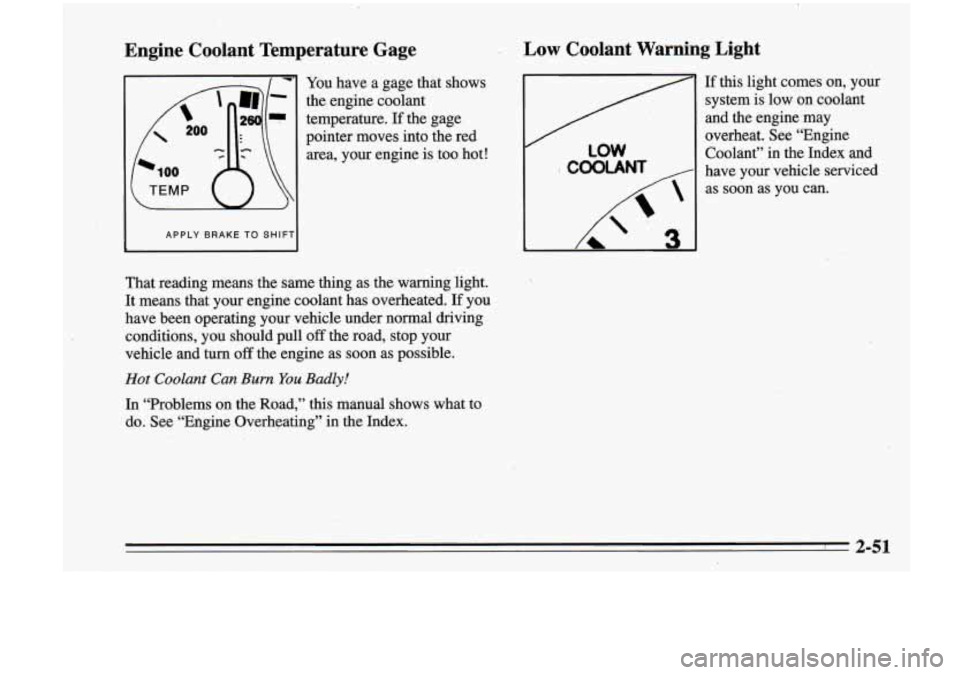
Engine Coolant Temperature Gage
APPLY BRAKE TO SHIF1
You have a gage that shows
the engine coolant
temperature.
If the gage
pointer moves into the red
area, your engine is too hot!
Low Coolant Warning Light
If this light comes on, your
system is low on coolant
and the engine may
overheat. See “Engine
Coolsint” in the Index and
have your vehicle serviced
as soon as you can.
i COOLANT
That reading means the same thing as the warning light.
It means that your engine coolant has overheated. If you
have been operating your vehicle under normal driving
conditions, you should pull
off the road, stop your
vehicle and turn
off the engine as soon as possible.
Hot Coolant Can Burn You Badly!
In “Problems on the Road,” this manual shows what to
do. See “Ennine Overheatine” in the Index.
Page 110 of 340
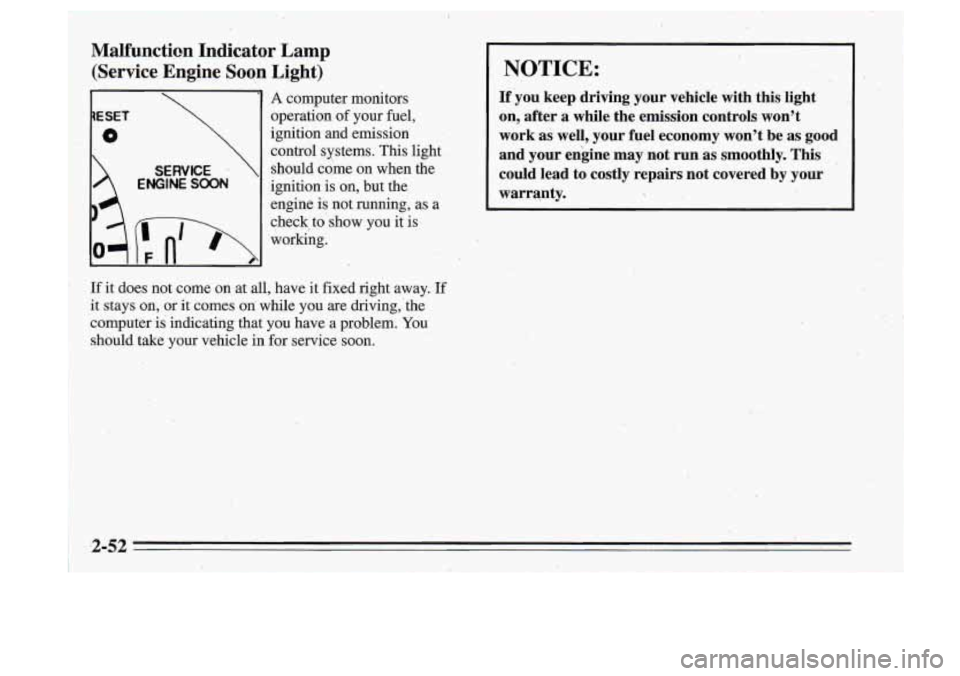
~ Malfunction Indicator Lamp
(Service Engine Soon Light)
1ESET
0
SERVICE
ENGINE SOON
1 A computer monitors
operation of your fuel,
ignition and emission control systems. This light
should come on when the
ignition
is on, but the
engine
is not running, as a
check, to'show you it is
working.
If it does not come
on at all, have it fixed right away. If
it stays on, or it comes on while you are driving,'the
computer is indicating that
you have a problem. You
should take your vehicle in for service soon.
,I.
NOTICE:
If you keep driving your vehicle with this light
on, after a while the emission controls won't
work as well, your fuel economy won't
be as good
and your en'gine may not run as smoothly. This
could lead to costly repairs not covered by your
warranty.