Page 168 of 354
Downloaded from www.Manualslib.com manuals search engine Power Winches
If you wish to use a power winch on your vehicle, only use it when your
vehicle
is stationary or anchored.
I NOTICE:
-
Operating a power winch with an automatic transmission in
PARK
(P) or a manual transmission in gear may damage the
transmission. Always put the transmission
in a Neutral position
while operating
a power winch.
Use the regular brakes, set the parking brake or block the wheels to keep
your vehicle from rolling.
If your vehicle is equipped with an airbag, see “Adding Equipment to Your
Air Bag-Equipped Vehicle” in the Index.
Recreational Vehicle Towing (Four- Wheel
Drive Only)
If your vehicle has four-wheel drive, you may tow it behind another vehicle
providing it does not have the optional electronic shift transfer case.
I NOTICE:
Recreational vehicle towing is not recommended for vehicles
with the optional electronic shift transfer case because the
electronic shift has no neutral position.
Before towing, you should:
1. Set the parking brake firmly.
2. Place the automatic transmission in PARK (P) or the manual
transmission in the lowest gear
(FIRST GEAR).
hitch manufacturer’s instructions.
3. Firmly attach the vehicle being towed to the tow vehicle. Refer to the
4. Place the transfer case shift lever in NEUTRAL (N).
NOTICE:
Removal of either propeller shaft is unnecessary.
4-35
Page 169 of 354
Downloaded from www.Manualslib.com manuals search engine 5. Release the parking brake only after the vehicle being towed is firmly
attached to the tow vehicle.
6. Insert the ignition key into the ignition switch and turn it one notch
forward of the
LOCK position. This places the key into the OFF
position, which unlocks the steering column while preventing battery
drain. Unlocking the steering column will allow for proper movement
of the front wheelshires during towing.
NOTICE:
You should exercise extra care whenever towing another vehicle.
Loading Your Vehicle
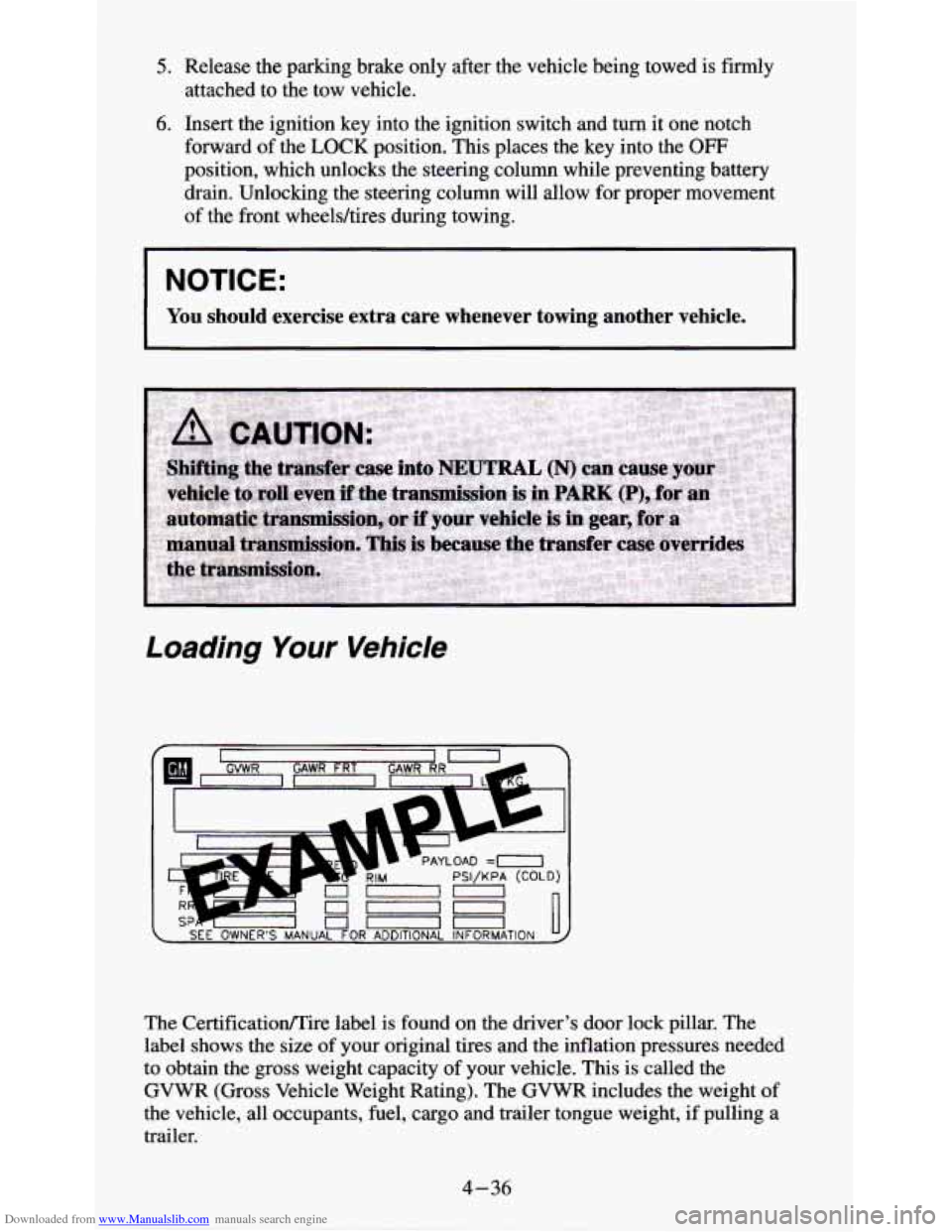
PAYLOAD =I-1
The Certificatioflire label is found on the driver’s door lock pillar. The
label shows the size of your original tires and the inflation pressures needed
to obtain the gross weight capacity of your vehicle. This is called the
GVWR (Gross Vehicle Weight Rating). The GVWR includes the weight of
the vehicle, all occupants, fuel, cargo and trailer tongue weight, if pulling a
trailer.
4-36
Page 175 of 354
Downloaded from www.Manualslib.com manuals search engine If your slide-in camper and its load weigh less than the CWR, the center of
gravity zone for your vehicle may be larger.
Your dealer can help you make a good vehicle-camper match. He’ll also
help you determine your CWR.
After you’ve loaded your vehicle and camper, drive to a weigh station and
weigh on the front and rear wheels separately. This will tell you the loads on
your axles. The loads on the front and rear axles shouldn’t be more than
either
of the GAWRs. The total of the axle loads should not be more than
the GVWR.
Open your driver’s door and look at the door lock pillar for the
Certificatiomire label to find out your GAWR and GVWR.
If you’ve gone over your weight ratings, move or take
out some things until
all the weights fall below the ratings. Of course, you should always tie down
any loose items when
you load your vehicle or camper.
When you install and load your slide-in camper, check the manufacturer’s
instructions.
If you want more information
on curb weights, cargo weights, cargo weight
rating and the correct center of gravity zone for your vehicle, your dealer
can help you. Just ask for a copy of “Consumer Information, Truck-Camper
Loading.”
Trailer Recommendations
You must subtract your hitch loads from the CWR for your vehicle. Weigh
your vehicle with your trailer attached,
so that you won’t go over the
GVWR or the GAWR.
You’ll get the best performance if you spread out the weight of your load
the right way, and if you choose the correct hitch and trailer brakes.
For more information, see “Towing a Trailer” in the Index.
Pickup Conversion to Chassis Cab
General Motors is aware that some vehicle owners may consider having the
pickup box removed and a commercial or recreational body installed.
However, we recommend that conversions of this type not be done to
pickups. Owners should be aware that, as manufactured, there are
differences between
a chassis cab and a pickup with the box removed which
may affect vehicle safety. For specific information
on this pickup, contact
the GM Zone Office for your area. (See the “Warranty and Owner
Assistance” booklet for Zone Office.)
4-42
Page 178 of 354
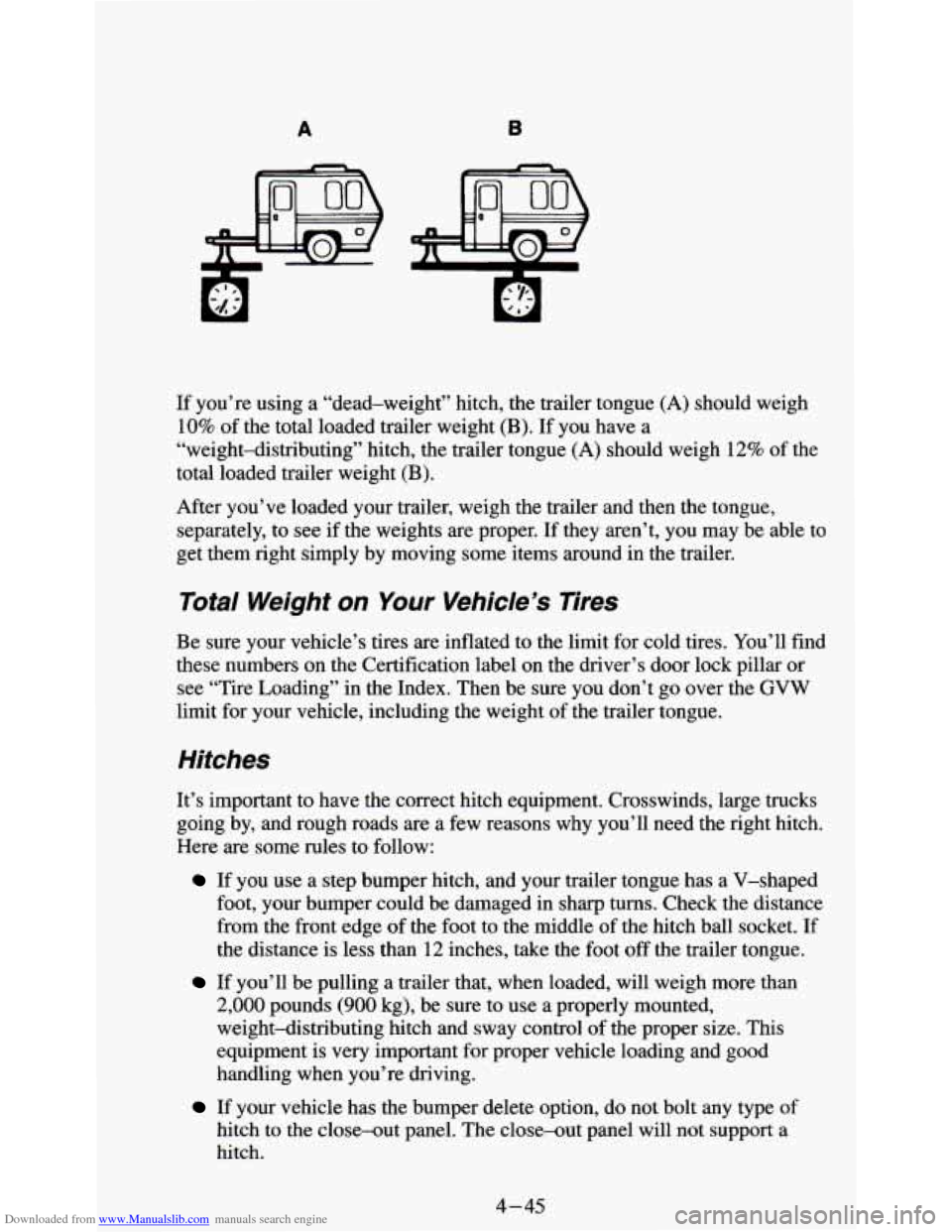
Downloaded from www.Manualslib.com manuals search engine A B
If you’re using a “dead-weight” hitch, the trailer tongue (A) should weigh
10%
of the total loaded trailer weight (B). If you have a
“weight-distributing” hitch, the trailer tongue
(A) should weigh 12% of the
total loaded trailer weight
(B).
After you’ve loaded your trailer, weigh the trailer and then the tongue,
separately, to see if the weights are proper. If they aren’t, you may be able to
get them right simply by moving some items around in the trailer.
Total Weight on Your Vehicle’s Tires
Be sure your vehicle’s tires are inflated to the limit for cold tires. You’ll find
these numbers on the Certification label on the driver’s door lock pillar or
see “Tire Loading” in the Index. Then be sure you don’t go over the GVW
limit for your vehicle, including the weight of the trailer tongue.
Hitches
It’s important to have the correct hitch equipment. Crosswinds, large trucks
going by, and rough roads are a
few reasons why you’ll need the right hitch.
Here are some rules to follow:
If you use a step bumper hitch, and your trailer tongue has a V-shaped
foot, your bumper could be damaged in sharp turns. Check the distance
from the front edge
of the foot to the middle of the hitch ball socket. If
the distance is less than
12 inches, take the foot off the trailer tongue.
If you’ll be pulling a trailer that, when loaded, will weigh more than
2,000 pounds (900 kg), be sure to use a properly mounted,
weight-distributing hitch and sway control of the proper size. This
equipment is very important for proper vehicle loading and good
handling when you’re driving.
If your vehicle has the bumper delete option, do not bolt any type of
hitch to the close-out panel. The close-out panel will not support a
hitch.
4-45
Page 190 of 354
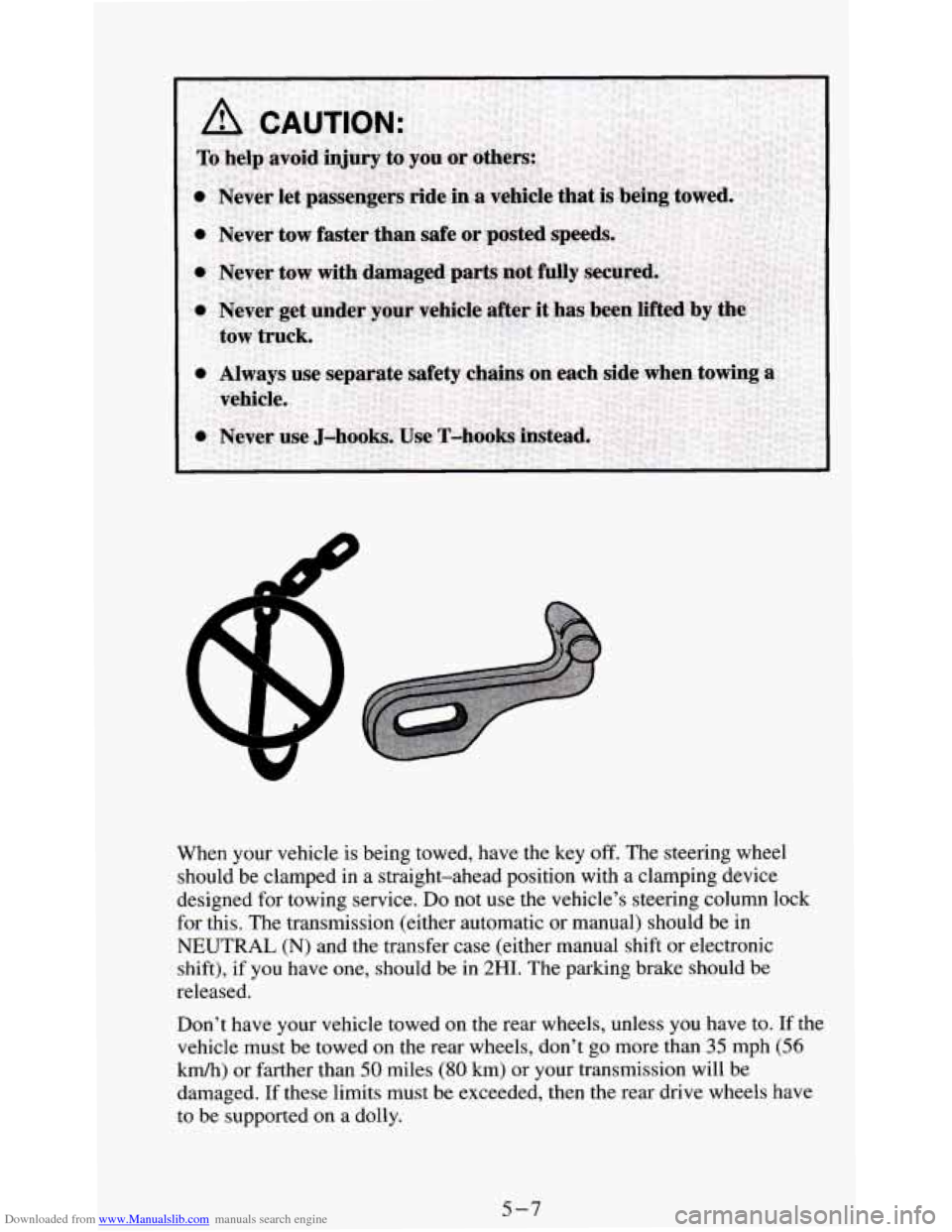
Downloaded from www.Manualslib.com manuals search engine When your vehicle is being towed, have the key off. The steering wheel
should be clamped in a straight-ahead position with
a clamping device
designed for towing service.
Do not use the vehicle’s steering column lock
for this. The transmission (either automatic or manual) should be
in
NEUTRAL (N) and the transfer case (either manual shift or electronic
shift), if you have one, should be in 2HI.
The parking brake should be
released.
Don’t have your vehicle towed
on the rear wheels, unless you have to. If the
vehicle must be towed on the rear wheels, don’t
go more than 35 mph (56
kmk) or farther than 50 miles (80 km) or your transmission will be
damaged.
If these limits must be exceeded, then the rear drive wheels have
to be supported on a dolly.
5-7
Page 202 of 354
Downloaded from www.Manualslib.com manuals search engine Changing a Flat Tire
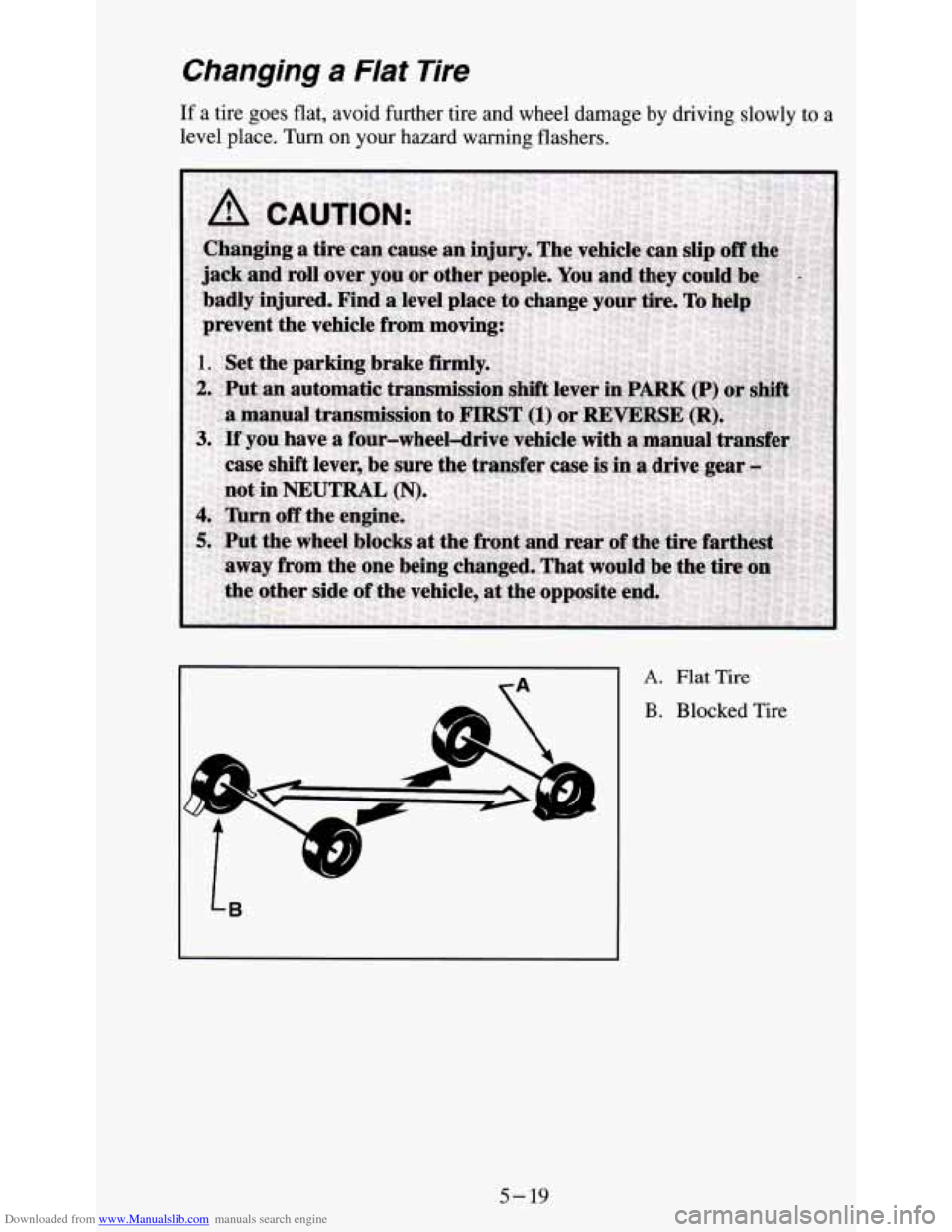
If a tire goes flat, avoid further tire and wheel damage by driving slowly to a
level place. Turn on your hazard warning flashers.
A. Flat Tire
B. Blocked Tire
5-19
Page 203 of 354
Downloaded from www.Manualslib.com manuals search engine The following steps will tell you how to use the jack and change a tire.
Jacking Equipment Storage
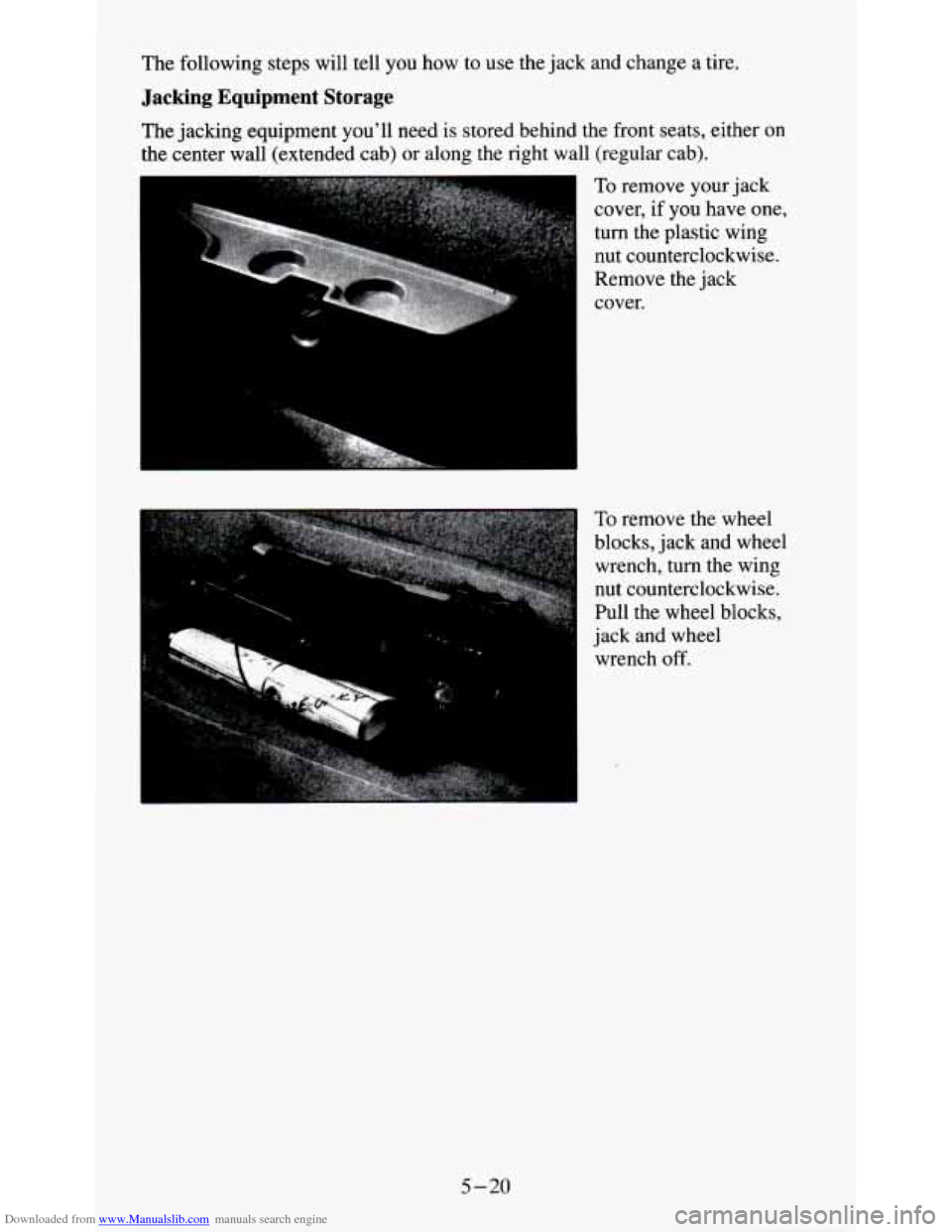
The jacking equipment you’ll need is stored behind the front seats, either on
the center wall (extended cab) or along the right wall (regular cab).
To remove your jack
cover, if you have one,
turn the plastic wing
nut counterclockwise.
Remove the jack
cover.
To remove the wheel
blocks, jack and wheel
wrench, turn the wing
nut counterclockwise.
Pull the wheel blocks,
jack and wheel
wrench
off.
5-20
Page 205 of 354
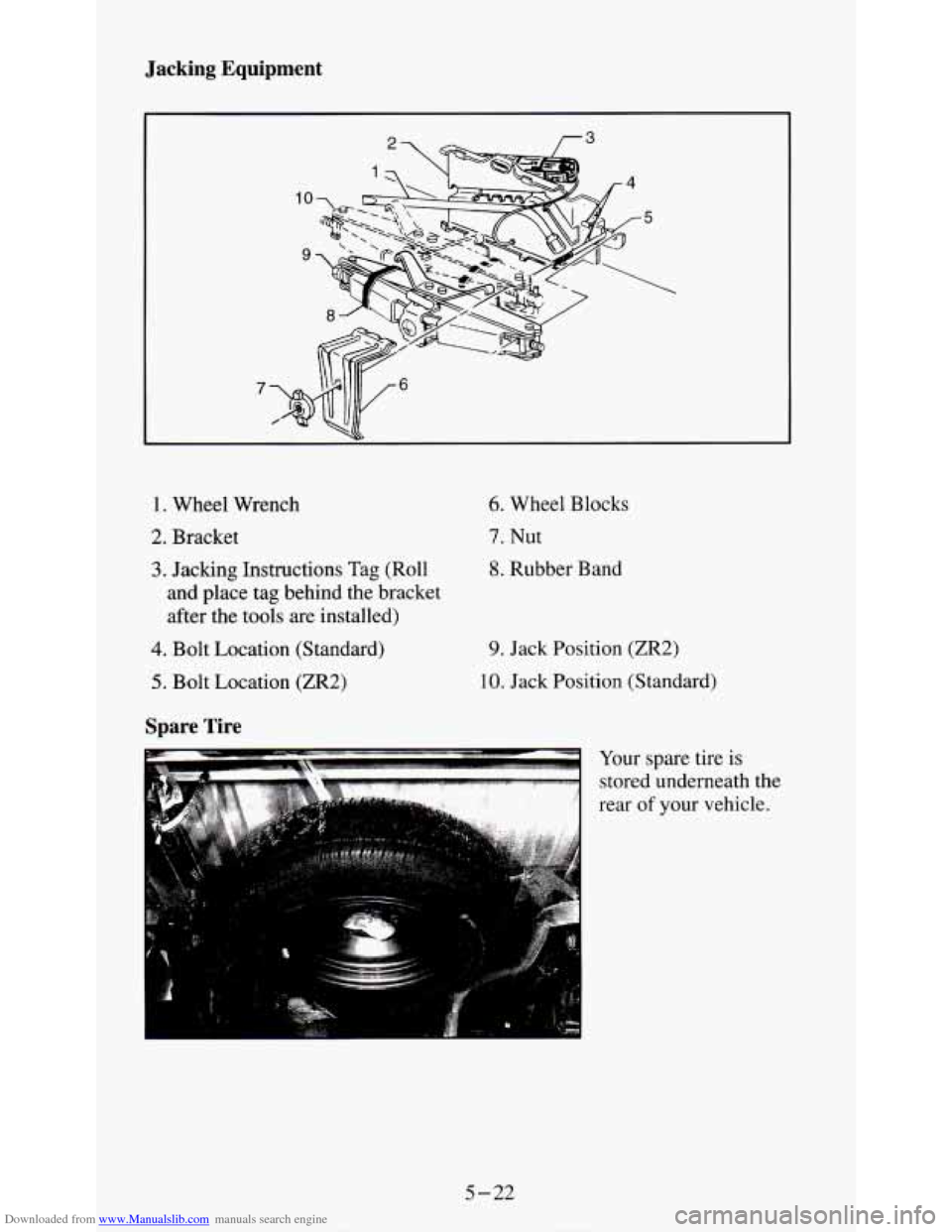
Downloaded from www.Manualslib.com manuals search engine Jacking Equipment
1. Wheel Wrench
2. Bracket
3. Jacking Instructions Tag (Roll
and place tag behind the bracket
after the tools are installed)
4. Bolt Location (Standard)
5. Bolt Location (ZR2)
Spare Tire
6. Wheel Blocks
7. Nut
8. Rubber Band
9. Jack Position (ZR2)
10. Jack Position (Standard)
Your spare tire
is
stored underneath the
rear
of your vehicle.
5-22