Page 70 of 354
Downloaded from www.Manualslib.com manuals search engine Torque Lock (Automatic Transmission)
If you are parking on a hill and you don’t shift your transmission into PARK
(P) properly, the weight of the vehicle may put too much force on the
parking pawl in the transmission. You may find it difficult
to pull the shift
lever out
of PARK (P). This is called “torque lock.” To prevent torque lock,
set the parking brake and then shift into PARK (P) properly before you
leave the driver’s seat.
To find out how, see “Shifting Into PARK (P)” in the
Index.
When you
are ready to drive, move the shift lever out of PARK (P) before
you release the parking brake.
If “torque lock” does occur, you may need
to have another vehicle push
yours a little uphill
to take some of the pressure from the transmission, so
you can pull the shift lever out of PARK (P).
Parkirig Your Vehicle (Manual Transmission
Models Only)
Before you get out of your vehicle, turn off your engine, put your manual
transmission in REVERSE
(R) and firmly apply the parking brake.
If you have four-wheel drive with a manual transfer case shift lever, be sure
your transfer case is in a drive gear. Your vehicle could roll if it isn’t.
If
you are parking on a hill, or if your vehicle is equipped to tow a trailer,
see “Parking on Hills”
or “Towing a Trailer” in the Index.
Parking Over Things That Burn
A
8
2-25
Page 75 of 354
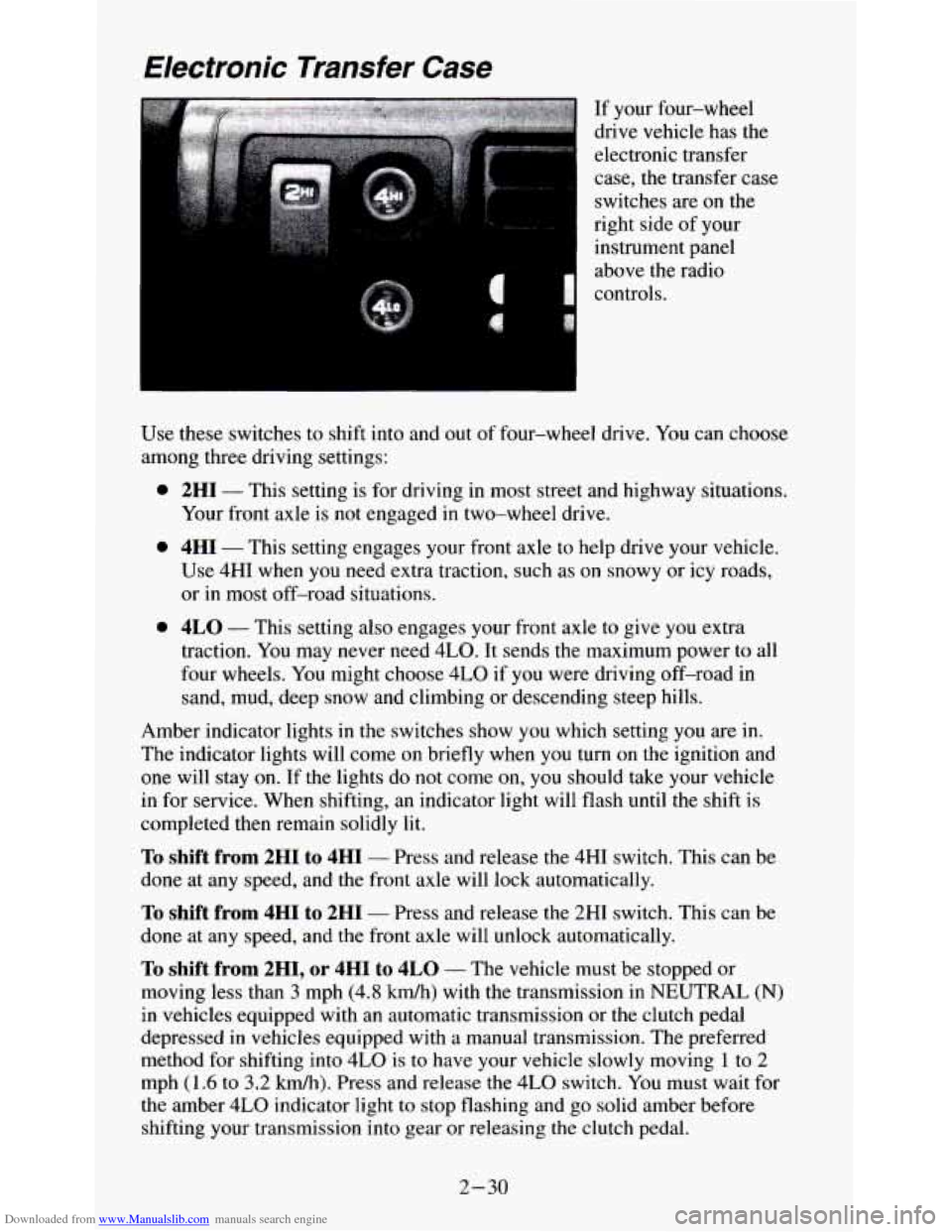
Downloaded from www.Manualslib.com manuals search engine Use these switches to shift into and out of four-wheel drive. You can choose
among three driving settings:
0
0
0
2HI - This setting is for driving in most street and highway situations.
Your front axle
is not engaged in two-wheel drive.
4HI - This setting engages your front axle to help drive your vehicle.
Use 4HI when you need extra traction, such as
on snowy or icy roads,
or
in most off-road situations.
4LO - This setting also engages your front axle to give you extra
traction. You may never need
4LO. It sends the maximum power to all
four wheels. You might choose
4LO if you were driving off-road in
sand, mud, deep snow and climbing or descending steep hills.
Amber indicator lights
in the switches show you which setting you are in.
The indicator lights will come on briefly when you turn on the ignition and
one will stay
on. If the lights do not come on, you should take your vehicle
in for service. When shifting, an indicator light will flash until the shift is
completed then remain solidly lit.
To shift from 2HI to 4HI - Press and release the 4HI switch. This can be
done at any speed, and the front axle will lock automatically.
To shift from 4HI to 2HI - Press and release the 2HI switch. This can be
done at any speed, and the front axle will unlock automatically.
To shift from 2H1, or 4HI to 4LO - The vehicle must be stopped or
moving less than
3 mph (4.8 km/h) with the transmission in NEUTRAL (N)
in vehicles equipped with an automatic transmission or the clutch pedal
depressed
in vehicles equipped with a manual transmission. The preferred
method for shifting into
4LO is to have your vehicle slowly moving 1 to 2
mph (1.6 to 3.2 kdh). Press and release the 4LO switch. You must wait for
the amber
4LO indicator light to stop flashing and go solid amber before
shifting your transmission into gear or releasing
the clutch pedal.
2-30
Page 79 of 354
Downloaded from www.Manualslib.com manuals search engine Tilt Wheel (Option)
I
I
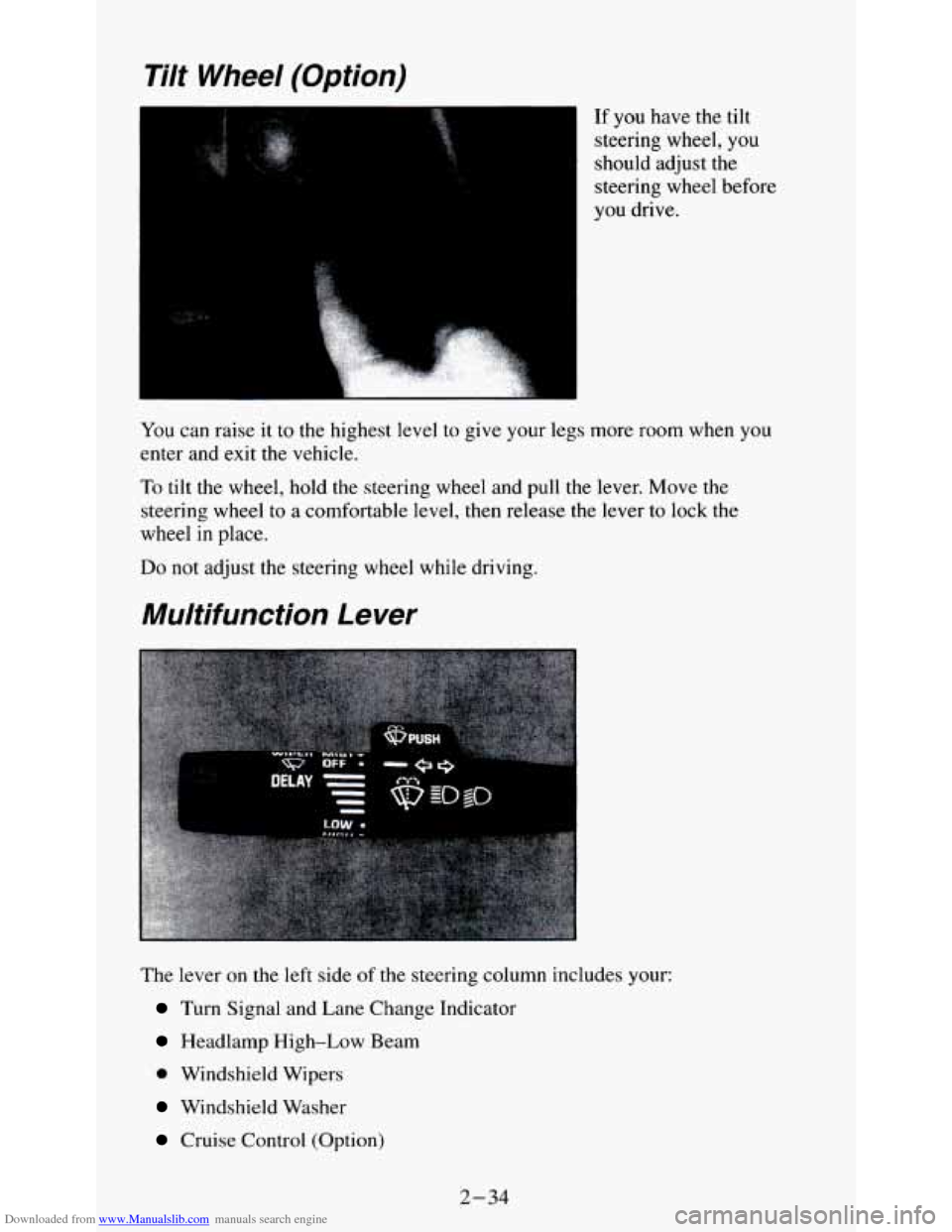
If you have the tilt
steering wheel,
you
should adjust the
steering wheel before
you drive.
You can raise it
to the highest level to give your legs more room when you
enter and exit the vehicle.
To tilt the wheel, hold the steering wheel and pull the lever. Move the
steering wheel to a comfortable level, then release the lever to lock the
wheel in place.
Do not adjust the steering wheel while driving.
Multifunction Lever
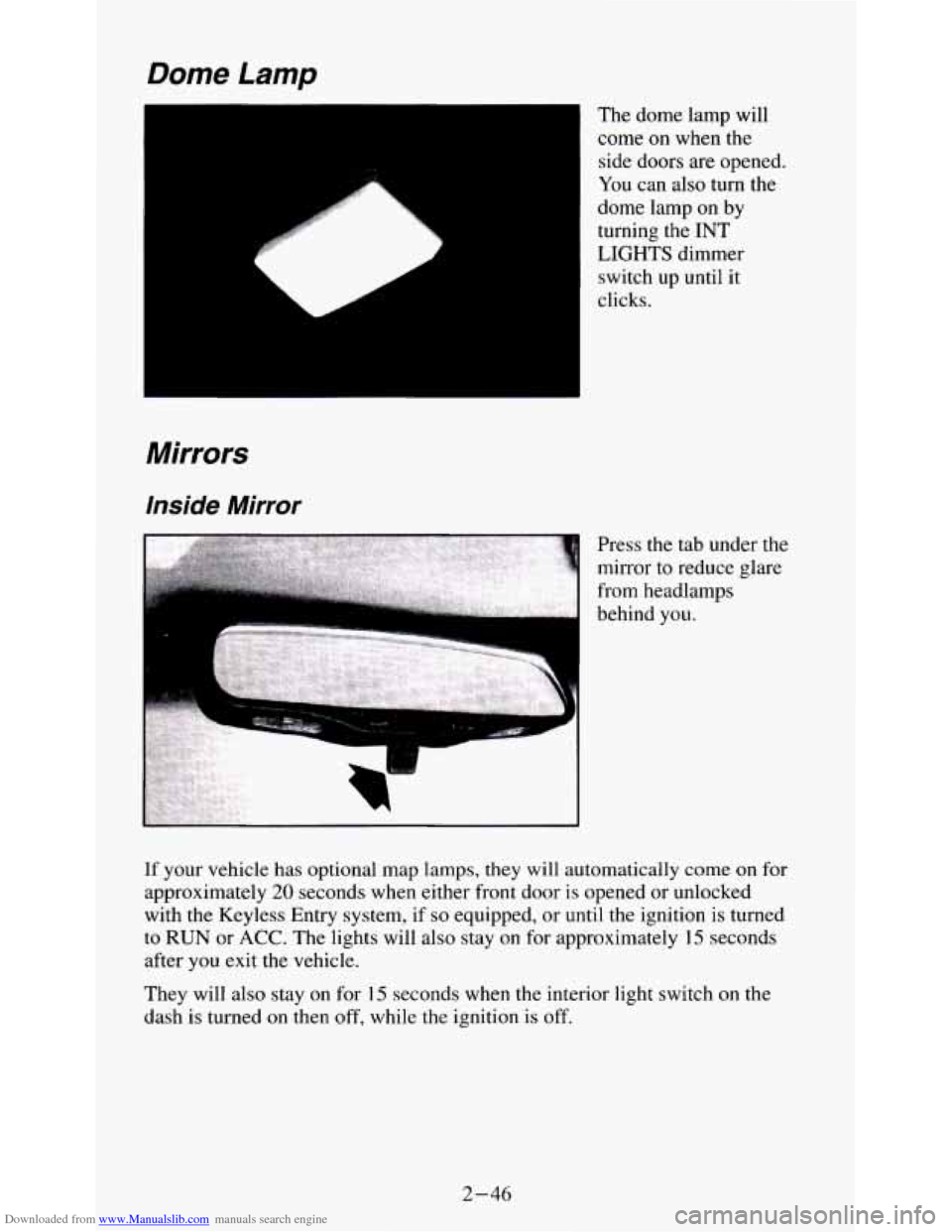
The lever on the left side of the steering column includes your:
Turn Signal and Lane Change Indicator
Headlamp High-Low Beam
0 Windshield Wipers
Windshield Washer
Cruise Control (Option)
2-34
Page 82 of 354
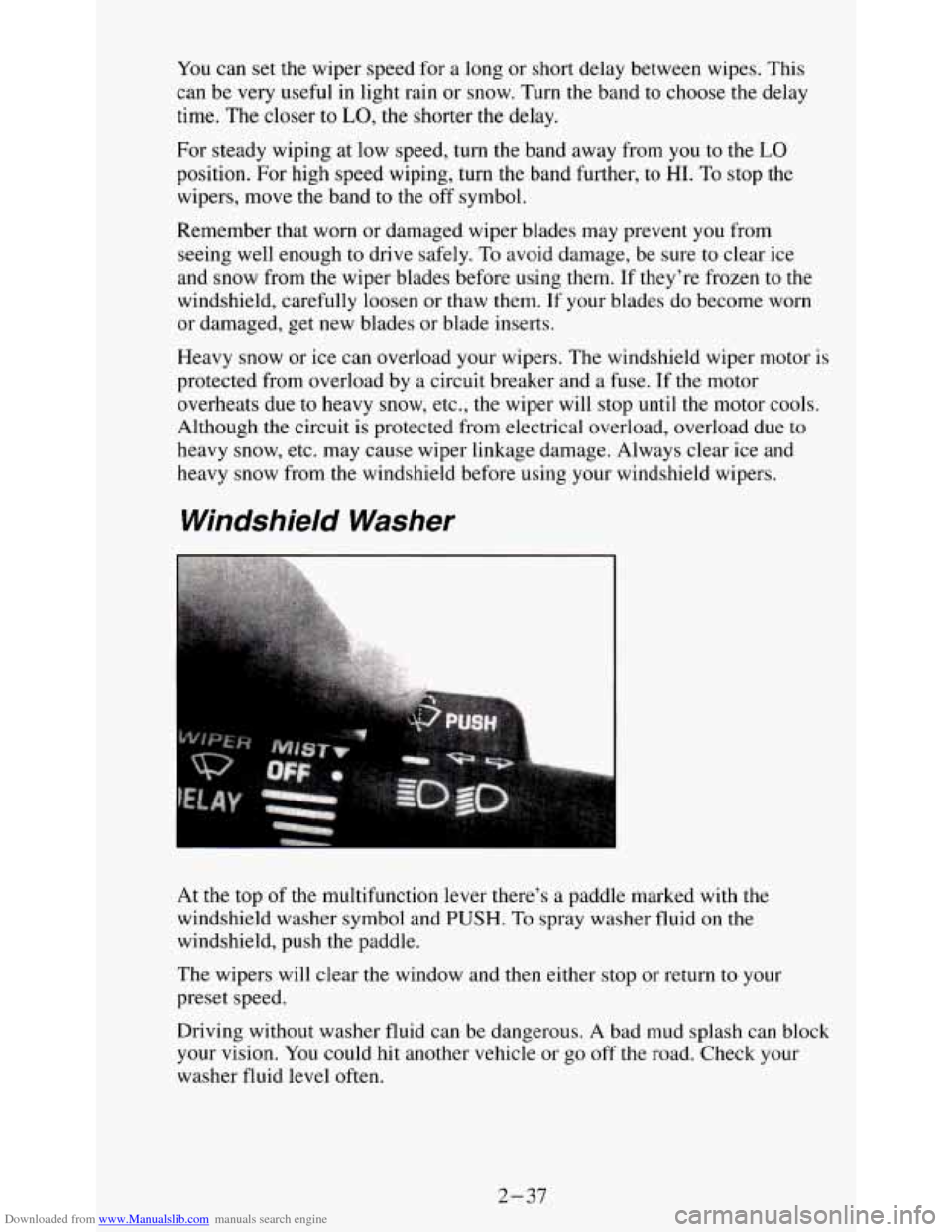
Downloaded from www.Manualslib.com manuals search engine You can set the wiper speed for a long or short delay between wipes. This
can be very useful in light rain or snow. Turn
the band to choose the delay
time. The closer
to LO, the shorter the delay.
For steady wiping at low speed, turn the band away from you to the
LO
position. For high speed wiping, turn the band further, to HI. To stop the
wipers, move the band to the
off symbol.
Remember that worn or damaged wiper blades may prevent
you from
seeing well enough to drive safely.
To avoid damage, be sure to clear ice
and snow from the wiper blades before using them. If they’re frozen to the
windshield, carefully loosen or thaw them. If your blades do become worn
or damaged, get new blades or blade inserts.
Heavy snow or ice can overload your wipers. The windshield wiper motor is
protected from overload by a circuit breaker and a fuse. If the motor
overheats due
to heavy snow, etc., the wiper will stop until the motor cools.
Although the circuit is protected from electrical overload, overload due to
heavy snow, etc. may cause wiper linkage damage. Always clear ice and
heavy snow from the windshield before using your windshield wipers.
Windshield Washer
At the top of the multifunction lever there’s a paddle marked with the
windshield washer symbol and
PUSH. To spray washer fluid on the
windshield, push the paddle.
The wipers will clear the window and then either stop or return
to your
preset speed.
Driving without washer fluid can be dangerous. A bad mud splash can block
your vision. You could hit another vehicle or go
off the road. Check your
washer fluid level often.
2-37
Page 83 of 354
Downloaded from www.Manualslib.com manuals search engine A CAUTION: I
In freezing weather, don’t use your washer until the windshield
is warmed. Otherwise the washer fluid can form ice on the
windshield, blocking your vision.
I
NOTICE:
When using concentrated washer fluid, follow the
manufacturer’s instructions for adding water.
Don’t mix water with ready-to-use washer fluid. Water can
cause the solution to freeze and damage your washer fluid
tank and other parts of the washer system. Also, water
doesn’t clean
as well as washer fluid.
Fill your washer fluid tank only 3/4 full when it’s very cold.
~ This allows for expansion, which could damage the tank if it is
completely full.
Don’t use radiator antifreeze in your windshield washer. It
can damage your washer system and paint.
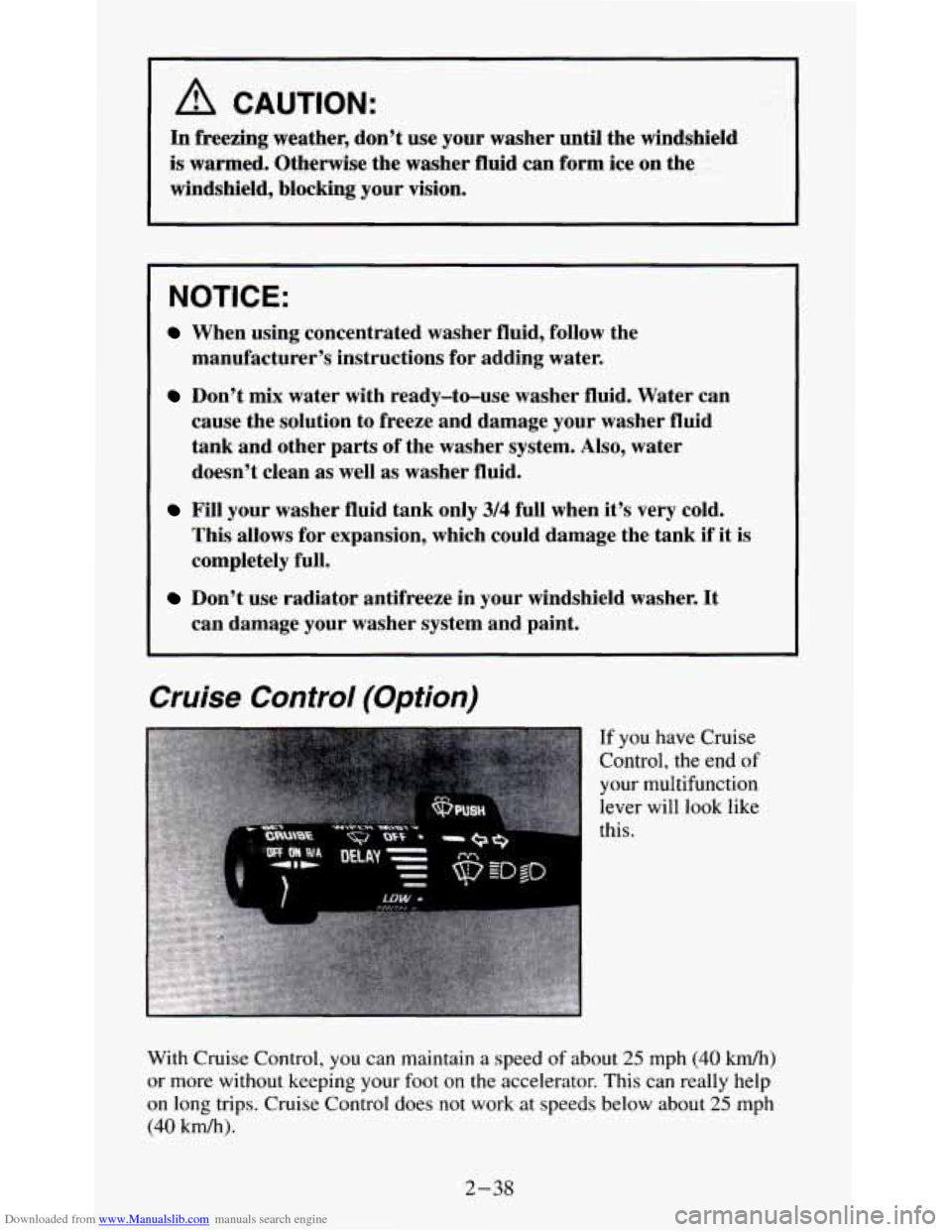
Cruise Control (Option)
If you have Cruise
Control, the end
of
your multifunction
lever will
look like
this.
With Cruise Control,
you can maintain a speed of about 25 mph (40 kdh)
or more without keeping your foot on the accelerator. This can really help
on long trips. Cruise Control does not work at speeds below about 25 mph
(40 km/h).
2-38
Page 90 of 354
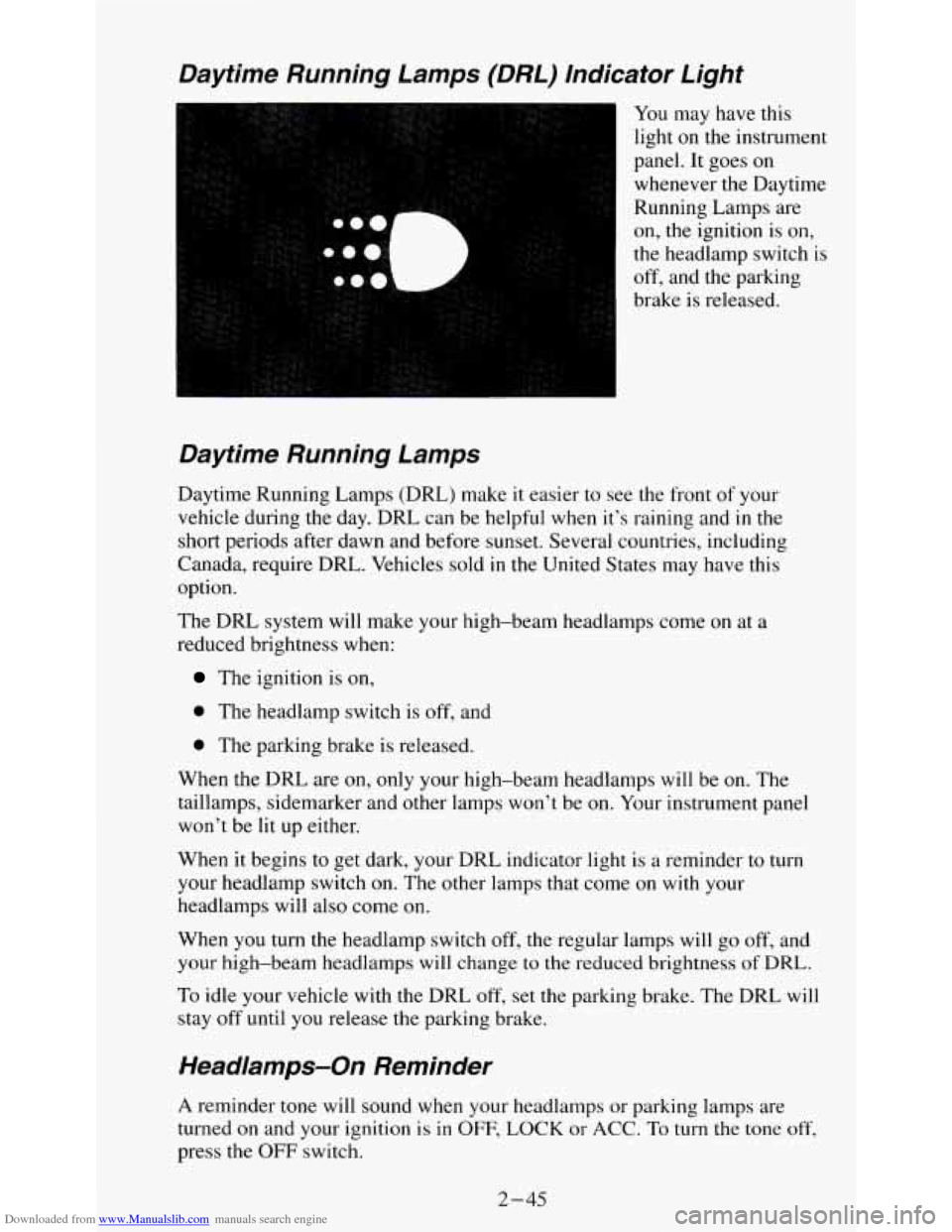
Downloaded from www.Manualslib.com manuals search engine Daytime Running Lamps (DRL) lndicator Light
I You may have this
light
on the instrument
panel.
It goes on
whenever the Daytime
Running Lamps
are
on, the ignition is on,
the headlamp switch is
off, and the parking
brake is released.
Daytime Running Lamps
Daytime Running Lamps (DRL) make it easier to see the front of your
vehicle during the day. DRL can be helpful when it’s raining and
in the
short periods after dawn and before sunset. Several countries, including
Canada, require DRL. Vehicles sold
in the United States may have this
option.
The DRL system will make your high-beam headlamps come
on at a
reduced brightness when:
The ignition is on,
0 The headlamp switch is off, and
0 The parking brake is released.
When the DRL are on, only your high-beam headlamps will be on. The
taillamps, sidemarker and other lamps won’t be
on. Your instrument panel
won’t be lit up either.
When it begins
to get dark, your DRL indicator light is a reminder to turn
your headlamp switch on. The other lamps that come
on with your
headlamps will also come on.
When you turn the headlamp switch off, the regular lamps
will go off, and
your high-beam headlamps will change to the reduced brightness of DRL.
To idle your vehicle with the DRL off, set the parking brake. The DRL will
stay
off until you release the parking brake.
Headamps-On Reminder
A reminder tone will sound when your headlamps or parking lamps are
turned
on and your ignition is in OFF, LOCK or ACC. To turn the tone off,
press the OFF switch.
2-45
Page 91 of 354
Downloaded from www.Manualslib.com manuals search engine Dome Lamp
L A
The dome lamp will
come
on when the
side doors are opened
You can also turn the
dome lamp on by
turning the INT
LIGHTS dimmer
switch up until it
clicks.
Mirrors
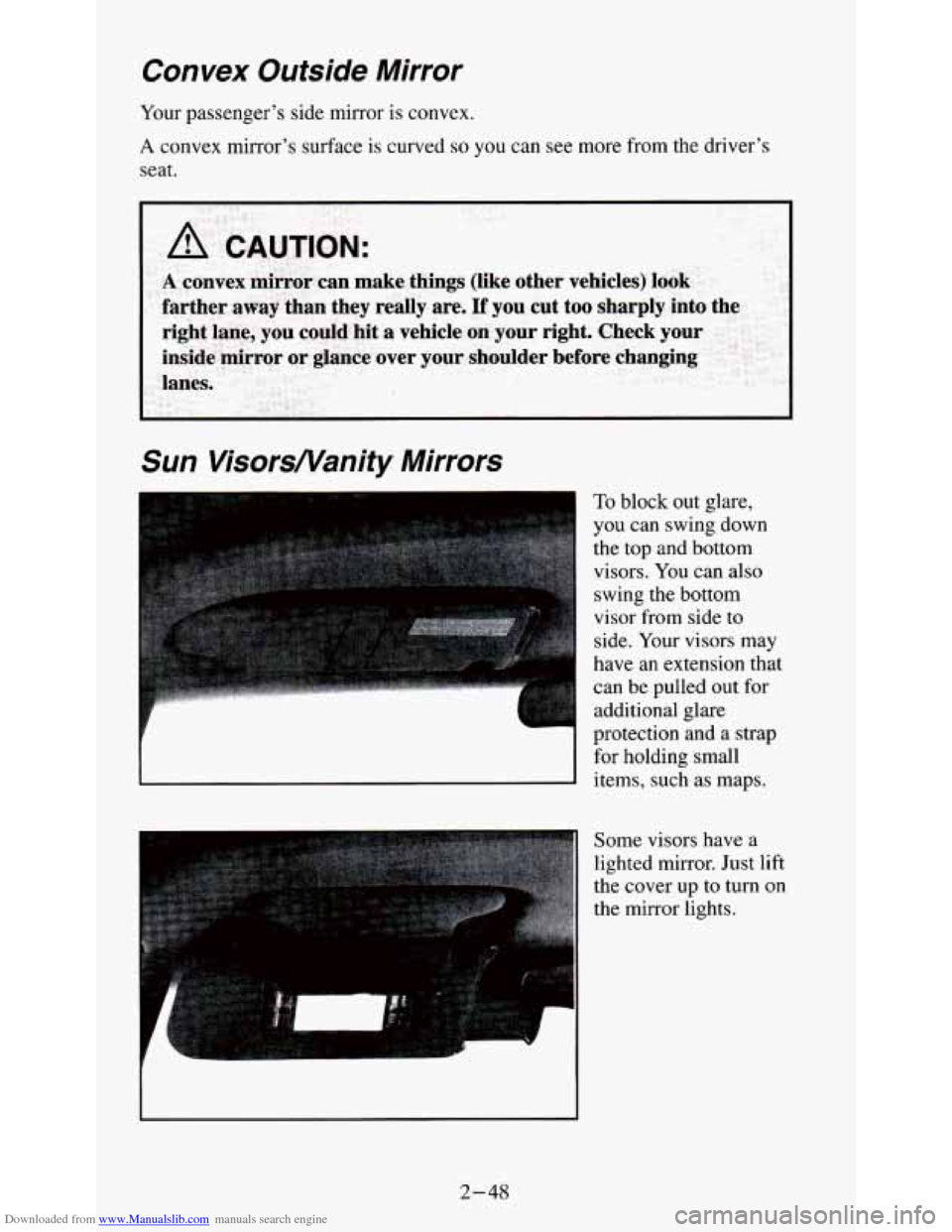
Inside Mirror
If your vehicle has optional map lamps, they will automatically come on for
approximately
20 seconds when either front door is opened or unlocked
with
the Keyless Entry system, if so equipped, or until the ignition is turned
to RUN or ACC. The lights will also stay on for approximately 15 seconds
after you exit the vehicle.
They will also stay on for 15 seconds when the interior light switch on the
dash is turned
on then off, while the ignition is off.
2-46
Page 93 of 354
Downloaded from www.Manualslib.com manuals search engine Convex Outside Mirror
Your passenger’s side mirror is convex.
A convex mirror’s surface is curved so you can see more from the driver’s
seat.
Sun VisorsNanity Mirrors
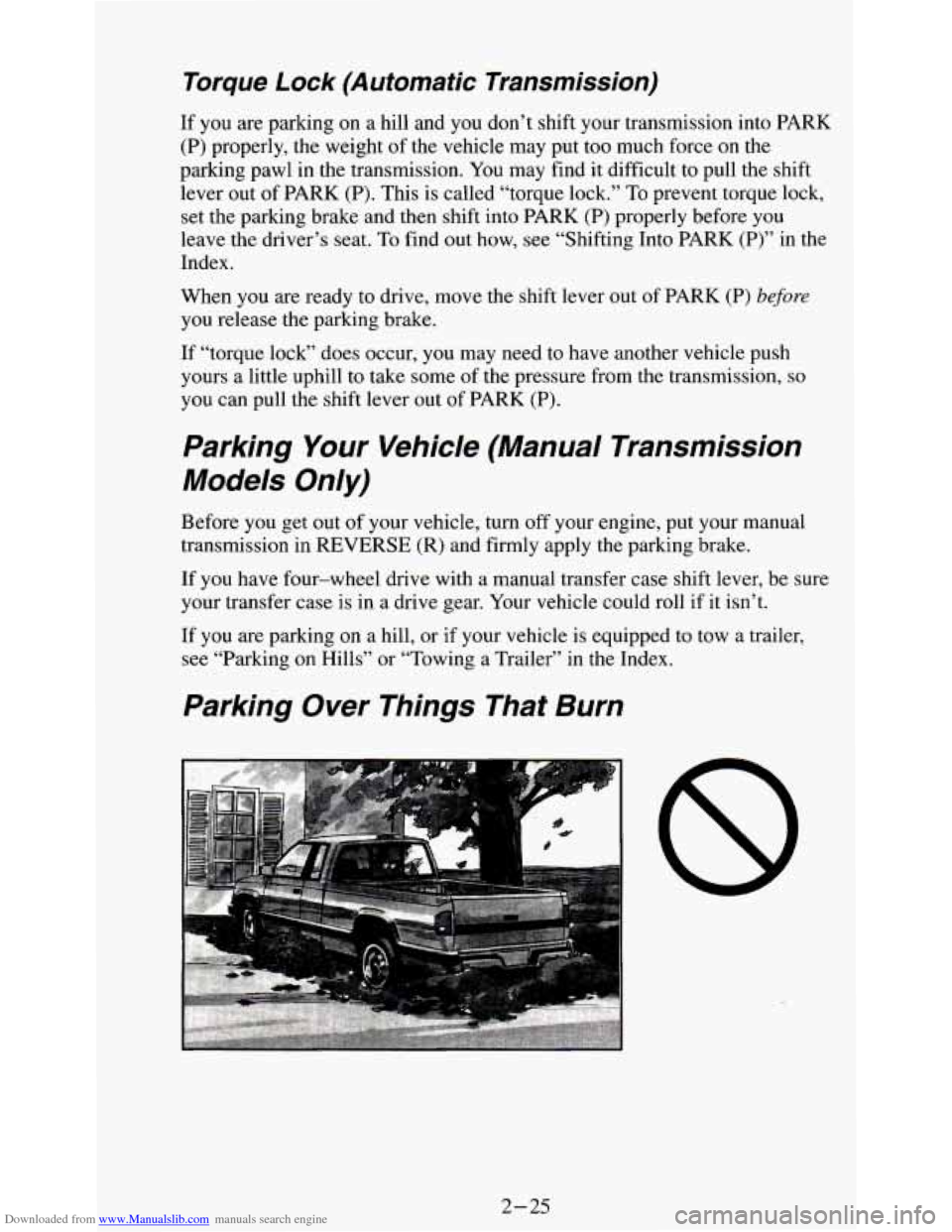
To block out glare,
you can swing down
the top and bottom visors.
You can also
swing the bottom
visor from side to
side.
Your visors may
have an extension that
can
be pulled out for
additional glare
protection and a strap
for holding small
items, such as maps.
Some visors have a
lighted mirror. Just lift
the cover
up to turn on
the mirror lights.
2-48