Page 83 of 354
Downloaded from www.Manualslib.com manuals search engine A CAUTION: I
In freezing weather, don’t use your washer until the windshield
is warmed. Otherwise the washer fluid can form ice on the
windshield, blocking your vision.
I
NOTICE:
When using concentrated washer fluid, follow the
manufacturer’s instructions for adding water.
Don’t mix water with ready-to-use washer fluid. Water can
cause the solution to freeze and damage your washer fluid
tank and other parts of the washer system. Also, water
doesn’t clean
as well as washer fluid.
Fill your washer fluid tank only 3/4 full when it’s very cold.
~ This allows for expansion, which could damage the tank if it is
completely full.
Don’t use radiator antifreeze in your windshield washer. It
can damage your washer system and paint.
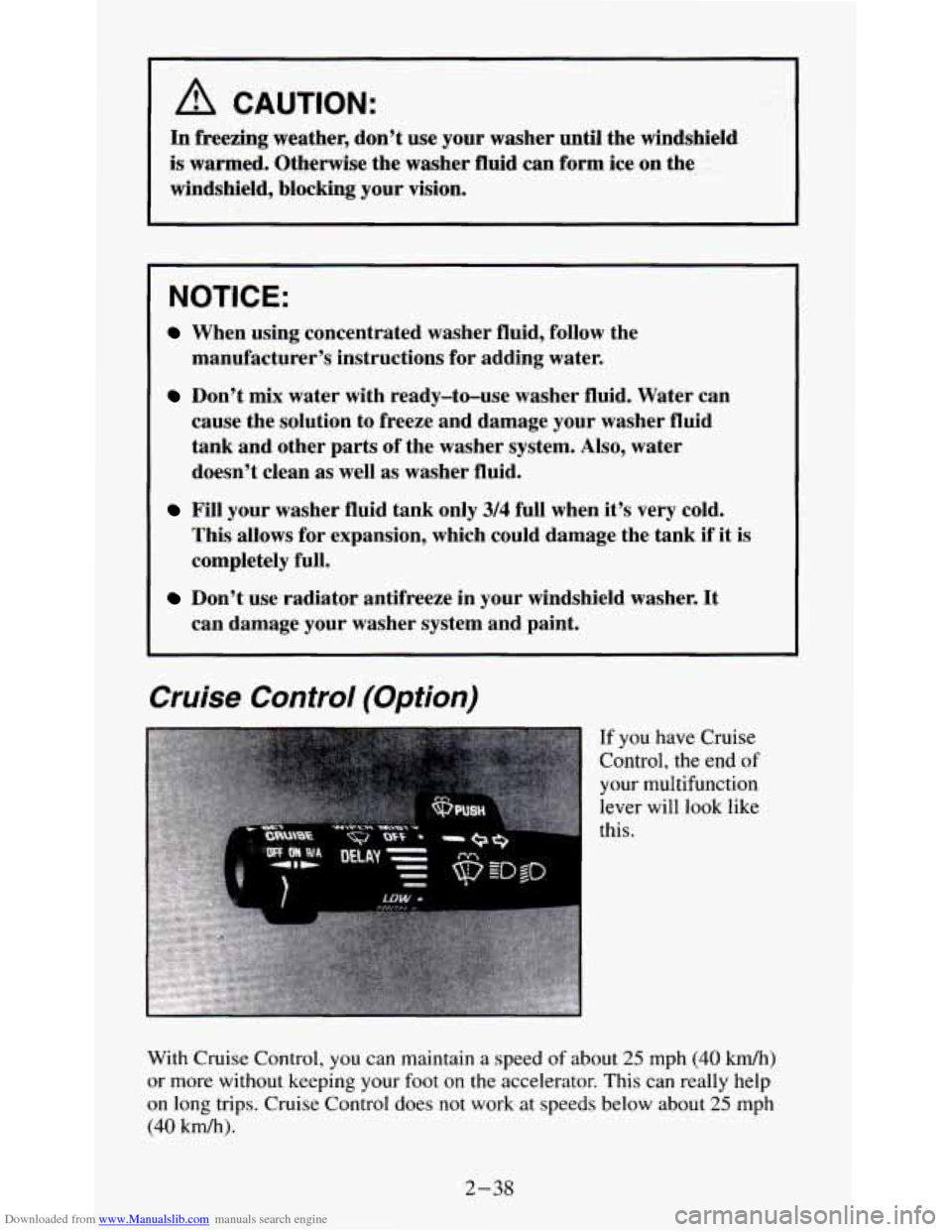
Cruise Control (Option)
If you have Cruise
Control, the end
of
your multifunction
lever will
look like
this.
With Cruise Control,
you can maintain a speed of about 25 mph (40 kdh)
or more without keeping your foot on the accelerator. This can really help
on long trips. Cruise Control does not work at speeds below about 25 mph
(40 km/h).
2-38
Page 195 of 354
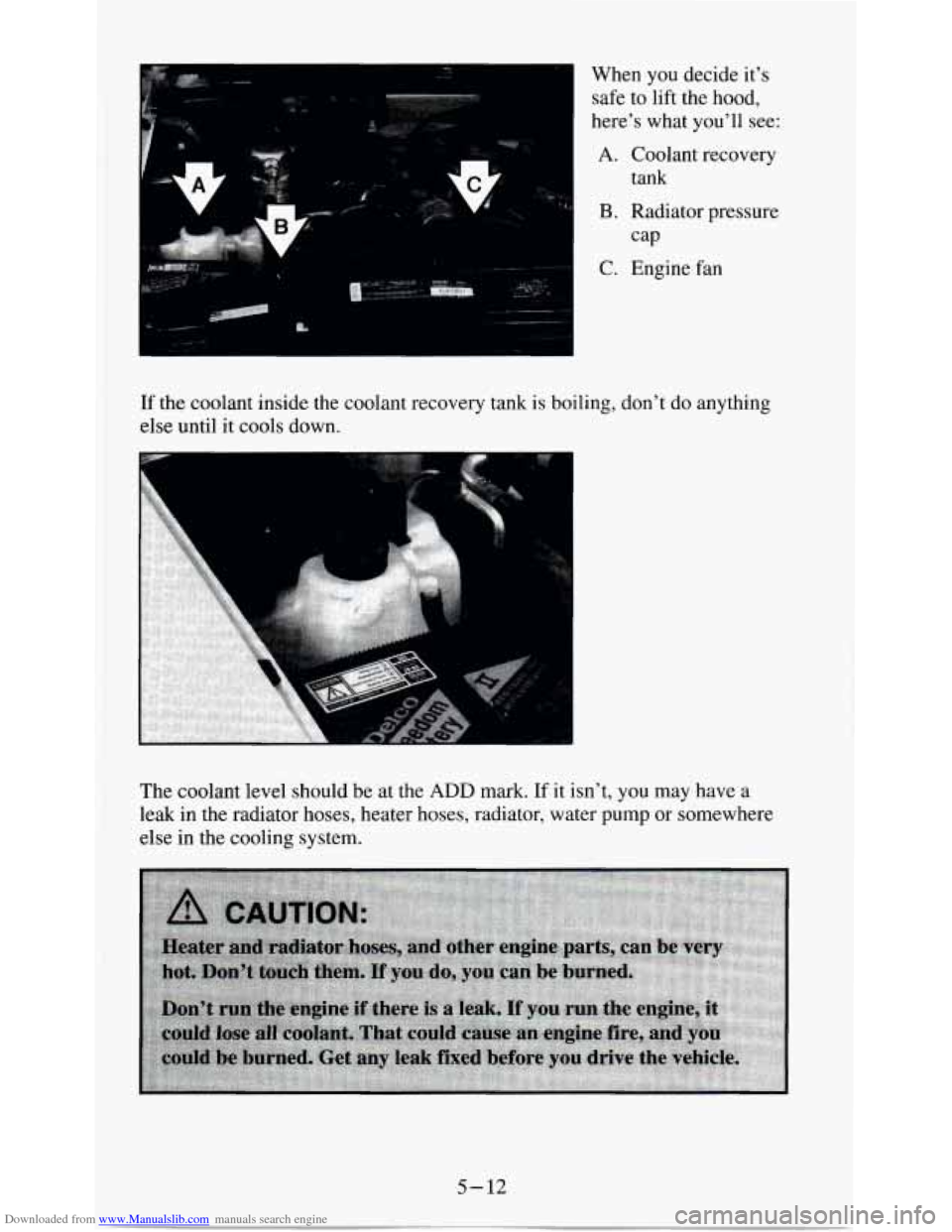
Downloaded from www.Manualslib.com manuals search engine When you decide it's
safe to lift the hood,
here's what you'll see:
A. Coolant recovery
tank
B. Radiator pressure
cap
C. Engine fan
If the coolant inside the coolant recovery tank is boiling, don't do anything
else until it cools down.
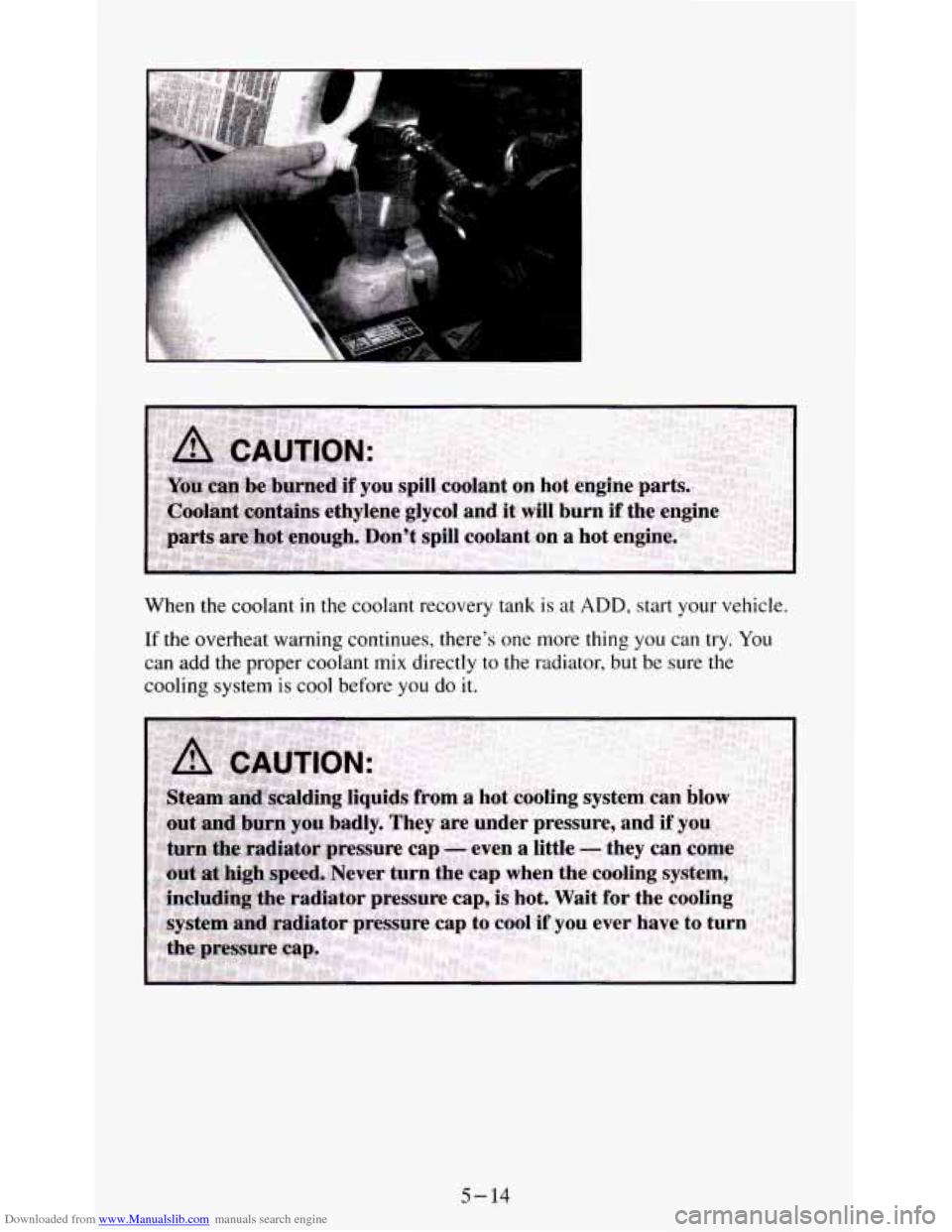
The coolant level should be at the
ADD mark. If it isn't, you may have a
leak in the radiator
hoses, heater hoses, radiator, water pump or somewhere
else in the cooling system.
5-12
Page 197 of 354
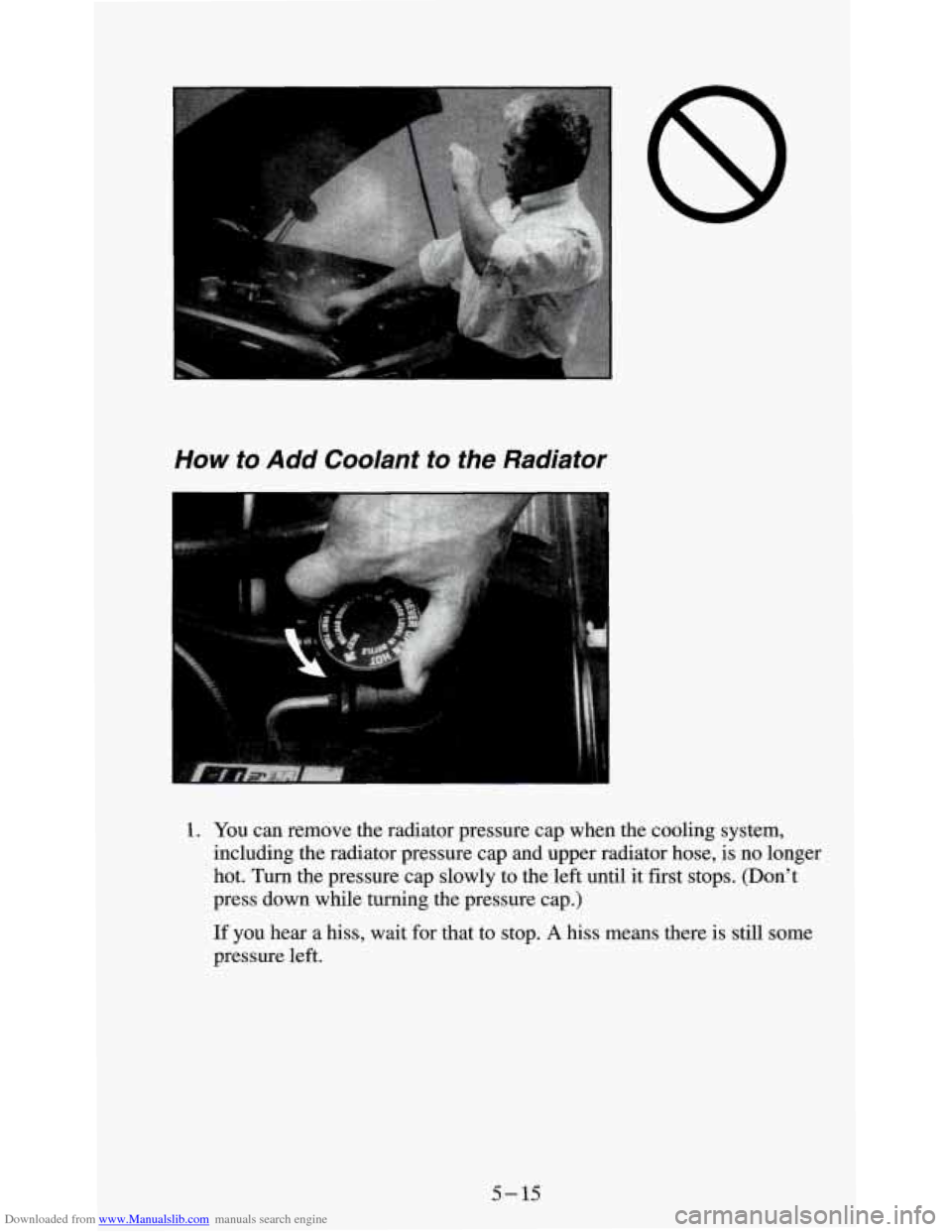
Downloaded from www.Manualslib.com manuals search engine When the coolant in the coolant recovery tank is at ADD, start your vehicle.
If the overheat warning continues, there's one more thing you can try. You
can add the proper coolant mix directly to the radiator, but be sure the
cooling system is cool before you do it.
5-14
Page 198 of 354
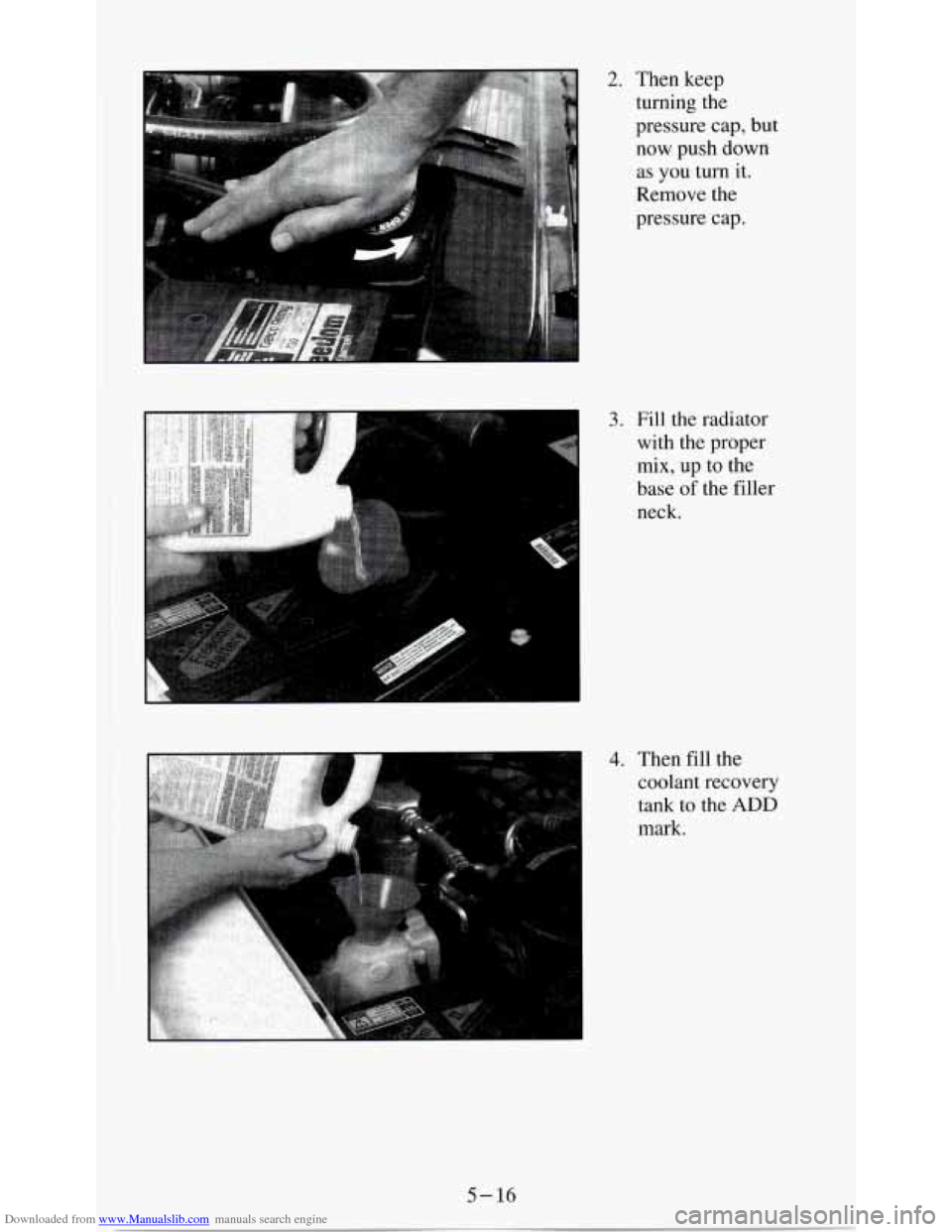
Downloaded from www.Manualslib.com manuals search engine How to Add Coolant to the Radiator
1 . You can remove the radiator pressure cap when the cooling system,
including the radiator pressure cap and upper radiator hose,
is no longer
hot. Turn the pressure cap slowly to the left until it first stops. (Don’t
press down while turning the pressure cap.)
If you hear a hiss, wait for that to stop. A hiss means there is still some
pressure left.
5- 15
Page 199 of 354
Downloaded from www.Manualslib.com manuals search engine I I
2. Then keep
turning the
pressure cap, but
now push down
as you turn it.
Remove the
pres sure cap.
3. Fill the radiator
with the proper
mix, up to the
base
of the filler
neck.
4. Then fill the
coolant recovery
tank to
the ADD
mark.
5-16
Page 200 of 354
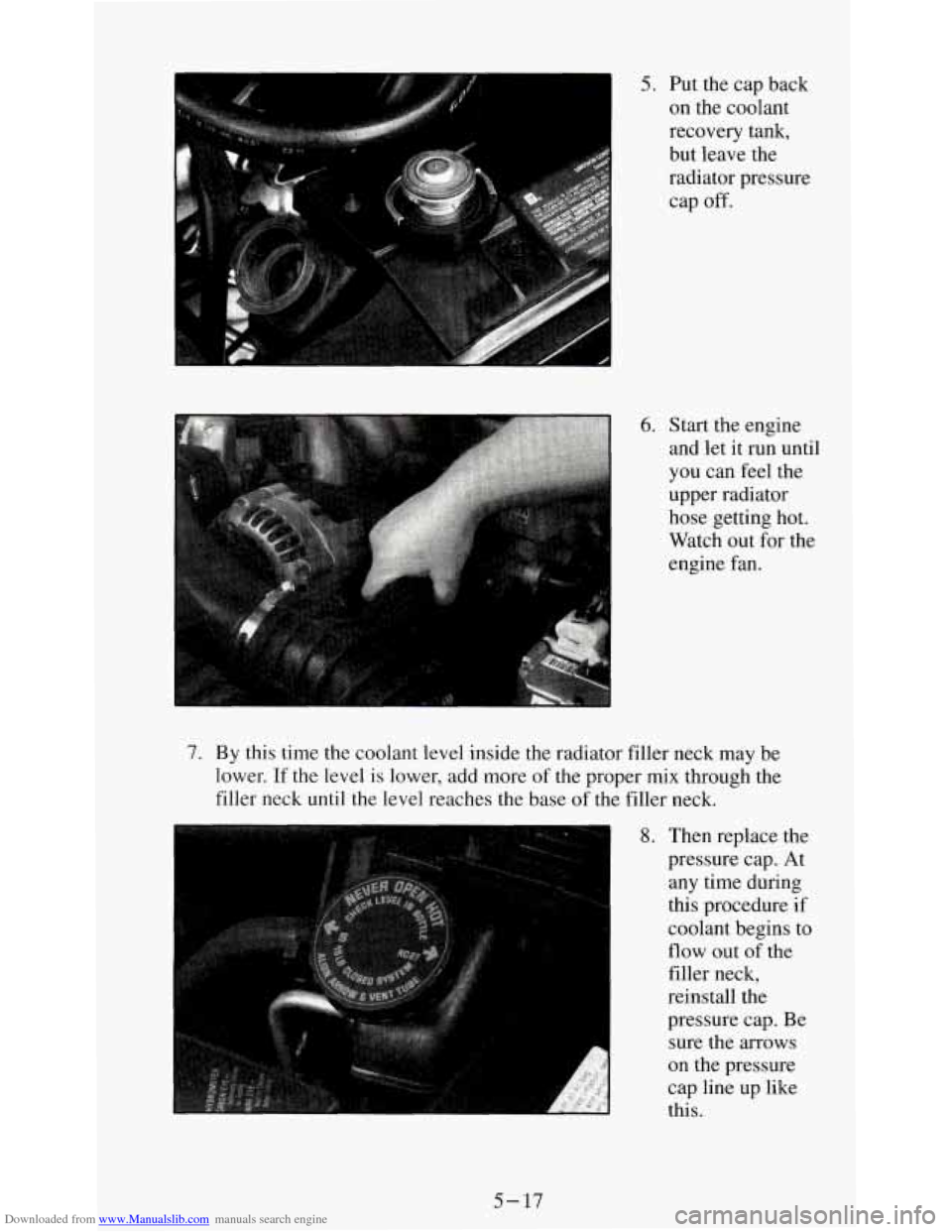
Downloaded from www.Manualslib.com manuals search engine 5. Put the cap back
on the coolant
recovery tank,
but leave the
radiator pressure
cap
off.
6. Start the engine
and let it run until
you can feel the
upper radiator
hose getting hot.
Watch out for the
engine fan.
7. By this time the coolant level inside the radiator filler neck may be
lower. If the
level is lower, add more of the proper mix through the
filler neck until the level reaches the base of the filler neck.
8. Then replace the
pressure cap. At any time during
this procedure if
coolant begins to
flow out of the
filler neck,
reinstall the pressure cap. Be
sure the arrows
on the pressure
cap line up like
this.
5-17
Page 229 of 354
Downloaded from www.Manualslib.com manuals search engine Four-wheel Drive Remote Oil Filter
If your vehicle has four-wheel drive, you will have a remote oil filter. There
is a special access door in the steering linkage shield assembly located under
the radiator support. Twist the screw to lock or unlock the door.
Engine Coolant Heater
An engine coolant heater can be a big help if you have to park outside in
very cold weather,
0°F (-1 8 O C) or colder. If your vehicle has this option,
see “Engine Coolant Heater” in the Index.
What to Do with Used Oil
Did you know that used engine oil contains certain elements that may be
unhealthy for your skin and could
even cause cancer? Don’t let used oil stay
on your skin for very long. Clean your skin and nails with soap and water,
or a good hand cleaner. Wash or properly throw away clothing or rags
containing used engine oil. (See the manufacturer’s warnings about the use
and disposal of oil products.)
Used oil can be a real threat to the environment. If you change your own oil,
be sure to drain all free-flowing oil from the filter before disposal. Don’t
ever dispose of oil by putting
it in the trash, pouring it on the ground, into
sewers, or into streams or bodies of water. Instead, recycle it by taking it
to
a place that collects used oil. If you have a problem properly disposing of
your used oil, ask your dealer, a service station or a local recycling center
for help.
Air Cleaner
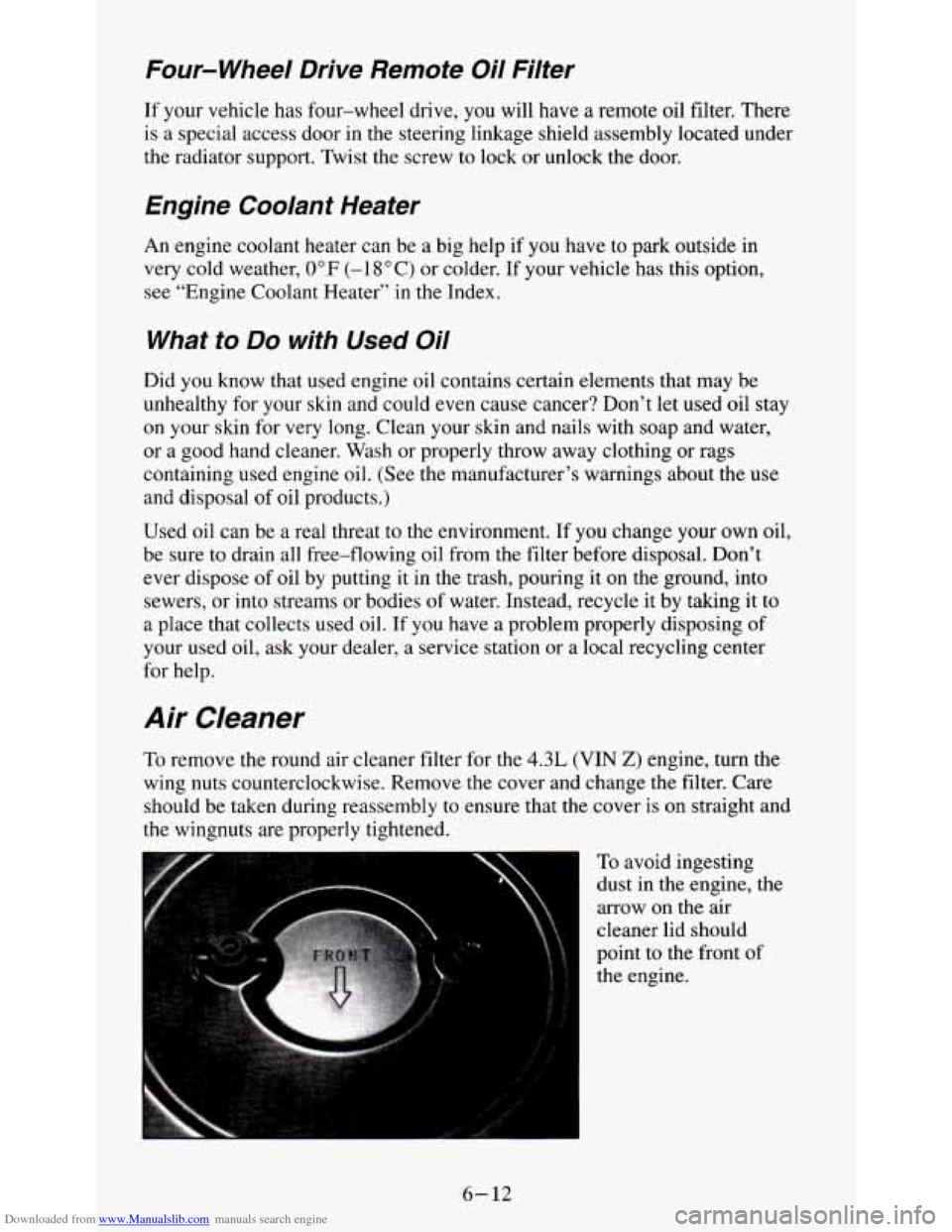
To remove the round air cleaner filter for the 4.3L (VIN 2) engine, turn the
wing nuts counterclockwise. Remove the cover and change the filter. Care
should be taken during reassembly to ensure that the cover is on straight and
the wingnuts
are properly tightened.
= To avoid ingesting
dust in the engine, the
arrow on the air
cleaner lid should
point
to the front of
the engine.
6- 12
Page 239 of 354
Downloaded from www.Manualslib.com manuals search engine NOTICE:
If you use an improper coolant mix, your engine could overheat
and be badly damaged. The repair cost wouldn’t be covered by
your warranty. Too much water in the mix can freeze and crack
the engine, radiator, heater core and other parts.
Some conditions, such as air trapped in the cooling system, can affect the
coolant level in the radiator. Check the coolant level when the engine is cold
and follow the steps under “Adding Coolant” for the proper way to add
coolant.
If you have to add coolant more than four times a year, have your dealer
check your cooling system.
NOTICE:
If you use the proper coolant, you don’t have to add extra
inhibitors or additives which claim to improve the system. These
can be harmful.
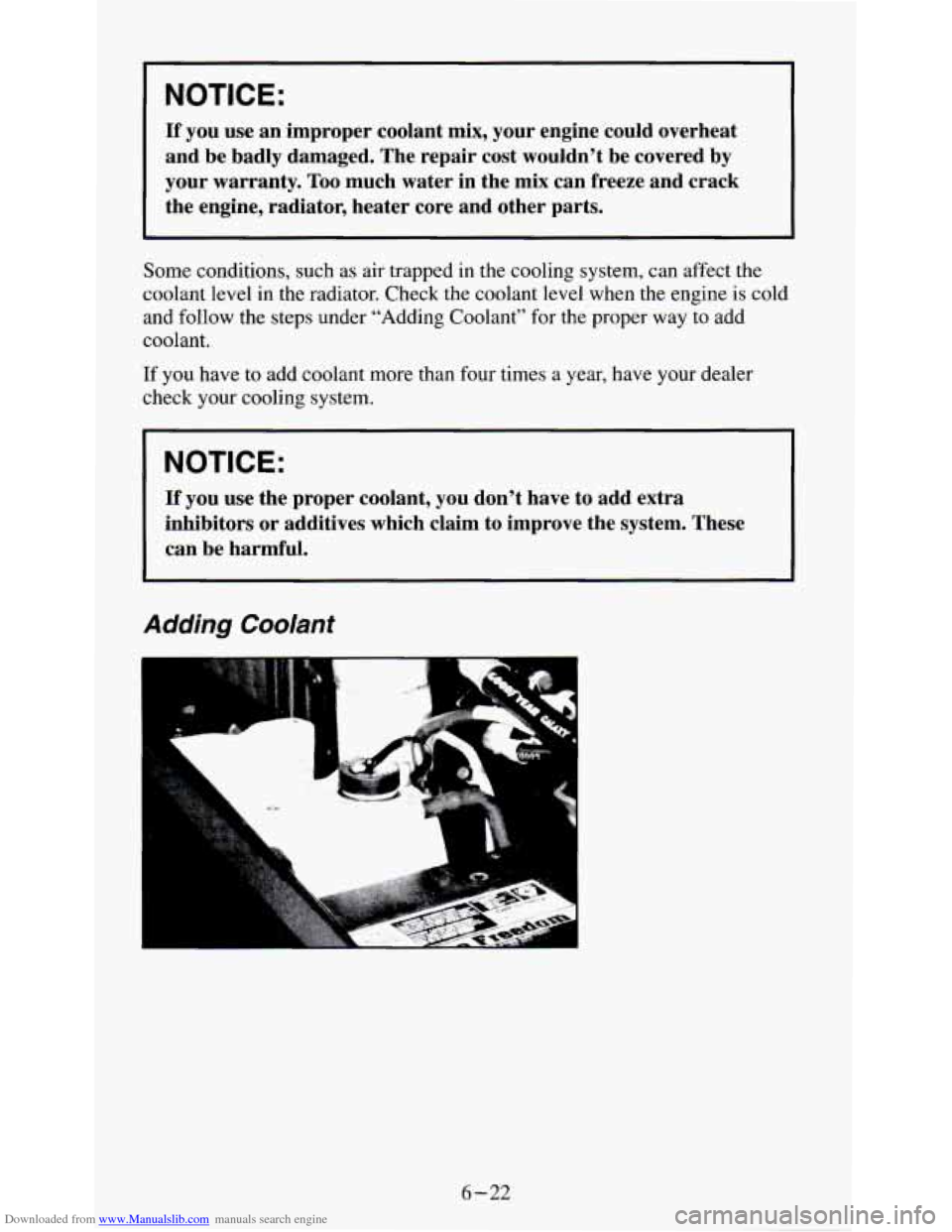
Adding Coolant
E I
6-22