Page 313 of 386
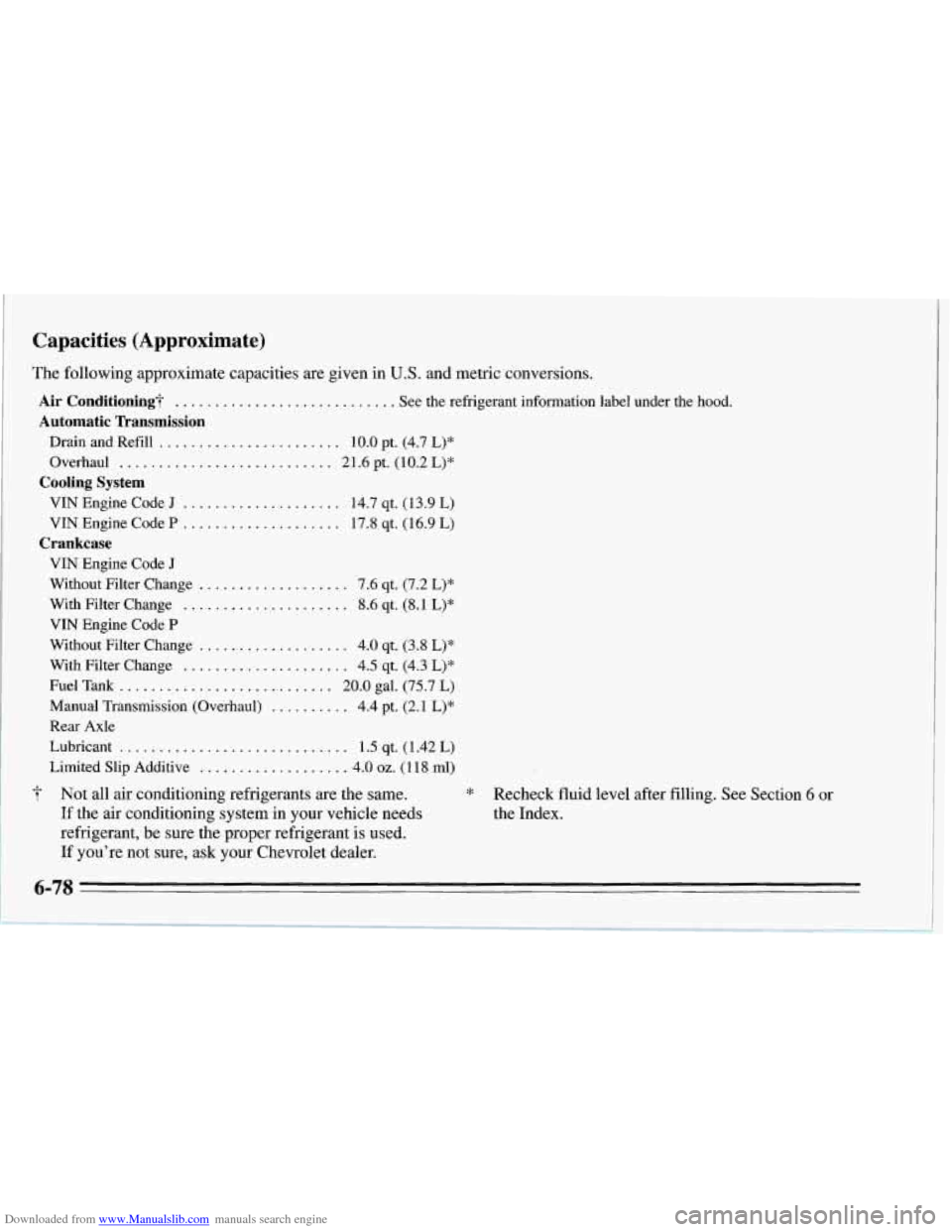
Downloaded from www.Manualslib.com manuals search engine Capacities (Approximate)
Air Conditioning? ............................ See the refrigerant information lab
The following approximate capacities are given in U.S. and metric conversions.
Automatic Transmission
Drain and Refill ....................... 10.0 pt. (4.7 L)*
Overhaul
....... ............. 21.6pt. (10.2L)*
VIN Engine Code J .................... 14.7 qt. (13.9 L)
VIN Engine Code P .................... 17.8 qt. (16.9 L)
Cooling System
Crankcase
VIN Engine Code J
Without Filter Change ................... 7.6 qt. (7.2 L)*
With Filter Change
..................... 8.6 qt. (8.1 L)*
Without Filter Change ................... 4.0 qt. (3.8 L)*
With Filter Change
..................... 4.5 qt. (4.3 L)*
Fuel Tank
........................... 20.0 gal. (75.7 L)
Manual Transmission (Overhaul)
.......... 4.4 pt. (2.1 L)*
Lubricant
............................. 1.5 qt. (1.42 L)
Limited Slip Additive
................... 4.0 oz. (1 18 ml)
VIN
Engine Code
P
Rear Axle
7 Not all air conditioning refrigerants are the same.
If the air conditioning system in your vehicle needs
refrigerant, be sure the proper refrigerant is used.
If you’re not sure, ask your Chevrolet dealer.
el und er
the hood.
* Recheck fluid level after filling. See Section 6 or
the Index.
6-78
Page 317 of 386
Downloaded from www.Manualslib.com manuals search engine I
1 How This Section is Organized
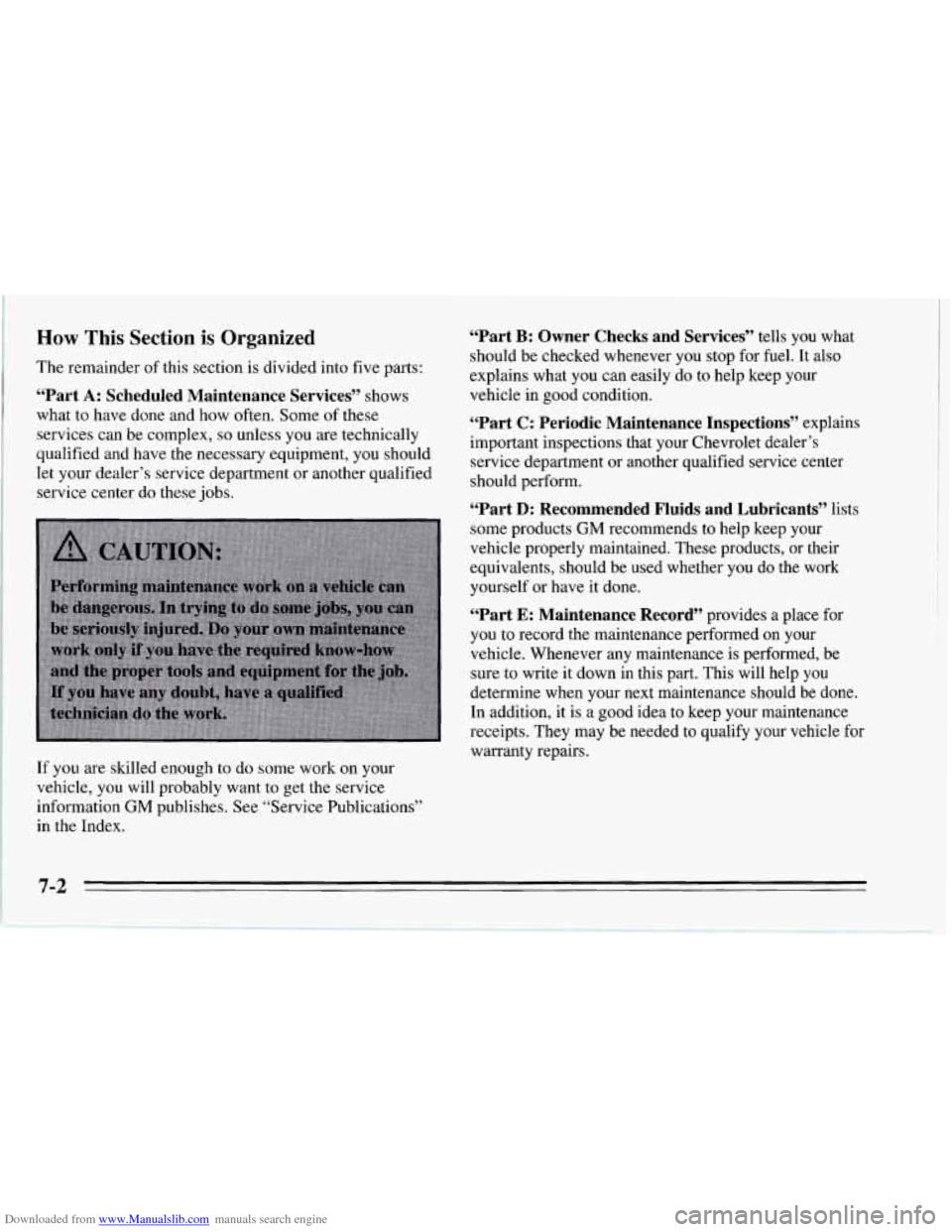
The remainder of this section is divided into five parts:
“Part A: Scheduled Maintenance Services” shows
what
to have done and how often. Some of these
services can be complex,
so unless you are technically
qualified and have the necessary equipment, you should
let your dealer’s service department
or another qualified
service center do these jobs.
If you are skilled enough to do some work on your
i vehicle, you will probably want to get the service
1
information GM publishes. See “Service Publications”
in the Index.
3
“Part B: Owner Checks and Services” tells you what
should be checked whenever you stop for fuel. It also
explains what you can easily do to help keep your
vehicle in good condition.
“Part C: Periodic Maintenance Inspections” explains
important inspections that your Chevrolet dealer’s
service department or another qualified service center
should perform.
“Part D: Recommended Fluids and Lubricants” lists
some products
GM recommends to help keep your
vehicle properly maintained. These products, or their
equivalents, should be used whether you do the work
yourself or have it done.
“Part E: Maintenance Record’’ provides a place for
you to record the maintenance performed on your
vehicle. Whenever any maintenance is performed, be
sure to write it down
in this part. This will help you
determine when your next maintenance should be done.
In addition, it is a good idea to keep your maintenance
receipts. They may be needed to qualify your vehicle for
warranty repairs.
7-2
Page 318 of 386
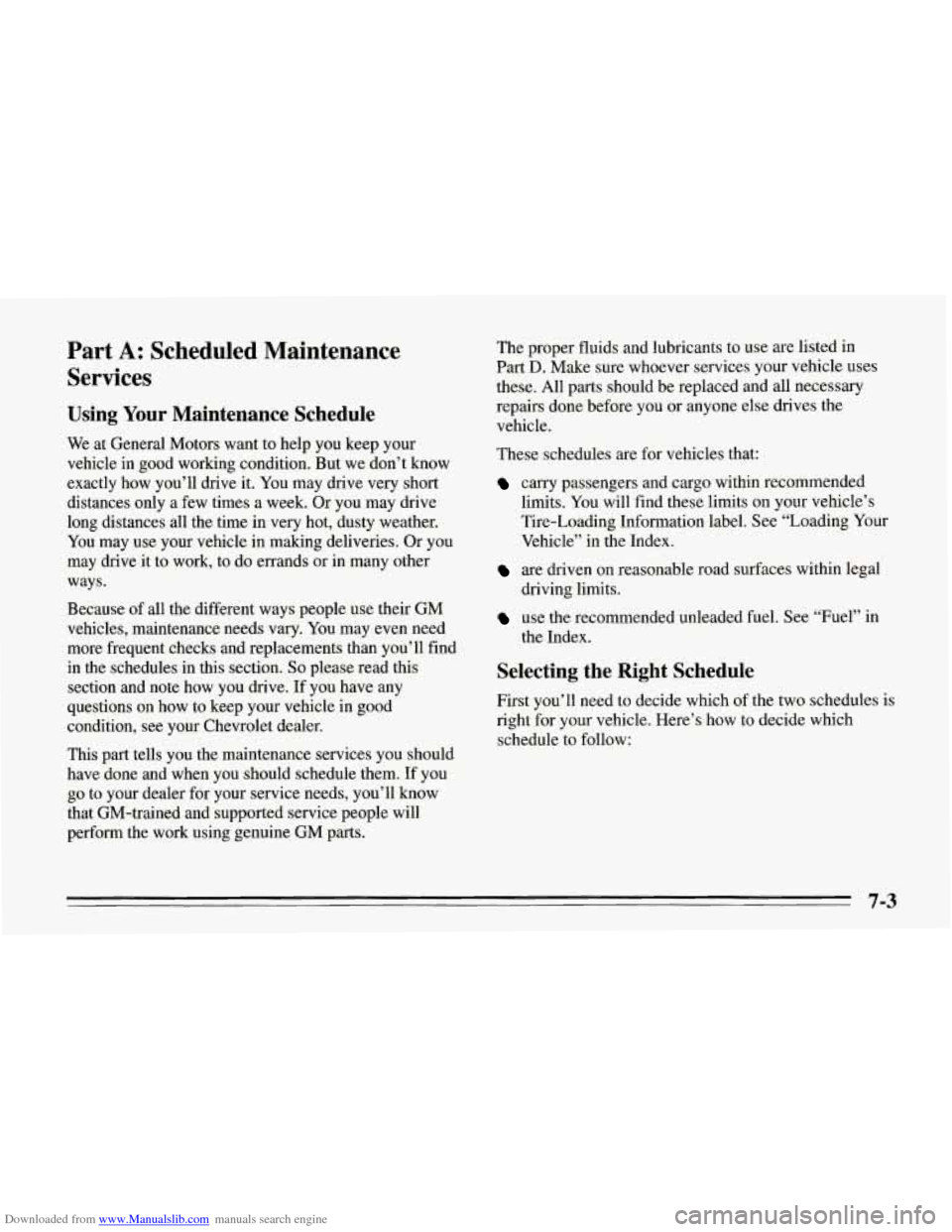
Downloaded from www.Manualslib.com manuals search engine Part A: Scheduled Maintenance
Services
Using Your Maintenance Schedule
We at General Motors want to help you keep your
vehicle in good working condition. But we don’t know
exactly how you’ll drive it. You may drive very short
distances only a few times a week. Or you may drive
long distances all the time in very hot, dusty weather.
You may use your vehicle in making deliveries. Or you
may drive it to work, to do errands or
in many other
ways.
Because of all the different ways people use their GM
vehicles, maintenance needs vary. You may even need
more frequent checks and replacements than you’ll find
in the schedules in this section.
So please read this
section and note how
you drive. If you have any
questions on how to keep your vehicle in good
condition, see your Chevrolet dealer.
This part tells you the maintenance services you should
have done and when you should schedule them. If you
go to your dealer for your service needs, you’ll know
that GM-trained and supported service people will
perform the work using genuine GM parts. The proper
fluids and lubricants to use are listed in
Part D. Make sure whoever services your vehicle uses
these. All parts should be replaced and all necessary
repairs done before you or anyone else drives the
vehicle.
These schedules are for vehicles that:
carry passengers and cargo within recommended
limits. You will find these limits on your vehicle’s
Tire-Loading Information label. See “Loading Your
Vehicle” in the Index.
are driven on reasonable road surfaces within legal
driving limits.
use the recommended unleaded fuel. See “Fuel” in
the Index.
Selecting the Right Schedule
First you’ll need to decide which of the two schedules is
right for your vehicle. Here’s how to decide which
schedule to follow:
7-3
Page 319 of 386
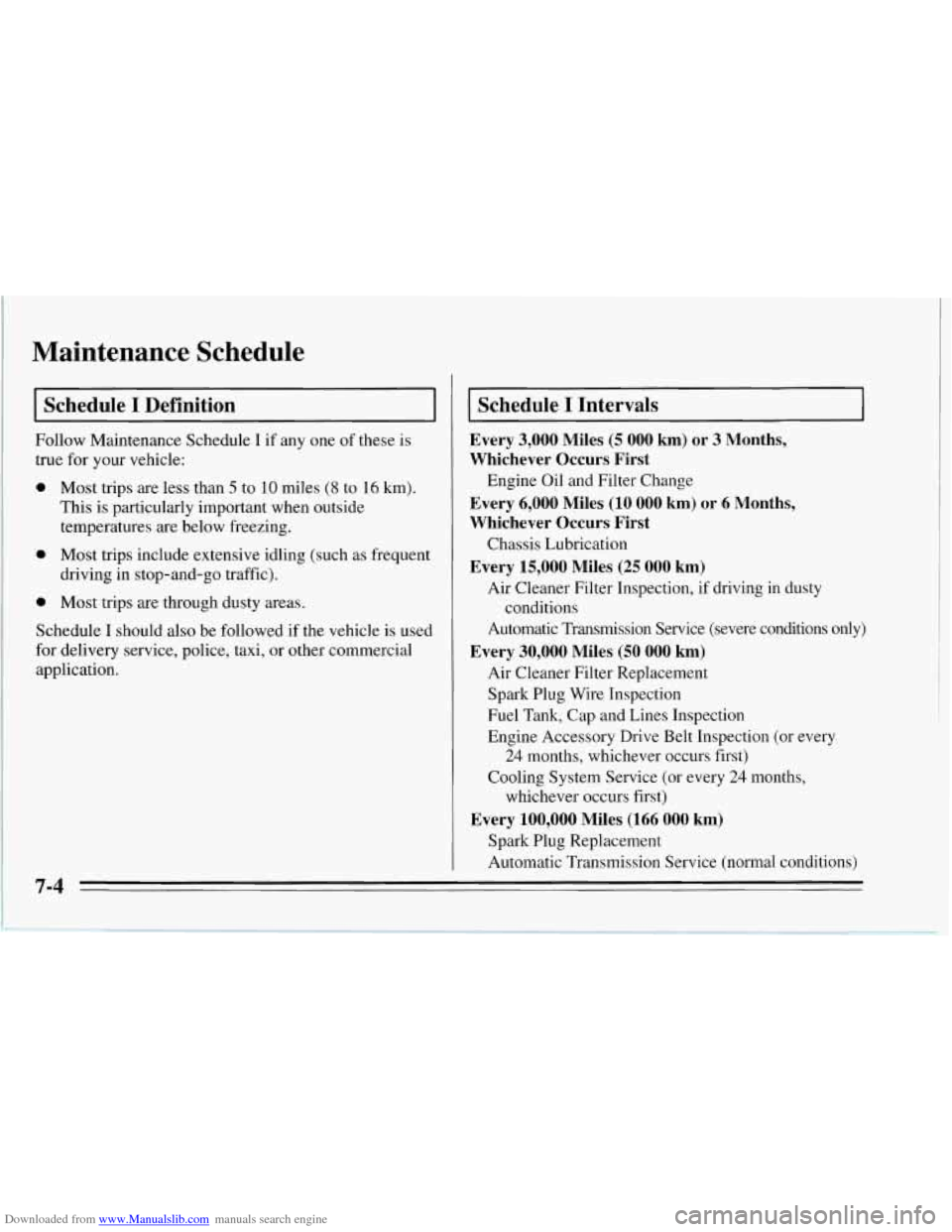
Downloaded from www.Manualslib.com manuals search engine Maintenance Schedule
I Schedule I Definition I
Follow Maintenance Schedule I if any one of these is
true for your vehicle:
0 Most trips are less than 5 to 10 miles (8 to 16 km).
This is particularly important when outside
temperatures are below freezing.
0 Most trips include extensive idling (such as frequent
driving in stop-and-go traffic).
0 Most trips are through dusty areas.
Schedule
I should also be followed if the vehicle is used
for delivery service, police, taxi, or other commercial
application.
Schedule I Intervals
Every 3,000 Miles (5 000 km) or 3 Months,
Whichever Occurs First
Every 6,000 Miles
(10 000 km) or 6 Months,
Whichever Occurs First
Chassis Lubrication
Every 15,000 Miles (25 000 km)
Air Cleaner Filter Inspection, if driving in dusty
Automatic Transmission Service (severe conditions only)
Every 30,000 Miles (50 000 km)
Air Cleaner Filter Replacement
Spark Plug Wire Inspection
Fuel Tank, Cap and Lines Inspection
Engine Accessory Drive Belt Inspection (or every
24 months, whichever occurs first)
Cooling System Service (or every
24 months,
whichever occurs first)
Spark Plug Replacement
Automatic Transmission Service (normal conditions)
Engine Oil and Filter Change
conditions
Every 100,000 Miles (166 000 km)
7-4
Page 320 of 386
Downloaded from www.Manualslib.com manuals search engine Maintenance Schedule
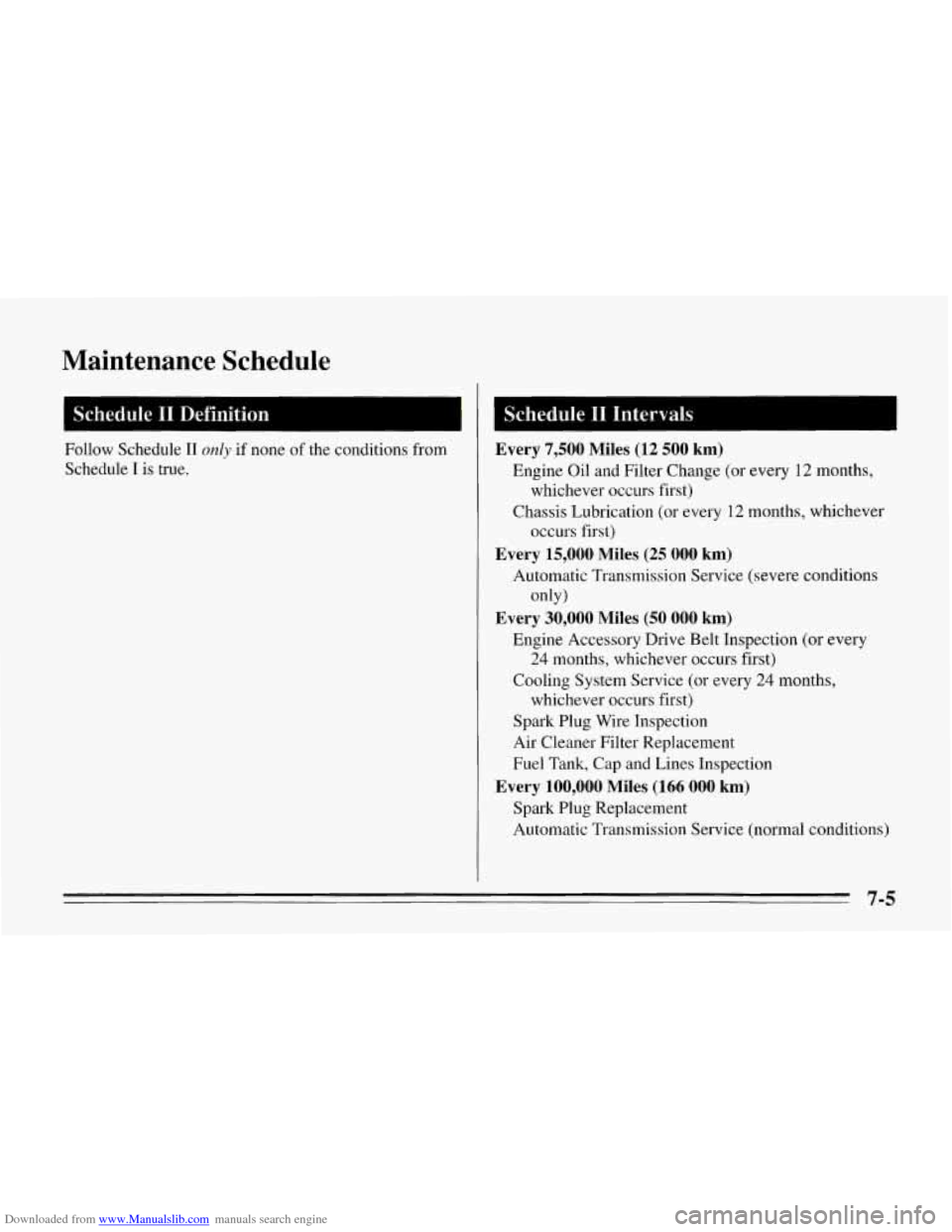
Follow Schedule I1 only if none of the conditions from
Schedule
I is true.
I Schedule I1 Intervals I
Every 7,500 Miles (12 500 km)
whichever occurs first)
occurs first)
Engine
Oil and Filter Change (or every
12 months,
Chassis Lubrication (or every
12 months, whichever
Every 15,000 Miles (25 000 km)
Automatic Transmission Service (severe conditions
only
1
Every 30,000 Miles (50 000 km)
Engine Accessory Drive Belt Inspection (or every
24 months, whichever occurs first)
Cooling System Service (or every
24 months,
whichever occurs first)
Spark Plug Wire Inspection
Air Cleaner Filter Replacement
Fuel Tank, Cap and Lines Inspection
Every 100,000 Miles (166 000 km)
Spark Plug Replacement
Automatic Transmission Service (normal conditions)
7-5
Page 327 of 386
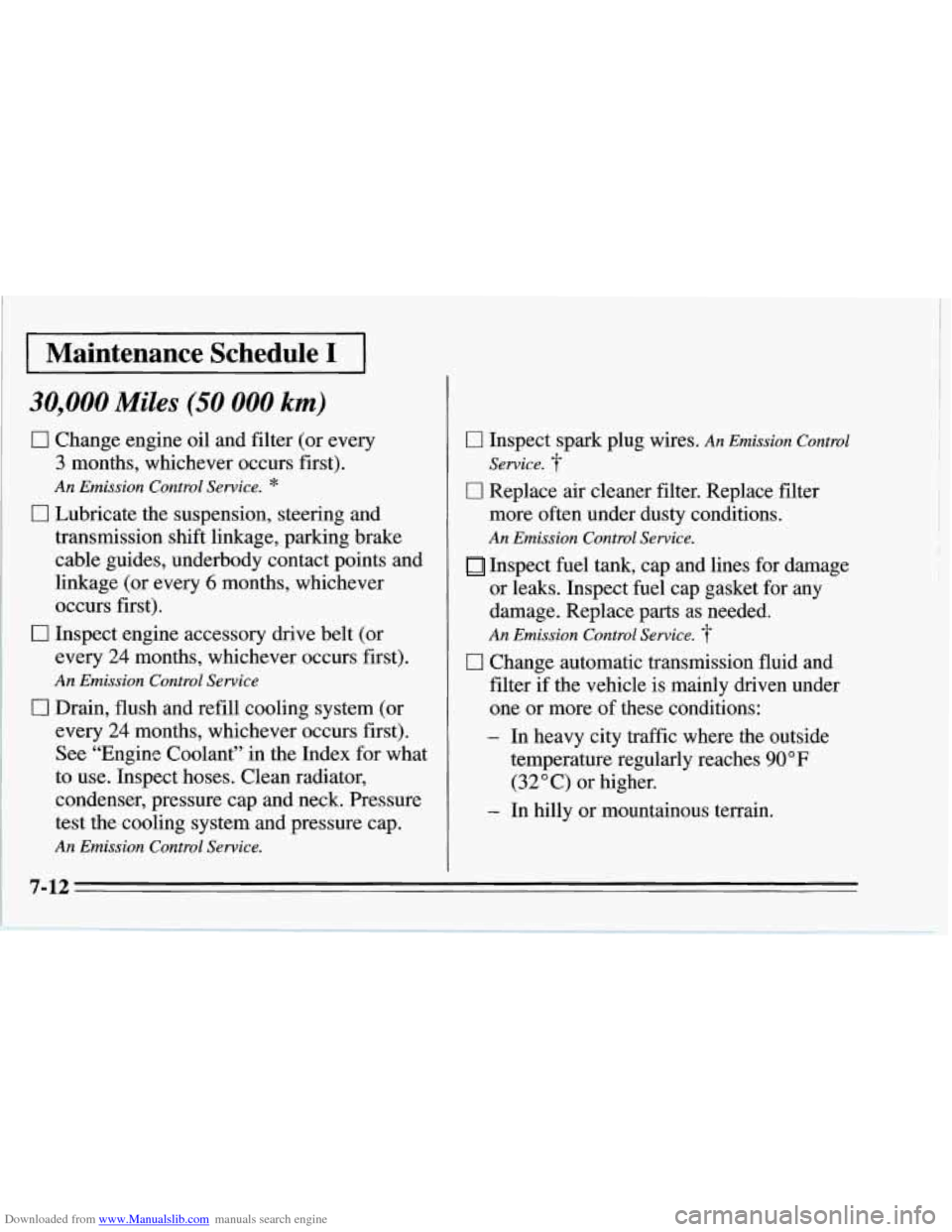
Downloaded from www.Manualslib.com manuals search engine Maintenance Schedule I
30,000 Miles (50 000 km)
0 Change engine oil and filter (or every [7 Inspect spark plug wires. An Emission Control
3 months, whichever occurs first). Service. -f-
An Emission Control Service. * [7 Replace air cleaner filter. Replace filter
17 Lubricate the suspension, steering and more often under dusty conditions.
transmission shift linkage, parking brake
An Emission Control Service.
cable guides, underbody contact Points and Inspect fuel tank, cap and lines for damage
linkage (or every
6 months, whichever or leaks. Inspect fuel cap gasket for any
occurs first). damage. Replace parts as needed.
every
24 months, whichever occurs first). 0 Change automatic transmission fluid and
An Emission Control Service filter if the vehicle is mainly driven under
every
24 months, whichever occurs first). - In heavy city traffic where the outside
See “Engine Coolant” in the Index for what temperature regularly reaches 90 O F
to use. Inspect hoses. Clean radiator, (32 O C) or higher.
condenser, pressure cap and neck. Pressure
test the cooling system and pressure cap.
0 Inspect engine accessory drive belt (or An Emission Control Service. -f-
0 Drain, flush and refill cooling system (or one or more of these conditions:
- In hilly or mountainous terrain.
An Emission Control Service.
7-12
Page 334 of 386
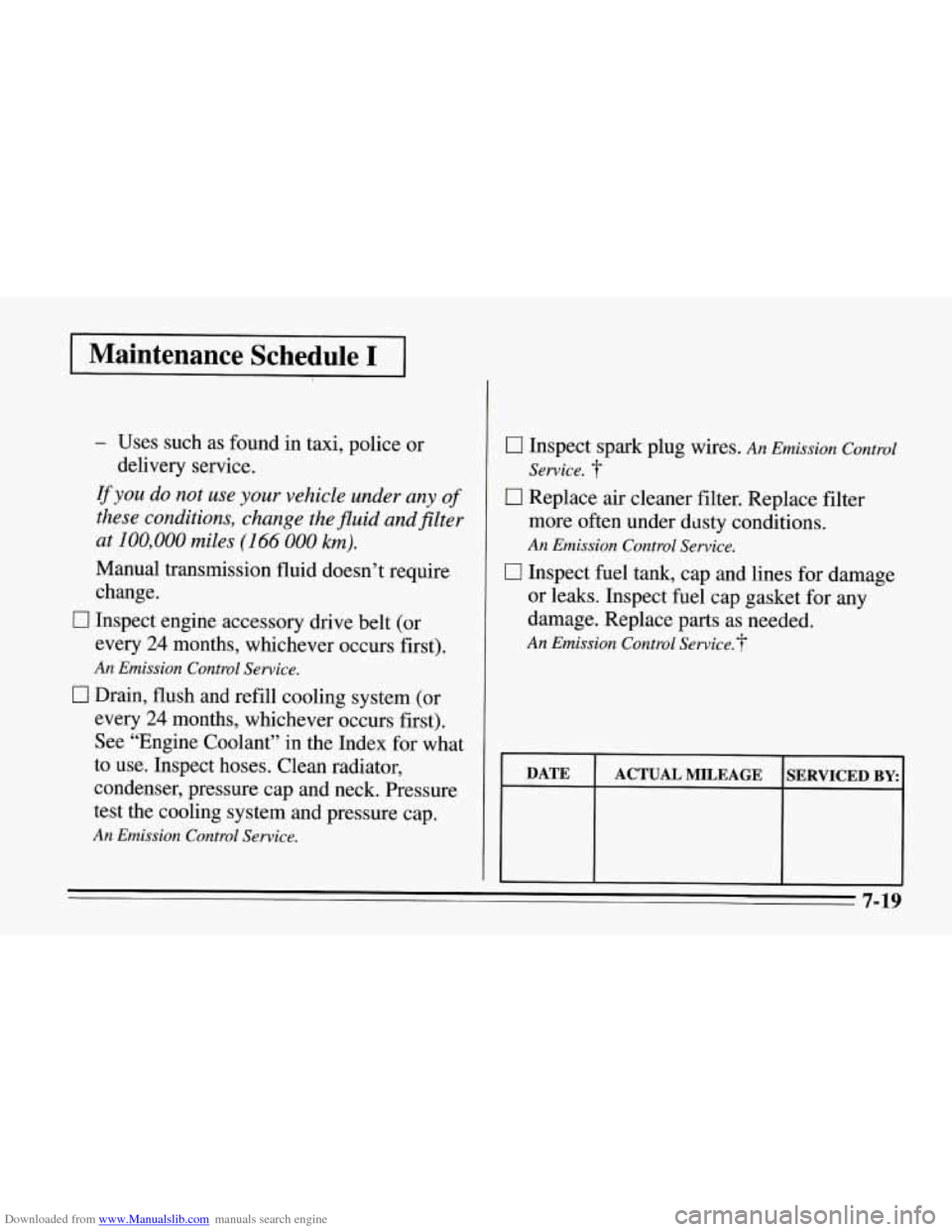
Downloaded from www.Manualslib.com manuals search engine Maintenance Schedule I
- Uses such as found in taxi, police or
Ifyou do not use your vehicle under any of
these conditions, change the fluid and filter
at
100,000 miles (1 66 000 km).
Manual transmission fluid doesn’t require
change.
every
24 months, whichever occurs first).
0 Drain, flush and refill cooling system (or
every
24 months, whichever occurs first).
See “Engine Coolant” in the Index for what
to use. Inspect hoses. Clean radiator,
condenser, pressure cap and neck. Pressure
test the cooling system and pressure cap.
An Emission Control Service.
delivery service.
I7 Inspect engine accessory drive belt (or
An Emission Control Service.
0 Inspect spark plug wires. An Emission Control
0 Replace air cleaner filter. Replace filter
Sewice.
more often under dusty conditions.
An Emission Control Service.
0 Inspect fuel tank, cap and lines for damage
or leaks. Inspect fuel cap gasket for any
damage. Replace parts as needed.
An Emission Control Service.?
DATE
SERVICED BY: ACTUAL MILEAGE
A
7-19
Page 341 of 386
Downloaded from www.Manualslib.com manuals search engine Maintenance Schedule I
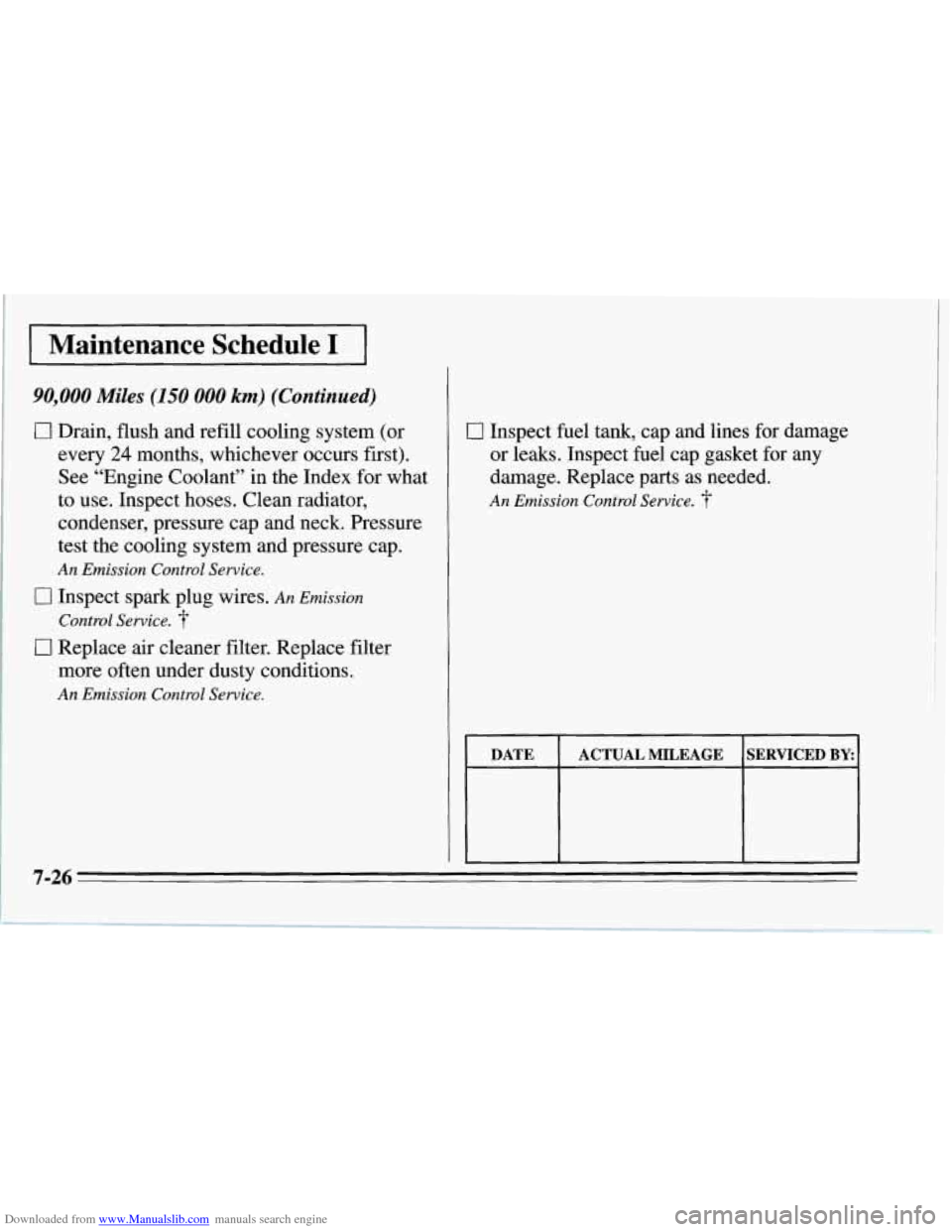
90,000 Miles (150 000 km) (Continued)
0 Drain, flush and refill cooling system (or
every
24 months, whichever occurs first).
See “Engine Coolant” in the Index for what
to use. Inspect hoses. Clean radiator,
condenser, pressure cap and neck. Pressure
test the cooling system and pressure cap.
An Emission Control Service.
0 Inspect spark plug wires. An Emission
0 Replace air cleaner filter. Replace filter
more often under dusty conditions.
An Emission Control Service.
Control
Service.
0 Inspect fuel tank, cap and lines for damage
or leaks. Inspect fuel cap gasket for any
damage. Replace parts as needed.
An Emission Control Service.
I I I 1
7-26