Page 293 of 395
Downloaded from www.Manualslib.com manuals search engine 6. With the car in OVERDRIVE (a), turn the Electronic Climate
7. Turn your engine off.
Control to AUTO and let the engine idle for three minutes or more.
Now your computer is programmed.
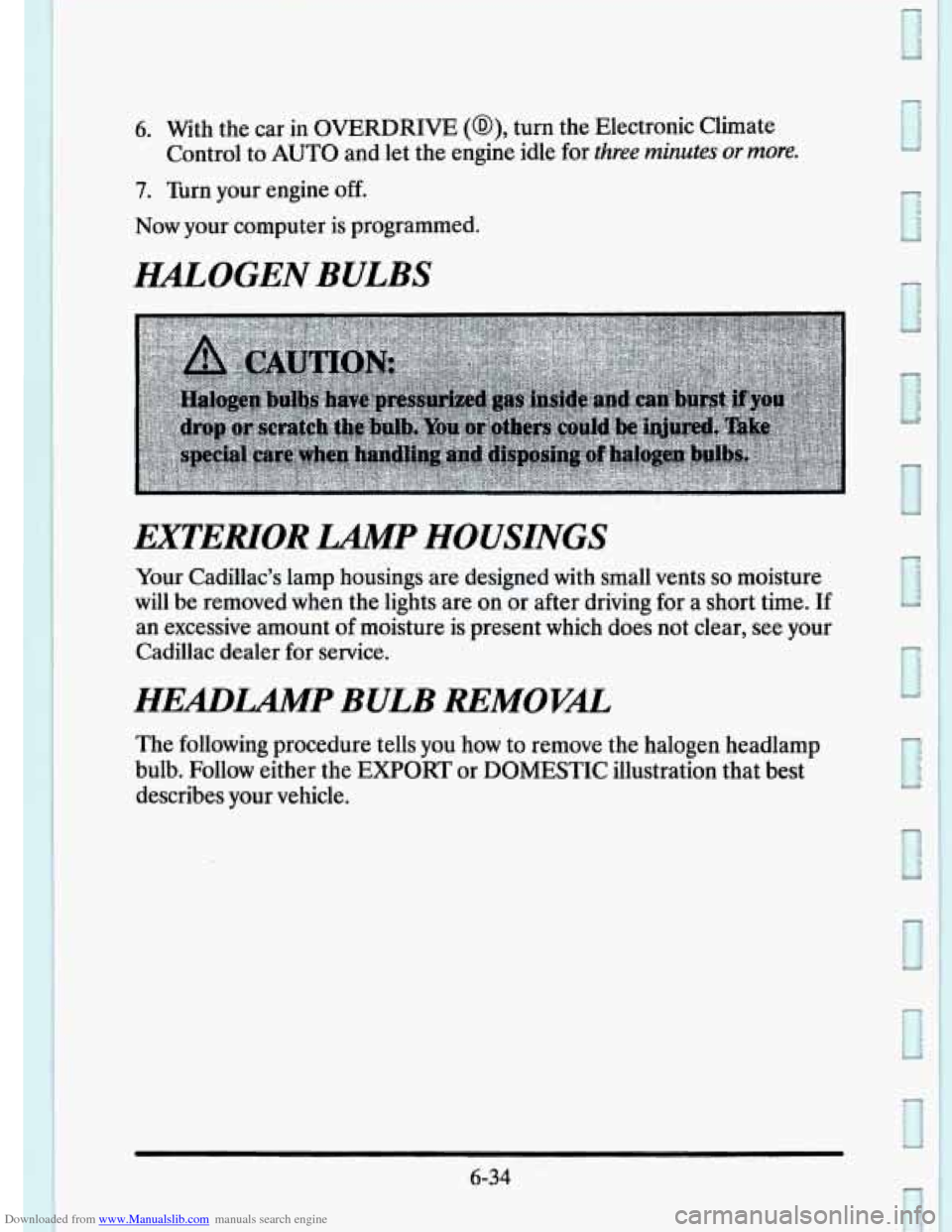
EQUOGEN BULBS
EXTERIOR LAMP HOUSINGS
Your Cadillac's lamp housings are designed with small vents so moisture
will be removed when the lights are on or after driving for a short time. If
an excessive amount of moisture is present which does not clear, see your
Cadillac dealer for service.
HEmWP BULB REMOVXL,
The following procedure tells you how to remove the halogen headlamp
bulb. Follow either the
EXPORT or DOMESTIC illustration that best
describes your vehicle.
6-34
I
Page 301 of 395
Downloaded from www.Manualslib.com manuals search engine 6. Reinstall the new insert by aligning the bladc housing tabs and the
edge
of the insert, starting with the second set from the outer edge.
Make sure that the insert is connected to all of the housing tabs and
that it moves freely back and forth.
7. To install the wiper blade, align the wiper arm pin with the hole on the
wiper blade assembly and snap
it into place. Return thc wipers to their
normal position.
TIRES
We don’t make tires. Your Cadillac comes with high-quality tires made by
a leading tire manufacturer. If you ever have questions about your tire
warranty
and where to obtain service, see your Cadillac Warranty booklet
for details.
~~ -~
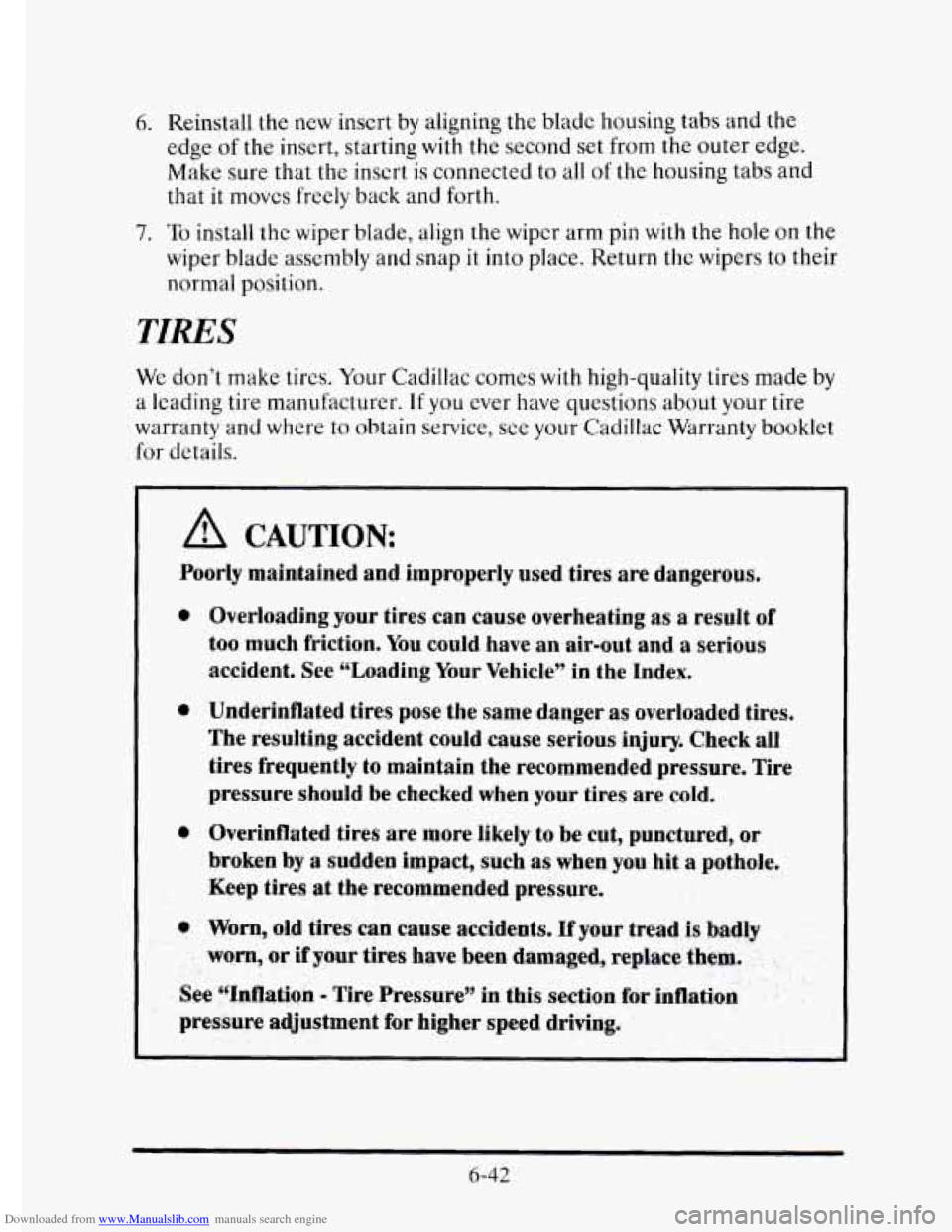
A CAUTION:
Poorly maintained and improperly used tires are dangerous.
0
0 Overloading your tires can cause overheating as a result of
too much friction. You could have an air-out and a serious
accident. See “Loading Your Vehicle”
in the Index.
Underinflated tires pose the same danger as overloaded tires.
The resulting accident could cause serious
injury. Check all
tires frequently
to maintain the recommended pressure. Tire
pressure should be checked when your tires are
cold.
Overinflated tires are more likely to be cut, punctured, or
broken by a sudden impact, such as when you hit a pothole.
Keep tires
at the recommended pressure.
Worn, old tires can cause accidents. If your tread is badly
worn, or if your tires have been damaged, replace them. . .
See (‘Inflation - Tire Pressure” in this section for inflation
pressure adjustment for higher speed
driving.
6-42
Page 303 of 395
Downloaded from www.Manualslib.com manuals search engine When to Check
Check your tires once a month or more.
Don’t forget your compact sparc tire.
It should be at 60 psi (420 kPa).
How to Check
Use a good quality pocket-type gage to check tire pressure. Simply
looking at the tires
will not tell you the pressure, especially ii you have
radial tires
-- which may look properly inflated even if they’re
underinflated.
If your tires have valve caps, be sure to put them back on. They help
prevent leaks
by keeping out dirt and moisture.
Tire Inspection and Rotation
Tires should be inspected every 6,000 to 8,000 miles (10 000 to ‘13 000 km)
for any signs
of unusual wear. If unusual wear is present, rotate your tires
as
soon as possible and check wheel alignment. Also check for damaged
tires or wheels. See “When it’s Time for
New Tires” and “Wheel
Replacement” later in this section
for more information.
The purpose of regular rotation is to achieve more uniform wear for all tires
on the vehicle. The first rotation is the most important. See “Scheduled
Maintenance Services”
in the Index for scheduled rotation intervals.
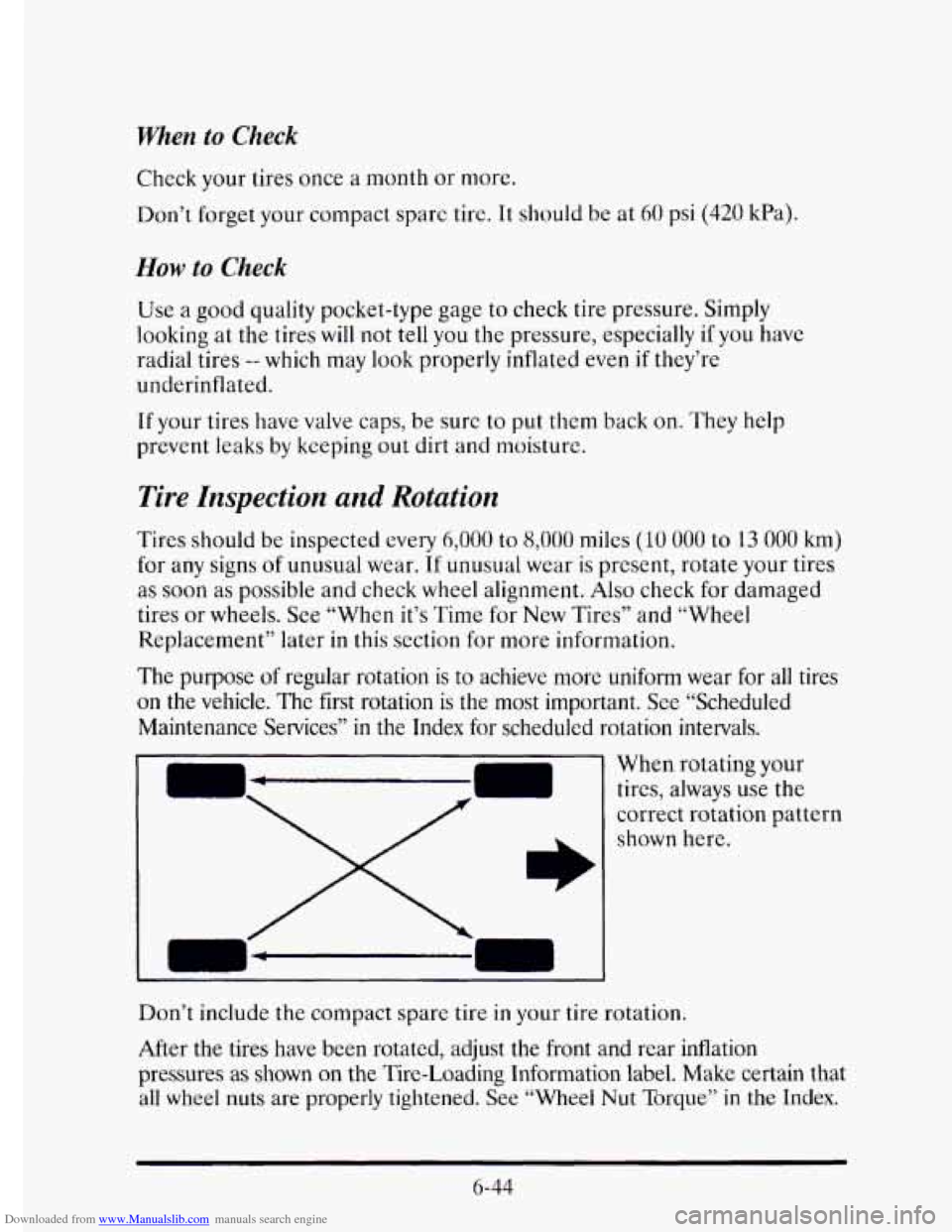
When rotating your
tires, always use
the
correct rotation pattern
shown here.
Don’t include the compact spare tire
in your tire rotation.
After the tires have been rotated, adjust
the front and rear inflation
pressures as
shown on the Tire-Loading Information label. Make certain that
all wheel nuts are properly tightened. See “Wheel Nut Torque” in the Index.
6-44
Page 305 of 395
Downloaded from www.Manualslib.com manuals search engine Buying New Tires
To find out what kind and size of tires you need, look at the Tire-Loading
Information label.
The tires installed on your vehicle when it was new had a Tire
Performance Criteria Specification (TPC Spec) number on each tire's
sidewall. When you get new tires, get ones with that same
TPC Spec
number. That way, your vehicle
will continue to have tires that are
designed to give proper endurance, handling, speed rating, traction, ride
and other things during normal service
on your vehicle. If your tires have
an all-season tread design, the
TPC number will be followed by an MS
(for mud and snow).
If you ever replace your tires with those not having a TPC Spec number,
make sure they are the same size,
load range, speed rating and
construction type (bias, bias-belted or radial) as
your original tires.
Mixing tires could cause you to lose control while driving. If yuu
mix tires of different sizes or types (radial and bias-belted
tires), the vehicle may
not handle properly, and you could hpve a
.. crash. Be sure to use the same size and type tires on all four
wheels.
It's all right to drive with your compact spare, though. It was
' developed for use on your vehicle.
. ..
6-46
Page 306 of 395
Downloaded from www.Manualslib.com manuals search engine Uniform Tire Quality Grading
The following information relates to the system developed by the United
States National Highway Traffic Safety Administration which grades tires
by treadwear, traction and temperature performance. (This applies only
to vehicles sold in the United States.)
Treadwear
The treadwear grade is a comparative rating based on the wear rate of the
tire when tested under controlled conditions on a specified government
test course. For example,
a tire graded 150 would wear one and a half
(1 1/2) times as well on the government course as a tire graded 100. The
relative performance
of tires depends upon the actual conditions of their
use, however, and may depart significantly from the norm due to
variations
in driving habits, service practices and differences in road
characteristics and climate.
Traction - A, B, C
The traction grades, from highest to lowest are: A, B, and C. They
represent the tire’s ability to stop on wet pavement as measured under
controlled conditions on specified government test surfaces
of asphalt and
concrete.
A tire marked C may have poor traction performance.
Warning: The traction grade assigned
to this tire is based on braking
(straight-ahead) traction tests and does not include cornering \
(turning)
traction.
6-47
Page 318 of 395
Downloaded from www.Manualslib.com manuals search engine FINISH DMGE
Any stone chips, fractures or deep scratches in the finish should be
repaired right away.
Minor chips and scratches can be repaired
with touch-up materials
available from your dealer or other service outlets. Larger areas
of finish
damage can be corrected
in your dealer’s body and paint shop.
UNDERBODYMNTENANCE
Chemicals used for ice and snow removal and dust control can collect on
the underbody. If these are not removed, accelerated corrosion (rust) can
occur on the underbody parts such
as fuel lines, frame, floor pan, and
exhaust system
even though they have corrosion protection.
At least
every spring, flush these materials from the underbody with plain
water. Clean any areas where mud and other debris can collect.
Dirt packed
in closed areas of the frame should be loosened before being flushed. Your
dealer or an underbody car washing system can do this for
you.
CHEMICAL PMNT SPOTTING
Some weather and atmospheric conditions can create a chemical fallout.
Airborne pollutants can fall upon and attack painted surfaces on your
vehicle. This damage can take
two forms: blotchy, ringlet-shaped
discolorations, and small irregular dark spots etched into the paint surface.
Although
no defect in the paint job causes this, Cadillac will repair, at no
charge to the owner, the surfaces of new vehicles damaged by this fallout
condition within
12 months or 12,000 miles (20 000 km) of purchase,
whichever
comes first.
6-59
Page 320 of 395
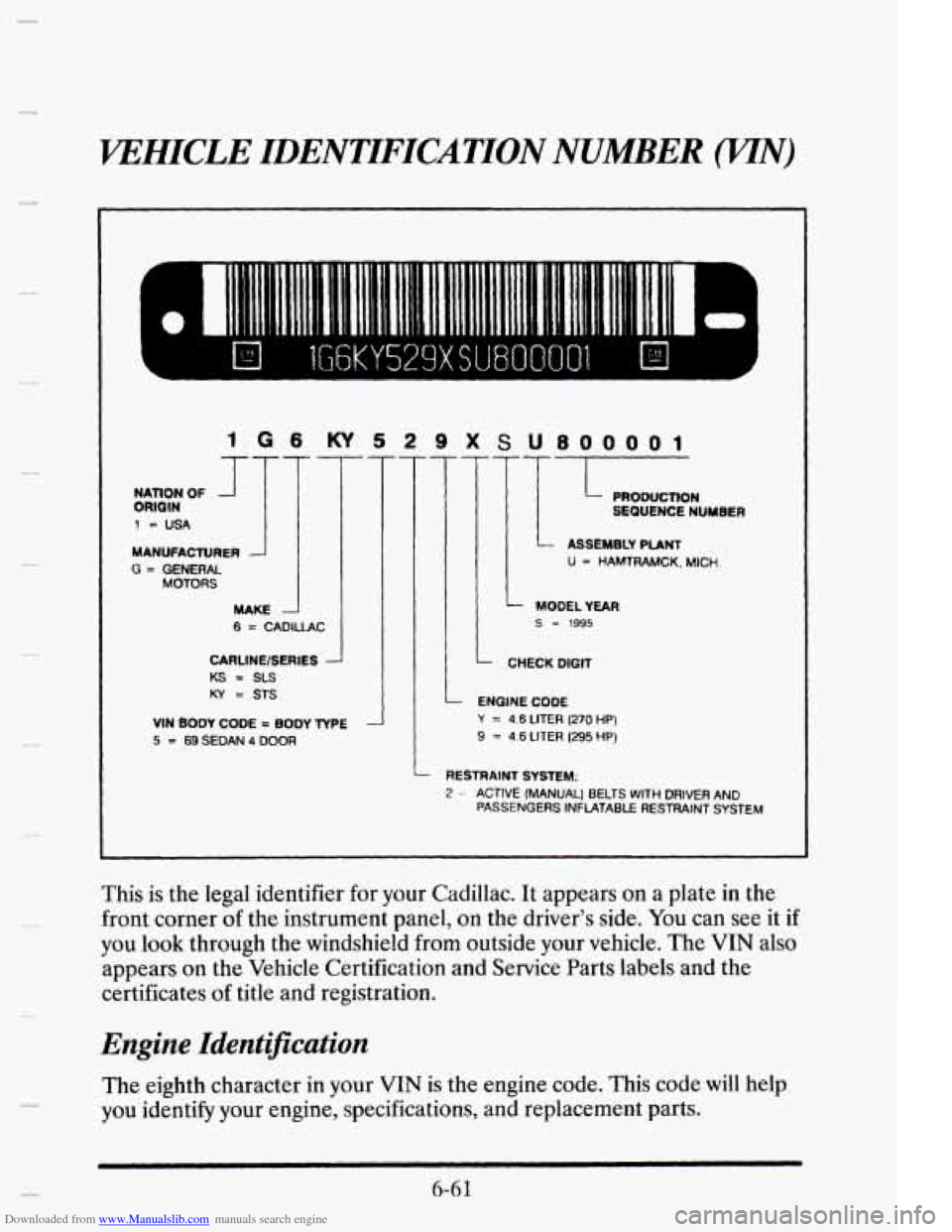
Downloaded from www.Manualslib.com manuals search engine VEHICLE IDENTIFICATION NUMBER (UN)
1 G 6 KY 5 2 9 X S U800001
MANUFACTURER
G = GENERAL MOTORS
MAKE
6 = CADIUAC
CARLlNElSEAlCS -
KS = SLS
KY = STS
VIN BODY CODE = BODY TYPE
5 = 69SEDAN 4 DOOR
-L!? U = HAMTRAMCK. MICH.
ENGINE CODE
Y = 4.6 LITER (270 HP)
9 = 4.6 LITER (295 HP)
- RESTRAINT SYSTEM:
2 - ACTIVE (MANUAL) BELTS WITH DRIVER AND
PASSENGERS INFLATABLE RESTRAINT SYSTEM
This is the legal identifier for your Cadillac. It appears on a plate in the
front corner of the instrument panel, on the driver’s side. You can see it if
you look through the windshield from outside your vehicle. The VIN also
appears
on the Vehicle Certification and Service Parts labels and the
certificates
of title and registration.
Engine Identification
The eighth character in your VIN is the engine code. This code will help
you identifj your engine, specifications, and replacement parts.
b 6-6 1
Page 323 of 395
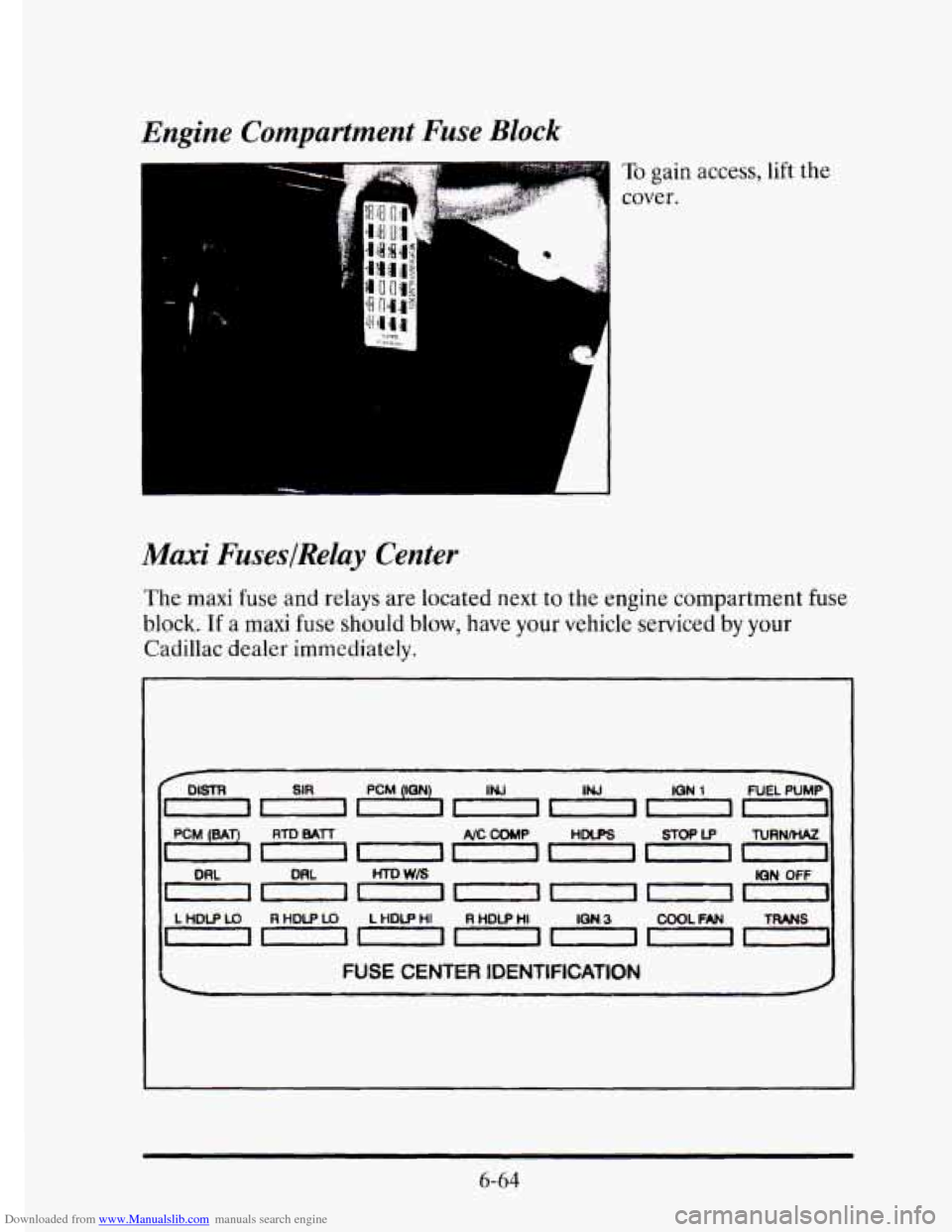
Downloaded from www.Manualslib.com manuals search engine Engine Compartment Fuse Block
Maxi FusesIRelay Center
The maxi fuse and relays are located next to the engine compartment fuse
block.
If a maxi fuse should blow, have your vehicle serviced by your
Cadillac dealer immediately.
NC COMP HDWS STOPLP WANM
HTD W/s 10N OFF
000~000
LHDLPLO RHDLPLO LHDLPHI RHDLPHI 1GN 3 COOL FAN TRANS
FUSE CENTER IDENTIFICATION
6-64