1995 ACURA TL weight
[x] Cancel search: weightPage 12 of 1771
Towing
If the vehicle needs to be towed, call a professional tow-
ing service. Never tow the vehicle behind another vehi-
cle with just a rope or chain. It is very dangerous.
Emergency Towing
There are three popular methods of towing a vehicle:
Flat-bed Equipment — The operator loads the vehicle on
the back of a truck. This is the best way of transporting the
vehicle.
Wheel Lift Equipment — The tow truck uses two pivoting
arms that go under the tires (front or rear) and lifts them
off the ground. The other two wheels remain on the
ground.
Sling-type Equipment — The tow truck uses metal cables
with hooks on the ends. These hooks go around parts of
the frame or suspension and the cables lift that end of
the vehicle off the ground. The vehicle's suspension and
body can be seriously damaged if this method of towing
is attempted.
If the vehicle cannot be transported by flat-bed, it should
be towed with the front wheels off the ground. If due to
damage, the vehicle must be towed with the front
wheels on the ground, do the following:
Release the parking brake.
Start the engine.
Shift to position, then position.
Turn off the engine.
CAUTION:
Improper towing preparation will damage the trans-
mission. Follow the above procedure exactly. If you
cannot shift the transmission or start the engine, the
vehicle must be transported on a flat-bed.
It is best to tow the vehicle no farther than 50 miles
(80 km), and keep the speed below 35 mph (55 km/h).
Trying to lift or tow the vehicle by the bumpers will
cause serious damage. The bumpers are not designed
to support the vehicle's weight.
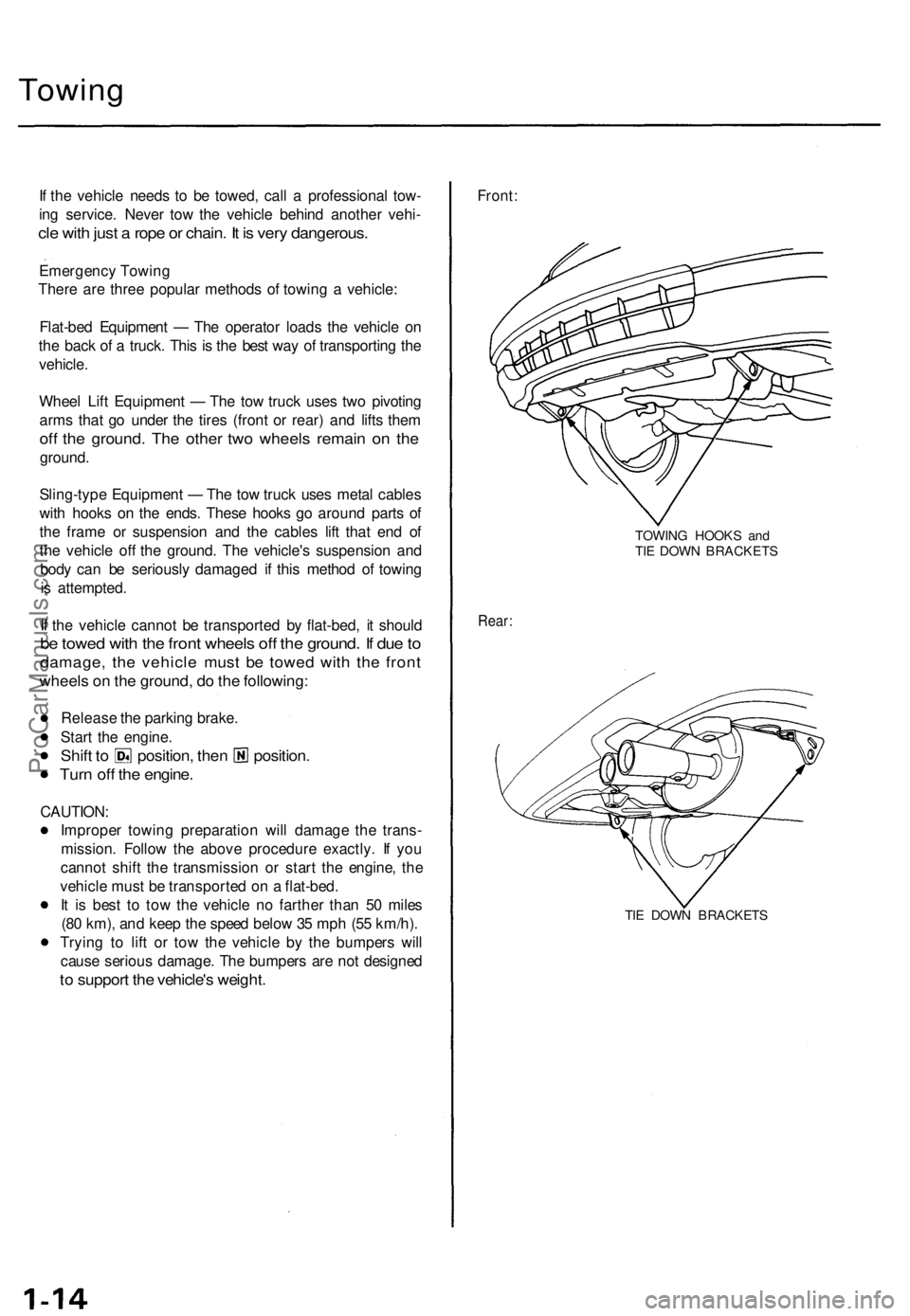
Front:
TOWING HOOKS and
TIE DOWN BRACKETS
Rear:
TIE DOWN BRACKETSProCarManuals.com
Page 104 of 1771
Main Bearing s
Clearanc eSelection
1.
2 .
3.
4 .
5.
6.
7 .
8 .
T o chec k mai n bearing-to-journa l oi l clearance ,
remov e th e mai n cap s an d bearin g halves .
Clea n eac h mai n journa l an d bearin g hal f wit h a
clea n sho p towel .
Plac e on e stri p o f plastigag e acros s eac h mai n jour -
nal.
NOTE : I f th e engin e i s stil l i n th e ca r whe n yo u bol t
th e mai n cap dow n t o chec k clearance , th e weigh t
o f th e crankshaf t an d flywhee l wil l flatte n th e plasti -
gag e furthe r tha n jus t th e torqu e o n th e ca p bolts ,
an d giv e yo u a n incorrec t reading . Fo r a n accurat e
reading , suppor t th e crankshaf t wit h a jac k unde r
th e counterweight s an d chec k onl y on e bearin g a t a
time .
Reinstal l th e bearing s an d caps , the n torqu e th e 9
m m ca p bolt s t o 3 9 N- m (4. 0 kgf-m , 2 9 Ibf-ft) . Torqu e
the 1 1 m m ca p bolt s to 7 6 N- m (7. 8 kgf-m , 5 7 Ibf-ft) .
Torqu e th e sid e bolt s t o 4 9 N- m (5. 0 kgf-m , 3 6 Ibf-ft) .
Remov e th e cap s an d bearings , an d measur e th e
wides t par t o f th e plastigage .
Mai n Bearing-to-Journa l Oi l Clearance :
Standar d (New) : 0.02 0 - 0.04 4 m m
(0.000 8 - 0.001 7 in )
Servic e Limit : 0.0 5 m m (0.00 2 in )
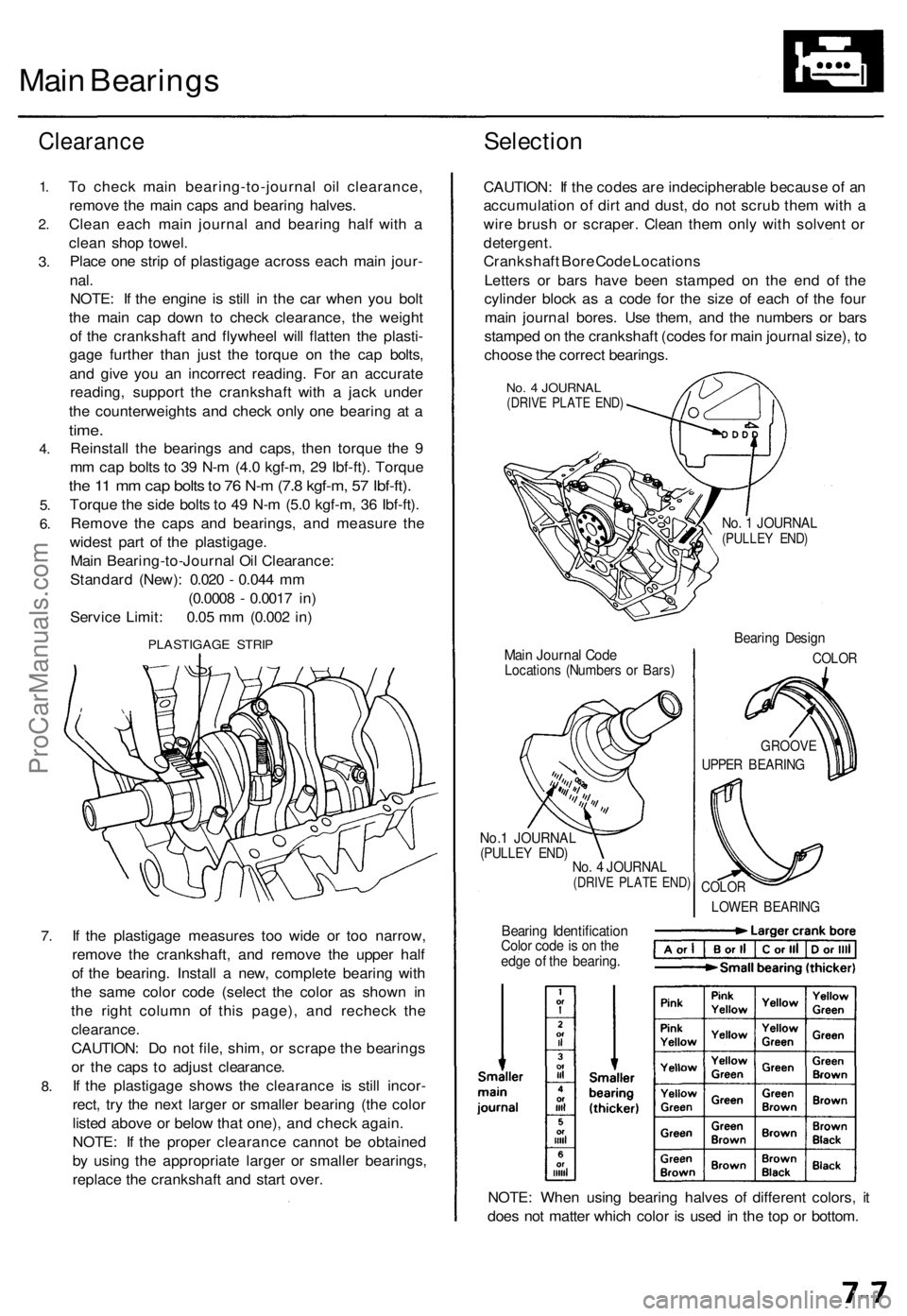
PLASTIGAG E STRI P
If th e plastigag e measure s to o wid e o r to o narrow ,
remov e th e crankshaft , an d remov e th e uppe r hal f
o f th e bearing . Instal l a new , complet e bearin g wit h
th e sam e colo r cod e (selec t th e colo r a s show n i n
th e righ t colum n o f thi s page) , an d rechec k th e
clearance .
CAUTION: D o no t file , shim , o r scrap e th e bearing s
o r th e cap s t o adjus t clearance .
I f th e plastigag e show s th e clearanc e i s stil l incor -
rect , tr y th e nex t large r o r smalle r bearin g (th e colo r
liste d abov e o r belo w tha t one) , an d chec k again .
NOTE : I f th e prope r clearanc e canno t b e obtaine d
b y usin g th e appropriat e large r o r smalle r bearings ,
replac e th e crankshaf t an d star t over . CAUTION
: I f th e code s ar e indecipherabl e becaus e o f a n
accumulatio n o f dir t an d dust , d o no t scru b the m wit h a
wir e brus h o r scraper . Clea n the m onl y wit h solven t o r
detergent .
Crankshaf t Bor e Cod e Location s
Letter s o r bar s hav e bee n stampe d o n th e en d of the
cylinde r bloc k a s a cod e fo r th e siz e o f eac h o f th e fou r
mai n journa l bores . Us e them , an d th e number s o r bar s
stampe d o n th e crankshaf t (code s fo r mai n journa l size) , t o
choos e th e correc t bearings .
No. 4 JOURNA L(DRIVE PLAT E END )
No. 1 JOURNA L(PULLEY END )
Main Journa l Cod eLocation s (Number s o r Bars )
No.1 JOURNA L(PULLEY END )No. 4 JOURNA L(DRIVE PLAT E END )
Bearin g Desig n
COLOR
GROOV E
UPPER BEARIN G
COLOR
LOWE R BEARIN G
Bearing Identificatio nColor cod e is o n th eedg e o f th e bearing .
NOTE: Whe n usin g bearin g halve s o f differen t colors , i t
doe s no t matte r whic h colo r i s use d i n th e to p o r bottom .
ProCarManuals.com
Page 128 of 1771
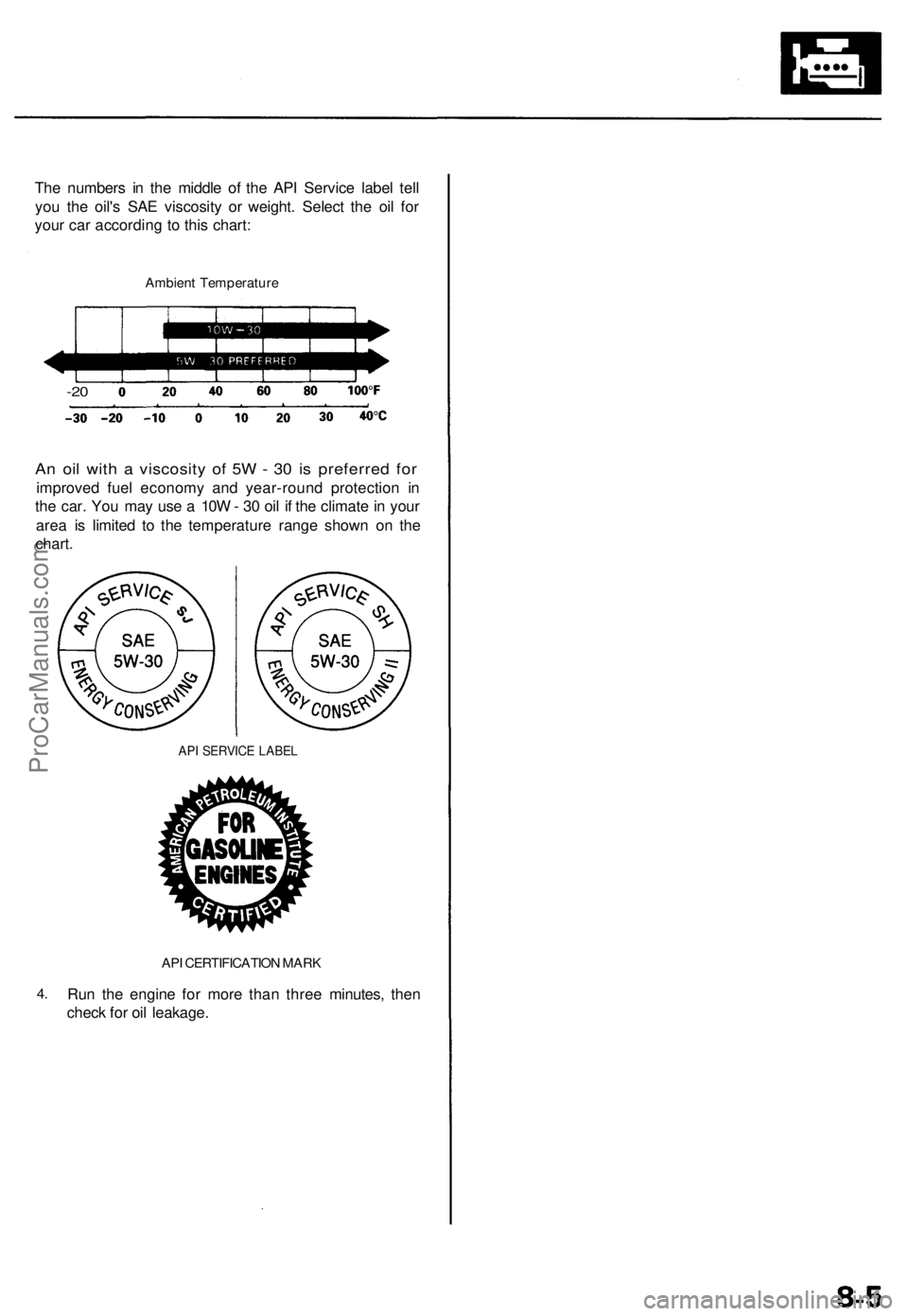
The numbers in the middle of the API Service label tell
you the oil's SAE viscosity or weight. Select the oil for
your car according to this chart:
Ambient Temperature
-20
An oil with a viscosity of 5W - 30 is preferred for
improved fuel economy and year-round protection in
the car. You may use a 10W - 30 oil if the climate in your
area is limited to the temperature range shown on the
chart.
API SERVICE LABEL
4.
API CERTIFICATION MARK
Run the engine for more than three minutes, then
check for oil leakage.ProCarManuals.com
Page 316 of 1771
Mainshaft/Countershaft Speed Sensors
Replacement (cont'd)
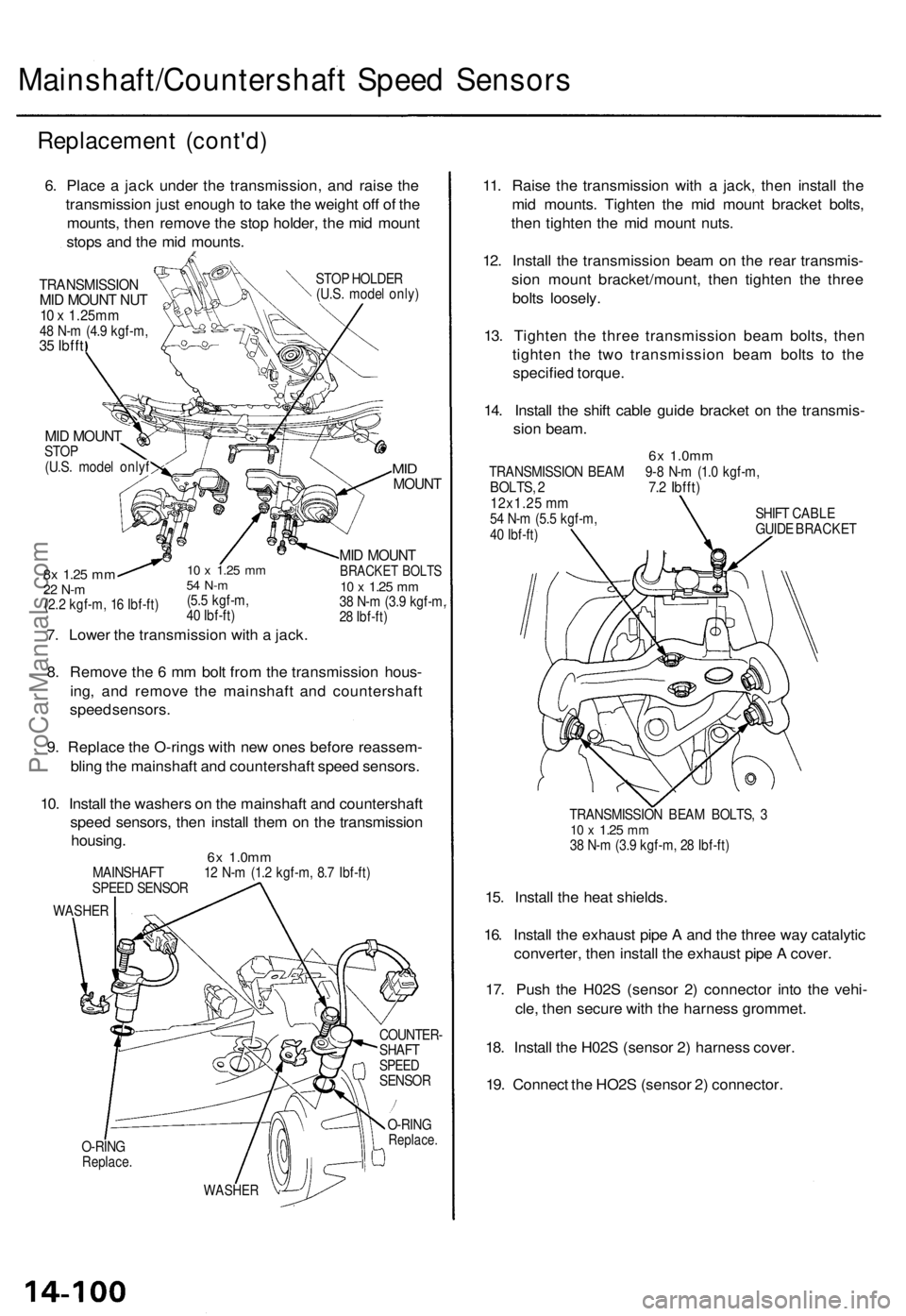
6. Place a jack under the transmission, and raise the
transmission just enough to take the weight off of the
mounts, then remove the stop holder, the mid mount
stops and the mid mounts.
TRANSMISSION
MID MOUNT NUT
10 x 1.25mm
48 N-m (4.9 kgf-m,
35 Ibfft
STOP HOLDER
(U.S. model only)
MID MOUNT
STOP
(U.S. model onlyf
10 x
1.25
mm
54 N-m
(5.5 kgf-m,
40 Ibf-ft)
7. Lower the transmission with a jack.
8x
1.25
mm
22 N-m
(2.2 kgf-m, 16 Ibf-ft)
MID
MOUNT
MID MOUNT
BRACKET BOLTS
10 x
1.25
mm
38 N-m (3.9 kgf-m,
28 Ibf-ft)
8. Remove the 6 mm bolt from the transmission hous-
ing, and remove the mainshaft and countershaft
speed sensors.
9. Replace the O-rings with new ones before reassem-
bling the mainshaft and countershaft speed sensors.
10. Install the washers on the mainshaft and countershaft
speed sensors, then install them on the transmission
housing.
6x
1.0mm
MAINSHAFT 12 N-m (1.2 kgf-m, 8.7 Ibf-ft)
SPEED SENSOR
WASHER
O-RING
Replace.
COUNTER-
SHAFT
SPEED
SENSOR
O-RING
Replace.
WASHER
11. Raise the transmission with a jack, then install the
mid mounts. Tighten the mid mount bracket bolts,
then tighten the mid mount nuts.
12. Install the transmission beam on the rear transmis-
sion mount bracket/mount, then tighten the three
bolts loosely.
13. Tighten the three transmission beam bolts, then
tighten the two transmission beam bolts to the
specified torque.
14. Install the shift cable guide bracket on the transmis-
sion beam.
6x
1.0mm
TRANSMISSION BEAM 9-8 N-m (1.0 kgf-m,
BOLTS, 2 7.2 Ibfft)
12x1.25 mm
54 N-m (5.5 kgf-m,
40 Ibf-ft)
SHIFT CABLE
GUIDE BRACKET
TRANSMISSION BEAM BOLTS, 3
10 x
1.25
mm
38 N-m (3.9 kgf-m, 28 Ibf-ft)
15. Install the heat shields.
16. Install the exhaust pipe A and the three way catalytic
converter, then install the exhaust pipe A cover.
17. Push the H02S (sensor 2) connector into the vehi-
cle, then secure with the harness grommet.
18. Install the H02S (sensor 2) harness cover.
19. Connect the HO2S (sensor 2) connector.ProCarManuals.com
Page 361 of 1771
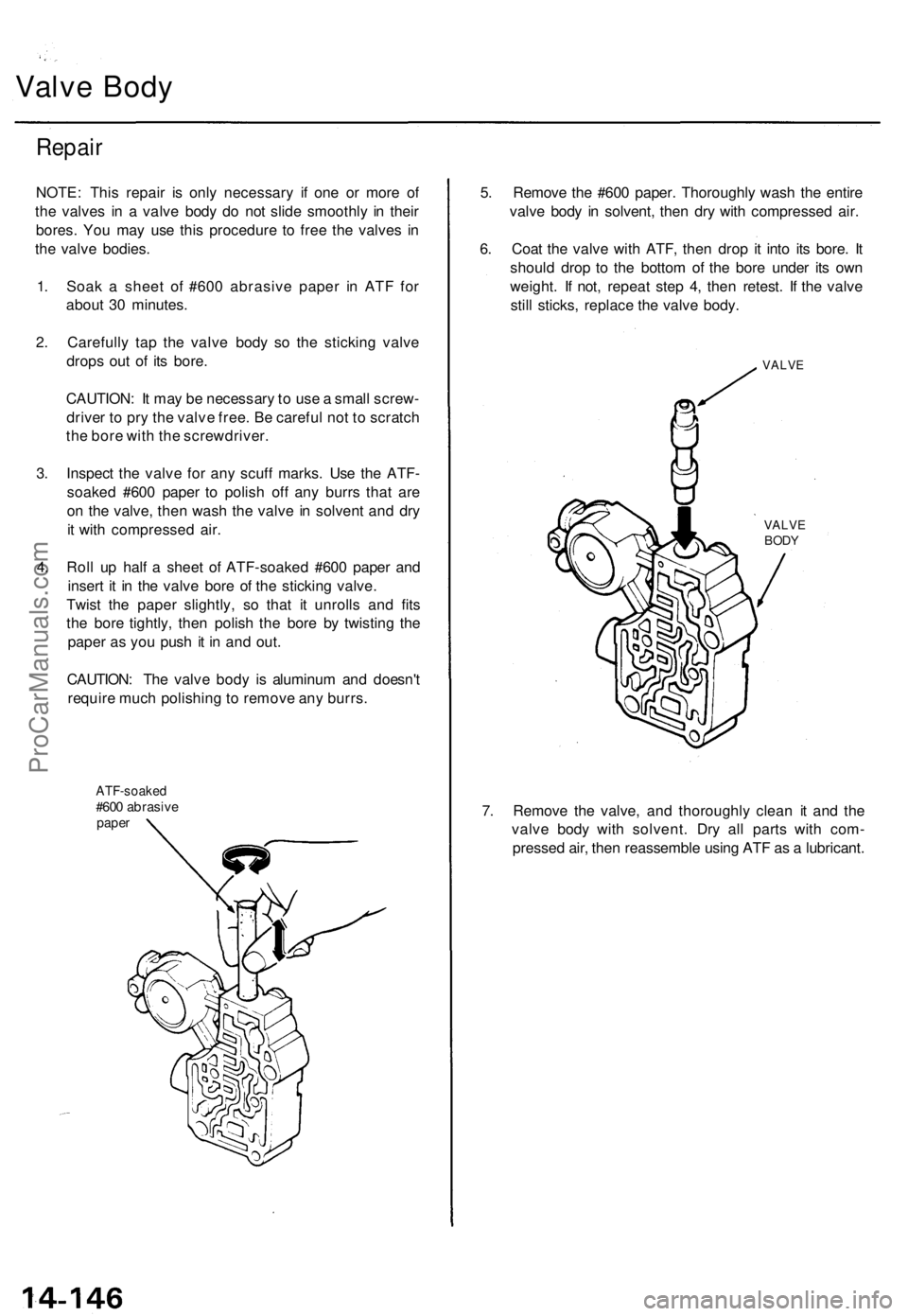
Valve Body
Repair
NOTE: This repair is only necessary if one or more of
the valves in a valve body do not slide smoothly in their
bores. You may use this procedure to free the valves in
the valve bodies.
1. Soak a sheet of #600 abrasive paper in ATF for
about 30 minutes.
2. Carefully tap the valve body so the sticking valve
drops out of its bore.
CAUTION: It may be necessary to use a small screw-
driver to pry the valve free. Be careful not to scratch
the bore with the screwdriver.
3. Inspect the valve for any scuff marks. Use the ATF-
soaked #600 paper to polish off any burrs that are
on the valve, then wash the valve in solvent and dry
it with compressed air.
4. Roll up half a sheet of ATF-soaked #600 paper and
insert it in the valve bore of the sticking valve.
Twist the paper slightly, so that it unrolls and fits
the bore tightly, then polish the bore by twisting the
paper as you push it in and out.
CAUTION: The valve body is aluminum and doesn't
require much polishing to remove any burrs.
ATF-soaked
#600 abrasive
paper
5. Remove the #600 paper. Thoroughly wash the entire
valve body in solvent, then dry with compressed air.
6. Coat the valve with ATF, then drop it into its bore. It
should drop to the bottom of the bore under its own
weight. If not, repeat step 4, then retest. If the valve
still sticks, replace the valve body.
VALVE
VALVE
BODY
7. Remove the valve, and thoroughly clean it and the
valve body with solvent. Dry all parts with com-
pressed air, then reassemble using ATF as a lubricant.ProCarManuals.com
Page 495 of 1771
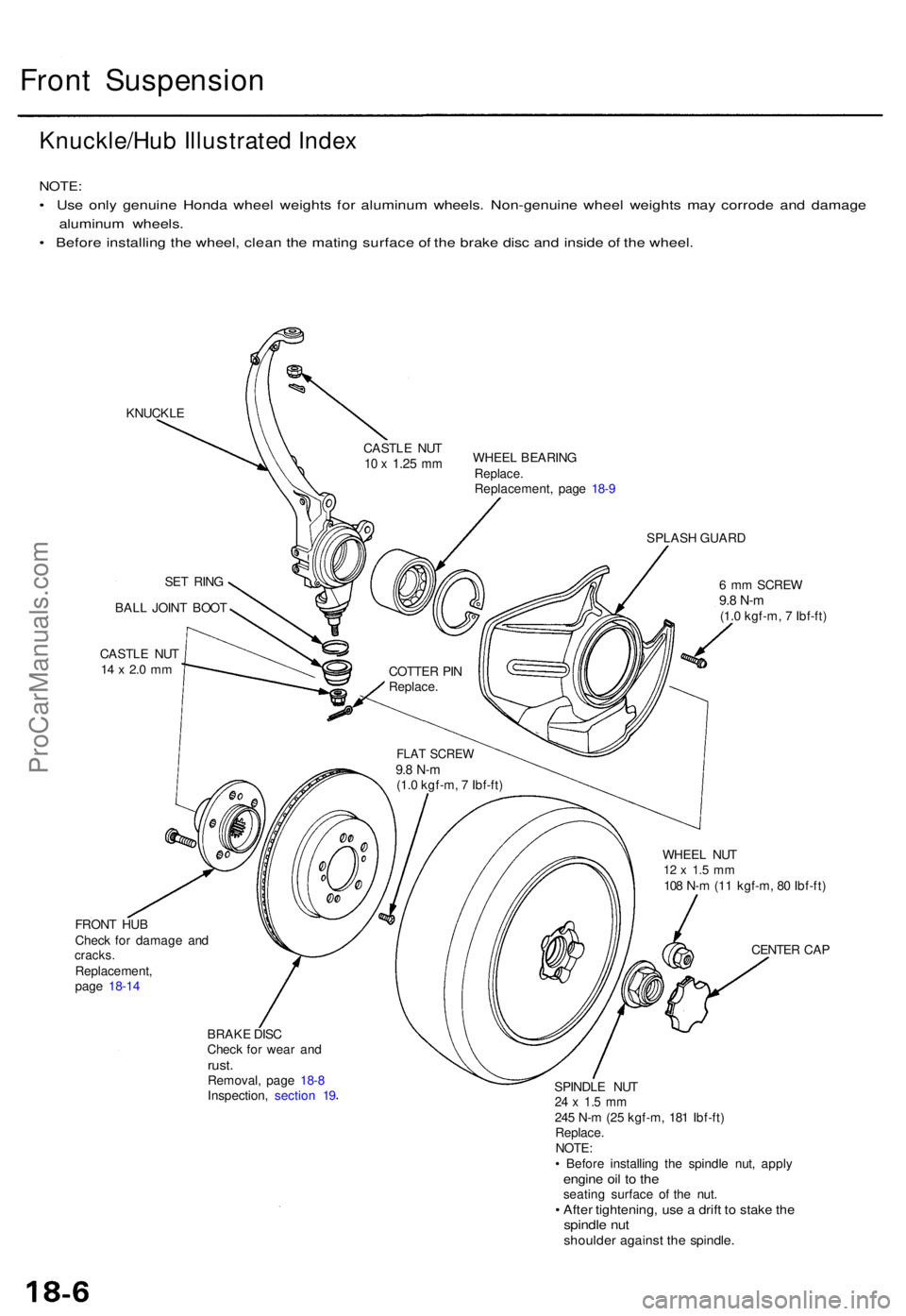
Front Suspensio n
Knuckle/Hu b Illustrated Index
NOTE :
• Us e onl y genuin e Hond a whee l weight s fo r aluminu m wheels . Non-genuin e whee l weight s ma y corrod e an d damag e
aluminu m wheels .
• Befor e installin g th e wheel , clea n th e matin g surfac e o f th e brak e dis c an d insid e o f th e wheel .
KNUCKL E
SET RIN G
BAL L JOIN T BOO T
CASTL E NU T
14 x 2. 0 m m
FRON T HU B
Chec k fo r damag e an d
cracks .Replacement ,
pag e 18-1 4 WHEE
L BEARIN G
Replace.Replacement , pag e 18- 9
SPLAS H GUAR D
6 m m SCRE W
9.8 N- m(1.0 kgf-m , 7 Ibf-ft )
WHEE L NU T
12 x 1. 5 m m108 N- m (1 1 kgf-m , 8 0 Ibf-ft )
CENTE R CA P
BRAK E DIS C
Chec k fo r wea r an d
rust .Removal , pag e 18- 8
Inspection , sectio n 1 9 SPINDL
E NU T
24 x 1. 5 m m245 N- m (2 5 kgf-m , 18 1 Ibf-ft )
Replace .
NOTE :
• Befor e installin g th e spindl e nut , appl y
engine oi l t o th eseatin g surfac e o f th e nut .• Afte r tightening , us e a drif t t o stak e th espindl e nu tshoulde r agains t th e spindle .
CASTLE NU T10 x 1.2 5 mm
COTTE R PI N
Replace .
FLAT SCRE W9.8 N- m(1.0 kgf-m , 7 Ibf-ft )
ProCarManuals.com
Page 688 of 1771
Towing
If the vehicle needs to be towed, call a professional tow-
ing service. Never tow the vehicle behind another vehi-
cle with just a rope or chain. It is very dangerous.
Emergency Towing
There are three popular methods of towing a vehicle:
Flat-bed Equipment — The operator loads the vehicle on
the back of a truck. This is the best way of transporting the
vehicle.
Wheel Lift Equipment — The tow truck uses two pivoting
arms that go under the tires (front or rear) and lifts them
off the ground. The other two wheels remain on the
ground.
Sling-type Equipment — The tow truck uses metal cables
with hooks on the ends. These hooks go around parts of
the frame or suspension and the cables lift that end of
the vehicle off the ground. The vehicle's suspension and
body can be seriously damaged if this method of towing
is attempted.
If the vehicle cannot be transported by flat-bed, it should
be towed with the front wheels off the ground. If due to
damage, the vehicle must be towed with the front
wheels on the ground, do the following:
• Release the parking brake.
• Start the engine.
• Shift to position, then position.
• Turn off the engine.
CAUTION:
• Improper towing preparation will damage the trans-
mission. Follow the above procedure exactly. If you
cannot shift the transmission or start the engine, the
vehicle must be transported on a flat-bed.
• It is best to tow the vehicle no farther than 50 miles
(80 km), and keep the speed below 35 mph (55
km/h).
• Trying to lift or tow the vehicle by the bumpers will
cause serious damage. The bumpers are not
designed to support the vehicle's weight.
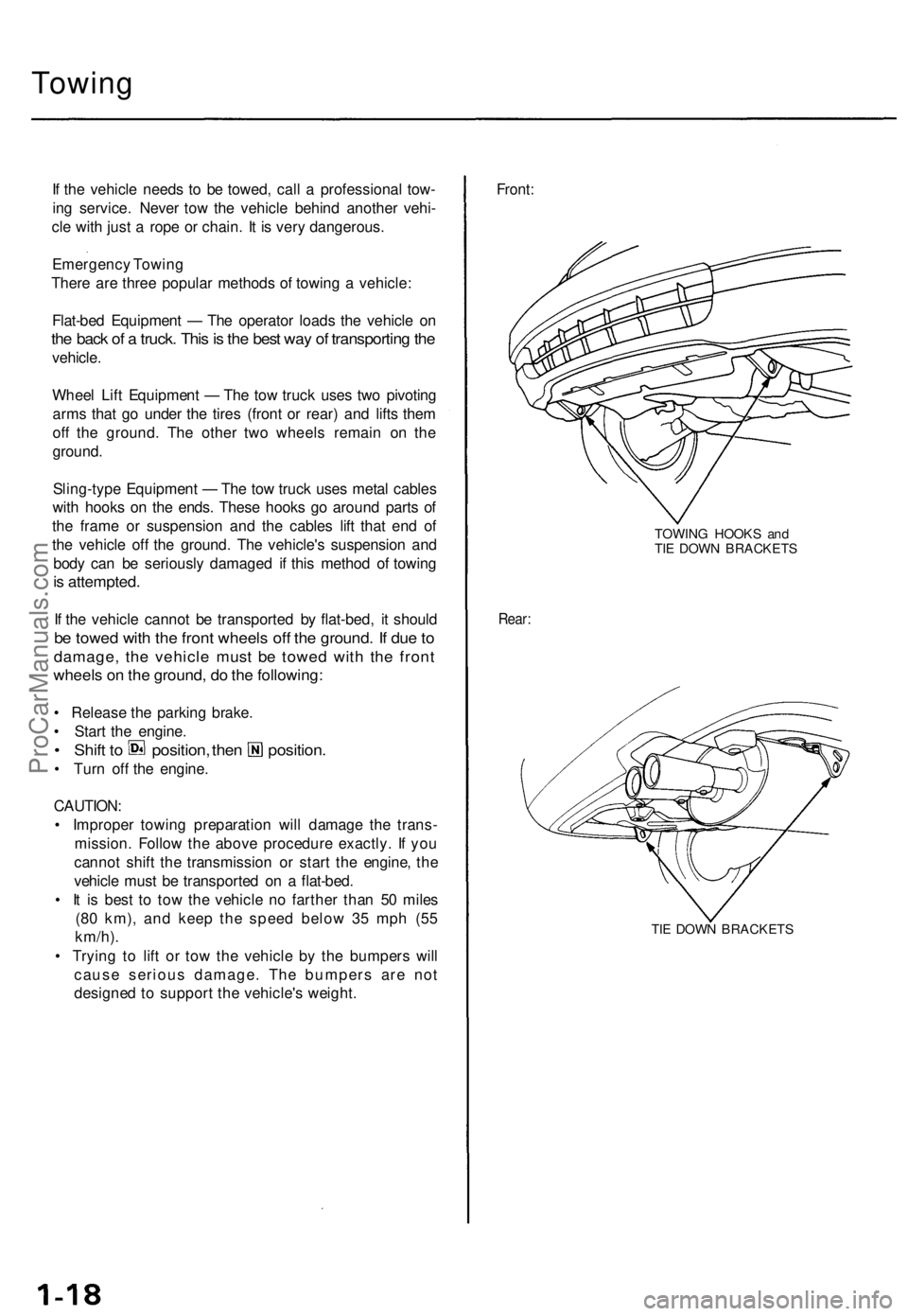
Front:
TOWING HOOKS and
TIE DOWN BRACKETS
Rear:
TIE DOWN BRACKETSProCarManuals.com
Page 781 of 1771
Main Bearings
Clearance
1. To check main bearing-to-journal oil clearance,
remove the main caps and bearing halves.
2. Clean each main journal and bearing half with a
clean shop towel.
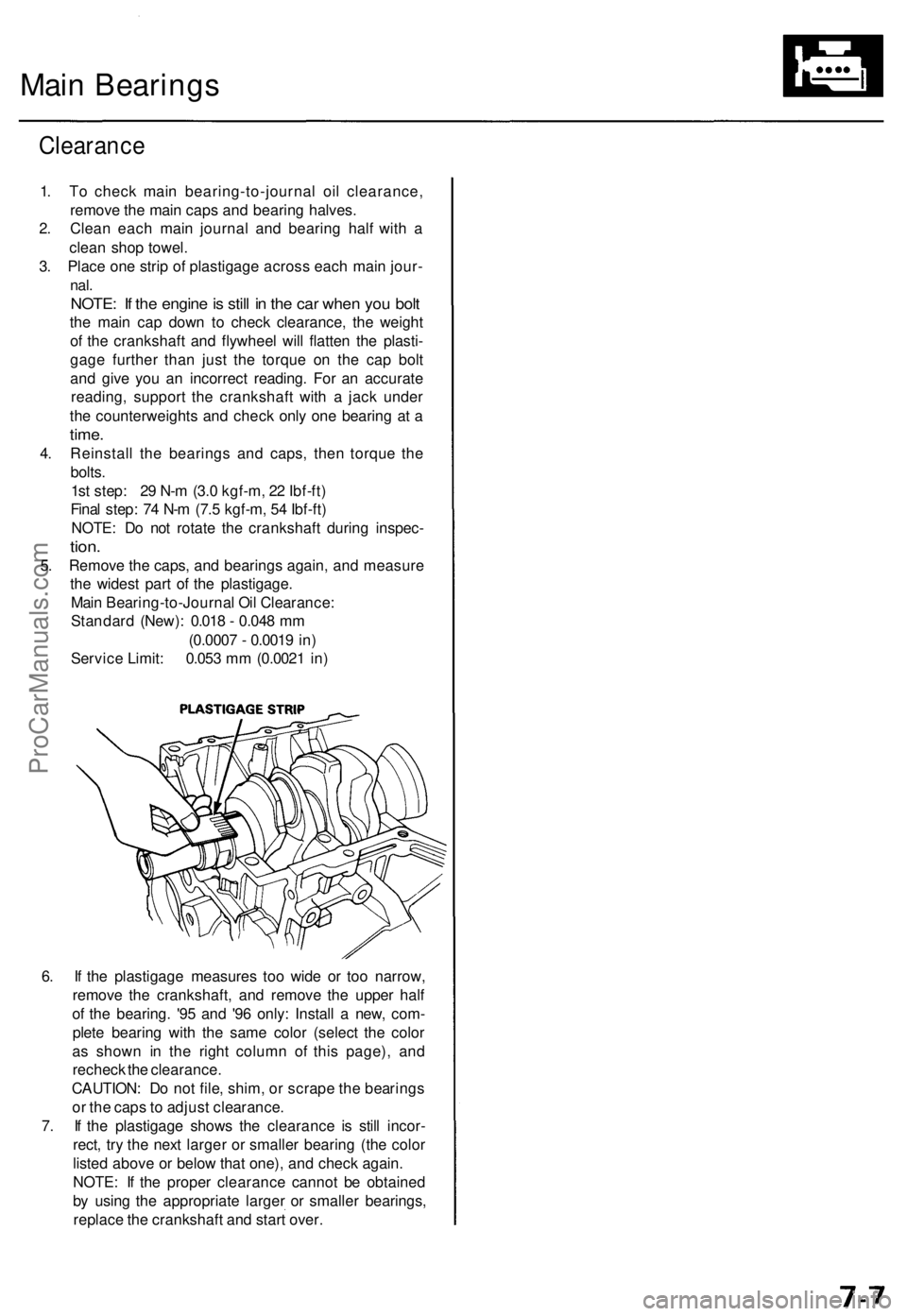
3. Place one strip of plastigage across each main jour-
nal.
NOTE: If the engine is still in the car when you bolt
the main cap down to check clearance, the weight
of the crankshaft and flywheel will flatten the plasti-
gage further than just the torque on the cap bolt
and give you an incorrect reading. For an accurate
reading, support the crankshaft with a jack under
the counterweights and check only one bearing at a
time.
4. Reinstall the bearings and caps, then torque the
bolts.
1st step: 29 N-m (3.0 kgf-m, 22 Ibf-ft)
Final step: 74 N-m (7.5 kgf-m, 54 Ibf-ft)
NOTE: Do not rotate the crankshaft during inspec-
tion.
5. Remove the caps, and bearings again, and measure
the widest part of the plastigage.
Main Bearing-to-Journal Oil Clearance:
Standard (New): 0.018 - 0.048 mm
(0.0007 - 0.0019 in)
Service Limit: 0.053 mm (0.0021 in)
6. If the plastigage measures too wide or too narrow,
remove the crankshaft, and remove the upper half
of the bearing. '95 and '96 only: Install a new, com-
plete bearing with the same color (select the color
as shown in the right column of this page), and
recheck the clearance.
CAUTION: Do not file, shim, or scrape the bearings
or the caps to adjust clearance.
7. If the plastigage shows the clearance is still incor-
rect, try the next larger or smaller bearing (the color
listed above or below that one), and check again.
NOTE: If the proper clearance cannot be obtained
by using the appropriate larger or smaller bearings,
replace the crankshaft and start over.ProCarManuals.com