1994 JAGUAR XJ6 ignition
[x] Cancel search: ignitionPage 48 of 327
Powertrain Automatic Transmission (V12)
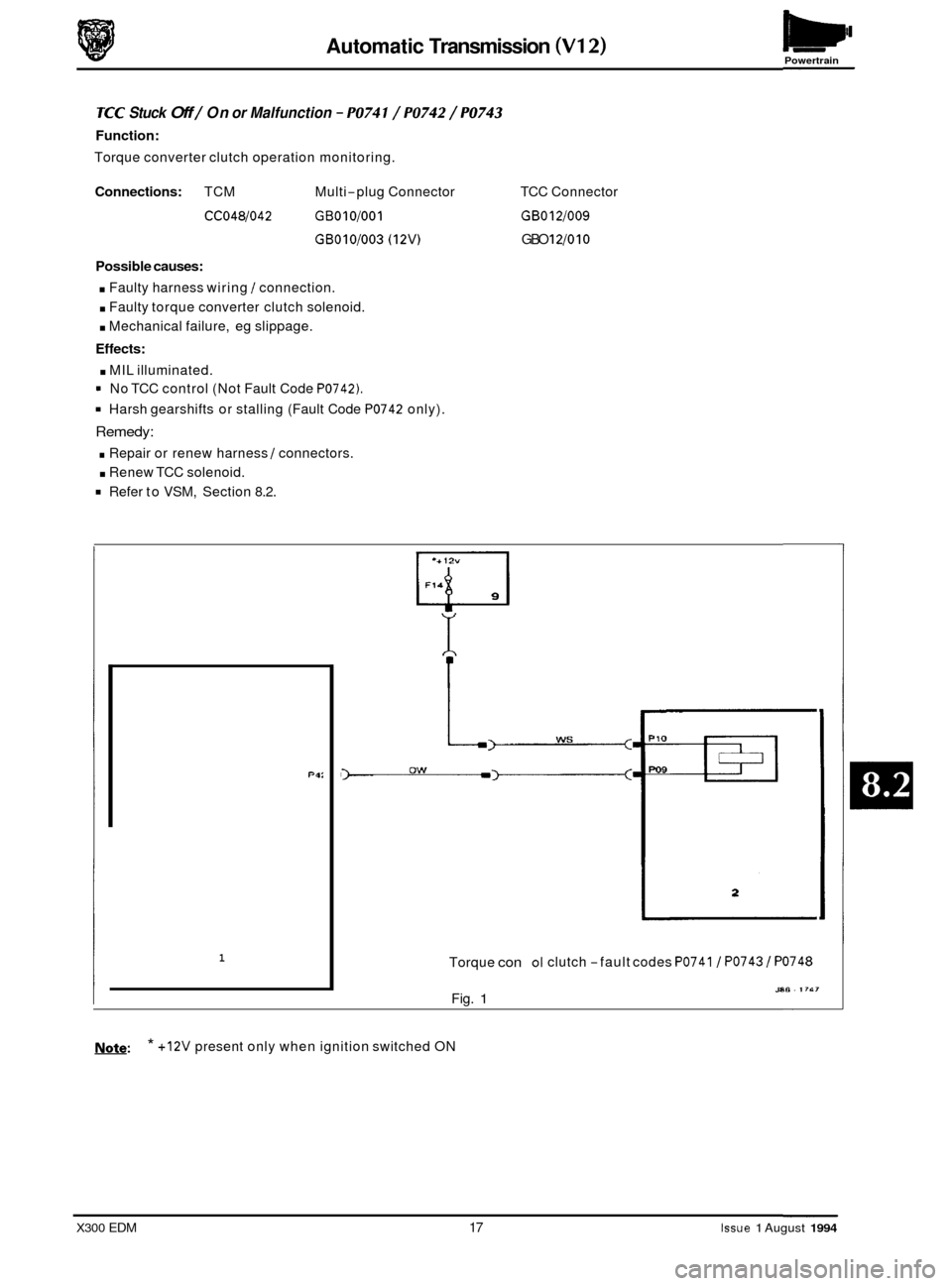
TCC Stuck Off / On or Malfunction - PO74 1 / PO742 / PO743
Function:
Torque converter clutch operation monitoring.
Connections: TCM Multi-plug Connector
CCO48/042 GBOlO/OO1
GB010/003 (12V)
Possible causes:
. Faulty harness wiring 1 connection.
. Faulty torque converter clutch solenoid.
. Mechanical failure, eg slippage.
Effects:
. MIL illuminated.
' No TCC control (Not Fault Code P0742).
Harsh gearshifts or stalling (Fault Code PO742 only).
Remedy:
. Repair or renew harness 1 connectors.
Refer to VSM, Section 8.2.
. Renew TCC solenoid. TCC
Connector
GBOl2/009
GBO 1210 10
PQ:
1 Torque con
Fig. 1
01 clutch -fault codes PO741 1 PO743 I PO748
J80 - IT47
Note: * +12V present only when ignition switched ON
X300 EDM 17 Issue 1 August 1994
Page 50 of 327

Powertrain Automatic Transmission (V12)
Solenoid Valves A and B - Performance /Electrical - PO75 1 / PO753 and PO756 / PO758
Function:
Valve operation monitoring.
Connections: TCM
CCO48/039
CCO48/043
Multi-plug
Connector
GBO
10/002
GBOl0/004
GBO 10/003
(+12V)
Transmission
GB012/001 SOL A
GBOl2/002 SOL B
GB012/003 SUPPLY
Possible causes:
. Faulty valve.
. Faulty harness wiring 1 connectors.
. Blown fuse.
Effects:
9 MIL illuminated.
Second gear selected permanently ie 'Limp Home' mode.
Remedy:
. Renew faulty valve.
Repair or renew harness 1 connectors.
. Renew fuse F14 in LH heelboard fuse-box on determining reason for rupture.
1 1
Solenoid valves -fault codes PO751 / PO753 / PO756 / PO758
1
Fia. 1 JUl3 ~ 1749
&@: * +12V present
only when ignition switched ON
X300 EDM 19 Issue 1 August 1994
Page 56 of 327

Automatic Transmission (V12) - Powertrain
System Voltage Malfunction - P1794
Function:
Battery voltage monitor.
Possible causes:
. Faulty harness wiring /connection.
. Blown fuses.
Effects:
. MIL illuminated.
. Second gear selected permanently ie ‘Limp Home’ mode.
Remedy:
Repair or renew harness I connector.
. Examine fuse F14 and F5 in LH and RH heelboard fuse-boxes respectively.
. Renew (if necessary) after determining cause of rupture.
P5 5
P53
1
I -3---+-2 YR
System supply voltage -fault code PI794
J86 - 1 753 Fig. 1
- Note: * +12V present only when ignition switched ON
X300 EDM ~.
25 Issue 1 August 1994
Page 62 of 327

Steering @
10.3 DIAGNOSTICS
a Fault: Steering light at all times
Cause: 1. No speed signal
2. Wiring fault
Remedy: 1.
2a.
2b. Check
wiring harness continuity between PSCM pin
V and instrument pack
pin
2.
Check voltage between transducer pin 1 (+ve) and ground, with ignition
ON. If 12V is recorded repair or renew harness.
Check wiring between transducer pin
2 (-ve) and OV. If OV is recorded
repair or renew harness.
Fault: Steering heavy at all times
Cause: 1. Fuse blown
2. Wiring fault
Remedy: 1.
2a.
2b.
2c.
2d Examine
fuse F12 in
RH heelboard fuse-box, if blown determine reason for
failure and renew.
Check wiring harness continuity between fuse F12 in
RH heelboard
fuse
-box and PSCM pin V.
Check wiring harness continuity between PSCM pin W1 and transducer
pin 1.
Check wiring harness continuity between PSCM pin W2 and transducer
pin
2.
Check voltage between transducer pin 2 and ground, with ignition ON. If
12V is recorded repair or renew harness and renew PSCM.
Fault:
Cause:
1. Short circuit
Remedy:
Steering becomes heavy during driving until ignition cycled
la.
1 b.
Check resistance between transducer pins 1 and 2. If a value below 7.5f is
recorded renew transducer.
Check resistance of wiring harness between transducer connections. If
short circuit is recorded renew harness.
Note: Operation ofthe PSCM can bechecked using Jaguar Diagnostic Equipment. Generation of input speed signals
and measurement of the resulting current outputs indicate
if PSCM is faulty.
X300 EDM 3 Issue 1 August 1994
Page 63 of 327
@ Steering
R
. WIP
+ Y
1- -------q I I +I" I
*Ti m) wp I
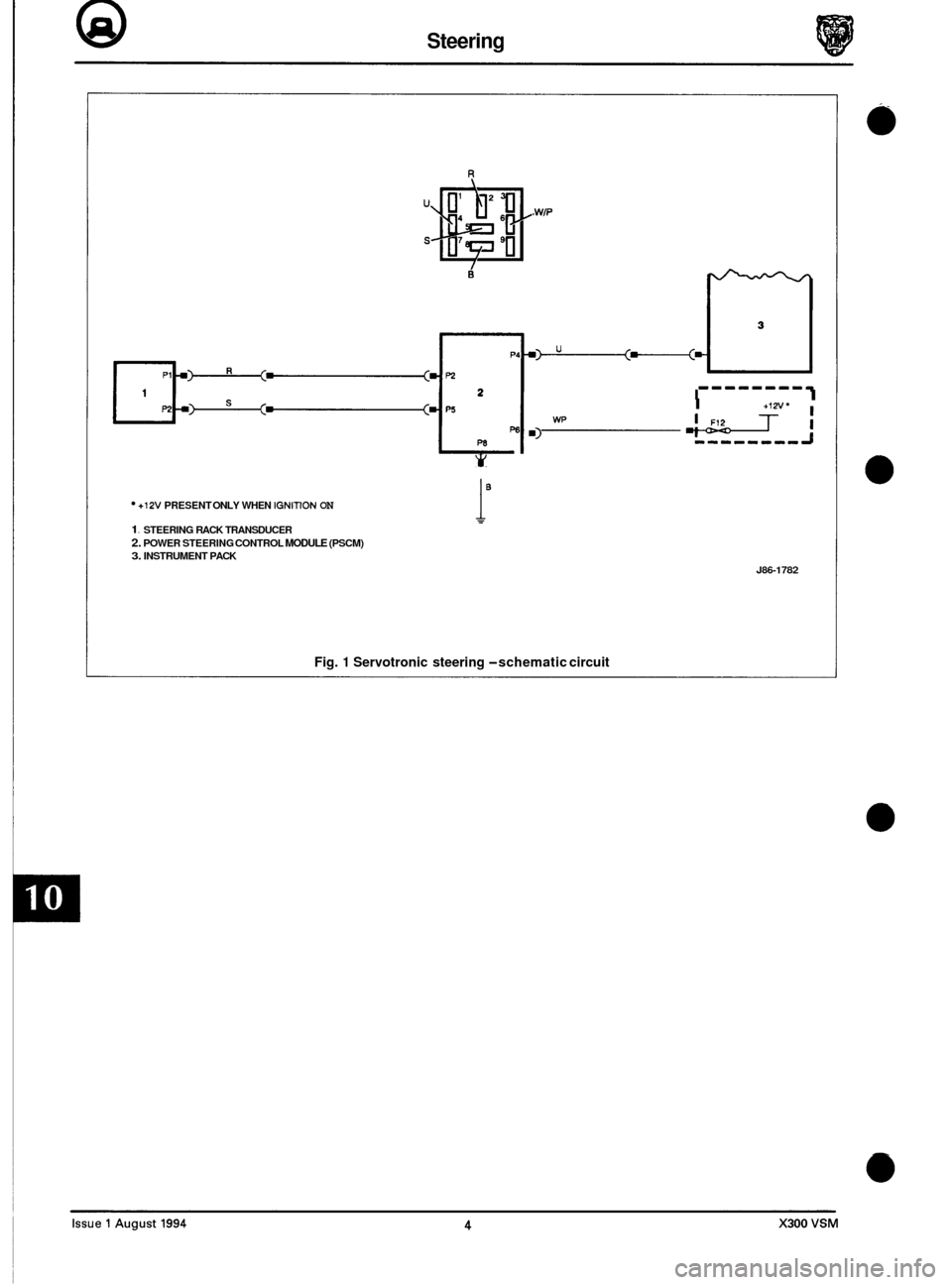
+12V PRESENT ONLY WHEN IGNITION ON
1. STEERING RACK TRANSDUCER 2. POWER STEERING CONTROL MODULE (PSCM) 3. INSTRUMENT PACK
i"
J86-1782
Fig. 1 Servotronic steering -schematic circuit
Page 66 of 327

Brakes
12.2 SYSTEM DESCRIPTION
The anti-lock braking system (ABS) and traction control system CTC) comprise the following components:
0 Hydraulic module: incorporating a pump, motor, low pressure accumulator, valve block, and either an ABS Con-
trol Module (ABS CM) or an ABS / TC Control Module (ABS / TC CM).
U!&: Within the hydraulic module are contained the electro-hydraulic inlet and outlet valves which regulate brake
system pressure.
o Four wheel speed sensors; hub end mounted.
0 Three warning indicators plus a Brake Warning Lamp and a Traction OFF / ON switch; fascia mounted.
0 Throttle valve flap positioning mechanism; mounted adjacent to the hydraulic module.
0 Various auxiliary inputs; providing information to ABS / TC CM.
0 Diagnostic IS0 communication BUS input / output link.
The solenoid operated hydraulic valves
are activated by signals, from the ABS /TC CM, which are generated using in-
formation received from the wheel speed sensors.
For vehicles without traction control thevalves operate on threecircuits, two front and one rear, as necessaryto prevent
wheel locking during braking. Brake pressure is modulated individually
at the front wheels and collectively at the rear.
Rear wheel control operates
a 'select low' principle such that locking in either wheel is sensed, and controlled brake
pressure is applied to both wheels.
Vehicles with traction control fitted have
all four wheels individually controlled allowing selective regulation of tractive
and braking force to each wheel as necessary when traction control is in operation.
The ABS
/ TC system as a whole is monitored constantly by the ABS / TC CM and is disabled (switched off until fault
is rectified) automatically when certain failures are identified. In the event of
a failure being detected the ABS and TC
MIL lamps, located on the instrument panel will illuminate. Full boosted brake operation and normal acceleration con- trol is available when ABS /TC is disabled. The system will be disabled when the following conditions occur:
0 Valve failure.
0 Sensor failure.
0 Main driver failure (internal ABS / TC CM fault).
0 Redundancy error (internal ABS / TC CM fault).
0 Over-voltage.
0 Pump motor failure.
0 Throttle valve actuator motor failure.
In the event
of under-voltage both ABS and TC will be disabled and the ABS andTC MIL lamps on the instrument panel
will illuminate.
U!&: The TC MIL lamp will only illuminate providing a voltage is still present at pin 15 'IGN FEED'
Throttle potentiometer failure will disable the TC function only and illuminate the TC MIL lamp.
The
moduleABS/TC CM is activated when ignition is ON, after an initiation period of approximately 1.7 seconds. After
this time delay the control module is ready to process signals provided from the various input sources and, using the
software defined algorithm, control the electrical and hydraulic circuits.
The inductive sensors attached to each of the four wheels provide speed signals to the ABS
/ TC CM. These signals are processed by ABS/TC CM giving comparison between individual wheel speeds, controlling braking or traction as
necessary and generating a pulse to drive the speedometer. Each sensor is monitored for open and short circuit failure,
causing disabling of ABS / TC on detection of a fault condition.
Issue 1 August 1994 2 X300 EDM
Page 67 of 327

Brakes (a)
The input frequency of each sensor signal is translated, by the ABS /TC CM, into a comparable wheel speed. Should
any sensed speed be in excess of 330 km / h the relevant sensor is designated 'faulty' and ABS /TC control disabled.
Similarly ABS/TCcontrol is inhibited (switched off until fault condition is cleared) at speeds up to 40 km/ h whenfre- quency fluctuations are detected that are inconsistent with wheel rotation. At speeds above 40 km / h both systems
are disabled when inconsistencies are detected.
Traction control (where fitted) is achieved by using
a small motor and pulley arrangement to adjust the position of the
throttle flap. Under normal operating conditions the system is enabled by default. Operation of the Traction OFF / ON switch, located on the RH side of the fascia switch pack, disables the system and illuminates the TRACTION OFF lamp
located in the instrument pack.
Control is effected to prevent wheel spin by regulating (reducing) the throttle flap position, irrespective of the acceler
-
ator pedal position, using sensor signal comparisons and applying braking force to the wheel affected. Precise posi- tioning of the flap is achieved by monitoring the position of a throttle position sensor. When traction control is
requested
a gearshift inhibit signal is transmitted to the traction control module and cruise control (if selected) is dis- abled.
1
2
3
4
Battery positive feed (via fuse F7,located in the left-hand 'A' post lower fuse-box).
Battery positive feed (via fuse
F7,located in the right-hand 'A' post lower fusebox).
Gearshift inhibit
- during traction control.
Cruise control inhibit
- during traction control.
5/6 Wheel sensor
- LHF
7/8 Wheel sensor
- RHF
9/10 Wheel sensor
- LHR
Control Module Connections
Control module connections numbering 1 - 28, inclusive, provide the necessary input / output signals to enable the
module to control and monitor ABS / TC operation.
Connections are as follows:
13 Ground
14 Ground
15
16
17
18
19 Not used
20 Brake pedal switch.
21
22
23
24
25
26 Throttle position sensor wiper.
27 Throttle position sensor ground.
28 Diagnostic
IS0 communication bus.
Ignition
feed
- monitoring battery voltage to ignition switch.
Throttle valve actuator motor
- battery voltage reference.
Throttle valve actuator motor switching
-during traction control.
Traction inhibit
- via traction OFF / ON switch.
ABS MIL
- malfunction indicator lamp.
ABS ground
- illuminates ABS MIL lamp if ABS /TC CM connector loose or not fitted.
TC MIL
- malfunction indicator lamp.
RL out
- LHR wheel sensor signal drive pulse to speedometer.
Throttle position sensor
5V supply.
I 1 11/12 1 Wheel sensor - RHR 1
X300 EDM 3 Issue 1 August 1994
Page 68 of 327

I I I I I I I I
I
I
I 11 I I
I
I
I I P24 1
I
I
I
I
I I I I I I I I
I
I
I
P19: 5
P3-6
7
8
I I I I P28 I-+ 9 10
I P15t T
I
I I I
I
,t I
I
I I I I I I I I
I
I I I
1. Throttle flap actuator 2. Throttle position sensor 3. Cruise control inhibit (when traction control in operation) 4. Traction OFF / ON switch 5. Not Used 6. Gearshift inhibit (when traction control in operation) 7. Wheel speed sensors 8. Battery voltage input
9 IS0 communication BUS IO. Ignition voltage input
1 1. Speedometer signal 12 ABS MIL lamp 13. TCS MIL lamp 14. Traction control OFF lamp 15. Brake warning lamp 16. Brake fluid level switch 17. Stop lamp switch
Fig.
1 Anti-lock braking system and traction
control
-schematic diagram
0
0
Issue 1 August 1994 4 X300 EDM