1994 CHEVROLET SUBURBAN brakes
[x] Cancel search: brakesPage 78 of 385
- Going about 35 mph (56 km/h) or more, push the accelerator all
the way down.
You’ll shift down to the next gear and have more power.
@ should not be used when towing a trailer, carrying a heavy load,
driving on steep hills, or for
off road driving. Select “D” (third gear)
when operating the vehicle under any of these conditions.
D (Third Gear)
This is like @, but you never go into Overdrive. You should use when
towing a trailer, carrying a heavy load, driving on steep hills, or for
off-road driving.
2 (Second Gear)
This position gives you more power but lower fuel economy. You can
use
“2” on hills. It can help control your speed as you go down steep
mountain roads, but then you would also want to use your brakes
off
and on. If you manually select “2”, the transmission will drive in
second gear.
You may use this feature for reducing torque to the rear
wheels when you are trying to start your vehicle from
a stop on
slippery road surfaces.
1 (First Gear)
This position gives you even more power (but lower fuel economy)
than
“2.” You can use it on very steep hills, or in deep snow or mud. If
the selector lever
is put in “1,” the transmission won’t shift into first
gear until the vehicle is going slowly enough.
NOTICE:
If your rear wheels can’t rotate, don’t try to drive. This might
happen if you were stuck in very deep sand or mud or were up
against
a solid object. You could damage your transmission.
Also, if you stop when going uphill, don’t hold your vehicle there
with only the accelerator pedal. This could overheat and damage
the transmission. Use your brakes
or shift into “P” Park to hold
your vehicle in position on
a hill.
2-23
ProCarManuals.com
Page 82 of 385
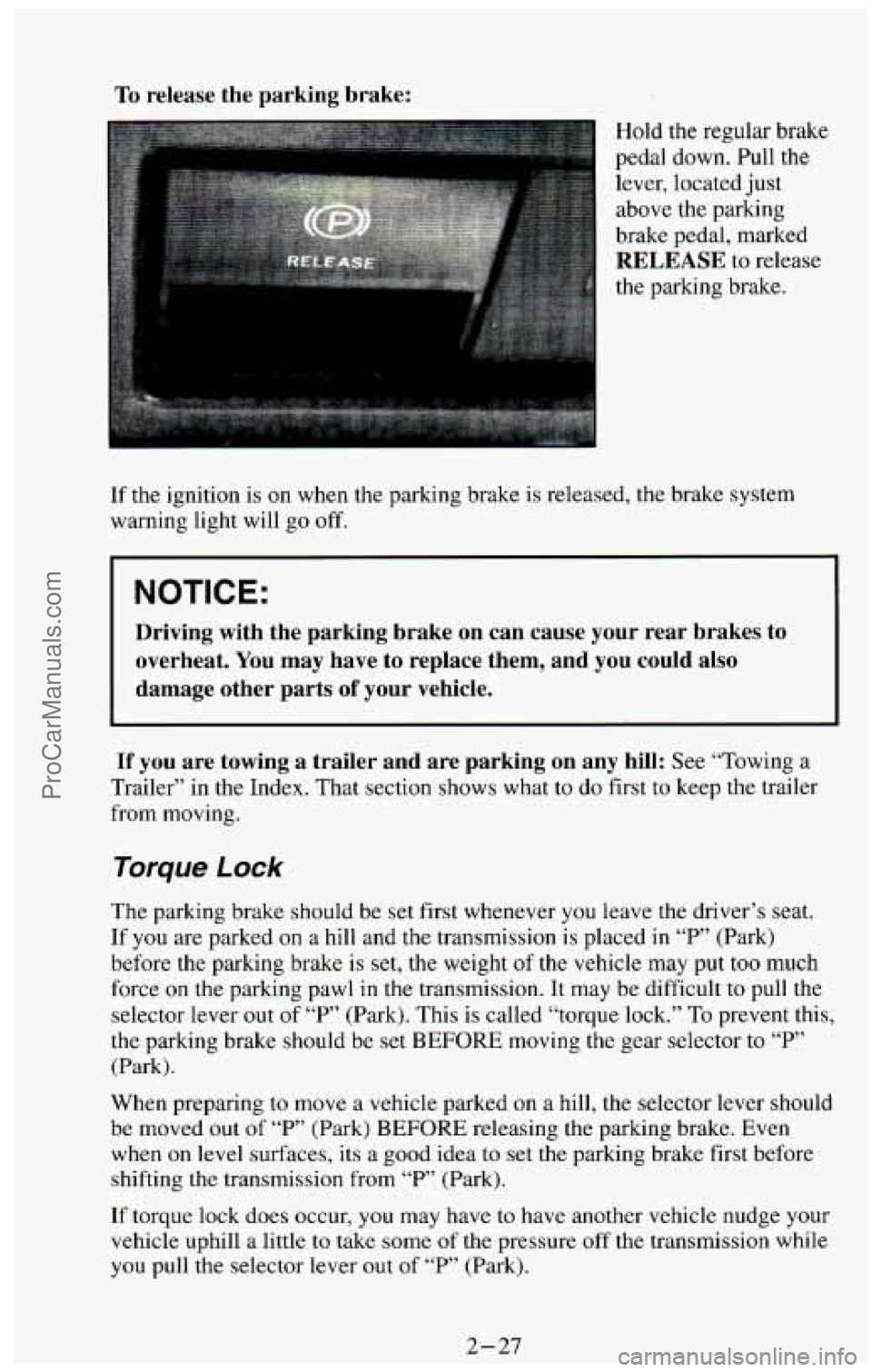
To release the parking brake:
Hold the regular brake
pedal down. Pull the
lever, located just
above the parking
brake pedal, marked
RELEASE to release
the parking brake.
If the ignition is on when the parking brake is released, the brake system
warning light will
go off.
NOTICE:
Driving with the parking brake on can cause your rear brakes to
overheat. You may have to replace them, and you could also
damage other parts
of your vehicle.
If you are towing a trailer and are parking on any hill: See “Towing a
Trailer” in the Index. That section shows what to do first to keep the trailer
from moving.
Torque Lock
The parking brake should be set first whenever you leave the driver’s seat.
If you are parked on a hill and the transmission is placed in “P’ (Park)
before the parking brake is set, the weight
of the vehicle may put too much
force on the parking pawl in the transmission. It may be difficult to pull the
selector lever out
of “P” (Park). This is called “torque lock.” To prevent this,
the parking brake should be set
BEFORE moving the gear selector to “P”
(Park).
When preparing to move a vehicle parked on a hill, the selector lever should
be moved out
of “P” (Park) BEFORE releasing the parking brake. Even
when on level surfaces, its a good idea to set the parking brake first before
shifting the transmission from
“P” (Park).
If torque lock does occur, you may have to have another vehicle nudge your
vehicle uphill a
little to take some of the pressure off the transmission while
you pull the selector lever
out of “P’ (Park).
2-27
ProCarManuals.com
Page 87 of 385
If you have four-wheel drive and your transfer case is in “N” (Neutral),
your vehicle will be free to roll, even if your shift lever is in
“P” (Park). So,
be sure the transfer case is in a drive gear - not in “N” (Neutral). Follow
the proper steps
to be sure your vehicle won’t move. See “Shifting Into ‘P’
(Park)” in the Index.
If you’re pulling a trailer, see “Towing a Trailer” in the Index.
Four Wheel Drive
If your vehicle has four-wheel drive, you can send your engine’s driving
power
to all four wheels for extra traction. To get the most satisfaction out
of four-wheel drive, you must be familiar with it’s operation. Read the part
that follows before using four-wheel drive.
You should use 2H for most
normal driving conditions.
Rear-wheel antilock brakes do
not work when you shift into four-wheel
drive. Your regular brakes will
still work. When you shift back into
two-wheel drive, your rear-wheel antilock brakes will take over again.
2-32
ProCarManuals.com
Page 98 of 385
When you apply your brakes, the Cruise Control shuts off.
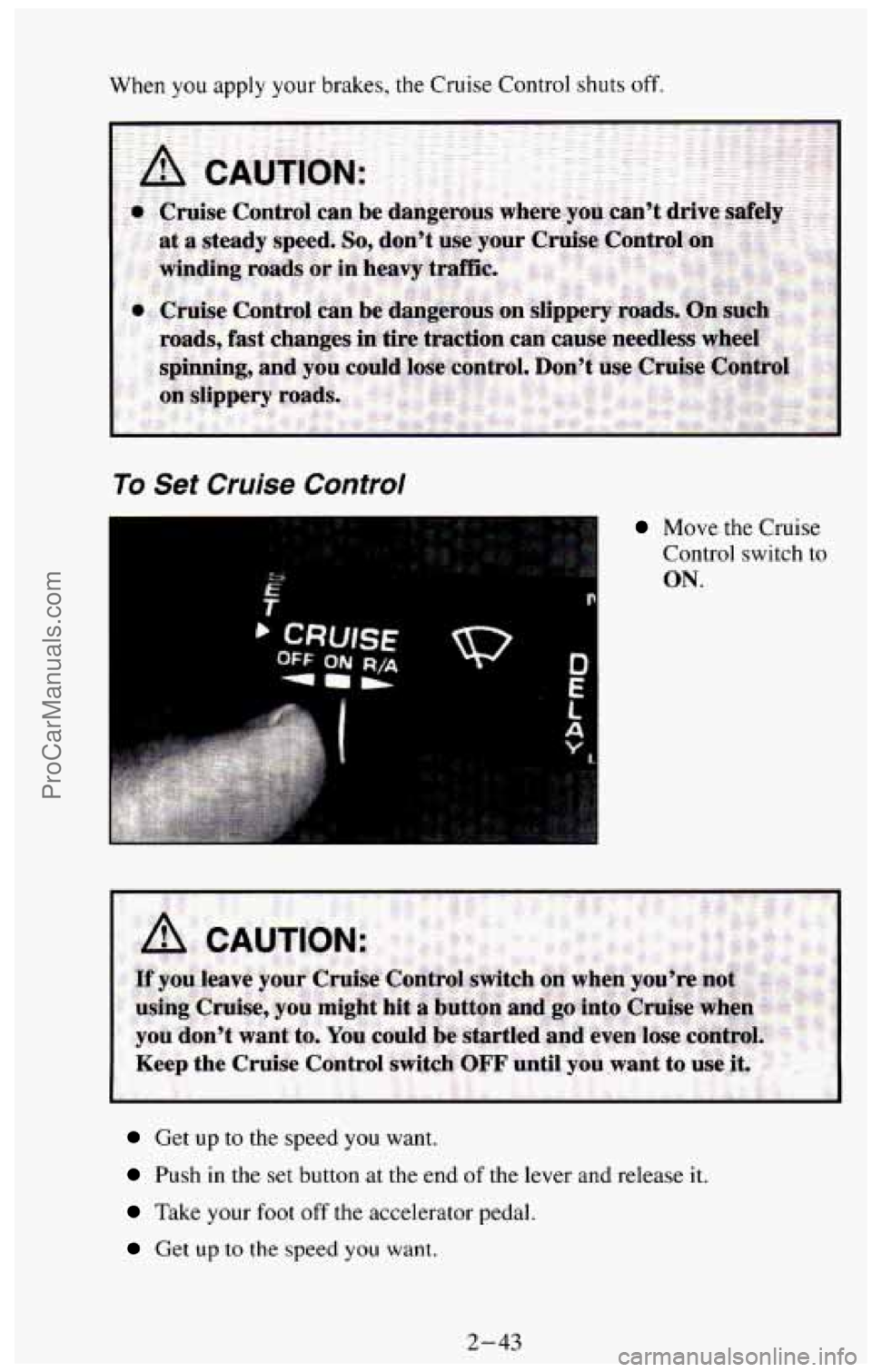
To Set Cruise Control
Move the Cruise
Control
switch to
ON.
Get up to the speed you want.
Push in the set button at the end of the lever and release it.
Take your foot off the accelerator pedal.
Get up to the speed you want.
2-43
ProCarManuals.com
Page 123 of 385
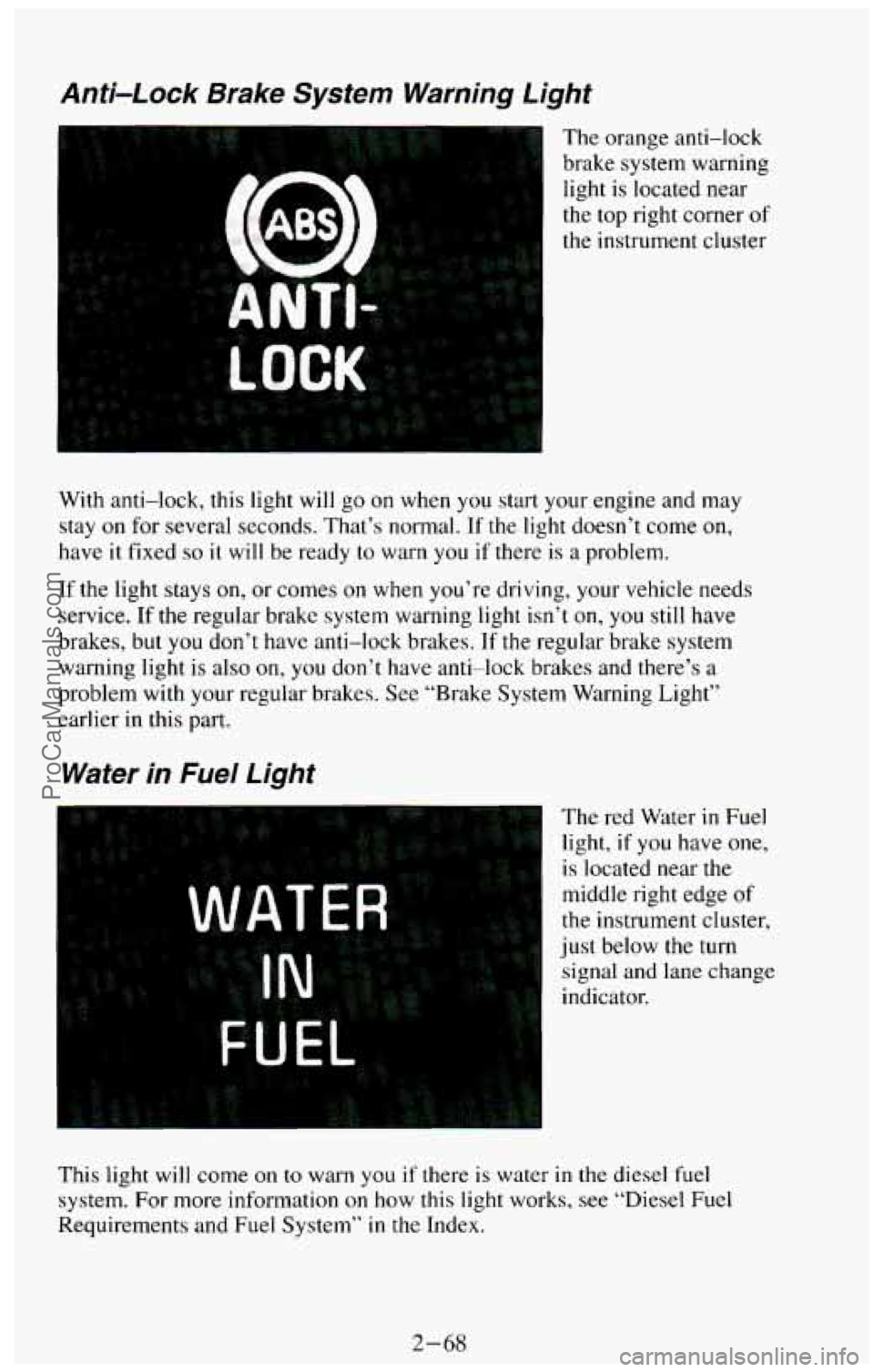
Anti-Lock Brake System Warning Light
The orange anti-lock
brake system warning light is located near
the top right corner
of
the instrument cluster
mi
With anti-lock, this light will go on when you start your engine and may
stay
on for several seconds. That’s normal. If the light doesn’t come on,
have it fixed
so it will be ready to warn you if there is a problem.
If the light stays on, or comes on when you’re driving, your vehicle needs
service.
If the regular brake system warning light isn’t on, you still have
brakes, but you don’t have anti-lock brakes. If the regular brake system
warning light is also
on, you don’t have anti-lock brakes and there’s a
problem with your regular brakes. See “Brake System Warning Light’’
earlier in this part.
Water in Fuel Light
The red Water in Fuel
light, if
you have one,
is located near the
middle right edge of
the instrument cluster,
just below the turn
signal and lane change
indicator.
This light will come on
to warn you if there is water in the diesel fuel
system.
For more information on how this light works, see “Diesel Fuel
Requirements and Fuel System”
in the Index.
2-68
ProCarManuals.com
Page 163 of 385
But it’s very important to keep in mind that the ability to drive is affected
well below a BAC
of 0.10 percent. Research shows that the driving skills of
many people are impaired at a BAC approaching
0.05 percent, and that the
effects are worse at night. All drivers are impaired at BAC levels above
0.05 percent. Statistics show that the chance of being in an accident
increases sharply for drivers who have a BAC
of 0.05 percent or above. A
driver with
a BAC level of 0.06 percent (three beers in one hour for a
180-pound or
82 kg person) has doubled his or her chance of having an
accident. At a BAC level of
0.10 percent, the chance of that driver having
an accident is six times greater; at a
level of 0.15 percent, the chances are
twenty-five times greater! And, the body takes about an hour to rid itself
of
the alcohol in one drink. No amount of coffee or number of cold showers
will speed that up.
“I’ll be careful” isn’t the right answer. What if there’s an emergency, a need
to take sudden action, as when a child darts into the street? A person with a
higher BAC might not be able
to react quickly enough to avoid the collision.
There’s something else about drinking and driving that many people don’t
know. Medical research shows that alcohol in a person’s system can make
crash injuries worse. That’s especially true for brain, spinal cord and heart
injuries. That means that if anyone who has been drinking
- driver or
passenger
- is in a crash, the chance of being killed or permanently
disabled is higher than if that person had not been drinking. And we’ve
already
seen that the chance of a crash itself is higher for drinking drivers.
Control of a Vehicle
You have three systems that make your vehicle go where you want it to go.
They are the brakes, the steering and the accelerator. All three systems have
to do their work at the places where the tires meet the road.
4-4
ProCarManuals.com
Page 164 of 385
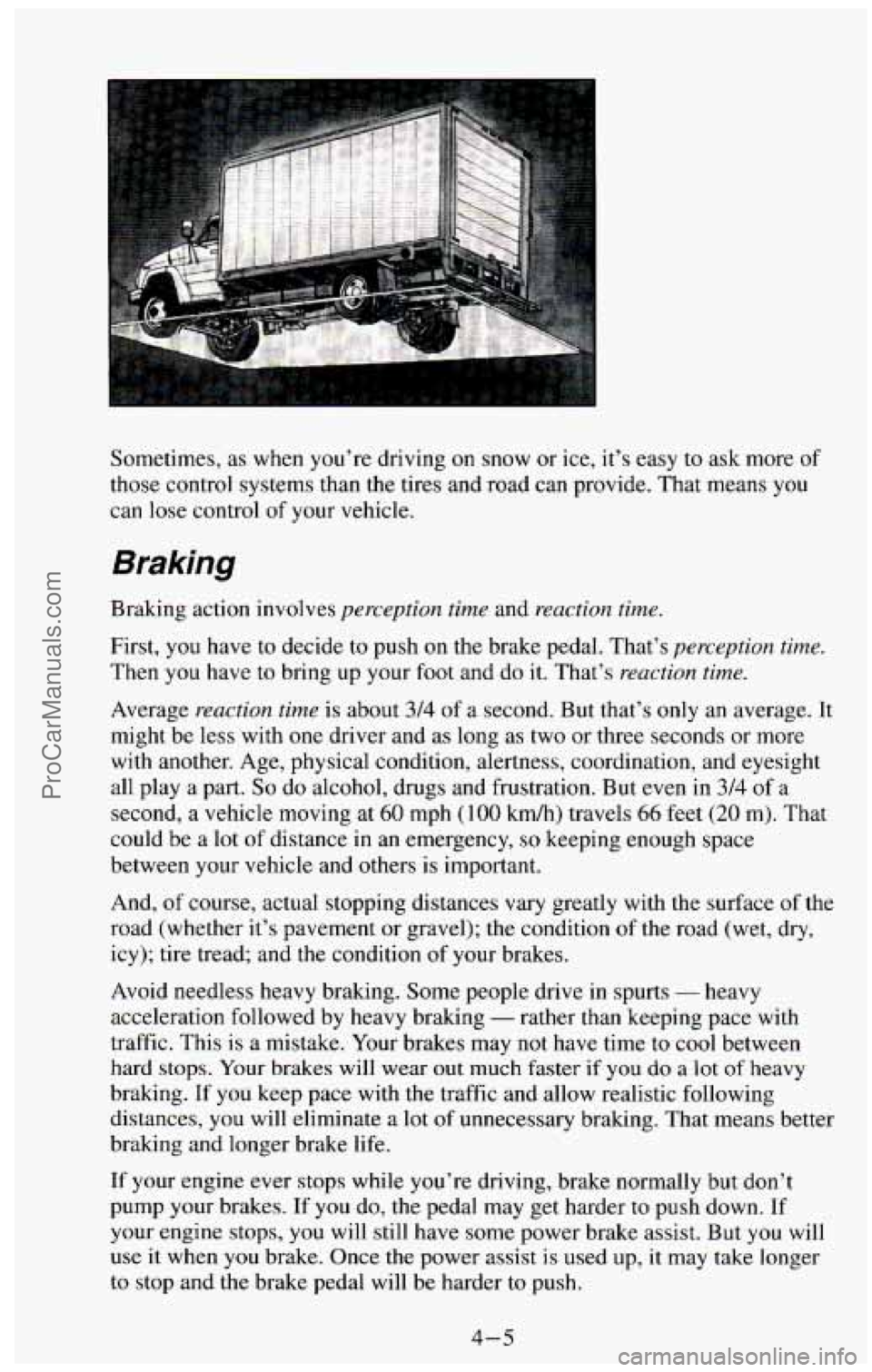
Sometimes, as when you’re driving on snow or ice, it’s easy to ask more of
those control systems than the tires and road can provide. That means you
can
lose control of your vehicle.
Braking
Brakmg action involves perception time and reaction time.
First, you have to decide to push on the brake pedal. That’s perception. time.
Then you have to bring up your foot and do it. That’s reaction time.
Average reaction time is about 314 of a second. But that’s only an average. It
might be less with one driver and as long as two or three seconds or more
with another. Age, physical condition, alertness, coordination, and eyesight
all play a part.
So do alcohol, drugs and frustration. But even in 3/4 of a
second, a vehicle moving at
60 mph ( 100 kdh) travels 66 feet (20 m). That
could
be a lot of distance in an emergency, so keeping enough space
between your vehicle and others is important.
And, of course, actual stopping distances vary greatly with the surface of the
road (whether it’s pavement or gravel); the condition of the road (wet, dry,
icy); tire tread; and
the condition of your brakes.
Avoid needless heavy braking. Some people drive in spurts
- heavy
acceleration followed by heavy braking
- rather than keeping pace with
traffic. This is a mistake. Your brakes may not have time to
cool between
hard
stops. Your brakes will wear out much faster if you do a lot of heavy
braking.
If you keep pace with the traffic and allow realistic following
distances, you will eliminate a lot
of unnecessary braking. That means better
braking and longer brake life.
If your engine ever stops while you’re driving, brake normally but don’t
pump your brakes. If
you do, the pedal may get harder to push down. If
your engine stops, you will still have some power brake assist. But
you will
use it when you brake. Once the power assist is used
up, it may take longer
to stop and the brake pedal will be harder to push.
4-5
ProCarManuals.com
Page 165 of 385
Anti-Lock Brakes (ABS)
Your vehicle has an advanced electronic braking system that can help you
keep it under control. When you start your vehicle and begin to drive away,
you may hear a momentary motor or clicking noise. This is the ABS system
testing itself.
..>
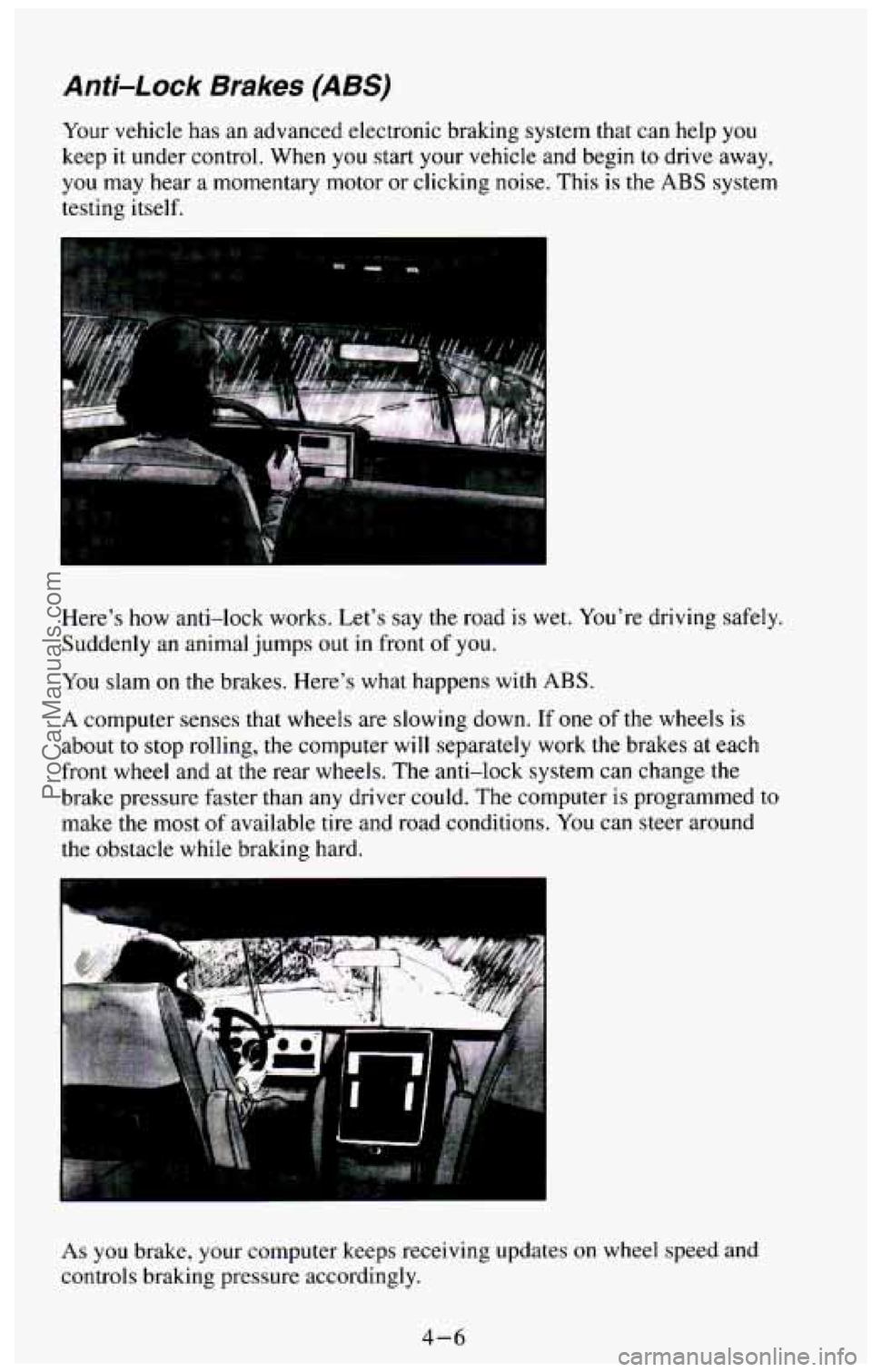
Here's how anti-lock works. Let's say the road is wet. You're driving safely.
Suddenly an animal jumps out in front of you.
You slam
on the brakes. Here's what happens with ABS.
. ...
A computer senses that wheels are slowing down. If one of the wheels is
about to stop rolling, the computer will separately work the brakes at each
front wheel and at the rear wheels. The anti-lock system can change the
brake pressure faster than any driver could. The computer is programmed to
make the most
of available tire and road conditions. You can steer around
the obstacle while braking hard.
'.." *!
As you brake, your computer keeps receiving updates on wheel speed and
controls braking pressure accordingly.
4-6
ProCarManuals.com