1994 CHEVROLET SUBURBAN tire pressure
[x] Cancel search: tire pressurePage 165 of 385
Anti-Lock Brakes (ABS)
Your vehicle has an advanced electronic braking system that can help you
keep it under control. When you start your vehicle and begin to drive away,
you may hear a momentary motor or clicking noise. This is the ABS system
testing itself.
..>
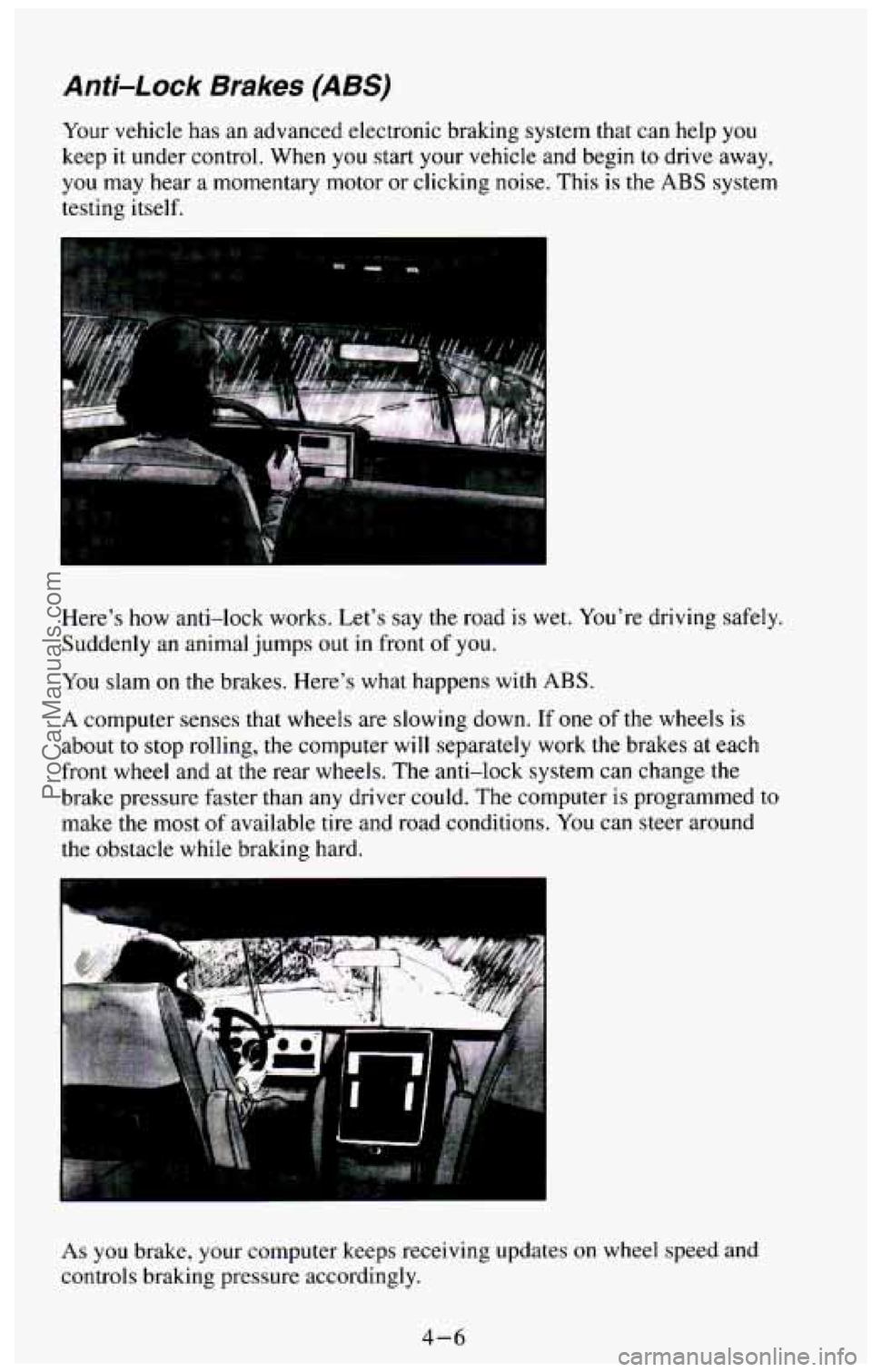
Here's how anti-lock works. Let's say the road is wet. You're driving safely.
Suddenly an animal jumps out in front of you.
You slam
on the brakes. Here's what happens with ABS.
. ...
A computer senses that wheels are slowing down. If one of the wheels is
about to stop rolling, the computer will separately work the brakes at each
front wheel and at the rear wheels. The anti-lock system can change the
brake pressure faster than any driver could. The computer is programmed to
make the most
of available tire and road conditions. You can steer around
the obstacle while braking hard.
'.." *!
As you brake, your computer keeps receiving updates on wheel speed and
controls braking pressure accordingly.
4-6
ProCarManuals.com
Page 180 of 385
Stalling on an Incline
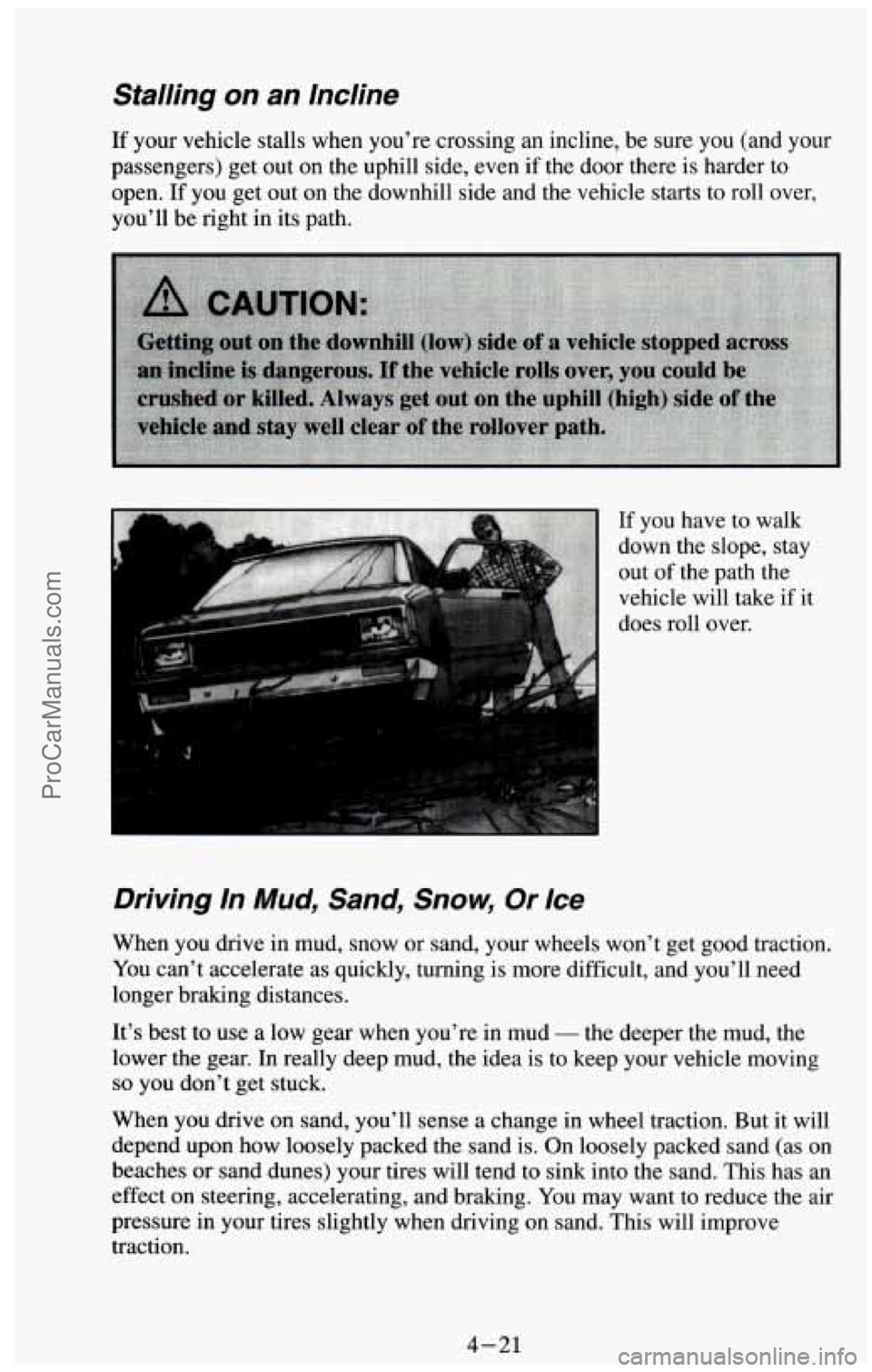
If your vehicle stalls when you’re crossing an incline, be sure you (and your
passengers) get out on the uphill side, even
if the door there is harder to
open. If you get out on the downhill side and the vehicle starts to roll over,
you’ll be right in its path.
Driving In Mud, Sand, Snow, Or Ice
When you drive in mud, snow or sand, your wheels won’t get good traction.
You can’t accelerate as quickly, turning is more difficult, and you’ll need
longer braking distances.
It’s best to use a low gear when you’re in mud
- the deeper the mud, the
lower the gear. In really deep mud, the idea is to keep your vehicle moving
so you don’t get stuck.
When you drive on sand, you’ll sense a change in wheel traction. But it will
depend upon how loosely packed the sand is. On loosely packed sand (as on
beaches or sand dunes) your tires will tend to sink into the sand. This has an
effect
on steering, accelerating, and braking. You may want to reduce the air
pressure in your tires slightly when driving on sand. This will improve
traction.
4-21
ProCarManuals.com
Page 185 of 385
Hydroplaning is dangerous. So much water can build up under your tires
that they can actually ride on the water. This can happen if the road
is wet
enough and you’re going fast enough. When your vehicle is hydroplaning, it
has little or no contact with the road.
Hydroplaning doesn’t happen often. But it can if your tires haven’t much
tread or if the pressure in one or more is
low. It can happen if a lot of water
is standing
on the road. If you can see reflections from trees, telephone
poles,
or other vehicles, and raindrops “dimple” the water’s surface, there
could be hydroplaning.
Hydroplaning usually happens at higher speeds. There just isn’t a hard and
fast rule about hydroplaning. The best advice
is to slow down when it is
raining.
Some Other Rainy Weather Tips
Turn on ybur low-beam headlights - not just your parKing lights - to
help make
you more visible to others.
Besides slowing down, allow some extra following distance. And be
especially careful when you pass another vehicle. Allow yourself more
clear room ahead, and be prepared to have your view restricted by road
spray.
Have good tires with proper tread depth. (See “Tires” in the Index.)
City Driving
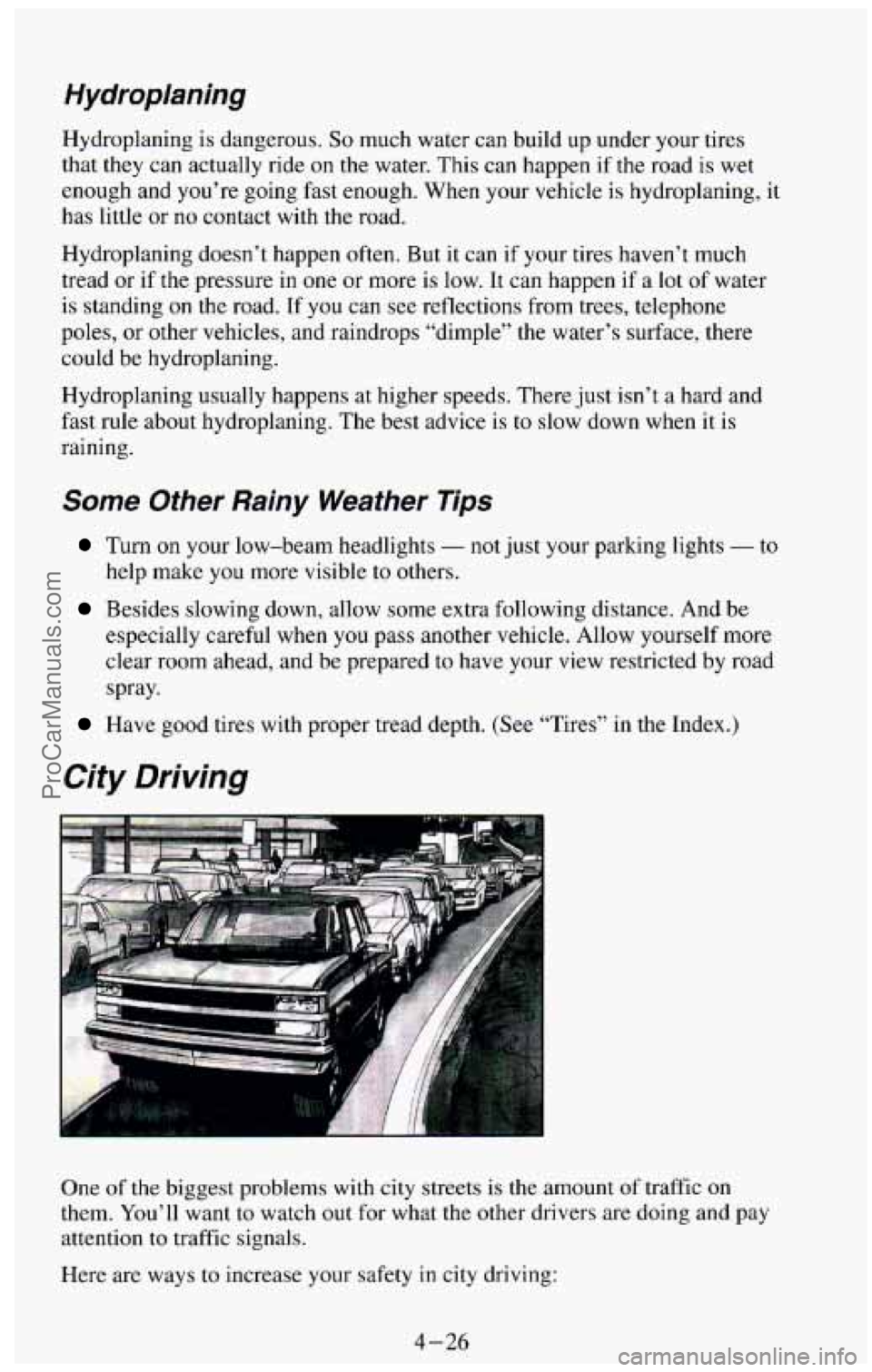
One of the biggest problems with city streets is the amount of traffic on
them. You’ll want to watch out for what the other drivers are doing and pay
attention to traffic signals.
Here are ways
to increase your safety in city driving:
4-26
ProCarManuals.com
Page 187 of 385
Once you are moving on the freeway, make certain you allow a reasonable
following distance. Expect to move slightly slower
at night.
When you want to leave the freeway, move to the proper lane well
in
advance. If you miss your exit do not, under any circumstances, stop and
back up. Drive on to the next exit.
The exit ramp can be curved, sometimes quite sharply.
The exit speed is usually posted.
Reduce your speed according to your speedometer, not to your sense of
motion. After driving for
any distance at higher speeds, you may tend to
think you
are going slower than you actually are.
Before Leaving on a Long Trip
Make sure you’re ready. Try to be well rested. If you must start when you’re
not fresh
- such as after a day’s work - don’t plan to make too many
miles that first part of the journey. Wear comfortable clothing and shoes you
can easily drive
in.
Is your vehicle ready for a long trip? If you keep it serviced and maintained,
it’s ready
to go. If it needs service, have it done before starting out. Of
course, you’ll find experienced and able service experts in vehicle
dealerships all across North America. They’ll be ready and willing
to help if
you need
it.
Here are some things you can check before a trip:
0
0
0
0
0
0
Windshield Washer Fluid: Is the reservoir full? Are all windows clean
inside and outside?
Wiper Blades: Are they in good shape?
Fuel, Engine OiZ, Other Fluids: Have you checked all levels?
Lights: Are they all working? Are the lenses clean?
Tires: They are vitally important to a safe, trouble-free trip. Is the tread
good enough for long-distance driving? Are the tires all inflated to the
recommended pressure?
Weather Forecasts: What’s the weather outlook along your route?
Should you delay your trip a short time to avoid a major storm system?
Maps: Do you have up-to-date maps?
4-28
ProCarManuals.com
Page 199 of 385
Trailer Brakes
If your trailer weighs more than 1,000 pounds (450 kg) loaded, then it needs
its own brakes
- and they must be adequate. Be sure to read and follow the
instructions for the trailer brakes
so you’ll be able to install, adjust and
maintain them properly.
Your trailer brake system can tap into your vehicle’s hydraulic brake system,
but consider the following:
Will the trailer brake system use more than 0.02 cubic inch (0.3 cc) of
fluid from your vehicle’s master cylinder? If it will, don’t tap into your
vehicle’s brake system. Both braking systems
won’t work well, and you
could even lose your brakes altogether.
not, the trailer brake system must not be used with your vehicle.
If everything checks
out this far, make the brake tap at the port on the
master cylinder that sends the fluid to the rear brakes. But don’t use copper
tubing for this. if you do, it will bend and finally break
off. Use steel brake
tubing.
Will the trailer brake parts take 3,000 psi (20 650 kPa) of pressure? If
Driving with a Trailer
Towing a trailer requires a certain amount of experience. Before setting out
for the open road,
you’ll want to get to know your rig. Acquaint yourself
with the feel
of handling and braking with the added weight of the trailer.
And always keep
in mind that the vehicle you are driving is now a good
deal longer and not nearly so responsive as your vehicle is by itself.
Before
you start, check the trailer hitch and platform, safety chains,
electrical connector, lights, tires and mirror adjustment. If the trailer has
electric brakes, start your vehicle and trailer moving and then apply the
trailer brake controller by hand to be sure the brakes are working. This lets
you check your electrical connection at the same time.
4-40
ProCarManuals.com
Page 247 of 385
......................
................
Brake Master Cylinder ................................... 6-43
Replacing Brake System Parts .............................. 6-46
Other Maintenance Items .................................... 646
Lubrication ............. ..... 648
Battery ................ ....... 6-49
Bulb Replacement ......................................... 6-50
Fuses and Circuit Breakers ................................ 6-56
Exhaust System ....................................... 6-58
Loading Your Vehicle ...................................... 6-59
Tires .................................................... 6-62
Inflation-Tire Pressure .................................. 6-62
Tire Inspection and Rotation ............................... 6-64
When It’s Time for New Tires ......................... 6-65
Buying New Tires ..................................... 6-66
Uniform Tire Quality Grading ............................. 6-66
Wheel Alignment and Tire Balance ......................... 6-67
Wheel Replacement ..................................... 6-68
Tire Chains ............................................ 6-69
Appearancecare .......................................... 6-69
Cleaning the Inside of Your Vehicle ......................... 6-70
Cleaning the Outside of Your Vehicle ..................... 6-74
Appearance Care Materials .................................. 6-77
Vehicle Identification Number .............................. 6-78
Service Parts Identification Label ............................. 6-80
Specification Charts ...................................... 6-81
6-2
ProCarManuals.com
Page 304 of 385
Malfunction Indicator
(SERVICE ENGINE SOON) Lamp
The Malfunction Indicator (SERVICE ENGINE SOON) Lamp on your
instrument panel lets you know when your emission system needs service.
The light
will come on briefly when you start your engine to let you know
that the system is working.
If it does not come on when you start your
engine,
or if it comes on and stays on while you're driving, your system
may need service. Your vehicle should still be driveable, but
you should
have your system serviced right away.
Secondary Air Injection Reaction (AIR) System
You may have this system. It has a control valve that will direct air to where
it is needed. If the AIR system needs service, your Malfunction Indicator
(SERVICE ENGINE SOON) Lamp on your instrument panel will come
on.
Loading Your Vehicle
MFD BY GENERAL MOT0 RSCORP
i IN EFFECT -
I
- MODEL [ISPEED w
u TIRE SIZE RTG FilM PSllKPA (COLD)
q----p nri
SEE OWNERS MANUAL FOR ADDITIONAL INFORMATION
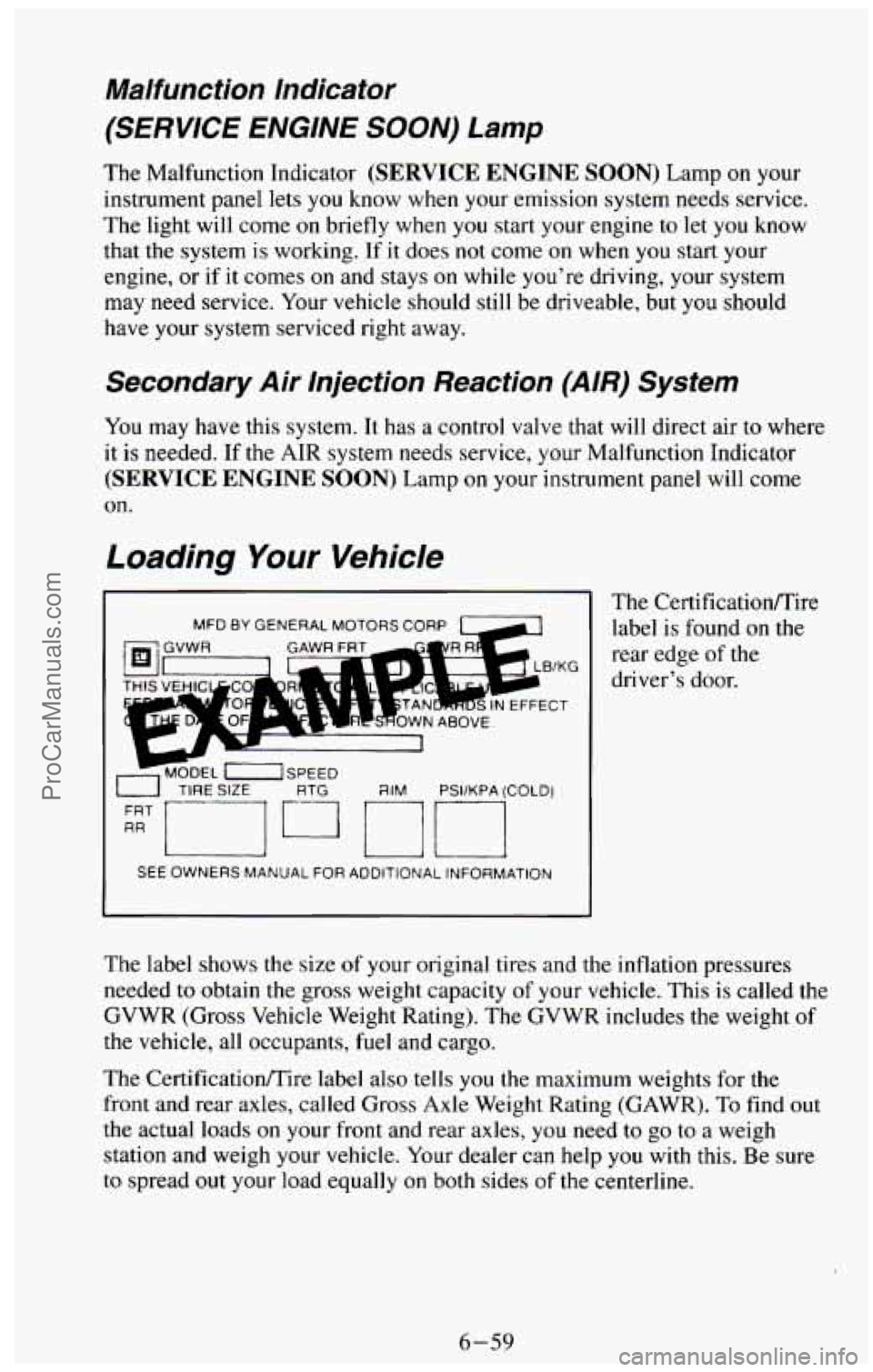
The CertificatiodTire
label is found
on the
rear edge
of the
driver's door.
The label shows the size
of your original tires and the inflation pressures
needed to obtain the gross weight capacity
of your vehicle. This is called the.
GVWR (Gross Vehicle Weight Rating). The GVWR includes the weight
of
the vehicle, all occupants, fuel and cargo.
The Certificatioflire label also tells you the maximum weights for the
front and rear axles, called Gross Axle Weight Rating (GAWR).
To find out
the actual loads on your front and rear axles,
you need to go to a weigh
station and weigh your vehicle. Your dealer can help you with this.
Be sure
to spread out your load equally on both sides of the centerline.
6-59
ProCarManuals.com
Page 307 of 385
Tires
We don’t make tires. Your new vehicle comes with high quality tires made
by a leading tire manufacturer. These tires are warranted by the tire
manufacturers and their warranties are delivered with every
new vehicle. If
your spare tire is a different brand than your road tires, you will have a tire
warranty folder from each of
these manufacturers.
Inflation - Tire Pressure
The Certification/Tire label which is on the rear edge of the driver’s door, or
on the incomplete vehicle document in the cab, shows the correct inflation
pressures for your tires, when they’re cold.
“Cold” means your vehicle has
been sitting for at least three hours or driven no more than
a mile.
6-62
ProCarManuals.com