1994 CHEVROLET SUBURBAN brakes
[x] Cancel search: brakesPage 191 of 385
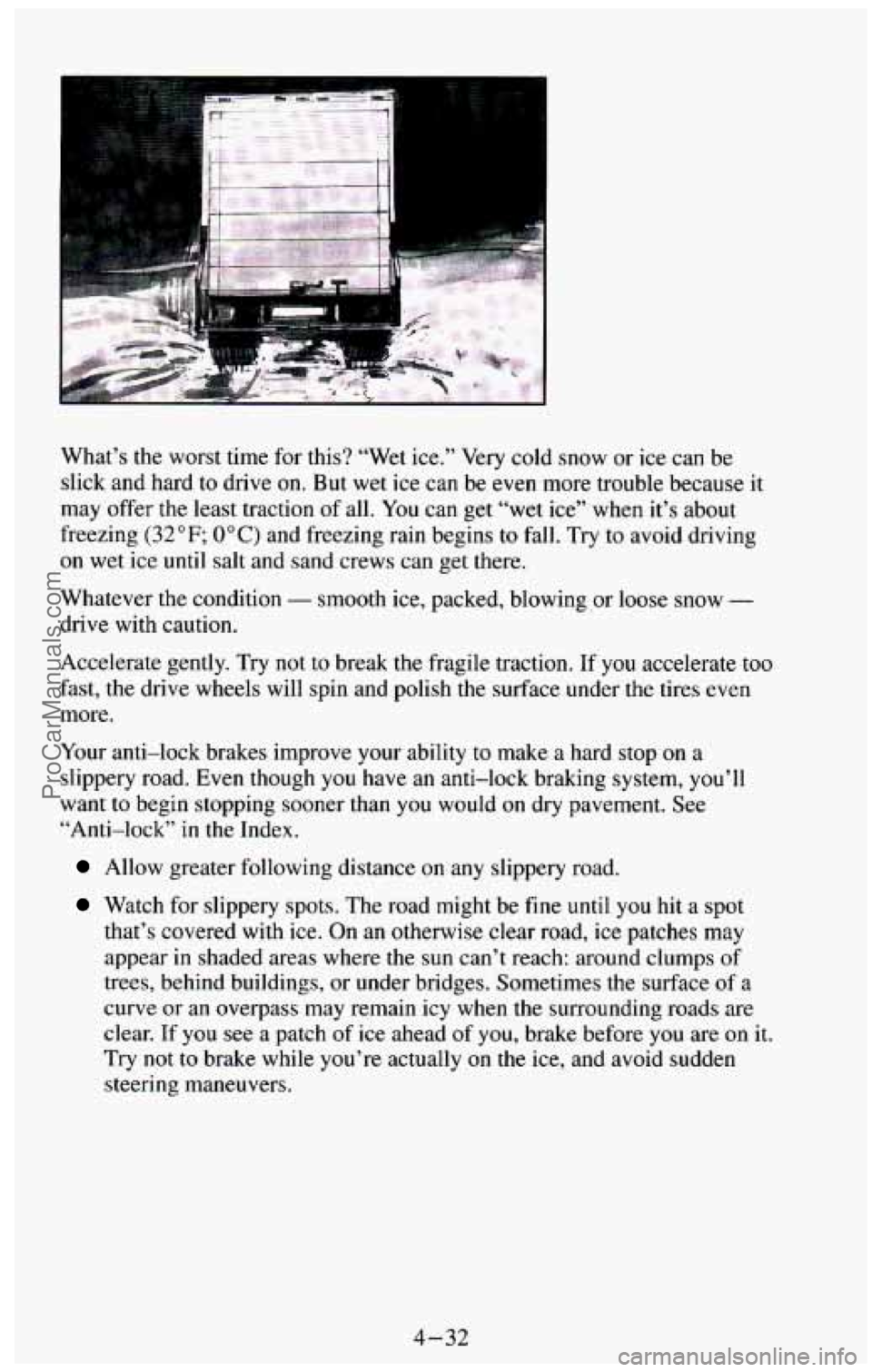
What’s the worst time for this? “Wet ice.” Very cold snow or ice can be
slick and hard to drive on.
But wet ice can be even more trouble because it
may offer the least traction of all. You can get “wet ice” when it’s about
freezing
(32°F; 0°C) and freezing rain begins to fall. Trv to avoid driving
on wet ice until salt and sand crews can get there.
Whatever the condition
- smooth ice, packed, blowing ,or loose snow -
drive with caution.
Accelerate gently. Try not to break the fragile traction. If you accelerate too
fast, the drive wheels will spin and polish the surface under the tires even
more.
Your anti-lock brakes improve your ability
to make a hard stop on a
slippery road. Even though you have an anti-lock braking system, you’ll
want to begin stopping sooner than you would on dry pavement. See
“Anti-lock” in the Index.
Allow greater following distance on any slippery road.
Watch for slippery spots. The road might be fine until you hit a spot
that’s covered with ice. On an otherwise clear road, ice patches may
appear
in shaded areas where the sun can’t reach: around clumps of
trees, behind buildings, or under bridges. Sometimes the surface of a
curve
or an overpass may remain icy when the surrounding roads are
clear. If you see a patch of ice ahead of you, brake before you are on it.
Try not to brake while you’re actually on the ice, and avoid sudden
steering maneuvers.
4-32
ProCarManuals.com
Page 193 of 385
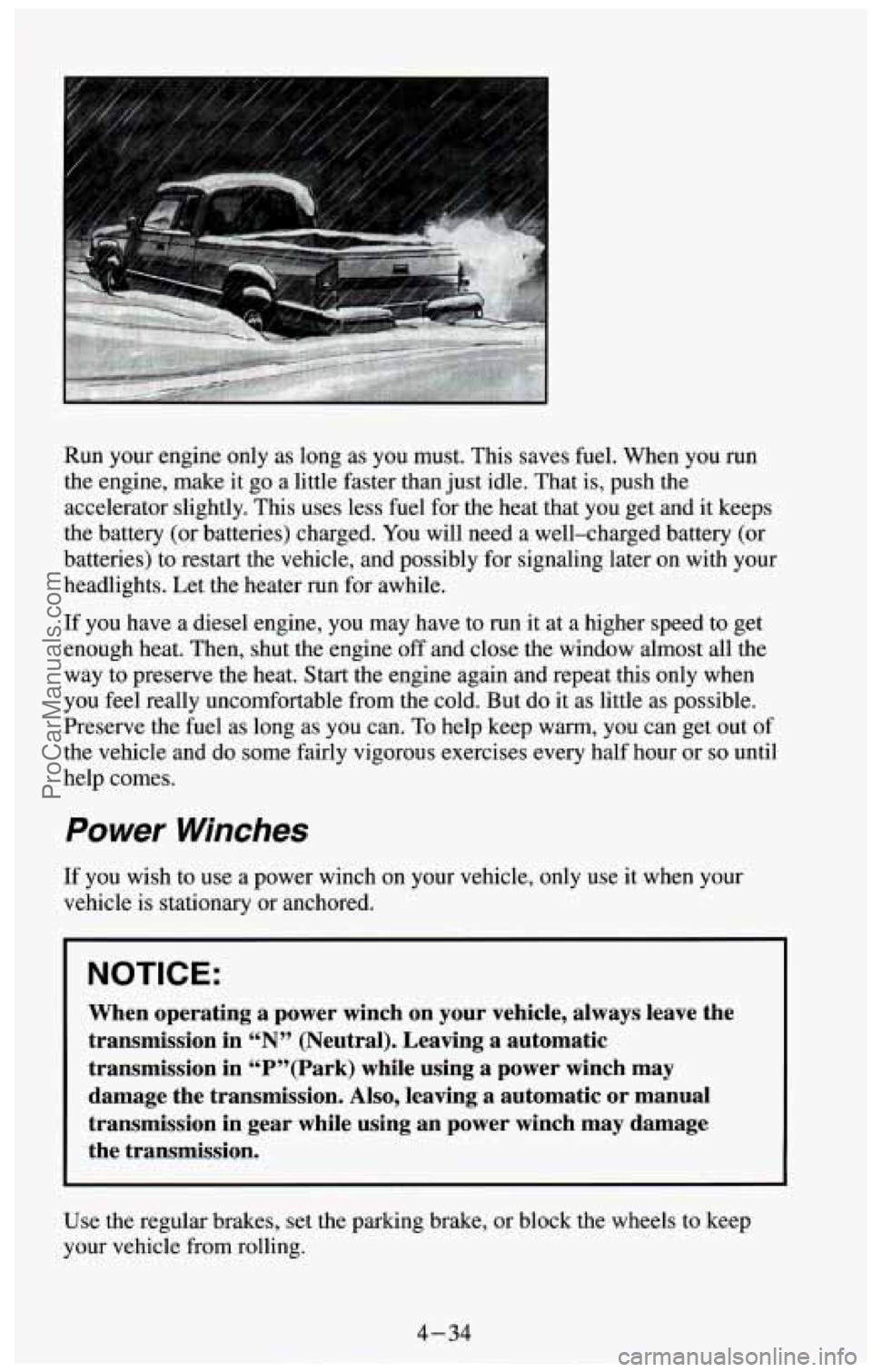
Run your engine only as long as you must. This saves fuel. When you run
the engine, make it
go a little faster than just idle. That is, push the
accelerator slightly. This uses less fuel for the heat that you get and it keeps
the battery (or batteries) charged.
You will need a well-charged battery (or
batteries) to restart the vehicle, and possibly for signaling later on with your
headlights. Let the heater run for awhile.
If you have a diesel engine, you may have to run it at a higher speed to get
enough heat. Then, shut the engine
off and close the window almost all the
way to preserve the heat. Start the engine again and repeat this only when
you feel really uncomfortable from the cold. But do it as little as possible.
Preserve the fuel as long as you can.
To help keep warm, you can get out of
the vehicle
and do some fairly vigorous exercises every half hour or so until
help comes.
Power Winches
If you wish to use a power winch on your vehicle, only use it when your
vehicle is stationary or anchored.
NOTICE:
When operating a power winch on your vehicle, always leave the
transmission in “N” (Neutral). Leaving a automatic
transmission in “P”(Park) while using a power winch may \
damage the transmission. Also, leaving a automatic or manual
transmission in gear while using an power winch may damage
the transmission.
Use the regular brakes, set the parking brake, or block the wheels to keep
your vehicle from rolling.
4-34
ProCarManuals.com
Page 194 of 385
Power Take-Off (PTO)
NOTICE:
If you will be using the PTO while the vehicle remains in one
place, drive the vehicle to warm it up before operating the
PTO.
Don’t use the PTO for more than four hours without driving
your vehicle again. If you don’t follow these guidelines, your
transfer case or transmission could be damaged.
NOTICE:
Don’t have a PTO that will exceed 35 horsepower installed on
your vehicle. It could damage your transmission or transfer
case.
Before using a power take-off, refer to the manufacturer’s or installer’s
instructions.
To engage a power take-off:
1. Set the parking brake.
2. Shift the transmission into “N” (Neutral).
3. Hold the clutch pedal down and engage the power take-off.
If
you are going to drive the vehicle, shift the transmission into the gear
you want. Then shift the transfer case into the range you want (if you
have four-wheel drive), apply the regular brakes and release the
parking brake.
When
you release the clutch, the power take-off will start.
4. Release the clutch (and the regular brakes) as you normally would.
Using a Transfer Case Mounted Power Take-Off
(Manual Transmission)
I. Set the parking brake.
2. Shift the transfer case into “N” (Neutral).
3. Hold the clutch pedal down. If the vehicle will remain in the same
place, shift the transmission
into the highest gear.
4-35
ProCarManuals.com
Page 195 of 385
4. Engage the power take-off.
If you are going to drive the vehicle, shift the transmission into the gear
you want. Then shift the transfer case into the range you want, apply
the regular brakes and release the parking brake.
When
you release the clutch, the power take-off will start.
5. Release the clutch (and the regular brakes) as you normally would.
Using a Transfer Case Mounted Power Take-Off
(Automatic Transmission)
1. Set the parking brake.
2. Shift the transfer case into “N” (Neutral).
3. Shift the transmission into “N’ (Neutral).
4. Engage the power take-off.
If you are going to drive the vehicle, shift the transfer case into the
range you want. Then apply the regular brakes and release the parkin\
g
brake.
5. Shift the transmission to “D” (Drive) to start the power take-off.
6. Release the regular brakes to drive the vehicle.
Towing a Trailer
4-36
ProCarManuals.com
Page 199 of 385
Trailer Brakes
If your trailer weighs more than 1,000 pounds (450 kg) loaded, then it needs
its own brakes
- and they must be adequate. Be sure to read and follow the
instructions for the trailer brakes
so you’ll be able to install, adjust and
maintain them properly.
Your trailer brake system can tap into your vehicle’s hydraulic brake system,
but consider the following:
Will the trailer brake system use more than 0.02 cubic inch (0.3 cc) of
fluid from your vehicle’s master cylinder? If it will, don’t tap into your
vehicle’s brake system. Both braking systems
won’t work well, and you
could even lose your brakes altogether.
not, the trailer brake system must not be used with your vehicle.
If everything checks
out this far, make the brake tap at the port on the
master cylinder that sends the fluid to the rear brakes. But don’t use copper
tubing for this. if you do, it will bend and finally break
off. Use steel brake
tubing.
Will the trailer brake parts take 3,000 psi (20 650 kPa) of pressure? If
Driving with a Trailer
Towing a trailer requires a certain amount of experience. Before setting out
for the open road,
you’ll want to get to know your rig. Acquaint yourself
with the feel
of handling and braking with the added weight of the trailer.
And always keep
in mind that the vehicle you are driving is now a good
deal longer and not nearly so responsive as your vehicle is by itself.
Before
you start, check the trailer hitch and platform, safety chains,
electrical connector, lights, tires and mirror adjustment. If the trailer has
electric brakes, start your vehicle and trailer moving and then apply the
trailer brake controller by hand to be sure the brakes are working. This lets
you check your electrical connection at the same time.
4-40
ProCarManuals.com
Page 200 of 385
During your trip, check occasionally to be sure that the load is secure, and
that the lights and any trailer brakes are still working.
Following Distance
Stay at least twice as far behind the vehicle ahead as you would when
driving your
vehicle without a trailer. This can help you avoid situations that
require heavy braking and sudden turns.
Passing
You’ll need more passing distance up ahead when you’re towing a trailer.
And, because you’re a good deal longer, you’ll need
to go much farther
beyond the passed vehicle
before you can return to your lane.
Backing Up
Hold the bottom of the steering wheel with one hand. Then, to move the
trailer to
the left, just move that hand to the left. To move the trailer to the
right, move your hand to the right. Always back up slowly and,
if possible,
have someone guide you.
4-41 ProCarManuals.com
Page 201 of 385
Making Turns
When you’re turning with a trailer, make wider turns than normal. Do this
so your trailer won’t strike soft shoulders, curbs, road signs, trees, or other
objects. Avoid jerky or sudden maneuvers. Signal well
in advance.
Turn Signals When Towing a Trailer
When you tow a trailer, your vehicle has to have a different turn signal
flasher and extra wiring, The green arrows on your instrument panel will
flash whenever you signal a turn or lane change. Properly hooked up, the
trailer lights will also flash, telling other drivers you’re about to turn,
change lanes or stop.
When towing a trailer,
the green arrows on your instrument panel will flash
for turns even if the bulbs on the trailer are burned out. Thus, you may think
drivers behind you are seeing your signal when they are not. It’s important
to check occasionally
to be sure the trailer bulbs are still working.
Driving On Grades
Reduce speed and shift to a lower gear before you start down a long or
steep downgrade. If
you don’t shift down, you might have to use your
brakes
so much that they would get hot and no longer work well.
On
a long uphill grade, shift down and reduce your speed to around 45 mph
(70 kdh) to reduce the possibility of engine and transmission overheating.
If you have an automatic transmission, you should use “D” (or, as you need
to, a lower gear) when towing
a trailer. Operating your vehicle in “D” when
towing a trailer will minimize heat buildup and extend
the life of your
transmission.
If
you have a manual transmission and you are towing a trailer, it’s better
not
to use fifth gear. Just drive in fourth gear (or, as you need to, a lower
gear).
Parking on Hills
You really should not park your vehicle, with a trailer attached, on a hill. If
something goes wrong, your rig could start to move. People can be injured,
and both your vehicle and the trailer can be damaged.
But
if you ever have to park your rig on a hill, here’s how to do it:
1. Apply your regular brakes, but don’t shift into “P’ (Park) yet, or in gear
for a manual transmission.
2. Have someone place chocks under the trailer wheels.
3. When the wheel chocks are in place, release the regular brakes until the
chocks absorb
the load.
4-42
ProCarManuals.com
Page 202 of 385
4. Re-apply the regular brakes. Then apply your parking brake, and then
shift to
“P” (Park), or “R’ (Reverse) for a manual transmission.
5. If you have a four-wheel-drive vehicle, be sure the transfer case is in a
6. Release the regular brakes. drive
gear-not in “N” (Neutral).
When You Are Ready to Leave After Parking on a Hill
1. Apply your regular brakes and hold the pedal down while you:
Start your engine;
Shift into a gear; and
Release the parking brake.
2. Let up on the brake pedal.
3. Drive slowly until the trailer is clear of the chocks.
4. Stop and have someone pick up and store the chocks.
4-43
ProCarManuals.com