1994 CHEVROLET SUBURBAN brakes
[x] Cancel search: brakesPage 166 of 385
Remember: Anti-lock doesn’t change the time you need to get your foot up
to the brake pedal. If you get too close to the vehicle in front of you, you
won’t have time
to apply your brakes if that vehicle suddenly slows or
stops. Always
leave enough room up ahead to stop, even though you have
anti-lock brakes.
To Use Four-wheel Anti-Lock
Don’t pump the brakes. Just hold the brake pedal down and let anti-lock
work for you. You may feel the brakes vibrate, or you may notice some
noise, but this is normal.
Braking in Emergencies
Use your anti-lock braking system when you need to. With anti-lock, you
can steer and brake at the same time. In many emergencies, steering can
help you more than even the very best braking.
Power Steering
If you lose power steering assist because the engine stops or the system is
not functioning, you can steer but it will take much more effort.
Steering Tips
Driving on Curves
It’s important to take curves at a reasonable speed.
A lot of the “driver lost control’’ accidents mentioned on the news happen
on curves. Here’s why:
Experienced driver or beginner, each
of us is subject to the same laws of
physics when driving
on curves. The traction of the tires against the road
surface makes
it possible for the vehicle to change its path when you turn
the front wheels. If there’s no traction, inertia will keep the vehicle going in
the same direction. If you’ve ever tried to steer a vehicle on wet ice, you’ll
understand this.
The traction you can get
in a curve depends on the condition of your tires
and the road surface, the angle at which the curve
is banked, and your
speed. ,- While you’re in a curve, speed is the one factor you can control.
Suppose you’re steering through a sharp curve. Then you suddenly
accelerate. Both control systems
- steering and acceleration - have to do
their work where the tires meet the road. Adding
the sudden acceleration
can demand too
much of those places. You can lose control.
4-7 ProCarManuals.com
Page 167 of 385
What should you do if this ever happens? Ease up on the accelerator pedal,
steer the vehicle the way
you want it to go, and slow down.
Speed limit signs near curves warn that
you should adjust your speed. Of
course, the posted speeds are based on good weather and road conditions.
Under less favorable conditions you’ll want
to go slower.
If you need to reduce your speed as you approach a curve, do it before you
enter the curve, while your front wheels are straight ahead.
Try
to adjust your speed so you can “drive” through the curve. Maintain a
reasonable, steady speed. Wait
to accelerate until you are out of the curve,
and then accelerate gently
into the straightaway.
Steering in Emergencies
There are times when steering can be more effective than braking. For
example,
you come over a hill and find a truck stopped in your lane, or a car
suddenly pulls out from nowhere, or a child darts out from between parked
cars and stops right
in front of you. You can avoid these problems by
braking
- if you can stop in time. But sometimes you can’t; there isn’t
room. That’s the time for evasive action
- steering around the problem.
Your vehicle can perform very well
in emergencies like these. First apply
your brakes. It is better to remove as much speed as you can from a possible
collision. Then steer around the problem, to the left or right depending on
the space available.
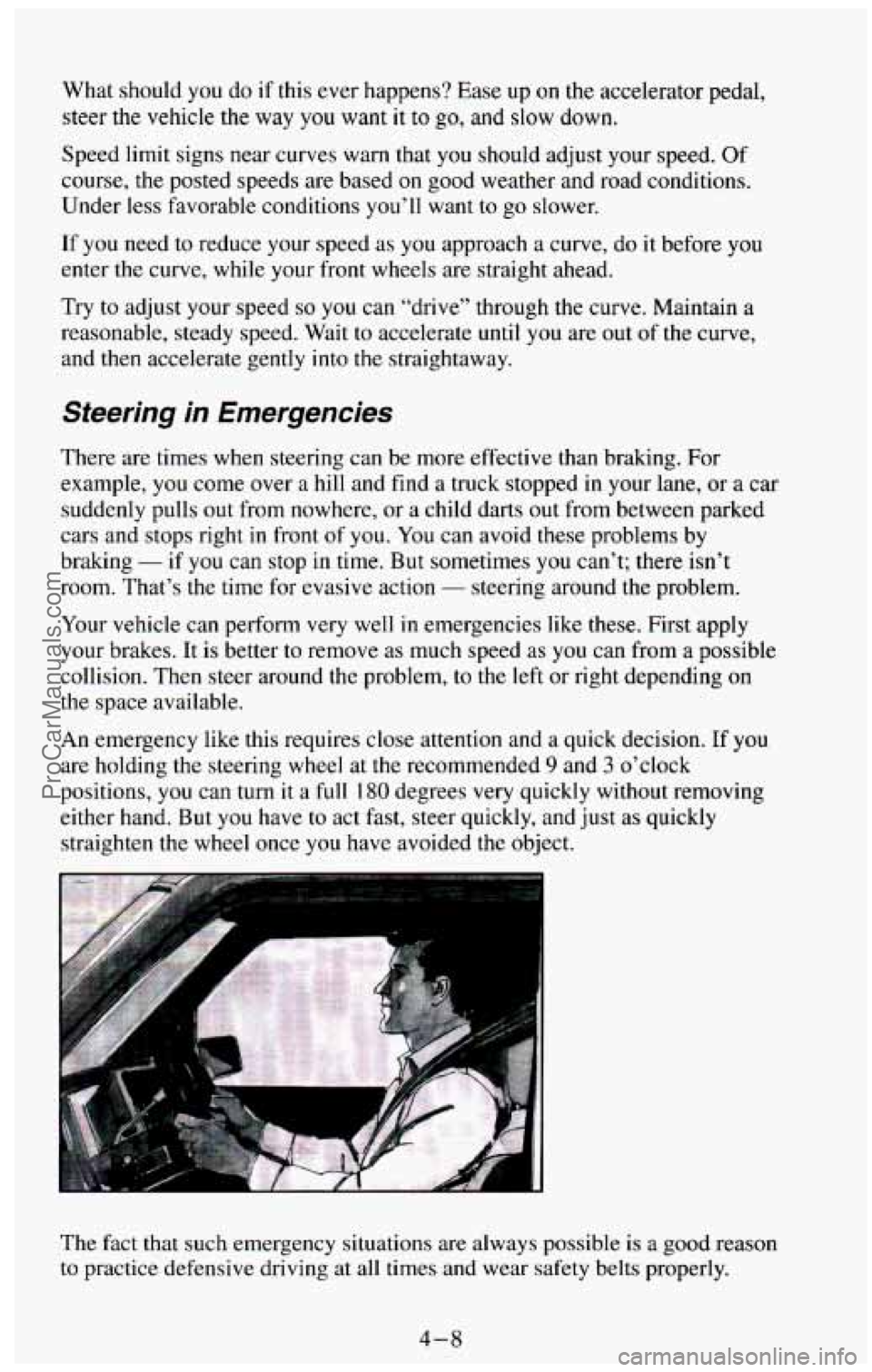
An emergency like this requires close attention and a quick decision. If
you
are holding the steering wheel at the recommended 9 and 3 o’clock
positions, you can turn it a full
180 degrees very quickly without removing
either hand. But you have
to act fast, steer quickly, and just as quickly
straighten the wheel once you have avoided the object.
The fact that such emergency situations
are always possible is ii good reason
to practice defensive driving at all times and wear safety belts properly.
4-8
ProCarManuals.com
Page 169 of 385
0
0
0
0
0
a
a
0
Watch for traffic signs, pavement markings, and lines. If you can see a
sign
up ahead that might indicate a turn or an intersection, delay your
pass. A broken center line usually indicates it’s all right to pass
(providing the road ahead is clear). Never cross a solid line on your
side of the lane or a double solid line, even if the road seems empty of
approaching traffic.
Do not get too close to the vehicle you want to pass while you’re
awaiting
an opportunity. For one thing, following too closely reduces
your area
of vision, especially if you’re following a larger vehicle.
Also, you won’t have adequate space if the vehicle ahead suddenly
slows or stops. Keep back a reasonable distance.
When it looks like
a chance to pass is coming up, start to accelerate but
stay in the right
lane and don’t get too close. Time your move so you
will be increasing speed as the time comes to move into the other lane.
If the way is clear to pass, you will have a “running start” that more
than makes up for the distance you would lose by dropping back. And
if something happens to cause
you to cancel your pass, you need only
slow down and drop back again and wait for another opportunity.
If other cars are lined up to pass a slow vehicle, wait your turn. But
take care that someone isn’t trying
to pass you as you pull out to pass
the slow vehicle. Remember
to glance over your shoulder and check
the blind spot.
Check your mirrors
, glance over your shoulder, and start your left lane
change signal before moving out of the right lane to pass. When
you
are far enough ahead of the passed vehicle to see its front in your inside
mirror, activate your right lane change signal and move back into the
right lane. (Remember that
if your right outside mirror is convex, the
vehicle you just passed may seem to be farther away from
you than it
really is.)
Try not
to pass more than one vehicle at a time on two-lane roads.
Reconsider before passing the next vehicle.
Don’t overtake a slowly moving
vehicle too rapidly. Even though the
brake lights are not flashing, it may be slowing down or starting to turn.
If you’re being passed, make it easy for the following driver to get
ahead
of you. Perhaps you can ease a little to the right.
Loss of Control
Let’s review what driving experts say about what happens when the three
control systems (brakes, steering and acceleration) don’t have enough
friction where the tires meet
the road to do what the driver has asked.
In any emergency, don’t give up. Keep trying to steer and constantly seek
an
escape route or area of less danger.
4-10
ProCarManuals.com
Page 171 of 385
Off-Road Driving with Your
Four- Wheel Drive Vehicle
This off-road guide is for vehicles that have four-wheel drive.
Also, see “Anti-lock Brakes”
in the Index.
If your vehicle doesn’t have four-wheel drive, you shouldn’t drive off-road
unless you’re
on a level, solid surface.
Off-road driving
can be great fun. But it does have some definite hazards.
The greatest of these is the terrain itself.
“Off-roading” means you’ve left the great North American road system
behind. Traffic lanes aren’t marked. Curves aren’t banked. There are no
road signs. Surfaces can be slippery, rough, uphill or downhill. In short,
you’ve gone right back
to nature.
Off-road driving involves some new skills. And that’s
why it’s very
important that you read this guide. You’ll find many driving tips and
suggestions. These will help make your off-road driving safer and more
enjoyable.
Before You Go Off-Roading
There are some things to do before you go out. For example, be sure to have
all necessary maintenance and service work done. Be sure you read
all the
information about your four-wheel drive vehicle
in this manual. Is there
enough fuel?
Is the spare tire fully inflated? Are the fluid levels up where
they should be? What are the local laws that apply to off-roading where
you’ll be driving? If you don’t know, you should check
with law
enforcement people in the area. Will you be on someone’s private land? If
so, be sure to get the necessary permission.
Loading Your Vehicle for Off-Road Driving
There are some important things to remember about how to load your
vehicle.
The heaviest things should be on the load floor and forward of your
Be sure the load is secured properly, so driving on the off-road terrain
rear axle.
Put heavier items as far forward as you can.
doesn’t toss things around.
4-12
ProCarManuals.com
Page 178 of 385

If you decide you can go down a hill safely, then try to keep your vehicle
headed straight down, and use a low gear. This way, engine drag can help
your brakes and they won’t have to do all the work. Descend slowly,
keeping your vehicle under control at all times.
Q: Are there some things I should not do when driving down a hill?
A: Yes! These are important because if you ignore them you could lose
control and have a serious accident.
0 When driving downhill, avoid turns that take you across the incline of
the hill. A hill that’s not too steep to drive down may be too steep to
drive across. You could roll over if you don’t drive straight down.
0 Never go downhill with the transmission in “N’ (Neutral) , or with the
clutch pedal depressed in a manual shift
. This is called
“free-wheeling.” Your brakes will have to do all the work and could
overheat and fade.
Q: Am 1 likely to stall when going downhill?
A: It’s much more likely to happen going uphill. But if it happens going
downhill, here’s what to do.
Stop your vehicle by applying the regular brakes. Apply the parking
brake.
Shift to “P,’ (Park) (or to Neutral with the manual transmission) and,
while still braking, restart the engine.
Shift back to a low gear, release the parking brake, and drive straight
down.
If the engine won’t start, get out and get help.
4- 19
ProCarManuals.com
Page 181 of 385
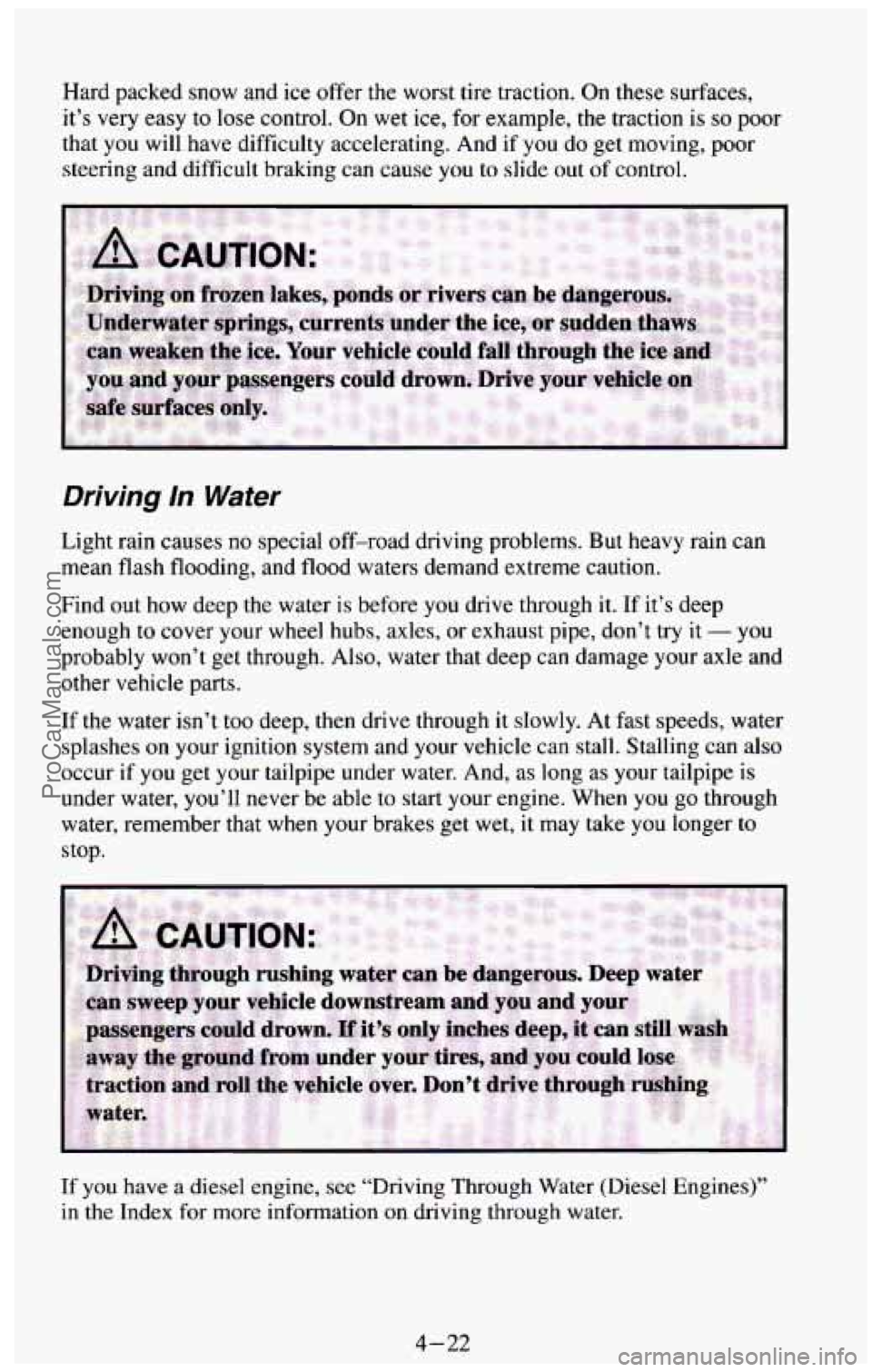
Hard packed snow and ice offer the worst tire traction. On these surfaces,
it’s very easy to lose control.
On wet ice, for example, the traction is so poor
that you will have difficulty accelerating. And if you do get moving, poor
steering and difficult braking can cause
you to slide out of control.
Driving In Water
Light rain causes no special off-road driving problems. But heavy rain can
mean flash flooding, and flood waters demand extreme caution.
Find out how deep the water
is before you drive through it. If it’s deep
enough to cover your wheel hubs, axles,
or exhaust pipe, don’t try it - you
probably won’t get through. Also, water that deep
can damage your axle and
other vehicle parts.
If the water isn’t too deep, then drive through it slowly. At fast speeds, water
splashes on your ignition system and your vehicle can stall. Stalling
can also
occur if
you get your tailpipe under water. And, as long as your tailpipe is
under water, you’ll never be able to start your engine. When you go through
water, remember that when your brakes get wet, it may take
you longer to
stop.
If you have a diesel engine, see “Driving Through Water (Diesel Engines)”
in the Index for more information
on driving through water.
4-22
ProCarManuals.com
Page 184 of 385

less traction. It’s always wise to go slower and be cautious if rain starts to
fall while you are driving. The surface may get wet suddenly when your
reflexes are tuned for driving on dry pavement.
The heavier the rain, the harder
it is to see. Even if your windshield wiper
blades are
in good shape, a heavy rain can make it harder to see road signs
and traffic signals, pavement markings, the edge of the road, and even
people walking.
It’s wise to keep your wiping equipment
in good shape and keep your
windshield washer tank filled. Replace your windshield wiper inserts when
they show signs of streaking or missing areas on the windshield, or when
strips of rubber start to separate from
the inserts.
_: ,
1
Driving too fast through large water puddles or even going through some
car washes can cause problems, too. The water may affect your brakes. Try
to avoid puddles. But if you can’t, try to slow down before you hit them.
4-25 ProCarManuals.com
Page 189 of 385
Keep your vehicle in good shape. Check all fluid levels and also the
brakes, tires, cooling system and transmission. These parts can work
hard on mountain roads.
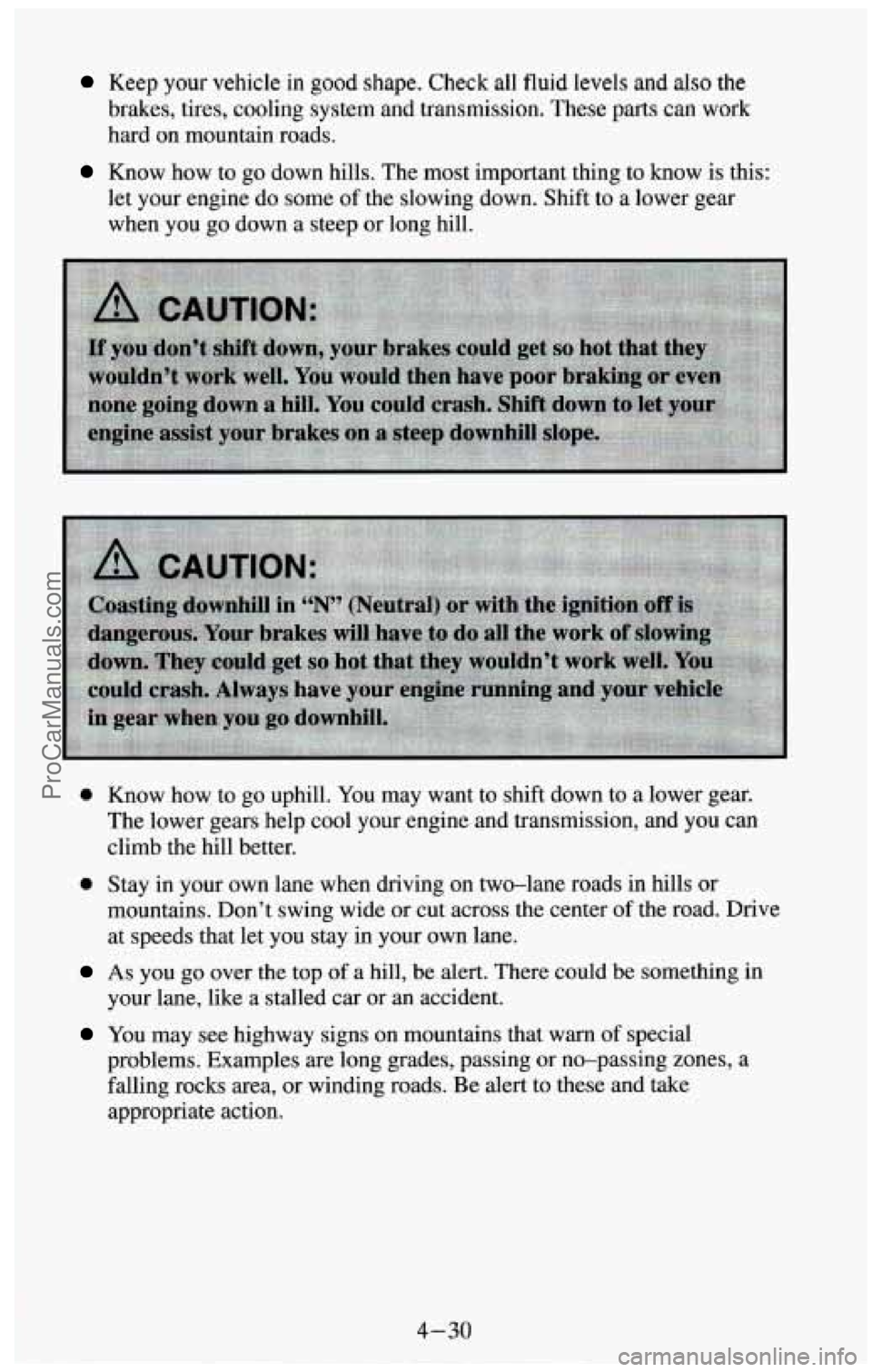
Know how to go down hills. The most important thing to know is this:
let your engine do some
of the slowing down. Shift to a lower gear
when you go down
a steep or long hill.
0 Know how to go uphill. You may want to shift down to a lower gear.
The lower gears help cool your engine and transmission, and you can
climb the hill better.
0 Stay in your own lane when driving on two-lane roads in hills or
mountains. Don’t swing wide or cut across the center of the road. Drive
at speeds that let you stay in your own lane.
As you go over the top of a hill, be alert. There could be something in
your lane, like
a stalled car or an accident.
You may see highway signs on mountains that warn of special
problems. Examples are long grades, passing or no-passing zones, a
falling rocks area, or winding roads. Be alert to these and take
appropriate action.
4-30
i ProCarManuals.com